Leidsid 33 sarnast õppematerjali, mis on seotud failiga "Megalithic Sites in England". Need materjalid aitavad sul teemat sügavamalt mõista.
stone, stones, henge, circle, england, overview, purpose, built, monument, stonehenge, burial, west, kennet, barrow, king, dolmen, sites, bronze, divided, menhir, tumulus, religion, place, 3100, alignment, village, 2600, 2400, little, elements, 3700, chamber, hill, wideStonehenge Stonehenge is a prehistoric monument located in the English county of Wiltshire, about 3.2 kilometres (2.0 mi) west of Amesbury and 13 kilometres (8.1 mi) north of Salisbury. One of the most famous prehistoric sites in the world, Stonehenge is composed of earthworks surrounding a circular setting of large standing stones. Archaeologists had believed that the iconic stone monument was erected around 2500 BC, as described in the chronology below. However one recent theory has suggested that the first stones were not erected until 2400-2200 BC,[1] whilst another suggests that bluestones may have been erected at the site as early as 3000 BC (see phase 1 below). The surrounding circular earth bank and ditch, which constitute the earliest phase of the monument, have been dated to about 3100 BC. The site and its surroundings were added to the UNESCO's
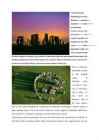
STONEHENGE Stonehenge is surely Britain's greatest national icon, symbolizing mystery, power and endurance
Stonehenge Hort 4000 Mary Laine What is Stonehenge? Derived from words that mean hanging stones, circle of stones, or stone hinges 162 stones originally and about half remain today Southern England, eight miles north of Salisbury and 30 miles north of the English Channel Nearby hillsides are covered with hundreds of burial pits known as barrows 80% of the barrows face east towards where the sun rises on the horizon There are at least 900 circles in Wales, Scotland, England, and Ireland. Most are made of stone, but wood was also used. Soil was also piled up to create banks, ditches, and circles. Many of these structures are
1) INDIAN ROCK ART: A NATIONAL TREASURE IN DANGER Unrecognized, unprotected, this priceless legacy of primitive art has endured the ravages of nature only to fall victim to wanton destruction by ,,civilized" man. Like the huge stone statues of Easter Island and prehistoric cave paintings of Altamira and Lascaux, North American Indian rock art is surrounded by an atmosphere of mystery. Although examples of rock art exist at some 15000 sites in canyons, deserts, caves and river gorges. Nowadays, however, primitive rock art in the United States has become a new field of scientific study. Klaus F Wellmann wrote two books about rock art. He is a professor of medicine. Rock art represents the history of aboriginal Americans
Revision questions for the test on Old English and Medieval Literature. 1.) How is literature analysed and studied? What is the difference between the diachronic and synchronic view? Literature is studied and analysed by reading the piece of work profoundly and work on all the aspects of the piece. Diachronic is development in history Synchronic is particular state at any given moment 2.) Give a general overview of Celtic Britain, Roman invasion in 55-54 BC, Anglo-Saxon invasion and the second Roman "invasion" of Great Britain, who were the leaders, what influence did they leave on the culture of Great Britain? Celtic Britain was during the Bronze Age, there were many small tribal kingdoms fighting one another. Many megalithic monuments were built around that time, e.g. Stonehenge, the Avebury ring. The Roman Invasion 55-54 BC, Julius Caesar ruled Rome, Rome built the Hadrian's wall (73 miles
The United Kingdom The United Kingdom consists of England, Scotland, Wales and North Ireland and it is situated in the Atlantic Ocean near the mainland of Europe. The population of the UK is 58.6 million and area is 244,110 sq km. Britain has a temperate humid climate. Its characteristic features are mild winters, warm summer, no temperature extremes, abundant rain all year round and frequent changes of weather. The mild climate is partly due to the warm Gulf Stream and partly to the south westerly winds
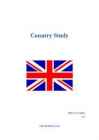
1) General facts The UK: * the United Kingdom of Great Britain and Northern Ireland was formed in 1801 * it covers 243,610 sq km * everybody from the UK is called British * the capital city is London * is made up of four constituent countries: England, Scotland, Wales and Northern Ireland which in turn are divided into counties * the flag is called the Union Jack which is a combination of the flags of England, Scotland and Northern Ireland * the population is about 60,000,000 people, the population density is 242 people/sq km * its coasts are washed by the Atlantic Ocean, the North Sea, the English Channel, the Celtic Sea, Saint George's Channel, and the Irish Sea. It is linked to France by the Channel Tunnel * the United Kingdom is a constitutional monarchy. The current monarch is Queen Elizabeth II, who is also the Queen and Head of State of fifteen other Commonwealth Realms, such as
relations and defence. Great Britain Across / 'krs / risti, läbi, põiki Locality / l'kælt / asukoht, paikkond Inland body / 'nlænd 'bd / sisemaine osa Inlet / 'nlet / merekäär, laht Headland / 'hedlnd / neem Scour / 'ska / küürima Foreshore / 'f:: / tõusu ja mõõna vaheline rand Recreational / rekr'enl / lõõgastumis-, vabaaja- Scenery / 'si:nr / maastik Juxtaposition / dkstpz'in / kõrvuti asetsev GB consists of England, Scotland and Wales. GB is only a dot on the world map. It offers a great variety and scenic contrasts are often within easy reach. The coastline is washed by the tidal system twice a day. Britain´s speciality is the man-made scenery. Each part of the country has its peculiar geographical features. England Indented / n'dentd / sakiline Estuary / 'estjr / suudmelaht
Make up your list of 5 top British people. Give your motivation. The Queen, Adele, Elton John, Shakespeare, JK Rowling. 5. Which 5 places attract visitors in Wales and Scotland? Edinburgh, Loch Ness, The Highlands, Snowdonia, Cardiff. 6. Name 6 islands, 5 rivers, 3 lakes, 3 mountains in UK. Isle of Man, Isle of Wight, Isle of Lewis, Island of Mull, Island of Arran, Anglesey Island Severn, Thames, Tweed, Avon, Trent, Dove Ben Nevis, Snowdon, Ben Macdui 7. Stonehenge. Stonehenge was produced by a culture that left no written records. Built on Salisbury Plain, in Wiltshire, England some time between 5,000-4,300 years ago. One of the most famous megaliths in the world, dating from prehistoric times. Stonehenge consists of circles of stone arranged in complex patterns, and their origin is still being explored. Some of the stones come from over 200 miles away in Wales
Legend has it that one day, when the Danes were about to lose a bloody battle, the sky suddenly opened and a red flag with a white cross on it dropped down upon them from the heavens. This is allegedly how the Danes obtained their national flag, the Dannebrog in a battle against the Estonians. In the middle of the 14th century Denmark sold its possessions in Estonia to the German Teutonic Order. Toompea became the seat of the German-born gentry. A wall was built to separate the Upper Town and the Lower Town. In 1285 Tallinn joined the Hanseatic league and became a junction of trade between East and West. Tallinn is said to be built on salt, as it was an important trading commodity. In the 16th century Tallinn had a population of about 7,000 8,000 making it one of the biggest cities in northern Europe. In 1629 Sweden took control of the whole of Estonia. Though hard times
It seems that the Celts, who had been arriving from Europe from the 8th cent BC onward, intermingled with the peoples who were already there. The Celts were extremely talented people, creative and artistic. More than 1 Celtic tribe invaded Br. The descendants of ancient Celts live in Wales, Scotland, Cornwall and Ireland. They lived in primitive society. Druids priests, more powerful than chiefs. Acted like prophets. 2. Stonehenge From prehistoric period. Was built on Salisbury plain between 2500 and 1500 bc. One of the most famous and mysterious archaeological sites in the world. One of the mysteries is how it was built at all with the technology of the time. Another is its purpose. It appears to function as a kind on astronomical clock and we know it was used by the Druids for ceremonies marking the passing of the seasons. It appears in number of novels. These days it is not only the interest of tourists but is also a
Every five years national song and folk dance festivals take place in Tallinn. The yachting regatta of the 1980 Moscow Olympic Games was held at Pirita. History Tallinn means in English "Danish town". The place is believed to have been settled by Finno-Ugric people about 2500 BC. It was first marked on a map of the world by the Arab geographer al-Idrisi in 1154. The Estonians were the first to build a stronghold on the spot of the Toompea Hill, but the real Tallinn was built by the Danes who conquered the north of Estonia in 1219. Legend has it that one day, when the Danes were about to lose a bloody battle, the sky suddenly opened and a red flag with a white cross on it dropped down upon them from the heaven. This is how the Danes obtained their national flag. In 1346 the Danish king sold his Estonian lands to the Teutonic Order, who a year later resold them to the Livonian Order. The Germans renamed Tallinn and called it Reval.
Stonehenge One of the best known ancient wonders of the world, 5000 years old Megalith monument, built by western mediterraneans during 3000-1600 BC Circular structure, large standing stones, aligned with rising sun at teh solstice Attlers and bones were sued to dig pits that hold the stones The Celts in Britain and their legacy 700-200 BC celts invade Britain Gaels or Goehls(Ireland and Scotland),Cymri(Wales) and Brythons(gave name to Brittany) Fierce fighters,superb horsemen.Most of them farmers, lived in thatched houses Good at art, craftmanship, used iron Divided into tribes, ruled by kings, only in face of danger would they choose a single leader Legacy- hill-forts, farms, churches, field system,
which is commodious, firm, and occasionally delightful. Spanning greater distances is a distinct measure of engineering prowess. In terms of engineering, bridges are discussed by design or type (beam, arch, truss, cantilever, suspension, or moveable); length (usually expressed in terms of clear or overall span); and materials (stone, wood, cast and wrought iron, and what we use today - concrete and steel). The purpose of this contextual essay is to provide parameters of value and significance so that we can focus our attention on those bridges - globally - that best illustrate the history of bridge building, and to encourage their preservation. What is a World Heritage bridge? The World Heritage Committee states that to be of World Heritage status a monument or site must be of outstanding universal value. It must illustrate or interpret the
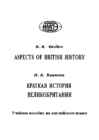
материала, закрепление словаря и развитие навыков ведения беседы по тематике пособия. Пособие предназначено для студентов гуманитарных специальностей. Подготовлено на факультете лингвистики. The book contains an overview of the most important events in British history – from the first documented invasions of the island to the formation and fall of the British colonial empire. A series of exercises will help to remember the subject matter, practise the vocabulary and contribute to skills work. The book is intended for the Humanities students. Вавилов Н.А., 2008 3 4 Contents 5
London History The Romans AD 43- AD 410 The Romans finally invaded Britain in AD 43 from Kent. The Romans lead by Julius Caesar attempted to invade Britain twice before that in 55 and 54 BC but the invasions were unsuccessful. They made their way to the river Thames and sailed up it. The Romans knew it was important to control a crossing point at the river Thames, so they decided to build a settlement on the north bank. Although small settlements had been built on the banks of the Thames, the Romans were the ones who built the first city. They called their city Londinium. The Roman engineers noticed that the point where the swampy river narrowed would make an ideal crossing point, they built London Bridge. Less than 20 years later the native Iceni tribe, led by Queen Boudicca, rose up against the Romans in revenge for mistreatment and burnt Londinium to the ground. The well disciplined Roman army defeated her forces and Londinium was rebuilt
........... 8 Population and Ethnicity..............................................................................................9 3 Introduction The official name of the country is the United Kingdom. The United Kingdom is an island country. It consists of the island of Great Britain and Northern Ireland. Great Britain can be divided into three parts England, Wales and Scotland. Each of them has their own capital city. Glasgow in Scotland, Cardiff in Wales and London in England. The country is situated in the north-western Europe. The territory of the United Kingdom is about 244,000 square kilometres and about 60 million people live there. The UK contains a number of small islands. The largest islands that belong to the United Kingdom are the Isle of Man in the Irish Sea and the Isle of Wight which lies off of England's southern coast
The United States of America is located on the continent of North America. It has borders with two countries Mexico and Canada. There are also the Atlantic Ocean, the Pacific Ocean and the Gulf of Mexico surrounding the big country. There are 50 states in America. Most of the people live in towns. The biggest state is Alaska; next by size are California, Alaska and Montana. Six states - Maine, Vermont, New Hampshire, Connecticut, Rhode Island and Massachusetts are called New England. They are all small states in the USA that lie in the north- east. The first colony of immigrants settled down in Virginia, in the eastern part of the USA. 3. Relief The USA is situated in the central part of the North American continent. Its western coast is washed by the Pacific Ocean and its eastern coast is washed by the Atlantic Ocean and in the south its coast is washed by the Gulf of Mexico. The coastline is even. There are no big islands
glaciation. Groups of settlers began building the first known permanent houses on Scottish soil around 9,500 years ago, and the first villages around 6,000 years ago. The well-preserved village of Skara Brae on the Mainland of Orkney dates from this period. Neolithic habitation, burial and ritual sites are particularly common and well-preserved in the Northern Isles and Western Isles, where lack of trees led to most structures being built of local stone. Roman influence The written protohistory of Scotland began with the arrival of the Roman Empire in southern and central Great Britain, when the Romans occupied what is now England and Wales, administering it as a province called Britannia. Roman invasions and occupations of southern Scotland were a series of brief interludes. In 834 AD the general Gnaeus Julius Agricola defeated the Caledonians at the battle of Mons Graupius, and
The origin of the name "Lai" Lai Street belongs among the oldest streets of Tallinn. Despite its length and width its share in the city's inner traffic is fairly modest. The extraordinary width of the street is likely due to the fact that the town wall used to be there and the street then sprang up on both sides of the city wall. But that city wall was eliminated in the construction of a new wall to the west. The freed area became a beautiful wide street with local significance, its main purpose was to create a link between the monastery of St Michael's female Cistercians (founded in 1294) and St Olaf's church. Previous names of the street also refer to it: Susterstrate 1361; Platea sororum 1364-1380; 1606 Süsterstrasse and Schwestergasse, all of which include the concept of a nun or a sister. After the Reformation, the monastery was eliminated and in 1631 a gymnasium was founded in its rooms, but the street name remained in the form of Süsterstrasse and Cisternstrasse. It
History exam *Stonehenge - is a monument located in England. It is one of the most famous prehistoric sites in the world and is composed of earthworks surrounding a circular setting of large standing stones. The surrounding circular, earth bank and ditch, have been dated to about 3100 BC. Stonehenge was produced by a culture with no written language. Many aspects of Stonehenge remain subject to debate. There is little or no direct evidence for the construction techniques used by the Stonehenge builders. *The Celts in Britain and their legacy The Cets lived in Britain in The Iron Age. They were warring tribes who were battleful amongst themselves as well as inter-tribal war. They were not centrally governed. The Celts brought iron working, iron ploughs and metal swords,
Permanent communities were established around 4000 BC in the northwestern parts of Prague, and the area was inhabited continuously by various Germanic and Celtic tribes before the arrival of the Slavs. The name Bohemia came from a Celtic tribe called Boii, and is still used today for the western part of the Czech Republic. Foundation of Prague In the 6th century, two Slav tribes settled on opposite sides of a particularly appealing stretch of the Vltava River. The Czechs built a wooden fortress where the residential area Hradcany stands today, and the Zlícani built theirs upstream at what is now Vysehrad. They had barely dug in when nomadic Avars thundered in, to rule until the Frankish trader Samo united the Slav tribes and drove the Avars out. Samo held on for 35 years before the Slavs reverted to squabbling. In the 9th century Prague was part of the short-lived Great Moravian Empire. Under its
4 million square kilometres and its population is more than 260 million people, 12% of them are the Afro-Americans. It is the world's third-largest country by size and by population. The population density is about 27 people per square kilometre. Most of the people live in towns. There are 50 states in America. The biggest of the state is Texas, next by size are California, Alaska and Montana. Six states - Maine, Vermont, New Hampshire, Connecticut ,Rhode Island and Massachusetts are called New England. They are all small states in the U.S. that lie in the north-east. The first colony of immigrants settled down in Virginia, in the eastern part of the U.S.A. The biggest cities are New York, Washington, Chicago, Los Angeles, San Francisco, etc. The flag of America was adopted on 14 th June 1777. It is called the "Stars and Stripes". It is said that Betsy Ross sewed the first flag. It features 13 horizontal red and white stripes (for the first colonies which formed the U.S.A
Most of Australian native animals move around at night. But the birds which are very colourful are easy to see. There are about 750 species of birds in Australia. Two types of crocodiles, the saltwater and the freshwater crocodile can be found in the north. The dingo or the native dog is not really an Australian native. It was brought from Asia around 3500 years ago. The dingo is an efficient sheep hunter. To protect sheep The Dog fence was built in 1946. Population About 20, 2 million people live in Australia. Mainly they live on in the eastern and southeastern part of the country, because the middle part of the country is mainly plains and deserts. The eastern part is the place where the big cities are like Sydney, Melbourne, Brisbane etc. In Sydney and Melbourne together live about 8 million people. The Native Australians The first people who arrived to Australia were the Aborigines. They arrived there about 50 000 years ago
In 1249, this Reconquista ended with the capture of the Algarve on the southern coast, giving Portugal its present-day borders, with minor exceptions. The reigns of Dinis I, Afonso IV, and Pedro I for the most part saw peace with the Christian kingdoms of Iberia, and thus the Portuguese kingdom advanced in prosperity and culture. In 1348 and 1349, like the rest of Europe, Portugal was devastated by the Black Death. In 1373, Portugal made an alliance with England, which is the longest-standing alliance in the world. In 1383, John I of Castile, husband of Beatrice of Portugal and son-in-law of Ferdinand I of Portugal, claimed the throne of Portugal. A faction of petty noblemen and commoners, led by John of Aviz (later King John I of Portugal) and commanded by General Nuno Álvares Pereira defeated the Castilians in the Battle of Aljubarrota. With this battle, the House of Aviz became the ruling house of Portugal. III
Our state to be disjoint and out of frame, Colleagued with the dream of his advantage, He hath not fail'd to pester us with message, Importing the surrender of those lands Lost by his father, with all bonds of law, To our most valiant brother. So much for him. Now for ourself and for this time of meeting: Thus much the business is: we have here writ To Norway, uncle of young Fortinbras,— Who, impotent and bed-rid, scarcely hears Of this his nephew's purpose,—to suppress His further gait herein; in that the levies, The lists and full proportions, are all made 14 Out of his subject: and we here dispatch You, good Cornelius, and you, Voltimand, For bearers of this greeting to old Norway; Giving to you no further personal power To business with the king, more than the scope Of these delated articles allow. Farewell, and let your haste commend your duty. CORNELIUS VOLTIMAND
modern world. The subject of the research is the study of the English language as itself, its history and possible future perspectives within the context of increasingly globalized world. The object is to investigate the premises of English being a single language in the world as well as to consider potential consequences. the aim of this paper is to explore Estonian students’ attitude to English being the world language. The purpose is to increase the authors’ and fellow students’ awareness of the latest linguistinc tendences in order to develop their understanding of the importance of learning languages, English in particular. 3 The theoretical part of the study relies upon the works of such scholars as David Cristal, Luke Mastin, David Graddol, etc. For the practical part, a survey has been
poem’s meaning To the Noblest & best of Ladyes, the Countesse of Denbigh Henry Vaughan: many obvious borrowings, striking opening lines. The World Andrew Marvell: many strands of 17thC thought, feeling and style, created the tradition of garden poems The Definition of Love, To His Coy Mistress, The Garden Ben Jonson: IX: Song: To Celia, II: To Penshurst; Hymn to Cynthia. 4. The arrival of classicism in England. The impact of the art collections of the Earl of Arundel and Charles I Inigo Jones, travel with Thomas Howard, Earl of Arundel. Purpose: in-depth study of ancient and modern architecture. Italy, Venice, Vicenza, Rome, Naples. New cultural scene, looked back to early Roman Empire. Arundel: influential, new ideal for gentleman’s life. Promotion of foreign culture, Renaissance Italy, world of classical antiquity. Virtue: civility, grace, elegant manners, interest in learning
immediately from indicators that the message bore for the guidance of Japanese code clerks that it was in the top Japanese cryptographic system. This was an extremely complicated machine cipher which American cryptanalysts called PURPLE. Led by William F. Friedman, Chief Cryptanalyst of the Army Signal Corps, a team of codebreakers had solved Japan's enciphered dispatches, deduced the nature of the mechanism that would effect those letter transformations, and painstakingly built up an apparatus that cryptographically duplicated the Japanese machine. The Signal Corps had then constructed several additional PURPLE machines, using a hodgepodge of manufactured parts, and had given one to the Navy. Its three components rested now on a table in Room 1649: an electric typewriter for input; the cryptographic assembly proper, consisting of a plugboard, four electric coding rings, and associated wires and switches, set on a wooden frame; and a printing unit for output
1. BRITISH NATIONAL SYMBOLS 1.1 Great Britain and British story Great Britain is an island in the North Atlantic off the north-west coast of continental Europe. With an area of 229,848 km2, it is the largest island of the British Isles, the largest island in Europe and the ninth-largest in the world. It is surrounded by over 1,000 smaller islands. The island is part of the United Kingdom of Great Britain and Northern Ireland, constituting most of its territory: most of England, Scotland, and Wales are on the island, with their respective capital cities, London, Edinburgh, and Cardiff. (wikipedia, 2015) The Kingdom of Great Britain resulted from the Union of Scotland and England in 1707. More than a hundred years before, in 1603, King James VI, King of Scots, had inherited the throne of England, but it was not until 1707 that the Parliaments of the two countries agreed to form a single kingdom
fresh, are so full of flavour that British haven't had to invent sauces to disguise their natural taste. What can compare with fresh pees or new potatoes just boiled and served with butter? Why drown spring lamb in wine or cream and spices, when with just one or two herbs it is absolutely delicious? If you ask foreigners to name some typically English dishes, they will probably say "Fish and chips" then stop. It is disappointing, but true that, there is no tradition in England of eating in restaurants, because the food doesn't lend itself to such preparation. English cooking is found at home. So it is difficult to a good English restaurant with a reasonable prices. In most cities in Britain you'll find Indian, Chinese, French and Italian restaurants. In London you'll also find Indonesian, Mexican, Greek... Cynics will say that this is because English have no "cuisine" themselves, but this is not quite the true. Vocabulary: to criticize - tasteless overcooked -
process. Consequently, they were attracted to the idea of democracy, where the government is "of the people, by the people, for the people," as Lincoln later expressed in his Gettysburg Address. Religious Tolerance: Much impetus for the ideas of religious tolerance came from the rule of King George II, who was a staunch Catholic and did not allow freedom of religion to Protestants in New England. Voltaire was among the first to denounce Christianity and other organized religions as mere ploys to support monarchy. What emerged was Deism, which was more or less a new religion that considered reason its foundation. In Deism, there is no interference by a deity, and man controls his own destiny. These ideas stirred the masses into action, as the people dreamed of carving their own futures. Adopted by the Founding Fathers, Enlightenment
8. European discoverers of Canada (Irish (?), Viking, British, French). St Brendan the Navigator, an Irish monk, is told to have taken a seven-year yoyage in the 6th century across the North Atlantic Ocean and he could have reached Canada. However, as far as we know, the first white men to discover the Atlantic seaboard of North America were the Norsemen from Greenland about 1000 AD. On 20 May in 1497 an Italian named John Cabot sailed west from Bristol in England, hoping to reach Kathay. He sighted land on 24 June rediscovered of Canada's eastern shores and landed somewhere near Newfoundland, Maine or Cape Breton Island. King Henry VII gave him 10 pounds for "finding a new isle" and sponsored a new yoyage. Jaques Cartier did three expeditions to Canada. He sailed from Northern France in 1534, 1535-1536 and 1541-1542 and sailed up the St Lawerence River. He visited the sites of the present Quebec City and Montreal then Indian villages
 annaabi.ee