Leidsid 33 sarnast õppematerjali, mis on seotud failiga "Kiwi". Need materjalid aitavad sul teemat sügavamalt mõista.
kiwi, five, species, span, animalia, bird, diet, size, height, wing, weight, speed, years, skin, feathers, eggs, little, brownFollowing the performance at the Munich games, a campaign began to have the song adopted as the national anthem. In 1976 a petition was presented to parliament asking for it to be made the national anthem, and, with the permission of Queen Elizabeth II, it became the country's second national anthem on November 21, 1977, on equal standing with God Save The Queen. Up until then God Save The Queen was New Zealand's national anthem. Kiwi as a national bird A kiwi a flightless bird, about 45 cm high an weighs about 3.3 kg. All kiwi species are endangered. The kiwi lays the largest egg in relation to its body size. The Kiwi as a symbol first appeared in the late 19th century in New Zealand regimental badges. It was later featured in the badges of the South Canterbury Battalion in 1886 and the Hastings Rifle Volunteers in 1887. Soon after, kiwis appeared in many military badges. During the First World War, the giant kiwi was carved on the chalk hill above Sling Camp in
Since then, a unique flora and fauna has evolved, with a large number of beautiful native birds and plants, as well as direct descendants of prehistoric wildlife, including the tuatara, weta (the world's heaviest insect), and giant snail. As Time magazine said, New Zealand is an "ultimate storehouse for discontinued zoological models". A reptile with links to the dinosaur, the native tuatara is found mainly on islands around New Zealand's coast. Every species of this reptile family, except the tuatara, died out around 65 million years ago. Tuatara can live for over 100 years, and were once found throughout New Zealand. Now only around 30,000 are found on protected offshore islands. They are about 60 cm long and have a third "eye" on the top of heir heads; tuataras sleep during the winter, and they use the third eye to wake themselves up in spring. New Zealand's moa was the only wingless bird ever known. The giant moa, one
Hunting in Estonia Ants Nokkur Metsandus I Introduction Hunting is the practice of killing or trapping any living organism 14 198 hunting license oweners in Estonia. In order to have the right to hunt a person must be at least 16-years old. Hunting seasons and limits Bag limits are provisions under the law that control how many animals of a given species or group of species can be killed There are seasonal bag limits in Estonia Open and closed hunting season. Big game 1. Brown Bear Ursus arctos 2. Wolf Canis lupus 3. Lynx Lynx lynx 4. Wild boar Sus scrofa 5. Moose Alces alces 6. Roe deer Capreolus capreolus Brown Bear (Ursus arctos) Hunting season 01.08-31.10 Biggest predator in Klõpsake juhtslaidi teksti laadide redigee Estonian forest. Teine tase Average weight 200kg Kolmas tase
Chipmunks are small and striped little animals that many peole adore. Chipmunks are easily recognized by the light and dark stripes on the back and head. They can be confused with some of the striped ground squirrels, but chipmunks are smaller and have five dark stripes on their backs. The cimpunk is very colorful: it’s black, white, grey, brown and red. Chimpunk weights up to one hundred and twenty five grams, but theres also some smaller species. Chimpunks are 16 cm to 30 cm long and have one-third to nearly half of their total length long tail. Chimpunks live usually in forests but you can find them also at parks. They eat many things: seeds, nuts, fruit, grass, shoots and many ohter plants, but also small frogs, worms and bird eggs. Some species hibernate in the winter, but some don’t. Chimpunks typically live about three years, but there have been some, who live nine years. Squirrels are familiar to almost everyone. More than
Tasmania, in the south-east of Australia. Government The full name of the county is the Commonwealth of Australia. Its territory is 7.7 million square kilometres and population is about 19.7 million. The state symbols are the coat of arms, flag anthem and aboriginal symbols. Australia's flag has a British Union flag. . It is blue with the flag of the UK in the upper left corner. Five stars represent the Constallation Southern Cross and a large star is for the country's states and territories. The coat of arms features a kangaroo and an emu. The kangaroo and emu are chosen for the coat of arms of Australia because they can only move forward just like Australia. The national anthem of Australia is "Advance Australia Fair". This replaced the "God Save the Queen" as Australia's national anthem in 1984. Aboriginal art uses Earth Colours(white, red, orange, brown)
A line of active volcanoes stretches along the north coast of the mainland and continues on the island of New Britain. To the north and south of this central mountain range on the main island lie vast stretches of mangrove swamps and coastal river deltas. /1/ Volcanoes and thermal pools are also found in the southeast of other islands. Papua New Guinea offers the greatest variety of terrestrial ecosystems in the South Pacific, including five types of lowland rainforest, 13 types of montane rainforest, five varieties of palm and swamp forest and three different mangrove forests. Two-thirds of the world's species of orchids come from New Guinea. /1/ Birds include 38 species of the bird of paradise, and the megapode and cassowary. Marsupials and mammals include cuscus, tree kangaroos, wallabies, bandicoots, spiny anteaters and, in the coastal waters, the dugong. There are between 170 and 200 species of frog and 450
These grasslands are called the savannas (2.). Farther west the trees disappear and the bushlands (3.) begin. The real desert (4.) occupies the centre of the Western Plateau. In the very southwest there are thin forests of evergreen trees (5.). Most of Australian trees are kinds of eucalyptus trees (or gum trees to Australians) and acacia ( wattle to Australians). Eucalyptus trees are found everywhere in Australia. There are many kinds of them and they greatly differ in size. One kind, the great mountain ash, can grow to 120 metres and it grows in the wet forests in the eastern part of the continent.These strong trees do not die when there are forest fires. Some other kinds are small bushes in the semi-deserts.Eucalyptuses give the local people timber and eucalyptus oil. Of 600 kinds of acacias the golden wattle, the national flower of Australia, is the best known. Australia has many other kinds of tree, and thousands of kinds of wild flowers too. Of
forest savannah antelope. It is found in Central African Republic, Sudan, Cameroon and Senegal. There are two subspecies: the endangered T. d. derbianus, found in Senegal's Niokolo-Koba National Park, and the low risk T. d. gigas, found in Central Africa. Characteristics Giant Eland are typically between 220-290 cm (7.3-9.6 ft) in length, stand approximately 150 to 175 cm (4.9 to 5.7 ft) at the shoulder, and weigh 440-900 kg (968- 1,980 lb). Despite its common name, it is of very similar size to the Common Eland. The smooth coat is reddish- brown to chestnut, usually darker in males than females, with several well-defined vertical white stripes on the torso. A crest of short black hair extends down the neck to the middle of the back, and is especially prominent on the shoulders. The slender legs are slightly lighter on their inner surfaces, with black and white markings just above the hooves. There are large black spots on the upper forelegs. The bridge of the nose is charcoal
particularly with members of the Russian Orthodox Church because sunflower oil was one of the few oils that was not prohibited during Lent. The cake remaining after the seeds have been processed for oil is used as a livestock feed. Some recently developed cultivars have drooping heads. These cultivars are less attractive to gardeners growing the flowers as ornamental plants, but appeal to farmers, because they reduce bird damage and losses from some plant diseases. There are also new breeds of sunflowers which are transgenic, so that they are resistant to some diseases.[citation needed] Sunflowers also produce latex and are the subject of experiments to improve their suitability as an alternative crop for producing hypoallergenic rubber. Additionally, the stem of a dead sunflower can dry out open wounds.[citation needed] For farmers not intending to grow it, the sunflower is considered a noxious weed. The
Sun Bear The Sun Bear is 120-150 cm long, making it the smallest member in the bear family. Males tend to be 10-45% larger than females the former normally weigh between 30 and 70 kg , and the latter between 20 and 40 kg. The shoulder height is about 60-72cm .The Sun Bear possesses sickle-shaped claws that are relatively light in weight. It has large paws with naked soles, probably to assist in climbing. Its inward-turned feet make the bear's walk pigeon toed, but it is an excellent climber. It has small, round ears and a stout snout. The tail is 1.2-2.8 inches (3-7 cm) long. Despite its small size, the Sun Bear possesses a very long, slender tongue, ranging from 8 to 10 inches (20-25 cm) in length
Panama. He was sailing from Panama to Peru when he accidentally discovered the islands. Islands became a favorite hideout for Pirates and the favorite location for whale hunters. After whales were locally cleared the whalers went there for tortoises, an estimated 200 000 or more adults had been removed. The island of Floreana was populated with a group of convicts' in October 1832. Charls Darwin visited the island in 1835, he spent there 5 weeks. Nowadays five of the islands are populated with about 40 000 inhabitants. The name Island of Galapagos means island of tortoises. Every animal or plant had to cross about 1000 km of open ocean to arrive on Galapagos. Despite the trials of arrival, over 560 species of native plants, over 55 species of native land vertebrates and 1700 species of native insect are found on Galapagos. There are no large mammals, the key herbivores are reptiles, and the top predators are birds and snakes
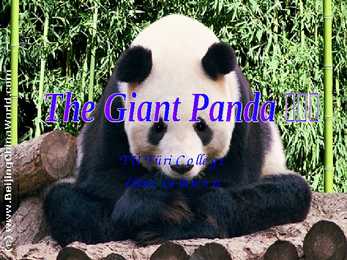
the bamboo forests. spraying urine. It is able · Though generally alone, to climb and take each adult has a shelter in hollow trees defined territory and or rock crevices. females are not tolerant · Pandas do not of other females in their hibernate, which is range. similar to other subtropical mammals. Eating and food · It has a diet which is 99% bamboo. · Giant Panda must have at least two different species of bamboo available in its range to avoid starvation. · The Giant Panda may eat other foods such as honey, eggs, yams, shrub leaves, oranges, bananas and even meat and fish when available. · The average Giant Panda eats as much as 9 to 14 kg of bamboo shoots a day. · Pandas eat for up to 14 hours a day. Size · At birth, the Giant Panda is only about the size of a
Tartu 2008 Contents p. 1. Introduction....................................................................................................1 2. Nature and geography.....................................................................................2 3. Position and size.............................................................................................2 4. Climate............................................................................................................3 5. Flora and fauna...............................................................................................4 6. Main fields of economy and industry..............................................................5 7. The people........................................................
Kingdom of Ireland to create the United Kingdom of Great Britain and Ireland. In the 13th century, king Edward I finally conquered the last remaining counties in north and west Wales. To appease the Welsh, Edward's son (the future Edward II), who had been born in Wales, was made Prince of Wales. So the tradition of giving the title `Prince(ess) of Wales' to the heir of the British Monarch continues to the present day. 4. Relief The island is just under a thousand kilometers long and under five hundred kilometers wide. The most mountainous region is of course Scotland with its highland and highest peak: Ben Nevis 1343 m. Scotland also has a wide lowland are between the Grampians and Southern Uplands, where most of the largest cities and population are located. Much of Wales is also mountainous and in England the Pennine Range extends 224 kilometres. The rest of England tends to be quite bumpy, for not even the large plains of East Anglia are perfectly flat
● Immatures – white mixed with some dull grey feathering; bills – black, large dirty-pink patch ● In Estonia first nesting - 1979 Whooper swan Behaviour of whooper swan ● Pair for life, cygnets stay with them all the winter ● Breffered breeding habitat – wetlands ● Both build the nest ● Male will stand guard over the nest while female incubates ● 4 to 7 eggs Influence of whooper swan ● Much admired in Europe ● National bird of Finland ● Protected species in Estonia Spread Bewick´s swan (väikeluik) ● Lenght 115 to 140 cm ● Adults – white all over ● Young birds – greyish with a pinkish bill ● Shorter neck, variable bill pattern ● Showing more black than yellow ● Bill is more yellow than black ● Europe, Asia, North America ● Resambles more of a goose than swan ● Estonia – one of the main transit regions for migrating
12) designed to roll rather than be dragged along the bottom. Warp length/water depth ratios are similar to those used with the single demersal trawl and bridles/sweeps (d) can be steel wire, combination wire, chain or a mixture of all three. Normal towing speed used is around 2.5 knots. 13 Beam trawls are used to harvest whitefish, mainly flatfish such as sole, plaice or megrim together with angler and other species found hard down on the seabed. Each net is fished from an outrigger boom, one on each side of the vessel (Figure 14), and towed from here on a single warp (a) shackled to a three chain bridle (b) attached directly to the beam (c) which holds open the mouth of the trawl. The beam, 9-12 m in length, is constructed from heavy steel tube and supported on each side by rugged steel trawlheads (d) which slide over the sea bottom. Ahead of each groundrope several tons of
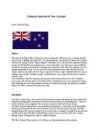
- The National Flag of Canada, also known as the Maple Leaf, and l'Unifolié (French for "the one-leafed"), is a red flag with a white square in its centre, featuring a stylized 11- pointed red maple leaf. - The flag is a defaced Blue Ensign: a blue field with the Union Flag in the canton (upper hoist quarter), and a large white seven-pointed star known as the Commonwealth Star in the lower hoist quarter. The fly contains a representation of the Southern Cross constellation, made up of five white stars one small five-pointed star and four, larger, seven-pointed stars. - The flag of New Zealand is a defaced Blue Ensign with the Union Jack in the canton, and four red stars with white borders to the right. The stars represent the constellation of Crux, the Southern Cross, as seen from New Zealand. - animals - ir - wild mammal - Beaver[1], Canadian Horse - Kangaroo -.... - birds -ir - as yet undetermined, suggestions include wren and robin
roads, circus, theatres and layman's homes are preserved throughout the country. Coins, some of which coined in Lusitania land, there are numerous pieces of ceramics. Contemporary historians include Paulus Orosius (c. 375-418) and Hydatius (c. 400469), bishop of Aquae Flaviae, who reported on the final years of the roman rule and arrival of the Germanic tribes. MUSLIM IBERIA Portugal was part of the Arab-Muslim world for slightly under five and a half centuries following the Umayyad Caliphate conquest of the Iberian Peninsula in 711 until 1249 with the taking of the Algarve by King Afonso III of Portugal during the Reconquista. After beating the Visigoths in only a few months, the Umayyad Caliphate started expanding rapidly in the peninsula. Beginning in 711, the land that is now Portugal became part of the vast Umayyad Caliphate's empire of Damascus that stretched from the Indus river in India up
LIST OF ILLUSTRATIONS START HERE Thinner, Bigger, Faster, Stronger? How to Use This Book FUNDAMENTALS--FIRST AND FOREMOST The Minimum Effective Dose: From Microwaves to Fat-Loss Rules That Change the Rules: Everything Popular Is Wrong GROUND ZERO--GETTING STARTED AND SWARAJ The Harajuku Moment: The Decision to Become a Complete Human Elusive Bodyfat: Where Are You Really? From Photos to Fear: Making Failure Impossible SUBTRACTING FAT BASICS The Slow-Carb Diet I: How to Lose 20 Pounds in 30 Days Without Exercise The Slow-Carb Diet II: The Finer Points and Common Questions Damage Control: Preventing Fat Gain When You Binge The Four Horsemen of Fat-Loss: PAGG ADVANCED Ice Age: Mastering Temperature to Manipulate Weight The Glucose Switch: Beautiful Number 100 The Last Mile: Losing the Final 510 Pounds ADDING MUSCLE Building the Perfect Posterior (or Losing 100+ Pounds)
The Timor Sea and the Arafura Sea separate Australia from Indonesia. In the north the coast is washed by Great Australian Bight and the Indian Ocean. In the northeast the Coral Sea washes the coasts and in the southeast there is the Tasman Sea which also separates Australia from New Zealand. The biggest island is Tasmania which is located to the south of the country. 3 Relief Australia is a flat and old continent. Its average height is 274 m above sea level. Its relief is pretty simple – plains cover the greater part of it. Basically one third of its area is covered by deserts and plains. Biggest deserts and plains are: the Great Sandy Desert, the Gibson Desert, the Great Victoria Desert and the Nullarbor Plain. They are also called as the Western Australian Shield. The Nullarbor Plain is an uninhabited limestone plateau. It is characterized by amazing cave and tunnel systems, which contain valuable information
Introducing Red Grouse Scoticus(Lagopus Lagopus scotica ) Evelyn Landing Red grouse scoticus: medium-sized bird found in heather moorland in Great Britain and Ireland usually classified as a subspecies of the Willow Ptarmigan but is sometimes considered to be a separate species moorfowl or moorbird Description plumage being reddish brown, and not having a white winter plumage tail is black and the legs are white white stripes on the underwing red combs over the eye young birds are duller and lack the red combs Habitat Red Grouse is endemic to the British Isles The British population is estimated at about 250,000 pairs with around 15,000 pairs in Ireland Pretators like Hen Harrier, foxes and
Another suggestion, although much less frequently used, is the Islands of the North Atlantic (IONA). Climate Overall, Ireland has a mild, but changeable, climate all year. The island is not noted for its extremes. The warmest recorded air temperature was 33.3°C. The coldest air temperature was -19.1°C Average temperatures in the island vary from -4°C (min) to 11°C (max) in January, and 9°C (min) to 23°C (max) in July. Flora and fauna Ireland has fewer animal and plant species than either Britain or mainland Europe because it became an island very soon after the end of the last Ice Age, about 8,000 years ago. Nevertheless, it is home to hundreds of plant species, some of them unique to the island. Many different habitat types are found in Ireland, including farmland, open woodland, temperate forests, conifer plantations, peat bogs, and various coastal habitats. Fauna
Ba/Ba - no Barrington Brown dilution ba/ba - Barrington Brown dilution/recessive brown THE BASIC SELF (SOLID) COLOURS OF CATS Copyright 2002 - 2013 Sarah Hartwell Genetically speaking, there are four basic self (or solid) colours of cats: black, chocolate, cinnamon and red. All other self colours are modifications of these. Although covered here as a self colour, red is a form of tabby and it is impossible to completely eliminate the tabby markings. Why are there not five basic colours? White is counted as an absence of colour rather than a colour. Different countries, registries and breeds have different names for some of the same basic colours. Even where the same name is used, there may be different views on what is an acceptable or ideal version of that colour. Colours which appear identical to the human eye are caused by different genetic interactions. The same colours are called by different names in different breeds. Even in the same breed,
ref. to presence of fatty acids changing pH; ref. to ionic bonds breaking (in soluble lipase); ora AVP; e.g. ref to industrial uses ref to effect on R groups max 4 [5] 14. (a) starts with previously uncolonised area / bare ground / bare rock / AW; ref to pioneer species / named pioneer; series of recognisable, seres / stages; progresses to, climax / final equilibrium stage; max 2 (b) stabilise environment; soil development / increase humus / organic material; change soil pH; hold more water; release more minerals or nutrients / increase N content or fix N / hold ions;
the world. Its area is about 7,6 million sq kilometers. Its population is about 20,0 million and most of the people live in bigger cities: Sydney (4.2 million), Melbourne (3.7 million), Brisbane (2 million) and in Canberra, Which is also the capital of Australia. National language in Australia is english and the monetary unit is Australian dollar. Australia is divided into 6 states and 2 territories. Symbols Australia has a British Union flag. It is red, white and blue. Five small stars represent the constellation Southern cross. The big star represents country's states and territories. In 1901 the flag was chosen from about 30000 entries in a public contest. It was officially adopted as Australian flag in 1953. The coat of arms features a kangaroo and an emu (the national animals of Australia), golden wattle (the national floral emblem), a shield with the coats of arms of the six states of Australia and a star for all states and territories.
Estonia is a small country in Northern Europe with an area of about 45 000 sq km. As a part of the East-European Plain, the country has a rather flat surface. The highest and most diverse region in Estonia is in the south-eastern part of the country. At 318 metres, Suur Munamägi is not only the highest point in Estonia, but of all the Baltic countries. There are about 1500 islands in Estonia, the biggest of which being Saaremaa and Hiiumaa. Sixty-four species of mammals have been recorded in Estonia, three of them have been introduced: the racoon dog, the American mink and the muskrat. A couple of species have been re-introduced The European beaver, who was hunted to extinction by the end of the 19th century. A vital population of them now exists in Estonia once again. Another re- introduced species is the red deer. An attempt has been made in Estonia in recent years to disperse the population of wolves,
As above, completed by others · Projective tests Inkblots (Rorschach) Eysenck Freud Maslow Bandura Thematic Apperception Test Cattell Rogers Rotter Big Five Mischel · Objective tests (limited success) Behavioural (amount of laughter, rapid/inaccurate responses) Physiological (heart rate, skin conductance, brain imaging) Personality traits Developing a satisfactory personality trait theory · A characteristic or distinguishing feature
commercially planted coniferous forests in Wales. Before they were affected by the people, the oak forests spread over the best soils of Britain. Forests were unable to establish themselves in the poorer soils of the mountains, wetlands and heath. The plants common to these wilder areas are heather, peat moss, rowan and bilberry. Some wetland areas have drained and are now covered by towns and farmland. Animal life An estimated 30,000 animal species live in Britain, although many of them are on the endangered list. Britain has many small mammals and the large ones tend to be gentle. The only surviving large mammals are red deer and roe deer. Semi wild ponies also inhabit the Shetland Islands. Once wild boars and wolves roamed Britain but they were hunted to extinction. Small mammals like badger, foxes, otters, red squirrels and wildcats inhabit Britain. Wildcats are found only in parts of Scotland.
The national language is English. The official name of it is the Commonwealth of Australia. It's divided into six states and two territories: New South Wales, Queensland, South Australia, Western Australia, Tasmania, Victoria, Australian Capital Territory (ACT) and Northern Territory. Symbols: Australia had the British flag as their official flag until 1901, when the Commonwealth of Australia was formed. Over 30 000 entries attracted the official competition. Five of them, which contained almost identical designs, were placed equally first. The Australian flag symbolises Australia's historical links with Britain, because it has British flag on it, and Australia's location in the southern hemisphere, because it has stars of the Southern Cross on it. The large seven-pointed star represents the six original states and the territories of Commonwealth. There is also the Indigenous Australian flag, which represents the Aboriginal Australians
16th century Italian architect and engineer, hit on the essence of bridge building when he said "...bridges should befit the spirit of the community by exhibiting commodiousness, firmness, and delight." In more practical terms, he went on to explain that the way to avoid having the bridge carried away by the violence of water was to make the bridge without fixing any posts in the water. Since the beginning of time, the goal of bridge builders has been to create as wide a span as possible which is commodious, firm, and occasionally delightful. Spanning greater distances is a distinct measure of engineering prowess. In terms of engineering, bridges are discussed by design or type (beam, arch, truss, cantilever, suspension, or moveable); length (usually expressed in terms of clear or overall span); and materials (stone, wood, cast and wrought iron, and what we use today - concrete and steel). The purpose of
smaller. Männipuistud on valdavad, kuusepuistu ala (18%) ja kaske (13%) leidub vähem. The share of oak forests (5%) is relatively big, especially on Saaremaa Island. Tammemetsade osakaal (5%) on suhteliselt suur, eriti Saaremaal. The most freguently occuring degree of stocking index is 0,5 ...0,7. The quality class is III ...IV. Kõige sagedasem täius on 0,5...0,7. Boniteediklass on III...IV. The density of undergrowth is very varied.: juniper, hazel, fly honeysuckle being the most common species. Alusmetsa tihedus on väga erinev: kõige levinumad liigid on kadakas, sarapuu, harilik kuslapuu. The ground vegetation varies according to the light conditions and geographical lacation. Alustaimestik muutub vastavalt valgustingimustele ja geograafilisele asukohale. The characteristic species are: red grass, heath false brome, mountain melick, blue moor grass, blood-red geranium, dropwort, hepatica. Iseloomulikud liigid on
"I am become death, the destroyer of worlds." So said the physicist Robert Oppenheimer, who helped to invent the atomic bomb. The two bombs dropped on Hiroshima and Nagasaki in 1945 killed around 200,000 Japanese people. No other species has ever wielded such power, and no species could. The technology behind the atomic bomb only exists because of a cooperative hive mind: hundreds of scientists and engineers working together. The same unique intelligence and cooperation also underlies more positive advances, such as modern medicine. But is that all that defines us? In recent years, many traits once believed to be uniquely human, from morality to culture, have been found in the animal kingdom (see part one in this two-part series). So, what exactly makes us special
Tallinn English College Topic Estonia Tallinn 2008 1. Introduction Estonia is a small country about the size of Switzerland, or New Hampshire and Massachussetts combined. Estonia is named after the people called "Ests" who lived in the region in the 1 st century AD. The Republic of Estonia is one of the three countries commonly known as the "Baltic States". The other Baltic States are Latvia and Lithuania. 2. Geographical position Estonia is situated in northeastern Europe. Estonia is bounded on the north by the Gulf of Finland, on the east by Russia, on the south by Latvia and on the west
 annaabi.ee