Traapüük (0)
Kordusküsimused
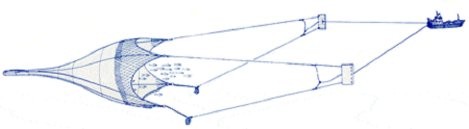
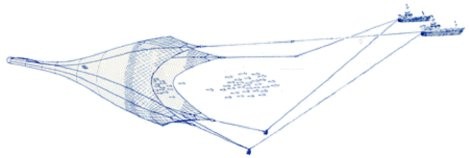
1. Nimetage kurnpüüniseid
2. Kuidas toimub püük kaldanoodaga
3. Milliseid kalu püütakse Eestis põhjanoodaga
4. Iseloomustage tõstevõrguga püüki
5. Milleks on seinnoodal haarad
6. Kuidas orienteerub laev seinnoodapüügil kalaparve
ja tuule suhtes
7. Mis asi on jõuplokk
8. Milliseid kalaparve käitumise iseärasusi tuleb
seinnoodapüügil arvestada
9. Miks on seinnooda vertikaalne rakenduskoefitsient
suurem, kui horisontaalne
1
1. Milline taglastuselement on põhjatraalnooda tunnuseks
2. Milles seisneb põhimõtteline vahe traalnoodaga ja põhjanoodaga
püügil
3. Milleks on vaja traallaudu
4. Millise traallaua konstruktsioonielemendi külge ühendatakse vaier
5. Milleks on vaja traalpüügil kaableid
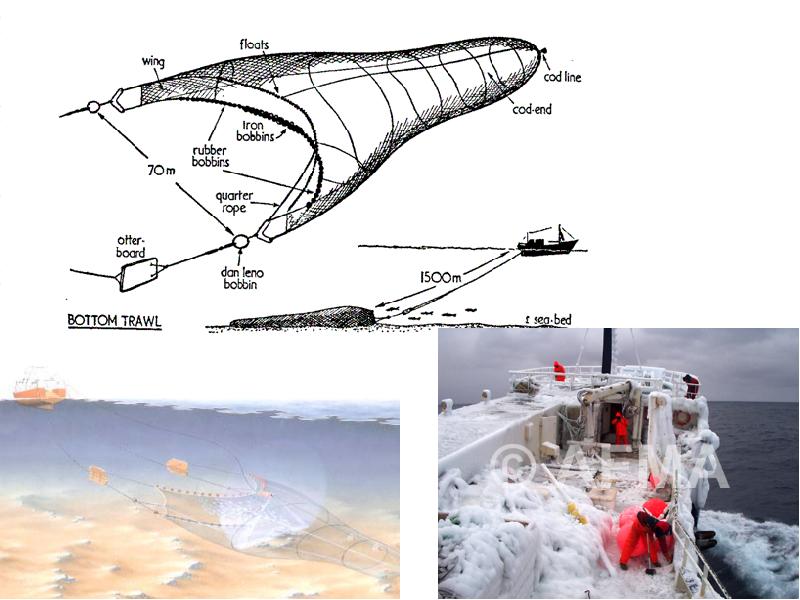
6. Nimeta põhjatraalnooda peamised osad
2
3
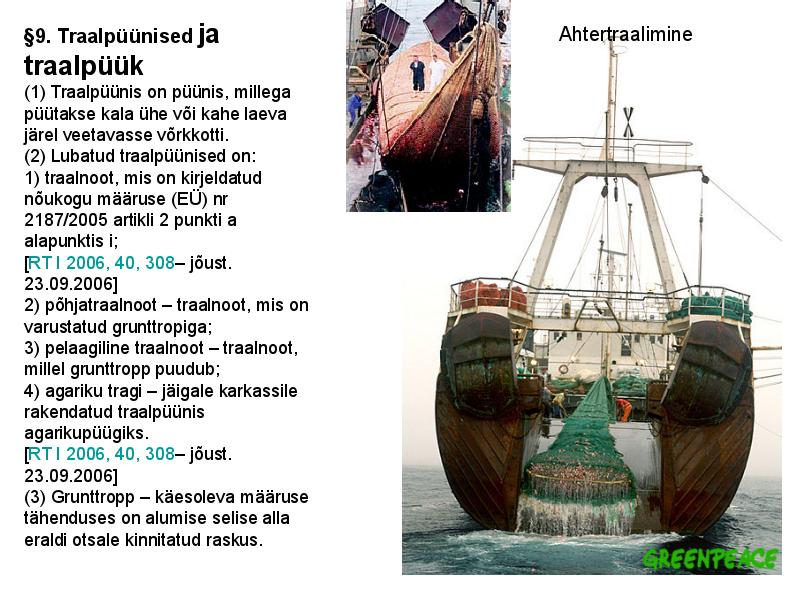
§9. Traalpüünised ja Ahtertraalimine
traalpüük
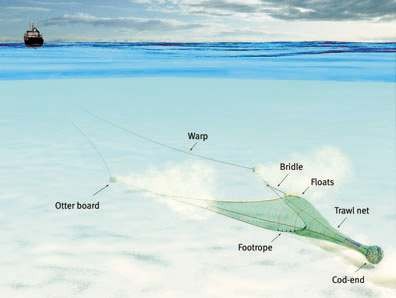
(1) Traalpüünis on püünis, millega
püütakse kala ühe või kahe laeva
järel veetavasse võrkkotti.
(2) Lubatud traalpüünised on:
1) traalnoot, mis on kirjeldatud
nõukogu määruse (EÜ) nr
2187/2005 artikli 2 punkti a
alapunktis i;
[RT I 2006, 40, 308 jõust.
23.09.2006]
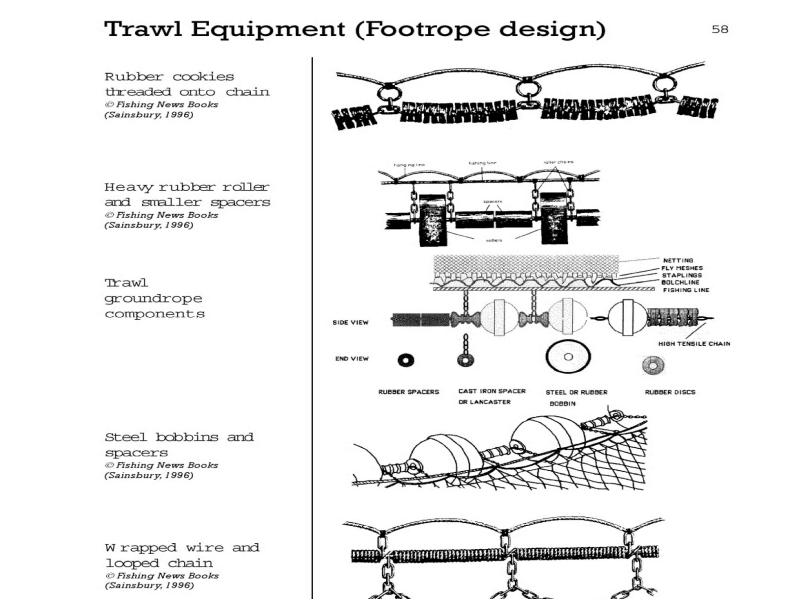
2) põhjatraalnoot traalnoot, mis on
varustatud grunttropiga;
3) pelaagiline traalnoot traalnoot,
millel grunttropp puudub;
4) agariku tragi jäigale karkassile
rakendatud traalpüünis
agarikupüügiks.
[RT I 2006, 40, 308 jõust.
23.09.2006]
(3) Grunttropp käesoleva määruse
tähenduses on alumise selise alla
eraldi otsale kinnitatud raskus.
4
5
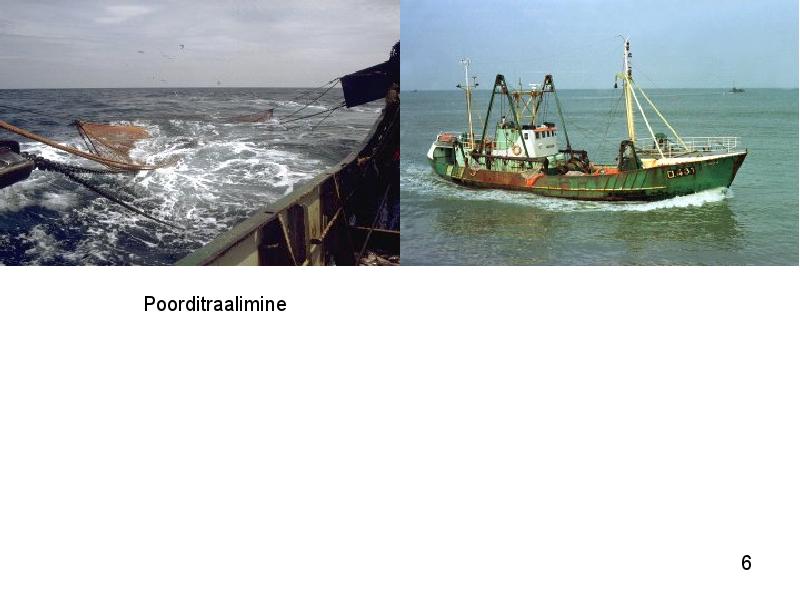
Poorditraalimine
6
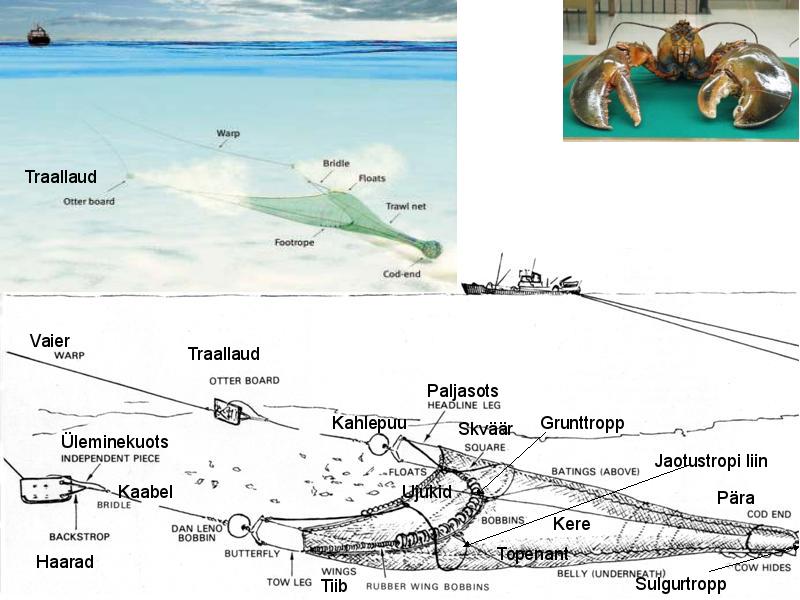
Traallaud
Vaier
Traallaud
Paljasots
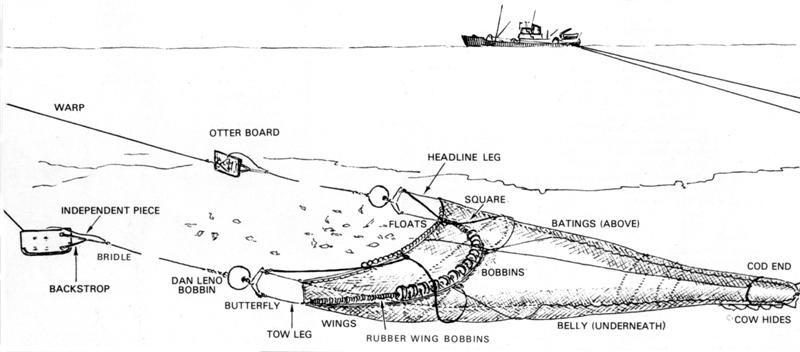
Kahlepuu Skväär Grunttropp
Üleminekuots
Jaotustropi liin
Kaabel Ujukid Pära
Kere
Haarad Topenant
7
Tiib Sulgurtropp
8
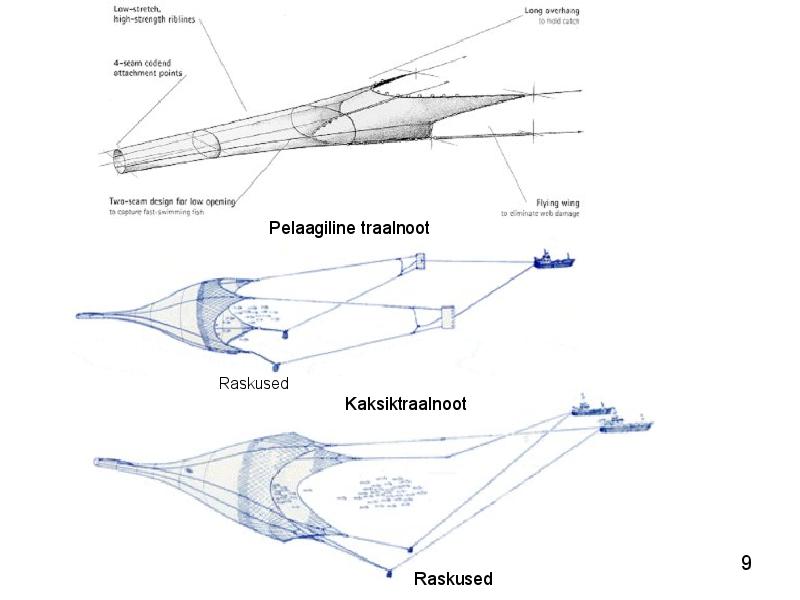
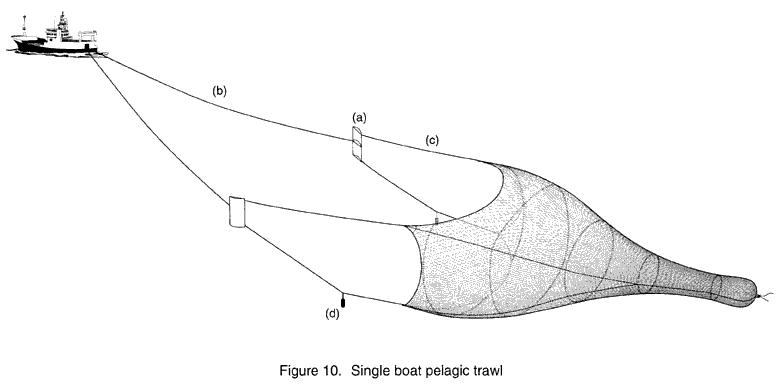
Pelaagiline traalnoot
Raskused
Kaksiktraalnoot
9
Raskused
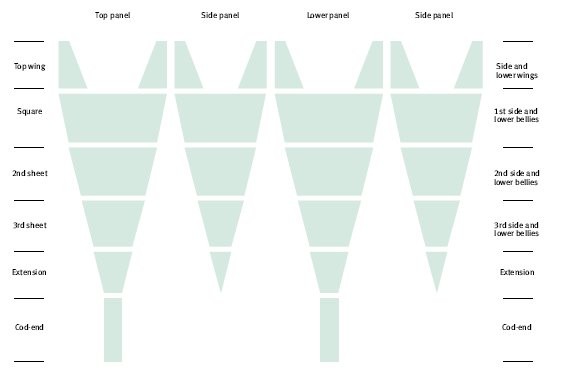
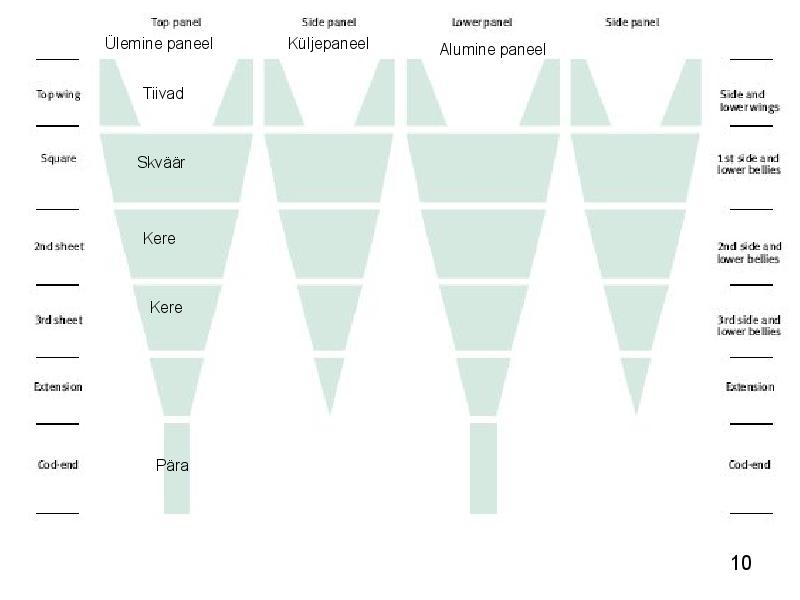
Ülemine paneel Küljepaneel Alumine paneel
Tiivad
Skväär
Kere
Kere
Pära
10
11
12
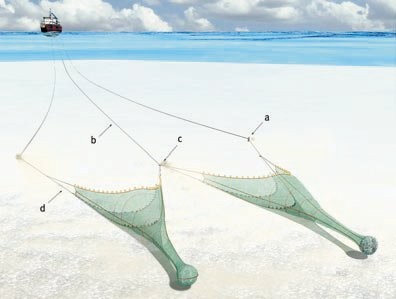
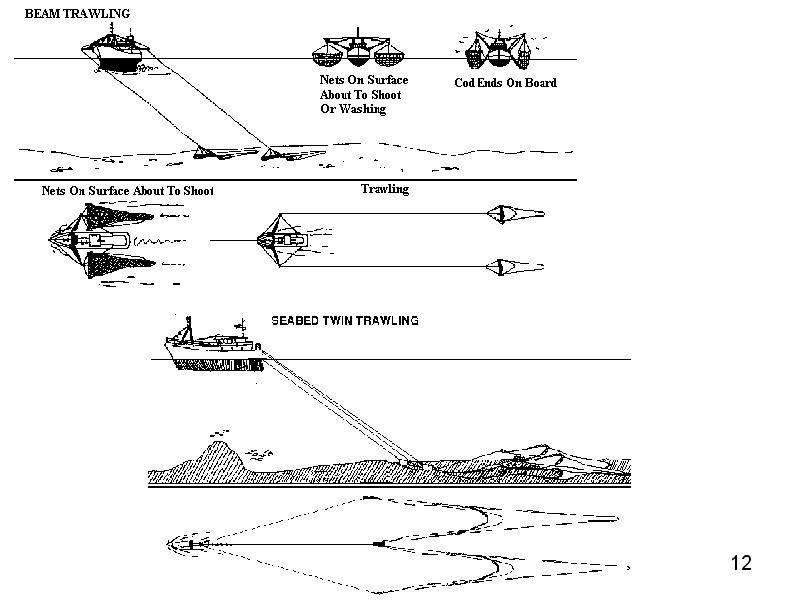
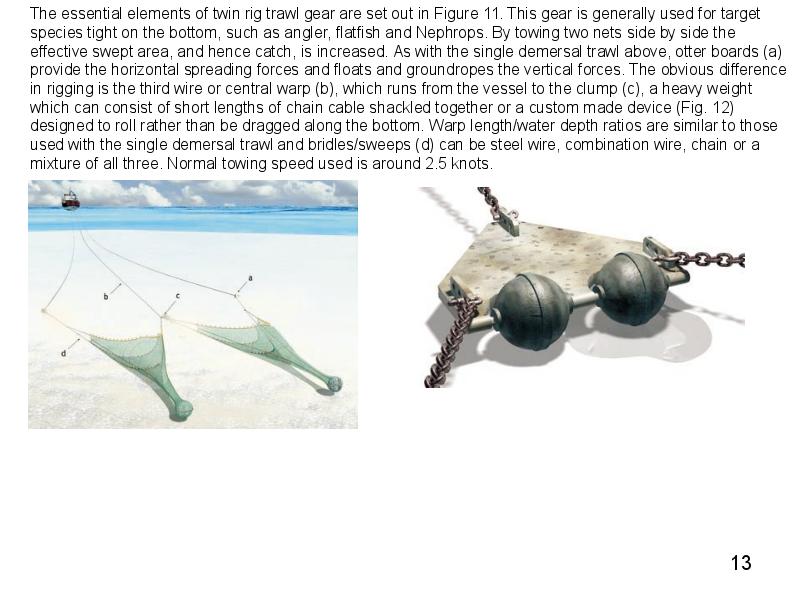
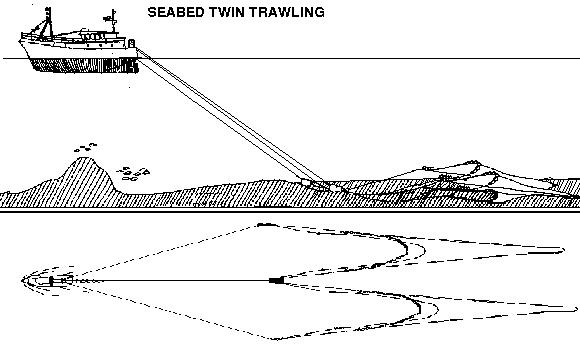
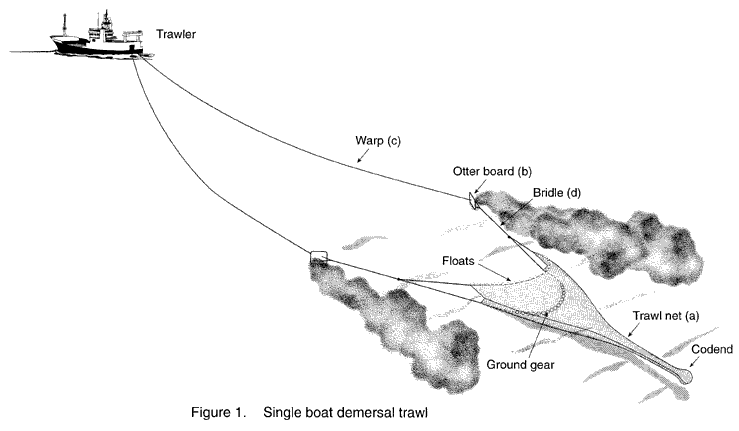
The essential elements of twin rig trawl gear are set out in Figure 11. This gear is generally used for target
species tight on the bottom, such as angler, flatfish and Nephrops. By towing two nets side by side the
effective swept area, and hence catch, is increased. As with the single demersal trawl above, otter boards (a)
provide the horizontal spreading forces and floats and groundropes the vertical forces. The obvious difference
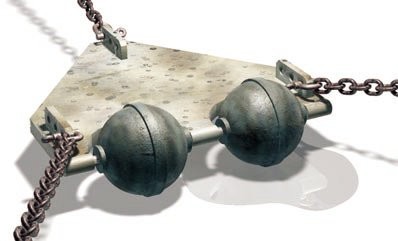
in rigging is the third wire or central warp (b), which runs from the vessel to the clump (c), a heavy weight
which can consist of short lengths of chain cable shackled together or a custom made device (Fig. 12)
designed to roll rather than be dragged along the bottom. Warp length/water depth ratios are similar to those
used with the single demersal trawl and bridles/sweeps (d) can be steel wire, combination wire, chain or a
mixture of all three. Normal towing speed used is around 2.5 knots.
13
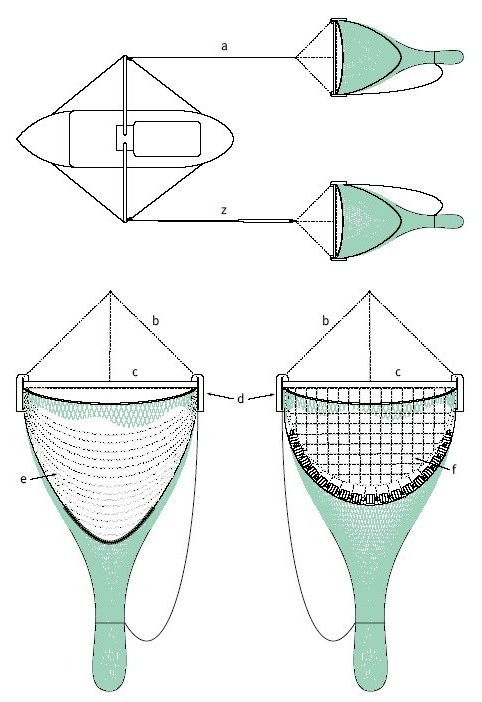
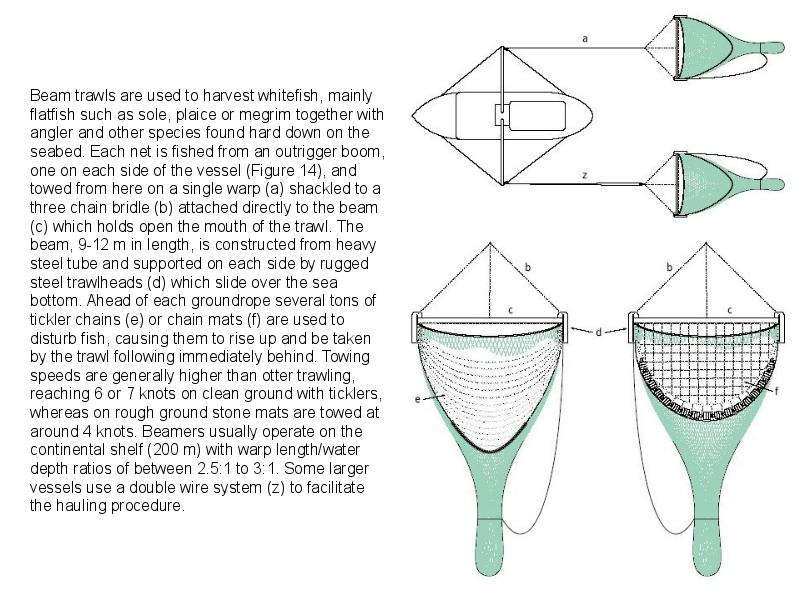
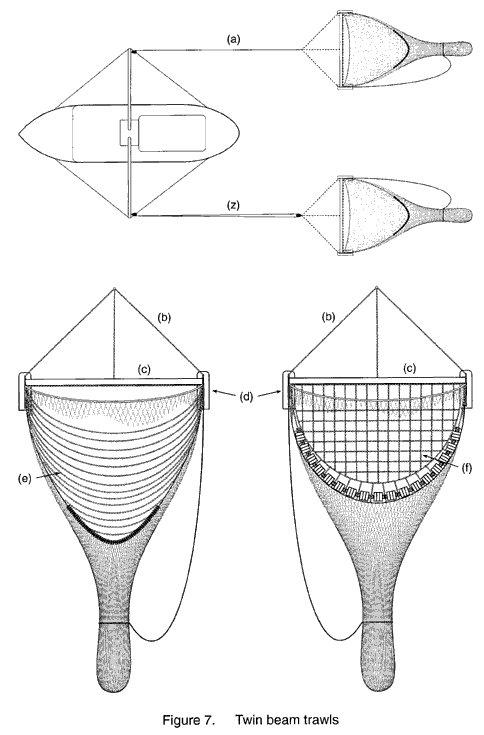
Beam trawls are used to harvest whitefish, mainly
flatfish such as sole, plaice or megrim together with
angler and other species found hard down on the
seabed. Each net is fished from an outrigger boom,
one on each side of the vessel (Figure 14), and
towed from here on a single warp (a) shackled to a
three chain bridle (b) attached directly to the beam
(c) which holds open the mouth of the trawl. The
beam, 9-12 m in length, is constructed from heavy
steel tube and supported on each side by rugged
steel trawlheads (d) which slide over the sea
bottom. Ahead of each groundrope several tons of
tickler chains (e) or chain mats (f) are used to
disturb fish, causing them to rise up and be taken
by the trawl following immediately behind. Towing
speeds are generally higher than otter trawling,
reaching 6 or 7 knots on clean ground with ticklers,
whereas on rough ground stone mats are towed at
around 4 knots. Beamers usually operate on the
continental shelf (200 m) with warp length/water
depth ratios of between 2.5:1 to 3:1. Some larger
vessels use a double wire system (z) to facilitate
the hauling procedure.
14
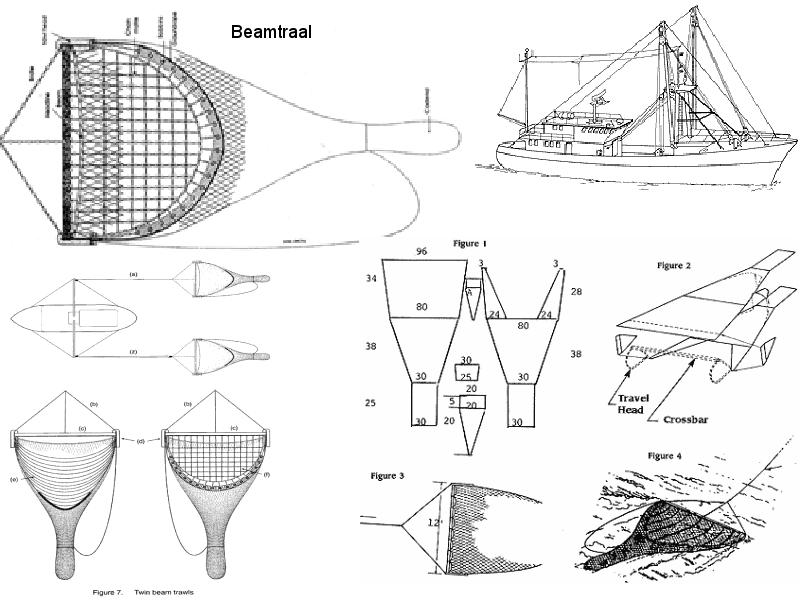
Beamtraal
15
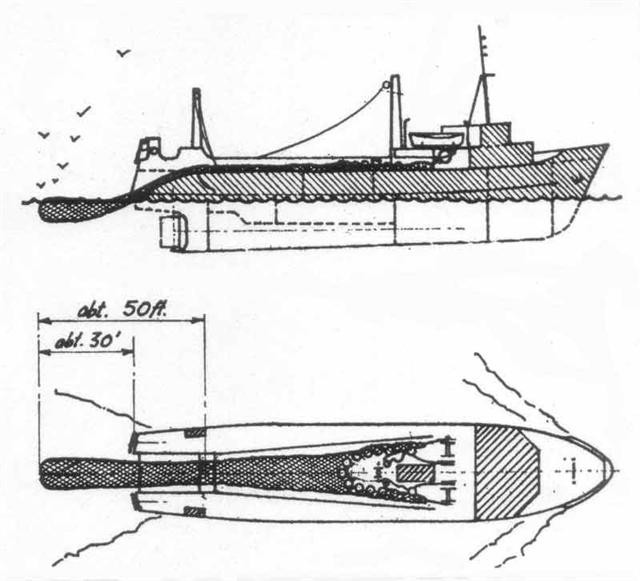
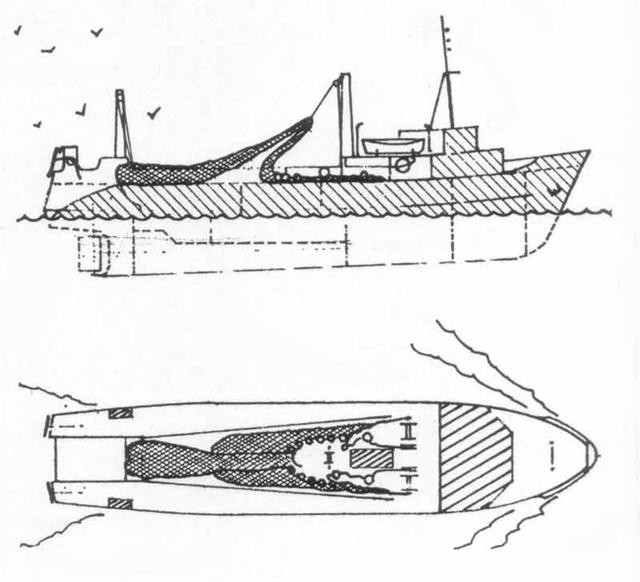
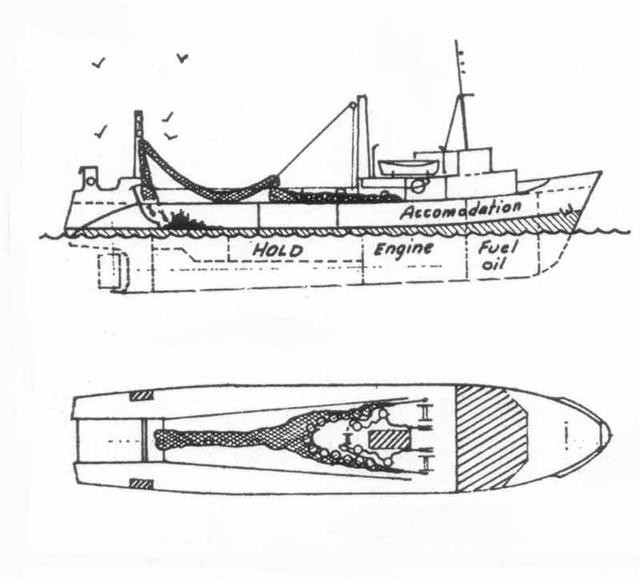
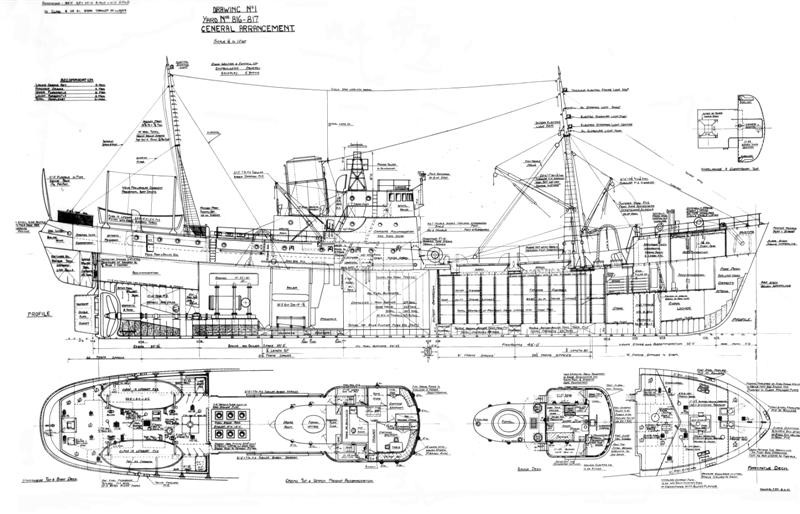
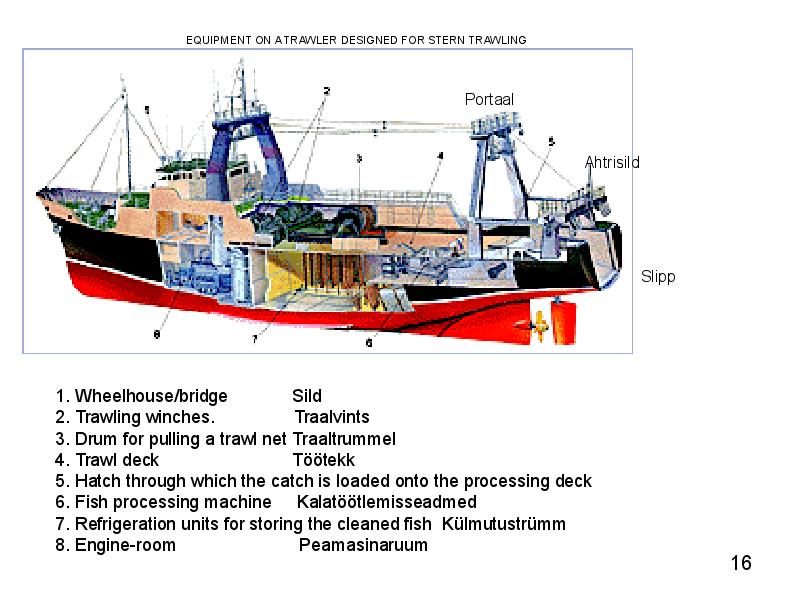
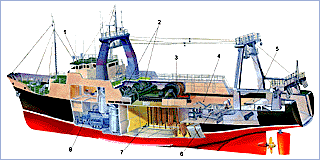
EQUIPMENT ON A TRAWLER DESIGNED FOR STERN TRAWLING
Portaal
Ahtrisild
Slipp
1. Wheelhouse/bridge Sild
2. Trawling winches. Traalvints
3. Drum for pulling a trawl net Traaltrummel
4. Trawl deck Töötekk
5. Hatch through which the catch is loaded onto the processing deck
6. Fish processing machine Kalatöötlemisseadmed
7. Refrigeration units for storing the cleaned fish Külmutustrümm
8. Engine-room Peamasinaruum
16
17
18
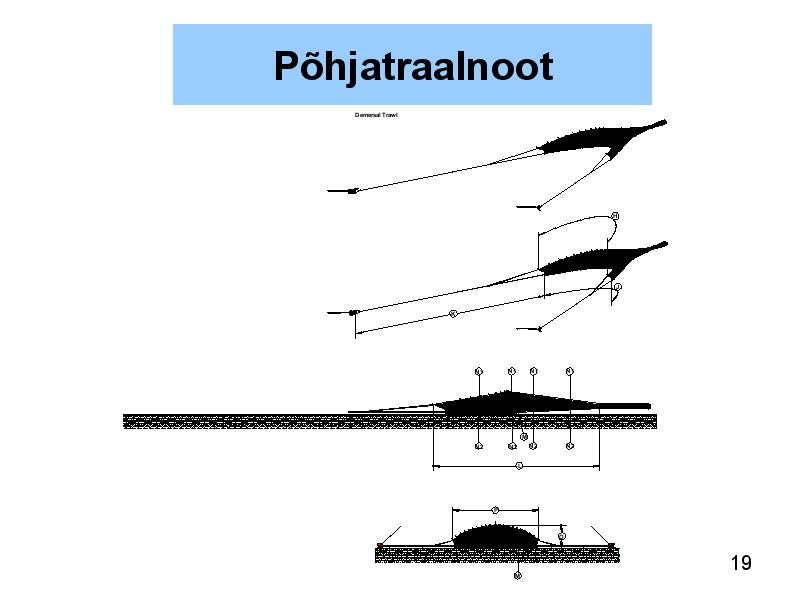
Põhjatraalnoot
D em e rs a l T r a w l
H
J
K
N 1 N 1 N 1 N 1
M
N 2 N 2 N 2 N 2
L
P
O
M
19
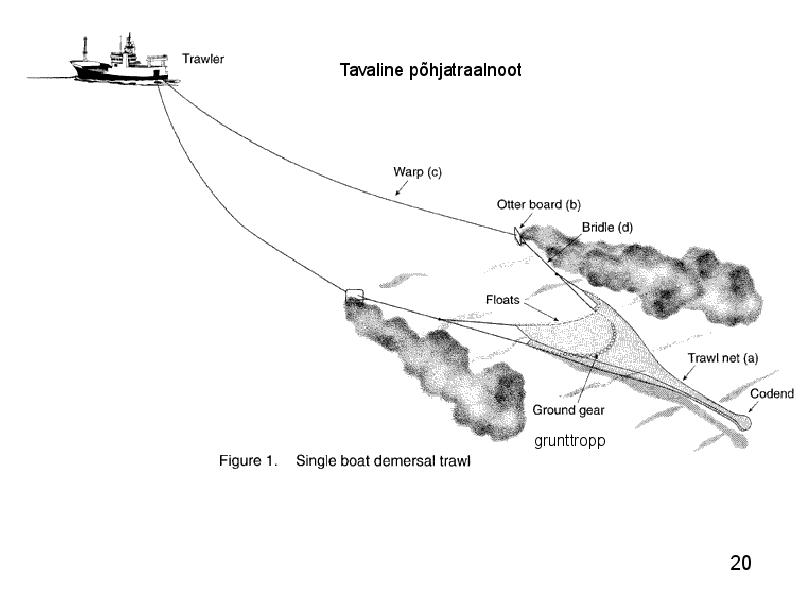
Tavaline põhjatraalnoot
grunttropp
20
21
22
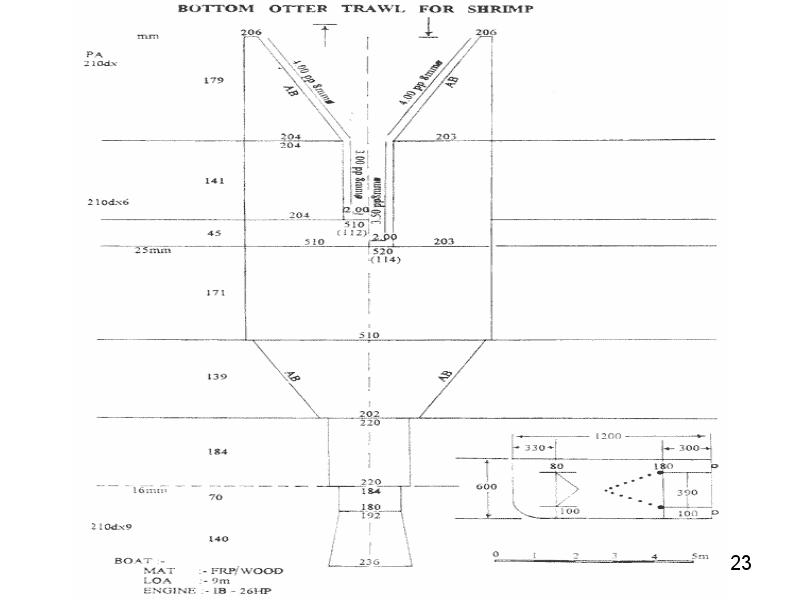
23
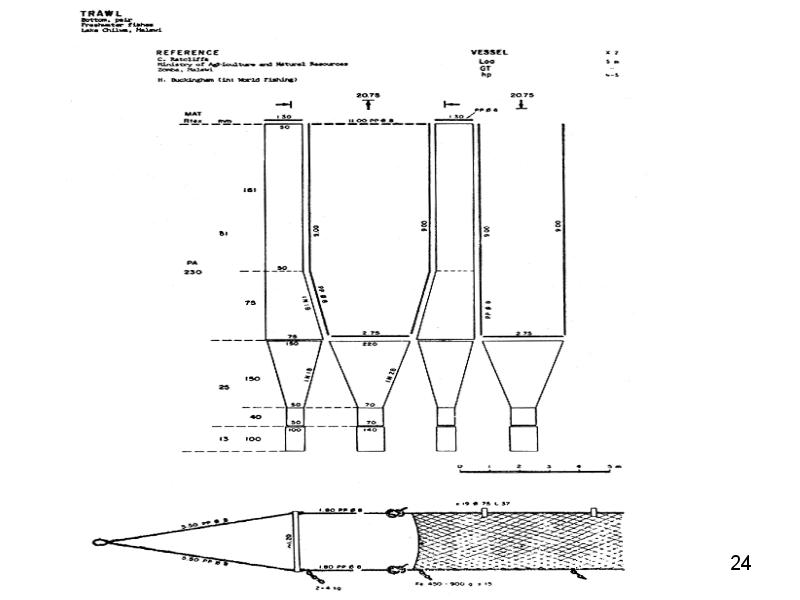
24
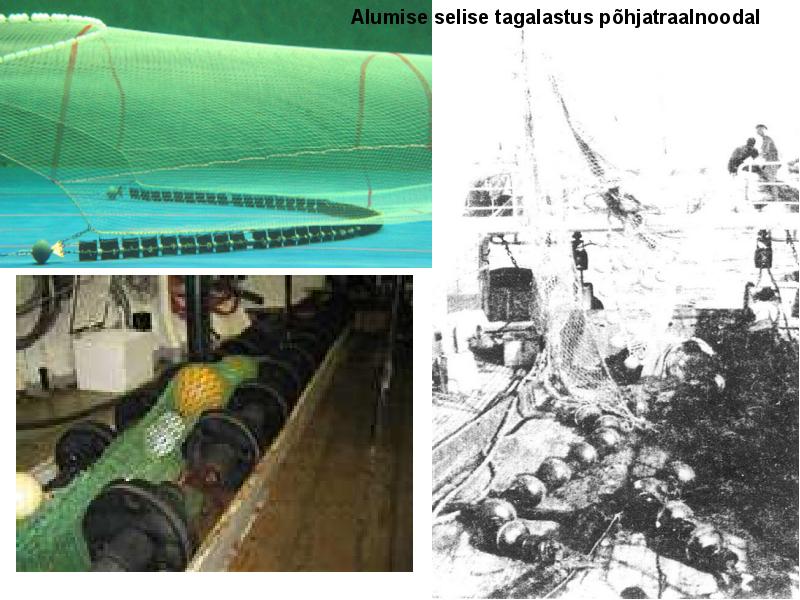
Alumise selise tagalastus põhjatraalnoodal
25
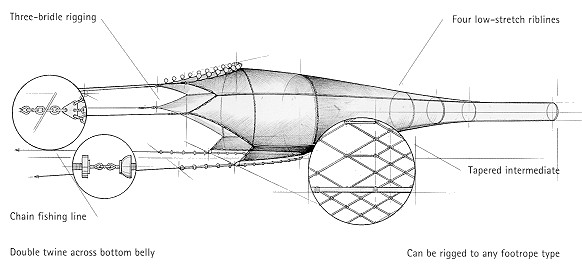
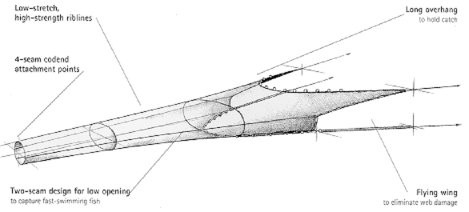
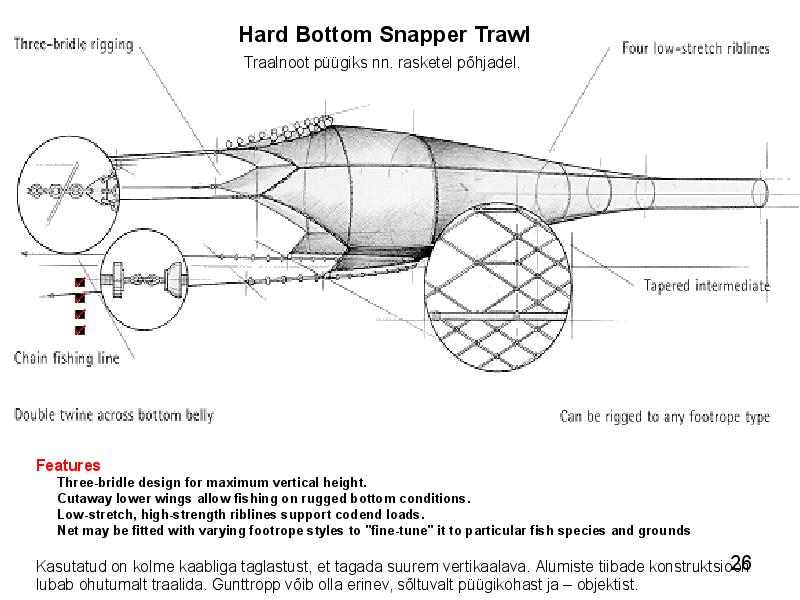
Hard Bottom Snapper Trawl
Traalnoot püügiks nn. rasketel põhjadel.
Features
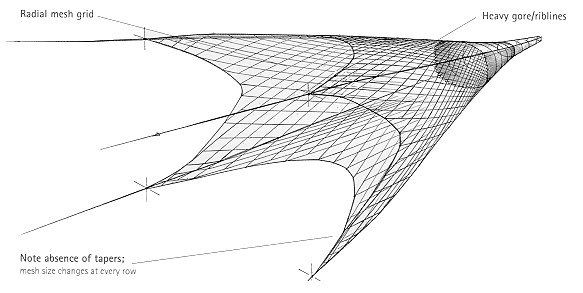
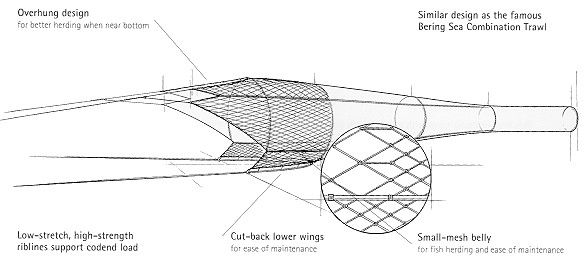
Three-bridle design for maximum vertical height.
Cutaway lower wings allow fishing on rugged bottom conditions.
Low-stretch, high-strength riblines support codend loads.
Net may be fitted with varying footrope styles to "fine-tune" it to particular fish species and grounds
Kasutatud on kolme kaabliga taglastust, et tagada suurem vertikaalava. Alumiste 26tiibade konstruktsioon
lubab ohutumalt traalida. Gunttropp võib olla erinev, sõltuvalt püügikohast ja objektist.
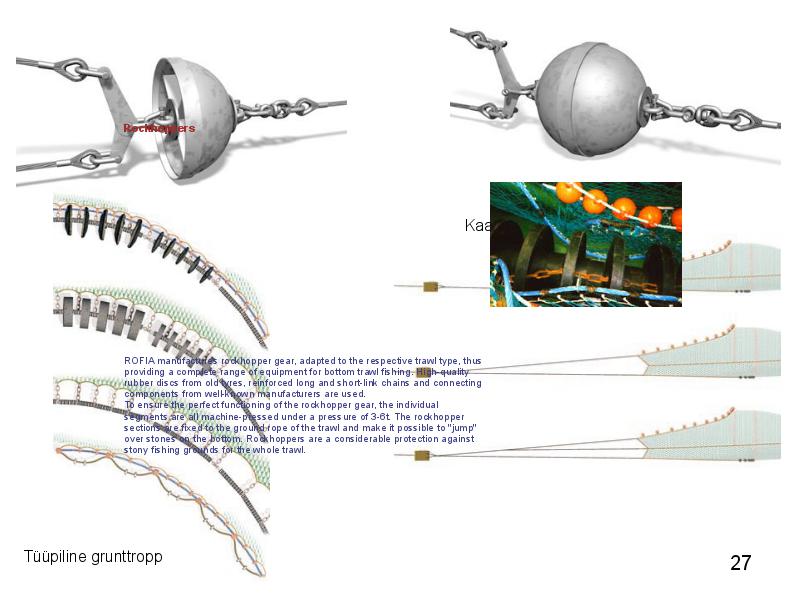
Rockhoppers
Kaablid
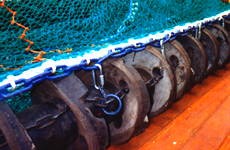
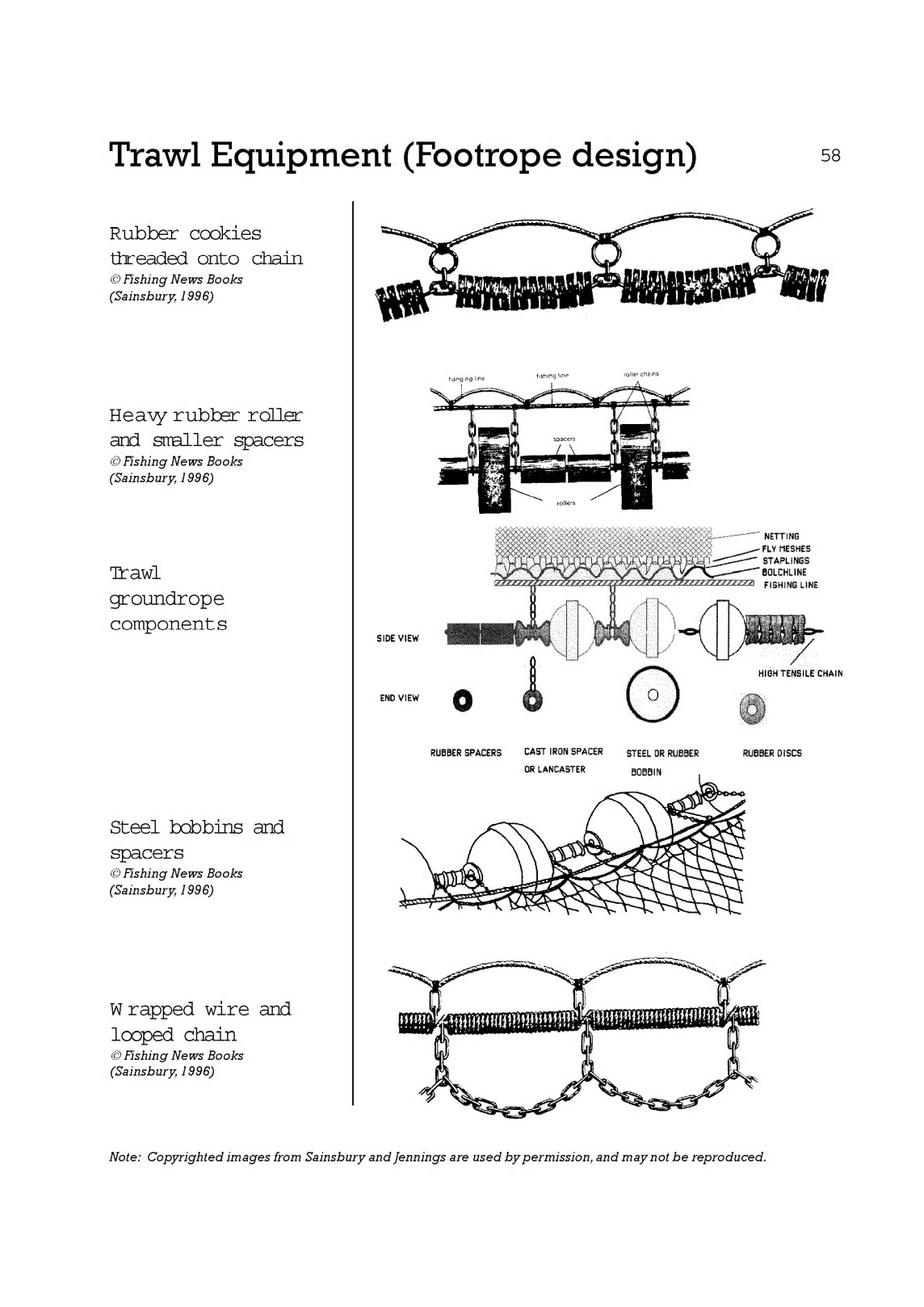
ROFIA manufactures rockhopper gear, adapted to the respective trawl type,
thus providing a complete range of equipment for bottom trawl fishing. High-
quality rubber discs from old tyres, reinforced long and short-link chains and
connecting components from well-known manufacturers are used.
To ensure the perfect functioning of the rockhopper gear, the individual
segments are all machine-pressed under a pressure of 3-6t. The rockhopper
sections are fixed to the ground rope of the trawl and make it possible to "jump"
over stones on the bottom. Rockhoppers are a considerable protection against
stony fishing grounds for the whole trawl.
Tüüpiline grunttropp
27
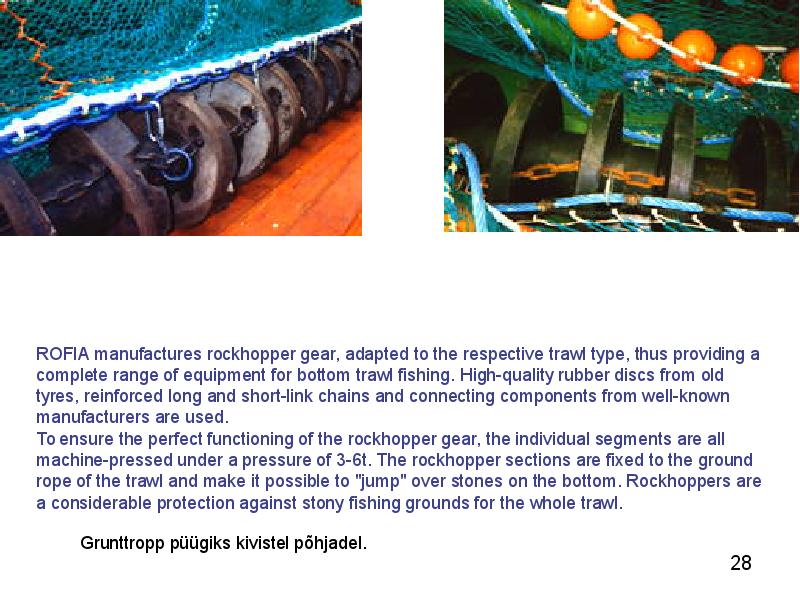
ROFIA manufactures rockhopper gear, adapted to the respective trawl type, thus providing a
complete range of equipment for bottom trawl fishing. High-quality rubber discs from old
tyres, reinforced long and short-link chains and connecting components from well-known
manufacturers are used.
To ensure the perfect functioning of the rockhopper gear, the individual segments are all
machine-pressed under a pressure of 3-6t. The rockhopper sections are fixed to the ground
rope of the trawl and make it possible to "jump" over stones on the bottom. Rockhoppers are
a considerable protection against stony fishing grounds for the whole trawl.
Grunttropp püügiks kivistel põhjadel.
28
29
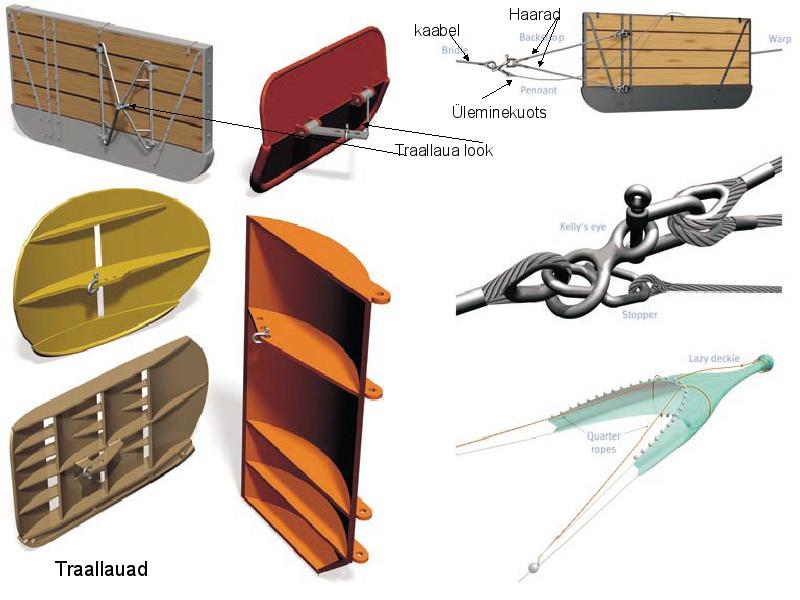
Haarad
kaabel
Üleminekuots
Traallaua look
Traallauad 30
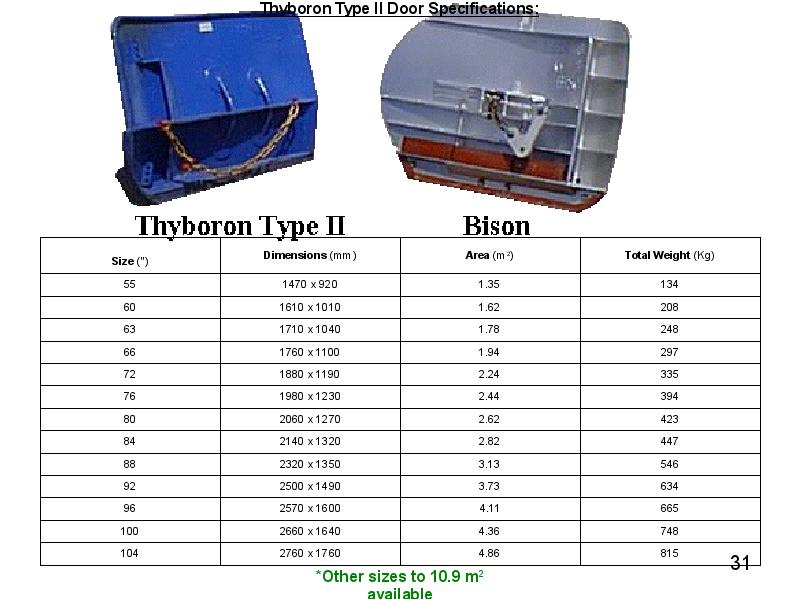
Thyboron Type II Door Specifications:
Dimensions (mm) Area (m2) Total Weight (Kg)
Size (")
55 1470 x 920 1.35 134
60 1610 x 1010 1.62 208
63 1710 x 1040 1.78 248
66 1760 x 1100 1.94 297
72 1880 x 1190 2.24 335
76 1980 x 1230 2.44 394
80 2060 x 1270 2.62 423
84 2140 x 1320 2.82 447
88 2320 x 1350 3.13 546
92 2500 x 1490 3.73 634
96 2570 x 1600 4.11 665
100 2660 x 1640 4.36 748
104 2760 x 1760 4.86 815
31
*Other sizes to 10.9 m2
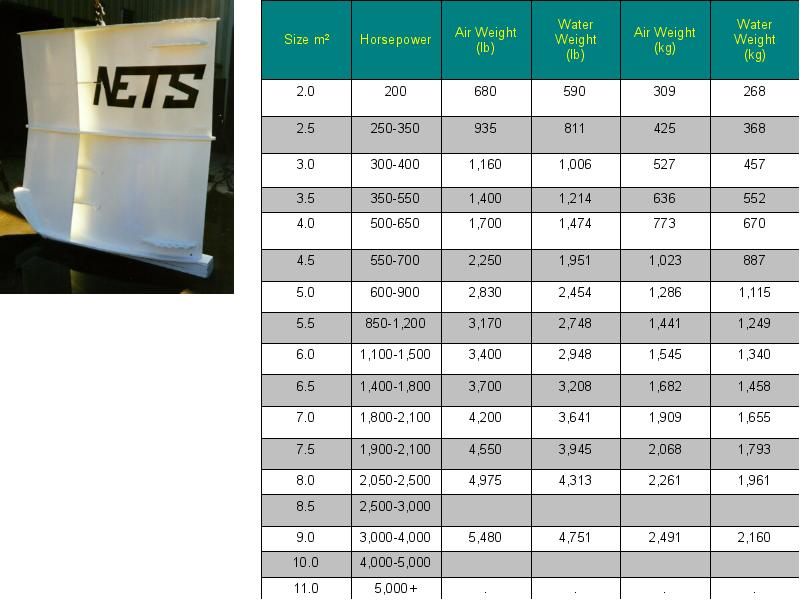
Water Water
Air Weight Air Weight
Size m2 Horsepower Weight Weight
(lb) (kg)
(lb) (kg)
2.0 200 680 590 309 268
2.5 250-350 935 811 425 368
3.0 300-400 1,160 1,006 527 457
3.5 350-550 1,400 1,214 636 552
4.0 500-650 1,700 1,474 773 670
4.5 550-700 2,250 1,951 1,023 887
5.0 600-900 2,830 2,454 1,286 1,115
5.5 850-1,200 3,170 2,748 1,441 1,249
6.0 1,100-1,500 3,400 2,948 1,545 1,340
6.5 1,400-1,800 3,700 3,208 1,682 1,458
7.0 1,800-2,100 4,200 3,641 1,909 1,655
7.5 1,900-2,100 4,550 3,945 2,068 1,793
8.0 2,050-2,500 4,975 4,313 2,261 1,961
8.5 2,500-3,000 . . . .
9.0 3,000-4,000 5,480 4,751 2,491 2,160
10.0 4,000-5,000 . . 32 . .
11.0 5,000+ . . . .
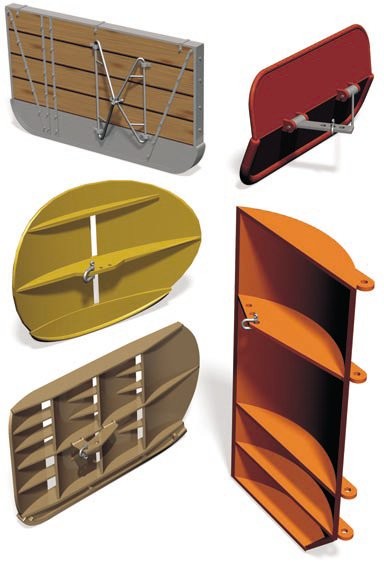
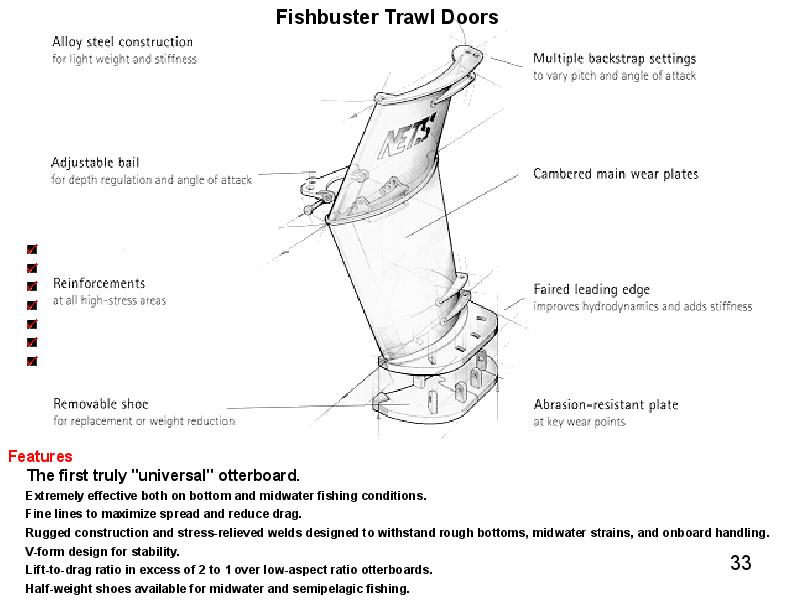
Fishbuster Trawl Doors
Features
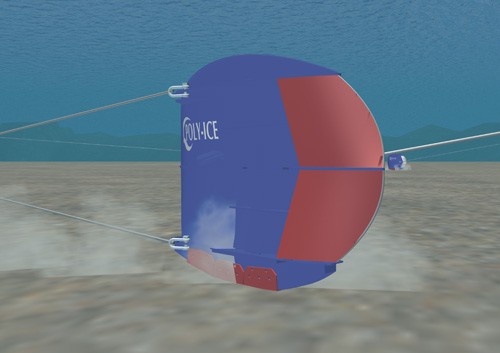
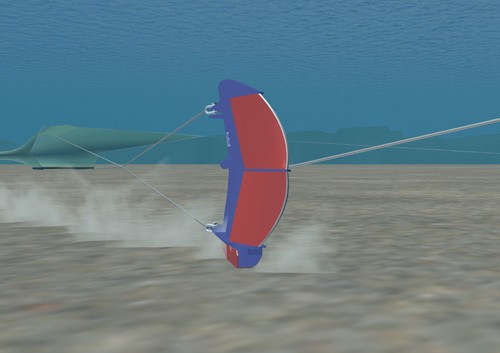
The first truly "universal" otterboard.
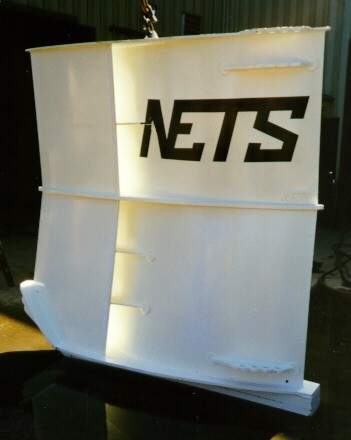
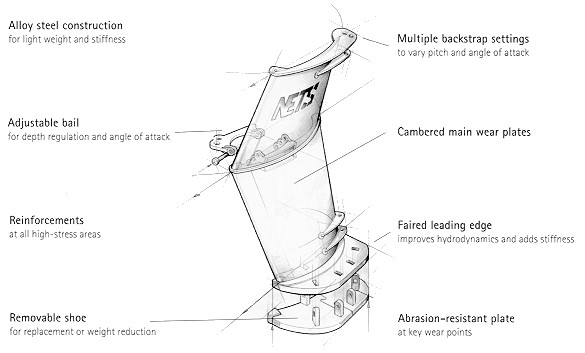
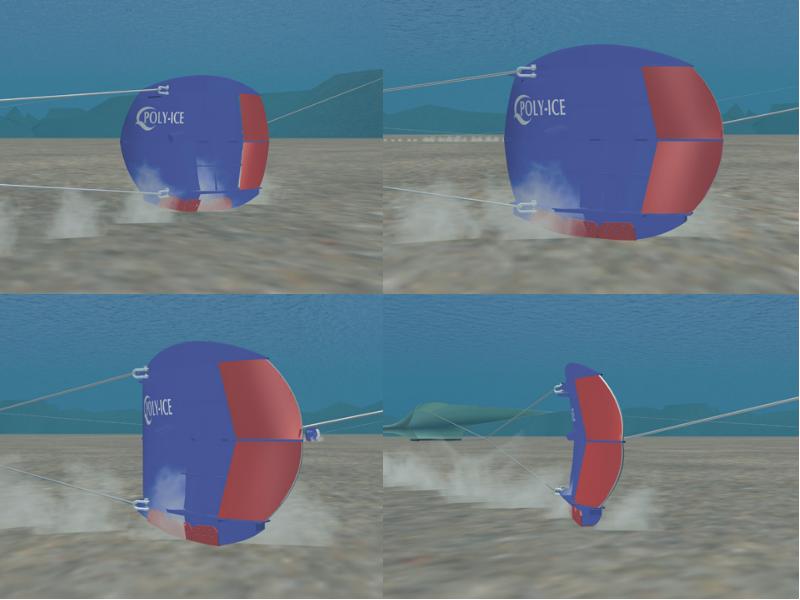
Extremely effective both on bottom and midwater fishing conditions.
Fine lines to maximize spread and reduce drag.
Rugged construction and stress-relieved welds designed to withstand rough bottoms, midwater strains, and onboard handling.
V-form design for stability.
Lift-to-drag ratio in excess of 2 to 1 over low-aspect ratio otterboards. 33
Half-weight shoes available for midwater and semipelagic fishing.
34
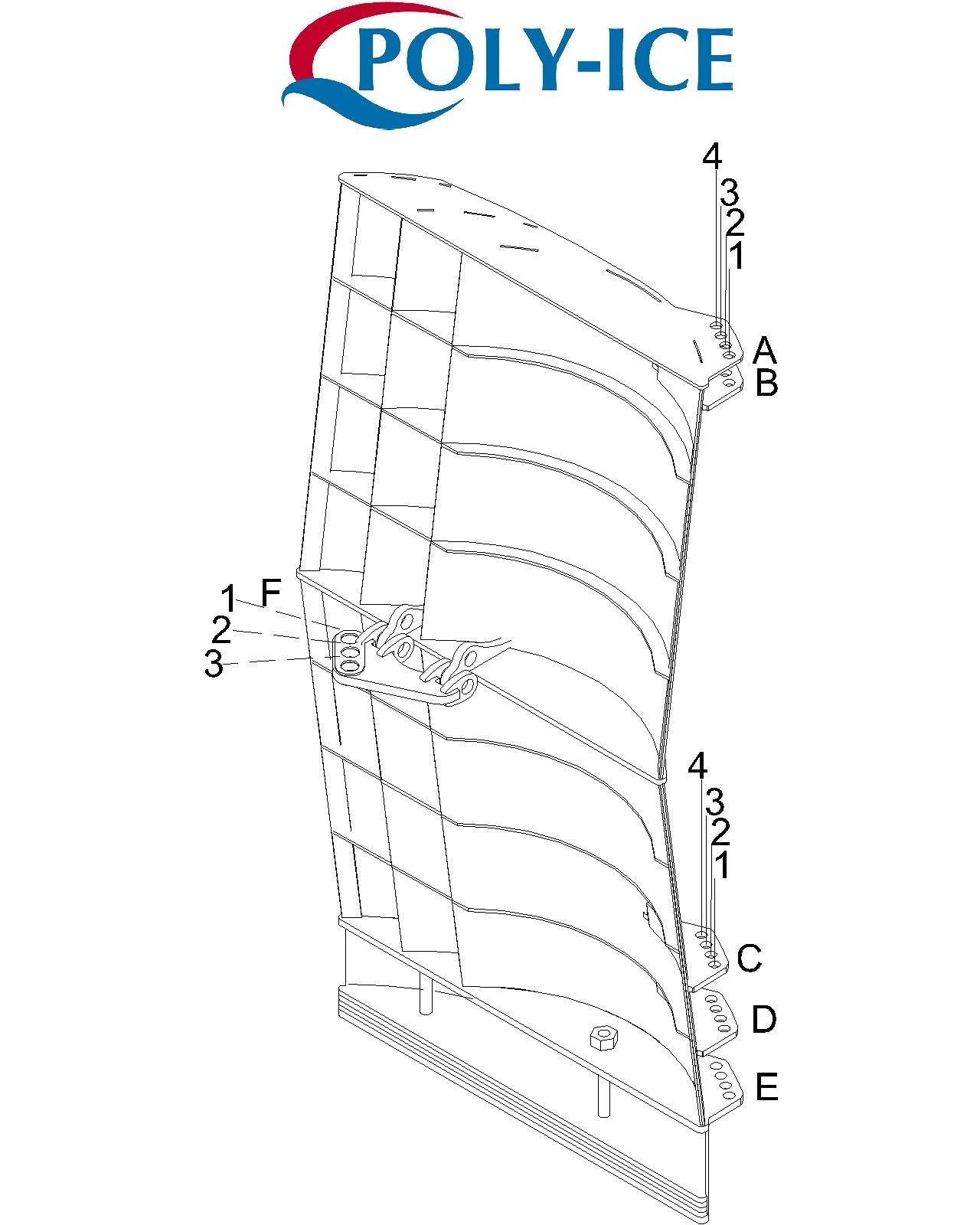
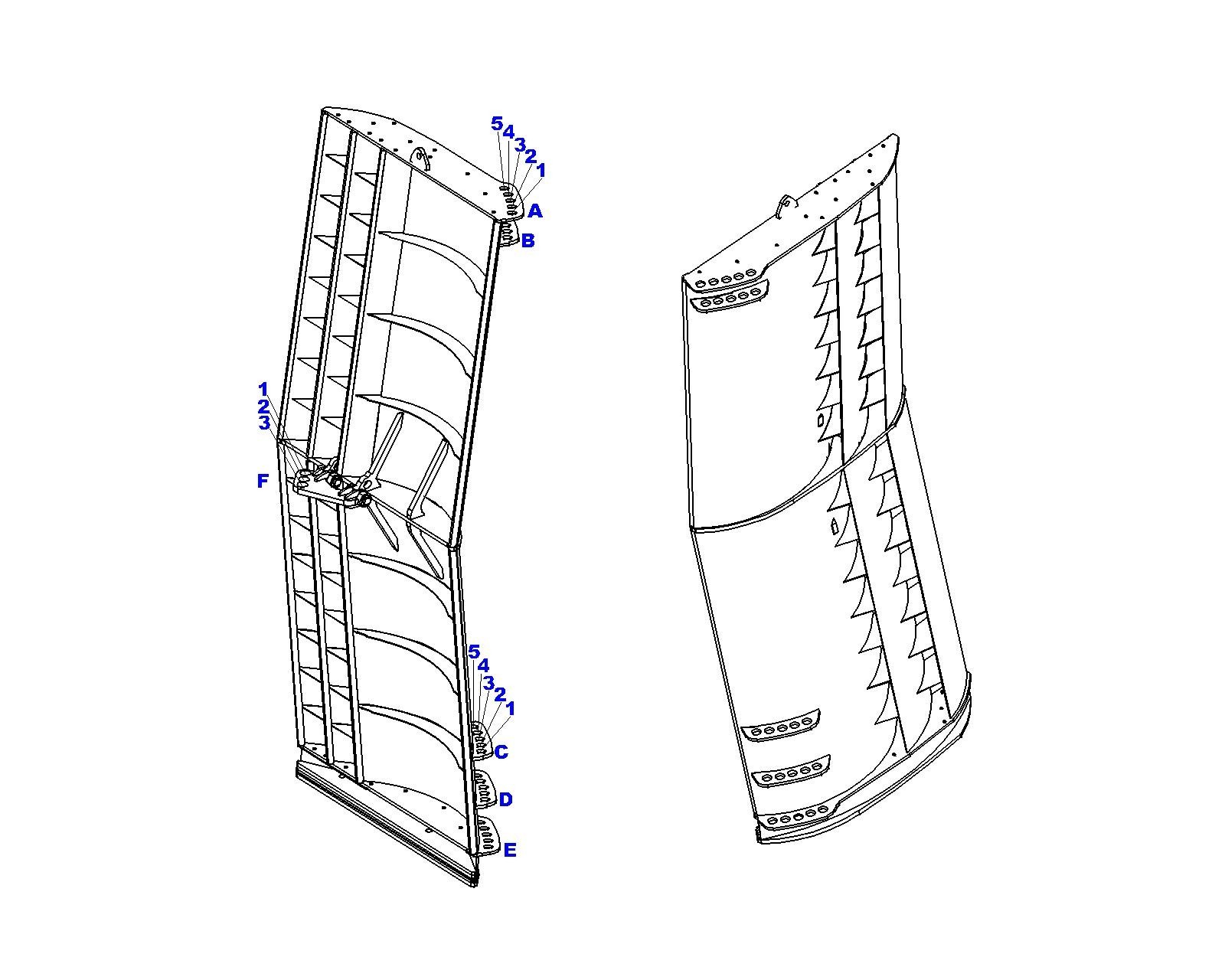
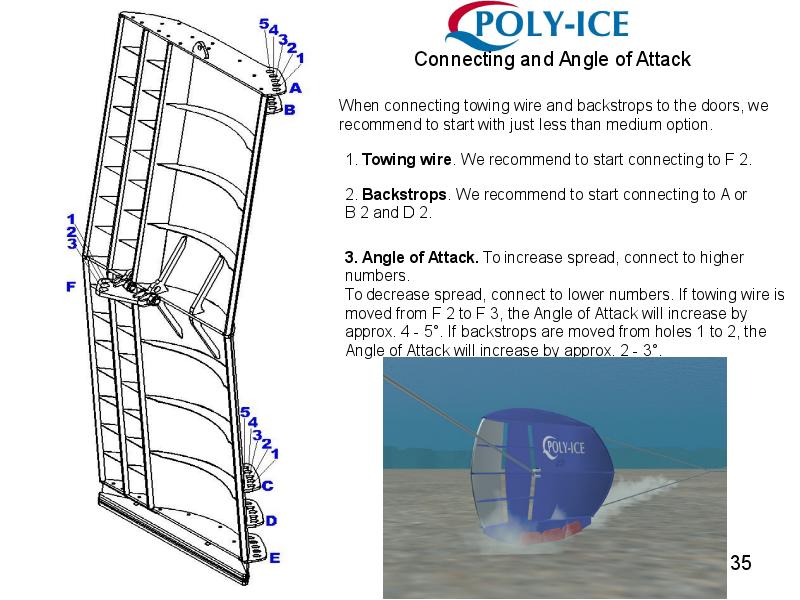
Connecting and Angle of Attack
When connecting towing wire and backstrops to the doors, we
recommend to start with just less than medium option.
1. Towing wire. We recommend to start connecting to F 2.
2. Backstrops. We recommend to start connecting to A or
B 2 and D 2.
3. Angle of Attack. To increase spread, connect to higher
numbers.
To decrease spread, connect to lower numbers. If towing wire is
moved from F 2 to F 3, the Angle of Attack will increase by
approx. 4 - 5°. If backstrops are moved from holes 1 to 2, the
Angle of Attack will increase by approx. 2 - 3°.
35
36
37
38
39
Pelaagiline traalpüük
40
41
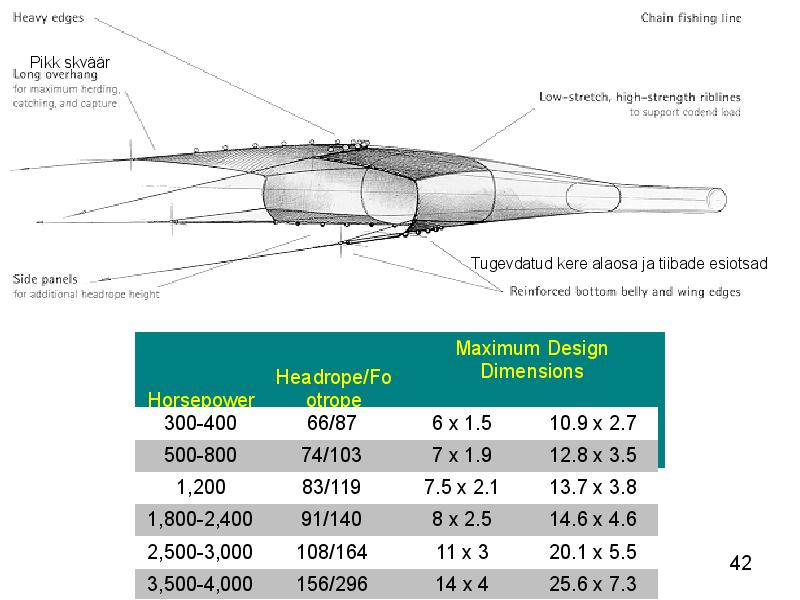
Pikk skväär
Tugevdatud kere alaosa ja tiibade esiotsad
Maximum Design
Headrope/Fo Dimensions
Horsepower otrope
300-400 Length
66/87(ft) 6 (fm)
x 1.5 10.9(m)
x 2.7
500-800 74/103 7 x 1.9 12.8 x 3.5
1,200 83/119 7.5 x 2.1 13.7 x 3.8
1,800-2,400 91/140 8 x 2.5 14.6 x 4.6
2,500-3,000 108/164 11 x 3 20.1 x 5.5
42
3,500-4,000 156/296 14 x 4 25.6 x 7.3
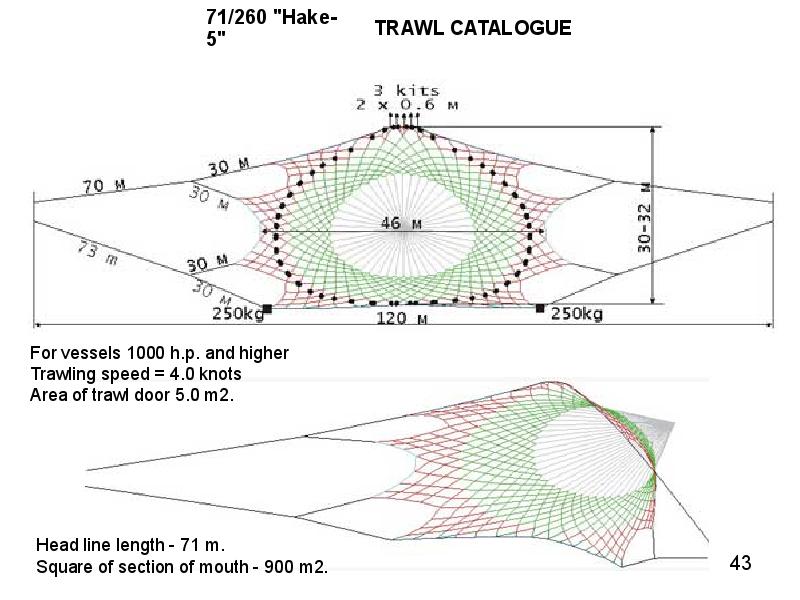
71/260 "Hake- TRAWL
5" CATALOGUE
For vessels 1000 h.p. and higher
Trawling speed = 4.0 knots
Area of trawl door 5.0 m2.
Head line length - 71 m.
Square of section of mouth - 900 m2. 43
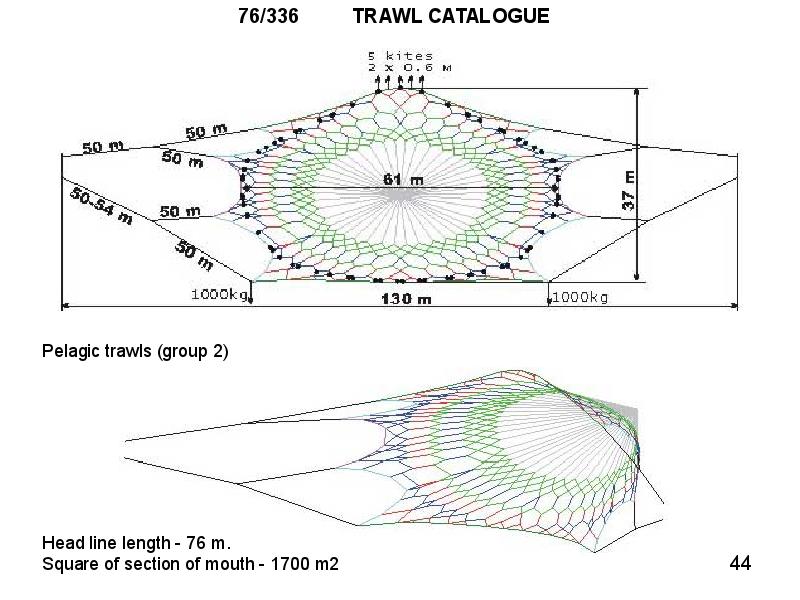
76/336 TRAWL CATALOGUE
Pelagic trawls (group 2)
Head line length - 76 m.
Square of section of mouth - 1700 m2 44
45
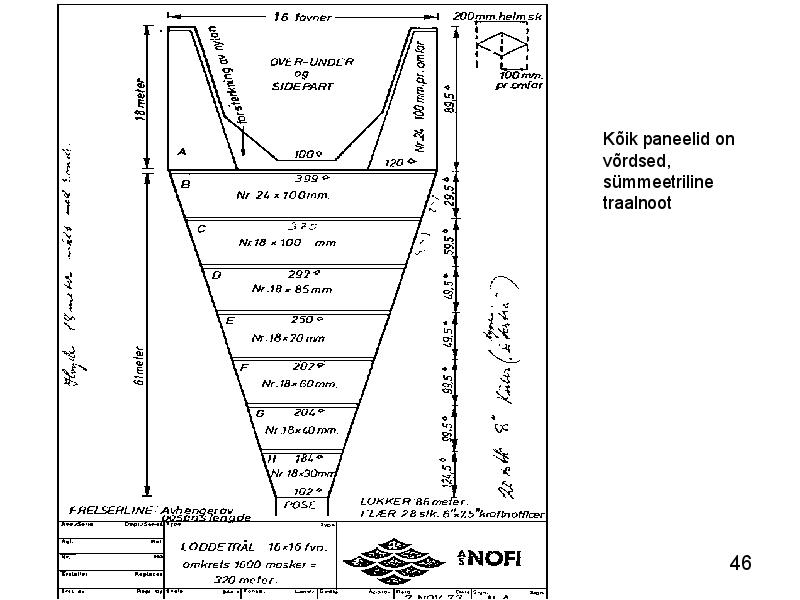
Kõik paneelid on
võrdsed,
sümmeetriline
traalnoot
46
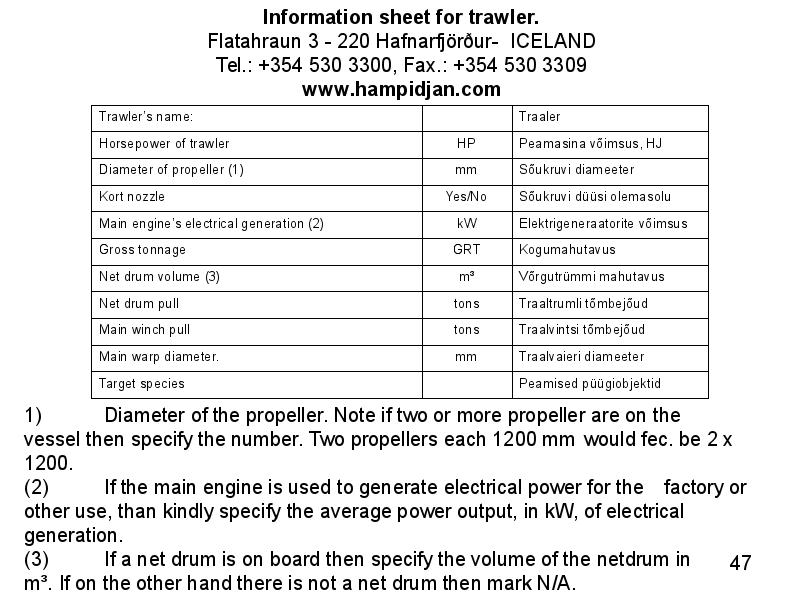
Information sheet for trawler.
Flatahraun 3 - 220 Hafnarfjörur- ICELAND
Tel.: +354 530 3300, Fax.: +354 530 3309
www.hampidjan.com
Trawler's name: Traaler
Horsepower of trawler HP Peamasina võimsus, HJ
Diameter of propeller (1) mm Sõukruvi diameeter
Kort nozzle Yes/No Sõukruvi düüsi olemasolu
Main engine's electrical generation (2) kW Elektrigeneraatorite võimsus
Gross tonnage GRT Kogumahutavus
Net drum volume (3) m³ Võrgutrümmi mahutavus
Net drum pull tons Traaltrumli tõmbejõud
Main winch pull tons Traalvintsi tõmbejõud
Main warp diameter. mm Traalvaieri diameeter
Target species Peamised püügiobjektid
1) Diameter of the propeller. Note if two or more propeller are on the
vessel then specify the number. Two propellers each 1200 mm would fec. be 2 x
1200.
(2) If the main engine is used to generate electrical power for the factory or
other use, than kindly specify the average power output, in kW, of electrical
generation.
(3) If a net drum is on board then specify the volume of the47netdrum in
m³. If on the other hand there is not a net drum then mark N/A.
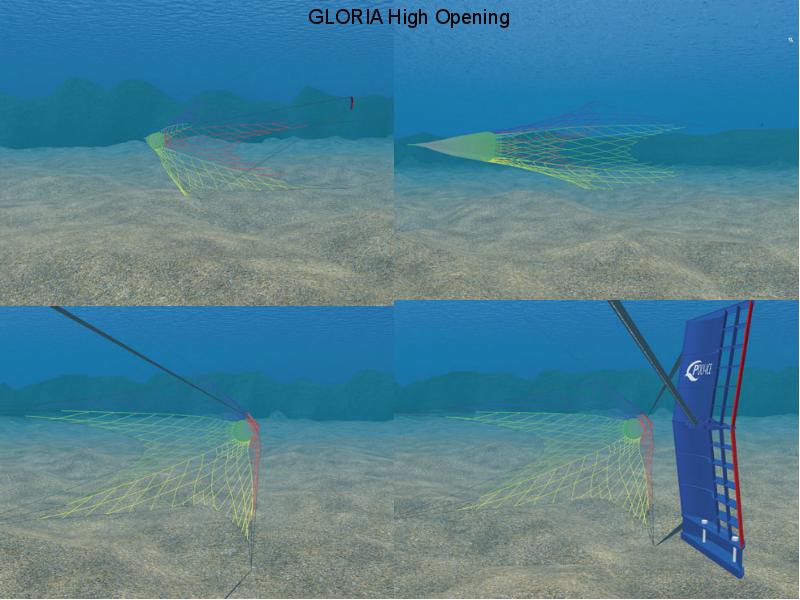
GLORIA High Opening
48
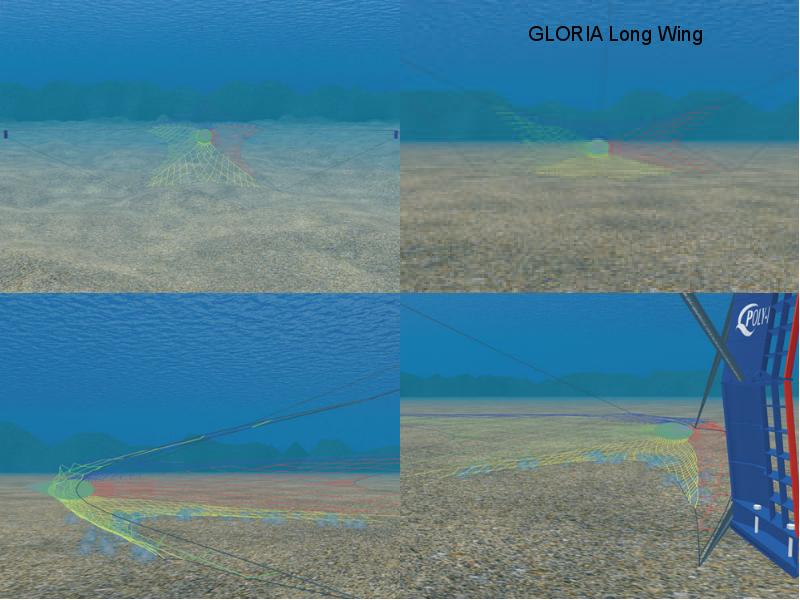
GLORIA Long Wing
49
50
· 07. september lõpp
51
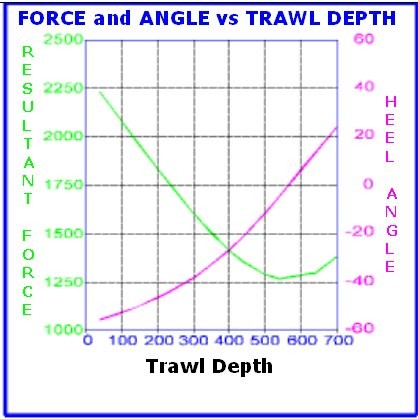
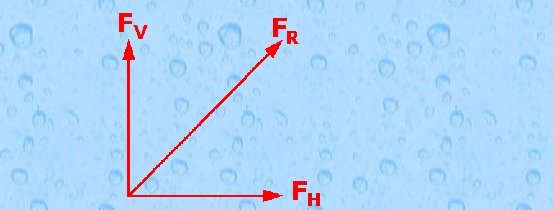
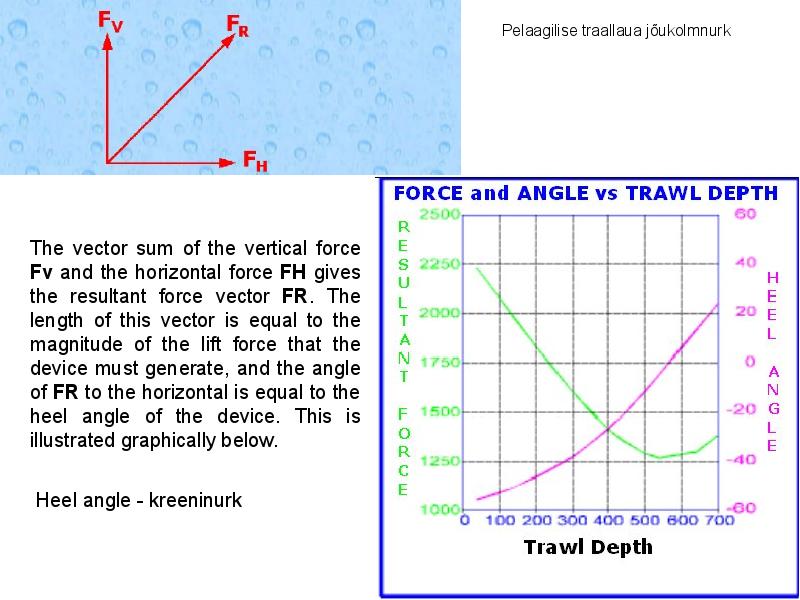
Pelaagilise traallaua jõukolmnurk
The vector sum of the vertical force
Fv and the horizontal force FH gives
the resultant force vector FR. The
length of this vector is equal to the
magnitude of the lift force that the
device must generate, and the angle
of FR to the horizontal is equal to the
heel angle of the device. This is
illustrated graphically below.
Heel angle - kreeninurk
52
53
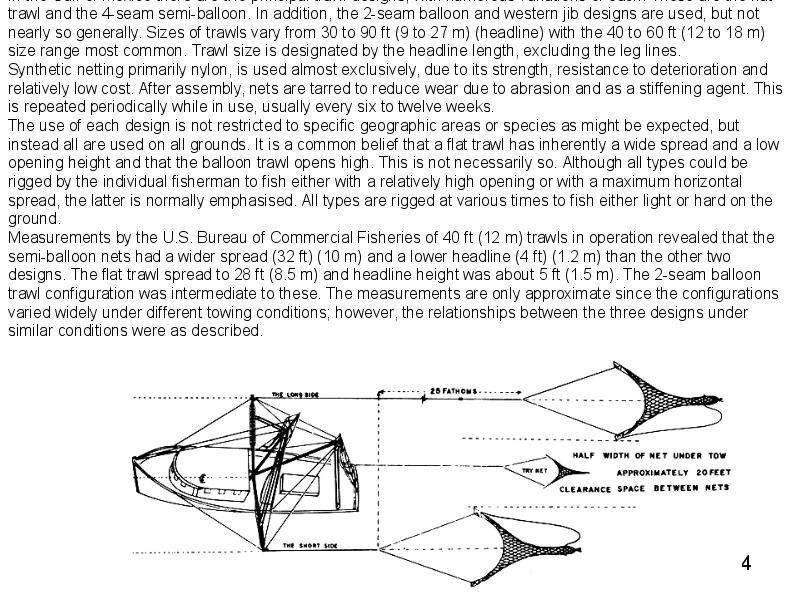
In the Gulf of Mexico there are two principal trawl designs, with numerous variations of each. These are the flat
trawl and the 4-seam semi-balloon. In addition, the 2-seam balloon and western jib designs are used, but not
nearly so generally. Sizes of trawls vary from 30 to 90 ft (9 to 27 m) (headline) with the 40 to 60 ft (12 to 18 m)
size range most common. Trawl size is designated by the headline length, excluding the leg lines.
Synthetic netting primarily nylon, is used almost exclusively, due to its strength, resistance to deterioration and
relatively low cost. After assembly, nets are tarred to reduce wear due to abrasion and as a stiffening agent. This
is repeated periodically while in use, usually every six to twelve weeks.
The use of each design is not restricted to specific geographic areas or species as might be expected, but
instead all are used on all grounds. It is a common belief that a flat trawl has inherently a wide spread and a low
opening height and that the balloon trawl opens high. This is not necessarily so. Although all types could be
rigged by the individual fisherman to fish either with a relatively high opening or with a maximum horizontal
spread, the latter is normally emphasised. All types are rigged at various times to fish either light or hard on the
ground.
Measurements by the U.S. Bureau of Commercial Fisheries of 40 ft (12 m) trawls in operation revealed that the
semi-balloon nets had a wider spread (32 ft) (10 m) and a lower headline (4 ft) (1.2 m) than the other two
designs. The flat trawl spread to 28 ft (8.5 m) and headline height was about 5 ft (1.5 m). The 2-seam balloon
trawl configuration was intermediate to these. The measurements are only approximate since the configurations
varied widely under different towing conditions; however, the relationships between the three designs under
similar conditions were as described.
54
55
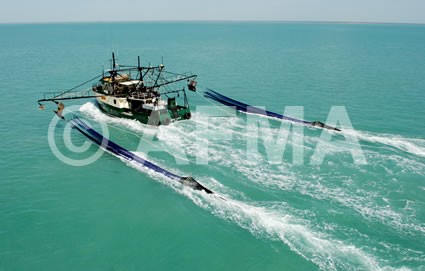
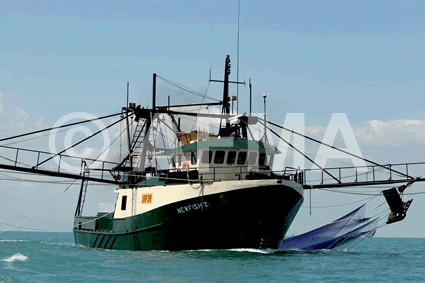
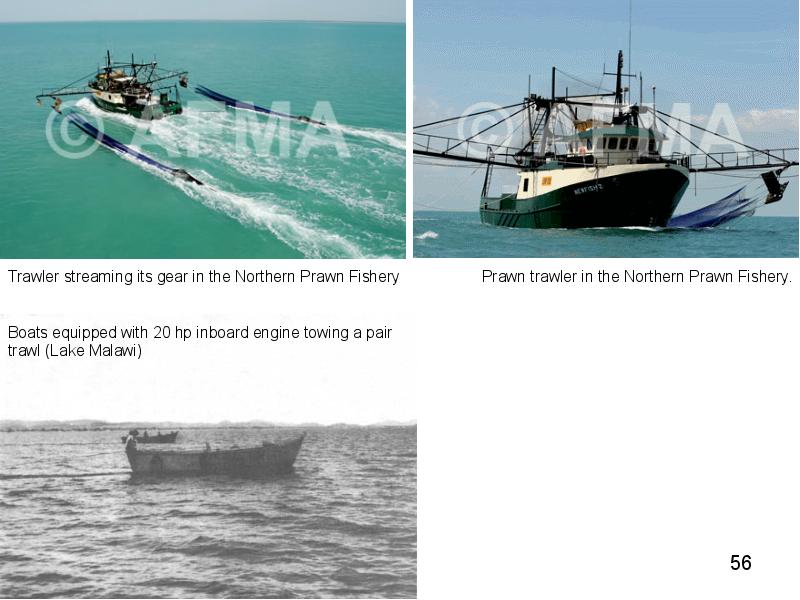
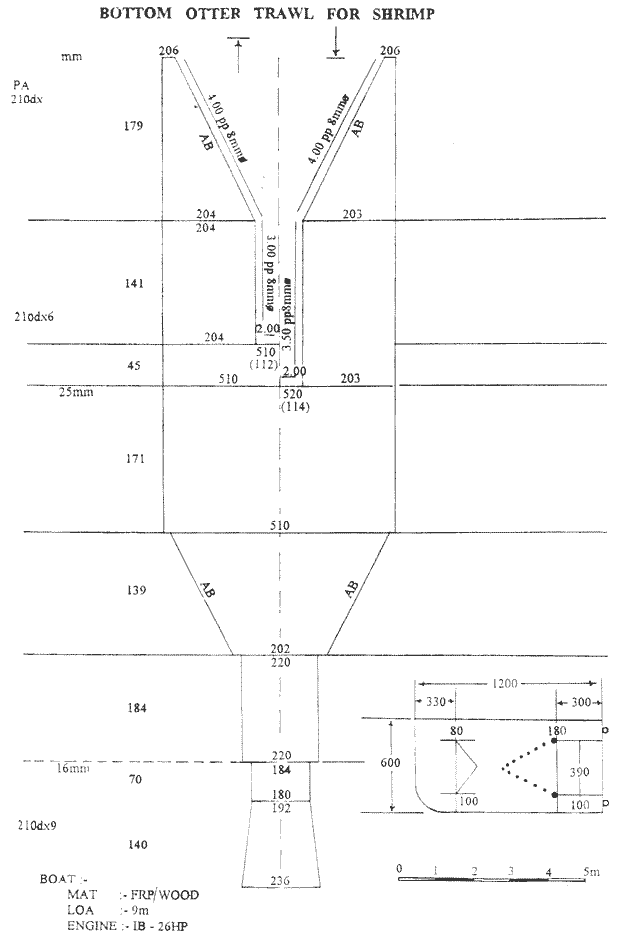
Trawler streaming its gear in the Northern Prawn Fishery Prawn trawler in the Northern Prawn Fishery.
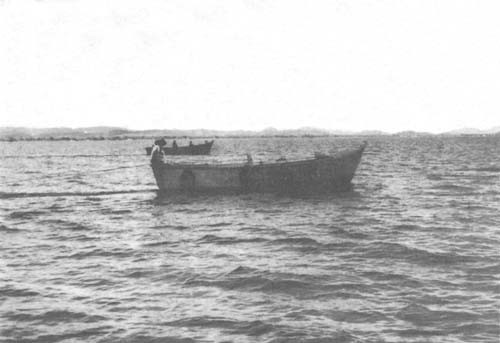
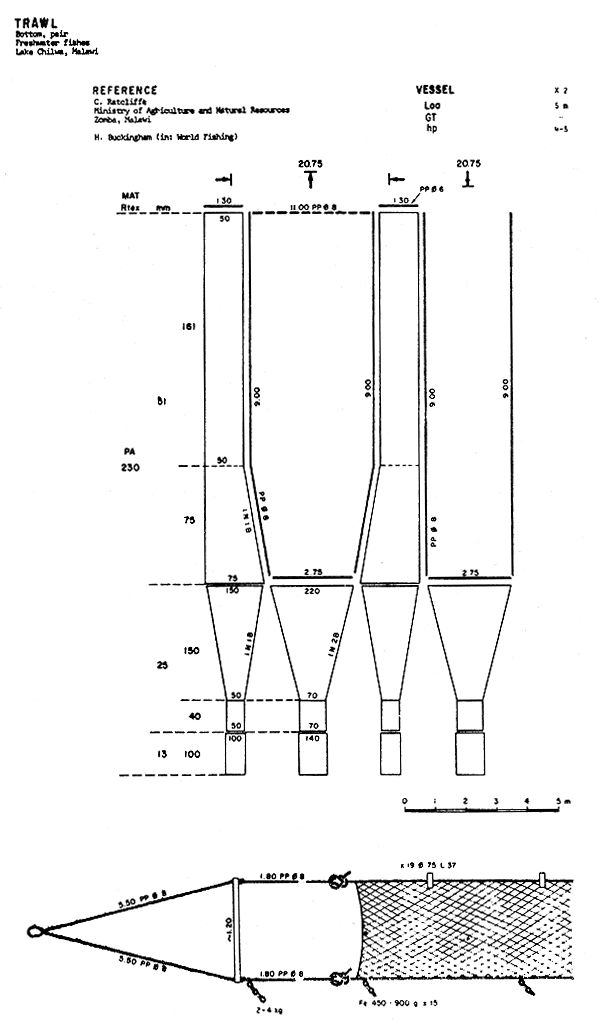
Boats equipped with 20 hp inboard engine towing a pair
trawl (Lake Malawi)
56
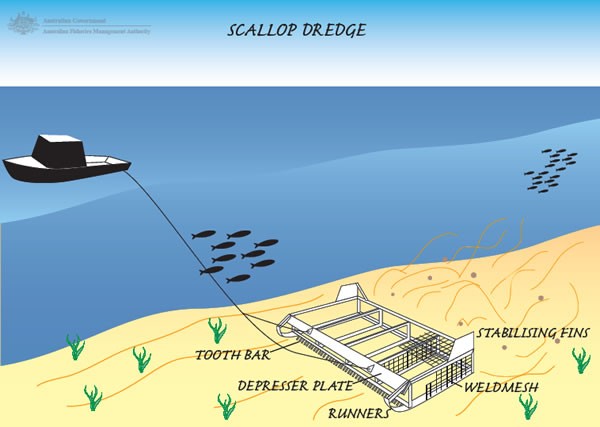
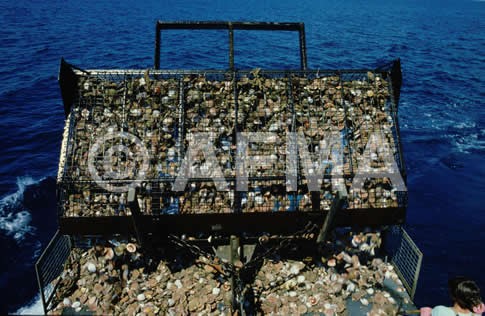
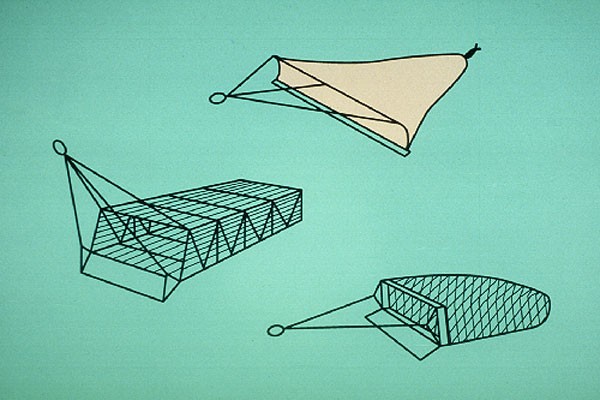
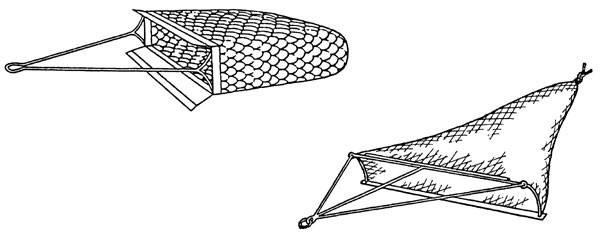
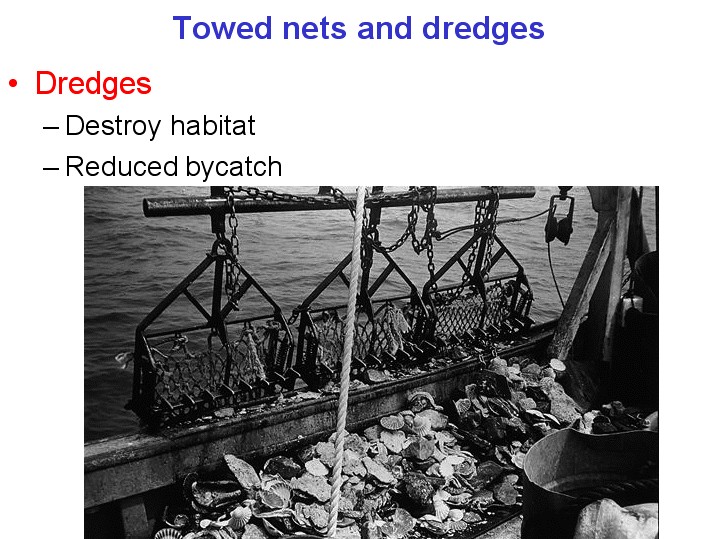
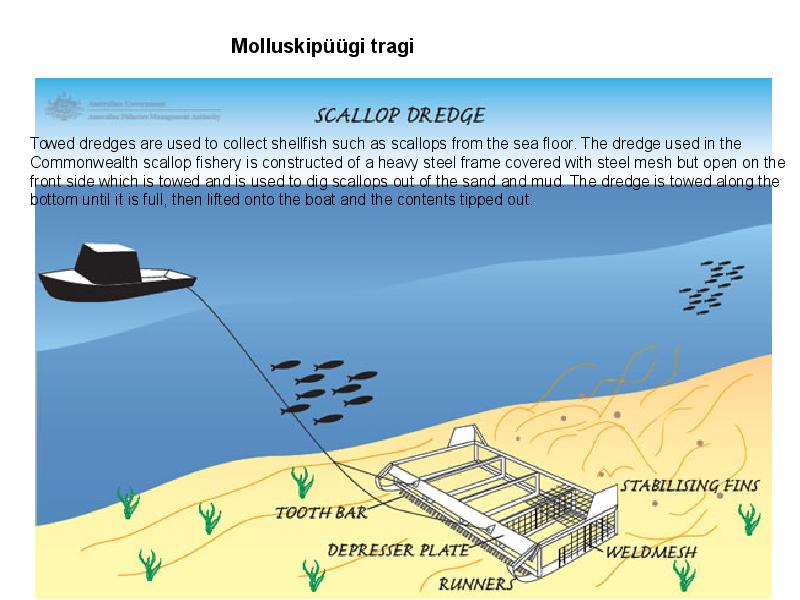
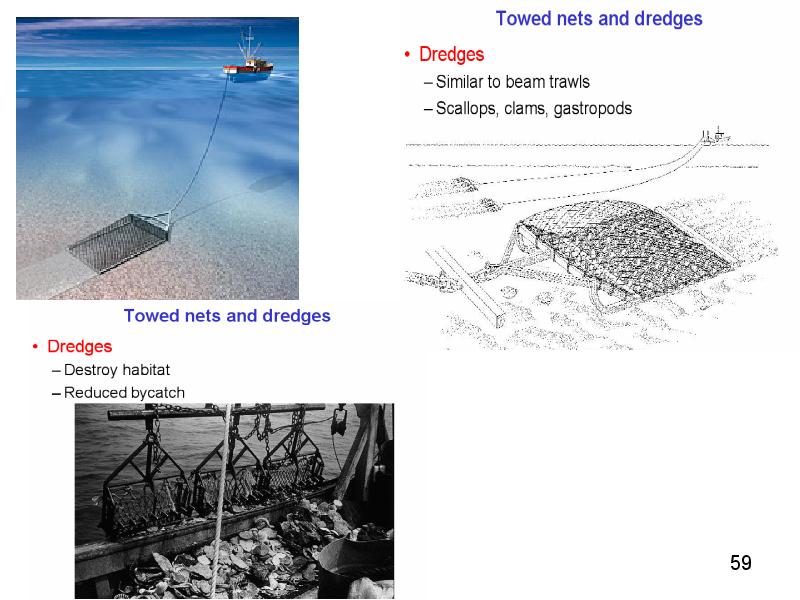
Molluskipüügi tragi
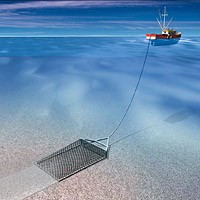
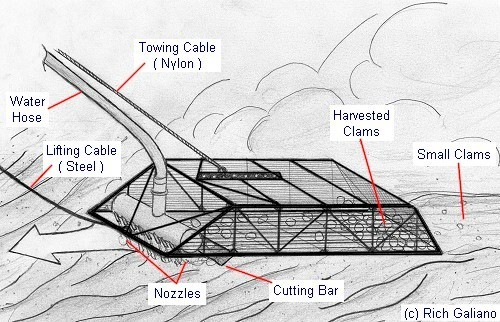
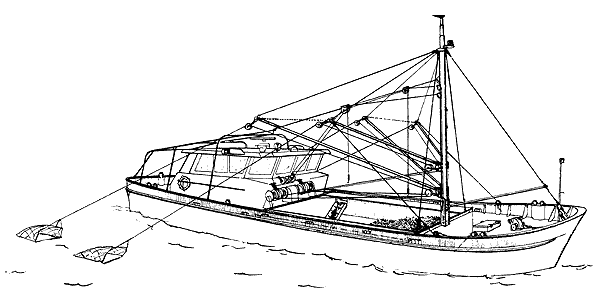
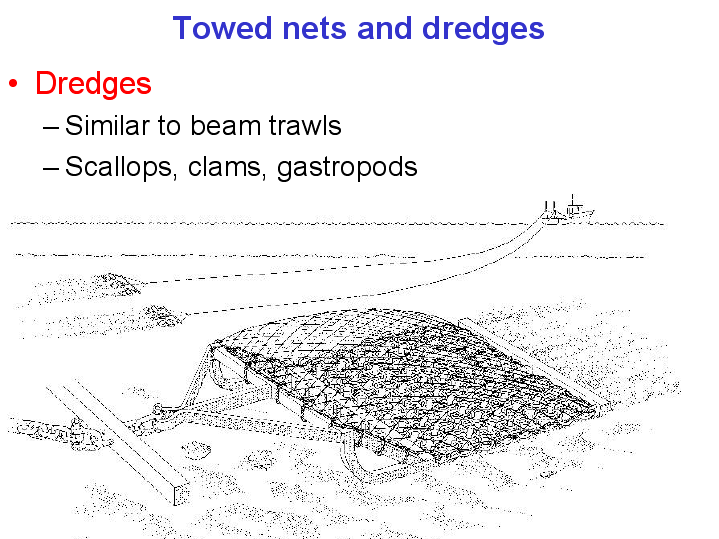
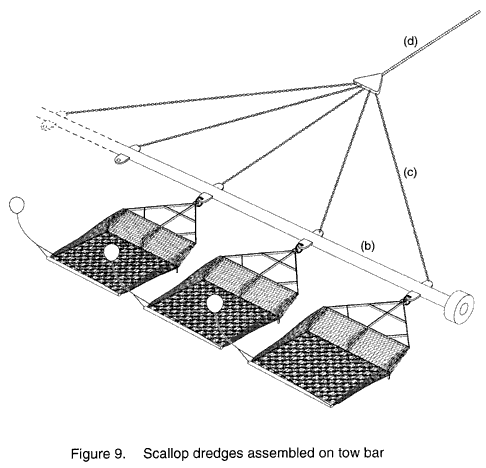
Towed dredges are used to collect shellfish such as scallops from the sea floor. The dredge used in the
Commonwealth scallop fishery is constructed of a heavy steel frame covered with steel mesh but open on the
front side which is towed and is used to dig scallops out of the sand and mud. The dredge is towed along the
bottom until it is full, then lifted onto the boat and the contents tipped out.
57
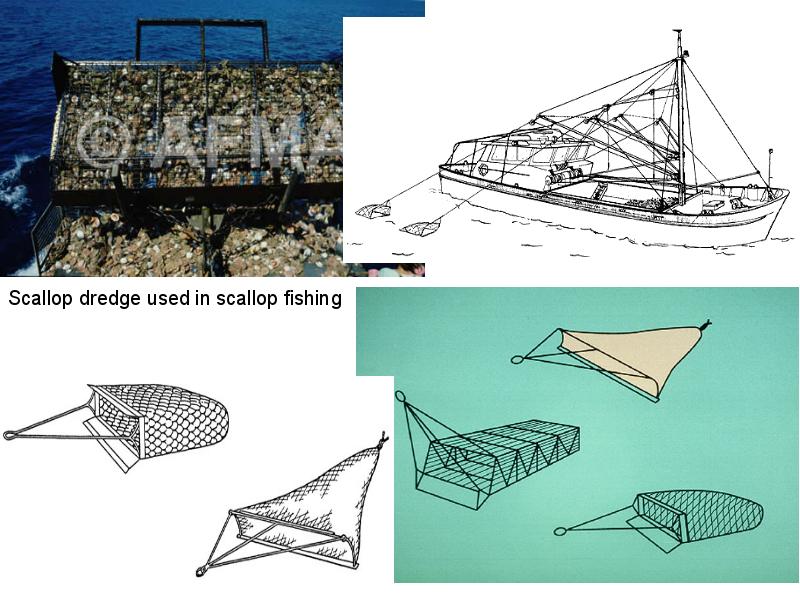
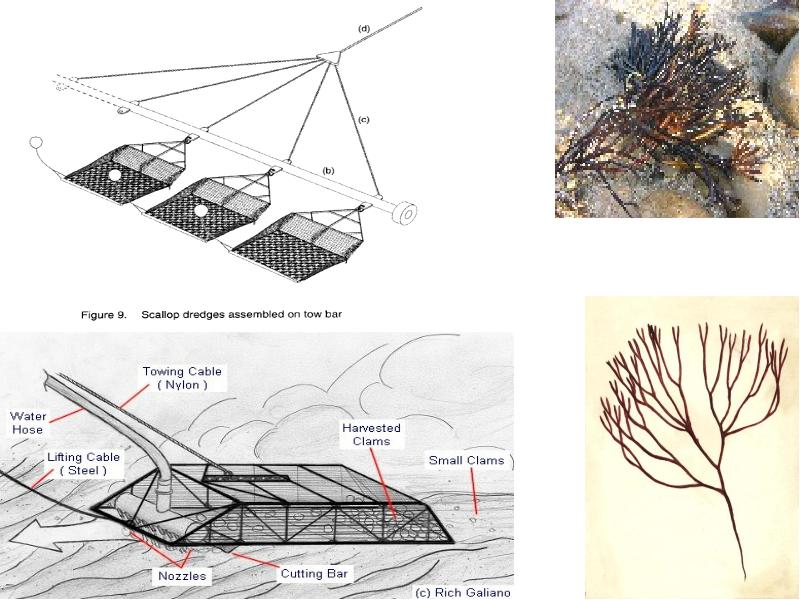
Scallop dredge used in scallop fishing
58
59
60
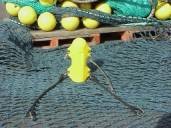
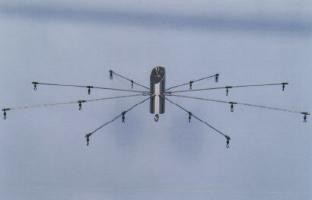
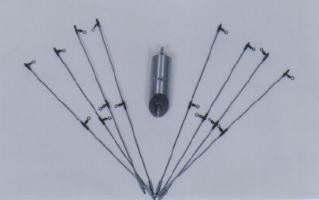
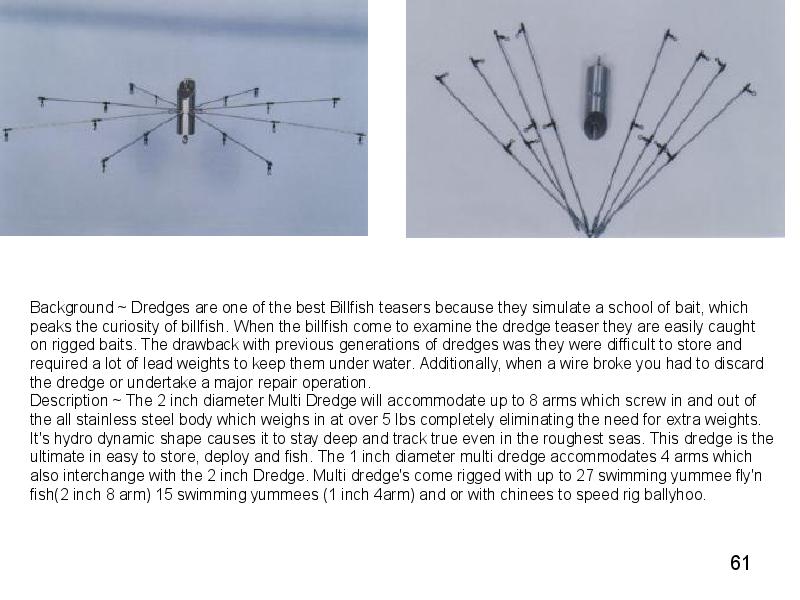
Background ~ Dredges are one of the best Billfish teasers because they simulate a school of bait, which
peaks the curiosity of billfish. When the billfish come to examine the dredge teaser they are easily caught
on rigged baits. The drawback with previous generations of dredges was they were difficult to store and
required a lot of lead weights to keep them under water. Additionally, when a wire broke you had to discard
the dredge or undertake a major repair operation.
Description ~ The 2 inch diameter Multi Dredge will accommodate up to 8 arms which screw in and out of
the all stainless steel body which weighs in at over 5 lbs completely eliminating the need for extra weights.
It's hydro dynamic shape causes it to stay deep and track true even in the roughest seas. This dredge is the
ultimate in easy to store, deploy and fish. The 1 inch diameter multi dredge accommodates 4 arms which
also interchange with the 2 inch Dredge. Multi dredge's come rigged with up to 27 swimming yummee fly'n
fish(2 inch 8 arm) 15 swimming yummees (1 inch 4arm) and or with chinees to speed rig ballyhoo.
61
62
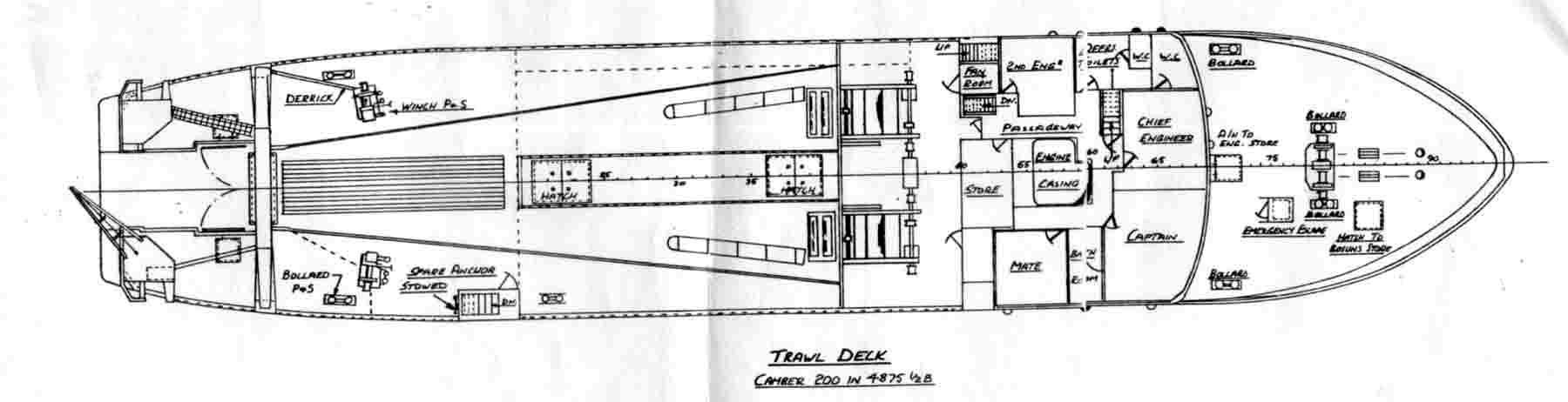
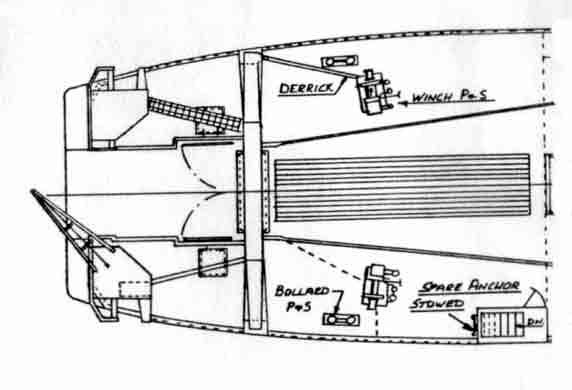
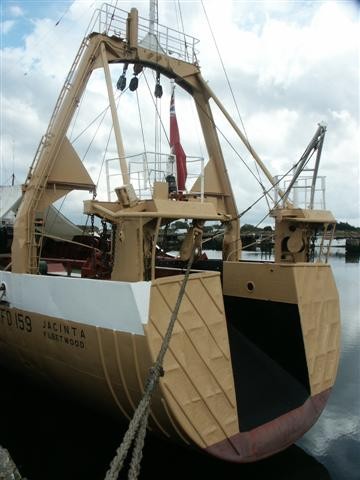
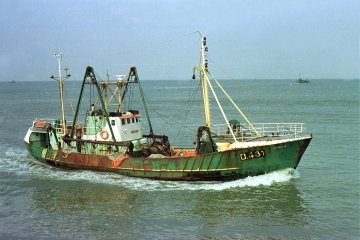
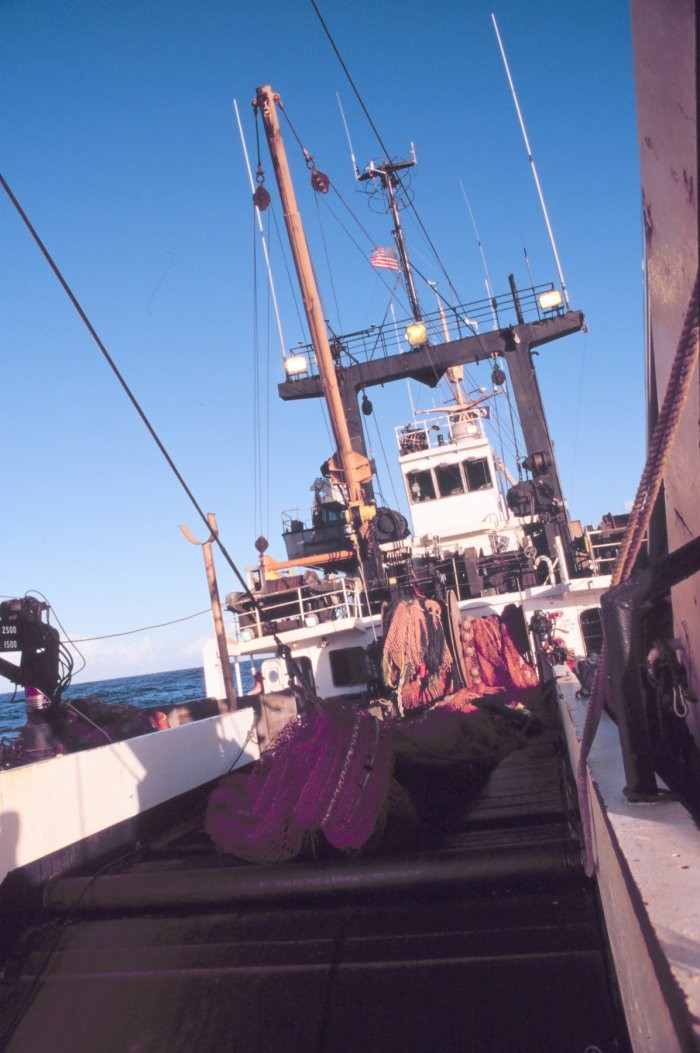
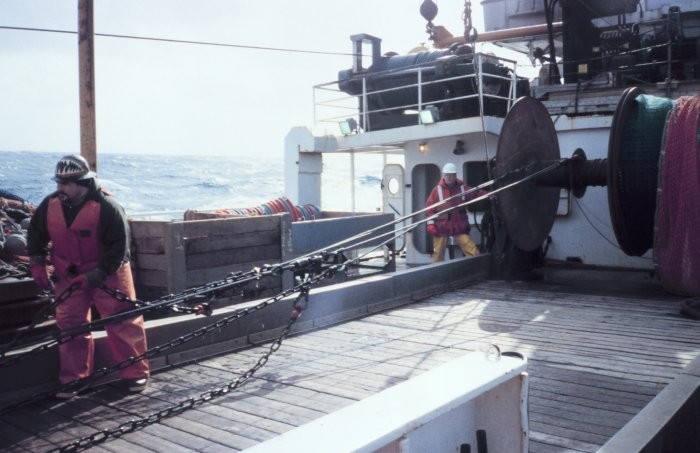
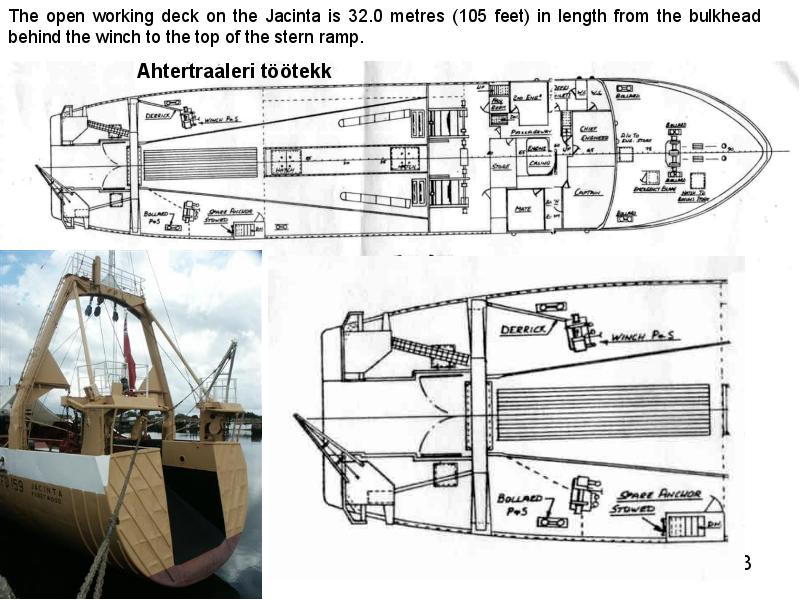
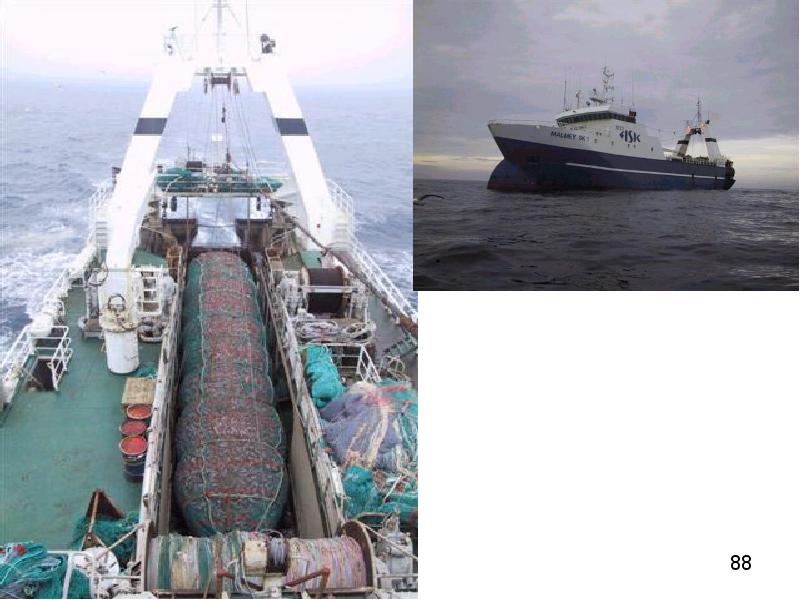
The open working deck on the Jacinta is 32.0 metres (105 feet) in length from the bulkhead
behind the winch to the top of the stern ramp.
Ahtertraaleri töötekk
63
64
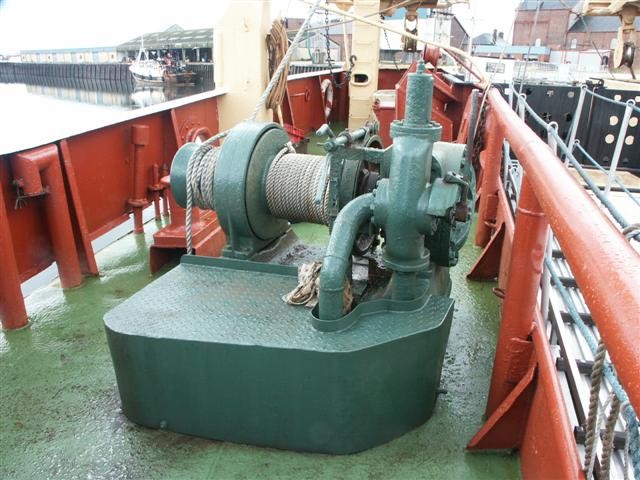
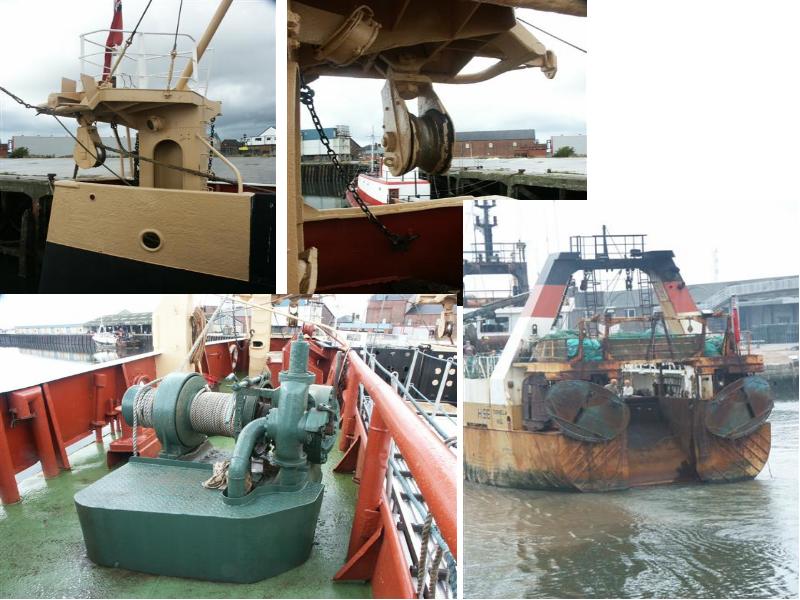
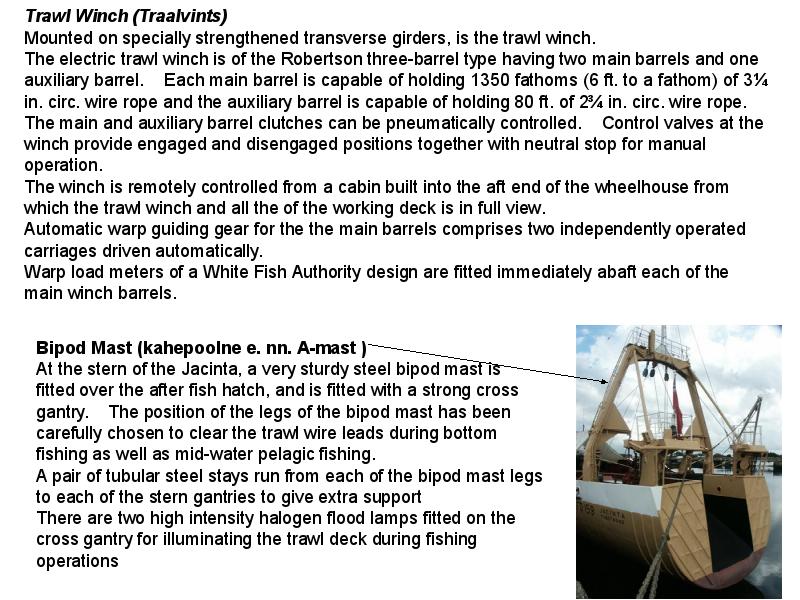
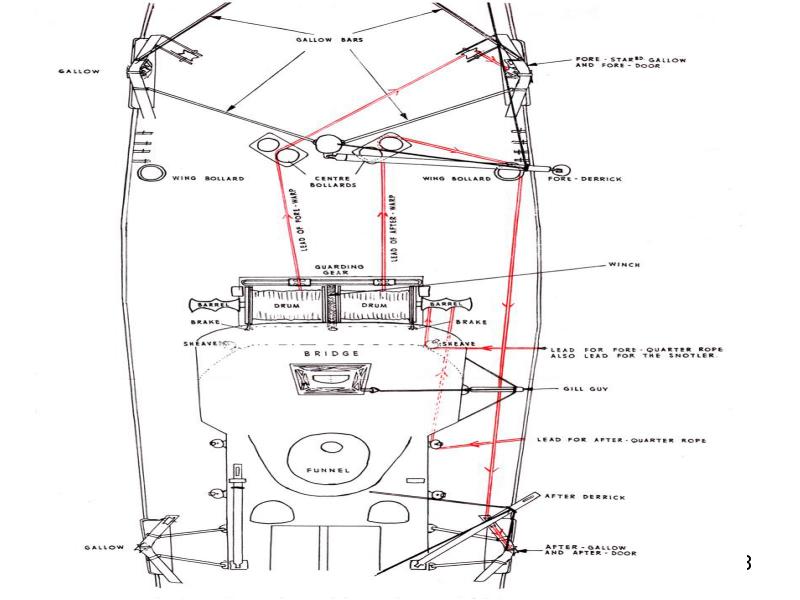
Trawl Winch (Traalvints)
Mounted on specially strengthened transverse girders, is the trawl winch.
The electric trawl winch is of the Robertson three-barrel type having two main barrels and one
auxiliary barrel. Each main barrel is capable of holding 1350 fathoms (6 ft. to a fathom) of 3¼
in. circ. wire rope and the auxiliary barrel is capable of holding 80 ft. of 2¾ in. circ. wire rope.
The main and auxiliary barrel clutches can be pneumatically controlled. Control valves at the
winch provide engaged and disengaged positions together with neutral stop for manual
operation.
The winch is remotely controlled from a cabin built into the aft end of the wheelhouse from
which the trawl winch and all the of the working deck is in full view.
Automatic warp guiding gear for the the main barrels comprises two independently operated
carriages driven automatically.
Warp load meters of a White Fish Authority design are fitted immediately abaft each of the
main winch barrels.
Bipod Mast (kahepoolne e. nn. A-mast )
At the stern of the Jacinta, a very sturdy steel bipod mast is
fitted over the after fish hatch, and is fitted with a strong cross
gantry. The position of the legs of the bipod mast has been
carefully chosen to clear the trawl wire leads during bottom
fishing as well as mid-water pelagic fishing.
A pair of tubular steel stays run from each of the bipod mast
legs to each of the stern gantries to give extra support
There are two high intensity halogen flood lamps fitted on the
cross gantry for illuminating the trawl deck during fishing
operations 65
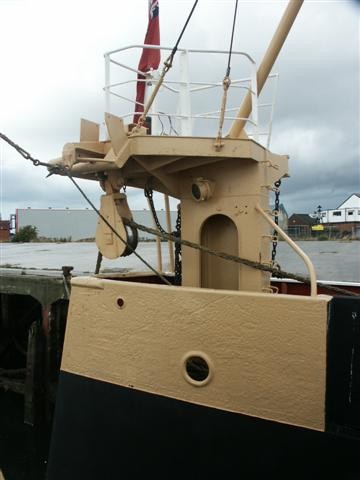
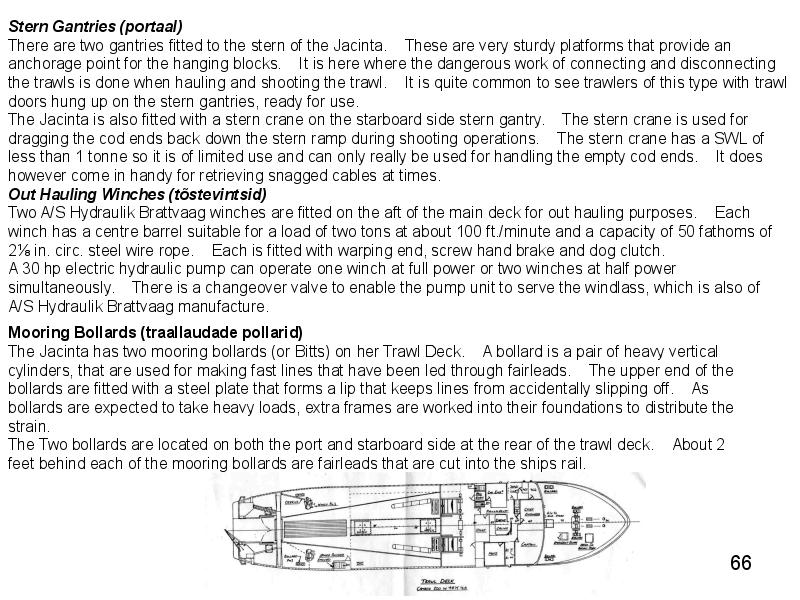
Stern Gantries (portaal)
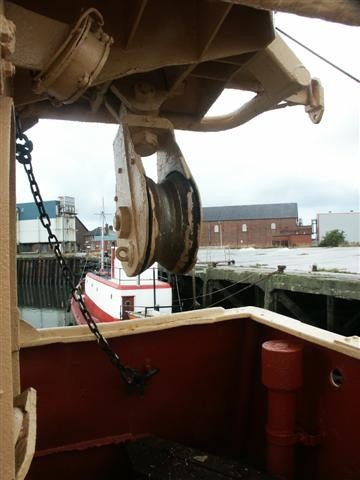
There are two gantries fitted to the stern of the Jacinta. These are very sturdy platforms that provide an
anchorage point for the hanging blocks. It is here where the dangerous work of connecting and disconnecting
the trawls is done when hauling and shooting the trawl. It is quite common to see trawlers of this type with trawl
doors hung up on the stern gantries, ready for use.
The Jacinta is also fitted with a stern crane on the starboard side stern gantry. The stern crane is used for
dragging the cod ends back down the stern ramp during shooting operations. The stern crane has a SWL of
less than 1 tonne so it is of limited use and can only really be used for handling the empty cod ends. It does
however come in handy for retrieving snagged cables at times.
Out Hauling Winches (tõstevintsid)
Two A/S Hydraulik Brattvaag winches are fitted on the aft of the main deck for out hauling purposes. Each
winch has a centre barrel suitable for a load of two tons at about 100 ft./minute and a capacity of 50 fathoms of
2 in. circ. steel wire rope. Each is fitted with warping end, screw hand brake and dog clutch.
A 30 hp electric hydraulic pump can operate one winch at full power or two winches at half power
simultaneously. There is a changeover valve to enable the pump unit to serve the windlass, which is also of
A/S Hydraulik Brattvaag manufacture.
Mooring Bollards (traallaudade pollarid)
The Jacinta has two mooring bollards (or Bitts) on her Trawl Deck. A bollard is a pair of heavy vertical
cylinders, that are used for making fast lines that have been led through fairleads. The upper end of the
bollards are fitted with a steel plate that forms a lip that keeps lines from accidentally slipping off. As
bollards are expected to take heavy loads, extra frames are worked into their foundations to distribute the
strain.
The Two bollards are located on both the port and starboard side at the rear of the trawl deck. About 2
feet behind each of the mooring bollards are fairleads that are cut into the ships rail.
66
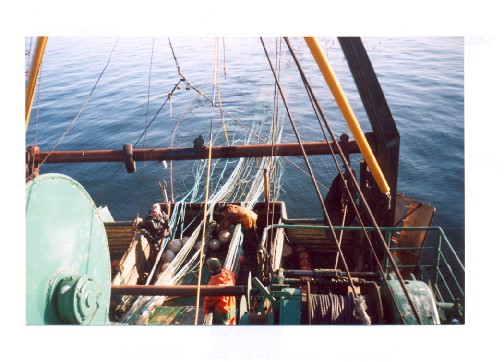
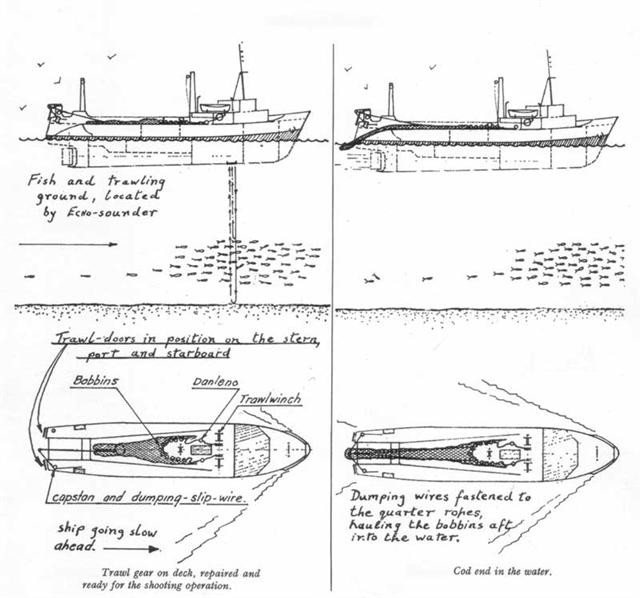
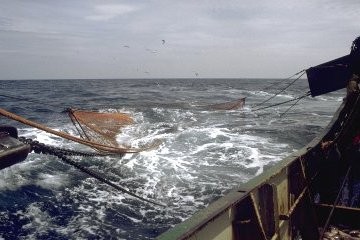
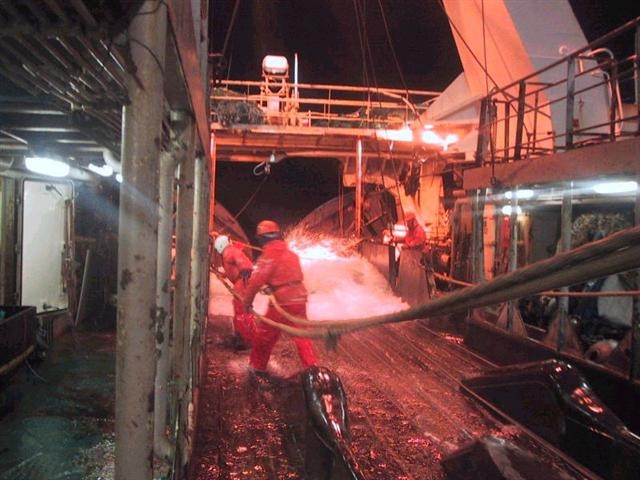
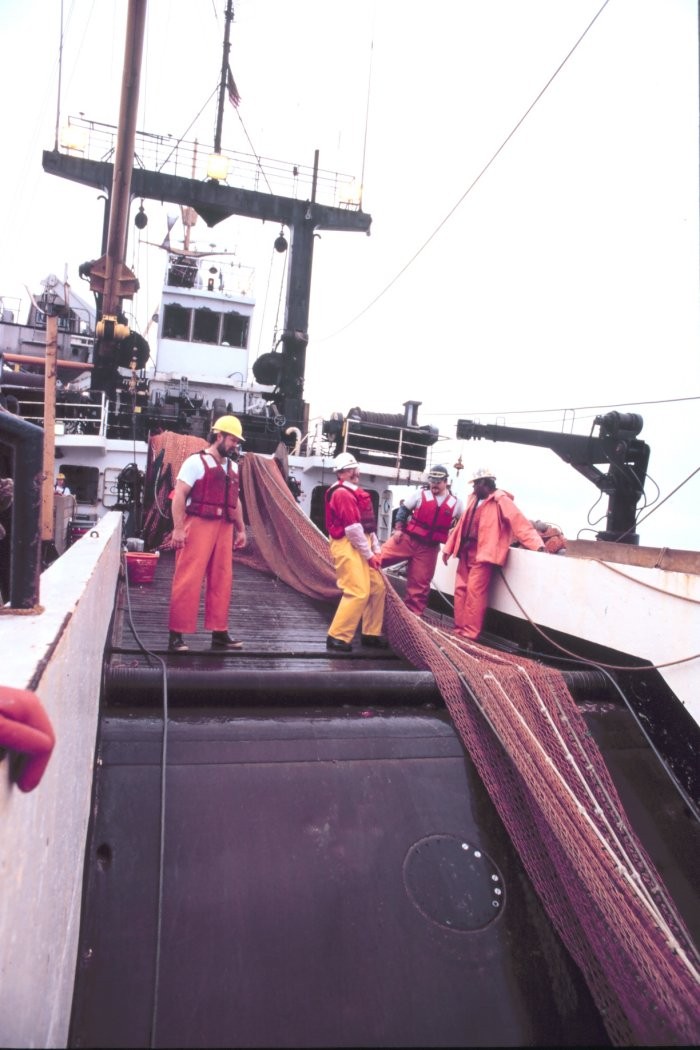
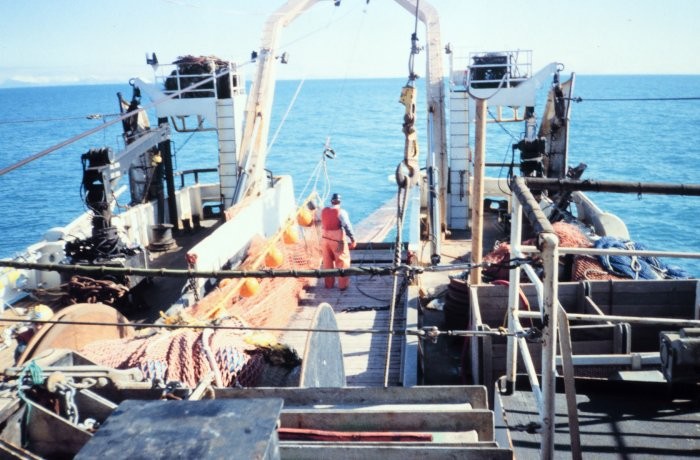
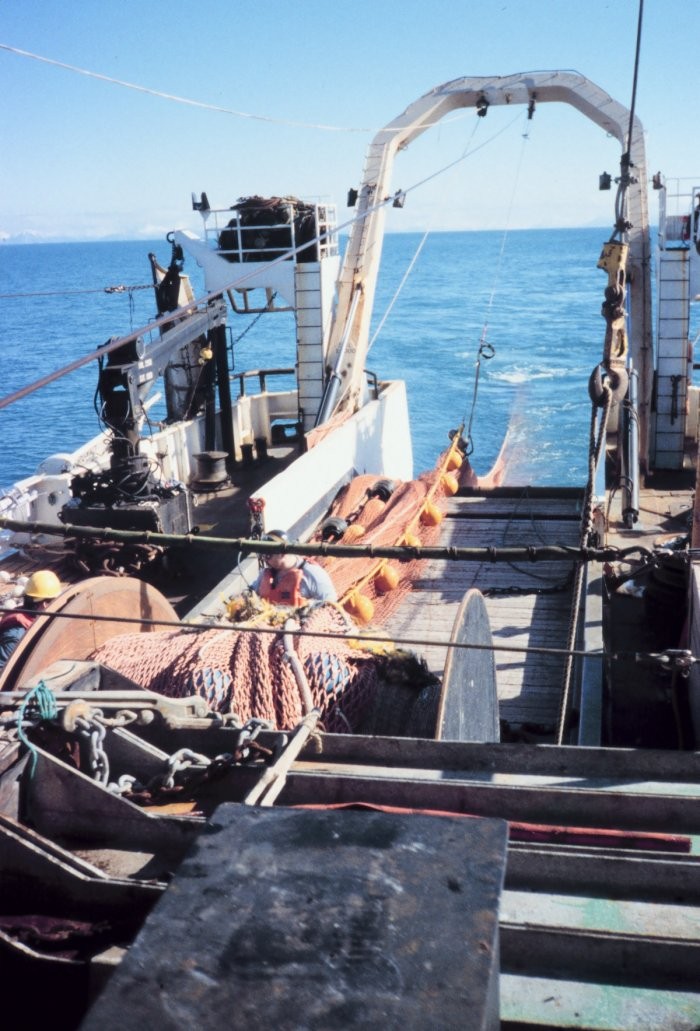
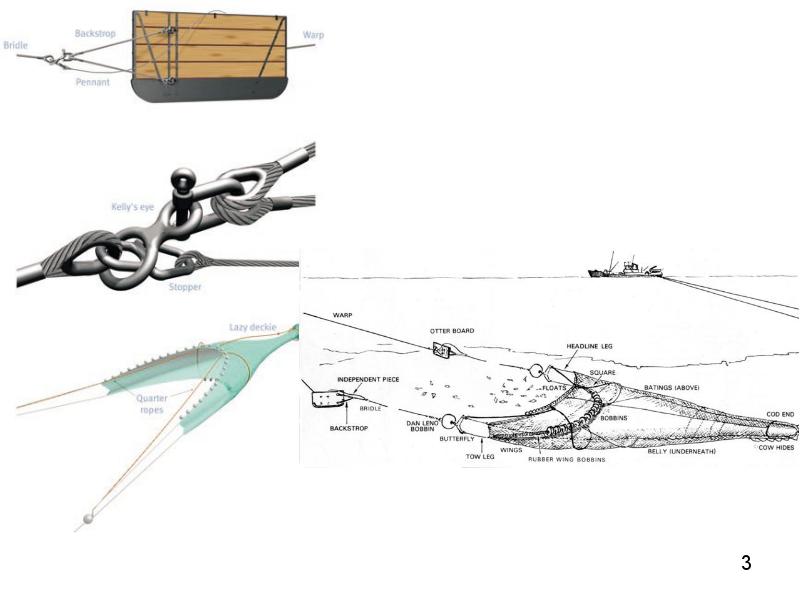
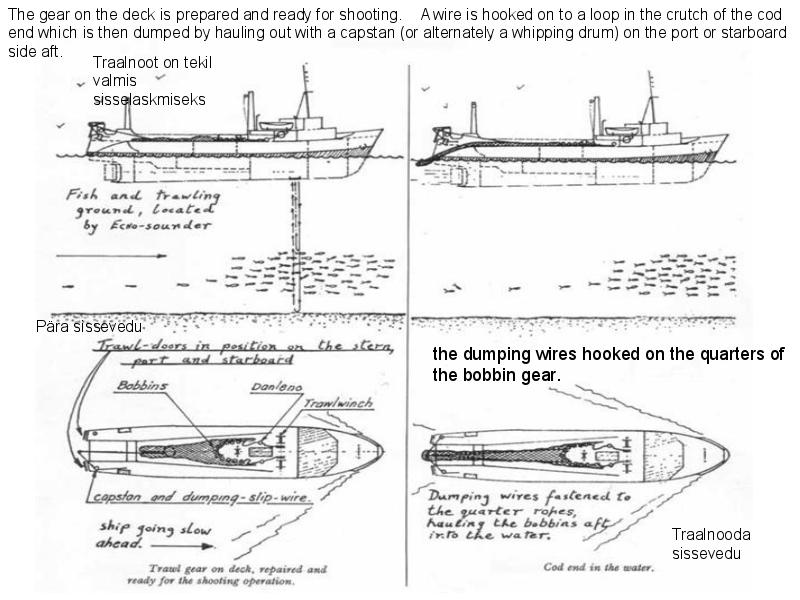
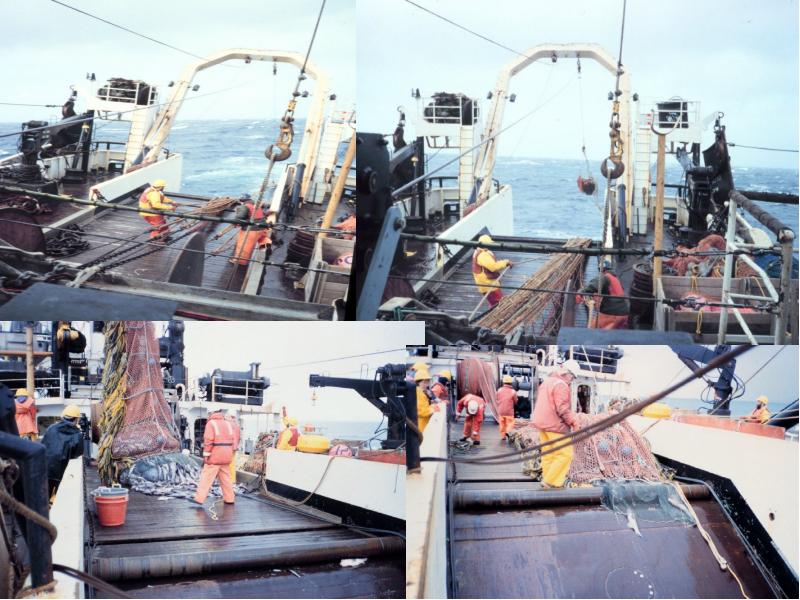
The gear on the deck is prepared and ready for shooting. A wire is hooked on to a loop in the crutch of the cod
end which is then dumped by hauling out with a capstan (or alternately a whipping drum) on the port or starboard
side aft.
Traalnoot on tekil
valmis
sisselaskmiseks
Pära sissevedu
the dumping wires hooked on the quarters of
the bobbin gear.
Traalnooda
sissevedu
67
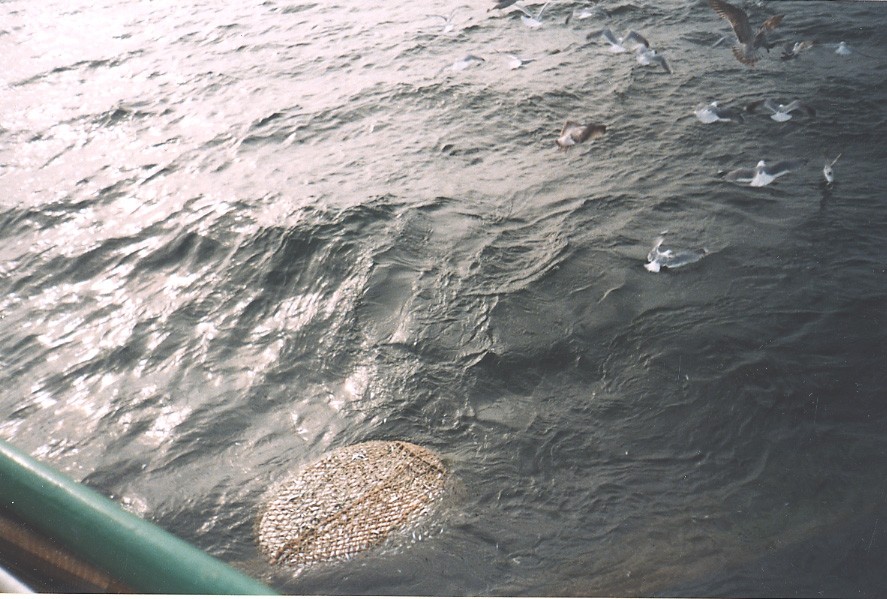
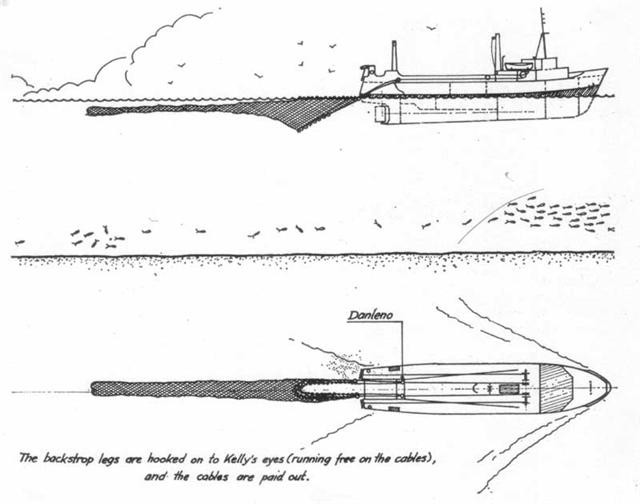
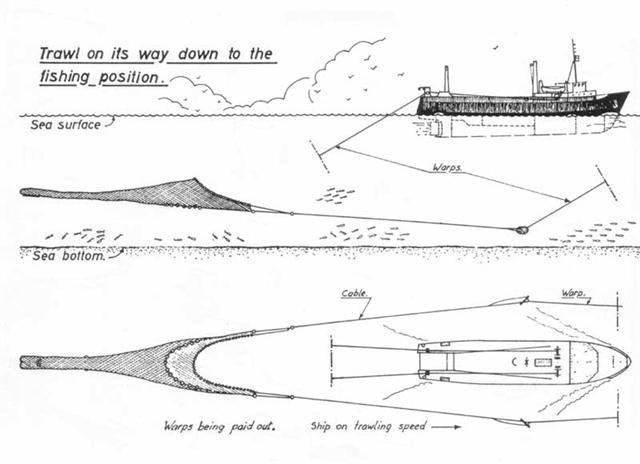
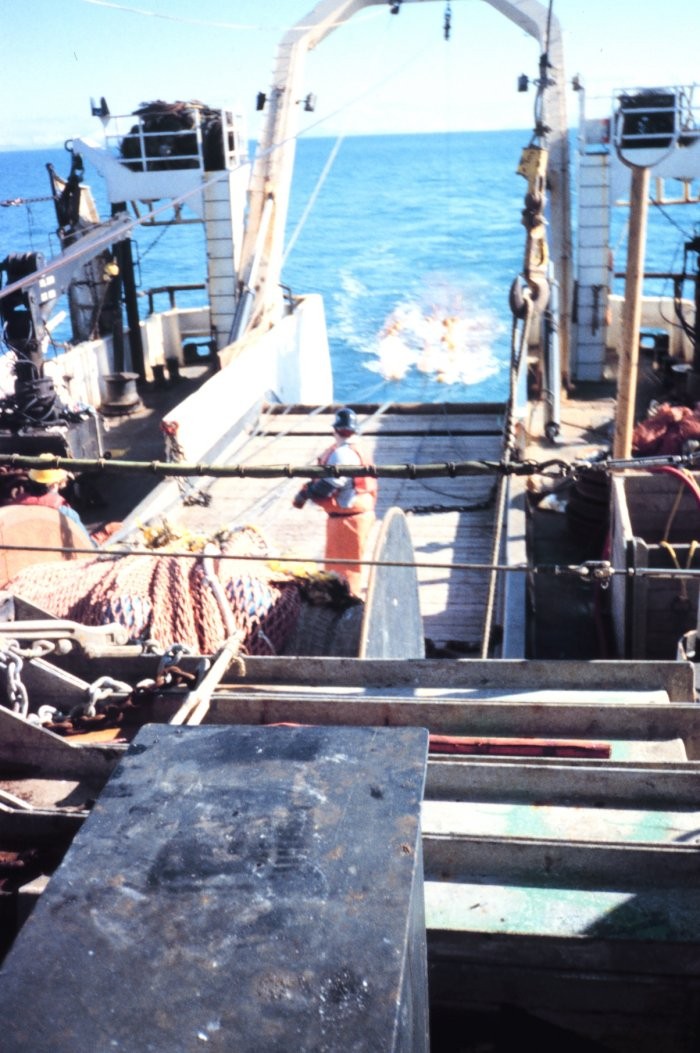
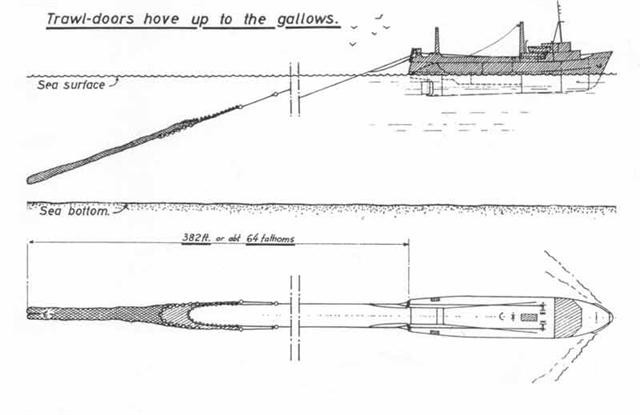
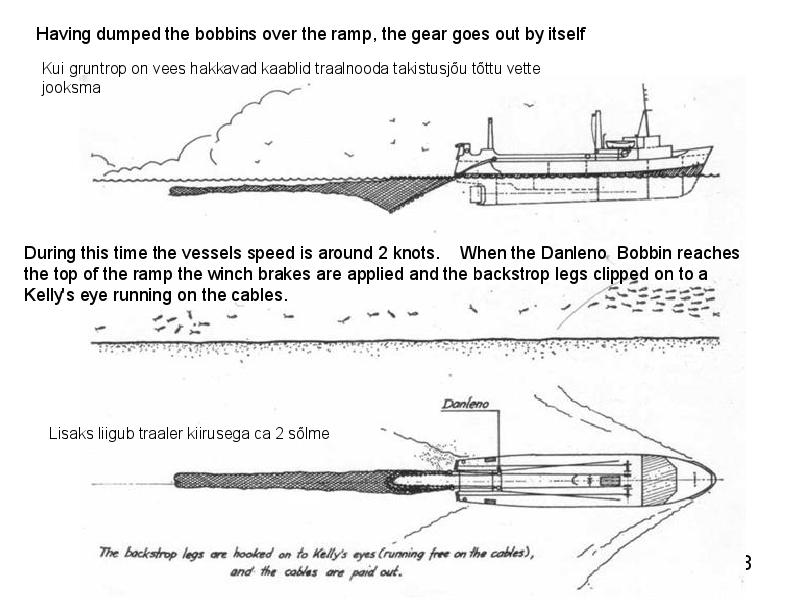
Having dumped the bobbins over the ramp, the gear goes out by itself
Kui gruntrop on vees hakkavad kaablid traalnooda takistusjõu tõttu vette
jooksma
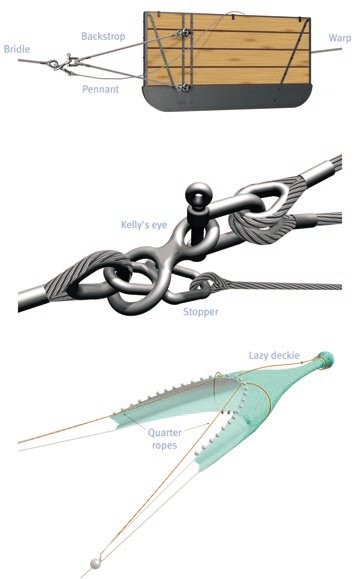
During this time the vessels speed is around 2 knots. When the Danleno Bobbin reaches
the top of the ramp the winch brakes are applied and the backstrop legs clipped on to a
Kelly's eye running on the cables.
Lisaks liigub traaler kiirusega ca 2 sõlme
68
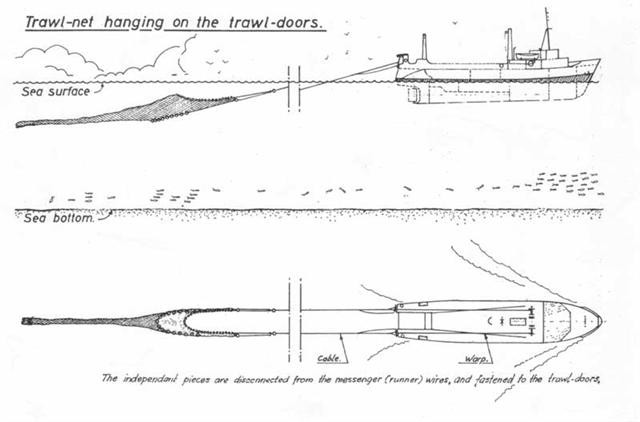
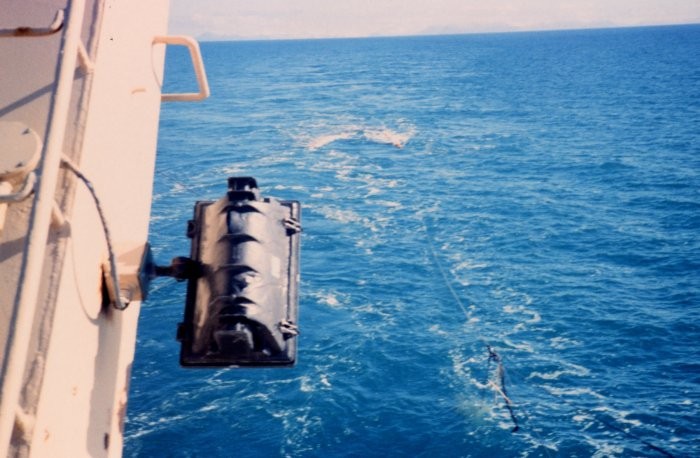
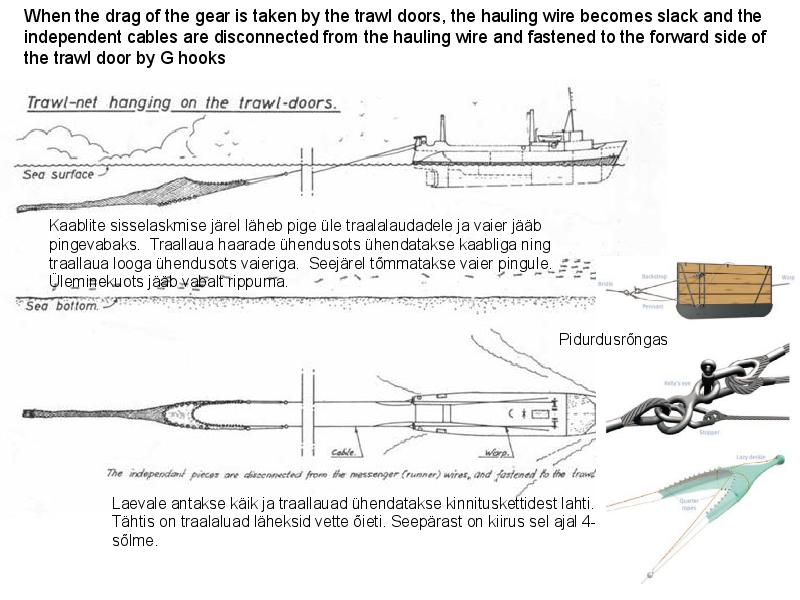
When the drag of the gear is taken by the trawl doors, the hauling wire becomes slack and the
independent cables are disconnected from the hauling wire and fastened to the forward side of
the trawl door by G hooks
Kaablite sisselaskmise järel läheb pige üle traalalaudadele ja vaier jääb
pingevabaks. Traallaua haarade ühendusots ühendatakse kaabliga ning
traallaua looga ühendusots vaieriga. Seejärel tõmmatakse vaier pingule.
Üleminekuots jääb vabalt rippuma.
Pidurdusrõngas
Laevale antakse käik ja traallauad ühendatakse kinnituskettidest lahti.
Tähtis on traalaluad läheksid vette õieti. Seepärast on kiirus sel ajal 4-6
sõlme.
69
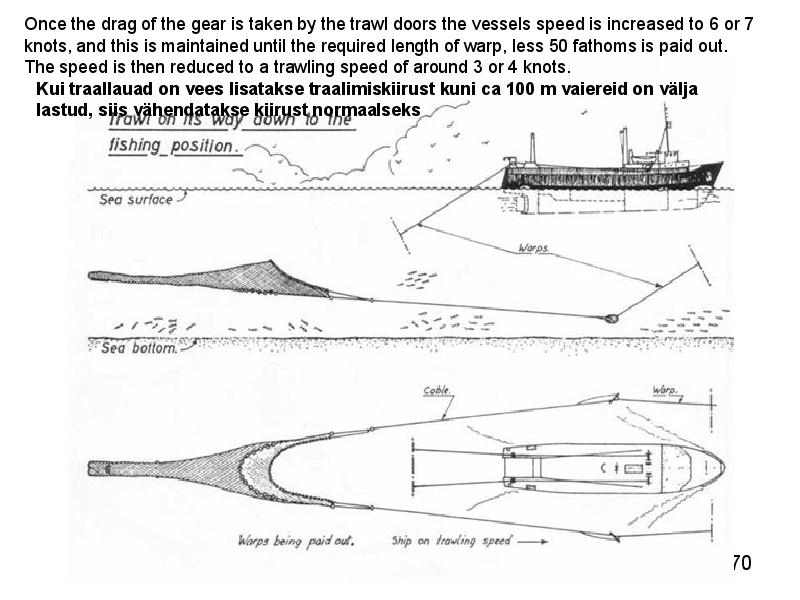
Once the drag of the gear is taken by the trawl doors the vessels speed is increased to 6 or 7
knots, and this is maintained until the required length of warp, less 50 fathoms is paid out.
The speed is then reduced to a trawling speed of around 3 or 4 knots.
Kui traallauad on vees lisatakse traalimiskiirust kuni ca 100 m vaiereid on välja
lastud, siis vähendatakse kiirust normaalseks
70
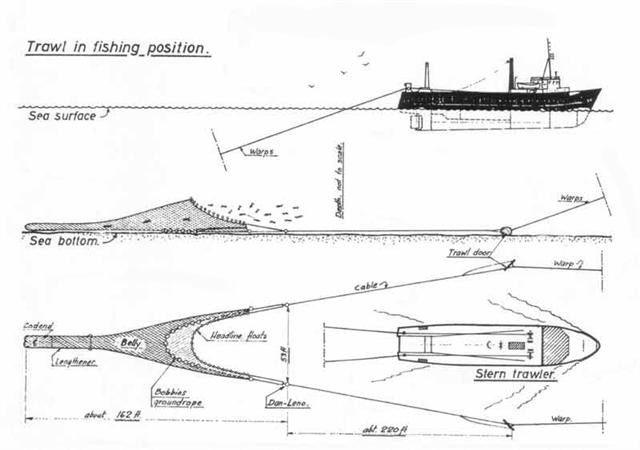
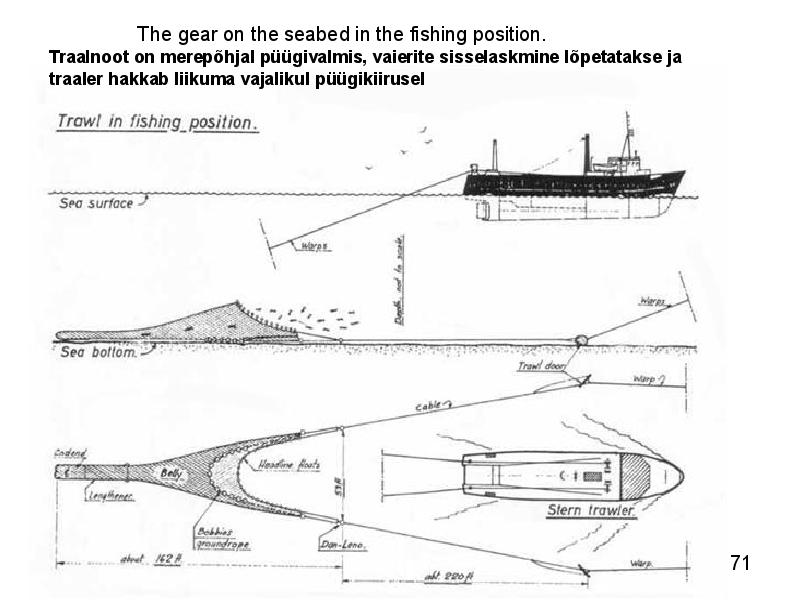
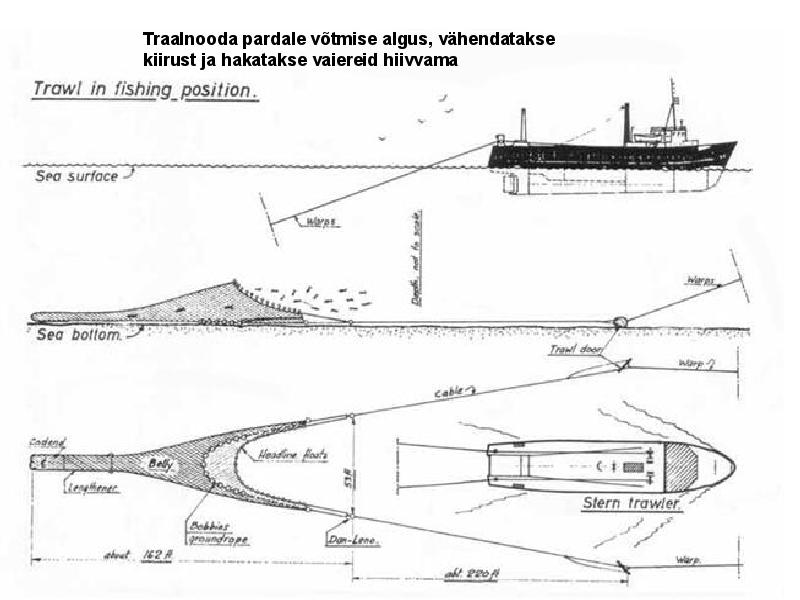
The gear on the seabed in the fishing position.
Traalnoot on merepõhjal püügivalmis, vaierite sisselaskmine lõpetatakse ja
traaler hakkab liikuma vajalikul püügikiirusel
71
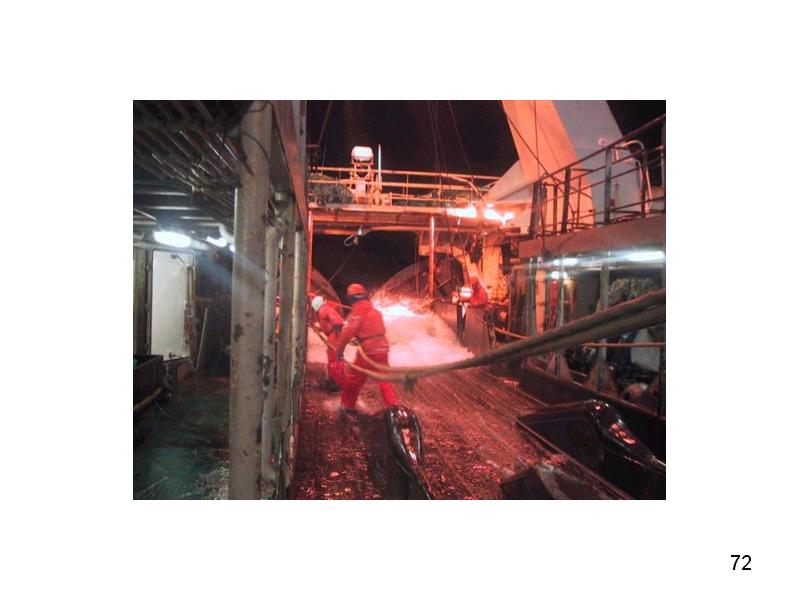
72
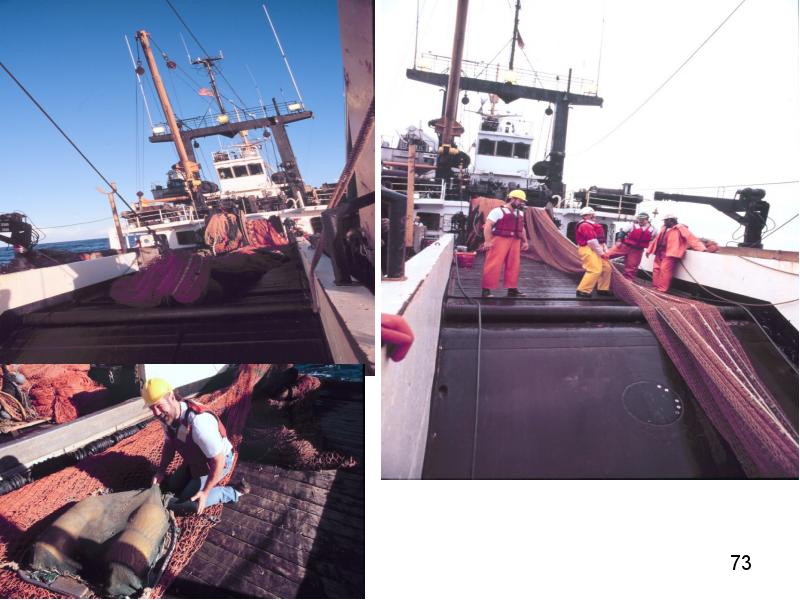
73
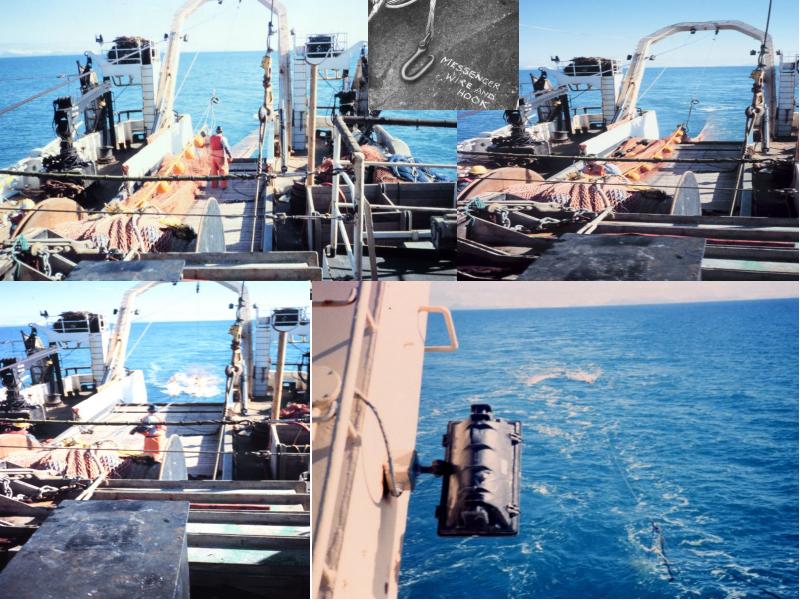
74
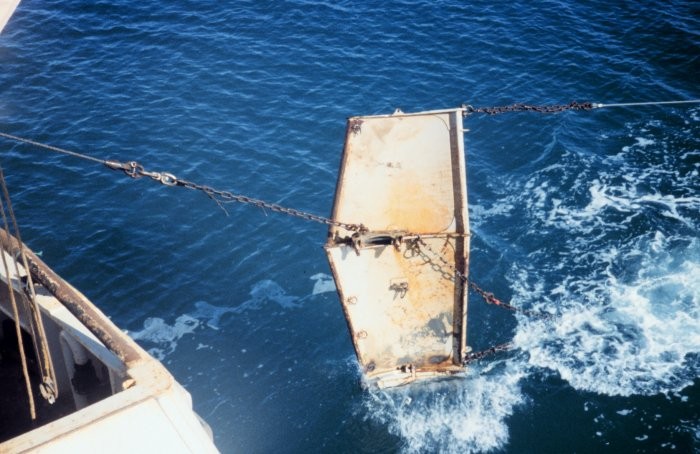
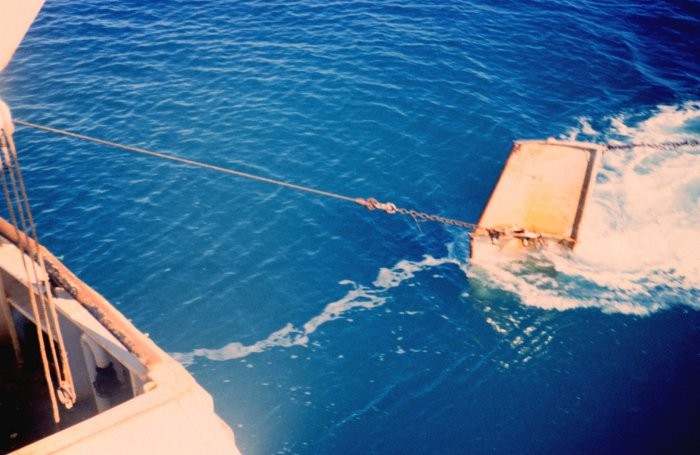
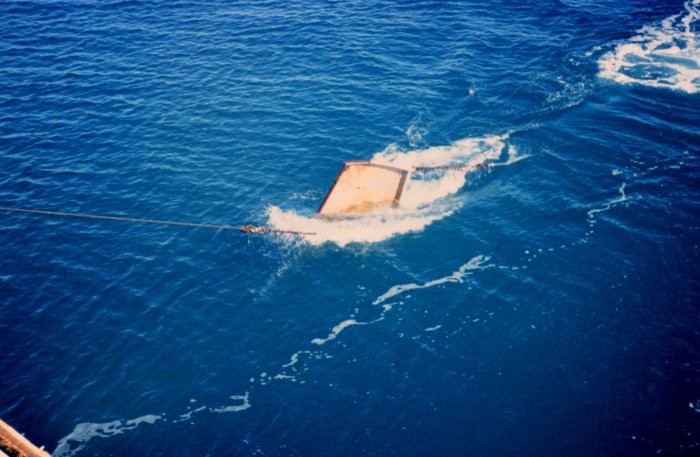
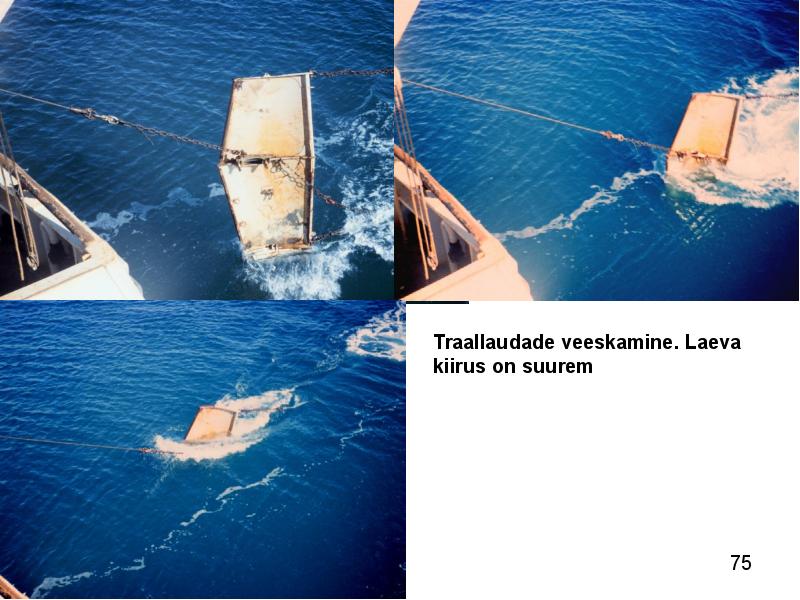
Traallaudade veeskamine. Laeva
kiirus on suurem
75
76
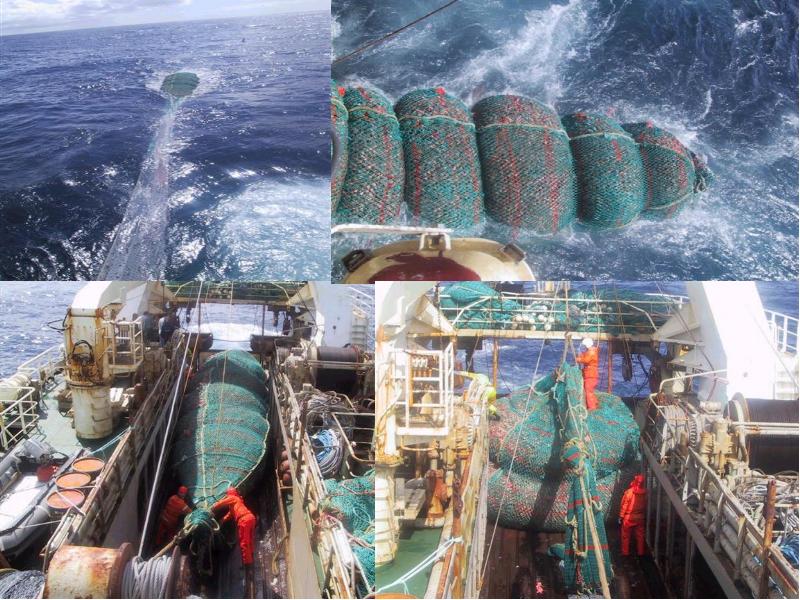
Traalnooda pardale võtmise algus, vähendatakse
kiirust ja hakatakse vaiereid hiivvama
77
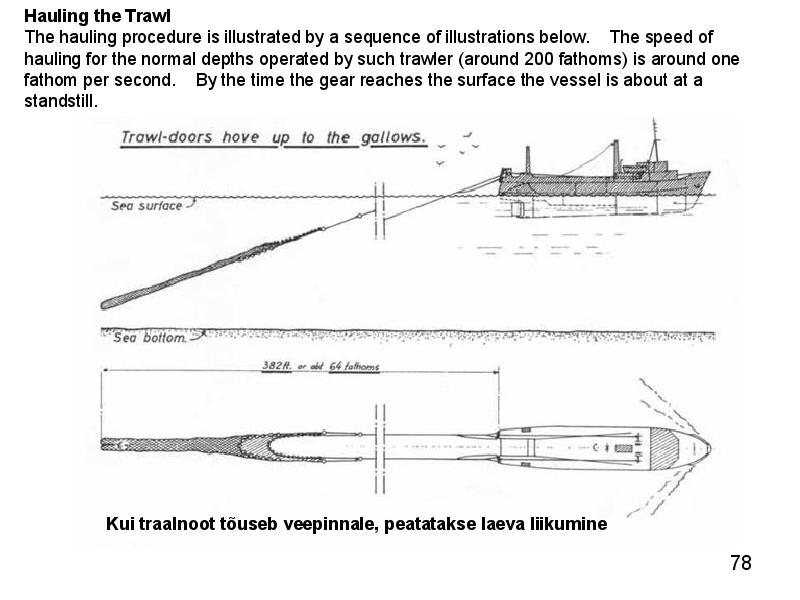
Hauling the Trawl
The hauling procedure is illustrated by a sequence of illustrations below. The speed of
hauling for the normal depths operated by such trawler (around 200 fathoms) is around one
fathom per second. By the time the gear reaches the surface the vessel is about at a
standstill.
Kui traalnoot tõuseb veepinnale, peatatakse laeva liikumine
78
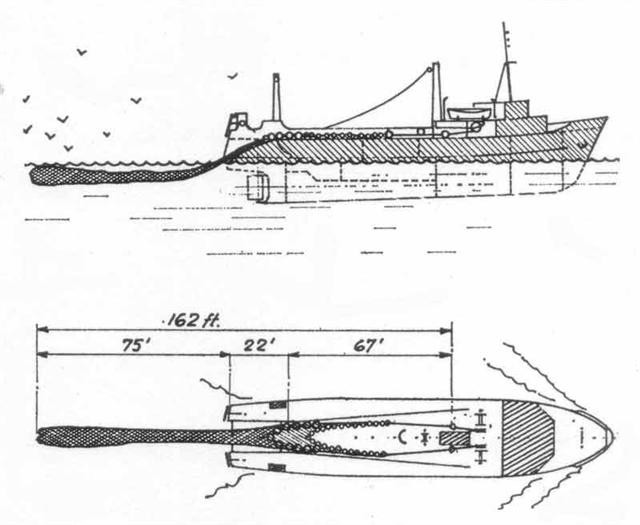
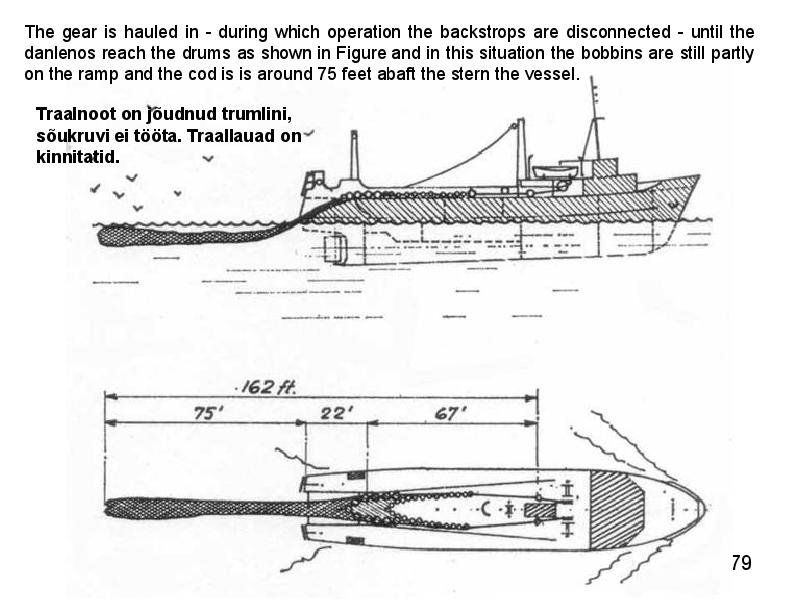
The gear is hauled in - during which operation the backstrops are disconnected - until the
danlenos reach the drums as shown in Figure and in this situation the bobbins are still partly
on the ramp and the cod is is around 75 feet abaft the stern the vessel.
Traalnoot on jõudnud trumlini,
sõukruvi ei tööta. Traallauad on
kinnitatid.
79
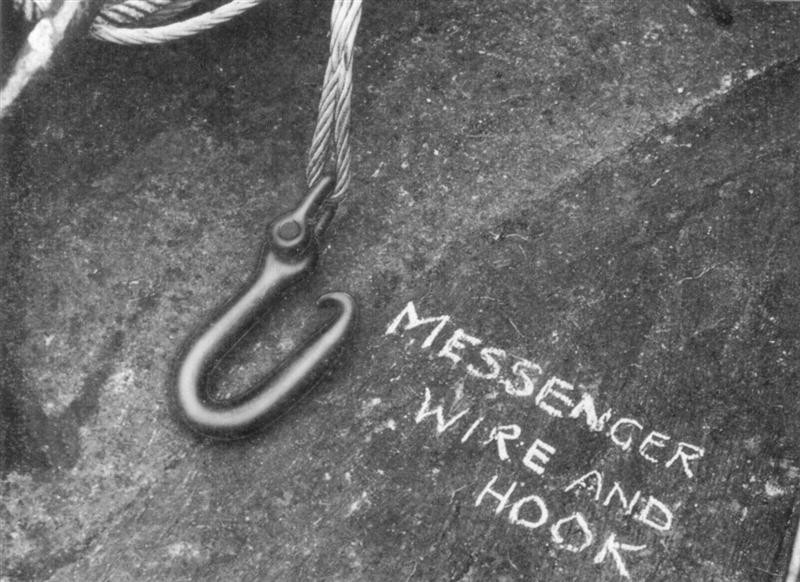
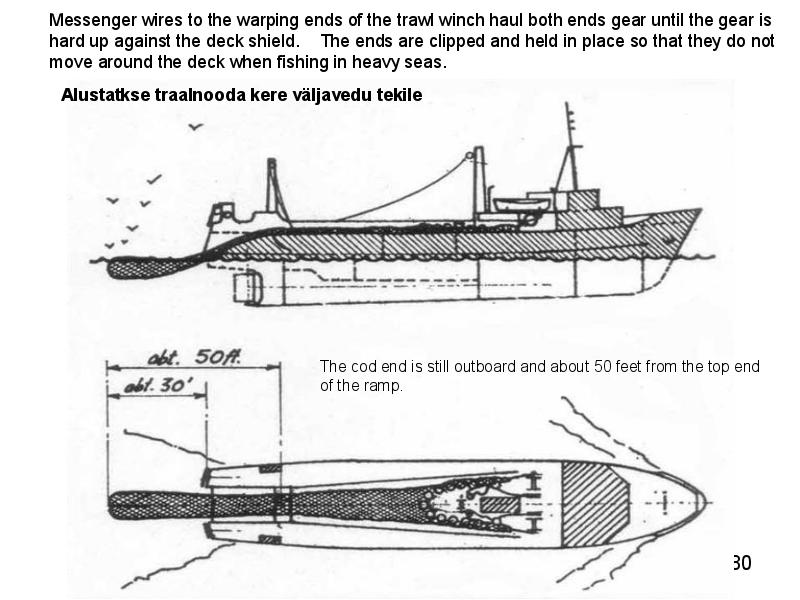
Messenger wires to the warping ends of the trawl winch haul both ends gear until the gear is
hard up against the deck shield. The ends are clipped and held in place so that they do not
move around the deck when fishing in heavy seas.
Alustatkse traalnooda kere väljavedu tekile
The cod end is still outboard and about 50 feet from the top end
of the ramp.
80
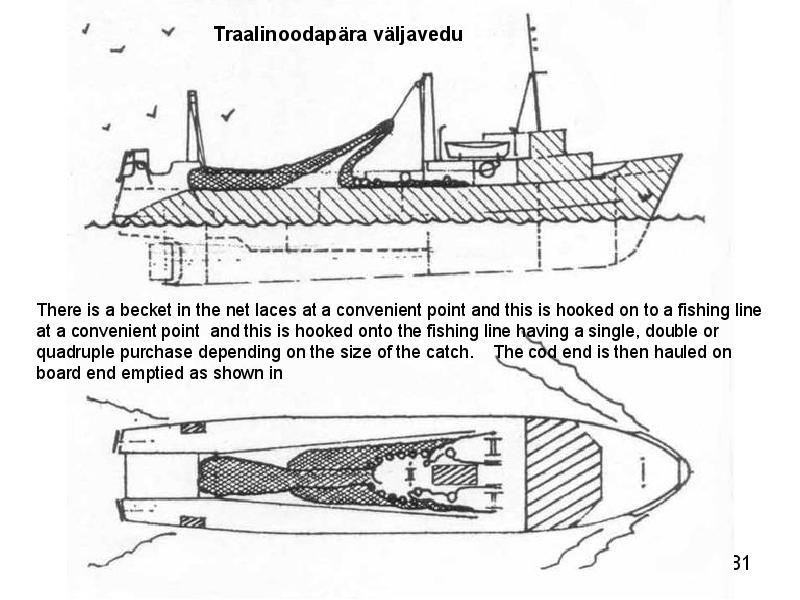
Traalinoodapära väljavedu
There is a becket in the net laces at a convenient point and this is hooked on to a fishing line
at a convenient point and this is hooked onto the fishing line having a single, double or
quadruple purchase depending on the size of the catch. The cod end is then hauled on
board end emptied as shown in
81
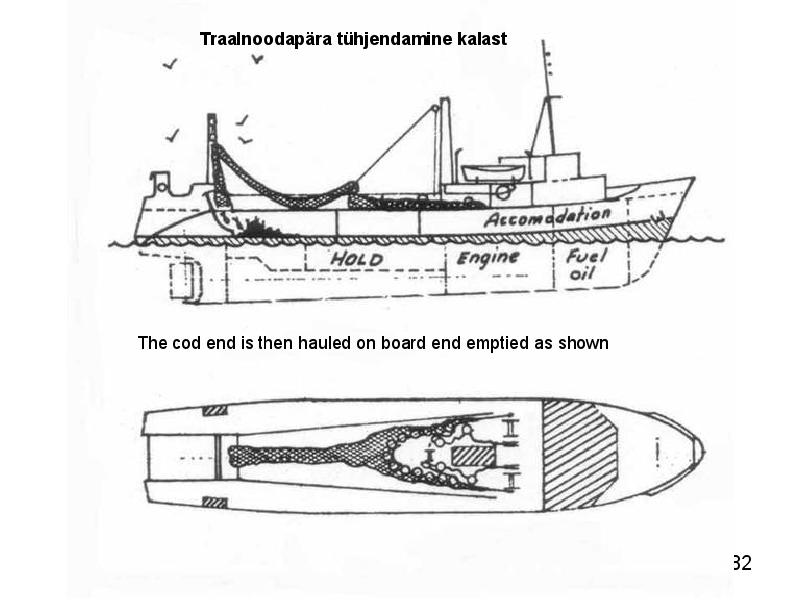
Traalnoodapära tühjendamine kalast
The cod end is then hauled on board end emptied as shown
82
83
84
85
86
87
88
89
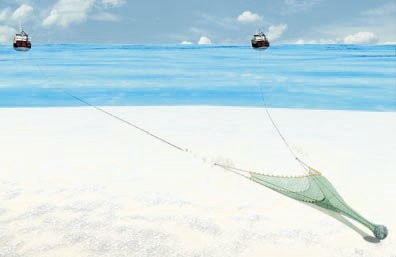
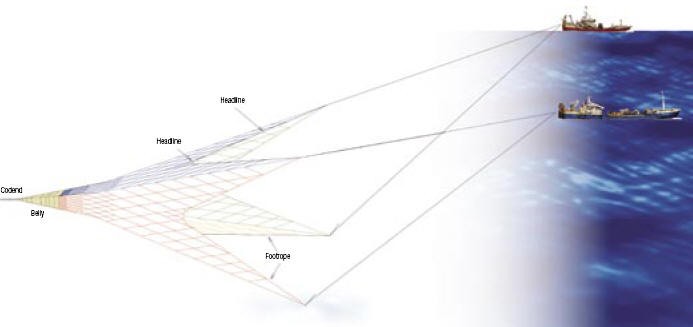
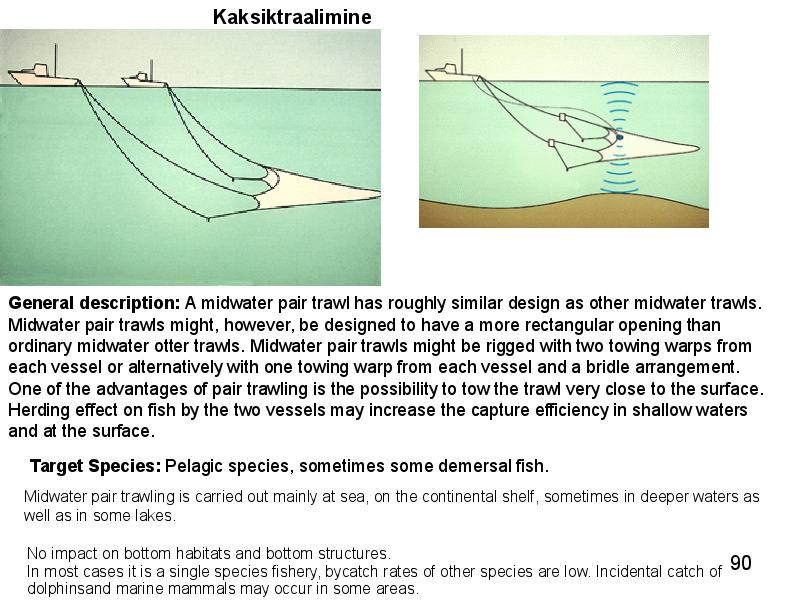
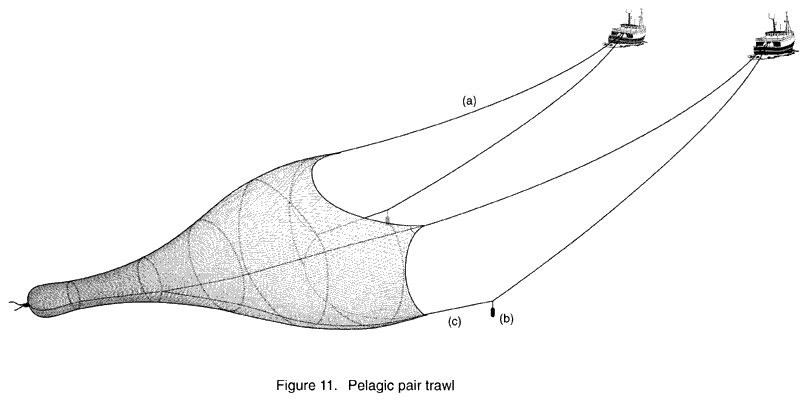
Kaksiktraalimine
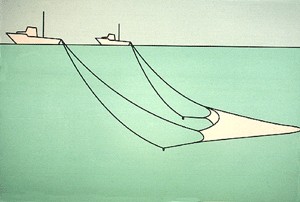
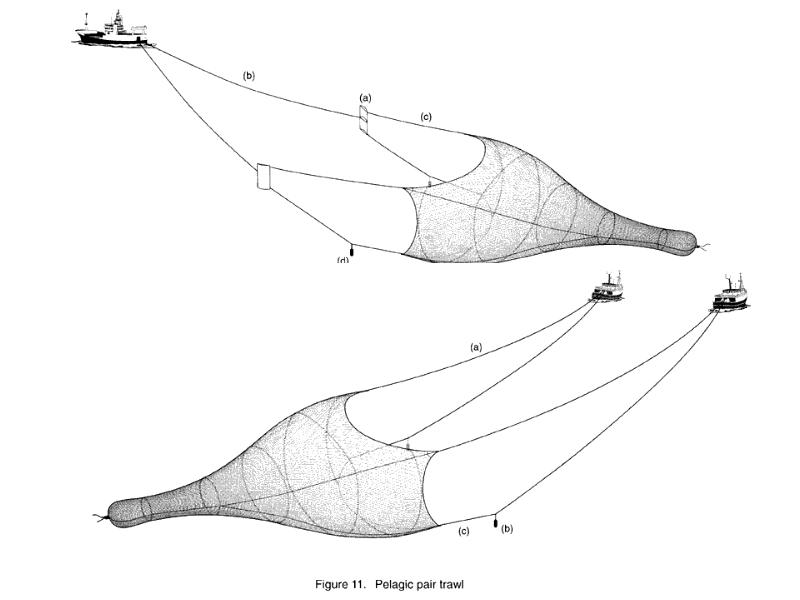
General description: A midwater pair trawl has roughly similar design as other midwater trawls.
Midwater pair trawls might, however, be designed to have a more rectangular opening than
ordinary midwater otter trawls. Midwater pair trawls might be rigged with two towing warps from
each vessel or alternatively with one towing warp from each vessel and a bridle arrangement.
One of the advantages of pair trawling is the possibility to tow the trawl very close to the surface.
Herding effect on fish by the two vessels may increase the capture efficiency in shallow waters
and at the surface.
Target Species: Pelagic species, sometimes some demersal fish.
Midwater pair trawling is carried out mainly at sea, on the continental shelf, sometimes in deeper waters as
well as in some lakes.
No impact on bottom habitats and bottom structures.
90Incidental catch of
In most cases it is a single species fishery, bycatch rates of other species are low.
dolphinsand marine mammals may occur in some areas.
Midwater pair trawling can be effective in different situations: when fish are aggregated into large
dense shoals and when (at another season or time of the day or according to physiological status)
fishes are regularly distributed within a given water layer. In addition to the difference it makes
whether the fish are aggregated in a small volume or spread within a large one, fish may swim (and
avoid the net) at different speeds according to its own physiological status and/or other external
conditions. As a result, in addition to the fish which is targeted, other different conditions will affect
the design and size of the midwater trawl, as well as the towing speed.
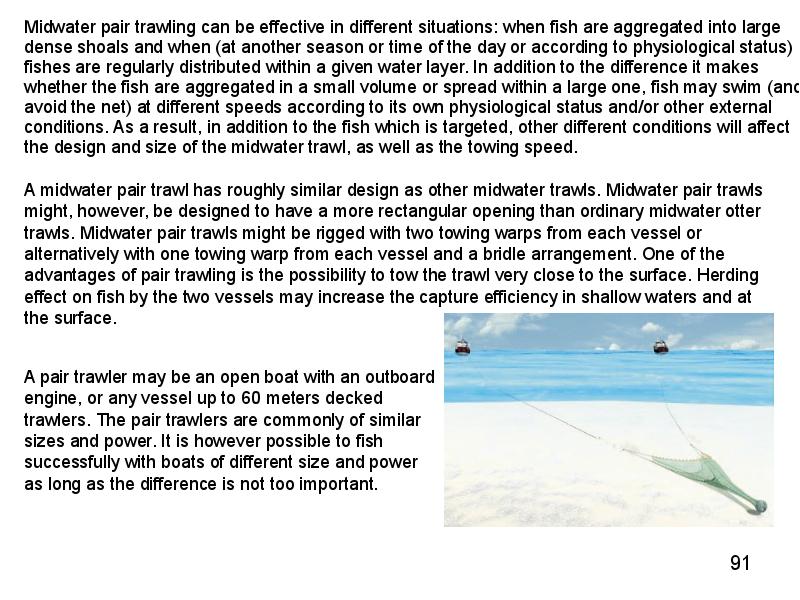
A midwater pair trawl has roughly similar design as other midwater trawls. Midwater pair trawls
might, however, be designed to have a more rectangular opening than ordinary midwater otter
trawls. Midwater pair trawls might be rigged with two towing warps from each vessel or
alternatively with one towing warp from each vessel and a bridle arrangement. One of the
advantages of pair trawling is the possibility to tow the trawl very close to the surface. Herding
effect on fish by the two vessels may increase the capture efficiency in shallow waters and at
the surface.
A pair trawler may be an open boat with an outboard
engine, or any vessel up to 60 meters decked
trawlers. The pair trawlers are commonly of similar
sizes and power. It is however possible to fish
successfully with boats of different size and power
as long as the difference is not too important.
91
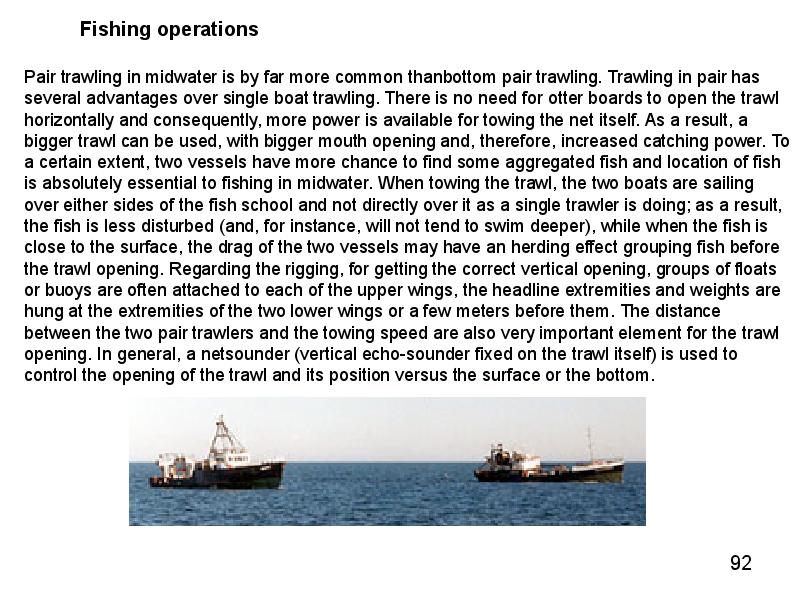
Fishing operations
Pair trawling in midwater is by far more common thanbottom pair trawling. Trawling in pair has
several advantages over single boat trawling. There is no need for otter boards to open the trawl
horizontally and consequently, more power is available for towing the net itself. As a result, a
bigger trawl can be used, with bigger mouth opening and, therefore, increased catching power. To
a certain extent, two vessels have more chance to find some aggregated fish and location of fish
is absolutely essential to fishing in midwater. When towing the trawl, the two boats are sailing
over either sides of the fish school and not directly over it as a single trawler is doing; as a result,
the fish is less disturbed (and, for instance, will not tend to swim deeper), while when the fish is
close to the surface, the drag of the two vessels may have an herding effect grouping fish before
the trawl opening. Regarding the rigging, for getting the correct vertical opening, groups of floats
or buoys are often attached to each of the upper wings, the headline extremities and weights are
hung at the extremities of the two lower wings or a few meters before them. The distance
between the two pair trawlers and the towing speed are also very important element for the trawl
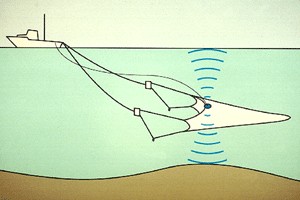
opening. In general, a netsounder (vertical echo-sounder fixed on the trawl itself) is used to
control the opening of the trawl and its position versus the surface or the bottom.
92
· 09.september lõpp
93
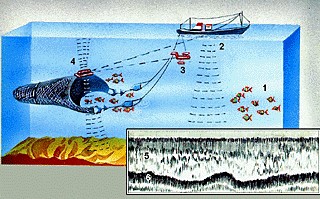
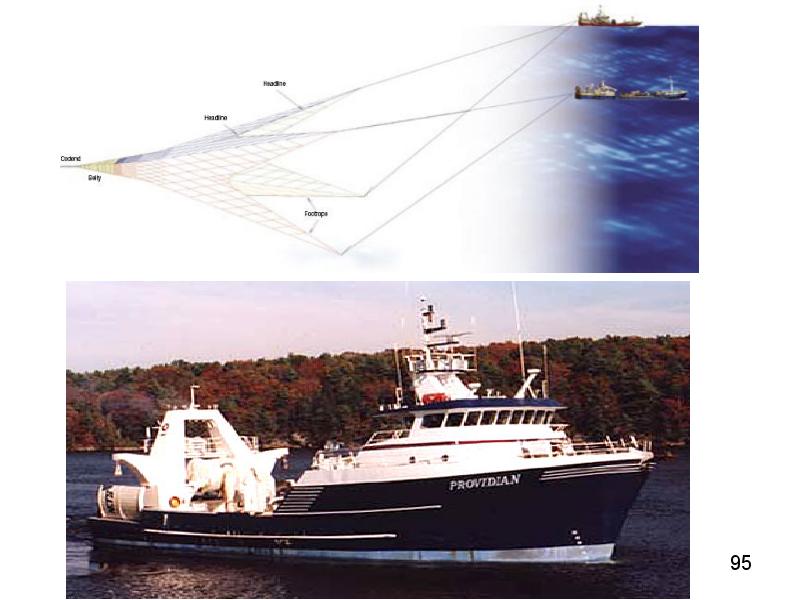
1. Searching for fish : The first part of the operation is the search for fish, by means of
echo-sounder and sonar.
2. Setting the net (Traalnooda püügile asetus) : Once a school of fish is located, and its size
and depth (versus the bottom or the surface) determined, the vessels move downwind and the
"main boat" on which the trawl was kept starts paying out the net. This is done very quickly.
Once the trawl has been completely shot in the water and is clear from any entanglement, the
"partner boat" comes alongside and to catch a light heaving line thrown from the main boat for
making the transfer of the bridles (one or two according to the type of rigging) or the wing
extremities (upper and lower) on one side of the trawl. The ends of the bridles or the wing
extremities are tied to the heaving line, pulled quickly aboard partner vessel and connected to
its warp. The midwater pair trawl is towed with one or two warps on each vessel; the rigging
with two warps from each vessel is more common.
3. Towing the net (traalimine) : When all the warp is set and the winch brakes applied, the
trawlers commence towing on parallel courses. Maintaining the correct spacing between
vessels while towing is a crucial factor, in particular for the correct horizontal opening of the
mouth. Anyway, it is very important that skippers keep in touch with each other during all the
fishing operations.
4. Hauling the net (traalnooda pardale võtmine) : Once the net has been pulled through the
school of fish or after a given duration selected for the haul (according to the density of
scattered fish within the water layer), hauling can begin. The hauling operation varies with the
type of pair trawl gear in use. Most pair trawlers heave in all the warp which make at the same
time that the two boats are gradually coming closer. When both warp ends have been reached,
a heaving line is throw across and the bridles or wings ends from one of the vessel are attached
to it for being transferred on board the vessel which will haul in the net itself. Then, the "hauling
vessel" pulls in together the bridles, the wings and the rest of the net. 94
95
Poorditraalimine
96
97
98
Poorditraalimine
forward
aft
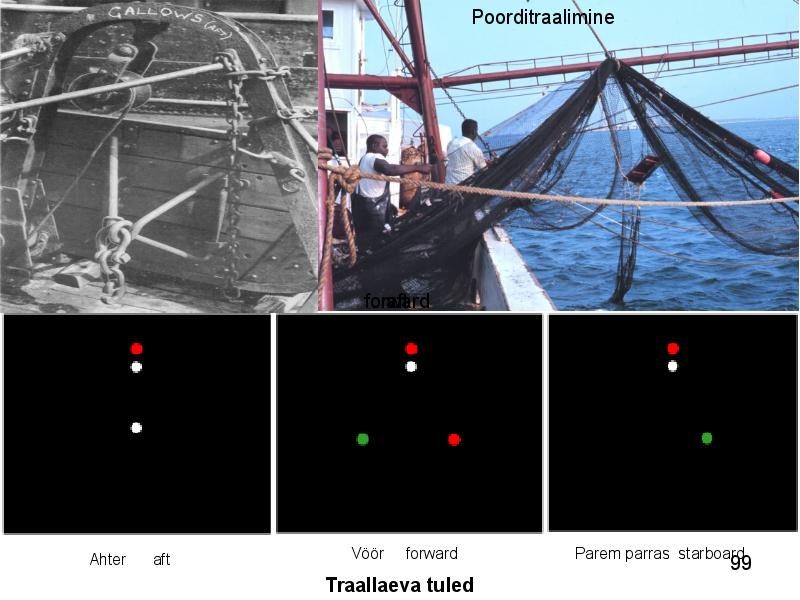
Ahter aft Vöör forward Parem parras starboard
99
Traallaeva tuled
100
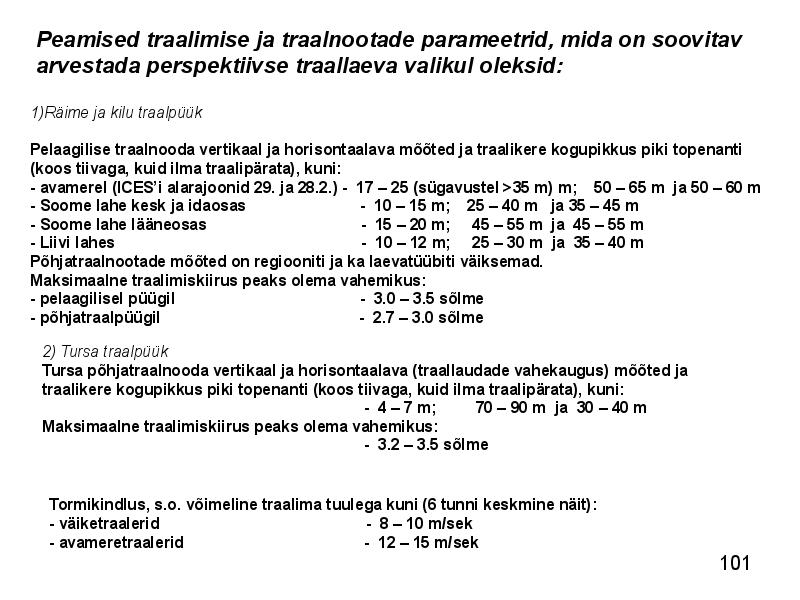
Peamised traalimise ja traalnootade parameetrid, mida on soovitav
arvestada perspektiivse traallaeva valikul oleksid:
1)Räime ja kilu traalpüük
Pelaagilise traalnooda vertikaal ja horisontaalava mõõted ja traalikere kogupikkus piki topenanti
(koos tiivaga, kuid ilma traalipärata), kuni:
- avamerel (ICES'i alarajoonid 29. ja 28.2.) - 17 25 (sügavustel >35 m) m; 50 65 m ja 50 60 m
- Soome lahe kesk ja idaosas - 10 15 m; 25 40 m ja 35 45 m
- Soome lahe lääneosas - 15 20 m; 45 55 m ja 45 55 m
- Liivi lahes - 10 12 m; 25 30 m ja 35 40 m
Põhjatraalnootade mõõted on regiooniti ja ka laevatüübiti väiksemad.
Maksimaalne traalimiskiirus peaks olema vahemikus:
- pelaagilisel püügil - 3.0 3.5 sõlme
- põhjatraalpüügil - 2.7 3.0 sõlme
2) Tursa traalpüük
Tursa põhjatraalnooda vertikaal ja horisontaalava (traallaudade vahekaugus) mõõted ja
traalikere kogupikkus piki topenanti (koos tiivaga, kuid ilma traalipärata), kuni:
- 4 7 m; 70 90 m ja 30 40 m
Maksimaalne traalimiskiirus peaks olema vahemikus:
- 3.2 3.5 sõlme
Tormikindlus, s.o. võimeline traalima tuulega kuni (6 tunni keskmine näit):
- väiketraalerid - 8 10 m/sek
- avameretraalerid - 12 15 m/sek
101
102
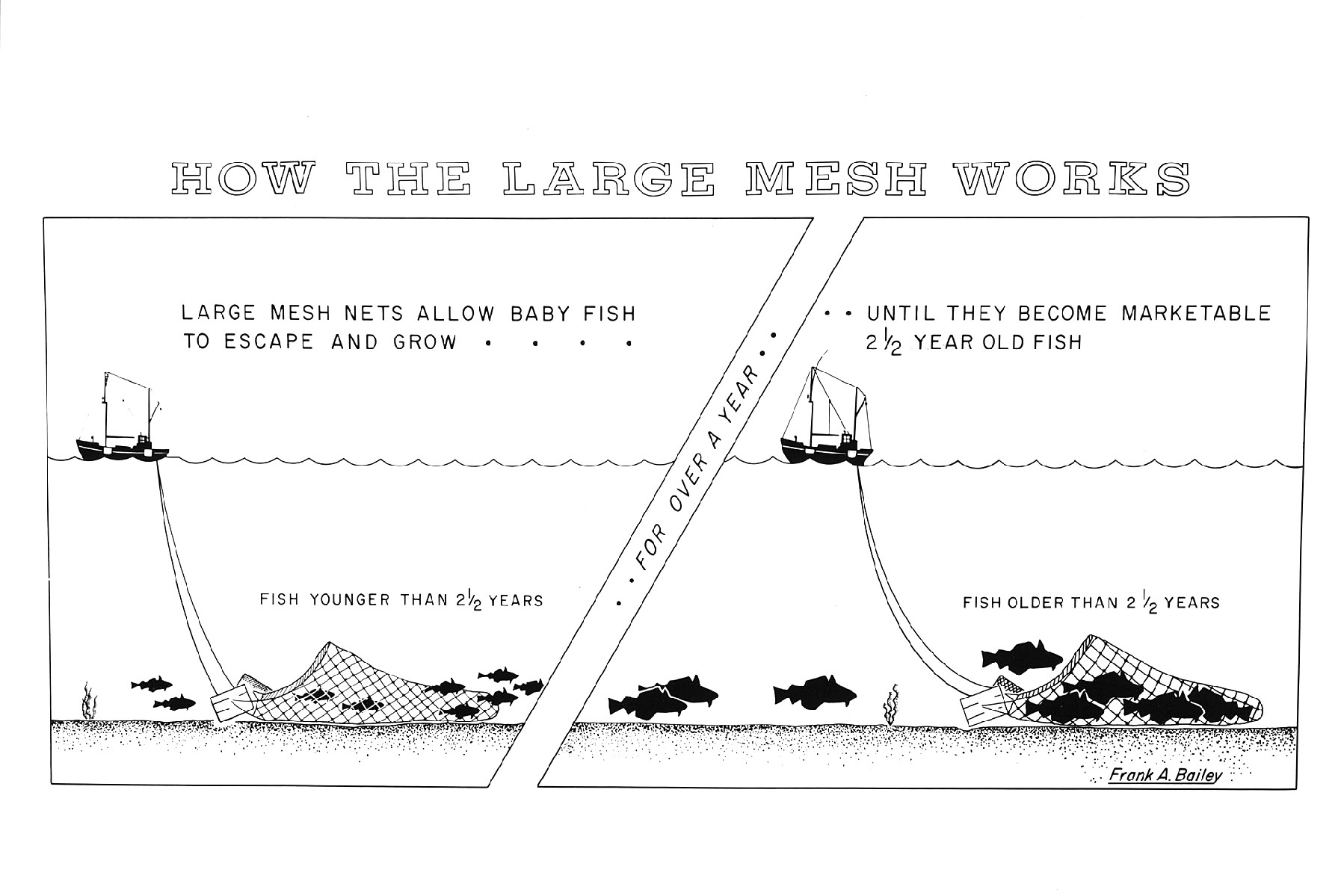
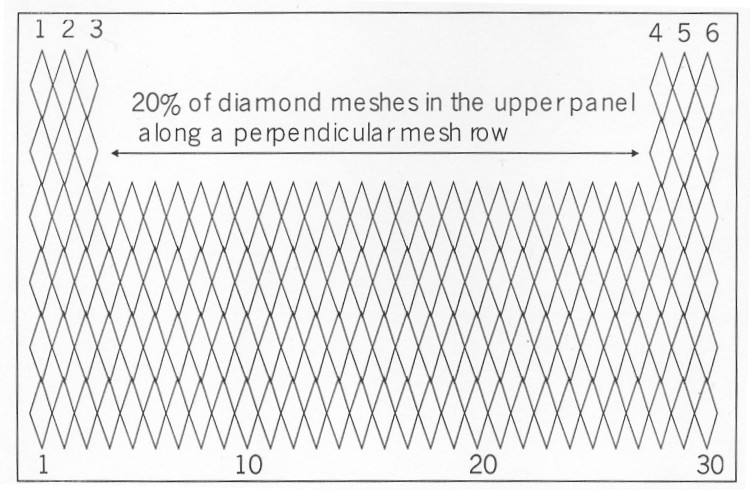
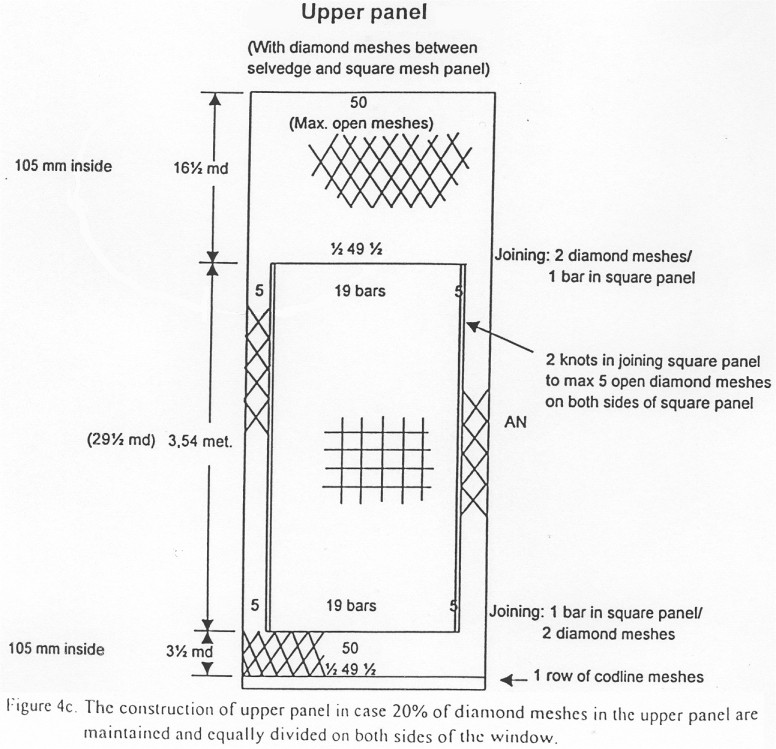
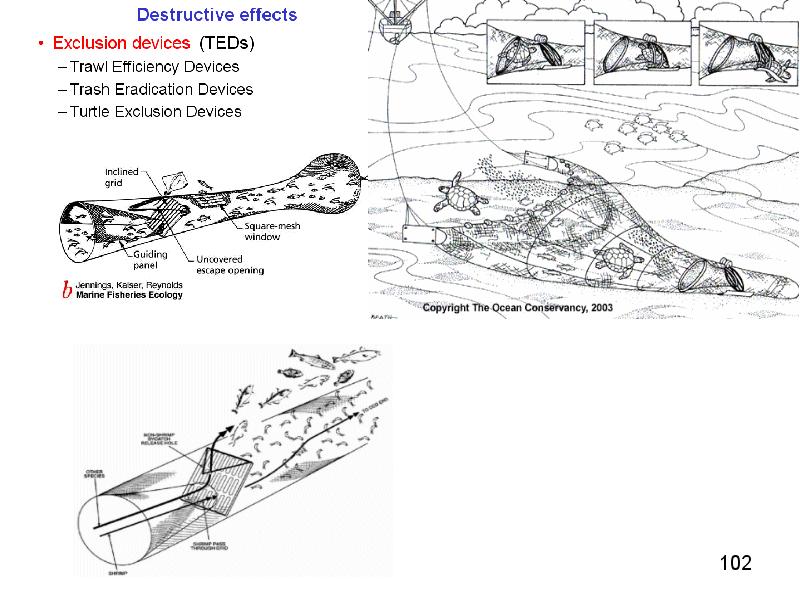
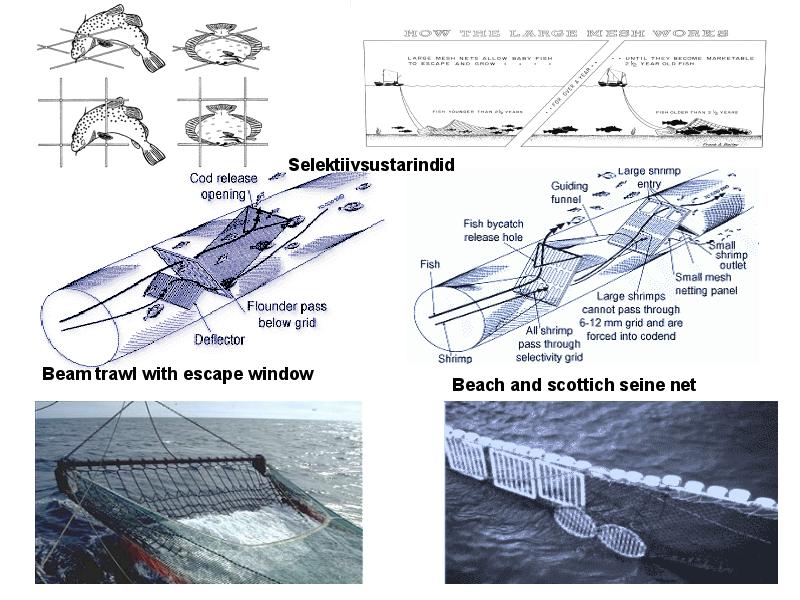
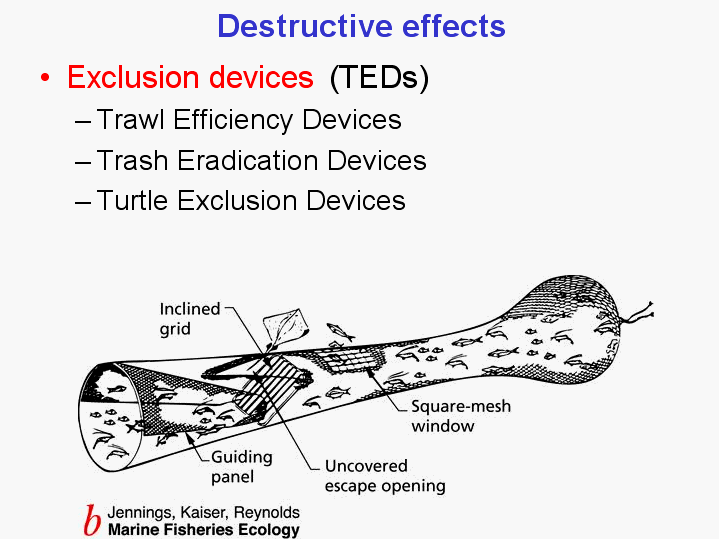
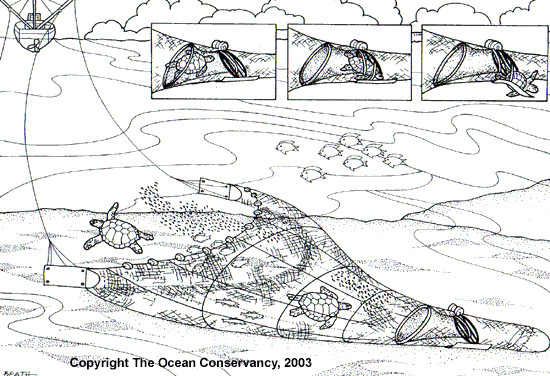
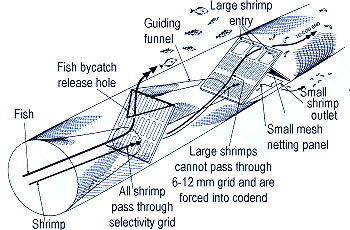
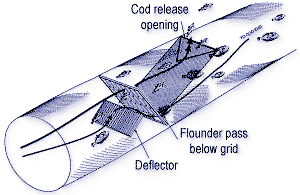
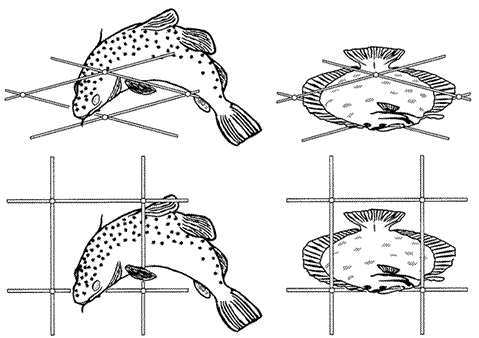
Selektiivsustarindid
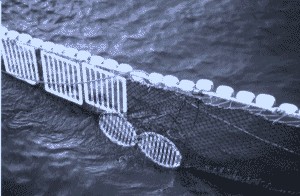
Beam trawl with escape window
Beach and scottich seine net
103
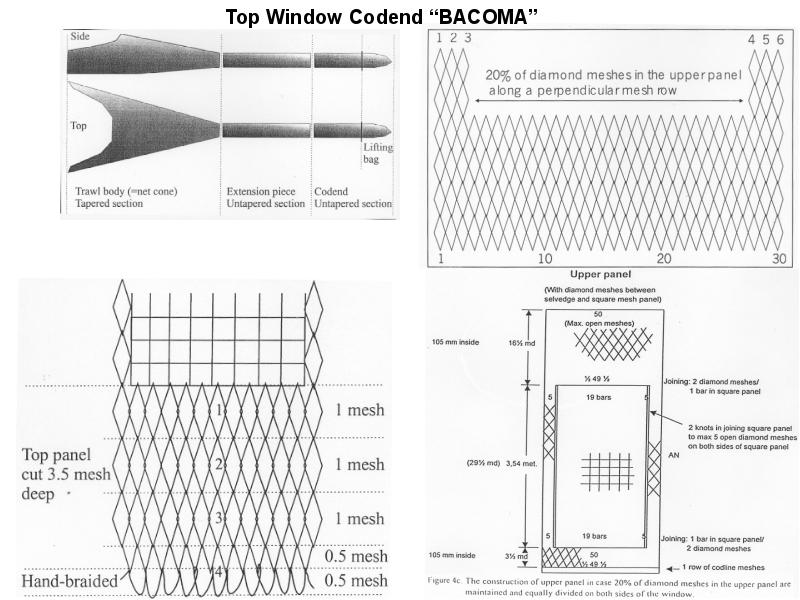
Top Window Codend "BACOMA"
104
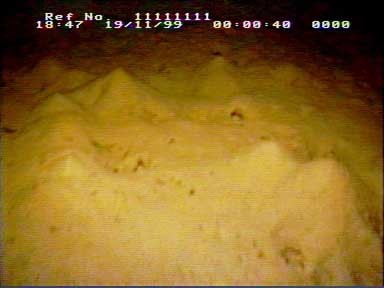
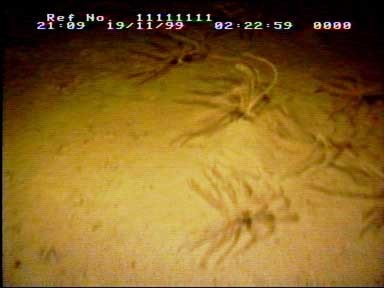
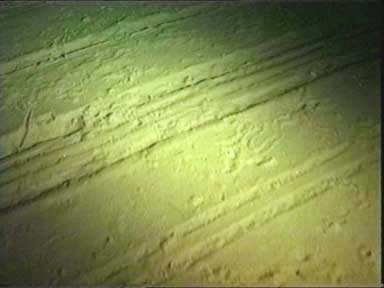
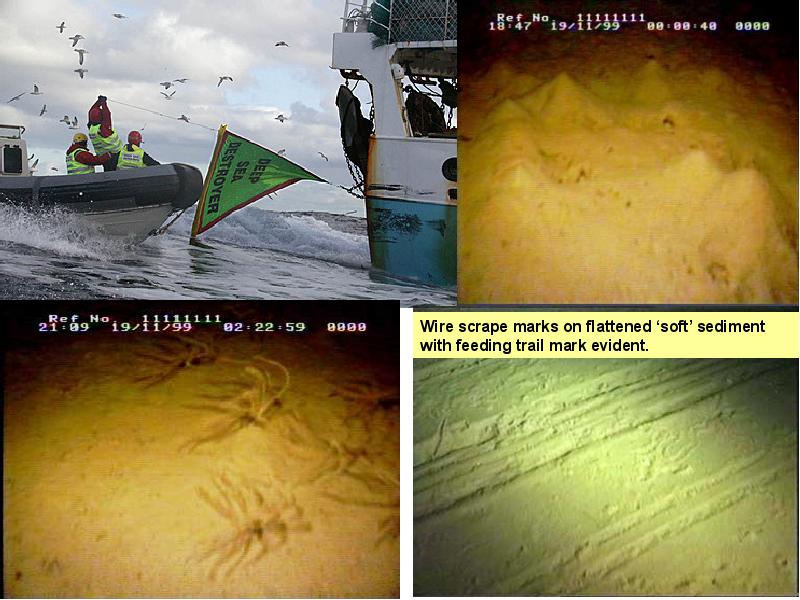
Wire scrape marks on flattened `soft' sediment
with feeding trail mark evident.
105
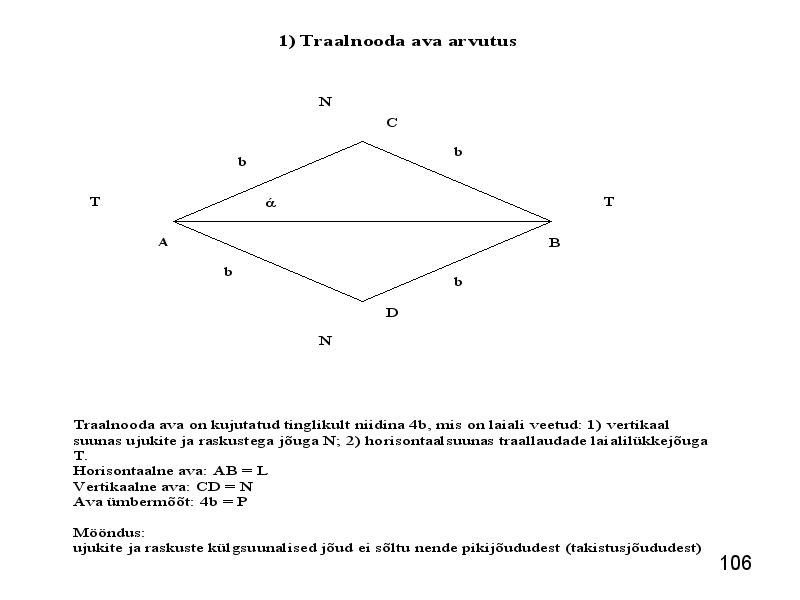
106
107
108
109
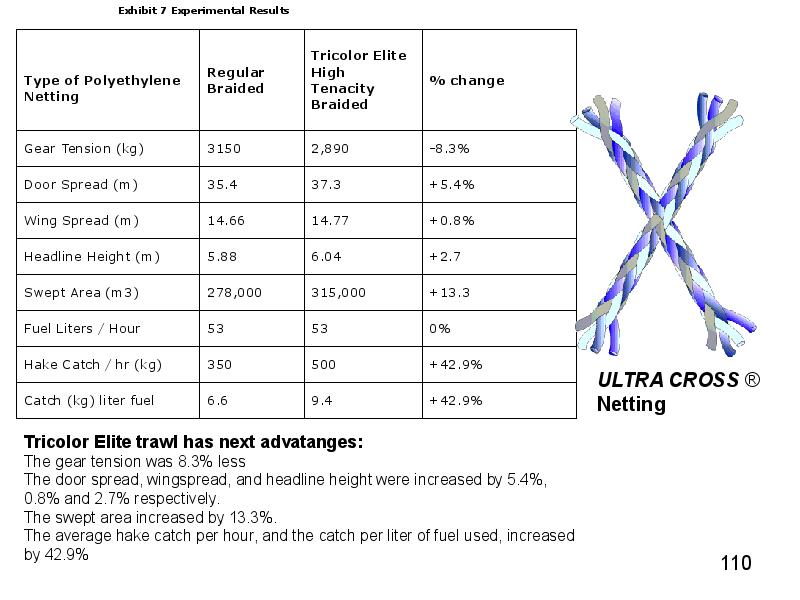
Exhibit 7 Experimental Results
Tricolor Elite
Regular
Type of Polyethylene High Tenacity % change
Braided
Netting Braided
Gear Tension (kg) 3150 2,890 8.3%
Door Spread (m) 35.4 37.3 +5.4%
Wing Spread (m) 14.66 14.77 +0.8%
Headline Height (m) 5.88 6.04 +2.7
Swept Area (m3) 278,000 315,000 +13.3
Fuel Liters / Hour 53 53 0%
Hake Catch / hr (kg) 350 500 +42.9%
ULTRA CROSS ®
Catch (kg) liter fuel 6.6 9.4 +42.9%
Netting
Tricolor Elite trawl has next advatanges:
The gear tension was 8.3% less
The door spread, wingspread, and headline height were increased by 5.4%,
0.8% and 2.7% respectively.
The swept area increased by 13.3%.
The average hake catch per hour, and the catch per liter of fuel used, increased
by 42.9%
110
111
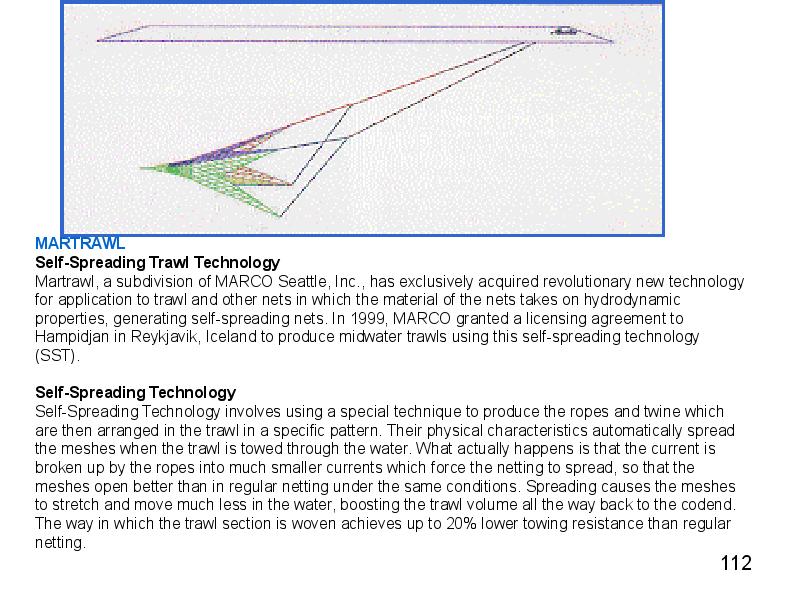
MARTRAWL
Self-Spreading Trawl Technology
Martrawl, a subdivision of MARCO Seattle, Inc., has exclusively acquired revolutionary new technology
for application to trawl and other nets in which the material of the nets takes on hydrodynamic
properties, generating self-spreading nets. In 1999, MARCO granted a licensing agreement to
Hampidjan in Reykjavik, Iceland to produce midwater trawls using this self-spreading technology
(SST).
Self-Spreading Technology
Self-Spreading Technology involves using a special technique to produce the ropes and twine which
are then arranged in the trawl in a specific pattern. Their physical characteristics automatically spread
the meshes when the trawl is towed through the water. What actually happens is that the current is
broken up by the ropes into much smaller currents which force the netting to spread, so that the
meshes open better than in regular netting under the same conditions. Spreading causes the meshes
to stretch and move much less in the water, boosting the trawl volume all the way back to the codend.
The way in which the trawl section is woven achieves up to 20% lower towing resistance than regular
netting.
112
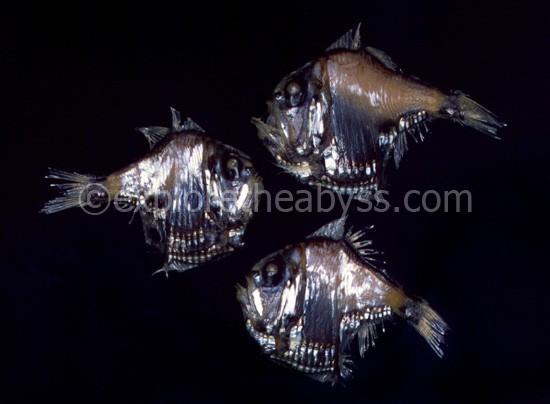
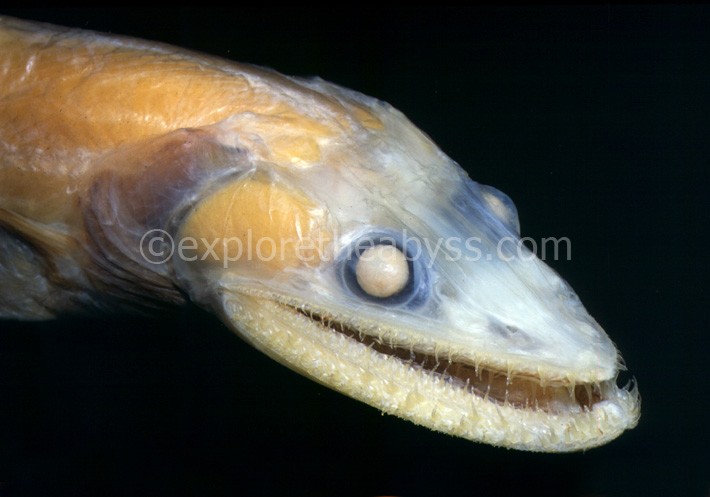
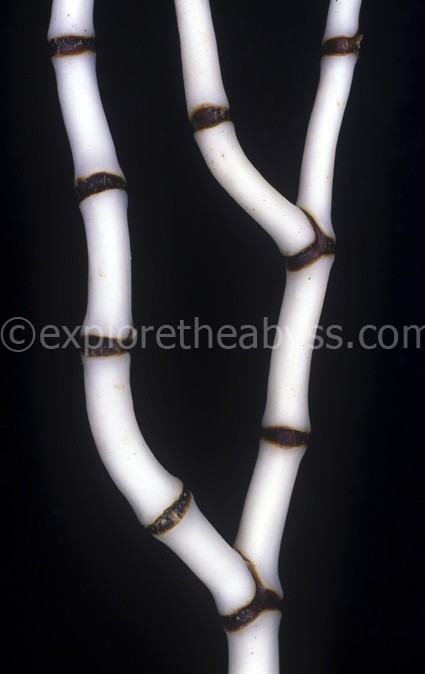
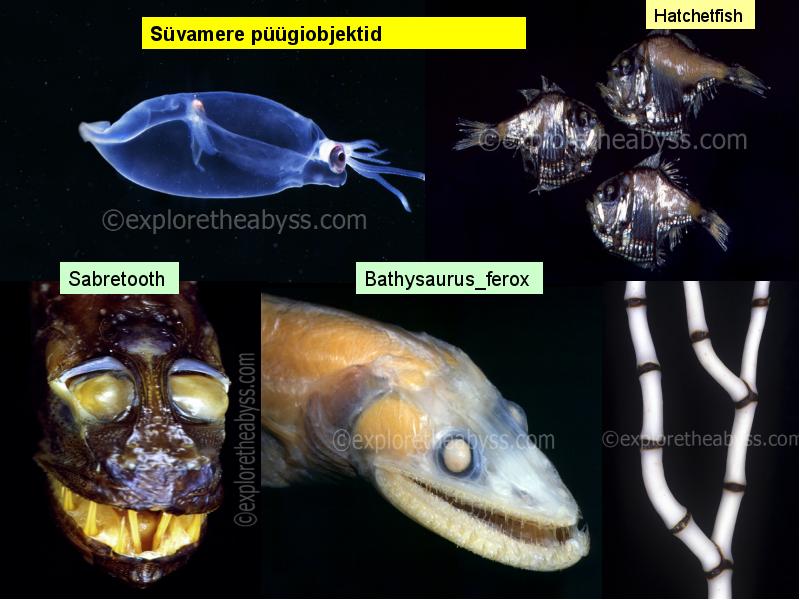
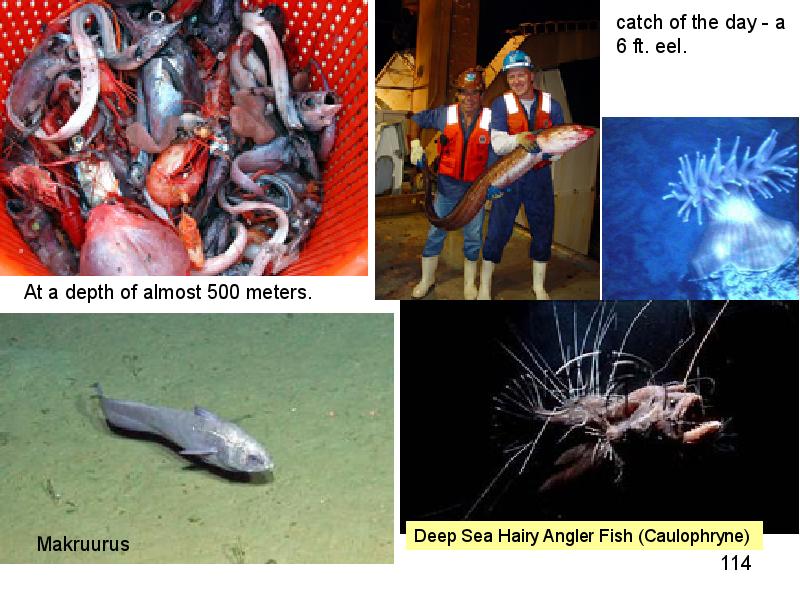
Hatchetfish
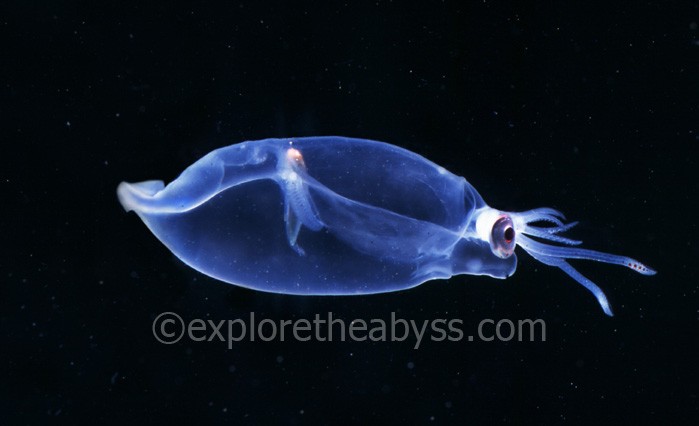
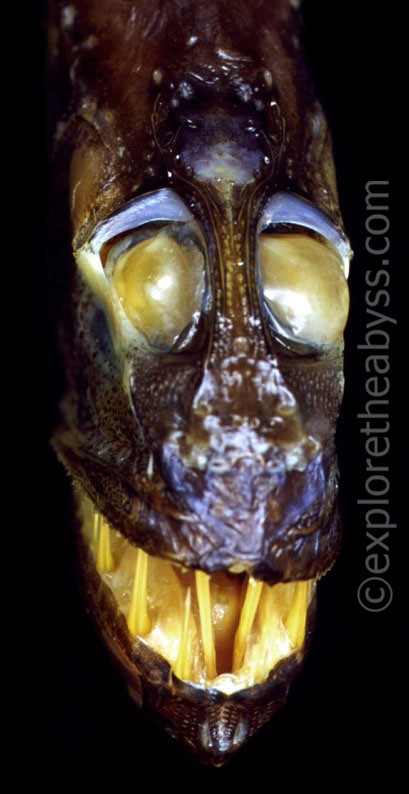
Süvamere püügiobjektid
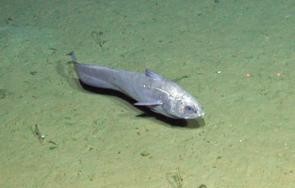
Sabretooth Bathysaurus_ferox
113
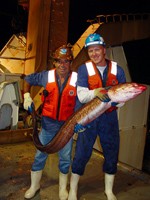
catch of the day - a
6 ft. eel.
At a depth of almost 500 meters.
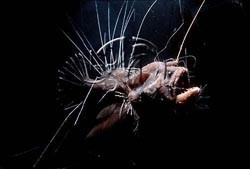
Makruurus Deep Sea Hairy Angler Fish (Caulophryne)
114
traalpüügist
Sarnased õppematerjalid
![Kurnpüünised]()
42
ppt
Kurnpüünised
Kordusküsimused
1. Nakkevõrkude töö põhimõte
2. Millised nakkevõrgu konstruktsioonilised iseärasused on eriti olulised
püügi efektiivsuse seisukohast
3. Mis kujuga võib olla nakkevõrkude jada
4. Milliseid kalu püütakse õngpüünistega
5. Mis asi on "mail"
6. Milline näeb välja vertikaalne õngejada
1
� 12. Kurnpüünised
8. Kurnpüünised (Kalapüügieeskiri)
(1) Kurnpüünis on püünis, millega püügi põhimõte seisneb veekogu osa
ümberpiiramises ja sealt kala kättesaamises püünise kokkuvedamisega.
(2) Lubatud kurnpüünised on:
1) põhjanoot, mis koosneb võrdse pikkusega veoköitest, tiibadest ja pärast ning mille
veoköied toimivad kalapeletina ehk hirmutina;
2) veonoot, mis koosneb veoköitest, tiibadest, noodakerest ja pärast ning mis
kokkuvedamisel kurnab läbi kogu veekihi ümberpiiratud alal;
3) kaldanoot veonoot, millega loomus veetakse kaldale
![TOPICS FOR SPEAKING]()
28
doc
TOPICS FOR SPEAKING
TOPICS FOR SPEAKING
CYLINDER FRAME
The cylinder section of the engine consists of a number of cylinder blocks, which
are tightened together with the engine frame and the bedplate by means of through-
going stay bolts.
Two central bores, one at the top and one halfway down inside the cylinder block,
enclose the cylinder liner. The upper part of the cylinder block forms part of the
cooling water space around the central part of the cylinder liner, whereas the lower
part forms the scavenge air space. A central bore in the bottom of the cylinder
block encloses the piston rod stuffing box. The bottom is double with a hollow
space through which cooling water is circulated.
On the exhaust side of the cylinder block there is a circular opening leading into
the longitudinal scavenge air receiver of the engine. Furthermore, there is an inlet
pipe for cooling and lubricating oil. The cylinder block is provided with cleaning
and inspection covers for the cooling water and
![Õngepüük]()
22
ppt
Õngepüük
Kordusküsimused
�10. Õngpüünised
��§3. Õngpüünised (Kalapüügieeskiri)
(1) Õngpüünis on püünis, millega püügi põhimõte seisneb kala peibutamises õngekonksule
kinnitatud söödaga või muu peibutusvahendiga, mille haaramisel kala haakub.
(2) Lubatud õngpüünised on:
1) lihtkäsiõng, mis koosneb ridvast, kuni 1,5 ridva pikkusest õngenöörist, üheharulisest
konksust ja millega püügil kasutatakse looduslikku sööta ning mis võib olla varustatud
raskuse ja ujukiga;
2) spinning, mis koosneb rõngastega ridvast, ridvarullist, õngenöörist ja landist või rakisest,
võib olla varustatud vahetrossi, lisaraskuse ja nn peibutustirguga;
3) käsiõng, mis koosneb ridvast, õngenöörist ja sellele lipsudega kinnitatud kuni kolmest
üheharulisest konksust või kirptirgust, võib olla varustatud ridvarõngaste, raskuse, ujuki või
noogutiga ja rulli või haspliga õngenööri kerimiseks;
4) vedel, mis koosneb õngenöörist, landist või rakisest, võib olla varustatud
![General terms SMCP]()
20
pdf
General terms SMCP
MÕISTED JA SELGITUSED
Mõisted ja selgitused sisaldavad ka piiratud arvu tehnilisi mõisteid, mis ei esine IMO SMCP tekstis, kuid võivad osutuda kasulikuks kui
konkreetse standardväljendi selgitus vajab uuendamist.
1 General terms 1 Üldised mõisted
Abandon vessel (to) To evacuate crew and passengers from a vessel Laeva maha jätma Merehäda tingimustes
following a distress laevapere ja reisijate laevast
lahkumine
Accommodation ladder Ladder attached to platform at vessel's side with Pardatrepp, Lamedate astmete ja
flat steps and handrails enabling persons to paraadtrepp käsipuuga laeva
emba
![Lõkspüünised]()
39
ppt
Lõkspüünised
Kordusküsimused:
1. Millest lähtudes valitakse silmasuurus nakkevõrkudega püügil
2. Kas ja kui kontrastne peab nakkevõrk vees olema
3. Milline on tavaliselt nakkevõrgu horisontaalrakendus, miks
4. Mida tähendab "lõhemäng"
5. Millise lipuga tähistakse nakkevõrgujada merepoolset otsa
6. Mis on õngekonksu "säär"
7. Kui pikk võib olla triivõngejada
8. Mis on mail
9. Millise jaotumisega kalu püütakse õngedega
� 11. Püük lõkspüünistega
§7. Lõkspüünised
(1) Lõkspüünis on püünis, millega püügi põhimõte seisneb kala eksitamises püünisesse või selle osasse,
kuhu sisenemine on lihtne, kuid väljumine raskendatud.
(2) Lubatud lõkspüünised on:
1) mõrd juhtaia, tiibade, mis moodustavad kariaia ja ühe või mitme pujusega varustatud kuni kahe pealt
kinnise mõrrakerega lõkspüünis. Võrtsjärvel ei ole mõrrakerede, kariaedade ja juhtaedade arv piiratud.
Mõrra osad on näidatud joonisel lisas 7;
2) 4) [kehtetud - RT I 2005, 28,
![Ford escorti käsiraamat]()
256
pdf
Ford escorti käsiraamat
1·1
Chapter 1
Routine maintenance and servicing
1
Contents
Air cleaner element renewal . . . . . . . . . . . . . . . . . . . . . . . . . . . . . . .34 Fuel filter renewal - fuel injection engines . . . . . . . . . . . . . . . . . . . .36
Alternator drivebelt check . . . . . . . . . . . . . . . . . . . . . . . . . . . . . . . .20 Hinge and lock check and lubrication . . . . . . . . . . . . . . . . . . . . . . .31
Automatic transmission fluid level check . . . . . . . . . . . . . . . . . . . . .27 Idle speed and mixture adjustment . . . . .
![2-stroke tuners handbook tuners]()
171
pdf
2-stroke tuners handbook tuners
�� Two-Stroke
TUNER’S HANDBOOK
By Gordon Jennings
Illustrations by the author
Copyright © 1973 by
Gordon Jennings
Compiled for reprint © 2007 by Ken
�i
� PREFACE
Many years have passed since Gordon Jennings first published this manual. Its
2007 and although there have been huge technological changes the basics are still the
basics. There is a huge interest in vintage snowmobiles and their “simple” two stroke
power plants of yesteryear. There is a wealth of knowledge contained in this manual.
Let’s journey back to 1973 and read the book that was the two stroke bible of that era.
Decades have passed since I hung around with John and Jim. John and I worked
for the same corporation and I found a 500 triple Kawasaki for him at a reasonable price.
He converted it into a drag bike, modified the engine completely and added mikuni carbs
and tuned pipes. John borrowed Jim’s cop
![Energy - põhjalik referaat energiast]()
62
doc
Energy - põhjalik referaat energiast
SISUKORD
ENERGY STORY................................................................................................................4
USES OF ENERGY............................................................................................................. 4
2.1 Uses of energy in homes...............................................................................................5
2.2 Types of energy used in homes.................................................................................... 6
2.3 Energy use in different types of homes........................................................................ 6
2.4 Commercial Energy Use...............................................................................................9
2.5 Industrial and Manufacturing Energy Use..................................................................11
2.6 Transportation Energy Use.........................................................................................12
RENE
Inglise keele foneetika ja fonoloogia
Meedia
Kommentaarid (0)
 50 punkti
Autor soovib selle materjali allalaadimise eest saada 50 punkti.
50 punkti
Autor soovib selle materjali allalaadimise eest saada 50 punkti.
 ~ 5 lehte
Lehekülgede arv dokumendis
~ 5 lehte
Lehekülgede arv dokumendis
 2009-10-21
Kuupäev, millal dokument üles laeti
2009-10-21
Kuupäev, millal dokument üles laeti
 35 laadimist
Kokku alla laetud
35 laadimist
Kokku alla laetud
 0 arvamust
Teiste kasutajate poolt lisatud kommentaarid
0 arvamust
Teiste kasutajate poolt lisatud kommentaarid
 triini14
Õppematerjali autor
triini14
Õppematerjali autor
 annaabi.ee



















Kõik kommentaarid