 50 punkti
Autor soovib selle materjali allalaadimise eest saada 50 punkti.
50 punkti
Autor soovib selle materjali allalaadimise eest saada 50 punkti.
 ~ 1 leht
Lehekülgede arv dokumendis
~ 1 leht
Lehekülgede arv dokumendis
 2014-12-24
Kuupäev, millal dokument üles laeti
2014-12-24
Kuupäev, millal dokument üles laeti
 1 laadimist
Kokku alla laetud
1 laadimist
Kokku alla laetud
 0 arvamust
Teiste kasutajate poolt lisatud kommentaarid
0 arvamust
Teiste kasutajate poolt lisatud kommentaarid
 annelirosman
Õppematerjali autor
annelirosman
Õppematerjali autor
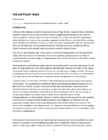
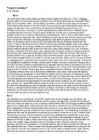
Character Sketch – Christophine Wide Sargasso Sea by Jean Rhys Christophine was the servant of Annette and the nurse of her daughter Antoinette. She was a wedding present from Alexander Cosway, the first husband of Annette. She practices magic which is called obeah, and also has wide knowledge of the Caribbean black culture. She has had all her three children with different men, but has still remained single. She opened her reason why she didn’t want to get married in a quote: All woman, all colors, nothing but fools. Three children I have. One living in this world, each one a different father, but no husband, I thank my God. I keep my money. I don’t give it to no worthless man. I think it also gives out her idea of marriage. She thinks that woman who get married are fools because married
the literature method no 1 in america · Naturalism appealed American authors because they found it very right to describe what was going on in the turn of century in America · They wanted something fresh, new · They were disgusted by romantics · Showed the harsh tone in moral life · Refleced the development of science · Period of intense urbanisation, the city is in the center of the novel, often · New characters were businessmen, salesman, immigants, poor farmers · These characters were in new settings, skyscrapers, departments store, apartment building, ghetto, stockyard (cattle, cows were slaughtered), commercial trust · Their world is not one of culture or high moral standards · For these new writers controlling new american social experience · Naturalists offered a view that questioned the belief that now was a conscious and
Ur,"" ':rzitnI knih..., '11:.1. The Hesearch Scene 5 TechnlcLo-ekonomic.:ka .kn.ibovna 10 il'ly Home Base 11 Z. Black Urban Poor ZZ 7715 /03 Stereotypes Versus Reality ZZ An Anthro/]ological Approach Z7 The table on pp. 102, 103, appears in the author's essay, "The Kindred 3
3) slaves who were household property, were the lowest class. The Creoles were the majority of the white population. They had a complex social organization, which included foreign groups such as Germans, Irish, and Spaniards whose names were given a French accent. The people who could trace their noble ancestors called themselves "Creole." Others were "chacas" or tradesmen, "chacalatas" or country folk (peasants), or "chacumas" for anyone with Black blood. All Creoles, no matter what level of society they were in, including slaves, looked down on the Americans. 3 Family life In the Creole family the father was dominant. His word was law. He was not always a faithful spouse, but he was an indulgent parent. If he was a planter, he ruled his estate like a king. He had a large house, large crops, and a large family. He was a dutiful husband and accompanied his wife to balls, the theatre, and social events. He would go to the
BOOK REPORT Title & author of the book: 'Anita and Me' by Meera Syal The setting of the book? The story resolves around Meena Syal, the daughter of the only Punjabi family in the Midlands' mining village of Tollington. The novel provides a vision of British childhood in the 1960s, a childhood caught between two cultures, each on the brink of enormous change. Meena is desperate to fit in with the other children in her neighbourhood while forever feeling like an outsider because she is "different". Eventhough the Punjabi family is well respected by the locals, there are still sutations when they have to deal with racism. Plot summary (NB! Use the present tenses)
By then, Ghana the former Gold Coast had been independent for three years under the great Osagyefo Kwame Nkumah. It was a time for celebrating Africa’s coming of age, as more and more African countries received their independence either from Britain or France. It was especially a poignant time for Africa, as then British Prime Minister Harold McMillan articulated his now famous “winds of change” sweeping Africa. We had high hopes for Africa, for the Black race, that the insidious imposition of foreign rule on us, the looting of Africa’s natural resources by our colonial masters accorded us would be things of history. That is more than forty years ago. Unfortunately, the promise of independence has not been fulfilled. Today, Africa has become more desolate; there is more starvation, diseases and non-provision of essential services than when we got our independence. There are all kinds of wars in Africa than the rest of world put together.
peopled by "noble savages", similar to the philosophical theory of Rousseau, exemplified by Uncas, from The Last of the Mohicans. There are picturesque "local color" elements in Washington Irving's essays and especially his travel books. Edgar Allan Poe's tales of the macabre and his balladic poetry were more influential in France than at home, but the romantic American novel developed fully with the atmosphere and melodrama of Nathaniel Hawthorne's The Scarlet Letter (1850). Later Transcendentalist writers such as Henry David Thoreau and Ralph Waldo Emerson still show elements of its influence and imagination, as does the romantic realism of Walt Whitman. The poetry of Emily Dickinson--nearly unread in her own time--and Herman Melville's novel MobyDick can be taken as epitomes of American Romantic literature. By the 1880s, however, psychological
During the vist he asks him to grant Anna a divorce, but Karenin's decisions are now governed by a French "clairvoyant" recommended by Lidia Ivanovna who apparently has a vision in his sleep during Stiva's visit, and gives Karenin a cryptic message that is interpreted as meeting that he must decline the request for divorce. Anna becomes increasingly jealous and irrational towards Vronsky, whom she suspects of having love affairs with other women, and of giving in to his mother's plans to marry him off to a rich Society woman. There is a bitter row, and Anna believes that the relationship is over. She starts to think of suicide as an escape from her torments. In her mental and emotional confusion, she sends a telegram to Vronsky asking him to come home to her, and pays a visit to Dolly and Kitty. Anna's confusion overcomes her, and in a parallel to the railway worker's accidental death in part 1, she commits
 annaabi.ee








Kõik kommentaarid