Leidsid 33 sarnast õppematerjali, mis on seotud failiga "History of english review questions and answers 2016". Need materjalid aitavad sul teemat sügavamalt mõista.
english, vowel, verb, noun, strong, verbs, weak, german, nouns, middle, sound, vowels, tense, germanic, shift, language, declined, adjectiveoun, consonant, change, sing, words, case, first, grimm, proto, except, other, languages, verner, following, umlaut, presentouns, between, early, different, these, linguistic, person, adjectives, periodSuppletion Present in languages of different families. Present in Old, Middle and Modern English, though the general tendency is towards more regularity/iconicity so the number of suppletive forms has decreased.In the text: goon to go wenden - to turn Gan was suppletive in Old English, past form: eode.Eode was supplanted by went (past form of wenden) at the end of the Middle English period.To wend has survived in Modern English in phrases such as to wend one's way, we wended homewards (ironic usage). Thus: suppletivity- suppletion different parts of one and the same paradigm come from what were originally different paradigms (different words with close meanings or words in different but close dialects).Suppletion embraces verbs, adjectives, nouns. Be was/were been (Old English beon/wesan) (am, art, is, are); in Old English some suppletive
English lexicology 1. Size of English vocabulary Vocabulary is a sum total of words used in a language by speakers or for dictionary-making. Active and passive vocabulary. The Old English vocabulary was homogenous. There were about 50 000 – 60 000 words, 1/3 of which have survived. o About 450 loans from Latin o About 2000 from the Viking invasions. The Middle-English vocabulary became a heterogeneous hybrid of Germanic and Romanic languages. 100 000 to 125 000 words. o About 10 000 loans from Norman French, 75% are still in use o Continuing Latin influence
CITATION FORM The citation form of the lexeme is the form that is employed to refer to the lexeme; it is also the form that is used for the alphabetical listing of lexemes in a conventional dictionary. In English, the citation form of a noun is the singular: e.g., mouse rather than mice. For multi-word lexemes which contain possessive adjectives or reflexive pronouns, the citation form uses a form of the indefinite pronoun one: e.g., do one's best, perjure oneself. In many languages, the citation form of a verb is the infinitive: French aller, German gehen, Spanish ir. In English it usually is the full infinitive (to go) although alphabetized without 'to' (go);
English structure revision for the exam 1. Terms Language → A systematic, conventional (tavakohane) use of sounds, signs or written symbols in a human society for communication and self-expression. Human language at all levels is rule- or principle- governed (valitsema) meaning that language corresponds to the grammar. Natural language is usually spoken, while language can also be encoded into symbols (such as letters, morse etc) For example: Estonian, English. Linguistics → The scientific study of human natural language. Broadly, there are three aspects to the study which are Pragmatics (studies the use of language → interested in the gap between the sentence’s meaning and the speaker’s meaning). Semantics (concerned with the meaning of the language aspects and the way they change, also how objects and language and thinking and language are related).
Phonology. Mid-term 2. Syllable - is a phonological unit consisting of one or more phonemes. In phonetics a syllable is a unit which consists of a centre, that has little or no obstruction to airflow; it is comparatively louder than other sounds. In phonology syllables are the possible combinations of phonemes. The syllable consists of - onset, nucleus, coda. (every syllable has a nucleus: vowel, syllabic l, or m, n). Rhyme/rime nucleus + coda; the nucleus and the coda constitute a sub-syllabic unit rhyme. Words rhyme, when their nucleus and coda are identical. (E.g 'cr-o-wn', 'd-o-wn'). The hierarchical structure of the syllable: Onset the beginning of the syllable Nucleus/peak the open part of a syllable, generally a vowel. Coda a consonant sound which ends the syllable. Open syllable - has no coda Closed syllable - has a coda!
Style The term style is a polysemantic one. The latin word ,,stilus" meant a writing instrument used by the ancients for writing on waxed tablets. Already, in classical latin the meaning of style was extended to denote the manner of expressing one's ideas in written or oral form. One of the abts/the best was given by Jonathan Swift: ,,Proper words in proper places." In present- day english, the world style is used in about half a dozen basic meanings. 1. the characteristic manner in which a writer expresses his ideas. Some speak about the style of Hemingway, Dickens etc. 2. the manner of expressing ideas, characteristic of a literary movement or period. Style of symbolism, romanticism 3. the use of language to pick a literary genre-comedy, novel, drama, O.D (poetic form) etc. 4
Infixation is common in languages of Southeast Asia and the Philippines, and it is also found in some Native American languages. circumfixes morphemes that are attached to a root or stem morpheme both initially and finally. Morphs: the concrete realisation of a morpheme (`was' be, past, singular) Allomorphs: a/an Types of affixes: Derivational and infelctional Derivational affixes: Derivational affixes may change the grammatical class of the root verbs into nouns, nouns into adjectives (boy, boyish), and so on. Derivation is a lexical process which actually forms a new word out of an existing one by adding affixes to stems or roots. consideration, considerate, inconsiderate, inconsiderateness Inflectional affixes: Inflectional affixes may be described as `relational markers' that fit words for use in a sentence (express a syntactic relation). Inflections do not change the grammatical class of a given item or produce new lexemes, just different word forms.
LEXICOLOGY 1. Size of English vocabulary 1) Old English – 50,000 to 60,000 words Vocabulary of Shakespeare OE – homogeneous; 1/3 of the vocabulary has survived • 884,647 words of running text About 450 Latin loans (Amosova) • 29,000 different words (incl. work, working, Viking invasions added 2,000 worked, which are counted here as separate 2) Middle English – 100,000 – 125,000 words) English becomes heterogeneous (Norman French, • 21,000 words English, Latin), hybrid of Germanic and Romance languages Norman French influence – about 10,000 words, 75 % are still in use (Baugh) Latin influence continues 3) Early Modern English – 200,000 – 250,000 English becomes a polycentric language; polyglot, cosmopolitan language
1. STYLE The term "style" is polysemantic (has many meanings): a Latin word "stilus" originally meant a writing instrument used by ancient people. Already in classical Latin the meaning was extended to denote the manner of expressing one's ideas in written or oral form. Jonathan Swift defined style as "proper words in proper places". In present day English the word "style" is used in about a dozen of principle meanings: 1. the characteristic manner in which a writer expresses his/her ideas (e.g. style of Byron) 2. the manner of expressing ideas, characteristic of a literary movement or period 3. the use of language typical of a literary genre (e.g. the style of a comedy, drama, novel). 4. the selective use of language that depends on spheres / areas of human activity (e.g. style of fiction, scientific prose,
Book 1 BASIC ENGLISH BASIC ENGLISH GRAMMAR GRAMMAR BASIC ENGLISH GRAMMAR Book 1 Book 1 Younger students at beginning to intermediate levels will greatly benefit from this step-by-step approach to English grammar basics. This is the ideal supplement to your language arts program whether your students are native
1) Standard and non-standard varieties of English Standard varieties of English are the varieties of the English language that are considered to be a norm and are spoken and written by the minority (educated people). This is the optimum for educational purposes. The standard varieties of English are: BrEng (British), EngEng (English), NAmEng (North-America), USEng (United States), CanEng (Canada), AusEng (Australia), NZEng (New Zealand). Standard English (British English) is the most widely accepted and understood among native speakers, learned by foreigners. It is used in broadcasting, TV, news etc. It doesn't concern pronounciation (accent), but grammar and vocabulary. It includes formal and informal styles. British Standard English grammar and vocabulary, together with the RP accent should be called English English. RP (Received Pronounciation) is an accent that originates from South-East of England. A
Byron) · the manner of expressing ideas characteristic of a literary movement or period (symbolism, romanticism) · the use of lg. typical of a literary genre (comedy, drama, novel) · the selective use of lg that depends on spheres of human activity. These are called functional styles or registers (fiction, newspaper) Stylistics is the study of style. However, for some reason, English stylistics is less developed than French, German or Russian. The term ,,stylistics"came into more common use in English only some 35 years ago. It was recorded much earlier; in 1882 as "the study of literary style, the study of stylistic features" Stylistics is a branch of linguistics that studies principles of selecting different linguistic means for passing on thoughts and emotions. It studies: · Different functional styles, styles of genres, individual styles
Ladusseva "Stylistic practice: Book I, Book II" - I. Ladusseva "A Guide to Punctuation" EXAMINATION TOPICS: 1. Style, stylistics, a survey of stylistic studies 2. Inherent connotations. Phonesthemes Use lecture notes 3. Adherent connotations 4. Stylistic morphology: articles, nouns, pronouns, adjectives, verbs, adverbs, number * 5. Expressiveness on the level of word-building 6. Phonetic expressive means Study independen tly 7. Phonetic SD ("Rhythm And Style") 8. Lexical SD* 9. Syntactic SD* Use lecture notes 10. Graphical means and devices 11
impedes the flow of air from the lungs. Vowels are produced so that the airstream is relatively unobstructed. NB! Any speech sound will always exhibit two components in some form or other: An activity that initiates a flow of air (i.e. initiation, lungs as initiators) An activity that modulates or articulates the air-stream, thus generating a specific type of sound Vowel and Consonant The difference between vowel and consonant is: in the way they are produced (phonetics) in their distribution, i.e. the different contexts and positions in which particular sounds can occur (phonology) NB! Vowels can stand alone they can be produced without consonants before or after them. Consonants require at least a "little bit" of vowel sound. Vowels are classified according to their phonetical quality: how high is the tongue what part of the tongue is involved the position of the lips
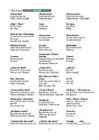
I am _____ years old. How old are you? (formal) How old are you? (informal) ¿Hablas inglés? ¿Habla usted español? (No) Hablo... ah-blahs een-glehs ah-blah oo-sted eh-spahn-yol noh ah-bloh Do you speak English? Do you speak Spanish? (formal) I (don't) speak... (informal) ¿Entiende usted? / ¿Entiendes? (No) Entiendo. Yo (no lo) se. ehn-tyen-deh oo-sted / ehn-tyen- noh ehn-tyen-doh yoh noh loh seh dehs I (don't) understand. I (don't) know. Do you understand? (formal / informal)
separate lg, there is Engl that bases on general L); contrastive (compares vocabularys in different languages). 2. Connection of L with other linguistic disciplines a) the word performes a certain grammatical function (nt, he always misses the class, how many misses are there; the girl powders her nose, soliders face powder)In speech words are combined according to grammatical rules. The plural of nouns may carry a new meaning (nt, arms-weapons, looks-appearance, works-plant) b)connected with phonetics. The meaning of a word is expressed by sounds and it depends on the order of sounds(spoonerism) c)history of the lg helps to understand ahanges in the meanings of words (nt, legend ment a book where a life of saints was described) d)stylistics is the sign of expressive means of the language. The same idea may be expressed in different ways and so may aquire a new meaning
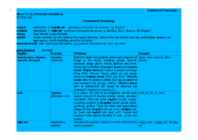
1 Grammatical Terminology PRACTICAL ENGLISH GRAMMAR FLGR.01.042 Grammatical Terminology analytic analüütiline (= uninflected - grammar is focused in the sentence , e.g. English) synthetic sünteetiline (= inflected - grammar is focused in the word, e.g. Estonian, Latin, Russian, Old English) ending lõpp (käände- ja pöördelõpud)
adjective + preposition omadussõna + eessõna proud of, good at, married to adverb particle Some verbs are followed by adverb particles. Examples are: put on, take off, give away, bring up, call in. Sometimes the particle is detached from the verb and put after the object. •He took his boots off. •They called the doctor in. apposition a grammatical construction in which two usually adjacent nouns having the same referent stand in the same syntactical relation to the rest of a sentence (as the poet and Burns in “a biography of the poet Burns”) back-reference In grammatical analysis, the term reference is often used to state a relationship of identity which exists between grammatical units, e.g. a pronoun 'refers' to a noun or noun phrase. When the reference is to an earlier part of the discourse, it may be called a 'back-reference' (or anaphora); collective noun
Review questions English lexicology Size of English vocabulary. Average speaker 45,000-60,000 words, a total of about 200,000. Core and periphery. English has been heavily influenced by other languages. 31.8 % comes from Old English, 45% comes from French, 16,7% comes from Latin, 4,2% other germanic languages and 2,3 other languages. The very core is mono-syllabic (93 of the first 100 words and the other seven are two-syllabic). The core vocabulary is predominantly germanic. Native and foreign element. Native words belong to very important semantic group (modal verbs-shall, will, can, may; pronouns- I, you, he, my, his; preps- in, out, under; numerals and conjunctions::but, till, as
To discuss this we need some terminology for talking about word-formation and diachronic lexical changes. The main grammatical mechanisms that languages have for creating new words are derivation and compounding. Some languages prefer one mechanism over the other. These mechanisms are fairly systematic and predictable and hence tend to feature in discussions of language structure. Derivation generally involves the use of affixation of various types, e.g. getting the noun derivation from the verb derive. Compounding involves putting together two existing elements of the lexicon (normally "content" words rather than grammatical words and affixes) to create a new word, like matchbox. In both derivation and compounding there is a strong element of compositionality, meaning that the meaning of the new word is broadly predictable from the meaning of its component parts. Probably the main non-grammatical way in which languages get words for new things is by
before the alveolar ridge. Dental sounds are produced by the tongue touching the front teeth. Bilabial sounds are produced by the contact of both lips. Labiodental sounds are produced by lip-to-teeth contact. Distribution is the act of looking sounds in different contexts and positions they can occur in. Any speech sounds must always have air flow and some kind of blockage or modification to the air flow. There are 2 kinds of sounds in English: Vowels that are produced do that the airstream is not obstructed – they can stand alone meaning that they can be produced without consonants before or after them Consonants that are produced with some restriction or closure in the vocal tract that the air flow is obstructed – consonants require some vowels around them To classify vowels, fixate: The height of the tongue – close, close-mid, open-mid, open
Leixcology revision questions 1) Composition of english vocabulary Vobabulary is the sum of a total of words used in a language by speekers or used in a dictionary. English vocabulary cosists of six units: Simple words- fall Complex words- prefall Phrasal word- face up to Compound word- face lift Multiword expression- face the music Shortened forms- prefab (prefabely?) 2) Core and pherifery English has been heavily influenced by other languages. 31.8 % comes from old english, 45% comes from french, 16,7% comes from latin, 4,2% other germanic languages and 2,3 other languages. The very core is mono-syllabic (93 of the first 100 words nad the other seven are two-syllabic). The core vocabulary is predominantly germanic. 3) Native and foreign elements Native vocabulary: INDO-EUROPEAN- mother, foot, heart, father, sea, night etc GERMANIC- friend, bidge, ship, life, heaven OLD-ENGLISH- bad, bird, woman, lady and gospel
Tallinna Mustamäe Humanitargümnaasium Valeria Jefremenkova ENGLISH AS A GLOBAL LANGUAGE INGLISE KEEL KUI ÜLEMAAILMNE KEEL Research work Supervisor: Jevgenija Kozlova Tallinn 2016 1 Table of Contents СONTENT…………………………………………………………………………………...2 INTRODUCTION…………………………………………………………………………...3
finding out what it is that random people find "sounding gay" or "sounding heterosexual". The articles have a nine year gap, and the newer, written 2015 also mentions Munson et al's research several times. One of the main differences between the researches is that while Munson et al included bisexual men and women, and also Lesbians, Erik.C. Tracy worked solely with the topic of gay men. Both, however, did their research on American English. As to the conclusions: * Yes, listeners can distinguish between LGB and heterosexual men and women. * Listeners rely more on vowels than consonants, and of those, only few. * The /s/ is the most important consonant when making a judgment. (also deriving from this topic, see "gay lisp" there were some excellent articles about that, too, but unfortunately they were about a research done in Belgium). But only if you are male. (Apparently there is a "gay lisp", but no
He plays the piano well. The rose is my favourite flower. We us a or an The dollar is a strong currency. only with singular nouns. The tiger lives in Asia. when we are talking about a thing in general. • when we refer to a system or service. Examples: When does the train arrive? We should call the ambulance.
The history of the English Language Kristin Klaus, 10a Short history · Started with the arrival of three Germanic tribes who invaded Britain during the 5th century AD · The tribes: the Angles, the Saxons, the Jutes · At that time the inhabitants spoke a Celtic language · The invadors pushed them west and north Germanic invaders entered Britain on the east and south coasts in the 5th century. Old English · 450-1100 AD · The Germanic tribes spoke similar languages which developed into Old English · Did not sound or look like English today · About half of the most commonly used English words have Old English roots · Be, strong, water Part of Beowulf, a poem written in Old English. Middle English · 1100-1500 · In 1066 William the Conqueror, the Duke of Normandy (part of modern France), invaded and conquered England · The new conquerors (called the Normans) brought
The Article Table of Contents General Rules....................................................................... 2 The Definite Article ............................................................... 5 Names that take the Definite Article...................................... 6 No article.............................................................................. 7 Countable and uncountable nouns ....................................... 9 General Rules There are two articles in the English language – the Indefinite Article and the Definite Article. The Indefinite Article has two forms – a and an (a precedes words beginning with a consonant sound and an precedes words beginning with a vowel sound). It comes from the Old English word ãn, which meant one. The Definite Article is the. It comes from the Old English word ţis, which meant this.
Officials were appointed (governors, procurators to collect taxes, look after the estates and mines and se that the gold, silver, iron and lead were exported back to Rome). Introduced schools,a new language Latin, large farms (villas), baths. In AD 410 they had to leave . roman occupation lasted nearly 400 years. They left behind very little. Roman province of Britannia covered most of present-day England and Wales. 4. Latin influence on English *The influence of Latin is noticeable also in the names of European cities: the Latin noun colonia (settlement, colony) may be found in numerous place-names: Lincoln, Colchester, Cologne ; from Latin word castrum (military camp) were derived English affixes -chester and -castle: Manchester, Lancaster, Newcastle; Latin word portus (seaport) in Portsmouth *-tor - person, doer, masculine form. The suffix is attached to the stem: victor (`winner', from the
Estuary English 1. The geographical dimension: Is `Estuary' English estuary? Estuary English is a dialect of English widely spoken in South East England, especially along the River Thames and its estuary. Phonetician John C. Wells defines Estuary English as "Standard English spoken with the accent of the southeast of England".[1] The name comes from the area around the Thames, particularly London, Kent, north Surrey and south Essex. The variety first came to public prominence in an article by DavidRosewarne in the Times Educational Supplement in October 1984. [2] Rosewarne argued that it may eventually replace RP (Received Pronunciation) in the south-east. Studies have indicated that Estuary English is
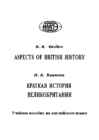
стран мира. 6 INTRODUCTION Aspects of British History presents a brief outline of the most significant milestones in the long and eventful history of Great Britain, such as the five successful invasions of the island, the birth of Parliament and transformation of an absolute monarchy into a constitutional monarchy, the origin of the English language, the rise and fall of the British Empire. The units contain an informative reading text on an important issue, preceded by preparatory discussion questions and followed by notes offering some additional information, and a vocabulary with relevant language notes. The main reading text is accompanied by comprehension, vocabulary and grammar exercises and discussion activities. Some of the units include reading passages.
Golden Grammar rules 1. Don't use an with own. Sue needs her own room. (NOT Sue needs an own room.) I'd like a phone line of my own. (NOT ... an own phone line.) 2. Use or rather to correct yourself. She's German or rather, Austrian. (NOT She's German or better, Austrian.) I'll see you on Friday or rather, Saturday. 3. Use the simple present play(s), rain(s) etc to talk about habits and repeated actions. I play tennis every Saturday. (NOT I am playing tennis every Saturday.) It usually rains a lot in November. 4. Use will ..., not the present, for offers and promises. I'll cook you supper this evening. (NOT I cook you supper this evening.) I promise I'll phone you tomorrow. (NOT I promise I phone you tomorrow.) 5
It also renders realistically the way the characters speak. The elliptical sentences convoy/render carelessness, familiarity, harshness. It makes the utterance tens and emotional or helps to stress most important elements. NT: I went to Oxford, as one goes to exile; she to London. APOSIOPESIS (Greek - silence) it is called break-in-the-narrative. APOSIOPESIS is an unfinished sentence where the speaker or writer suddenly stops in the middle, as if unable or unwilling to proceed. A indicates strong emotions, paralyzing the speaker or his desire to conceal part of information. NT: she must leave or better yet drown herself make away with herself at some way or The speaker's strong emotions therefore inability to finish. NT: And it was so unlikely that she had stolen his wallet that... well. NOMINATIVE SENTENCES NOMINATIVE SENTENCES are just a noun-sentence, containing a noun or a nominal-noun-phrase sentence. NOMINATIVE SENTENCES strengthen the dynamic nature of the narrative
English began as a west Germanic language which was brought to England bt the Saxons around 400 AD. The spoken and written laguage berween 400 and 1100 AD is referred to as Old English. Many words used today come from Old English. In the 9th and 10th centuries, when Vikings invaded England, Old Norse words entered the language English from about 1300 to 1500 is known as Middle English. It was influenced by French and Latin. French brouht many words connected with goverment. Modern English eas greatly influenced by the English used in London and changed a great deal until the end of the 18th century. Many words were introduced from Greek and Latin to express new ideas, especially in science, medicine and philosophy. Nowadays 80 percent of the word-stock is foreign-born. So we can say that most world languages have contributed some words to English at some time, and the process is now being reversed. Purists of the languages are resisting the
 annaabi.ee