Leidsid 33 sarnast õppematerjali, mis on seotud failiga "Henry Moore". Need materjalid aitavad sul teemat sügavamalt mõista.
moore, work, part, bronze, cast, scale, brick, henry, abstract, sculptures, particular, forms, figure, even, draw, before, casting, final, known, career, carved, support, usually, lying, figures, works, provide, drawing, still, able, took, working, shape, plaster, often, first, building, other, 30th, july, 1898, english, best, located, around, modernistGuy painted city life, Birch painted the seascape. The "Peale formula" was adhered to: objects along tableware against a dark background. Also, trompe-l'oeil persisted via Charles Willson's Peale's sons. Artists: Ralph Earl, Francis Guy, Thomas Birch, James Peale, Raphaelle Peale. Mid-C19 Landscape. In C19, landscape painting became dominant and provided many unexplored subjects. The tradition of landscape art emerged in the 1820s through the work of the so-called Hudson River School. The school of "luminism" is also distinguished, it is interested in the phenomenon of light. Exemplary artists. Thomas Cole (early-C19). He painted more in the Romantic mold than his contemporaries. He was inspired by the valleys of Catskill Mountains. He depicted lonely wilderness and apocalyptic visions. Albert Bierstadt (late-C19). He painted the last frontier, the heroic landscape of the country. He compiled a
Guy painted city life, Birch painted the seascape. The "Peale formula" was adhered to: objects along tableware against a dark background. Also, trompe-l'oeil persisted via Charles Willson's Peale's sons. Artists: Ralph Earl, Francis Guy, Thomas Birch, James Peale, Raphaelle Peale. Mid-C19 Landscape. In C19, landscape painting became dominant and provided many unexplored subjects. The tradition of landscape art emerged in the 1820s through the work of the so-called Hudson River School. The school of "luminism" is also distinguished, it is interested in the phenomenon of light. Exemplary artists. Thomas Cole (early-C19). He painted more in the Romantic mold than his contemporaries. He was inspired by the valleys of Catskill Mountains. He depicted lonely wilderness and apocalyptic visions. Albert Bierstadt (late-C19). He painted the last frontier, the heroic landscape of the country. He compiled a
Mõnda aega töötas maalrina, õhtuti õppis École des Beaux-Arts kunstikoolis (18971899). Aastatel 19021904 õppis Pariisis Academie Humbert'is. Georges Braque teenis Esimese maailmasõjas Prantsuse sõjaväes ja sai raskelt haavata. Ta kasutas maalis esimesena kirjatähti, imiteeris puu ja marmori faktuuri ning leiutas kollaazitehnika Robert Delaunay Robert Delaunay (12 April 1885, Paris 25 October 1941) was a French artist who used Orphism, which is similar to abstract art, abstraction and cubism in his work. Delaunay concentrated on Orphism, while his later works were more abstract, reminiscent of Paul Klee. His key influence related to bold use of colour, and a clear love of experimentation of both depth and tone. While he was a child, Delaunay's parents divorced, and he was raised by his uncle, in La Ronchère (near Bourges). He took up painting at an early age and, by 1903, he was producing mature imagery in a confident, impressionistic style.
3) JAMES WATT He was born in the small port of Greenock on the river Clyde in Scotland in 1736. His father was a mathematical-instrument maker and also kept a shop to supply ships with goods for their voyages. James was a delicate boy and often suffered from headaches. That is why he could not go to school at the age when other children did. His mother taught him to read and his father taught him writing and arithmetic. He had very good memory and a natural love of work. He liked mathematics and was also fond of designing and making things. James was an observant and thoughtful boy. When James was able to go to school, he was sent to a private school. He learnt many subjects there. In his spare time James began to make experiments. He built a small electrical apparatus with which he gave his friends shocks that made them jump. When James was 18 he decided to become a professional instrument- maker. He could not find anyone to teach him, so he went to London
Guinea, the Solomon Islands, Tuvalu, Saint Lucia, Saint Vincent and the Grenadines, Belize, Antigua and Barbuda, and Saint Kitts and Nevis. In 1947 she married Prince Philip, Duke of Edinburgh, with whom she has four children: Charles, Anne, Andrew, and Edward. In 1992, which Elizabeth termed her annus horribilis ("horrible year"), Charles and Andrew separated from their wives, Anne divorced, and a severe fire damaged part of Windsor Castle. Revelations continued on the state of Charles's marriage to Diana, Princess of Wales, and they divorced in 1996. The following year, Diana died in a Paris car crash, and the media criticised the royal family for remaining in seclusion 4 in the days before her funeral. Elizabeth's
prominently in many of the stories Kipling was writing for the Gazette. Kipling describes this time: "My month's leave at Simla, or whatever Hill Station my people went to, was pure joy--every golden hour counted. It began in heat and discomfort, by rail and road. It ended in the cool evening, with a wood fire in one's bedroom, and next morn--thirty more of them ahead!--the early cup of tea, the Mother who brought it in, and the long talks of us all together again. One had leisure to work, too, at whatever play- work was in one's head, and that was usually full." Back in Lahore, some thirty-nine stories appeared in the Gazette between November 1886 and June 1887. Most of these stories were included in Plain Tales from the Hills, Kipling's first prose collection, which was published in Calcutta in January 1888, a month after his 22nd birthday. Kipling's time in Lahore, however, had come to an end. In
Michelangelo went on to study sculpture at Medici gardens, where Leonardo da Vinci had also been taught. Following his sojourn at Medici gardens, Michelangelo went to Bologna, then to Rome, where he saw the impressive marble statues, which he would later echo in his own works. Upon his return, he set out to create his first complete sculpture, as statue of Mary holding Jesus' lifeless body, known as La Pietà. His first large scale commissioned work was the statue of Bacchus for a sculpture garden. Shortly thereafter, he created one of his most important works, the statue of David, and a commissioned piece symbolizing the freedom of the republic of Florence. Michelangelo truly had achieved fame as an artist, and his talent became sought after by Pope Julius II, who asked him to go on a very artistic ship-journey, a commission to paint the ceiling of the Sistine chapel in Vatican. At first,
especially by Thomas Paine in "The Age of Reason" and by Thomas Jefferson in his short Jefferson Bible from which all supernatural aspects were removed. Benjamin Franklin was influential in America, England, Scotland, and France, for his political activism and for his advances in physics. The American Dream is a national ethos of the United States, a set of ideals in which freedom includes the opportunity for prosperity and success, and an upward social mobility achieved through hard work. In the definition of the American Dream by James Truslow Adams in 1931, "life should be better and richer and fuller for everyone, with opportunity for each according to ability or achievement" regardless of social class or circumstances of birth. The idea of the American Dream is rooted in the United States Declaration of Independence which proclaims that "all men are created equal"
charter to found Tartu University, which was also named Academia Gustaviana in his honour. The memorial statue to King Gustav II Adolf (1594-1632) stood next to the main building of the university from 1928, until 1950, when it was removed by the Soviet occupation forces. With Swedish assistance, it was repaired and re-mounted 42 years later, in 1992. The King of Sweden was present both at the original and the re-opening of the monument. Elisabeth Tebelius-Myren authored the restored work. Karl Ernst von Baer monument Karl Ernst von Baer was a naturalist, the founder of comparative embryology and geocryology, recognized worldwide as the discoverer of the ovum in mammals. He was a student of Tartu University, practiced in the sciences in Königsberg and St. Petersburg, and was an academician at the St. Petersburg Academy of Sciences.Seven geographical objects worldwide have been named in his honour. A ritual for university students is washing the hair
from Walter Scott's Waverley novels. The tales, which include The Last of the Mohicans, recount the adventures of the great frontiersman Natty Bumppo, nicknamed `Leatherstocking'. Cooper shows great skill in weaving history into the exciting plots and in creating credible and identifiably Am characters. His works sold widely in Am, Britain and Europe. Edgar Allan Poe was a southerner who moved north to find work as an author and editor in Baltimore, Philadelphia and New York City. His gothic tales of horror included the Romantic elements of fantasy and terror. His masterpieces The Fall of The House of Usher (1839) and The Masque of the Red Death (1842) show a deeply analytical mind which Poe also applied to literary criticism. His novel The Murders in the Rue Morgue is widely considered to have given rise to the genre of detective stories
Manchester, Lancaster, Newcastle; Latin word portus (seaport) in Portsmouth *-tor - person, doer, masculine form. The suffix is attached to the stem: victor (`winner', from the verb vincere `to win'), spectator (spectare). *-orium - place, where the activity marked with the verb occurs: dormitorium (dormire `to sleep'). In English the suffix is -ory: dormitory. *tas - it denotes an abstract notion, derives from the adjective: celebritas (celeber), libertas (liber), universitas (universus). In English the suffix is -ty: celebrity, liberty, university. *-tudo - characteristic or condition, derives from the adjective: longitudo (longus), fortitudo (fortis). In English -tude: longitude, fortitude. 5. The Angles, Saxons and Jutes. The Angles were one of the main groups that settled in Britain in the post-Roman period, founding
After she studied at the Amherst Academy for seven years in her youth, she spent a short time at Mount Holyoke Female Seminary before returning to her family's house in Amherst. Thought of as an eccentric by the locals, she became known for her penchant for white clothing and her reluctance to greet guests or, later in life, even leave her room. Dickinson was a prolific private poet, though fewer than a dozen of her nearly eighteen hundred poems were published during her lifetime. The work that was published during her lifetime was usually altered significantly by the publishers to fit the conventional poetic rules of the time. Dickinson's poems are unique for the era in which she wrote; they contain short lines, typically lack titles, and often utilize slant rhyme as well as unconventional capitalization and punctuation. Many of her poems deal with themes of death and immortality, two subjects which infused her letters to friends. Walter Whitman
I was spread orally until it was written down in the 10th century. The author is unknown and the manuscript is kept in the British Museum (near Trafalgar Square). The story is very important as it allows us to lear about the way of life in the 4th century. The characters can be divided into two groups fictitious and historical. The epic deploys many metaphors - e.g. the sea = the swan's road, body = a house for bones and alliteration. It is structured as two parts. In the first part King Hroghtgar, king of Danes built a palace Hereot near a lake. He disturbed the lake monsters sleep with his racuous parties. Grendel then goes to the castle every night and kidnaps a man. This went on for 12 years. Beowulf, a young viking, decides to put an end to it. He chooses 14 men to join him and sails across the strait with no weapns, mind you, because Grendel fought unarmed and Beowulf was an idiot however according to the rules of fiction he defeats Grendel
By DAVID KAHN (abridged by the author) A SIGNET BOOK from NEW AMERICAN LIBRARV TIMES MIRROR Copyright © 1967, 1973 by David Kahn All rights reserved. No part of this book may be reproduced or transmitted in any form or by any means, electronic or mechanical, including photocopying, recording or by any information storage and retrieval system, without permission in writing from the publisher. For information address The Macmillan Company, 866 Third Avenue, New York, New York 10022. Library of Congress Catalog Card Number: 63-16109 Crown copyright is acknowledged for the following illustrations from Great Britain's Public Record Office: S.P. 53/18, no
earlier texts. Among the first to study Russian dialects was Lomonosov in the 18th century. In the 19th, Vladimir Dal compiled the first dictionary that included dialectal vocabulary. Detailed mapping of Russian dialects began at the turn of the 20th century. In modern times, the monumental Dialectological Atlas of the Russian Language ( [dlktitskj ats ruskv jzka]), was published in three folio volumes 19861989, after four decades of preparatory work. Orthography Russian spelling is reasonably phonemic in practice. It is in fact a balance among phonemics, morphology, etymology, and grammar; and, like that of most living languages, has its share of inconsistencies and controversial points. A number of rigid spelling rules introduced between the 1880s and 1910s have been responsible for the former whilst trying to eliminate the latter. The current spelling follows the major reform of 1918, and the final codification of 1956. An
well as a vigorous social campaigner. Considered one of the English language's greatest writers, he was acclaimed for his rich storytelling and memorable characters, and achieved massive worldwide popularity in his lifetime. Charles Dickens was born in Landport, Portsmouth in Hampshire, the second of eight children to John Dickens n 7 February 1812. The 12-year-old Dickens began working ten hour days in a Warren's boot-blacking factory. In May 1827, Dickens began work in the office of Ellis and Blackmore as a law clerk. At the age of seventeen, he became a court stenographer and, in 1830, met his first love, Maria Beadnell. Maria's parents disapproved of the courtship and effectively ended the relationship when they sent her to school in Paris. In 1834, Dickens became a political journalist, reporting on parliamentary debate and traveling across Britain by stagecoach to cover election campaigns for the Morning Chronice.
Viktoria Gumennaja 2018 INTRODUCTION "The city's the best gallery I could imagine." — JR I choose the topic for writing an essay - street art. Why did I choose this genre? Because for me it is something magical and special, not at all similar to those works that are in museums, at exhibitions and so on. Think for yourself, because street art began with the graffiti, and now we can see on the streets of our city just a work of art. I think graffiti, by the way, is also a great and invaluable work. Trends are changing. Now, young artists are moving from an endless unthinking tagging to a more conceptual and rich sense, abstract and volumetric work. Street art has become popular among the general public, because it is more accessible to him both in content and in location: for art, now you do not need to go to a museum or gallery, and the meaning of the work is often clear at a glance
This great number serves as motivation to confine myself to orchestral works. Moreover, this number may be somewhat larger if we take into account that I have no exact information about the activities of all Estonian composers living outside Estonia. From this uneven and variegated whole I had to choose works worthy of attention. Thus I have had to treat the symphonists in the same manner. I apologise if a colleague does not find his name mentioned. The volume for this extensive work is limited. As the manifold activity of several elder composers still has deep significance today, I have, for the sake of completeness, discussed their other spheres of operation. Symphonic music is divided into two large subsections: instrumental and choral (oratorio and cantata) works. The latter has been severely cut from this work; some examples from momentous stage and oratorical works constitute an exception. The
womens magazine. Anti human values of the city. Sacco and Vanzetti-two Americans of Italian origin, who were fighters of rights of workers. They were executed, it is been proved that they have been accused wrongfuly, it wasnt fair, they were communists. The 1930's saw the publications ,,USA trilogy"- 1."The 42nd Parallel", 2. ,,1919", 3. ,,Big Money". All the three books were published in 1930's. It's his masterpiece, the greatest work. He did a huge work. He traces the history of usa to the very end of the 19th century, the american-spanish war-to 1927, the execution of Sacco and Vanzetti. He shows history as a great operative force, wants to recreate history, wants to show that the causes of what is happening now has to be found somewhere in the history. Unlike other modernists Dos Passos is interested in the average man, more than other modernist authors. Geography of the novel extends from east coast to west coast
Olympiad. In the beginning the games lasted for only one day and comprised only one event, the running of one Stadion, but gradually more events were added resulting, towards the 5th century B.C., in the games lasting for 5 days. In total the Olympic Games consisted of 10 events: running, the pentathlon (viievõistlus), jumping, discus, "ekebolon" javelin, wrestling, boxing, the pancration, chariot racing and horse racing. All Greeks who were not criminals had the right to take part in the games. Women were not allowed to compete, they could not even watch the competition. The athletes presented themselves 1 moth before the games began at Elis, the organising town. The athletes had to swear that they would compete with honour and respect the rules. The victors enjoyed great honours and on returning to their cities their compatriots pulled down part of the walls for them to enter. They were also given special privileges and high office.
guitarist Pete Townshend, bassist John Entwistle, and drummer Keith Moon. They became known for energetic live performances which often included instrument destruction. The Who have sold about 100 million records and have charted 27 top forty singles in the United Kingdom and United States with 17 top ten albums, including 18 Gold, 12 Platinum and 5 Multi-Platinum album awards in the United States alone. The Who rose to fame in the UK with a series of top ten hit singles, boosted in part by pirate radio stations such as Radio Caroline, beginning in January 1965 with "I Can't Explain". The albums My Generation (1965), A Quick One (1966) and The Who Sell Out (1967) followed, with the first two reaching the UK top five. They first hit the US Top 40 in 1967 with "Happy Jack" and hit the top ten later that year with "I Can See for Miles". Their fame grew with memorable performances at the Monterey Pop and Woodstock music festivals. The 1969
Kadrina Secondary School Princess Diana Report Mattias Suurkivi 8.a Class Instructor: Katrin Mägi Kadrina 2009Contents Introduction I chose Princess Diana, because I wanted to know about her and I like the British royal family and she was a part of the family, too. She is dead and if somebody reads it, he or she can learn about her and will know what she was like. The purpose of the work is to introduce Diana and get to know her better. Diana Facts about Diana Main Facts Her full name is Diana Frances Spencer and she was the Princess of Wales. Diana was called people's Princess. She was born on 1. July 1961 in Park house, Sandringham, Norfolk. She was born at the same place as her mother
started during the days of the Industrial Revolution * the flag is of Wales bears a Red Dragon (it is not represented on the Union Jack) Northern Ireland: * the capital city is Belfast * 54% of people regard themselves as Protestants and 42% as Roman Catholics * the flag is called the Saint Patrick's Cross 2) History Prehistoric Britain, Roman Britain, Anglo-Saxon, Danish, Norman invasions (...-1066): Britain was part of the European land mass until the end of the last Ice Age. It became an island by about 6000 BC. From about 3000 to 2000 BC the British Isles were inhabited by a group of people called the Iberians. These Stone Age people lived in limestone caves, they used stone axes and fashioned antlers and bones into leather-working tools. Later groups of people from what are now Germany, the Netherlands and Brittany also settled in Briton.
1 The Medium Is the Message In a culture like ours, long accustomed to splitting and dividing all things as a means of control, it is sometimes a bit of a shock to be reminded that, in operational and practical fact,, the medium is the message. This is merely to say that the personal and social consequences of any medium-that is, of any extension of ourselves-result from the new scale that is introduced into our affairs by each extension of ourselves, or by any new technology. Thus, with automation, for example, the new patterns of human association tend to eliminate jobs, it is true. That is the negative result. Positively, automation creates roles for people, which is to say depth of involvement in their work and human association that our preceding mechanical technology had destroyed. Many people would be disposed to say that it was not the machine,
The French period (up to 1370). early works were based mostly on French models. The Italian period (up to c. 1387). Was influenced by Italian literature, especially Dante and Bocaccio. The English period. Wrote Canterbury tales. CANTERBURY TALES This unfinished poem of about 17,000 lines was written mostly after 1387. The poem introduces a group of pilgrims who are journeying from London to the shrine of Thomas à Becket at Canterbury. Chaucer originally planned that the work should contain 120 tales, four for each pilgrim, but at the time of his death he had only written twenty-four and some of them were not complete. The Prologue. The pilgrims are described in the General Prologue; together, they represent a wide cross-section of fourteenth-cent. English life, although the nobility and the poor are missing as they would not have taken part in this type of group pilgrimage. Why masterpiece: It is written in English in a period when it
he stumbled and got a deep wound in the right knee. What worried the most was that his tendon was about to be cut and doctors stated he would have never jumped like before. Fortunately he could go on practicing long jump and at the age of 13 he jumped 5,51 m. Then in the years after he realized a nice progression in this event: 6,07 m, 6,93 m, 7,26 m and 7,85 m when he was 17. Trainers pointed out him as a young promise. In fact in 1979 he was allowed to enter the national team and to take part to the Pan-American games in San Juan, Portorico. He arrived 1 hour late (because trainers gave him the wrong program of the games) but judges made him jump anyway after Carl's explanation. And it was really a worthy decision: he placed third with 8,13 m at the last jump. A prophetic measure as it was formerly Owens' world record (which lasted 25 years). Meanwhile he spent part of his time even to train in 100 m and in 1979 he run 10"67.
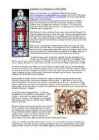
Edward was the oldest son of Ethelred II (Ethelred the Unready http://en.wikipedia.org/wiki/Ethelred_the_Unready) and Emma of Normandy (http://en.wikipedia.org/wiki/Emma_of_Normandy). He wast he penultimate Anglo-Saxon king of England. The family was exiled in Normandy after the Danish invasion of 1013 so Edward spent the first part of his life in Normandy. He grew up in deep religious views and gained the nickname ''Confessor''. As Edward was seperated from his family and grew up in a strange land, it is said that his childhood wasn't a happy one. After Ethelred's death in 1016 the Danes again took control of England. The throne of England passed to Canute the Great. The new king married Emma
information about Lai Street, as they need to pass the guide practice exam in form eleven. The report is divided into chapters so that each chapter deals with one of the important houses in Lai Street. In the beginning there are also two introductory chapters about Lai Street in general and the origin of the name "Lai". 3 Lai Street in general Lai Street is 520 m long and begins at a small green patch below the Toompea slope, where a graceful bronze statue of a Roe Deer by Jaan Koort (1883-1935), one of the best-known Estonian sculptors, has been standing for several decades. Lai Street stretches from Nunne Street to Pikk Street. Parallel with Pikk Street, Lai Street, too, ends at the Great Coast Gate (first mentioned 1359). Lai Street is very wide considering that it was laid out in the Middle Ages. This is because it sprang up on both sides of former city wall. Lai is quite a peaceful street with few shops
7) Analysis To begin with, the 18th century was all about the rebirth of classicism and antiquity. Surprisingly, it was very hard for David to find examples from Antique, because they almost did not exist. Only some paintings that were meant for decor in Pompeii were preserved. That is why he went to Pompeii for an expedition, in order to best represent the classicism requirements. David painted carefully all the contours and forms of the human body, because he started to imitate Antique sculptures. Moreover, David and Classicism in general were not limited to only mimicking the external form of the Antique, but also the plot was often borrowed from the Antique literature or mythology. Best suited were the subjects that glorified bravery, loyalty, love for the fatherland and other virtues. Paintings were supposed to be instructive and fight against vices. (Leesi, 2003, p.115) As a matter of fact, the whole life of Jacques-Louis David was somehow connected to
Since the beginning of time, the goal of bridge builders has been to create as wide a span as possible which is commodious, firm, and occasionally delightful. Spanning greater distances is a distinct measure of engineering prowess. In terms of engineering, bridges are discussed by design or type (beam, arch, truss, cantilever, suspension, or moveable); length (usually expressed in terms of clear or overall span); and materials (stone, wood, cast and wrought iron, and what we use today - concrete and steel). The purpose of this contextual essay is to provide parameters of value and significance so that we can focus our attention on those bridges - globally - that best illustrate the history of bridge building, and to encourage their preservation. What is a World Heritage bridge? The World Heritage Committee states that to be of World Heritage status a monument or site must be of outstanding universal value
kool Research work Styles in interior design nimi TALLINN2010 Interior design is a multifaceted profession in which creative and technical solutions are applied within a structure to achieve a built interior environment. The interior design process follows a systematic and coordinated methodology, including
observing the writings of the men with whom he worked. When Mr. Auld discovered this, he strongly disapproved, saying that if a slave learns to read, he would become dissatisfied with his condition and desire freedom; Frederick later referred to this as the first anti-abolitionist speech he had ever heard. In 1833, Capt. Auld took Douglass back from his brother after a dispute ("as a means of punishing Hugh", Douglass says). Dissatisfied with him, Thomas Auld then sent Douglass to work for Edward Covey, a poor farmer who had a reputation as a "slave-breaker," where Douglass was whipped regularly. 3 Sixteen-year-old Frederick was indeed nearly broken psychologically by his ordeal under Covey, but finally rebelled against the beatings and fought back. Covey lost out on a confrontation with Frederick and never tried to beat him again. This incident was kept
British authors from the United Kingdom, which includes England, Scotland, Northern Ireland, Wales, the Channel Islands, and Isle of Man Includes early works written in Gaelic, Welsh, and Latin, works in Old, Middle, and Modern English, each of which represents a different period Full of great works British works in Latin Venerable Bede He lived between 673 and 735 AD The greatest of all the AngloSaxon scholars He's the earliest English historian, whose work has shed light on a period of English history that would have otherwise been unknown ,,The Father of English History" Wrote / translated about 40 books on almost every area of knowledge, i.e. nature, astronomy, and poetry His best known work is "The Ecclesiastical History of the English People" Starting with the Roman invasion in the 5th century, he recorded the history of the English up to his own day Old English Cædmon ,,The Father of English Hymn"
 annaabi.ee