Leidsid 33 sarnast õppematerjali, mis on seotud failiga "Georgian Era in Britain". Need materjalid aitavad sul teemat sügavamalt mõista.
revolution, prince, elector, british, cause, rule, came, britain, industrial, throne, parliament, became, mother, years, regent, support, battle, napoleon, beginning, first, england, queen, speak, english, walpole, prime, period, changed, stuart, royal, agriculture, colonies, could, temporary, castle, reform, children, europe, building, sometimesIt is one of the most famous prehistoric sites in the world and is composed of earthworks surrounding a circular setting of large standing stones. The surrounding circular, earth bank and ditch, have been dated to about 3100 BC. Stonehenge was produced by a culture with no written language. Many aspects of Stonehenge remain subject to debate. There is little or no direct evidence for the construction techniques used by the Stonehenge builders. *The Celts in Britain and their legacy The Cets lived in Britain in The Iron Age. They were warring tribes who were battleful amongst themselves as well as inter-tribal war. They were not centrally governed. The Celts brought iron working, iron ploughs and metal swords, horses, wheels and chariots - all these things gave them an instant superiority over the native tribes. The Celts built a number of hill forts throughout the region. The society was divided
Britain History Pre-Norman Britain The Iberians brought their metal-working skills and the first real civilization to Britain in the third millennium B.C and were overrun by various Celtic invasions that began in the 8th century. The Celts introduced their tribal organization and an early form of agriculture before they were forced westward by the Roman invasion. Forms of Celtic language are still spoken in Britain. Romans (with Julius Caesar in the head of them) first tried to occupy Britain in 55 B.C., but there was a rebellion in Gaul so they had to leave to fight against it. Next time they came in 43 A.D. and their leader was Emperor Claudius. Romans brought a lot with them. Their brought paved roads, the sites of important cities, the seeds of Christianity, the Roman law, Roman baths, language and advanced civilization. They also built Hadrian's Wall in 122 A.D
Stonehenge One of the best known ancient wonders of the world, 5000 years old Megalith monument, built by western mediterraneans during 3000-1600 BC Circular structure, large standing stones, aligned with rising sun at teh solstice Attlers and bones were sued to dig pits that hold the stones The Celts in Britain and their legacy 700-200 BC celts invade Britain Gaels or Goehls(Ireland and Scotland),Cymri(Wales) and Brythons(gave name to Brittany) Fierce fighters,superb horsemen.Most of them farmers, lived in thatched houses Good at art, craftmanship, used iron Divided into tribes, ruled by kings, only in face of danger would they choose a single leader Legacy- hill-forts, farms, churches, field system, woodland, pasture, weapons, iron objects, langugae, culture Caesar in Britain The great Roman Emperor
[2] Victoria's father died when she was eight months old. The Duchess of Kent developed a close relationship with Sir John Conroy, an ambitious Irish officer. Conroy acted as if Victoria was his daughter and had a major influence over her as a child. [2] Edward, Duke of Kent Victoria Maria Louisa of Saxe-Coburg When Princess Victoria of Kent was eleven years old, her uncle, King George IV, died childless, leaving the throne to his brother, the Duke of Clarence and St Andrews, who became King William IV. As the new king was childless, the young Princess Victoria became heiress-presumptive to the throne. Since the law at that time made no special provision for a child monarch, Victoria would have been eligible to govern the realm as would an adult. In order to prevent such a scenario, Parliament passed the Regency Act 1831, under which it was
British history Roman Britain Roman Britain was those parts of the island of Great Britain controlled by the Roman Empire between 43 and about 410. The Romans referred to their province as Britannia. Prior to the Roman invasion, Iron Age Britain already had cultural and economic links with Continental Europe, but the invaders introduced new developments in agriculture, urbanization, industry and architecture, leaving a legacy that is still apparent today. Historical records beyond the initial invasion are sparse, although many Roman historians mention the province in passing. Most of the knowledge of the period stems from archaeological investigations and especially epigraphic evidence.
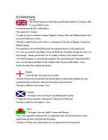
1) General facts The UK: * the United Kingdom of Great Britain and Northern Ireland was formed in 1801 * it covers 243,610 sq km * everybody from the UK is called British * the capital city is London * is made up of four constituent countries: England, Scotland, Wales and Northern Ireland which in turn are divided into counties * the flag is called the Union Jack which is a combination of the flags of England, Scotland and Northern Ireland * the population is about 60,000,000 people, the population density is 242 people/sq km * its coasts are washed by the Atlantic Ocean, the North Sea, the English Channel, the Celtic Sea,
Country Study Mari-Liis Luukas 11c The British Isles Administrative / d'mnstrtv / haldus- Self-governing / self'gvn / isemajandav, iseseisev Legislative assembly/ 'ledsltv 'sembl/ seadusandlik kogu
History of Great Britain Prehistory (55BC) no written records 6th 3rd c. BC the Celts came to British isles hill figures, hill forts, stone circles ( Stonehenge ) RomanBritain (55BC 400AD) Julius Caesar, named the country Albion Hadrian's Wall, villas, roads, the town of Bath The AngloSaxon, Danish and Norman invasions Germanic tribes settled and stayed Anglia Christianity was brought, religion became important, churches were built 8th century = raids by the Vikings and the Danes 1016 1042 : Under Danish rule ( York was the capital ) 1042 : local AngloSaxons regain their rule
ENGLISH LITERATURE Ancient Britain Lived on the British Isles in the 1st millenium. They most probably came from Eastern Europe and belonged to the Celtic race and also spoke Celtic. They were primitive hunters- gatherers, farmers. Some Celtic words are still used in modern English, however they are used mostly in place names. For example: · avon river · cumb valley · ford shallow place in the river Ancient Britons had their own religion and priests or druids and temples. In the year 55 BC Britain became a Roman province. Romans were highly developed and
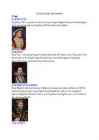
British kings and queens Kings King Henry VIII King Henry VIII is arguably the most well-known king of England. Famous for beheading his wives, of which he had six, King Henry VIII also had several children. King James I King James I was already King of Scotland when he got the English crown. King James I was the first ruler to call himself King of Great Britain, as he ruled England, Scotland and Wales. King James was the first King of Great Britain. King William I, the Conqueror King William I, otherwise known as William the Conqueror was born in France on 1028. He became friendly with the current English King, Edward the Confessor. He invaded and attacked England on Edward's death, as he was promised the English crown, but then denied it by the Saxon Harold. King George VI King George VI did not expect to become king, he was the shy brother of Edward VIII who only took the thrown when Edward abdicated
immoral. They were also fiercely anti-Catholic and suspicious of the apparent sympathy towards Catholicism of the Stuart monarchs. ☄ This led to The Civil War ☄ Victory for the parliamentary force ☄ The king (Charles I) was captured and became the first monarch in Europe to be executed after a formal trial for crimes against his people. 1649 Charles I is executed. For the first and only time, Britain briefly becomes a republic and is called the Common wealth. 1660 The monarchy and the Anglican religion are restored. ☾ The church was restored. However, the conflict between monarch and Parliament soon re-emerged ☾ Prince William and Mary became the king and the queen so this way it was established that a monarch could rule only with the support of Parliament. ☾ Bill of Rights, which limited some of the powers of the monarch 1666
with the technology of the time. Another is its purpose. It appears to function as a kind on astronomical clock and we know it was used by the Druids for ceremonies marking the passing of the seasons. It appears in number of novels. These days it is not only the interest of tourists but is also a gathering point of certain minority groups. It is now fenced off to protect it from damage. 3. The Roman conquest Julius Caesar's first raid was in 55 BC but the romans left. Ad 43- the Romans came to stay. The army established Roman rule in the south and SW of the country. The Romans started to introduce their laws to a new province of the Roman Empire and started to build good roads. Officials were appointed (governors, procurators to collect taxes, look after the estates and mines and se that the gold, silver, iron and lead were exported back to Rome). Introduced schools,a new language Latin, large farms (villas), baths. In AD 410 they had to leave
House of Commons first and that grew anger in the country. Parliament established its supermacy over the monarchy The ideological Protestantism had grown in England. They regarded the luxorious lifestyle of the KInga and his followers as immoral The civil war, which ended with complete victory for the parliamentary forces The Glorious Revolution-because it was bloodless, in which Prince William of Orange, ruler of the Netherlands, and his Stuart wife Mary accepted the Parliaments invitation to become king and queen. The Bill of rights, which limited some of the monrarchs powers The Prebyterian Church was granted its legality The 18th Century in 1707, the Act of union was posed and the former two kingdoms became The united kingdom monarch and parliament on on quite well together
Medieval England 1066-1485 Eva Asper Anna Pohlak 11.c The Norman Dynasty The Norman Conquest In the 11th century, Normans conquered England - The Battle of Hastings 14.10.1066 The Anglo-Saxon forces had more soldiers but the Normans had better military tactics and won in the end thanks to a clever strategy William I, also known as William the Conqueror, replaced King Harold on the throne The invasion was completed by 1071 - The Norman invasion is depicted on the Bayeux Tapestry a long embroidered cloth The death of King Harold embroidered on the Bayeux Tapestry The Norman England William I ensured his power by dividing the land into parts and making 1/7 of it a royal domain He made his nobles swear an oath of allegiance and become his vassals Died in 1087 while fighting in France, was
House of Winsdor. Their influence on modern society, key personalities. People all over the world are obsessed with the British royal family. Most fans know all the royal names and faces, the line of succession to the throne, and even the family's rarely- used last name. But let's start from the beginning. The House of Windsor is the reigning royal house of the United Kingdom and the other Commonwealth realms. The dynasty is of German paternal descent and was originally a branch of the House of Saxe-Coburg and Gotha, itself derived from the House of Wettin, which succeeded the House of Hanover to the British monarchy following the death of Queen Victoria, wife of Albert, Prince Consort.
1. The Queen’s official title. Elizabeth the Second, by the Grace of God, of the United Kingdom of Great Britain and Northern Ireland and of Her other Realms and Territories Queen, Head of the Commonwealth, Defender of the Faith. 2. The Queen’s working day. Starts after breakfast. Reads the newspapers which are prepared by the Press Secretary, and a report on the previous day’s proceedings in the Parliament and the letters she receives. Also phone calls. Once a month she attends the Privy Council in order to give Royal Assent to various
материала, закрепление словаря и развитие навыков ведения беседы по тематике пособия. Пособие предназначено для студентов гуманитарных специальностей. Подготовлено на факультете лингвистики. The book contains an overview of the most important events in British history – from the first documented invasions of the island to the formation and fall of the British colonial empire. A series of exercises will help to remember the subject matter, practise the vocabulary and contribute to skills work. The book is intended for the Humanities students. Вавилов Н.А., 2008 3 4 Contents 5 ПРЕДИСЛОВИЕ
Years 1154-1485 Henry I was the first unquestioned ruler. One of the most important kings in the Middle Ages. He had lands in Britain & France. Then the government was the monarch, a person, not a place. He had more land than any pervious king. After his marriage to Eleanor of Aquitaine, he also ruled the lands south of Anjou. His empire stretched from the Scottish border to the Pyrenees. England provided most of its wealth, but the heart was Anjou. Henry II began to regain royal control. During the war some barons had become very powerful. He pulled down some of their castles. He tried to restore law & order. He wanted
Son William Rufus Westminster Palace and Westminster Hall. The 14th century a turbulent 1337 Hundred Years War against period France 1348 the Black Death, a quarter of the British people died The Tudor era (1485 1603) Henry Tudor end to the Wars of the Roses (1455- 1488) Henry VIII - 1534 the Breach with the papacy Act of Supremacy made
This is assured by the fact that many great castles and other buildings, including the Tower of London, were built during the Norman Conquest. In 1086. Domesday Book was compiled. It is a detailed survey of England ordered by William the Conqueror. The reign of King William Rufus who was the son of William started in 1087 and lasted until 1100. Next king was Henry I who was the brother of William Rufus. His reign was from 1100-1135. In 1135 Henry I nephew Stephen got to the throne of England and reigned the country for 19 years. He was the last Norman king of England and his reign ended in 1154. From 1154 until 1377 the Plantagenet Kings of England ruled the English. The first Plantagenet King was Henry II. He was the grandson of Henry I. He had struggles with Thomas Beckett, who was the Archbishop of Canterbury. Beckett ended up being murdered in Canterbury's cathedral in 1170. Henry II reign ended in 1189 and the next King of England was his third son Richard
London History The Romans AD 43- AD 410 The Romans finally invaded Britain in AD 43 from Kent. The Romans lead by Julius Caesar attempted to invade Britain twice before that in 55 and 54 BC but the invasions were unsuccessful. They made their way to the river Thames and sailed up it. The Romans knew it was important to control a crossing point at the river Thames, so they decided to build a settlement on the north bank. Although small settlements had been built on the banks of the Thames, the Romans were the ones who built the first city. They called their city Londinium.
inherent in the English society (rebellions over relatively minor issues), but their society is more utopian compared to the English society. WIKI Lilliput and Blefuscu were intended as, and understood to be, satirical portraits of the kingdom of Great Britain and the kingdom ofFrance, respectively, as they were in the early 18th century. Only the internal politics of Lilliput are described in detail; these are parodies of British politics, in which the great central issues of the day are belittled and reduced to unimportance. For instance, the two major political parties of the day were the Whigs and the Tories. The Tories are parodied as the Tramecksanor "HighHeels" (due to their adhesion to the high church party of the Church of England, and their exalted views of royal supremacy), while the Whigs are represented as the Slamecksan or "LowHeels" (the Whigs inclined toward low church views, and believed
It is about the men (and women) who lost their lives fighting in the World Wars. It's celebrated then, because that's the day WWI was ended with a treaty. 4. Which powers does the Queen of the UK have? The Queen has to sign all the bills for them to pass. She is the one who opens the Parliament every fall for the next session. She is however more of a representative than an actual decision maker these days. 5. What is the British Parliament made up of? What are their roles? It's made of 3 parts: the monarch, the House of Commons and the House of Lords. The House of Lords can ask the House of Commons to rewrite parts of the bill. The bill needs the Queen's signature to pass. The House of Commons writes the bills. 6. What do you know about the Wars of the Roses? It was a war between two families, one had a red rose as their symbol and the other had a white rose as their symbol
son William II Rufus when he went to the holy land to fight the Muslims. When William Rufus died, he had no son to take the crown. At the time of William's death, his father was on his way back from the holy land. Their younger brother Henry acted quickly and took the crown for himself. That made Robert very angry and tried to invade England. In 1106 Henry invaded Normandy and captured Robert. The two countries were now reunited under one king. Henry hoped to give the throne to his son, who unfortunately drowned. He hoped for another son, but got a daughter Matilda instead. Matilda married to a great French noble to make the family stronger. When Henry died, there were to heirs. One was Henry's nephew Stephen who was in England and Matilda who was in France. Stephen acted quickly and claimed the throne to himself. Matilda invaded England a few years later. That led to a terrible civil war. Neither side could win so Matilda agreed to let Stephen be king, but her son
years ago, and the first villages around 6,000 years ago. The well-preserved village of Skara Brae on the Mainland of Orkney dates from this period. Neolithic habitation, burial and ritual sites are particularly common and well-preserved in the Northern Isles and Western Isles, where lack of trees led to most structures being built of local stone. Roman influence The written protohistory of Scotland began with the arrival of the Roman Empire in southern and central Great Britain, when the Romans occupied what is now England and Wales, administering it as a province called Britannia. Roman invasions and occupations of southern Scotland were a series of brief interludes. In 834 AD the general Gnaeus Julius Agricola defeated the Caledonians at the battle of Mons Graupius, and Roman forts were briefly set along the Gask Ridge close to the Highland line (none are known to have been constructed beyond that line)
governess, Louise Lehzen, and the Reverend George Davys at home. She was certainly busy.( Queen Victoria published two books during her lifetime, 'Leaves from the Journal of Our Life in the Highlands' and 'More Leaves' in 1868 and 1884 respectively.) She was given religious instruction and lessons in French, Latin, German, Italian, arithmetic, drawing, music, geography and history . A young Victoria In 1837 Queen Victoria took the throne after the death of her uncle William IV. Due to her secluded childhood, she displayed a personality marked by strong prejudices and a willful stubbornness. Barely eighteen, she refused any further influence from her domineering mother and ruled in her own stead. Popular respect for the Crown was at a low point at her coronation, but the modest and straightforward young Queen won the hearts of her subjects. She wished to be informed of political matters, although she had
states. However, the country's international status was greatly reduced during the 19th century, especially following the Independence of Brazil, its largest colony. After the 1910 revolution deposed the monarchy, the democratic but unstable Portuguese First Republic was established, itself being superseded by the "Estado Novo" authoritarian regime. Democracy was restored after the Portuguese Colonia l War and the Carnation Revolution in 1974. POPULATION As of 2011, the population of Portugal was 10,562,178, of which 547,733 live in Lisbon, the country's capital and largest city, located in the South, and 237,591 in Porto, also known as Oporto, the second-largest city, located in the North. The country is a democratic republic with a president (currently Aníbal Cavaco Silva) and prime minister (currently Pedro Passos Coelho). Since the 1990s, Portugal's economic development model has been slowly changing
The Renaissance In the history the Middle Ages were followed by the Renassance period. During this period a new class called bourgeoeisie came into being. This is the period when monarchies based on nationality were estabilished. The Renaessance started in Italy In the 14th century. Then it spread all over Europe, reached England in 16th century. The struggle for power culminated in a war called The War of Roses. It was a civil war between two dynasties, families. They had different emblems on one side the Yorks (white rose) other Lancasters (red). They couldn't decide who gets the throne. War ended 1485
Protestantism and other religious reforms by J. Calvin and M. Luther. For that, the pope named Henry VIII the Fidei Defensor, meaning Defender of the Faith 4. Why did Mary I get the nickname Bloody Mary? Because during her reign, England became officially a Roman Catholic country, Parliament persecuted a lot of protestants and over 300 people who were burned at the stake. 5. Historians often speak about different ages or times in British history. When (in which centuries) were the following ages: Elizabethian, Georgian, Victorian. Characterise each of them (2 3 sentences). Elizabethian time started in the middle of 16th century and ended in the beginning of 17th century. During Elizabeth I reign, England became independent of the Pope in religious matters, England's overseas expansion began. It was a prosperous period. Georgian time was from the beginning of 18th century to 19th century
tools, means of travel, etc.). They pride themselves on their distinctiveness from both the cultures from which they are descended. 3. From where have the Indians come to Canada? When? Less than 500 years ago, the only people living in Canada were the Aboriginal people of Canada. They all collectively refer to themselves as the First Nations or First Peoples of Canada. However, there are many different cultural groups. Scientists do not agree on where First Nations people came from, or how they got to North America, but they do know that First Nations people are genetically related to people in parts of Asia. Scientists know that First Nations people have lived in what is now Canada for at least 12,000 years, because they have found bones and artifacts that go back that far. Many scientists now believe that some of the First Peoples may have been here for much longer than that.
had more men. Eventually, the Ramons conquered the Geeks. History call people Romans because they never stayed in one place for very long. At Roman banquets, the guests wore garlic in their hair. Julius Caesar extinguished himself on the battlefields of Gaul. The Ides of March killed him because they thought he was going to be made king. Nero was a cruel tyrany who would torture his poor subjects by playing the fiddle to them. Then came the Middle Ages. King Alfred conquered the Dames, King Arthur lived in the Age of Shivery, King Harlod mustarded his troops before the Battle of Hastings, Joan of Arc was cannonized by George Bernard Shaw, and the victims of the Black Death grew boobs on their necks. Finally, the Magna Carta provided that no free man should be hanged twice for the same offense. In midevil times most of the people were alliterate. The greatest writer of the time was Chaucer, who wrote many
Technical English, Scientific English, English for medical professionals, English for waiters, English for tourism, English for Art Purposes, etc 4. What is the difference between settlement colonies and the trading empire (dependencies)? Settlement colonies were regions colonized by the UK that later established governments and became dominions and independent. Dependencies were regions in the world that became trading partners and where English became a second language. 5. Which British colonies became dominions? What was their status? Is the name dominion used for these countries nowadays? The first dominions were Canada (1867), Australia (1901), and New Zealand (1907) The name "dominion" is not used anymore. 6. Which organisation unites Britain and most of its former colonies nowadays? The Commonwealth unites Britain with its former colonies. Ireland 1. Who were the early inhabitants of Ireland?
Mary was born in London on February 18, 1516, the daughter of Henry VIII by his first wife, Catherine of Aragón. Because Henry divorced Catherine, Mary was declared illegitimate. Nonetheless, Henry included her in his will, and on the death of her half-brother, Edward VI, on July 6, 1553, she became the legal heir to the throne. Although Lord High Chamberlain John Dudley, Duke of Northumberland, favoured the succession of his daughter-in-law, Lady Jane Grey, and proclaimed her queen on July 10, the country supported Mary. As a Roman Catholic, Mary began her reign by sweeping away the religious innovations of her father and her brother. Henry VIII had separated England from the Church in Rome; Edward VI had replaced Roman Catholicism with a Protestant settlement. Mary restored the
 annaabi.ee