Leidsid 33 sarnast õppematerjali, mis on seotud failiga "Charles Dickens". Need materjalid aitavad sul teemat sügavamalt mõista.
dickens, novel, novels, work, create, character, popular, english, characters, laws, italy, first, other, serial, class, twist, child, february, 1812, eight, children, victorian, literature, stories, never, gone, print, gave, raised, support, copyright, 1835, became, engaged, catherine, hogarth, 1844, abroad, france, until, 1847, june, stroke, appearedCharles Dickens Charles John Huffam Dickens was the foremost English novelist of the Victorian era, as well as a vigorous social campaigner. Considered one of the English language's greatest writers, he was acclaimed for his rich storytelling and memorable characters, and achieved massive worldwide popularity in his lifetime. Charles Dickens was born in Landport, Portsmouth in Hampshire, the second of eight children to John Dickens n 7 February 1812. The 12-year-old Dickens began working ten hour days in a Warren's boot-blacking factory. In May 1827, Dickens began work in the office of Ellis and Blackmore as a law clerk. At the age of seventeen, he became a court stenographer and, in 1830, met his first love, Maria Beadnell. Maria's parents disapproved of the courtship and effectively ended the relationship when they sent her to school in Paris. In 1834, Dickens became a political journalist, reporting on parliamentary debate and
English Literature ,Victoria Age 1) Overview of the Victorian age · Periodization During the reign of Queen Victoria (1837-1901) · Why is the Victorian Age compared to the Elizabethan Age? Both are associated with the reign of a very popular queen; Victorian age idealised the Elizabethan Age; many changes in different fields- economy, religion etc.; focusing more on people's attitudes, political developments etc; Victorian age was inspired by Elizabethan era; Britain became an empire · What were the most important changes in politics, religion and social life that occurred during the Victorian age? Politics: 1848 Chartist movement (voting right for the working class); women's suffrage movements;
Outstanding figures in British literature Eva Martina Põder 11.b British literature Refers to all literature produced by British authors from the United Kingdom, which includes England, Scotland, Northern Ireland, Wales, the Channel Islands, and Isle of Man Includes early works written in Gaelic, Welsh, and Latin, works in Old, Middle, and Modern English, each of which represents a different period Full of great works British works in Latin Venerable Bede He lived between 673 and 735 AD The greatest of all the AngloSaxon scholars He's the earliest English historian, whose work has shed light on a period of English history that would have otherwise been unknown ,,The Father of English History" Wrote / translated about 40 books on almost every area of knowledge, i.e. nature, astronomy, and poetry
(teach right from wrong) or ecclesiastical (biblical subject). Middle ages – English becomes a literary language. Geoffrey Chaucer (1343–1400) – Father of English literature, The Canterbury Tales in English, increased the prestige of the language, provided a standardised form. The Canterbury Tales: frame story. Majority in verse, some prose. Intended to contain 124 stories, only finished 24. Story: a pilgrimage to Canterbury Cathedral, where archbishop Thomas Becket had been murdered
In Deism, there is no interference by a deity, and man controls his own destiny. These ideas stirred the masses into action, as the people dreamed of carving their own futures. Adopted by the Founding Fathers, Enlightenment ideals became the vision for modernday America, where these ideologies are deeply rooted in the nation. The Enlightenment was important America because it provided the philosophical basis of the American Revolution. The Revolution was more than just a protest against English authority; as it turned out, the American Revolution provided a blueprint for the organization of a democratic society. And while imperfectly done, for it did not address the terrible problem of slavery, the American Revolution was an enlightened concept of government whose most profound documents may have been the American Declaration of Independence and United States Constitution. To feel the full impact of the Enlightenment
lending library in America and first fire department in Pennsylvania. He was an early proponent of colonial unity, and as a political writer and activist he supported the idea of an American nation.As a diplomat during the American Revolution he secured the French alliance that helped to make independence of the United States possible. A year after Benjamin Franklin's death, his autobiography, entitled "Memoires De La Vie Privee," was published in Paris in March of 1791. The first English translation, "The Private Life of the Late Benjamin Franklin, LL.D. Originally Written By Himself, And Now Translated From The French," was published in London in 1793. Known today as "The Autobiography of Benjamin Franklin," this classic piece of Americana was originally written for Franklin's son William, then the Governor of New Jersey. Noah Webster Noah Webster (October 16, 1758 May 28, 1843) was an American lexicographer, textbook
the Slavic languages. It is also the largest native language in Europe, with 144 million native speakers in Russia, Ukraine and Belarus. Russian is the eighth most spoken language in the world by number of native speakers and the seventh by total number of speakers. The language is one of the six official languages of the United Nations. Russian is also the second most widespread language on the Internet after English. Russian distinguishes between consonant phonemes with palatal secondary articulation and those without, the so-called soft and hard sounds. Almost every consonant has a hard or a soft counterpart, and the distinction is a prominent feature of the language. Another important aspect is the reduction of unstressed vowels. Stress, which is unpredictable, is not normally indicated orthographically. though an optional acute accent ( , znak udareniya)
Ameerika Kirjandus 30.01.13 Naturalism · France, Emile Zola · Put down his theory in 1879: Le Roman Experimental, attempt to explain the development of human society throuch biological laws · Outlook is deterministic, pessimistic, fatalistic (fate or biology) · Man as an animal-clever than other beasts, still explainable within the framework · Man is not a free agent, is govern by something · Unable to determine his own faith · Hereditary · Naturalists tried to apply in fiction the processes of natural sciences · Writers task is to record facts, systems of behaviour, living conditions, never revealing
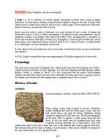
ENGLISH LITERATURE Ancient Britain Lived on the British Isles in the 1st millenium. They most probably came from Eastern Europe and belonged to the Celtic race and also spoke Celtic. They were primitive hunters- gatherers, farmers. Some Celtic words are still used in modern English, however they are used mostly in place names. For example: · avon river · cumb valley · ford shallow place in the river Ancient Britons had their own religion and priests or druids and temples. In the year 55 BC Britain became a Roman province. Romans were highly developed and had their own language latin, which has also greatly influenced English. The military occupation of the Isles ended in 410 AD
biographies, accounts of voyages, diaries, sermons, pamphlets. Much of the material addressed the problems of Church and State. There were few examples of fiction, poetry or drama. Anne Bradstreet of Massachusetts published some lyrical poems of high literary quality (1650) and Edward Taylor, who was born in England but lived in Boston, wrote some poetry in the style of John Donne and the metaphysical poets. All 17 th cent Am writings were, both in content and form, similar to English lit of the same period. The great literary figures of the 18th cent were Benjamin Franklin (1706-1790), Thomas Paine (1737-1809) and Thomas Jefferson (1743-1826). The common sense and witty aphorisms of Franklin's popular Poor Richard's Almanac series appealed to colonial readers. Franklin also wrote effectively on the question of allegiance to the British crown but it was his protégé, Thomas Paine, who
We are in Heaven that can only be Anglican, filled with deep inner piety which spoke of the anguish of heart in its search for God.Church resumed as holy place again, restoration, beautification, painting and sculpture aided liturgy. 7. 17th century philosophical writing (Burton, Browne, Hobbes) Thomas Hobbes: Leviathan – developed his political philosophy. Man by nature selfishly individualistic animal, constant war with other men. Fear of violent deat principle motive causes them to create state and submite to sovereign, whose power, though derived from people, is absolute and not subject to law. Though he favoured monarchy as the most effective form of sovereignty, theory could apply to parliament also. Led to investigations by other political theorists. Robert Burton: The Anatomy of Melancholy – on surface medical textbook, Burton applies his large and varied learning in the scholastic manner to the subject of melancholia. A philosophical text. Part of medical
· Extended the distance between the lower and upper class · The rich got richer, the poor got poorer 2. Romanticism is a reaction against classicism, science and atomic (aesthetic ideal of order and unity) worldview. Romantic ideal is the organic world. Romanticism: · Returns to nature and belief in the goodness of mankind · Exaltation of the senses and emotion overcome reason and intellect is the time when novels became more important · Imagination is very important, it is a God-like creator (W. Blake: "I know that this world is a World of Imagination and Vision") 3. Romantic image of the poet The poet was a learned man who also knew how to appreciate nature. He was in spiritual marriage between the mind and the external world. Poets believed that emotions were universal and almost inexpressible. They were always looking for smth. new, but
decisions to their Shires. Edward I continued this experiment and in 1295 called a parliament that became known as the Model Parliament. The House of Commons as a separate Chamber resulted from the unofficial meeting of these knights and burgesses. The person chosen to speak for these commoners in Parliament became known as the speaker. The Hundred Years War fought between France and England had a devastating effect on the English economy. The high taxation necessary to finance the war and the Black Death (1348) led to such extreme hardship for the peasant class that there was a revolt in 1381. Although the Peasant's Revolt was soon put down, it led to greatly improved conditions for the peasant class and was the first step towards the ending of the feudal system in England. The Tudors Tudor Period began when Henry VII (Henry of Tudor) of the House of York defeated
Like psychoanalysis, surrealistic painting and writing explores the inner depths of the unconscious mind. Freudian ideas have provided subject matter for authors and artists. Critics often analyze art and literature in Freudian terms. 2. Literary Modernism and its sub-movements. The influence of Structuralism and psychoanalysis. Main characteristic features of Modernism. Denial of conventions, traditional structure, plot and presentation of character. The stream of consciousness. Allusiveness. Virginia Woolf's Modern Fiction as a theoretical platform for Modernism. Criticism of Realist literary method. Literary modernism: end of the 19th century-1920 (reached its height) and ended 1940s. A self- conscious break with traditional aesthetic forms. Rejecting the sentiment and discursiveness typical of Romanticism and Victorian literature for poetry that instead favored precision (täppis) of imagery and clear, sharp language
''the mysterious affair at styles'' CONTENTS 1. INTRODUCTION................................................... 3 2. AGATHA CHRISTIE............................................. 4 3. PICTURES.............................................................. 5 4. PLOT....................................................................... 6 5. PLOT....................................................................... 7 6. CHARACTERS...................................................... 8 7. SETTING................................................................ 9 8. LANGUAGE AND STYLE................................... 9 9. WHOM DO I RECCOMEND THIS NOVEL........ 9 10. SUMMARY........................................................... 10 11. SOURCES.............................................................. 11 INTRODUCTION
, Devon, a school founded a few years earlier to prepare boys for the armed forces. The school proved rough going for him at first, but later led to firm friendships, and provided the setting for his schoolboy stories Stalky & Co. published many years later.[22] During his time there, Kipling also met and fell in love with Florence Garrard, a fellow boarder with Trix at Southsea (to which Trix had returned). Florence was to become the model for Maisie in Kipling's first novel, The Light that Failed (1891).[22] Towards the end of his stay at the school, it was decided that he lacked the academic ability to get into Oxford University on a scholarship[22] and his parents lacked the wherewithal to finance him; [16] consequently, Lockwood Kipling obtained a job for his son in Lahore (now in Pakistan), where Lockwood was now Principal of the Mayo College of Art and Curator of the Lahore Museum. Kipling was to be assistant editor of a small local
Arthur Conan Doyle Life Arthur Conan Doyle was born on 22 May 1859, in Edinburgh, Scotland, to an English father, Charles Altamont Doyle, and an Irish mother, Mary Foley, who had married in 1855.] Although he is now referred to as "Conan Doyle", the origin of this compound surname is uncertain. Conan Doyle's father was an artist, as were his paternal uncles (one of whom was Richard Doyle), and his paternal grandfather John Doyle. Conan Doyle was sent to the Roman Catholic Jesuit preparatory school St. Mary's Hall, Stonyhurst, at the age of eight
It is influenced by the surrounding seas. The climate is the primary talk subject. In winter there is an average of only an hour or two of sunshine a day. The Weather Wintry / 'wntr / talvine, jäine Set in / set n / algama, võimust võtma Spell / spel / hoog Localised / 'lklazd / paigutama, lokaliseeruma They say that you can experience four seasons in the course of one day. English wisely comment current weather, not the entire day. The weather is always unpredictable. Questions 1) British Isles is the geographical name of islands that consist of Great Britain, Ireland and many small islands. Great Britain consists of England, Scotland and Wales. The United Kingdom of Great Britain and Northern Ireland and the Republic of Ireland. 3) Estonia lies on the eastern shores of the Baltic Sea, south of Finland
because of a heart attack. He had 1 child. Liis: "The Phantom of the Opera" A.L. Webber is knighted, started writing musicals in 1965, owns 7 theatres and has written 13 musicals. The story is based on a book. The musical was first staged at Sydmonton, at the home of A.L Webber. The main actors were Sarah Brightman and Michael Crawford. There have been 65 000 performances and over 80 million people have seen it. There was a film made in 2004. The play consists of 2 acts. The main characters are The Phantom and Christine, then Raoul, Carlotta, Madame Giry. It has won over 50 awards. The opera house has 17 floors, is above an underground lake, was built in 1861-1875 in a neo-baroque style, golden ornamental decorations, statues, columns and bronze busts of composers Siret: "Prince Albert" Born in 1819 in Germany. He had unhappy childhood (parents divorced when he was little), mother left them, met Victoria at age 17, they were introduced by Uncle Leopold, they fell in love
The infrastructure with making money. Studium. Black maria-first film studio. It was turnable to catch light. George melies(1861-1938) Brought the film from the street to studio. Magic. He was hacing a background in the theater and was a musician and thought that it is a good idea do produce fictional movies. He was disliked by lumiere brothers, they thought that cinema should be documentary. He was the man who did it all. You can tell cinema storys if u use tricks, costumes, you create illusiona nd tricks in technological way. ,,special effects". He was interested how to make things to look like magic. Some tricks came by accident. Melies was filming in the street. He saw a horsecar passing by. Camera stopped and started later, there was a horsecar with a coffin. Appearing and dissapearing things. It was the beginning of special effects. Tricks nowadays are more and more sophisticated. Cinema ca produce things that are magic. He became
and lived at Wem, in Shropshire Education Hazlitt was educated at home and at a local school At age 13 one of his letters was first published In 1793 his father sent him to a Unitarian seminary at Hackney College He suffered a loss of faith and left Hackney At puberty he became unapproachable and introverted He read a lot, laying the foundation of his education He turned to painting and in 1802 traveled to Paris to work in the Louvre In 1805 he turned to metaphysics and the study of philosophy, publishing his first book: On the Principles of Human Action Marriage In 1808 he married Sarah Stoddart, They went to live at Winterslow on Salisbury Plain Critic, journalist and essayist By the end of 1811 Hazlitt was penniless He then gave a course of lectures in philosophy in London Began reporting for the Morning Chronicle,
as one paragraph, it means that he attaches equal importance to every sentence. If separate sentence is patterned as one paragraph it stands out meaningfully, emotionally. E.g. She hated Rosemary Barton. If thoughts could kill, she would have killed her. But thoughts do not kill Thoughts are not enough.... From the rhythmical point, the alteration of long and short paragraphs adds to the rhythmical effect on the text. Long paragraphs create a monotonous rhythmic effect. A sequence of short or very short paragraphs creates an abrupt rhythm. The most prominent punctuation marks are exclamation marks and question marks. Their frequent use in the text speaks of emotionality. E.g. Winter! So cold! Why snow? The exclamation mark is often used to offer the sentences that are not exclamatory in form. In such cases it expresses the specific, mostly ironic attitude or indignation. E.g
BOOKS (From Wikipedia, the free encyclopedia) A book is a set or collection of written, printed, illustrated, or blank sheets, made of paper, parchment, or other various material, usually fastened together to hinge at one side. A single sheet within a book is called a leaf, and each side of a leaf is called a page. A book produced in electronic format is known as an electronic book (e-book). Books may also refer to works of literature, or a main division of such a work. In library and information science, a book is called a monograph, to distinguish it from serial periodicals such as magazines, journals or newspaper. The body of all written works including books is literature. In novels and sometimes other types of books (e.g. biographies), a book may be divided into several large sections, also called books (Book 1, Book 2, Book 3, etc.). A lover of books is usually referred to as a bibliophile, or, more informally, a bookworm.
For the Danish king he is the only a mysterious creature, for he doesn't know the Bibel. Again, when aged B. is killed by the dragon, the poet observes that his soul departs from the body. Yet the hero's people, the Geats, in the pagan manner burn his body and bury his ashes with much treasure. This is what commanded in a dying speech of a pagan who cannot hope for anything more than earthly remembrance after death. Important thing about is that both the characters and the narrator continually look before and after and this can sometimes seem difficult to the reader to make clear what in the narrative present is actually happening. For example, after his defeat of Grendel, young receives from grateful Danish host the gift of a rich collar. Instead of describing what the collar looked like, the poet first compares it to a collar in ancient legend, and
Philip Larkin’s Poetry: Themes, Form, Style, Imagery and Symbolism Author: Sandra Olivares González Tutor: Jesús Marín Calvarro Degree in English Studies, English Department, Faculty of Philosophy and Letters, University of Extremadura Cáceres, 29th January 2016 Philip Larkin’s Poetry: Themes, Form, Style, Imagery and Symbolism The aim of this work is to obtain some characteristics of the poetry of Philip Larkin, such us the origin of his themes, the way in which he writes his poems and the symbolism he uses (which is a very controversial topic because some assume that he does use it, while some others say that he uses it in an ironic way). In this work we tried to make a revision on the vision of Larkin through the studies that had been made on him, and on the basis of it we can say, that the voice of Larkin still clearly contemporary
Blandings Castle by P.G. Wodehouse Wodehouse was an acknowledged master of English prose admired both by contemporaries and by modern writers. He has been called "English literature's performing flea", a derogatory description that Wodehouse cherished and adopted as the title of his autobiography. Best known today for the Jeeves and Blandings Castle novels and short stories, Wodehouse was also a talented playwright and lyricist who was part author and writer of fifteen plays and of 250 lyrics for some thirty musical comedies. Wodehouse took a modest attitude to his own works
threatening the death penalty upon him if he returned. Dante spent most of his time in exile writing new pieces of literature. It is believed that around 1307 he interrupts his unfinished work, Convivio, a reflection of his love poetry philosophy of the Roman tradition, to begin The Comedy (later known as The Divine Comedy). He writes a book called De Vulgari Eloquentia explaining his idea to combine a number of Italian dialects to create a new national language. In 1310 he writes De Monarchia presenting Dante's case for a one-ruler world order. Among his works, his reputation rests on his last work, The Divine Comedy. He began writing it somewhere between 1307-1314 and finished it only a short while before his death in 1321, while in exile. In this work, Dante introduces his invention of the terza rima, or three-line stanza as well as himself as a character. The Inferno is the first of three parts of Dante's epic poem, The
animals are often strikingly lifelike and artistic. Many of these ancient relics have been destroyed by the ravages of nature and of man. Wind and water have worn away and continue to wear away, unprotected sites. And the paintings and carvings are increaslibly falling victim to vandalism: they have been painted over, spoilt with knives, even used for target practice. The American Rock Art Research Association protects rock-art sites. 2) THE FAVOURITE SPORT IN BRITAIN The most popular sport is probably football. Two kinds of football is played in Great Britain. One of them, which is called association football, is played all over Europe. The other kind: rugby football is also very popular in New Zealand, France, and some other European countries. English boys play it at school, and in public parks. When they grow up, they play as members of important amateur teams or as a professional in teams competing in football ,,leagues". Professional football is as much a business
Brother jumped off horse into a river, died in bed. Elder brother was already married. Henry Vlll married with his brothers widow.Catherine of Aragon, she came from Spain, she was arden(innukas) Catholic. At first they had good relations. Soon there were big problems. Had daughter Mary, couldn't get a son. Needed a new king. Henry decided to get a divorce. Henry wrote a long letter to Pope for a divorce. Pope said no. Then Henry decleared himself the head of English church to get divorce. Catherine was sent to live in countryside and brought up Mary, who was also a Catholic. Next wife was Anne Bolyn, daughter of a knight. They had daughter called Elizabeth l. Time went by and Henry had to get rid of Anne, she was sent to tower accused of treason (riigi reetmine) and executed. Henry was free, needed another wife. Had six wives together. 1 died, 1 survived, 2 divorced, 2 killed. Henry had a son, was a king Edward Vl, died very young
theatre and film in all their complexity. For making the music accessible 238 score examples (piano arrangements and some score originals) have been added. There is a Bibliography and list of useful addresses. I have worked on this text for twenty-five years, with some intervals, paying a lot of attention to the phenomena of cultural life in general. Without this background and the changes in it there would be no new and novel happenings in the Arts. For evaluating the past and present we need a perspective. This perspective cannot be confined to that which is at hand at the present moment: it loses its sense. While examining our present achievements we must not praise them excessively: this may lead to the abasement of the ideal. The essential development of Estonian music has taken place within the past one hundred years. The creation of national symphonic works indicated that a
Phonetic SD ("Rhythm And Style") 8. Lexical SD* 9. Syntactic SD* Use lecture notes 10. Graphical means and devices 11. Common literary and common colloquial vocabulary 12. Special literary vocabulary 13. Special colloquial vocabulary 14. Metre in English poetry. Modifications of metre ("Rhythm and Text") 15. Typically English stanzas ("Rhythm and Text") 16. Rhythm in poetry and in prose ("Rhythm and Text") Study independently 17. Varieties of language (I. Galperin "Stylistics") 18. Emotive prose (I. Galperin "Stylistics") 19. Scientific prose style (I. Galperin "Stylistics")
American Art Revision Materials Colonial Period Portraiture. The first typically American paintings were illustrated maps but painting remained scarce during C17. There were 4 reasons: settlers came from backgrounds where art was unusual, Protestant attitudes was averse to imagery and painting, the English were not yet distinguished in visual arts and religious art was non-existent. The colonial period is almost entirely limited to portraiture (deemed as `useful' by settlers). These first paintings were made by limners and artisans without formal training and were based on what was popular in England during the Tudors. The paintings are technically unskilled, strongly patterned, flat and linear. Spanish painting in America was mostly religious.
American Art Revision Materials Colonial Period Portraiture. The first typically American paintings were illustrated maps but painting remained scarce during C17. There were 4 reasons: settlers came from backgrounds where art was unusual, Protestant attitudes was averse to imagery and painting, the English were not yet distinguished in visual arts and religious art was non-existent. The colonial period is almost entirely limited to portraiture (deemed as `useful' by settlers). These first paintings were made by limners and artisans without formal training and were based on what was popular in England during the Tudors. The paintings are technically unskilled, strongly patterned, flat and linear. Spanish painting in America was mostly religious.
 annaabi.ee