Leidsid 33 sarnast õppematerjali, mis on seotud failiga "Ajavormid (Tenses)". Need materjalid aitavad sul teemat sügavamalt mõista.
tegusõna, lauses, present, year, simple, yesterday, years, tomorrow, perfect, summer, same, days, rääkimise, sometimes, usually, often, millestki, määratletud, teacher, these, look, entered, classroom, listen, phone, rang, kuulnud, already, since, never, today, continuous, tenses, lihtminevik, tavalisest, lihttulevik, ennustused, lubadused, fiveINGLISE KEEL Sisukord Sisukord 2 Ajavormid Tense vorms 3 Lihtolevik The present simple 3 Lihtminevik The past simple 3 Lihttulevik The future simple 3 Kestev olevik The present continuous 3 Kestev minevik The past continuous 4 Kestev tulevik The future conrinuous 4 Täisminevik The present perfect 4 Enneminevik The past perfect 4 Ennetulevik Future perfect 5 Üldminevik Past tense 5 Üldtulevik Future indefinite 5 Artiklid ja eessõnad 7
INGLISE KEEL Sisukord Sisukord.................................................................................................................................. 2 Ajavormid Tense vorms.......................................................................................................3 Lihtolevik The present simple..................................................................................... 3 Lihtminevik The past simple....................................................................................... 3 Lihttulevik The future simple...................................................................................... 3 Kestev olevik The present continuous......................................................................... 3 Kestev minevik The past continuous
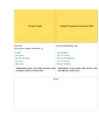
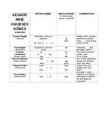
Affirmative tense Use Signal Words /Negative/Question · always · action in the present taking place Simple Present A: He speaks. · every ... once, never or several times N: He does not speak. tegevus, mis toimub ühe korra, mitte · never Lihtolevik Q: Does he speak? · normally kunagi või mitu korda
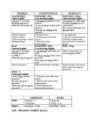
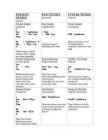
SIMPLE CONTINUOUS PERFECT I (-s) DO/DOES AM/IS/ARE + ING HAVE/HAS + III pv. I learn English I am learning English I have learned English. I get up at 7 every day. I'm reading a good book at the I've learned 10 words today. He doesn't get up at 7. moment. He hasn't learned any new What time do you get up? He isn't reading anything at the words today. moment
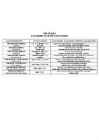
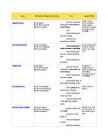
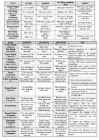
AJAVORMID JA NENDE MOODUSTAMINE AJAVORMI NIMETUS MOODUSTAMINE KASUTAMINE, SAGEDAMINI ESINEVAD AJAMÄÄRUSED THE PRESENT I pv; do/does + I Tegevus toimub korduvalt, on harjumuspärane SIMPLE live, goes twice a week, every day, usually, often, sometimes, always THE PAST (+) II pv; did + I Tegevus toimub minevikus SIMPLE lived, went yesterday, last week, two years ago, in 1996 THE FUTURE (shall)/will + I Tegevus toimub tulevikus, on üksteisele järgnev
THE TENSES AJAVORMID JA NENDE KASUTAMINE AJAVORMI NIMETUS MOODUSTAMINE KASUTAMINE; SAGEDAMINI ESINEVAD AJAMÄÄRUSED THE PRESENT SIMPLE I pv. (+ s); do/does + I pv. Tegevus toimub korduvalt, on harjumuspärane. püsiv olukord, ajagraafikutega seotud tulevik Lihtolevik live, goes every day, usually, often, sometimes, always THE PAST SIMPLE II pv.; did + I pv. Tegevus toimub minevikus. Lihtminevik lived, went yesterday, last week two years ago, in 1998
AJAVORMI NIMETUS MOODUSTAMINE KASUTAMINE ; SAGEDAMINI ESINEVAD AJAMÄÄRUSED THE PRESENT I pv ( +s ); do/does Tegevus toimub korduvalt, on harjumuspärane. ev SMPLE live, goes every day, usually, often, somtimes, always,never Lihtolevik THE PAST SIMPLE II pv; did ,lived, Tegevus toimus minevikus. Lihtminevik went yesterday, last week, two years ago, in 1998 THE FUTURE SMPLE ( shall ) / will +I pv. Tegevus toimub tulevikus. Lihttulevik will go tomorrow, next week, soon, later, In 2050 THE FUTURE IN THE ( should ) / would +I Kaudses kõnes tuleviku asemel, kui pealause on
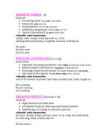
TENSES. ACTIVE VOICE. 1. Present Simple (üldolevik) I (he, she, it s) he works Eitav,küsiv do (I, you, we, they) he does not work does (he, she, it) does he work? Verbidele, mis lõpevad infinitiivis ss, -sh, -ch, -x või o, lisatakse ainsuse 3. pöördes es he touches, she goes Verbidel, mis lõpevad y-ga, mille ees on konsonant, muutub y->ies
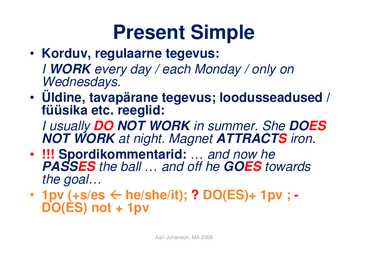
Present Simple · Korduv, regulaarne tegevus: I WORK every day / each Monday / only on Wednesdays. · Üldine, tavapärane tegevus; loodusseadused / füüsika etc. reeglid: I usually DO NOT WORK in summer. She DOES NOT WORK at night. Magnet ATTRACTS iron. · !!! Spordikommentarid: ... and now he PASSES the ball ... and off he GOES towards the goal... · 1pv (+s/es Å he/she/it); ? DO(ES)+ 1pv ; - DO(ES) not + 1pv Aari Juhanson, MA 2008 Present Progressive · Hetkel toimuv, pooleliolev tegevus: S/he IS TALKing on the phone now. I AM READing an interesting book. · Ajutine, regulaarsele ja tavapärasele vastanduv tegevus (tulevikku viitav): This summer they ARE not GROWing cucumbers as usual. They'RE GROWing tomatoes instead. · !!! Halvakspanu väljendus harjumuspärase tegevuse kohta: He IS always COMPLAINing! · BE (am/is/are) + 1pv-ing Aari Juhanson, MA 2008 Present Perfect ON -NUD
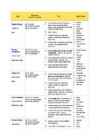
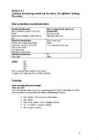
Tense Form Use Hints Example + I pv ((e)+s) Present Simple 1. daily routines, habits or repeated actions Every hour/day/week etc , I always play football in -? do/does not+I pv 2. permanent states usually, always, in the the evenings
Will + infinitive (will go) Am/is/are going to + infinitive (is going to rain) 1.A decision at the moment of 1.Future plans made before the speaking: moment of speaking: A: 'I'm cold'. A: 'We've run out of milk.' B: 'I'll close the window'. B: 'I know, I'm going to buy some.' 2.Prediction based on opinion: 2.Prediction based on present I think the Conservatives will win the evidence: next election. Look at those boys playing football! 3.A future fact: They're going to break the window. He will be ten next year. 4.Promises / requests / refusal / willingness: I'll help you with your homework. Will you give me a hand? 5.In the same way as the future continuous, but with state verbs: I'll be at the station when you arrive. 'Shall' is used mainly in the forms 'shall I
Present simple Work/works, do/does Every, often,usually,always,sometimes,once,twice, at weekends Püsiv ja korduv tegevus Tulevikus toimub tegevus, mis on seotud graafikute, sõiduplaanidega, tunniplanid Üleüldised tõed ja loodusseadused Kui midagi kommenteeritakse - tv Present continius am, is, are working be vormi abil tehakse now, at the moment, look, listen, hurry up just praegu toimub tegevus praegusel perioodil toimuv tegevus kõige kindlam tulevik ettekavatsetud tulevik Present perfect Have, has worked 3pv Eitavaid, küs have / has Ever, never, for, since, already, yet, today, this week / month / yrear Äsja lõppenud tegevus, millele visatakse pilk peale Tükk aega varem toimunud tegevus (eesti keeles nud) Elavate inimeste puhul kui tahame öelda, mida on oma elus teinud Present Prefect continius have has been working for, all, since, lately, recently tegevus algas minevikus, aga rõhutatakse, et parajasti nüüd kestab ta ikka edasi she has been working all morning
· ajatabelid ja programmid. The buss leaves at 7 am. · (spordi) kommentaarid. Ben passes ball to Tom. väljendid, mida kasutatakse: usually, often, always, every day/week etc, in the morning/afternoon/evening, at night/the weekend, on Friday etc. He works He don't work Does he work PRESENT CONTINUOUS [ is + ing] kestev olevik · tegevused, mis praegu leiavad aset. Karl is doing his homework at the moment. · plaanitud tegevus lähitulevikus. I am going to school tomorrow. · kui midagi toimub/muutub praegu. The number of burglaries is increasing. · alati sama korduv tegevus. You are always eating, when i wake up. väljendid, mida kasutatakse: now, at the moment, at present, these days, nowdays, still, today, tonight etc. He is working He isn't working Is he working PRESENT PERFECT [have/has + ed] täisolevik · algab minevikus ja kestab siiani · just lõpetatud tegevus, mille tegevused ilmuvad olevikus
tense Affirmative/Negative/Question Use Signal Words always, every ..., action in the present Simple Present A: He speaks. never, normally, N: He does not speak. taking place once, never or often, seldom, Q: Does he speak? several times sometimes, usually if sentences type I
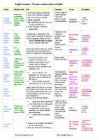
Inglise keeles Eesti keeles + -/? Usage Näited 1. Present Simple Lihtolevik I ajavorm Do, don't, does, doesn't A permanent state, a generally Every day, always, often, (He, she, it + -s) known fact, usual or repeated usually, sometimes, rarely,
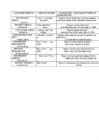
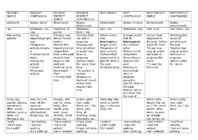
PRESENT PRESENT PRESENT PRESENT PAST SIMPLE PAST PAST PERFECT PAST PERFECT SIMPLE CONTINIOUS PERFECT PERFECT CONTINUOUS SIMPLE CONTINUOUS SIMPLE CONTINUOUS Lihtolevik Kestev olevik Täisminevik Kestev Lihtminevik Kestev minevik Enneminevik Kestev täisminevik enneminevik I pv Am/is/are, I pv, Has/have, III Has/have, II pv, -ed Was/were, -ing Had, III pv Had, been, -ing
Inglise keele ajavormid: 5. Õppeaasta Ajavorm Tähendus Vormid Abisõnad Present Continuous Kestev olevik am Look! Listen! Now! At (Present Progressive) BE is +ING the moment. At the are present. Present Simple Üldolevik He, she, it + S Always, usually (Indefinite) They, we, you, I (s) Sometimes, every ?does (he, she, it) (s) often Do (they, we, you, I) (s) Past Simple Lihtminevik II pv/ -ed Last, yesterday, ago
Simple ... ago infinitive + he worked connected with an expression of I went liht in 1990 ed time (no connection to the present) he went minevik yesterday · an action happened in the Kestis teatud Past When you middle of another action hetkel minevikus I was working Prog came was/were + · someone was doing sth. at a he was working
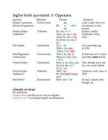
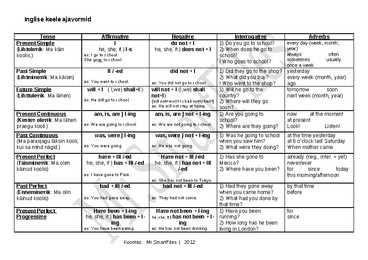
Inglise keele ajavormid Tense Affirmative Negative Interrogative Adverbs Present Simple I do not + I 1) Do you go to school? every day (week, month, (Lihtolevik: Ma käin he, she, it } I-s he, she, it } does not + I 2) When does he go to year) koolis.) ex: I go to school. school? always often She goes to school
PRESENT PAST TENSES FUTURE TENSES TENSES minevik tulevik olevik Present Simple Past Simple Future Simple lihtolevik Lihtminevik Lihttulevik I You + I põhivorm + II pv We ? , - Do + I pv. ?, - Did + I pv Will + I põhivorm They He + I põhivorm + S Tegevus tulevikus, mis ei She ?,- Does + I pv Lõpetatud tegevus ole ettekavatsetud It (yesterday, last week) (tomorrow, next week, next
They are building a new bridge in our town. 2. Changes happening around now. The population of the world is increasing fast. 3. Arrangements for the future. I am flying to Toronto next Friday. Negative form: We aren't (are not) working at the moment. I am not enjoying this show very much. Question form: Are they playing football in the park right now?Why is she laughing? Signal words: at the moment, now, right now, Listen!, Look! etc. PRESENT PERFECT (täisminevik) Form: have/has + past participle (3. põhivorm) Use: 1. An action in the past, where the fact, not the time, is important. I have been to England four times. 2. An action in the past that has a result now. She has lost her keys. 3. Something that began in the past and still continues now. He has been in hospital since Monday. Negative form: We haven't (have not) done our homework yet. He hasn't (has not) visited his granny since August.
We are going to the theatre. Pane tähele! Kestvat olevikku kasutatakse tegevusverbides (I am dancing, you are eating etc.). Mõned verbid on mitte tegevusverbid, näiteks ei saa öelda I am liking või you are knowing, vaid I like ja you know. Järgmiseid verbe ei kasutata tavaliselt kestvas olevikus. like love hate want need prefer know realise suppose mean understand believe remember belong contain consist depend seem Past Simple Lihtmineviku moodustamine Jaatav vorm Eitav vorm Küsiv vorm I asked I did not ask Did I ask? He/she/it went He/she/it did not go Did he/she/it go? We/you/they made We/you/they did not make Did we/you/they make?
Get/ Have something TENSE ACTIVE PASSIVE WHEN? done Present Simple Am/is/are + Every day, year, often, I pv + do/does Have/ get + sth+ III pv Lihtolevik III pv usually, always Past Simple Yesterday, last year, II pv(-ed)+ did Was/ were + III pv Had/got + sth + III pv
INGLISE KEELE KORDAMINE TIME CLAUSES Present Simple · Permanent states, facts (Tom works..) · Repeated and habitual actions, routines (She usually goes..) · Laws of nature and general truths (The sun sets in the west) · Timetables and programmes · Sporting commentaries, rewiews (Beckham wins the ball, crosses and Owen scores) · Feelings and emotions (I love Tallinn..) TIME EXPRESSIONS USED WITH PRESENT SIMPLE: usually, often, always, every day/week etc, in the morning/evening
We can report people's words by using direct speech or direct speech reported speech. speech `I'm tired!', Helen said. Helen said (that) she was tired. The main verb of the sentence is usually past ( Tom said that... / I told her that...) and the rest of the sentence is usually past too. Sequence of tenses if the verb in the main sentence is in the past tense the other verbs are usually in one of the past tense too. Present Simple Past Simple I'm a teacher. He said (that) he was a teacher Present Progressive Past Progressive I'm having lunch with my He said (that) he was having parents. lunch with his parents. Past Simple Past Perfect He said (that) he had bought a I bought a new car. new car.
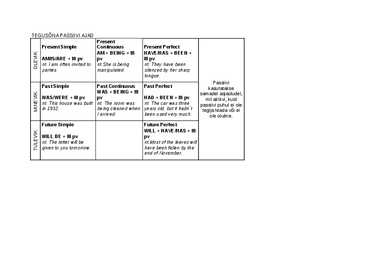
TEGUSÕNA PASSIIVI AJAD Present Present Simple Continuous Present Perfect AM + BEING + III HAVE/HAS + BEEN + OLEVIK AM/IS/ARE + III pv pv III pv nt. I am often invited to nt.She is being nt. They have been parties. manipulated. silenced by her sharp tongue. Passiivi
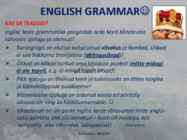
Pikk ajalugu on lihvinud keelt ja tulemuseks on lihtne loogika ja käändelõppude puudumine! Mitmekesine ajalugu on aidanud kaasa eri päritolu sõnavarale ning ka hääldusmuredele. Väidetavalt on üle poole inglise keele sõnavarast mitte anglo- saksi päritolu, ehk siis laenatud – kontrolli hoolega, kas ‘sympathy’ ikka tähendab ‘sümpaatiat! kaastunne Aari Juhanson, MA 2009 Tenses – Tegusõna ajad • Olevik (Present) • Minevik (Past) • Tulevik (Future) • Kaudne tulevik (Future-in-the-Past) Aari Juhanson, MA 2009 Present Tenses • Lihtolevik (Present Simple / Present Indefinite) – regulaarne, korduv tegevus • Kestev olevik (Present Progressive / Present Continuous) – pooleliolev, ühes tükis tegevus • Täisminevik !!! (Present Perfect) – tehtud, *lõpetamata* tegevus • Kestev täisminevik (Present Perfect
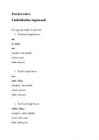
Simple Present Present Progressive/Continious (99%) infinitive form of 'be' and verb + ing (3rd person singular: infinitive + 's') I speak I am speaking you speak you are speaking he / she / it speaks he / she / it is speaking we speak we are speaking
3 TALLEGG 11 MIZDE 4 VESITERM 12 LADA 5 STOW 13 SCHWUNG 6 KALEV 14 MAIASMOKK 7 YAMAHA 15 ISKU 8 ESTRAVEL 2 Affirmative tense Use Signal Words Negative/Questions · action in the present taking always, Present Simple A: He speaks. place once, never or several every ..., N: He does not speak. normally, often, Q: Does he speak? times seldom, · facts sometimes,
Passive voice Umbisikuline tegumood Kui tegija pole oluline või pole teada. · The Present Simple Passive am is + III pv are Examples: I am watched. A book is read. Marks are given. · The Past Simple Passive was were + III pv Examples: I was watched. A book was read. Marks were given. · The Future Simple Passive will be + III pv Examples: I will be watched. A book will be read. Marks will be given. · The Future Simple Passive in the Past would be + III pv Examples: I would be watched. A book would be read. Marks would be given. · The Present Progressive Passive am is + being + III pv are Examples: I am being watched. A book is being read. Marks are being given. · The Past Progressive Passive was were + being + III pv Examples: I was being watched. A book was being read. Marks were being given. · The Present Perfect Passive have has been + III pv
MOODUSTAMINE ABITEGUSÕNAD AJAMÄÄRUSED AEGADE Et moodustada eitavat, küsilauset NIHE KAUDSES KÕNES AJAVORM Present Simple Tegusõna I põhivorm Always, often, usually, Lihtolevik (algvorm) do sometimes, seldom, does every .... , once a year, he / she / it +s twice a month ...... Past Simple Tegusõna II põhivorm did Yesterday, ..... ago,
Present Continuous (kestev olevik) Be(am, is, are), kasutatakse jaatavates, + be (am, is, are) + 1.põhivorm ing eitavates ja küsilausetes. - be (am, is, are) + not+ 1.põhivorm -ing ? be (am, is, are) + 1.põhivorm ing Väljendab: Praegu toimuvat tegevust, praeguse momendi vältel toimuvat tegevust, ettekavatsetud tegevus tulevikus Spikkrisõnad: now, at the moment, at 6'clock, today Present perfect (täisminevik) Have, has kasutatakse kõikides + have, has + 3.põhivorm lausetes - have, has + not + 3.põhivorm ? have, has + 3.põhivorm Väljendab: Äsja lõppenud tegevust, täna/sel nädalal/sel kuul/sel aastal toimunud tegevust, tegevust, mida on/ei ole kunagi tehtud Spikkrisõnad: today, this week, this year, already, yet, just, never, ever, for, lately
Cali 2005 Was Born Traveled to Europe Husband 1978 School graduates @ Oxford 1999 Started Got married School 1983 2008 2 The Six English Verb Tenses Three Simple Tenses Simple continuous Present You walk. You are walking I run. I am running. Past You Walked You were walking. I ran. I was running. Future You will walk. You will be walking. I will run. I will be running. Three Perfect Tenses Perfect continuous Present perfect you have walked
 annaabi.ee