Leidsid 33 sarnast õppematerjali, mis on seotud failiga "Windpower". Need materjalid aitavad sul teemat sügavamalt mõista.
power, years, first, fuels, cause, turbines, built, electricity, fossil, doesn, farms, sailing, ships, least, practical, afghanistan, century, grind, corn, draw, production, scotland, lighting, cottage, thus, making, during, submarine, 1990s, became, important, alternative, necessary, building, quite, expensive, strong, these, things, cost, than, lookgeothermal heat--which are renewable (naturally replenished). In 2006, about 18% of global final energy consumption came from renewables, with 13% coming from traditional biomass, such as wood-burning. Hydroelectricity was the next largest renewable source, providing 3% (15% of global electricity generation),followed by solar hot water/heating, which contributed 1.3%. Modern technologies, such as geothermal energy, wind power, solar power, and ocean energy together provided some 0.8% of final energy consumption. While there are many large-scale renewable energy projects and production, renewable technologies are also suited to small off-grid applications, sometimes in rural and remote areas, where energy is often crucial in human development.Kenya has the world's highest household solar ownership rate with roughly 30,000 small (20100 watt) solar power systems sold per year.
..................................16 SIGNFICANT EVENTS IN THE HISTORY OF ENERGY BY FUEL.......................16 5.1 Signficant Events in the History of Energy Uses....................................................... 18 SAVING ENERGY ........................................................................................................... 20 ELECTRICITY .................................................................................................................20 7.1 The science of electricity............................................................................................21 7.2 Static electricity..........................................................................................................22 7.3 Magnets and electricity...............................................................................................22 7.4 Batteries produce electricity....................................................................................... 23 7
Renewable energy Meriliin Lend Estonian University of Life Sciences Tartu 2013 Topics Renewable energy Solar energy Wind energy Hydroelectric power Geothermal energy Biomass energy Renewable energy Renewable energy comes from sources that naturally renew, or will not run out in our lifetimes. Includes sunlight, wind, water, geothermal heat and various forms of biomass. Renewable energy cannot be exhausted and is constantly renewed. Does not harm the environment. Saves money. Solar energy Solar energy is the technology used to harness the sun's energy and make it useable. Every hour the sun beams onto Earth
- And Just Chadrick Overview- What is Green Energy? Different Types? What is sustainability? German Green Energy Cost and Efficiency Recycling What is Green Energy? -It is energy resources that are renewable -Can be naturally replenished -Clean, Safe and not harmful to the environment (aka mother earth) Types of Green Energy Green Energy going cute Solar Power · Is produced by using photovoltaic cells, which capture sunlight and turns that into energy. Problems ? -The sun has got to shine -The cost of solar panels and the systems range between $20k-40k -The light from the sun produces a very small amount of energy Wind Power -These giant pinwheels spin from strong winds which spins a turbine of a generator to produce energy. Giant Pin Wheels? Any Studies done? · It is said that wind · Bentek Energy did the
1 Wave energy Introduction to wave energy There are several possibilities to harvest different forms of energy from the sea. One of these options is the usage of waves for the generation of electricity. The devices needed to perform this task are called wave energy converters. Wave energy is indirect solar energy in twice. At first there is the wind, which is caused by variations in atmospheric pressure due to a differential solar heating of earth's surface by the sun. Different regions of pressure drives a force which rises a movement of atmospheric air masses that causes the earths wind system. If wind strikes over the surface of an open water, waves are induced. First they are very flat with only a low level of energy. When there is a long distance over
Natural resources are land or raw materials like minerals, fluids, gases, organic matters and also woods, groundwater, animals and so on, in other words it's everything that human hasn't created. These resources are also used in industry. We get natural resources from the environment. Many of them are essential for our survival while others are used for satisfying our wants. Renewable resources: Some natural resources can be reproduced within a few years or decades. These are called renewable resources. Solar radiation, wind and hydroelectricity, are perpetual resources that are in no danger of a lack of long-term availability. Some natural renewable resources such as geothermal power, fresh water, timber, and biomass must be carefully managed to avoid exceeding the worlds capability to displace them. Solar energy is the energy derived directly from the Sun. Along with nuclear energy, it is the
New energy sources Rauno Hermann Scheer Energy law example for 47 countries 6.3% to over 20% Numerous awards including The Right Livelihood Award Renewable energy in world Investments 63 billion USD > 120 billion USD 20062009 Wind energy: 74 000 MW to 135 000 MW Solar energy: 5100 MW to 19 000 MW WHAT ARE THE ALTERNATIVES TO TODAYS SOLAR, WIND AND BIOMASS ENERGY SOURCES? Osmotic power How it works? Pressure created by osmosis powers turbines Where could be used Where fresh and salt water meet (creeks, fjords) Desalination plants Now Worlds first test factory in Norway Tofte (2009) Disadvantages Km2s of membranes needed Norway, Tofte Click to edit Master text styles Second level Third level Fourth level
Causes · It is caused when sulfur dioxide and nitrogen oxides are released into the air. In the atmosphere they react with water, oxygen and other chemicals to form more acidic pollutants, known as acid rain. Sulfur dioxide and nitrogen oxides dissolve very easily in water and can be carried very far by wind. As a result, the two compounds travel long distances where they become part of the rain, sleet, snow or fog. SO2 and NOx come mainly from power stations and factories burning fossil fuels, or from motor vehicles. · Carbon dioxide in the air can dissolve in rain water to form carbonic acid, H 2CO3 CO2 + H2O H2CO3 · During the last century the rain water in some parts of the world has become far more acidic. This acid rain has been caused by the emission of pollutants gasses such as sulfuric dioxide, when goal is burned in electric power stations, sulfur impurities form sulfur
Hello My name is JOHN SMITH and I am here to talk about Hydroelectricity. Global energy use has risen by 70% since 1971 and continues to increase at the rate of 2% per year. There are many scenarios for future demand. One solution would be to use more hydropower. In 2005, renewable energy represented one-fifth of total power generation. Hydropower is the most advanced of the renewable and represents 87% of this production. 160 countries all over the world are using hydropower. Five countries make up more than half of the world's hydropower production. Those countries are: Brazil,Canada, China, Russia and the USA. (Production) *Most of the energy comes from the potential energy of dammed water driving a water turbine and generator
Tartus secondary school of business Nuclear Power Helena Nulk form 11b Tartu 2009 Table of contents Introduction..........................................................................................................................................3 What is nuclear power?....................................................................................................................3 Nuclear life cycle.............................................................................................................................3 What is nuclear energy?...................................................................................................................3 What is nuclear fusion?.................................................................
1.1)Main engine The engine room of a motor vessel typically contains several engines for different purposes. Main, or propulsion engines are used to turn the ship's propeller and move the ship through the water. They typically burn diesel oil or heavy fuel oil, and may be able to switch between the two. There are many propulsion arrangements for motor vessels, some including multiple engines, propellers, and gearboxes. Large engines drive electrical generators that provide power for the ship's electrical systems. Large ships typically have three or more synchronized generators to ensure smooth operation. The combined output of a ship's generators is well above the actual power requirement to accommodate maintenance or the loss of one generator. 1.1.1)Diesel engine The diesel engine (also known as a compression-ignition engine) is an internal combustion engine that uses the heat of compression to initiate ignition and burn the fuel that has been
· Energy, food and water sources, transportation systems and basic infrastructure, must all adapt to emerging pressures from climate change, dwindling resources and growing urban populations. · 70 million people a year migrate from the country to cities. That is about 130 a minute, that means very massive globalization. · At this rate, our future cities may turn out to be quasi-temporary, missing the basics of human life, such as water and electricity, still belching out the waste of fuels that warm the globe. · The New City in China: The buildings and all around it work like biological, growing beings, photosynthesising and producing and re- using their own energy. China will be largest solar manufacturer in the world. · Masdar city in United Arab Emirates near Abu Dhabi. First city in the world, that would rely on the renewable energy sources. 6 square kilometers, home for 50,000 people and 1,500 businesses.
The Chernobyl accident in 1986 was the result of a flawed reactor design that was operated with inadequately trained personnel. The resulting steam explosion and fires released at least 5% of the radioactive reactor core into the atmosphere and downwind. Two Chernobyl plant workers died on the night of the accident, and a further 28 people died within a few weeks as a result of acute radiation poisoning. The April 1986 disaster at the Chernobyl nuclear power plant in the Ukraine was the product of a flawed Soviet reactor design coupled with serious mistakes made by the plant operators. It was a direct consequence of Cold War isolation and the resulting lack of any safety culture. The accident destroyed the Chernobyl 4 reactor, killing 30 operators and firemen within three months and several further deaths later. Acute radiation syndrome was originally diagnosed in 237 people on-site and involved with the clean-up. Of these, 28 people died
surface than any preceding decade since 1850. More than 90% certain that most of global warming was being caused by increasing concentrations of greenhouse gases produced by human activities.In 2010 that finding was recognized by the national science academies of all major industrialized nations. Affirming these findings in 2013, the IPCC stated that the largest driver of global warming is carbon dioxide (CO2) emissions from fossil fuel combustion, cement production, and land use changes such as deforestation. Its 2013 report states:Human influence has been detected in warming of the atmosphere and the ocean, in changes in the global water cycle, in reductions in snow and ice, in global mean sea level rise, and in changes in some climate extremes. Initial causes of temperature changes Greenhouse gases The greenhouse effect is the process by which absorption and emission of infrared radiation
the advancement in spacecraft related research. The purpose of this essay is to explain what a railgun is and how it works along with a little history and the recent advancements in railgun related science. 3 1. What a railgun basically is A railgun is an electrically powered electromagnetic projectile launcher and a large electric circuit, made up of three parts: a power source, a pair of parallel rails and a moving armature. Along the pair of parallel conducting rails a sliding armature is accelerated by the electromagnetic effects of a current that flows down one rail, into the armature and then back along the other rail. Railguns have long existed as experimental technology but the mass, size and cost of the required power supplies have prevented railguns from becoming practical military weapons.
( hindamine ) by Economist magazine. The weather Irish think there are 4 kinds of weather , rainy spring , rainy summer , rainy autumn and rainy winter and only the lastone is a bit diffrent from others , its more like sleet ( lõrts) The typical Irish weather is few minutes rain , few minutes sunny then again some rain and sun will shine for a bit more again. Energy The vast majority ( enamus ) of Irish energy needs are met by fossil fuels. About 98% of Ireland's final energy demand is produced by burning coal, petroleum, peat, or natural gas. This over reliance on fossil fuels ( see liigne toetumine sisseostetavatele kütustele )-particularly oil - (eriti õli) has left Ireland vulnerable to international price fluctuations as it imports all of its oil needs. (on jätnud iirimaa haavatavaks tänu rahvusvahelistele hindande muutumisele )
Geodesy Study group: GI-21b PETROLEUM PRESENTATION Petroleum (L. petroleum, from Greek: Πέτρα (rock) + Latin: oleum (oil) is a naturally occurring flammable liquid consisting of a complex mixture of hydrocarbons of various molecular weights and other liquid organic compounds, that are found in geologic formations beneath the Earth's surface. The name Petroleum covers both naturally occurring unprocessed crude oils and petroleum products that are made up of refined crude oil. A fossil fuel, it is formed when large quantities of dead organisms, usually zooplankton and algae, are buried underneath sedimentary rock and undergo intense heat and pressure. Petroleum is recovered mostly through oil drilling. This comes after the studies of structural geology (at the reservoir scale), sedimentary basin analysis, reservoir characterization (mainly in terms of porosity and permeable structures). It is refined and
Moreover, there are no students who have both breakfast and school lunch, eat more than four slices of brown bread per day, and avoid fat. In this essay, I will discuss whether prevention is better than trying to treat people who are ill and whether or not this is possible in all cases. I will divide the subject into illnesses caused by lifestyle, and illnesses caused by other factors such as genetic factors. First of all, a person's lifestyle can be a major factor in their wellbeing, both physical and mental. People who eat too much fast, fatty, or sugary foods without doing enough physical activity, may put on weight. This has serious effects and can lead to heart disease. Similarly, people who smoke and drink too much run the risk of getting cancers and heart disease. However, by
been compiled through publications and interviews. DH systems require large investments, have negative initial cash flow and long payback time, which obstructs financing. One actor should control DH from source to consumption. If the value chain is fragmented, contracts are required between the links. It increases risks and financing costs, like in the UK and Ireland, where DH is not established. There are few multi- family houses with central heating and it is expensive to build DH networks in built areas. Most French DH systems are operated according to long-term concessions by companies that sell electricity and gas. No strong actor provides unbiased DH support. In the Czech Republic, gas offers DH severe competition. Much DH is produced at the expense of electricity that is considered more valuable, and waste incineration is not popular. In Romania, DH consumption was reduced by one-half. Distribution losses are enormous. New less polluting plants are needed.
Normal rain water is slightly acidic and has a pH range of 5.3-6.0. Acid deposition is anything below that scale. It is also important to note that the pH scale is logarithmic and each whole number on the scale represents a 10-fold change. Causes and History of Acid Rain Acid deposition can occur via natural sources like volcanoes and rotting vegetation but it is mainly caused by the release of sulfur dioxide and nitrogen oxide during fossil fuel combustion. When these gases are discharged into the atmosphere they react with the water, oxygen, and other gases already present there to form sulfuric acid, ammonium nitrate, and nitric acid. These acids then disperse over large areas because of wind patterns and fall back to the ground as acid rain or other forms of precipitation. The gases responsible for acid deposition are normally a byproduct of electric power generation and the burning of coal
and natural radioactivity are all among the natural causes of air pollution. Usually, natural air pollution does not occur in abundance in particular locations. The pollution is spread around throughout the world, and as a result, poses little threat to the health of people and ecosystems. Though some pollution comes from these natural sources, most pollution is the result of human activity. The biggest causes are the operation of fossil fuel-burning power plants and automobiles that combust fuel. Combined, these two sources are responsible for about 90% of all air pollution in the United States. Some cities suffer severely because of heavy industrial use of chemicals that cause air pollution. Places like Mexico City and Sao Paulo have some of the most deadly pollution levels in the world. EFFECTS Air pollution is responsible for major health effects. Every year, the health of countless people is ruined or endangered by air pollution.
prospects of the biogas. I have tried to make this report as understandable as possible. By the end of this report I want to come to a conclusion whether biogas is the best source of future energy or are there any other sources that are better. What is biogas? Typically it refers to the gas produced by the anaerobic digestion or fermentation of organic matter including manure, sewage sludge, municipal solid waste, biodegradable waste. If opportunely refined it can be used for electricity production. Also for space-, water- or process heating. Unintentional production of biogases has been an ongoing issue in many regions of the world, and several nations have also looked to biogas as a potential source of clean energy. India and China have both invested extensively in creative biogas technology to provide fuel for their citizens and there are a number of interesting applications for this gas which appeal to people who are interested in
There are many reasons why biofuels are necessary, but at the same time, they are controversial for a number of reasons. 2.2. Biofuels' feedstock and future projections There are mainly two types of liquid biofuels, which have significantly grown in the last decade: that is bioethanol and biodiesel. Bioethanol is based on sugar, extracted from sugarcane and beet, or starch, which mainly comes from maize, wheat or cassava. Starch- based crops must be first converted into sugars in the saccarification process, which requires substantial volumes of enzymes to turn starch into sugars (Soetaert, W. 2008). The starchy products represent only a small percentage of the total plant mass. Other plants' building blocks like cellulose and lignin are currently not being used to make biofuels as there is not a commercial viable production method for making ethanol form cellulosic biomass (FAO, 2008).
Norway in the east and France in the south. Britain also has many dependant territories which are scattered throughout the world and are the remains of the huge former British Empire. Today Britain assists them, but they may become independent whenever they wish. There have been some difficulties with some of the territories. Argentina has made claims to the Falkland Islands and Spain to Gibraltar. History When the glaciers retreated from Britain about 10,000 years ago, Stone-Age men started to inhabit the isles. The early Britons came across the land bridge which joined Britain to the continent. They were cave-dwellers at first. This way of life was replaced by the invaders from the Mediterranean lands. These men were the first farmers. In about 500 BC came the people whose homeland was near the Rhine River. These were the Celts. The Roman invasion began in 43AD. The Romans were highly organized conquerors. They built good roads, baths and bridges
Nuclear Energy U.S. Government History of Nuclear Energy- Nuclear Energy History of Nuclear Energy · Uranium was discovered in 1789 by Martin Klaproth. He was a German chemist, and named his discovery after the planet Uranus ("Outline history of," 2010) · 1939-1945 Manhattan Project- atomic energy program to develop the first transportable atomic bomb ("Nuclear technologies timeline," ) · 1942- First self-sustaining nuclear chain reaction ("Nuclear technologies timeline," ) · 1945- Hiroshima and Nagasaki- US. drops atomic bombs to Japan to end World War II ("Nuclear technologies timeline," ) · 1946- First nuclear energy in civilian use ("Nuclear technologies timeline," ) NUCLEAR ENERGY · 1954- Atomic Energy Act of 1954- allows the Atomic Energy Commission to license
durability, insulation properties and aesthetic qualities, recent findings show that they also produce less carbon emissions than any other masonry material. History (slide 3) In more detail the earliest bricks were dried bricks, meaning they were formed from clay- bearing earth or mud and dried usually in the sun until they were strong enough for use. The oldest discovered bricks, originally made from shaped mud and dating before 10000 BC, were found in Mesopotamia related to the first known cities. Ceramic or fired bricks were first introduced by the Romans. These were mainly flat, broad thin sections, not unlike a tile, which is probably why they `burnt' so well, causing them to last for centuries. In Estonia the fired clay bricks came in to use in 13 century. The greatest buildings from that time are the St John's Church and the Tartu Cathedral. (Jaani kirik ja Toomkirik) Moving on, What is clay? (slide 4)
The Inchcape Rock by Robert Southey The Inchcape Rock is a poem about Sir Ralph the Rover, an evil man, who wants to sink other ships, so he could use his own ship to blunder villages and towns. He removes a warning bell that warns sailors about a secret underwater rock. By doing this, he signs his own death sentence. At a dark night, he crashes his ship to the Rock, because there was no bell to warn him. In the first stanza of the poem Southey describes the surroundings. The tone of the poem is set, at the begging it is very serene and relaxed. The weather and sea are calm, the ship stands, undisturbed, in the water. The reader is supposed to feel joy and relax when this description is given, it brings to mind a sunny and warm summer-day, when everything is just perfect. The point on the first stanza is only to set the tone, it has no real artistic value.
........................................................183 The New Earth Is No Utopia.....................................................................184 Notes...........................................................................................................186 About the Author........................................................................................189 CHAPTER ONE THE FLOWERING OF HUMAN CONSCIOUSNESS EVOCATION Earth, 114 million years ago, one morning just after sunrise: The first flower ever to appear on the planet opens up to receive the rays of the sun. Prior to this momentous event that heralds an evolutionary transformation in the life of plants, the planet had already been covered in vegetation for millions of years. The first flower probably did not survive for long, and flowers must have remained rare and isolated phenomena, since conditions were most likely not yet favorable for a widespread flowering to occur
....................................................... ................................. Climate............................................................................................. ................................. States and Territories.......................................................................................... .......... Industry............................................................................................. ................................. Aborigines and first settlers.......................................................................................... Sports............................................................................................. .................................... Culture............................................................................................. .................................. Factfile Australia is the only country in the worlf that fills the whole continent.
Tartu Kutsehariduskeskus Autode ja masinate remondi osakond Rainer Kaine AT-109 Iseseisev töö Electric cars Instructor: Tauris Vijar Tartu 2010 Introduction In this essay i´m write electric cars and this how these cars are built, how easy is built electric car, how much costs electric cars. The problems for electric cars, there are many problems why peoples still can´t use quiet and more green cars. But even the electric car is not all green because the electricity produced for nuclear, coal, oil shale and natural gas. These ways to get electricity pollutes nature, the only difference between lies in the fact that pollution is in the one place. Coal Electric power station Oil shale power station in Narva What is a electric car
during braking. 4. Hybrid car engines produce less emission, give better mileage, idle less, and are fuel efficient. Why to purc has e a hybrid c ar? 5. The aerodynamic design reduces drag and the tires are made of a special rubber that reduces friction. 6. The battery has high capacity and is made of nickel-metal- hydride. The battery can run the hybrid when called for. 7. The power-train technology enables using two power sources and enhances fuel efficiancy. 8. There are many choices. You can have a hybrid from Honda, Ford, Toyota, GMC, and Chevrolet. 9. If your transportation of choice is a hybrid then the US Government will applaud your choice by giving you significant tax breaks. (USA only) Hybrid te c hno lo g y Basically a normal, fuel efficient car that has two motors - an electric motor and a gasoline powered motor.
capital. The population is about 19 million people and growing. New South Wales is the most populated state and Victoria is the most densely populated state. The national language is English. It is English because British settlers came to live in Australia in the past and they brought convicts with them who were also British. Symbols. The Australian Flag came into being after the federation of the Australian States into the Commonwealth of Australian on the first January, 1901. The Commonwealth Blue Ensign was selected as a result of a public competition (over 30 000 designs were submitted). In the upper left corner there is the Union Jack that is the national flag of England. It denotes Australia's historical links with Great Britain. Under the flag there is the Commonwealth star which has seven tips. Six of them represent the states and the last one is for the Commonwealth of Australia. The Southern Cross is in the right. It consists of five stars
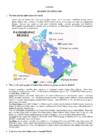
Physiographic regionalization is defined here as the process by which regions with relatively homogeneous physical geography are determined 2. Who are the native people of Canada? Into which three groups can they be divided? Canada's constitution specifies three categories of aboriginal peoples: Indian (First Nations), Métis, Inuit. According to Canadian census 2011, 1.4 mln people of Aboriginal origin (4.3%): 852,000 First Nations persons, 452,000 Métis, 59,000 Inuit. Indian (First Nations) - No written history before the contact with Europeans. Chief historical sources European priests, travellers and traders not interested in the preservation of "pagan"myths. Different estimates about their number in Canada when Europeans reached North America from 300,000 to 1 mln. Saw themselves as part of nature, not as its masters.
 annaabi.ee