Leidsid 33 sarnast õppematerjali, mis on seotud failiga "Tales of Unease". Need materjalid aitavad sul teemat sügavamalt mõista.
king, conan, doyle, cousin, brazil, arthur, writer, stories, rich, plot, tales, sherlock, holmes, statue, character, baldwin, black, call, puma, wordsworth, 1859, edinburgh, july, british, medicine, wrote, hospital, heart, attack, setting, characters, wife, haggard, woman, bills, uncle, invitation, meeting, cigar, darkness, returns, dead, hints, sameArthur Conan Doyle Life Arthur Conan Doyle was born on 22 May 1859, in Edinburgh, Scotland, to an English father, Charles Altamont Doyle, and an Irish mother, Mary Foley, who had married in 1855.] Although he is now referred to as "Conan Doyle", the origin of this compound surname is uncertain. Conan Doyle's father was an artist, as were his paternal uncles (one of whom was Richard Doyle), and his paternal grandfather John Doyle. Conan Doyle was sent to the Roman Catholic Jesuit preparatory school St. Mary's Hall, Stonyhurst, at the age of eight. He then went on to Stonyhurst College, but by the time he left the school in 1875, he had rejected Christianity to become an agnostic. From 1876 to 1881 he studied medicine at the University of Edinburgh, including a period working in the town of Aston (now a district of Birmingham). While studying, he also began writing short stories; his first published story appeared in Chambers's
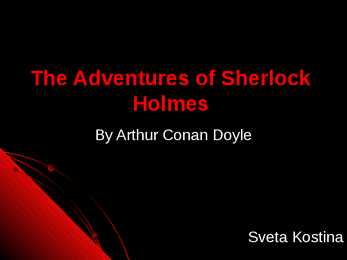
The Adventures of Sherlock Holmes By Arthur Conan Doyle Sveta Kostina Arthur Conan Doyle was born in Edinburgh on 22nd May 1859. he studied medicine at the University of Edinburgh medical practice at Bush Villas in Elm Grove, Southsea good at sport two wives: Louisa (or Louise) Hawkins and Jean Elizabeth Leckie five childrens: two with his first wife and three with his second wife studied the eye in Vienna; practice as an ophthalmologist died of his heart attack, aged 71, on 7th July 1930 Arthur Conan Doyle Bibliography
astronomer, diplomat Wrote The Book of the Duchess, the House of Fame, the Legend of Good Women and Troilus and Criseyde Best known today for "The Canterbury Tales" Crucial figure in developing the legitimacy of the vernacular, Middle English, at a time when the dominant literary languages in England were French Modern English William Shakespeare 26 April 1564 23 April 1616 The Elizabethan Era English poet and playwright, widely regarded as the greatest writer in the English language and the world's most important dramatist ,,England's national poet" Early plays in 1590's were mostly comedies (The Taming of the Shrew, The Merchant of Venice..) Began to focus on tragedy/drama in early 1600's (Romeo and Juliet, Hamlet, Macbeth, Othello..) In 1608 tragedy is replaced with romance Wrote historical plays too (Richard III, Julius Caesar..) Used allegory and methaphores Brought over 1700 words into the English language
Charles Dickens Charles John Huffam Dickens was the foremost English novelist of the Victorian era, as well as a vigorous social campaigner. Considered one of the English language's greatest writers, he was acclaimed for his rich storytelling and memorable characters, and achieved massive worldwide popularity in his lifetime. Charles Dickens was born in Landport, Portsmouth in Hampshire, the second of eight children to John Dickens n 7 February 1812. The 12-year-old Dickens began working ten hour days in a Warren's boot-blacking factory. In May 1827, Dickens began work in the office of Ellis and Blackmore as a law clerk. At the age
Referaat: Agatha Christie raamatu kohta ''the mysterious affair at styles'' CONTENTS 1. INTRODUCTION................................................... 3 2. AGATHA CHRISTIE............................................. 4 3. PICTURES.............................................................. 5 4. PLOT....................................................................... 6 5. PLOT....................................................................... 7 6. CHARACTERS...................................................... 8 7. SETTING................................................................ 9 8. LANGUAGE AND STYLE................................... 9 9. WHOM DO I RECCOMEND THIS NOVEL........ 9 10. SUMMARY........................................................... 10 11. SOURCES.............................................................. 11
BOOK REPORT FORM "Life, The Universe and Everything" KOHT, AASTAARV Page 1 Contents · About the author .................................................................................................................... 3 · Plot ................................................................................................................................... ........ 4 · Characters ......................................................................................................................... ...... 5 · Theme/setting.................................................................................................................... ...... 6
Geoffrey Chaucer (1343–1400) – Father of English literature, The Canterbury Tales in English, increased the prestige of the language, provided a standardised form. The Canterbury Tales: frame story. Majority in verse, some prose. Intended to contain 124 stories, only finished 24. Story: a pilgrimage to Canterbury Cathedral, where archbishop Thomas Becket had been murdered. The stories present a portrait of medieval society, e.g. a knight, a student, a monk, a miller (a flour maker at a mill), a wife of Bath, etc
Like psychoanalysis, surrealistic painting and writing explores the inner depths of the unconscious mind. Freudian ideas have provided subject matter for authors and artists. Critics often analyze art and literature in Freudian terms. 2. Literary Modernism and its sub-movements. The influence of Structuralism and psychoanalysis. Main characteristic features of Modernism. Denial of conventions, traditional structure, plot and presentation of character. The stream of consciousness. Allusiveness. Virginia Woolf's Modern Fiction as a theoretical platform for Modernism. Criticism of Realist literary method. Literary modernism: end of the 19th century-1920 (reached its height) and ended 1940s. A self- conscious break with traditional aesthetic forms. Rejecting the sentiment and discursiveness typical of Romanticism and Victorian literature for poetry that instead favored precision (täppis) of imagery
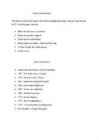
American literature The literary history of this nation when the first humanbeing living in what has since become the U.S used language creatively. · Mid to late 18 century put down · Words are powerful, magical · Words must be remembered · Native Americans stories creation of the world · Attidude thought their land/language · Similar stories Dates and names · America was discovered in 1492 by Columbus · 1497 John Cabot went to Canada · 1579 San Fransisco/St. Fransis · 1607 Jamestown collony/John Smith · 1620 a boat called MayFlower · 1630 Boston was established · 1636 Harvard University · 1773 Boston Teaparty · 1775 War of Independence · 1776 4 July Declaration of Independence
Moor House) and Morton, where her cold clergyman-cousin St John Rivers proposes to her; and her reunion with and marriage to her beloved Rochester. Partly autobiographical, the novel abounds with social criticism. It is a novel considered ahead of its time. In spite of the dark, brooding elements, it has a strong sense of right and wrong, of morality at its core. There are several Christian aspects underlying the plot that mold its character and essence. Jane Eyre is divided into 38 chapters; most editions are at least 400 pages long (although the preface and introduction on certain copies are liable to take up another 100). The original was published in three volumes, comprising chapters 1 to 15, 16 to 26, and 27 to 38. Brontë dedicated the novel's second edition to William Makepeace Thackeray. [edit] Plot summary [edit] Chapters 1-4: Jane's childhood at Gateshead
jordan. She places love above war, politics. Pablo is another type, he is a moral coward, he is a defeatist, who wants to avoid personal danger and wants to save his life, he is mean and betrays his country men. Pilar, Pablo's woman, strong, courageous, patriot, never the less understands the importance of individual human happiness. Human independence and solitarity. Jordan dies, he is left to die. Maria problably is pregnant. Towards the end of his life Heingay wrote short stories. 1952 novella ,,The old man and the sea". The protagonist is an old cuban fisherman. Cuba was that time almost the colony of usa. Santiago is an old fisherman who isn't able to catch anything for several days. One day he catches enormous fish. He is exhausted from trying to fight that fish and has to tie the fish to the boat. While he is rowing back to village the sharks eat the fish when he arrives back to village. It is a moral victory of defeat. Man may be destroyed but not defeated
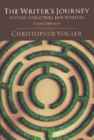
i this book required reading for movie executives, screenwriters, playwrights, fiction and non-fiction writers, scholars, and fans of pop culture all over the world. Discover a set of useful myth-inspired storytelling paradigms like "The Hero's Journey," and step-by-step guidelines to plot and • character development. Based on the work of Joseph Campbell, The Writers Journey is a must for all writers interested in further developing their craft. This updated and revised Third Edition provides new insights and observations from Vogler's ongoing work on mythology's influence on stories, movies, and man himself. In revealing new material, he explores key principles like polarity and catharsis, plus:
they deemed "inalienable." Democracy: The colonies had no say in the formation of the government, and had no representation in the lawmaking process. Consequently, they were attracted to the idea of democracy, where the government is "of the people, by the people, for the people," as Lincoln later expressed in his Gettysburg Address. Religious Tolerance: Much impetus for the ideas of religious tolerance came from the rule of King George II, who was a staunch Catholic and did not allow freedom of religion to Protestants in New England. Voltaire was among the first to denounce Christianity and other organized religions as mere ploys to support monarchy. What emerged was Deism, which was more or less a new religion that considered reason its foundation. In Deism, there is no interference by a deity, and man controls his own destiny.
In towns there was a need for "green lungs"; air of the city was problematic; people had a place to go on a free day (people started to work 6 days in a week- 1 day off); a place for different classes to mingle and mix (Georgian/landscape park with Romantic/pleasure garden etc.) 3) Lord Tennyson and Victorian poetry · What was his main source of inspiration? He was inspired by romantic authors, especially Keats; another source was King Arthur and Arthurian Tales; (also inspired by nature many descriptions of nature, in many works discussed the role of man and woman in society; morbid themes/deaths etc.); · His works: Collection ,,Poems", ,,The Epic. Morte d'Arthur", ,,Idylls of a King", ,,The Holy Grail", ,,In Memoriam A.H.H" · Other important Victorian poets: Robert Browning, Matthew Arnold, Gabriel and Christina Rossetti, Gerard Manley Hopkins · Describe their works in general:
She was one of the seven principal mediums involved in the famous cross-correspondences cases. Fleming continued to do automatic writing until 1910, when she suffered a nervous breakdown. Early Life Rudyard Kipling was born Joseph Rudyard Kipling on 30 December 1865 in Bombay, in British India. Some of Kipling's earliest and fondest memories are of his and sister Alice's trips to the bustling fruit market with their ayah or nanny, or her telling them Indian nursery rhymes and stories before their nap in the tropical afternoon heat. His father's art studio provided many creative outlets with clay and paints. Often the family took evening walks along the Bombay Esplanade beside the Arabian Sea, the dhows bobbing on the glittering waters. Kipling's days of "strong light and darkness" in Bombay were to end when he was five years old.[21] As was the custom in British India, he and his three-year-old sister, Alice
hilltop or skyline. Situation: Albertine was explaining that when she was young, her grandma seemed to her the same size as the rock cairns commemorating Indian defeats around there. to cut a figure (17) - present oneself or appear in a particular way. Situation: Albertine was telling that she adored June for adult confidences and for the figure she cut when she was talking. morosely (26) - not feeling very cheerful. (gloomily) situation: King was upset and sat morosely in the car with a beer. to cajole (36) - persuade (someone) to do something by sustained coaxing or flattery. Situation: Lynette cajoled Eli to wear a hat for a while and then she took it. to relent (39) - abandon or mitigate a severe or harsh attitude, especially by finally yielding to a request. Situation: When Lipsha was talking about mother with Albertine he said he wouldn't relent on her even if she would come back, goes down on her knees and
1. Beowulf. The dating of Beowulf is still controversial. The poem is one of the earliest and greatest monuments of the Germanic literatures. The main stories of the poem (the fights of B.) are versions of common folk-tales, but the poet also introduces many incidental stories, some of which belong to the world of ancient Germanic legend. He writes his folk-tales and legends in a web of other events, mainly set in the Baltic Kingdoms. He shows a very rich and leisurely portrayal of this Baltic world, providing many customs like the close relationship between lord and man in the war-band and others. All this encouraged the supposition that the unknown author of the poem was himself a bard of the ancient type portrayed within the poem (a lord's scoop). However, many people propose that the author could be Christian poet, perhaps a monk, versed not only in old native traditions, but also in the culture and
She has the need to exploit her situation, to challange and to test boundaries in order to find herself. It is by doping so that she comes across racism and narrow- mindedness and has to deal with that. She makes up a wonderful story about the hardships that her yet innocent parents went through during their first time in England. She tells her friends when they play in the park that she [...]" was a Punjabi princess and owned an elephant Kalled Jason King," and at school she uses her Indianness as an excuse: [...] ,,I hadn't completed my homework because of an obscure religious festival involving fire eating..." Meena isa n unreliable story-teller and a self- confessed liar who uses stories and mythology to feel komplete and to belong. She basically wants to be someone, populaar and admired. She really gets the chance t omake use of her talent when her grandmother comes to visit
Taken at the Flood "There is a Tide" redirects here. "There is a Tide" is also the name of a short story by Larry Niven, set in the Known Space universe. Taken at the Flood is a work of detective fiction by British writer Agatha Christie, first published in the US by Dodd, Mead and Company in March 1948 under the title of There is a Tide...[1] and in the UK by the Collins Crime Club in the November of the same year under Christie's original title.[2] The US edition retailed at $2.50[1] and the UK edition at eight shillings and sixpence (8/6).[2] It features her famous Belgian detective, Hercule Poirot, and is set in 1946. 1 Plot summary In a flashback from late Spring to early Spring, Lynn
Test on Romantic Poetry and Prose 1. Approximate dates of romanticism: in the second half of the 18th century. Major events on world history at that time: · Industrial revolution · In America the Declaration of Independence, July 4, 1776 · The French Revolution, 1789 · The King of England was George III, after him George IV and then Queen Victoria Outcomes: · Revolution did not bring welfare · Lives of the lower-classes worsened · Extended the distance between the lower and upper class · The rich got richer, the poor got poorer 2. Romanticism is a reaction against classicism, science and atomic (aesthetic ideal of order and unity) worldview. Romantic ideal is the organic world. Romanticism:
Chekov Lady and the Lapdog Reid about Chekov: The characters in Chekhov's plays are never fully "known" as a writer, he seems to delight in maintaining a sense of indeterminacy, and unknowability, about them. The bare facts are always laughably inadequate to the complexity of "real" people. Anton Pavlovich Chekhov was born on 29 January (New Style), 1860, in Taganrog, a small port on the Sea of Azov, in southern Russia. As the son of a grocer and grandson of a serf, Chekhov was a first-generation intellectual. His modest background and upbringing are crucial to his development as a writer
The Romans gave us a language based on Latin, the calendar, law and legal system, the census and also straight roads, central heating and concrete. Anglo- Saxons around AD 400 Anglo- Saxons were warrior farmers from Germany, Denmark and the Netherlands. Later in the 5th century, Anglo-Saxons settled just west of Londinium, around the Strand, and formed the town of Lundenwic. The area of the old Roman city became a landing-place for ships and a centre for trade.The first English King to convert to Christianity, King Ethelbert, founded St Paul's Cathedral in 604. The Vikings 8th and 9th century By the 9th century, London was a very prosperous trading centre, and its wealth attracted the attention of Danish Vikings. The Danes periodically sailed up the Thames and attacked London. In 851 some 350 longboats full of Danes attacked and burned London to the ground. King Alfred the Great totally defeated the Danes in 878 and they split the country between them
Lady Lucas quieted her fears a little by starting the idea of his being gone to London only to get a large party for the ball; and a report soon followed that Mr. Bingley was to bring twelve ladies and seven gentlemen with him to the assembly. The girls grieved over such a number of ladies, but were comforted the day before the ball by hearing, that instead of twelve he brought only six with him from London--his five sisters and a cousin. And when the party entered the assembly room it consisted of only five altogether--Mr. Bingley, his two sisters, the husband of the eldest, and another young man. Mr. Bingley was good-looking and gentlemanlike; he had a pleasant countenance, and easy, unaffected manners. His sisters were fine women, with an air of decided fashion. His brother-in-law, Mr. Hurst, merely looked the gentleman; but his friend Mr. Darcy soon
about 40,000 and 100,000. The total number of witch trials in Europe which are known for certain to have ended in executions is around 12,000. In Early Modern European tradition, witches have stereotypically, though not exclusively, been women. Witch-hunts first appeared in large numbers in southern France and Switzerland during the 14th and 15th centuries. The peak years of witch-hunts in southwest Germany were from 1561 to 1670. One writer has estimated the number of executions at an avarage of 600 a year for certain German cities or two a day. Nine-hundred witches were put to deathh in a day. In the Bishopric of Trier, in 1585, two villages were left with only one female inhabitant each. Many writers have estimated the total number killed to have been in the millions. Women made up some 85 percent of Athose executed old women, young women and children.
when epics and chronicles in Old Russian were composed. By the Age of Enlightenment, literature had grown in importance, and from the early 1830s, Russian literature underwent an astounding golden age in poetry, prose and drama. Romanticism permitted a flowering of poetic talent: Vasily Zhukovsky and later his protégé Alexander Pushkin came to the fore. Prose was flourishing as well. The first great Russian novelist was Nikolai Gogol. Then came Ivan Turgenev, who mastered both short stories and novels. Leo Tolstoy and Fyodor Dostoyevsky soon became internationally renowned. In the second half of the century Anton Chekhov excelled in short stories and became a leading dramatist. The beginning of the 20th century ranks as the Silver Age of Russian poetry. The poets most often associated with the "Silver Age" are Konstantin Balmont, Valery Bryusov, Alexander Blok, Anna Akhmatova, Nikolay Gumilyov, Osip Mandelstam, Sergei Yesenin, Vladimir Mayakovsky, Marina
"Sense and Sensibility"the 1st novel, published under a pseudonym "A Lady", has been the material in TV many times. "Pride and Prejudice". Henno Rajandi translated the last into Estonian in 1985, it ends with 2 major weddings. The movie has been nominated for 4 oscars but hasn´t won any. There are 9 books all together in Estonian. Merily: "Helen Beatrix Potter" Children´s author, illustrator, homeschooled, had many pets, read Walter Scott´s novels, liked science, stories are based on little animals which she smuggled into her room. "The Tale of Peter Rabbit", has written 23 books. She married her publisher who died of penicious anemia. She bought a farm, had many animals, was happy. B. Potter Gallery in London. Drew illustrations, pictures, there are 2 films and many books about her. Eliis: "Woodstock Festival" 5 festivals have been held, the first in 1969. There is rock, folk and jazz music. It was
"[6] Many individuals including Jack Clemmons, the first LAPD Police officer to arrive at the death scene[7] believed that she was murdered.[8] She is the only female on the Forbes top earning dead celebrities list.[9] Contents 1 Childhood 1.1 Family and early life 1.2 Foster homes 2 Career 2.1 Early years 2.2 Stardom 2.2.1 Playboy playmate 2.2.2 A-list actress 2.2.3 Marilyn Monroe Productions 2.3 Later years 3 Marriages and relationships 3.1 James Dougherty 3.2 Joe DiMaggio 3.3 Arthur Miller 4 The Kennedys 5 Death and aftermath 5.1 Administration of estate 6 Trivia 6.1 Pornographic film claims 7 Quotes 7.1 Quotes about Monroe 8 Filmography 9 Awards and nominations 10 Art (selection) 11 See also 12 Notes 13 References 14 External links Childhood Family and early life Main article: Childhood of Marilyn Monroe Marilyn Monroe was born in the charity ward of the Los Angeles County Hospital.[1][10] According
1. The Jacobean masque Elizabethan one nation culture, now cultural polarisation between the new courtly culture and the rest of the country. Court in cultural isolation. Ben Jonson. King and courtiers were close to universally recognised ideal types (conflict with the reality). Mysticism. Emergence of perspective view, stage machinery, artificial light, revolution. The stage cast the monarch in the focal point (the lines of perspective of the stage met there. Inigo Jones. Masque an educative vehicle, towards classical antiquity and architecture. Tide towards absolute monarchy. Masque – linked poetry and moral philosophy into art.
The common sense and witty aphorisms of Franklin's popular Poor Richard's Almanac series appealed to colonial readers. Franklin also wrote effectively on the question of allegiance to the British crown but it was his protégé, Thomas Paine, who inspired colonists during the dark days of the Revolution with his stirring pamphlet Common Sense (1776), which sold over half a million copies, and American Crisis Papers (1776-1783). Thomas Jefferson was also an influential political writer. He made important contributions to the 85 essays of The Federalist papers, which effectively outlined the Am governmental system and the basic principles of republican theory. Jefferson also wrote the Declaration of Independence (1776), which identifies the moment in which the nation was born, and in stirring language explains the reasons for its birth. In the post-Revolution period the search began for a characteristic Am lit. The most
Hamlet Shakespeare, William Published: 1599 Categorie(s): Fiction, Drama Source: Feedbooks 1 About Shakespeare: William Shakespeare (baptised 26 April 1564 – died 23 April 1616) was an English poet and playwright, widely regarded as the greatest writer in the English language and the world's pre-eminent dramatist. He is often called England's national poet and the "Bard of Avon" (or simply "The Bard"). His surviv- ing works consist of 38 plays, 154 sonnets, two long narrative poems, and several other poems. His plays have been trans- lated into every major living language, and are performed more often than those of any other playwright. Shakespeare was born and raised in Stratford-upon-Avon. At the age of 18
They were warring tribes who were battleful amongst themselves as well as inter-tribal war. They were not centrally governed. The Celts brought iron working, iron ploughs and metal swords, horses, wheels and chariots - all these things gave them an instant superiority over the native tribes. The Celts built a number of hill forts throughout the region. The society was divided into warrior aristocracy, agricultural commons and the priests, the druids. *Caesar in Britain - Britain was very rich in minerals but that wasn't the main reason Caesar wanted to defeat it. He could clearly see that Britain was a threat to his latest and greatest conquest - France. He invaded Britain twice, in 55 and 54 BC. The first invasion was unsuccessful - it gained a beachhead on the coast of Kent but achieved little else. The second was more successful, the Celts asked for truce. However it wasn't a victory he had imagined and Julius Caesar never returned to Britain after that
Romans developed a number of towns and introduced schools, new language Latin large farms, baths. In AD 410 they had to leave. 11. The battle of hastings. Bayeux Tapestry. On I 4 October 1066 an invading army from Normandy defeated the English at the Battle of Hastings. The battle was close and extremely bloody. At the end of it, most of the best warriors in England were dead , including their leader, King Harold. On Christmas day that year the Norman leader, Duke William of Normandy, was crowned king of England. He is known in popular history as 'William the Conqueror'. The date is remembered for being the last time that England was successfully invaded. The Bayeux Tapestry is technically not a tapestry, but a huge band of embroidered linen, which describes the Norman invasion of England and the events that led up to it. The Tapestry contains
England `Angle-land'. The Angles and the Saxons became the most powerful tribes in England with the Saxons in southern England and the Angles in the north. The language the Anglo-Saxons spoke (Anglo-Saxon German) gradually developed into Old English. Old English was not a written language. In 787 the Vikings began their invasion from Denmark. They mercilessly raided and pillaged coastal towns in Britain. The king of Wessex, Alfred the Great, resisted and defeated the Vikings in 886. A treaty the Danelaw was signed between King Alfred the Great of Wessex and Guthrum, Danish king of East Anglia. England was divided. Later, the Anglo-Saxon dynasty was restored and lasted until 1066. The last famous Saxon king of England was Edward the Confessor. In 1066 at the battle of Hastings the Norman Duke William defeated the Saxon King Harold and was crowned the king of England
 annaabi.ee