Leidsid 33 sarnast õppematerjali, mis on seotud failiga "Stages of democratization". Need materjalid aitavad sul teemat sügavamalt mõista.
german, germany, east, change, democracy, west, south, africa, rule, democratic, mexico, come, able, regime, structures, economic, 1950s, reformrty, though, domestic, hold, account, democratization, experience, 1990s, economy, volk, crises, division, pressure, effect, institutions, develop, felt, best, severalrties, thought, president, governmentSouth Africa Apartheid and before South Africa was created by peoples from Africa, Asia, and Europe. created their own states , combined (sometimes through war, sometimes through negotiation) to form the current South African state. The important thing is not what states were called or how long they lasted, but how they were organised, maintained control, gained and lost legitimacy. South African state formed out of: Conquest Colonization Slavery Indentured labour Racially discriminatory laws reserved jobs for whites; differential pay-scales etc Post 1910 state strong and centralized institutionalised racism: "power, wealth and privileges [distributed] unequally on a racial basis" (Giliomee, 1995, p190) Farming and mining (the basis of the economy) both required large work forces
what are `territorial politics' The multi-level politics of federal, regionalised, devolved states Distribution of power between central and regional government Party competition across levels of government `Regions' as spheres for autonomous action South Africa Mexico Germany · 9 provinces · 31 states plus federal district · Developed democracy · `Cooperative' federalism · Predominant role for federal 16 Laender German influence, ANC government · Cooperative federalism
Tartu 2011 After the collapse of USSR in 1991, many observers expected Russia to develop into a competitive party system. Yet, the reality quickly challenged this view. The developments of party politics in post-Soviet Russia have accurately been described in terms of a pendulum effect, as in the 2000s, Russia's party system did finally begin to take for, but with a remarkable twist. Following the break of one-party rule, Russia's party system became strongly fragmented - during the 1995 parliamentary elections, 43 parties competed for popular votes (McFault 1996: 90). In the 21st century, the pendulum has moved back, as the intense party- competition has been replaced with a one-party monopoly. During his term in office, president Putin made a series of reforms that reduced the strength of the most influential pre-
established the relationships between Estonia, Livonia and the Russian Empire. The Baltic Landesstaat reached its full development. The freedom of action in the new provinces was naturally granted to one of the most firm ideological pillars of the tsarist empire -- the Russian orthodox church; though as the Landeskirche in the Estonian and Livonian territories, the Lutheran church long maintained a de facto predominance. The most important organ of Baltic German local government was the Diet, consisting of all the noble families who had been `selected' in a list of the eligible. Although jealously guarding their privileges, the knighthoods still never became entirely closed. Between sessions of a Diet, the legislative power of the knighthoods belonged to the Council of the Diet. The towns were governed by the Town Councils, which supplemented their ranks from among the representatives of merchants and lawyers. The
Granted citizenship to 300,000 indigenous people, to friendly tribes State support was limited Absorb Indians into the mainstream Didn't have the right to vote · Trail of Broken Treaties of 1972 Took place in 1972 Cross-country protest by American Indian organizations Intended to bring attention to American Indian issues such as treaty rights, living standards, and inadequate housing. Huge media coverage "20-Point Program" · Present situation 1 Reservations situated west of the Mississippi 1% of the population Minority group, less privileged Social problems Self-awareness Mixture of old and new HOW GOVERNMENT ACTS NOW- gives natives money and near Las Vegas the right to own casinos to compensate injustice and taking away land. II First Settlements · Jamestown Colony (living conditions, population, plantations, import of slaves) First permanent English colony in North-America 214 settlers Searching for gold (none found)
Introduction The aim of this research is to get know more about the Netherlands history and its geographical facts. This report is describing one of most the most beautiful countries in the Europe - Netherlands. Netherlands is famous for its windmills and flowers. Netherlands is also known unofficially as Holland. Government is constitutional monarchy of north-western Europe. Netherlands is bordered on the north and west by the North Sea, on the east by Germany and on the south by Belgium. The European portion of the Netherlands has a total area of 41,528 sq km of which 33,939 sq km is land surface. Country's capital and largest city is Amsterdam. Population is about 16 million. 3 Chapter 1 The Netherlands 1.1 Mainly about the Netherlands Netherlands is also known unofficially as Holland. Netherlands is bordered on the north and
officially the Portuguese Republic, Portuguese: República Portuguesa) is a country located in Southwestern Europe, on the Iberian Peninsula. It is the westernmost country of mainland Europe, and is bordered by the Atlantic Ocean to the west and south and by Spain to the north and east. The Atlantic archipelagos of the Azores and Madeira are Portuguese territory as well. The country is named after its second largest city, Porto, whose Latin name was Portus Cale. SETTLEMENT The land within the borders of the current Portuguese Republic has been continuously settled since prehistoric times
The Troubled Peace 1 a) The Nazis didn't care for any other nationalities, they used people who weren't German only for ''slave work'' . Germanys only concern was to keep themselves happy and powerful. They wanted to make themselves the superior race. Hitlers idea of the perfect race, the Aryan race also didn't help, because the Aryan race should have people with light eyes,hair and skin, they should be tall and powerful. He didn't care for people who didn't meet his expectations of the perfect race. In his eyes all other groups of people like the Russians, Jews and just crazy, crippled or diseased
peace and human development, while others have called the organization ineffective, corrupt, or biased. 2. General knowledge on your delegation COUNTRY: Syrian Arab Republic POPULATION: Over 13 million LANGUAGE: Arabic (official); French; English RELIGION: Islam, Christianity, Druze, Judaism, Baha'i Syrian Arab Republic, more commonly known as Syria. The fertile land of Syria lies at the crossroads of great trade routes between the East and West. It is also the site of many holy places in Judaism, Christianity, and Islam. Because of these advantages, it has been invaded, conquered, and occupied by many different peoples over its long history. These groups include the Egyptians, Babylonians, Persians, Greeks, Romans, Arabs, European Crusaders, Mongols from Central Asia, Turks, British, and French. In 1946, the French gave up control over Syria, and the Syrian Arab Republic was created.
buildings, roads Christianity in Roman Britain Until 4th C christians were persecuted 313 AD Emperor Constantine legalised christianity 380 AD Emperor Theodosius I made it the official religion of the empire Paganism had been eclipsed but continued to pose a political, religious challenge Boudicca Queen of Iceni people of Eastern England, led an uprising against Roman forces Prasutagus(ruler) was first allowed to rule when romans conquered England, after his death, romans decided to rule Iceni and flogged Boudicca and raped her daughters 60-62 AD Iceni rebelled, Boudicca´s warriors defeated Roman Ninth Legion, destroied capital-Colchester Finally Boudicca was defetated, she poisoned herself to avoid capture Hadrian´s wall A defensive barrier builtin 122 AD by Roman emperor Hadrian to guard the northern part of Britain against barbarian invaders
Ukrainians, Belarusians and Finns. Rest are of unknown nationality. 68.5% of population speaks Estonian as a mother language, 29.6% speaks Russian as a mother language and 0.6% Ukrainian. Estonia has only one official language which is Estonian. According to information by the Institute of the Estonian Language there are about 75% of Estonian people who speak Estonian. The most common foreign languages learned by Estonian students are English, Russian, German and French. Other popular languages include Finnish, Spanish and Swedish. Tallinn is the capital and largest city of Estonia. In Estonia there are 47 cities/towns. More than 70% of the population lives in towns. The largest cities are Tallinn, Tartu, Narva, Pärnu. According to the information from tallinn.ee there are 439 517 people living in Tallinn of the 1th of January. In 2013 there where 621 300 people employed across all industry sectors. 26 500 of them
Introduction Estonia, officially the Republic of Estonia (Estonian: Eesti or Eesti Vabariik) is a country in the Baltic region of Northern Europe. It is bordered to the north by Finland across the Gulf of Finland, to the west by Sweden across the Baltic Sea, to the south by Latvia (343 km), and to the east by the Russian Federation (338,6 km). The territory of Estonia covers 45,227 km² and is influenced by a temperate seasonal climate. The Estonians are a Finnic people closely related to the Finns, with the Estonian language sharing many similarities to Finnish. The modern name of Estonia is thought to originate from the Roman historian Tacitus, who in his book Germania (ca. AD 98) described a people called the Aestii. Similarly, ancient Scandinavian sagas
European Union Exam 1949 France, UK and the Benelux countries decide to set in place a Council of Europe. 1951 Treaty of Paris signed by the Six (Belgium, France, Germany, Italy, Luxembourg, Netherlands), establishing the European Coal and Steel Community (ECSC). 1957 Treaties of Rome establish the European Economic Community (EEC) and the European Atomic Energy Community (Euratom). 1959 July, seven countries of the Organisation for European Economic Co- operation (OEEC) – Austria, Denmark, Norway, Portugal, Sweden, Switzerland and the UK – decide to establish a European Free Trade Association (EFTA). 1960 Creation of European Free Trade Association 1961
TRADERUN ANSWERS 1. Have the ENP and EaP been successful in terms of their original goals? Which has been the theoretical logic to cause it? Bring examples! The main idea of the ENP is to offer our neighbours a privileged relationship, building upon a mutual commitment to common values (democracy and human rights, rule of law, good governance, market economy principles and sustainable development). The ENP goes beyond existing relationships to offer political association and deeper economic integration, increased mobility and more people-to- people contacts. The level of ambition of the relationship depends on the extent to which these values are shared. Some examples which steps ENP has made in the field of human rights and which are
conquest - France. He invaded Britain twice, in 55 and 54 BC. The first invasion was unsuccessful - it gained a beachhead on the coast of Kent but achieved little else. The second was more successful, the Celts asked for truce. However it wasn't a victory he had imagined and Julius Caesar never returned to Britain after that. The island was left undisturbed for nearly a century. *The Roman occupation of Britain 43-410 and its legacy Britain was conquered by Emperor Claudius, the Roman rule in England lasted up to 410. The Romans left behind a huge legacy: many types of animals and plants were brought to Britain in Roman times. Roman introduced theire measurements, Christianity, reading and writing. Also, many words in English and Welsh have been borrowed from the Latin language. An important legacy of the Romans was its roads, agriculture and cities. In the Roman times the land was dominated by rules and reguations.
Jonathan Dekel-Chen lectures, Jews in the USSR, 1917-2000 1937 census didn't get published. 1939, pretty accurate for Js. 3.1 mill Js in pre- Molotov-Ribbentrop area. 1939, 2.2 mill. Js not shy about declaring Jewishness. Inherits 1.3 mill in Poland. Similar # annexed by Germ. 250,000 in Lithuania. 330,000 Bessarabia. Back to pre-1917 #s of Sov Jewry. 5 ½ mill of pre-war levels. Pre-mature deaths during famine of '21-'22, '31-'33, 7 years of war, emigration up to 1924 (vast majority to West, 3rd and 4th aliyahs). J pop growth still significant, high birth rates, but pop static. Grows more in SU than anywhere else few leaving, pop growth significant. Vast majority in W borderlands. Very few emigrate during year and a half from annexed areas. Germans occupied Leningrad-Moscow-Stalingrad, all and more of former Pale. 1939, started evacuating. Stalin thought 43-44, war. Purges, Winter War, military needed improvement, military industrial complex and factories and personnel moved E.
The state is denoted primarily by its monopoly of power, force, and coercion on one side and its orientation towards the public good, the commonweal or the ben commune, on the other; the business world legitimately focuses on profit maximization. NPM, however, as it has been said, "harvests" the public; it sees no difference between public and private interest. The use of business techniques within the public sphere thus confuses the most basic requirements of any state, particularly of a Democracy, with a liability: regularity, transparency, and due process are simply much more important than low costs and speed. This low-cost and speed imperative is directly related to the main battle-cry of NPM, efficiency, which is invariably defined much too narrowly in NPM perhaps, this misunderstanding is even defining, and systemic to, NPM. Efficiency is a relative concept that is based on context and appropriateness: it is efficient to achieve a certain effect with a minimum of resources
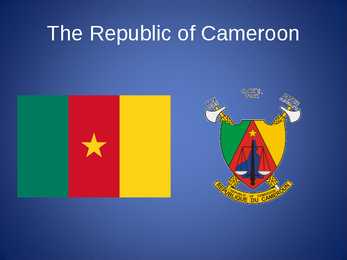
The Republic of Cameroon Cameroon · A unitary republic of central and western Africa · Bordered by Nigeria to the west; Chad to the northeast; the Central African Republic to the east; and Equatorial Guinea, Gabon, and the Republic of the Congo to the south. · Cameroon's coastline lies on the Bight of Bonny, part of the Gulf of Guinea and the Atlantic Ocean. · The country is called "Africa in miniature" for its geological and cultural diversity. History · The territory of present day Cameroon was first settled during the Neolithic · Portuguese sailors reached the coast in 1472 · The German Empire claimed the territory as the colony of Kamerun in 1884 and began a steady push inland.
Its geography is very diverse ranging from moist rainforests to dry deserts and bald mountain peaks. There are two big mountain ranges, one of them is the Rocky Mountains and the other is The Appalachian Mountains. The Capital of The USA is Washington D.C. Other big and famous cities are New York, Los Angeles, Houston, Chicago and Las Vegas. The national anthem of the United States is "The Star-Spangled Banner", with lyrics written in 1814 by Francis Scott Key. There are 6 time zones. From east to west they are: Eastern Standard Time, which is 5 hours behind Greenwich Time, Central Standard Time, Mountain Standard Time, which is 7 hours behind Greenwich Time, Pacific Standard Time. Alaska and Hawaii have their own time zones: Alaska Standard Time and Hawaii Standard Time. Geographical Position The USA lies in the Northern Hemisphere in North America. It covers a big part of the continent and is also the third largest country in the world
can be problems. by naturalization (reasons: immigration, marriage, adoption etc), the procedure: you should spend certain amount of time in the country etc, some procedures are simplified (adoption). from the state, e.g. for scientists, for people who have accomplished certain things. by international treaties (if territories change, people can choose to keep their citizenship, or to obtain citizenship of the new state) How one becomes stateless country can take away citizenship, or in some countries marrying someone from another country the person loses citizenship; if a country stops existing, then. Why is international community against stateless persons? Travelling is difficult,
GDP growth, %: 1.0 (2013 forecast EBRD downward revision from previously projected 2.5%). Official language: Ukrainian (although Russian is widely used in business communication). Currency: Hryvnya (UAH). Government type: republic. Membership: the United Nations, the International Monetary Fund (IMF), the World Bank, the European Bank for Reconstruction and Development (EBRD), the World Trade Organization (WTO), etc. Ukraine is bordered by Russia in the east, the Black Sea in the south, Moldova, Romania, Hungary, Slovakia and Poland in the west, and Belarus in the north. The country is rich in mineral resources: iron ore, coal, manganese, natural gas (shale costly and dangerous to extract), oil, sulfur, graphite, titanium, magnesium, kaolin, nickel, mercury, timber and others. It's commonly known that Ukraine is politically divided between its Western and Eastern regions
2) History Prehistoric Britain, Roman Britain, Anglo-Saxon, Danish, Norman invasions (...-1066): Britain was part of the European land mass until the end of the last Ice Age. It became an island by about 6000 BC. From about 3000 to 2000 BC the British Isles were inhabited by a group of people called the Iberians. These Stone Age people lived in limestone caves, they used stone axes and fashioned antlers and bones into leather-working tools. Later groups of people from what are now Germany, the Netherlands and Brittany also settled in Briton. During the Bronze Age, they mined tin, gold and copper and made bronze tools. They also probably built the spectacular prehistoric megaliths, such as Stonehenge on Salisbury Plain. The Celts invaded the British Isles in the 5th century BC in two waves. The Britons grew wheat and corn, caught fish, and tamed and bred animals. They made coarse cloth for their clothes,
The Great Lakes between the USA and Canada are joined together by rivers and canals. The lakes are connected to the Atlantic Ocean by the St. Lawrence River and to the Hudson River by a canal. Between Lake Ontario and Lake Erie is Niagara Falls (51 m). Another large lake in the USA is Great Salt Lake. It is saltier than the sea. Rivers The Mississippi river is the major river of North America and the United States. It flows from north-western Minnesota south to the Gulf of Mexico. It is a significant transportation artery and when combined with its major tributaries (the Missouri and the Ohio rivers) it becomes the third largest river system in the world (at 6,236 km). The western tributaries are the Red River, the Arkansas and the Missouri. The eastern tributaries are the Tennessee and the Ohio. Its name means the Father of Waters in the Red Indian. Together with its tributaries it forms 20,000 km of navigable waterways.
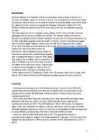
Estonia. Estonia, officially the Republic of Estonia is a country in Northern Europe. It is the smallest of the three Baltic countries. Estonia has land borders with Latvia (339 km) to the south and Russia (229 km) to the east. It is separated from Finland in the north by the narrow Gulf of Finland and from Sweden in the west by the Baltic Sea. Estonia has been a member of the European Union since May 1, 2004 and of the NATO since March 29, 2004. The area of Estonia is about 45000 square kilometres and the population is about 1.4 million people. The capital of Estonia is Tallinn and the official language is Estonian. The currency is Eesti kroon. The main religion is Lutheran. Anniversary of the republic is celebrated on February 20. The national flower is cornflower, national
The United States of America Geography The United States of America is situated in the central part of the North American continent. Its western coast is washed by the Pacific Ocean, and its eastern coast by the Atlantic Ocean and the Gulf of Mexico. It borders on Canada in the north and on Mexico in the South. The U.S.A. consists of 51 states and the District of Columbia. The state of Alaska is separated from the rest of the U.S.A. by Canada. Hawaii, which became the fiftieth state in 1959, is in the Pacific Ocean, halfway between the continents of America and Asia. The area of the United States of America is over nine million square kilometres. The continental part of the U.S.A. consists of two highland regions and two lowland regions. The
- 751 liiget, 750 max + president Party groups - Group of the European People’s Party (Christian Democrats) - Group of the Progressive Alliance of Socialists and Democrats in the European Parliament - Group of the Alliance of Liberals and Democrats for Europe - Group of the greens/european free Alliance - European conservatives and reformists group - Confederal group of the european united left – nordic green left - Eruope of freedm and direct democracy group - Europe of nations and freedom European Comission - EL täitevorgan (rakendab seadusi ja viib ellu poliitikat), sai täidesaatva võimu Lissaboni lepinguga 2007 - executive - Teeb parlamendile ja EL nõukogule õigusaktide ettepanekuid ja teostab järelvalvet koos kohtuga - Haldab EL eelarvet ja eraldab rahalisi vahendeid - Esindab EL rahvusvaheliselt - Komiteed, sekretariaat
Rumours of corruption in City Hall are rife, affordable 6 housing remains in short supply, the health system is under strain, and traffic congestion and crime rates are up. Despite this, the mood of the city remains buoyant. Václav Havel's 13 years as president came to an end in February 2003, when his place was taken by hard-nosed, right-wing economist Václav Klaus. More change was to come: the decision on whether the Czech Republic should join the European Union was settled by a referendum - with 77% voting in favour - and on 1 May 2004 the Czech Republic became a member of the EU. However, the parliamentary elections of June 2006 ended in stalemate - it looks like a rocky road ahead for Czech politics in the next few years. From the beginning The oldest evidence of human habitation in the Prague valley dates from 600, 000 BC, but
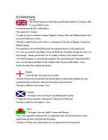
The United Kingdom consists of England, Scotland, Wales and North Ireland and it is situated in the Atlantic Ocean near the mainland of Europe. The population of the UK is 58.6 million and area is 244,110 sq km. Britain has a temperate humid climate. Its characteristic features are mild winters, warm summer, no temperature extremes, abundant rain all year round and frequent changes of weather. The mild climate is partly due to the warm Gulf Stream and partly to the south westerly winds. Occasional winds from the east in winter may bring cold and dry weather. The distribution of rainfall is influenced by the Atlantic Stream. The mountainous areas of the north and west have more rain than the lowlands of the south and east. Wales is located on a peninsula in central-west Britain. The entire area of Wales is about 20,779 km². Wales borders by England to the east and by sea in the
The Kingdom of the Picts as it was in the early 8th century, when Bede was writing, was largely the same as the kingdom of the Scots in the reign of Alexander (11071124). However, by the tenth century, the Pictish kingdom was dominated by what we can recognise as Gaelic culture, and had developed an Irish conquest myth around the ancestor of the contemporary royal dynasty, Cined mac Ailpn (Kenneth MacAlpin). From a base of territory in eastern Scotland north of the River Forth and south of the River Oykel, the kingdom acquired control of the lands lying to the north and south. By the 12th century, the kings of Alba had added to their territories the Anglic-speaking land in the south-east and attained overlordship of Gaelic-speaking Galloway and Norse-speaking Caithness; by the end of the 13th century, the kingdom had assumed approximately its modern borders. However,
SOCIETY AND CULTURE OF ENGLISH-SPEAKING COUNTRIES Introduction 1. Nowadays, English is so widely spoken that it can hardly be considered "a one nation's" language. The main countries where English is spoken are: the U.K, the U.S, Canada, Australia, the Republic of Ireland, New Zealand, West Indies 2. There are approx. 300-400 million speakers of English in the world. English occupies the 3rd place by its number of speakers; it is right behind Mandarin and Spanish. 3. ESL (English as a Second Language) used in your own country (e.g. India) EFL (English as a Foreign Language) used in a foreign country ESP (English for Specific Purposes) used in business, airlines, hotels etc. 4
words is also Finland's national anthem. The current coat of arms of Estonia is a golden shield which includes three slim, blue leopards (or lions) in the middle, with oak branches along the side of the shield. It originates from Denmark. It was officially adopted in 1925. Geography Estonia is the northernmost of the three Baltic States. It is located on the northern hemisphere on the eastern shores of the Baltic Sea in the north-east of Europe. It has land contact with Russia from the east and Latvia from the south. In the north The Gulf of Finland separates Estonia from Finland. The Gulf of Riga is situated to the south-west. Estonia has more than 1500 islands. The biggest ones are located to the west. The four biggest islands are Saaremaa, Hiiumaa, Vormsi and Muhu. The highest point in Estonia and also in the Baltic region is Suur Munamägi. It is 318. above sea level. Estonia is a country of a thousand lakes. The Largest one is Lake Peipsi which is also the
1. Introduction Estonia is a small country about the size of Switzerland, or New Hampshire and Massachussetts combined. Estonia is named after the people called "Ests" who lived in the region in the 1 st century AD. The Republic of Estonia is one of the three countries commonly known as the "Baltic States". The other Baltic States are Latvia and Lithuania. 2. Geographical position Estonia is situated in northeastern Europe. Estonia is bounded on the north by the Gulf of Finland, on the east by Russia, on the south by Latvia and on the west by the Baltic Sea. In the north it borders on Finland. The coastline of the Baltic Sea in Estonia is characterized by numerous gulfs and bays, the biggest of them being the Gulf of Finland, the Gulf of Riga and the Gulf of Pärnu. Bays include the Narva Bay, Matsalu Bay, Kolga Bay, Kunda Bay, Tallinn Bay etc. Estonia has over 1500 islands, the largest being Saaremaa and Hiiumaa, Muhu and Vormsi.
It was probably associated with sun-worship and other rites of prehistoric people. It appears to function as a kind of astronomical clock. Conceivable reports and implications about a secret government conspiracy, which seeks to hide the irrefutable evidence of extraterrestrial origins. 8. The Roman Conquest. Julius Caesar’s first raid was 55 BC. In 43 the Emperor Claudius launched a full- scale invasion, army of 40,000 men. Permanent Roman rule was established in south and south-west of the country as a consequence. Forts were built in Wales, but the local tribes were difficult to subdue. Hadrian ordered to build the Hadrian’s Wall in 121 or 122, a 117km wall from sea to sea, to protect their territory from the Scots. The Roman rule was more of a colonial control rather than a large-scale settlement. They left very little behind. 9. The Anglo-Saxon Invasion.
 annaabi.ee