Leidsid 33 sarnast õppematerjali, mis on seotud failiga "Some theories of Literature". Need materjalid aitavad sul teemat sügavamalt mõista.
literature, work, feel, truth, poet, affect, words, flower, nature, feelings, heart, know, reality, pleasure, rest, offers, than, value, aristotle, gives, other, through, introduction, poetry, performance, sense, makes, power, delight, savage, first, rare, something, actor, waterloo, apple, copy, happened, special, knowledge, insight, seem, existOpposition to abstract, untested theories &ideologies. Friedrich Nietzsche ,,God is dead"-through explaining and putting forward theories had killed Christian god. The essence of Freudian theory: the process in the human psyche Superego-society, conscience, morals, traditions, religion, a moral censor Ego-rational behavior, motivation, self-identification, conscious decisions Id-instincts, natural responses, the pleasure principle, aggressive instincts, the death wish Influence: In art and literature, Freud's theories influenced surrealism . Like psychoanalysis, surrealistic painting and writing explores the inner depths of the unconscious mind. Freudian ideas have provided subject matter for authors and artists. Critics often analyze art and literature in Freudian terms. 2. Literary Modernism and its sub-movements. The influence of Structuralism and psychoanalysis. Main characteristic features of Modernism. Denial of
English literature is one of the oldest literatures in Europe; dates back to the 6th century AD. Oral literature, i.e. not written down, spread from person to person. In 449 AD Anglo-‐Saxon tribes invaded England – beginning of the Anglo-‐Saxon period in English literature. The first form of literature was folklore, carried by scops and gleemen, who
University of North Carolina. He is the author of over 150 articles as well as seven books. Routledge Contemporary Introductions to Philosophy Series Editor: Paul K. Moser Loyola University of Chicago This innovative, well-structured series is for students who have already done an introductory course in philosophy. Each book introduces a core general subject in contemporary philosophy and offers students an accessible but substantial transition from introductory to higher-level college work in that subject. The series is accessible to non-specialists and each book clearly motivates and expounds the problems and positions introduced. An orientating chapter briefly introduces its topic and reminds readers of any crucial material they need to have retained from a typical introductory course. Considerable attention is given to explaining the central philosophical problems of a subject and the main competing solutions and arguments for those solutions. The primary aim is to
argued: o About the origin of things o Without image or story o Claimed that all things are unified · Anaximander 610-546 BC · Anaximenes 585-528 BC Lawgivers: - Seven Sages - Solon of Athens - Thales of Miletus The Presocratics- first Greece philosophers Anaximander · All things are apeiron (without border, either internal or external) · From Anaximander we have the earliest words from a philosopher's own writing: - Whence things have their origin, Thence also their destruction happens, According to necessity; For they give to each other justice and recompense For their injustice In conformity with the ordinance of Time Things have tendency to return back to its original form. Things were undifferented mass, this mass is in motion. All things are always in motion.
The great Enlighteners: Crèvecoeur, Jefferson, Paine, Franklin. The American Enlightenment is the intellectual thriving period in the United States in the midtolate 18th century (17151789), especially as it relates to American Revolution on the one hand and the European Enlightenment on the other. Influenced by the scientific revolution of the 17th century and the humanist period during the Renaissance, the Enlightenment took scientific reasoning and applied it to human nature, society, and religion. American Enlightenment a gradual but powerful awakening that established the ideals of democracy, liberty, and religious tolerance in the people of America. If there were just one development that directly caused the American Revolution and uplifted the intellectual culture of the continent while it was only a British colony, it would be the American Enlightenment. Broadly, the Enlightenment was an intellectual movement that changed the fundamental
is speaking in this way? Is it the story’s hero, concerned to ignore the castrato con- cealed beneath the woman? Is it the man Balzac, endowed by his personal experience with a philosophy of Woman? Is it the author Balzac, professing certain “literary” ideas of femininity? Is it universal wisdom? or romantic psychology? It will always be impossible to know, for the good reason that all writing is itself this special voice, consisting of several indiscernible voices, and that literature is precisely the invention of this voice, to which we cannot assign a specific origin: literature is that neuter, that composite, that oblique into which every subject escapes, the trap where all identity is lost, beginning with the very identity of the body that writes. — Probably this has always been the case: once an action is recounted, for intransitive
Logic is the science of correct reasoning. Logic helps us in constructing and evaluating arguments. How to recognize an argument? Generally a passage contains an argument if it attemps to prove something. It requires evidence presented (premise(s)) and a claim that is said to follow from the alleged evidence (conclusion). This inferential relationship might be explicit or implicit. The relationship between the premises and the conclusion might be explicitly expressed thanks to words that serve as indicators to distinguish the premises from the conclusion. Conclusion indicators Swans are birds and birds have wings. Therefore, swans must have wings. The word “Therefore” indicates the conclusion which are claimed to follow from the premises. Other conclusion indicators include: - consequently - thus - so - hence - it follows that - it implies that - we may infer that - etc. Premise(s) indicators
Philip Larkin’s Poetry: Themes, Form, Style, Imagery and Symbolism Author: Sandra Olivares González Tutor: Jesús Marín Calvarro Degree in English Studies, English Department, Faculty of Philosophy and Letters, University of Extremadura Cáceres, 29th January 2016 Philip Larkin’s Poetry: Themes, Form, Style, Imagery and Symbolism The aim of this work is to obtain some characteristics of the poetry of Philip Larkin, such us the origin of his themes, the way in which he writes his poems and the symbolism he uses (which is a very controversial topic because some assume that he does use it, while some others say that he uses it in an ironic way). In this work we tried to make a revision on the vision of Larkin through the studies that had been made on him, and on the basis of it we can say, that the voice of Larkin still clearly contemporary
the angles, to the saints and Virgin Mary. We are in Heaven that can only be Anglican, filled with deep inner piety which spoke of the anguish of heart in its search for God.Church resumed as holy place again, restoration, beautification, painting and sculpture aided liturgy. 7. 17th century philosophical writing (Burton, Browne, Hobbes) Thomas Hobbes: Leviathan – developed his political philosophy. Man by nature selfishly individualistic animal, constant war with other men. Fear of violent deat principle motive causes them to create state and submite to sovereign, whose power, though derived from people, is absolute and not subject to law. Though he favoured monarchy as the most effective form of sovereignty, theory could apply to parliament also. Led to investigations by other political theorists. Robert Burton: The Anatomy of Melancholy – on surface medical textbook, Burton applies his large and
· Unable to determine his own faith · Hereditary · Naturalists tried to apply in fiction the processes of natural sciences · Writers task is to record facts, systems of behaviour, living conditions, never revealing any natural unbiased (completely natural) · Point of view: amoral-outside the category of morality, neither good or bad · Naturalist find it absurd to blame the wicked. These criminals are doing what nature, environment, their unconscious tells them to do. Naturalists do not judge their characters, they simply report. Try to describe facts like they are. Naturalists depict the lower, coarser forms of life. · Drab, squallid set of scene. Revolting, disgusting · Characters are people with strong animal desires · Neurotic characters unable to understand the forces that control them
3) Experiment: Split-brain experiments by Gazzaniga & Sperry, brain plasticity experiments by Rosenzweig and Bennett. Neurotransmission experiment by Martinez and Kesner. 4) Case studies: Phineas Gage studied by Dr John Harlow and Oliver Sack's study on Dr P. Discuss how and why particular research methods are used at the biological level of analysis. Biological researchers often adopt a reductionist approach to the study of human behavior. They work on a micro-level of research, breaking down complex behavior into its smallest parts (e.g. genes, neurotransmitters or proteins). This approach is sometimes criticized for being overly simplistic, but it is important to have detailed information of the components of human behavior in order to understand the interaction of several factors. Kasamatsu and Hirai studied a group of Buddhist monks who went on a 72-hour pilgrimage to a holy mountain in Japan
.........................................................................46 War Is a Mind-set.....................................................................................48 Do You Want Peace or Drama? ...............................................................49 Beyond Ego: Your True Identity .............................................................50 All Structures are Unstable.......................................................................51 The Ego's Need to Feel Superior..............................................................52 Ego and Fame...........................................................................................52 Chapter Four Role-Playing: The Many Faces of the Ego - 54 Villain, Victim, Lover...............................................................................55 Letting Go of Self-Definitions..................................................................56
the medium is the message. This is merely to say that the personal and social consequences of any medium-that is, of any extension of ourselves-result from the new scale that is introduced into our affairs by each extension of ourselves, or by any new technology. Thus, with automation, for example, the new patterns of human association tend to eliminate jobs, it is true. That is the negative result. Positively, automation creates roles for people, which is to say depth of involvement in their work and human association that our preceding mechanical technology had destroyed. Many people would be disposed to say that it was not the machine, but what one did with the machine, that was its meaning or message. In terms of the ways in which the machine altered our relations to one another and to ourselves, it mattered not in the least whether it turned out cornflakes or Cadillacs. The restructuring of human work and
After I've said what I think about each topic, readers may have a fair comprehension of my philosophy. First comes sensitivity. If a person be insensitive, be it from numbing cold, exhaustion, drugs, genetic makeup, or upbringing, then the process of education is bogged down, and results come only after great efforts. Sensitivity in my integrated meaning is broad, covering literally the senses, so that deaf and blind people are less sensitive, as well as people whose senses work perfectly, but whose receptivity or thought processes are blunted for whatever reason. A person can be insensitive in one way, such as blind, and extraordinarily sensitive in another way, such as in hearing. It is also possible to be so ultra-sensitive that the result is disadvantageous. I expect no argument in asserting that a normal sensitivity is a healthy, indispensable ingredient for optimal education. Sensitivity can be heightened or blunted by education
Style The term style is a polysemantic one. The latin word ,,stilus" meant a writing instrument used by the ancients for writing on waxed tablets. Already, in classical latin the meaning of style was extended to denote the manner of expressing one's ideas in written or oral form. One of the abts/the best was given by Jonathan Swift: ,,Proper words in proper places." In present- day english, the world style is used in about half a dozen basic meanings. 1. the characteristic manner in which a writer expresses his ideas. Some speak about the style of Hemingway, Dickens etc. 2. the manner of expressing ideas, characteristic of a literary movement or period. Style of symbolism, romanticism 3. the use of language to pick a literary genre-comedy, novel, drama, O.D (poetic form) etc. 4
profoundly as he stands nearer to the Source of all sources from which all the innermost sublime and substantial ideas stream. In this book Estonian symphonic music is discussed from its starting point, the pathetic overture Julius Caesar (1896) by Rudolf Tobias, up to the works of the young composers of the 1990s. This is the first book that presents a general treatment of the Estonian symphonic music. Other Estonian literature on this subject has offered a broader background. This book should appeal to composers, musicologists, conductors, educationalists, instrumentalists, music students, as well as everybody interested in Estonian symphonic music. The book is divided into 29 chapters where more than 70 orchestral compositions of 32 composers are examined. The background on the developments in music is illustrated through historical data and cultural achievements in literature, art,
STYLISTICS 1. Style, stylistics, a survey of stylistic studies The term ,,style" is polysemantic. Latin ,,stilus"--a writing instrument used by the ancients for writing on waxed tablets. Soon, the meaning was extended to denote the manner of expressing one's ideas in written or oral form. Jonathan Swift said: ,, Style is proper words in proper places" Present day--half a dozen meanings: · the characteristic manner in which a writer expresses his ideas (Style of Byron) · the manner of expressing ideas characteristic of a literary movement or period (symbolism, romanticism) · the use of lg. typical of a literary genre (comedy, drama, novel) · the selective use of lg that depends on spheres of human activity. These
because made of steel 2. Formal cause: - what form, definition or property it has - why is this salt? because made of sodium and chloride 3. Efficient cause: - what initiated the change or movement - why did the baseball move? because someone hit it 4. Final cause: - what end or goal does it have? - why does he walk? because he wants to be healthy - also nature operates in terms of final causes - things don't happen spontaneously, every action that nature takes is for the sake of something, everything has a purpose - where a series has a completion, all the previous steps are done for the sake of that - art partly competes with and imitates nature - animals and plants do things for the sake of an end - plants grow leaves to provide shade for fruit - has roots downwards for nourishment
STYLE AND STYLISTICS FGI 1081 Stylistics (I. Ladusseva) 2 The term "style" is polysemantic (has many meanings): a Latin word "stilus" originally meant a writing instrument used by ancient people. Already in classical Latin the meaning was extended to denote the manner of expressing one's ideas in written or oral form. The precise definition was given by Jonathan Swift, who defined style as "proper words in proper places". In present day English the word "style" is used in about a dozen of principle meanings: 1. the characteristic manner in which a writer expresses his/her ideas (e.g. style of Byron). 2. the manner of expressing ideas, characteristic of a literary movement or period (e.g. symbolism, romanticism, renaissance). 3. the use of language typical of a literary genre (e.g. the style of a comedy, drama, novel). 4
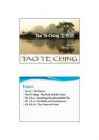
Tim Chiu April 4th , 2009 Topics y Lao Zi The Person y Tao Te Ching The Book and the Name y Ch. 1 & 14 Describing the indescribable Tao y Ch. 2 & 11 On duality and Formlessness y Ch. 8 & 78 The Virtues of Water Lao Zi The Person y Real name was Lee Er, who was a highly regarded philosopher of his time y Keen observer of the virtues of Nature and the relationship between man and his environment y Realized the existence of a formless and indescribable origin: Tao y Can not thoroughly analyzed by our thoughts and logic y Its existence gave rise to everything and pervades all that we know y The manifestation of Tao in humans is called our True Nature y Purity and innocence of a child y Spring and Autumn, Warring States Era of the Chou dynasty (~500BC), during a time of turmoil and spiritual disintegration
Viktoria Gumennaja 2018 INTRODUCTION "The city's the best gallery I could imagine." — JR I choose the topic for writing an essay - street art. Why did I choose this genre? Because for me it is something magical and special, not at all similar to those works that are in museums, at exhibitions and so on. Think for yourself, because street art began with the graffiti, and now we can see on the streets of our city just a work of art. I think graffiti, by the way, is also a great and invaluable work. Trends are changing. Now, young artists are moving from an endless unthinking tagging to a more conceptual and rich sense, abstract and volumetric work. Street art has become popular among the general public, because it is more accessible to him both in content and in location: for art, now you do not need to go to a museum or gallery, and the meaning of the work is often clear at a glance
surrounding us, therefore, we often supplement perception with unconscious inferences. Thus he argues that perception begins with an incomplete retinal image that is two- dimensional, flat and size depends on distance. He says that perception is a constructive process in which the two-dimensional retinal image is elaborated to a three- dimensional picture in our brain, based on personal knowledge and experience. In other words the processes of perception is essentially affected by our expectations and probability in perceiving the world. Therefore conceptually driven perceptual processing is called a top- down process due to the indirect process that involves making assumptions about the world. 1 05144023 However, another theory of visual perception is called bottom-up/data driven processes Gibson (1979)
(1984). A Guide to The Culture of Science, Technology, 3. Broad Synthetic vs. Narrow Analytic. Third, one may approach science and Medicine. The Free Press. pp. 217-222. (Katkendid) from a narrow analytic or a broad synthetic point of view. That is, one could see one's task as primarily dissecting various features of science to see how they look or work, or C. Frameworks for Philosophy of Science as primarily locating science within a broader framework of human activities and artifacts. Questions about, for example, the form and function of scientific explanations
One of the most important developments in the western intellectual tradition was the Scientific Revolution. The Scientific Revolution was nothing less than a revolution in the way the individual perceives [ tajub ] the world. As such, this revolution was primarily an epistemological revolution it changed man's thought process. It was an intellectual revolution a revolution in human knowledge. Even more than Renaissance scholars who discovered man and Nature, the scientific revolutionaries attempted to understand and explain man and the natural world. Thinkers such as the Polish astronomer Nicholas Copernicus(14731543), the French philosopher René Descartes(15961650) and the British mathematician Isaac Newton(16421727) overturned the authority of the Middle Ages and the classical world. And by authority I am not referring specifically to that of the Church the demise of its authority was already well under way even before the
1. What does the word “philosophy” mean? The study of proper behaviour and the search for wisdom, in greek means love for wisdom 2. Is philosophy a science? Why? What kind of science it is? Yes it is. It tries to understand the meaning of reality. It’s the science of truth. Science, as it exists today, happens within the framework of philosophy. Philosophy, however, is bigger than science. It is also a form of art and discipline…... 3. Name three characteristics of Classical philosophy? deeply rooted in religious traditions ; believes that inferior was created by superior ; more positive ; seeks the real truth ; about intelligence ; reaalsuse üle mõtisklus ; believes that god is truth 4. Name three characteristics of Modern philosophy.
results, you have the right road map in your hands.You have before you the DNA of your future. All you need to create a wonderful fu- ture for yourself is to read this book, decide how you are going to apply it to your own life, write out a plan, and then go forth with en- thusiasm and make it happen. I have a confession to make. I am one of Brian’s raving fans. I have studied him, his brilliant work, and the extraordinary results he has achieved. I am also one of his close colleagues and friends. We have worked together on many platforms, and met and talked with each other on numerous occasions. Brian is one of the finest thinkers and writers on inner develop- ment and personal success in the world. I know; I have sold over 82 million books aimed at helping people get the most out of themselves.
22. If you want to get along you have to get along with those who don't want to get along. 23. If you whine whenever anybody messes with your crutches you can't claim not to be crippled. 24. I hate an unfair fight, so I need to be ganged up on. 25. Inattention is not O.K. 26. Injustice in your vicinity is your business--particularly your own. 27. It is not enough to refrain from bearing false witness against your neighbor. When he is falsely accused it is your duty to bear witness to the truth, no matter what your opinion of him generally may be. 28. It isn't stupidity that bothers me; it's the reign of stupidity. 29. I want to separate the sheep from the goats; I have no use for sheep. 30. I want what I want. Don't offer me any substitutes. When there's a problem I want a solution. Don't offer me any half measures. 31. Literal-mindedness is good. 32. One of the biggest energy-wasting manifestations is the compulsion to begrudge energy. 33
"We've known for years that people buy based on emotions and justify their buying decision based on logic. Dr. Cialdini was able, in a lucid and cogent manner, to tell us why this happens." --MARK BLACKBURN, Sr. Vice President, Director of Insurance Operations, State Auto Insurance Companies "Dr. Cialdini's ability to relate his material directly to the specifics of what we do with our customers and how we do it, enabled us to make significant changes. His work has enabled us to gain significant competitive differentiation and advantage" -LAURENCE HOF, Vice President, Relationship Consulting, Advanta Corporation "This will help executives make better decisions and use their influence wisely ... Robert Cialdini has had a greater impact on my thinking on this topic than any other scientist." -CHARLES T. MUNGER, Vice Chairman, Berkshire Hathaway, Inc.
You need time to: 1. read the theory 2. collect material 3. regularity (1-2 hours a day deal with your paper) The first draft of term paper should be ready by March. Supervisors are: 1. Suliko Liiv (country study, grammar, contrastive studies, methodology) 2. Liliana Skopinskaja (methodology) 3. Jaanika Marley (foneetika, methods) 4. Ene Alas (translation, methods) 5. Paul Rüsse (literature (Am.,Br.), methods) 6. Annika Namme (American literature, methods) 7. Irina Ladusseva (lexicology, methods, stylistics) Choose your topic and find a supervisor. Language needs to be very transparent, but do not use colloquial elements and abbreviations (e.g. I'll, you're). Start collecting the expressions you like (e.g. "many" "the abundance" etc.) How to elaborate a topic? collaborate with supervisor (a topic has to be narrowed down).
1. STYLE The term "style" is polysemantic (has many meanings): a Latin word "stilus" originally meant a writing instrument used by ancient people. Already in classical Latin the meaning was extended to denote the manner of expressing one's ideas in written or oral form. Jonathan Swift defined style as "proper words in proper places". In present day English the word "style" is used in about a dozen of principle meanings: 1. the characteristic manner in which a writer expresses his/her ideas (e.g. style of Byron) 2. the manner of expressing ideas, characteristic of a literary movement or period 3. the use of language typical of a literary genre (e.g. the style of a comedy, drama, novel). 4. the selective use of language that depends on spheres / areas of human activity (e.g
nobility · What were the reasons behind upward mobility? New public schools for poorer people; S. Smile "Self Help"; questioning the social status of the nobility · Reasons behind the rise of literacy 1850 Libraries Act, the Sixpenny novels (people could by cheap books- T. Malory "Morte d'Arthur", W. Scott historical novels- most popular was "Ivanhoe"; new schools for middle class- public schools; not so rich people got some education; the Penny Magazine · Key words of the British national identity: 1852- the Great Exhibition; Gothic revival Architectures; the Battle of the Styles; The Tower of London, Hampton Court were opened to public · Why were the Brits obsessed with the middle ages? People were afraid of new things, they didn't feel comfortable in new and fast-moving world; people wanted security and they found it in old things; Middle ages became popular, "Morte d'Arthur" by Thomas Malory 2) Ruskin and the medieval revival
And shall we never dare amuse ourselves Till this fine gentleman deigns to consent? DORINE If we must hark to him, and heed his maxims, There's not a thing we do but what's a crime; He censures everything, this zealous carper. MADAME PERNELLE And all he censures is well censured, too. He wants to guide you on the way to heaven; My son should train you all to love him well. DAMIS No, madam, look you, nothing--not my father Nor anything--can make me tolerate him. I should belie my feelings not to say so. His actions rouse my wrath at every turn; And I foresee that there must come of it An open rupture with this sneaking scoundrel. DORINE Besides, 'tis downright scandalous to see This unknown upstart master of the house-- This vagabond, who hadn't, when he came, Shoes to his feet, or clothing worth six farthings, And who so far forgets his place, as now To censure everything, and rule the roost! MADAME PERNELLE Eh! Mercy sakes alive! Things would go better
Russian philology The meaning of the word "philology" is "love for word". This is love that unites teachers and researchers of modern and Classical languages and literature, interpreters and diplomats, journalists and publishers, writers and poets. Russian philologis are highly demanded in various spheres of scholarly research and education, in the mass media, in civil service at the Ministry of Foreign Affairs, in archives, libraries, museums, in travel agencies, as well as Russian and international companies. Curriculum within in philological faculty includes courses of Russian and European
 annaabi.ee