Since William was crowned king, there were many rebellions against the Normans. A small Norman army marched from village to village and destroyed the ones it couldn't control. The Normans took away the Saxon lords' land. Only a few Saxons who supported William could keep their land. Feudalism William gave parts of his conquered land to his captains around the country to avoid rebellions and uprisings. He also kept some land to himself to make sure his was much stronger than his nobles. Of all the farmland half went to his nobles, quarter to church and fifth he kept to himself. William organised the English kingdom according to feudal system. The main purpose of using that system was economic. King gave the land to "vassals" in return of army services and goods. When a noble dies, his son took over the estate. When there was no family, the land went back to king who could give it to another noble or just keep it for a few years.
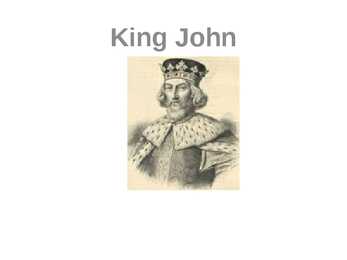
King John King John He was born in 1167 John died in October 1216 His brother was King Richard I King John nick-name was John Lackland. He had intelligence, administrative ability and he was good at planning military campaigns. The Magna Carta I, King John, accept that I have to govern according to the law. So I agree: 1. Not to imprison nobles without trial 2. That trials must be in courts; not held in secret by me 3. To have fair taxation for the nobles 4. To let freemen travel wherever they like 5. Not to interfere in Church matters... Rule King John ruled 1199 to 1216. He faced the following problems. Problems 1. John raised taxes in England to pay for the wars. This upset his BARONS!
locked the churches. In 1204 John lost his lands in France. He tried to recapture Normandy. As the cost of War had risen, he raised the taxes, the barons didn't like it. In 1214 the barons rebelled against John. He was forced to sign Magna Carta, the Great Charter (symbol of freedom, hundreds of years later it was used by Parliament to protect itself from a powerful king),in 1215, but was unwilling to keep to the agreement. The nobles rebelled and civil war was avoided only because John died suddenly. John's son Henry became King as Henry III. He was then 9 years old and until the age of 20 he was under the control of powergul nobles. When he became independent, he became involved in wars & got foreign advisers. This upset the nobles. Their leader Simon de Montfort took over the government and called a Great Council in 1258. It included knights, barons & bishops. It forced Henry III to get rif of his
10.1066 the normans defeated the English and their leader, Duke William of Normandy, was crowned the king onf England(william the conqueror) o In 1086 the domesday book was completed- a complete catalogue of who owned what in the country o The french language became dominant o The normans imposed a strict feudal system (anglo-saxons were the peasants who were under the norman nobles and barons) o Built castles, cathedrals Three facts about the history of parliament It was in the medieval period that Parliament began its gradual evolution into the democratic body which it is today. The word 'parliament', which comes from the French word parler (to speak), was first used in England in the thirteenth century to describe an assembly of nobles called together by the king.
V died six days after her birth. First marriage Mary was sent by her mother, Mary of Guise, to be raised at the court of the French king Henry II. She was married in 1558 to Francis II. When Francis died Mary returned to Scotland. Francis II and Mary Stuart Scotland She was distrusted because of her Catholic upbringing. In 1565 the red-haired queen married her ambitious cousin Lord Darnley She became a victim of intrigues among the Scottish nobles. Darnley murdered Mary's confidant David Riccio. The murder of Riccio Third marriage Lord Darnley was murdered in 1567. The suspect was Bothwell. Ignoring objections by the jealous Scottish nobility, Mary married Bothwell. England Mary Stuart had to take refuge in England. Her cousin Elizabeth I arranged to keep her in captivity. Mary was executed at Fotheringhay Castle in 1587. Thank you for listening!
No trip to London would be complete without a visit to the Tower of London. This famous historical site has been the living quarters of monarchs. It has been a site of imprisonment and execution of many traitors, clergymen, nobles and framed members of the royal court and was also an armory, treasury, zoo and mint. Today it houses the crown jewels and has a museum filled with armor, weapons and implements of torture. Another popular tourist sight is the London eye. Constructed by British Airways, it towers 135 meters above the banks of the Thames River. It is located near Big Ben and Westminster Abbey, on the opposite bank, adjacent to London's county hall
associated with the coronation of English kings since the time of Edgar. William had gained his throne by accepting the English form of coronation, William emphasised his claim to be legitimate successor to Edward the Confessor. William I was a strong king and a man of immense determination. He was stern to people who opposed his will, but kindly disposed to those who did not. William saw England as an extension of his French domains. He dispossessed nearly all the Anglo-Saxon nobles of their lands, and put Normans in their places. These men discouraged rebellion by building strong castles throughout the country, especially in Wales. In return for their land, William's barons had to perform certain services. They and their bishops had to perform certain services. They and the bishops served as members of William's Council, which replaced the Anglo-Saxon Witan. The barons also had military obligations to serve as knights (army commanders) for William.
many changes. From the Magna Carta to the creation of the English Parliament, England laid the foundation for representative government and regulated sovereignty. The Magna Carta clearly defined the ancient rights and privileges of the people 1. It established the principle that the king no longer had absolute control, and prevented English rulers from taking advantage of their subjects. Later, England would institute a Parliament to allow British nobles the opportunity to voice their opinions in political matters. This entire process moved the world one step closer to the types of governments that are seen today. 3.12.2012
· The lords and the barons · English-speaking Saxons · The peasants · Cow, pig, sheep the living animals · Anglo-Saxon origin · Beef, pork, mutton the animal you eat · French origin · Implication: only the Normans ate meat Feudalism · William's power consolidated by a combination of feudal practices from the continent and old Saxon customs · Wanted to keep his followers from getting too powerful · Gave the nobles land · Scattered them all over England (could not gather power in one area) · Exceptions: frontiers bordering Scotland and Wales · Took about 20% of England's land for himself · Showing that it was the primary source of power · Demanded a large feudal army from the barons · England came to resemble the feudal monarchy of France · Built around 500 castles · Against local uprisings and foreign invasions
mainstream of European society. William introduced the feudalism. Under it, land was divided among noble overlords, or barons. Knights pledged their wealth and services to the overlords. In return overlords let them use their land. At the lowest end of the social scale were the serfs, peasants bound to the land. In 1154 the Norman time was at the end. In 1154 Henry II started to reign. Henry II was the king who increased royal power at the expense of nobles. His desire to control the Roman Catholic Church in England led to the murder of T. Becket. Richard I has become a model of a true knight. John(Richards brother) gained a weak, even villainous ruler. 1215 he signed the Magna Carta. This was the beginning of constitutional morachy in England. Henry V won the Fench in the battle of Agnicourt in 1415. Henry VI went insaine and gave his throne to his uncle Duke of Yorke. When Henry IV wanted his throne back, his uncle refused,
handpicked Jumala poolt-didnt hoidke peaaegu sama palju vett kui viimastel aastakümnetel. Lõppkokkuvõttes, need erinevad probleemid hilja-1700 Prantsusmaa ei olnud nii palju kohe põhjuste revolutsiooni, nagu nad olid lõplik katalüsaator. Range Prantsuse klassi süsteem oli pikka aega suunatud vaimulike ja aadli palju kõrgemal ülejäänud prantsuse kodanikke, hoolimata sellest, et paljud need kodanikud ületas nobles jõukus ja maine. Veelgi enam, need ainult pealkirjad, millest enamik olid ostetud ja edasi suunata läbi perede-sisuliselt asetatud nende omanike seadusest kõrgemal ja vabastada need maksud. Aastal 1789, kui Prantsusmaa on vana seadusandlik organ, Estates peadirektor, uuesti kokku ja selgus, et kõrgema järjekoha klasside keeldus kaotab oma privileegid huvides päästa riik, pettumust prantsuse kodanlus saavutas keev. Prantsuse revolutsioon oli seega
toppled from control of the Soviets in September, and by the Tsarists, who wanted to rescue Nicholas II and put him back on the throne. Lenin made peace with Germany ,the Treaty of Brest-Litovsk, in which Russia had lost much of Russia's best agricultural and industrial land to Germany, including Ukraine, Estonia, Latvia and Lithuania and the former army officers were angry about this. Also, the Bolshevik government had taken land from the Tsar and the nobles and given it to the peasants, and the civil war was supported by those landlords who had lost their land. All these enemies of the Bolsheviks co-operated to try to bring down the Bolshevik government. A second cause of the Civil War was the Czech Legion. These were some Czech prisoners of war being taken across Russia who in 1918 mutinied, took control of the Trans-Siberian Railway, and attacked towards Moscow. Finally, these groups within Russia were helped by the Great Powers, angry that
· Along the way Frederick fell in a river and drowned. · Phillip and Richard did not get along very well, so Phillip said screw it and went home. · That left Richard to fight by himself. · Although Richard and his army did win several victories but were never able to retake Jerusalem. · The English eventually had to give up and head home. · Along the way, Richard was taken prisoner by one of the nobles he had offended. 5.slide Richard was a king of England, later known as the 'Lion Heart', and famous for his exploits in the Third Crusade. Richard was the third son of Henry II of England 6.Slide Started to the Holy Land, but decided to take over Constantinople instead Disorganization and a lack of strong leadership made the fourth crusade another failure. Five other crusades followed the sack of Constantinople, but all of them were failures.
county or regional names to this day: Essex (East Saxons), Sussex (South Saxons), Wessex (West Saxons), East Anglia (East Angles). The seven kingdoms were first united into one under Egbert of Wessex, who became the first king of England (829–839). And the country got its new name, England, ‘the land of Angles’. One of the institutions created by the Anglo-Saxons in the ninth century was the King’s Council, called the Witan, which included nobles and senior churchmen. The Witan advised the king on important matters and was the highest law court. When a king died, the Witan chose a successor. The Anglo-Saxons had little use for towns, which fell into disrepair. But they had a great effect on the countryside, where they founded the thousands of self- sufficient villages which formed the basis of English society during the next thousand or so years. They cut down many forest areas in the valleys to make new fields. 32
9 million tonnes. Based on these estimates, building this in 20 years would involve installing about 800 tonnes of stone every day. The pyramid remained the tallest man-made structure in the world for over 3,800 years Pyramid complex The Great Pyramid of Giza is the main part of a complex setting of buildings that included two temples in honor of Khufu, three smaller pyramids for Khufu's wives, an even smaller "satellite" pyramid and small Mastaba tombs surrounding the pyramid for nobles. There was a town for the workers of Giza, which included a cemetery, bakeries, a beer factory and a copper melting complex Giza's Materials The Great Pyramid consists of more than 2.3 million limestone blocks. The Egyptians got the majority of the limestone blocks from a nearby quarry. The Tufa limestone, used for the casing, was quarried across the river. The largest granite stones in the pyramid,
followers of the king in Canterbury Cathedral. · Harold Godwinson- Also known as Harold II was the last Anglo-Saxon king of England. He died at the Battle of Hastings.(+ battles) · William the Conqueror- William I, usually known as William the Conqueror and sometimes as William the Bastard, was the first Norman King of England, reigning from 1066 until his death in 1087. Although Willam's victory was remarkable, the way how he managed to control the nobles was even more. He gave them lands, but scattered them all over England so that he would not have the same faith as French Monarch. He also demanded that each freeman in England would utter the oath of loyalty to him(not to the feudals as they used to). · Henry II and the Angevin Empire- Henry II was the King of Angevin Empire. The term Angevin Empire is a modern term describing the collection of states once ruled by the Angevin Plantagenet dynasty, which
crystal, topaz, and patchouli has been used to obtain beautiful Taj Mahal. Giza Pyramid It is the oldest and largest pyramid of the three pyramids in Giza Nekropolis. Built as a tomb for Fourth dynasty Egyptian pharaoh, Khufu. Built for more than 20 years and is expected to take place in about 2560 BC. The three smaller pyramids for Khufu's wives, and a pyramid of "satellite" even smaller, in the form of an elevated track, and mastaba tombs surrounding the pyramid is small nobles. Acropolis of Athens Acropolis is a rocky plateau as high as 156 m, and there are some ruins of an ancient building that was once the temple who were the historical center of Athens. Was built 1,300 years BC. Acropolis is actually a lovely little town, to destroy the Persian empire in 480 BC. A year later the Greek army defeated the Persians and rebuilt temples. Between the years 467 until 404 BC, the building was completed. In 1834 Athens became the capital of Greece, King Otto set the
The Middle Ages The Middle Ages are one of the most turbulent periods in English history. The Middle Ages are so called as the middle period between the decline of the Roman Empire and the Renaissance. The Middle Ages started in 1066. with the Battle of Hastings and the Norman Conquest. William the Conqueror took all the lands from the Saxon English and gave these to French nobles. Normans were known as great builders. This is assured by the fact that many great castles and other buildings, including the Tower of London, were built during the Norman Conquest. In 1086. Domesday Book was compiled. It is a detailed survey of England ordered by William the Conqueror. The reign of King William Rufus who was the son of William started in 1087 and lasted until 1100. Next king was Henry I who was the brother of William Rufus. His reign was from 1100-1135
The peasants of the village formed a community. The Anglo-Saxons had Trial by Ordeal. In the 7-9th cent. the situation started to change. Not all member stayed equal. Military leaders & elders possessed more land & cattle and slaves. Land became private property, could be sold or presented or given in return for debts to another owner. Free peasants began to lose their freedom. Many fell into bondage. Lost their land. In return for the land had to work on sb's land. Many nobles seized land by force. Sheriffs became king's officials. Moots lost their importance. This was the beginning of feudal relations. The man's position in the society depended on how much land he had. The root of power was land. It was the beginning of a class system, made up of king, lords, soldiers & workers on the land. By 600 Saxon settlements had gradually formed 7 kingdoms (Essex, Sussex, Wessex, Kent, Mercia, East Anglia, Northumbria). They were constant struggle against one another for
friends in Normandy and he wanted the people of Dover punhised for this. Edward asked Earl Godwin to be the punisher. After saying no to king he raised an army against Edward instead. The other two senior noblemen, the earls of Mercia and Northumbria, remained loyal to Edward. Later Edward outlawed Godwin and his family in Flanders. Between 1051 and 1052, Edward increased the number of Normans who advised him at court. Edward's continued favouritism caused problems with his nobles. In 1052 Godwin and his sons returned to England with an army. The army was commanded by his two sons Harold and Tostig. Godwin's lands were returned to him and many of Edward's Norman favourites were exiled. In 1053 Godwin died. His title was taken by Harold who became known as Harold of Wessex. He was the most powerful nobleman in England. It was Harold who subjugated Wales in 1063 and negotiated with the rebellious Northumbrians in 1065. Thereof, shortly before his death, Edward named
in the end thanks to a clever strategy William I, also known as William the Conqueror, replaced King Harold on the throne The invasion was completed by 1071 - The Norman invasion is depicted on the Bayeux Tapestry a long embroidered cloth The death of King Harold embroidered on the Bayeux Tapestry The Norman England William I ensured his power by dividing the land into parts and making 1/7 of it a royal domain He made his nobles swear an oath of allegiance and become his vassals Died in 1087 while fighting in France, was succeeded by his third son, William II Rufus William II was very unpopular: - Problems with the church - Increased taxes and claimed the money of many positions of the church William the Conqueror began building the Tower of London one of the most notorious prisons in the world After William II died in 1100 due to an incident
Toompea. It was finished in 1900, when the country was a part of the Russian empire. Time of russification, many estonians against it. Dedicated to the prince of novgorod, alexander nevsky who won the battle of ice. Due to the lack of funds and the building’s massive construction, it was never demolished. Kohtuotsa viewing platform - gives great view to the both parts of the city. blabla Estonian Knighthood House - The German nobles in Estonia were united in the Estonian Knighthood. The Estonian Knighthood House was the building where the Knights met and held their festivities and where their peerage register was kept. Town Hall Square Raekoja plats (English: Town Hall Square) is a town square beside Tallinn Town Hall(Estonian: Raekoda) in the center of the Tallinn Old Town in Tallinn, Estonia. It is a venue for numerous small festivals or concerts like Tallinn Old Town Days. Also hosts regular market every
In 1420 combined Hussite forces led by military 8 commander Jan Zizka successfully defended Prague against the first anti-Hussite crusade, launched by Sigismund, the Holy Roman emperor, during the Battle of Vítkov Hill. In the 1420s a split developed in the Hussite ranks between radical Taborites, who advocated total war on Catholics, and moderate Utraquists, who consisted mainly of nobles who were more concerned with transforming the Church. In 1434 the Utraquists agreed to accept Sigismund's rule in return for religious tolerance; the Taborites kept fighting, only to be defeated in the same year at the Battle of Lipany. Following Sigismund's death, George of Podbrady (Jií z Podbrad) ruled as Bohemia's one and only Hussite king, from 1452 to 1471, with the backing of Utraquist forces. He was
offered detailed theories of evolution (Clark, 1984, pg.24-25). Therefor the idea of evolution went very far back in Western history. At that time this concept was referred to as The Great Chain Of Life and was conceived in the middle ages, based on a mixture of classical and Biblical ideas. The ranking order ranged from the "lowest" forms of life to "higher" living beings (lion), through the various classes of human beings from peasants to nobles to Popes, and upwards through the hierarchy of angles to God. This concept, in and of itself, has nothing to do with evolution, in fact it seems to be anti-evolutionary, since every member is fixed in its own place. This chain was created in a time when the world was considered to be more static rather than a diverse collection of dynamic ideas. But the Newtonian revolution of the seventeenth century replaced the old static world with a new world view in which
elders. Until the beginning of the 13th century Estonia was politically independent. Then began a long chain of occupation and control by foreign powers. In the 1200s the German crusaders converted Estonia into a Christianity by force and took control over South Estonia. In 1219 Denmark conquered Northern Estonia. About a century later, in 1346 Denmark sold its territory to Germany. By the 1500s German nobles owned much of Estonia's land. After the Livonian War (1558-1583) the northern part of Estonia went under Swedish control, the southern part belonged to Poland and the islands to Denmark. Only in1629 the whole mainland Estonia became subject to Sweden. Under Swedish rule the University of Tartu was founded in 1632 and also the oldest school working on the same premises was founded in Tallinn (GAG).After the Northern War (1700-1721) Estonia became a province of Russia
called the Low Countries, or Netherlands, including present-day Belgium. (3) 7 During the 9th and 10th centuries Scandinavian raiders, called Vikings, frequently invaded the coastal areas, sailing far up the rivers in search of loot. The need for a stronger system of defenses against such marauders gradually led to an increase in the power of the local rulers and their vassals, the nobles, who were largely a warrior class. Concurrently, the towns began to grow in importance, as artisans and merchants settled in them and improved their defenses. The gradual development of powerful towns was a notable feature of Dutch history during the 12th, 13th, and 14th centuries, and the area became an important trading centre. Under the leadership of wealthy merchants the towns began to challenge the power of the nobles who ruled the countryside
Üks hiiglaslik Watti ausammas Chantrey oli paigutatud Westminster Abbey`isse ning sellele ausambale on kirjutatud järgmised sõnad: NOT TO PERPETUATE A NAME, WHICH MUST ENDURE WHILE THE PEACEFUL ARTS FLOURISH, BUT TO SHOW THAT MANKIND HAVE LEARNED TO HONOUR THOSE WHO BEST DESERVE THEIR GRATITUDE, THE KING, HIS MINISTERS, AND MANY OF THE NOBLES AND COMMONERS OF THE REALM RAISED THIS MONUMENT TO JAMES WATT WHO DIRECTING THE FORCE OF AN ORIGINAL GENIUS EARLY EXERCISED IN PHILOSOPHIC RESEARCH TO THE IMPROVEMENT OF THE STEAM-ENGINE ENLARGED THE RESOURCES OF HIS COUNTRY INCREASED THE POWER OF MAN AND ROSE TO AN EMINENT PLACE
While Denmark took the northern part of Estonia, the knights occupied the southern portion. In 1346 the Danes sold their territory to the order, and Estonia remained under the rule of the knights and the Hanseatic merchants until the order's dissolution in 1561. Northern Estonia was then passed to Sweden, the rest was briefly held by Poland but was transferred to the Swedes by the Treaty of Altmark in1629. It ended the first Polish-Swedish war. German nobles--the Baltic barons--kept their sway over the Estonian peasantry until the eve of the 1917 Russian Revolution. Industrialization proceeded during the 19th century. The republic became heavily interlaced with railroads, and the port of Tallinn grew in importance. Russification took place and it caused rebellion and considerable emigration mostly to the United States and Canada. The Twentieth Century
12. Magna Carta. In 1215 King John was forced to sign the document, drawn up by the noblemen of England. It limited his power and extended the rights of his subjects. The Magna Carta is a well-known charter of personal and political liberty. Later, especially in the 17th century, the document was seen as a statement of basic civil rights. Four copies have survived. 13. The Wars of the Roses. During the 15th century, the power of the greatest nobles, who had their own private armies, meant that constant challenges to the position of the monarch were possible. These power struggles came to a head in the Wars of the Roses, in which the nobles were divided into two groups, one supporting the house of Lancaster, whose symbol was a red rose, the other the House of York, whose symbol was a white rose. Three decades of almost continual war ended in 1485, when Henry Tudor
Henry was a talented musican and scholar, spent much money on it. Soon he had spent all savings his father had collected, he needed money. He understood that monasteries had become useless. So he closed them, took away the riches dissolution of monasteries. When henry quarreled with the Pope, made England independent of Rome. Beginning of the Anglican church. Henry died 1547, only son came to throne Edward Vll, was too young to rule alone. There was acouncil of nobles who did it for him. Unfortunately he died at the age of 16 There was a great problem with finding new king. His daughter Mary became a king. Called Bloody Mary. England had become protestant country. She started oersecuting protestants who were burnt alive. Was said that you could sense the smell of burning flesh all over England. Mary married with the king of Spain, but Mary couldn't get a child. She was afraid of
home landin many european countries from 850´s onwards In Ireland, ScotlandWales and Cornwall- mainly Norwegian, in English, Frankish lands- Danish 9th C invaded England, conquered all nothern, Feudalism, manor system Feudalism- social system of rights and dutie based on land tenure and personal relationship The basis- holding land, Main purpose- economy King was the owner of the whole land, land was held by vassals, greater nobles gave part of their land to smaller, system developed mailny in 9th C, loyal dynasties became independent and started to build up small territorial states Manor system- political, economical, social system, peasants depended on their land and lord The head of the society was the lord of the manor, part of his land was rent out or by military Peasants who held a land and field, were attached tot heir land, paid for in money or labour Edward the Confessor
and in the 21st century, Runrig's And The Accordions Played. The last two lyrics include a reference to the bluebell. The "Scottish Bluebell" is Campanula rotundifolia, (known elsewhere as the "Harebell") rather than Hyacinthoides nonscripta, the "Common Bluebell". Trees held an important place in Gaelic culture from the earliest times. Particularly large trees were venerated, and the most valuable such as oak , Common Hazel and Apple were classed as "nobles". The less important Common Alder, Common Hawthorn and Gean were classed as "commoners", and there were "lower orders" and "slaves" such as Eurasian Aspen and Juniper. The alphabet was learned as a mnemonic using tree names. Rowan was regularly planted close to Highland houses as a protection from witchcraft.
Parliament was regularly called and consulted. Convinced of the divine right of kings, the Stuart (1603-1714) kings James I and Charles I followed the medieval notion of monarchy, ignoring parliament. Charles I raised taxes without its permission and prevented it from meeting for 11 years until he needed its help to raise the money to fight the war against Scotland. Relations between King and Parliament became so bad that the civil war broke out in 1642. The majority of the nobles supported Charles and the majority of the gentry supported Parliament in this fight over who should have sovereign power. After Oliver Cromwell had led the Parliamentarian Roundheads to victory in 1648, Charles I was executed for treason and Cromwell became Lord Protector. England was now a Republic but the monarchy (together with the Anglican Church and the House of Lords) was restored in 1660. The Great Fire of London took place in 1666 and it destroyed most of the city.
greatest childhood benefactors. This position changed when Feodor died in 1682. As Feodor did not leave any children, a dispute arose between the Miloslavsky family (Maria Miloslavskaya was the first wife of Alexis I) and Naryshkin family (Natalya Naryshkina was the second wife) over who should inherit the throne. Peter's other half-brother, Ivan V of Russia, was next in line for the throne, but he was chronically ill and of infirm mind. Consequently, the Boyar Duma (a council of Russian nobles) chose the 10-year-old Peter to become Tsar with his mother as regent. This arrangement was brought before the people of Moscow, as ancient tradition demanded, and was ratified. Sophia Alekseyevna, one of Alexis' daughters from his first marriage, led a rebellion of the Streltsy (Russia's elite military corps) in AprilMay 1682. In the subsequent conflict some of Peter's relatives and friends were murdered, including Matveev, and Peter witnessed some of these acts of political violence.
Erinevalt Chardonnay'st ei vaja oma isikupära esiletoomiseks tammevaati vastupidi, see tapaks Rieslingi ilu. Väga head veinid tulevad Prantsusmaalt Alsace'ist, Saksamaalt, Austriast, ka Austraalia jahedama kliimaga veinipiirkondadest, Uus-Meremaalt, Itaaliast, Californiast ja Kanadast, Rieslingist saab valmistada ka magusaid ja väga hästi säilitamist taluvaid veine. Alsace'i Rieslingist valmistatud Vendage Tardive ja Selection des Grains Nobles või Saksamaal väärishallitusega Rieslingist valmistatud Beerenauslese või Trockenbeerenauslese võivad oma keerukalt väljaarenenud maitse- ja aroomibuketiga pakkuda veinielamuse ka 50- aastaselt. Isegi hea aastakäigu Kabinett Riesling võib areneda pudelis kuni 20 aastat. Toiduskaala, millega koos Rieslingit juua, on lai: alustades mahlasematest-piprasematest ja Mari Akkermann Valge veini ja toidu kokkusobivus
being fought in Europe at the time between Spain and the Netherlands. War led to a deterioration of the relations with Portugal's oldest ally, England, and the loss of Hormuz. From 1595 to 1663 the Dutch-Portuguese War primarily involved the Dutch companies invading many Portuguese colonies and commercial interests in Brazil, Africa, India and the Far East, resulting in the loss of the Portuguese Indian Sea trade monopoly. In 1640, John IV spearheaded an uprising backed by disgruntled nobles and was proclaimed king. The Portuguese Restoration War between Portugal and the Spains, on the aftermath of the 1640 revolt, ended the sixty-year period of the Iberian Union under the House of Habsburg. This was the beginning of the House of Braganza, which reigned in Portugal until 1910. Official estimates and most estimates made so far place the number of Portuguese migrants to Colonial Brazil during the gold rush of the 18th century at 600,000. This
Scottish Independence. The Scots were defeated. John was imprisoned in the Tower of London briefly at first, but eventually released and allowed to go to France. *William Wallace was a Scottish patriot who lead a resistance during the Wars of Scottish Independence. Wallace enters history when he killed the English Sheriff of Lanark. Soon after that other men joined him to fight against the English. It was a remarkable achievement for a mere knight to hold power over the nobles of Scotland. Wallace's extraordinary military success catapulted him to the top of the social ladder. He defeated an English army at Stirling, and became Guardian of Scotland, serving until his defeat at the Battle of Falkirk. After several years in hiding, Wallace was eventually found and captured and executed. *Robert Bruce He became one of Scotland's greatest kings, as well as one of the most famous warriors of his generation, eventually leading Scotland during the Wars of Scottish
--La estatua en la que trabajas, el hombre de lavara, ¿sabes quién es? --No, es sólo un hombre. Se encarga del ganado... de las vacas. Hay muchas allí (estatuas). Nosotros sabemos cómo son. Es un material muy raro. Cuesta trabajarlo. Se desmigaja. --¿Conoces el nombre del material? --No veo eso. Sólo rojo, algo rojo. --¿Qué pasará con la estatua después que la hayas terminado? --La venderán. Algunas las venderán en el mercado. Otras se las darán a los diferentes nobles. Sólo la mejor artesanía irá a las casas de los nobles. El resto será vendido. --¿Tratas tú alguna vez con esos nobles? --No. --¿Éste es tu trabajo? --Sí. --¿Te gusta? --Sí. --¿Hace mucho tiempo que haces esto? --No. --¿Lo haces bien? --No muy bien. --¿Necesitas más experiencia? --Sí, apenas estoy aprendiendo. --Comprendo. ¿Vives aún con tu familia? --No sé, pero veo cajas marrones. --¿Cajas marrones? --repetí. 116
Since then, little or nothing has been heard of this breed. The most famous bobtailed breed is the Japanese Bobtail found in both shorthair and semi- longhair varieties. This is due to a recessive gene. It has appeared in ancient Japanese art and has evidently existed back as far as the 6th century. It is claimed that it was introduced into Japan from China at that time, which corresponds to Ida Mellen's account of curly tailed cats in China. Once the pet of Japanese nobles, it eventually spread to the general population but was not considered anything more than a common moggy. It attracted the interest of American breeders in 1968 and was recognised in the US in 1978. The longhaired version had always existed (longhair is due to a recessive gene) but was not given breed status until 1991. In a study comparing the genetics of several breeds (Lipinski MJ, et al., The ascent of cat
1979, conducted by Peeter Lilje. Example 193. There is no thematic image; the colours of the orchestra are in the forefront. The ruler of the island, Kaspar, has his own theme, commanding and vigorous: Example 194. The Mermaid is a fantastic figure, unearthly, frail and pure: Example 195. At the end of the ballet there is a scene of metamorphosis as all the nobles on the island are transformed into frogs and perish: Example 196. The characterisation of the main heroes is well realized, as are the sound pictures of the calm sea. As for the other characters they seem less well formed. Compared to the ballet music by Tamberg, the lack of polished solo numbers is felt. The orchestration exhibits a strong sense of colour and detail, all the woodwinds are used and the electronic and ‘colour’ instruments. Merineitsi is among the most
resplendent one of Louis XIV, Rossignol served with an extraordinary facility. The stronghold of Hesdin surrendered a week sooner than it otherwise would have because he solved an enciphered plea for help, and then composed a reply in the same cipher telling the townspeople how futile their hopes were. How many other towns he compelled to surrender, how many diplomatic coups he made possible, how many betrayals he uncovered among the great nobles in those days of shifting allegiances, he never discussed. This reticence caused some at the court to charge that he never actually solved a single cipher, and that the cardinal spread inflated rumors about his abilities to discourage would- be conspirators. But in fact Richelieu was frequently telling his subordinates such things as, "It is necessary to make use, in my opinion, of the letters of the man who has been arrested by the civil authorities at
 annaabi.ee