 50 punkti
Autor soovib selle materjali allalaadimise eest saada 50 punkti.
50 punkti
Autor soovib selle materjali allalaadimise eest saada 50 punkti.
 ~ 2 lehte
Lehekülgede arv dokumendis
~ 2 lehte
Lehekülgede arv dokumendis
 2015-10-08
Kuupäev, millal dokument üles laeti
2015-10-08
Kuupäev, millal dokument üles laeti
 1 laadimist
Kokku alla laetud
1 laadimist
Kokku alla laetud
 0 arvamust
Teiste kasutajate poolt lisatud kommentaarid
0 arvamust
Teiste kasutajate poolt lisatud kommentaarid
 kerli illak
Õppematerjali autor
kerli illak
Õppematerjali autor
Names with and without the Names fot the streets/roads/squares/parks etc are without the: Union street Fifth avenue Piccadilly Circus Hyde Park Blackrock road Broadway Times Square Waterloo Bridge Many names (especially names of important buildings and institutions) are two words: Kennedy Airport Cambridge University The first word is usually the name of a person (Kennedy) or a place (Cambridge). We do not usually use ,,the" with names like these. Some more examples: Victoria Station Edinburgh Castle London Zoo Westminister Abbey Buckhingham Palace Canterbury Cathedral But we say 'the White House' and 'the Royal Palace' because 'white' and 'royal' are not
........................................................ 5 Names that take the Definite Article...................................... 6 No article.............................................................................. 7 Countable and uncountable nouns ....................................... 9 General Rules There are two articles in the English language – the Indefinite Article and the Definite Article. The Indefinite Article has two forms – a and an (a precedes words beginning with a consonant sound and an precedes words beginning with a vowel sound). It comes from the Old English word ãn, which meant one. The Definite Article is the. It comes from the Old English word ţis, which meant this. Thus, in most general terms, a and an cannot be used with countable nouns in the plural and with uncountable nouns. Countable nouns are names of the things you can count (one elephant, two elephants, three elephants, etc).
ARTICLES INDEFINITE ARTICLE (A/AN) 1.The indefinite article a/an is only used in front of a singular countable noun mentioned for the first time.The is used when it is mentioned.The is used when it is mentioned a second time, e.g. I bought a jacket and a dress. The jacket was quite cheap 2.Other uses: -to talk about someone's job, e.g. She's an architect. -with numbers and fractions, e.g. a hundred, a million, a third -to mean every with expressions of time, e.g. once a week, five times a year -with What...! exclamations, e.g. What a strange person! ZERO ARTICLE (NO ARTICLE) There is no article: -in front of plural countable nouns when making general statements, e.g. Apples are good for you. -in front of an uncountable noun when making general statements, e.g. Coffee keeps me awake. -in front of abstract nouns, e.g. Honesty is the best policy. -in front of meal times ,e.g. We have lunch at one.
THE NO ARTICLE · Names in the plural = countries: the Nether- * Names of countries / towns (also with an es- lands, the USA; the West Indies ablished modifier): (South) Estonia, Tartu · Names of the countries, and towns with a * Expressions from North to South etc. characteristing / spacifying modifer: the Tartu of th 19th century * Names of streets, bridges, airports, parks, squares, buildings, railway stations, shops, · Names of rivers, channels / canals, seas, addresses: Fleet Street, Tower Bridge, oceans, streams, straits: the Danube; the Suez Kennedy Airport, Hyde Park, Trafalgar Canal; the Baltic Sea; the Pacific Ocean; the Square, Buckingham Palace, Victoria Station,
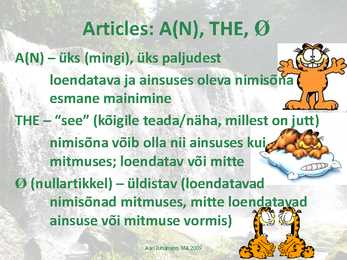
court, prison, home, work kui neist kõneldakse seoses nende põhiotstarbega: She was in hospital for two weeks and we often went to the hospital to cheer her up. Sundays are good I don't have to be at work, I can stay in bed when others go to church and don't come home until noon. · Transpordivahendid: We usually come to school by bus. Nowadays people often travel by car. Aari Juhanson, MA 2009 NAMES without ARTICLE · Pärisnimed (ka koos tiitlitega): Senator Clinton ran for presidency in 2008. BUT: viidates kogu perele The Lopezes live in NYC now. · Õppeained, spordialad, erialad jne. (kui määratlemata): I like Japanese, and Japanese literature is interesting. · Mandrid, maailmajaod, riigid, linnad, mäed, saared, rannad, tänavad, pargid, lennu- ja raudteejaamad, paleed + Heaven, Hell and Paradise Have you seen Buckingham Palace? I thought I was in heaven but I was wrong.
1. Ancient Britain: the Celtic tribes. 2000 years ago there was an Iron Age Celtic culture throughout the Br Isles. It seems that the Celts, who had been arriving from Europe from the 8th cent BC onward, intermingled with the peoples who were already there. The Celts were extremely talented people, creative and artistic. More than 1 Celtic tribe invaded Br. The descendants of ancient Celts live in Wales, Scotland, Cornwall and Ireland. They lived in primitive society. Druids priests, more powerful than chiefs. Acted like prophets. 2. Stonehenge From prehistoric period. Was built on Salisbury plain between 2500 and 1500 bc. One of the most famous and mysterious archaeological sites in the world
TIME CLAUSES Present Simple · Permanent states, facts (Tom works..) · Repeated and habitual actions, routines (She usually goes..) · Laws of nature and general truths (The sun sets in the west) · Timetables and programmes · Sporting commentaries, rewiews (Beckham wins the ball, crosses and Owen scores) · Feelings and emotions (I love Tallinn..) TIME EXPRESSIONS USED WITH PRESENT SIMPLE: usually, often, always, every day/week etc, in the morning/evening etc, at night/the weekend, on Fridays etc. Present Continuous · Actions taking place at or arount the moment of speaking (The kids are watching TV..) · Fixed arrangements in the near future (I'm going to the dentist tomorrow) · Currently changing ang developing situations (The number of burgularies is increasing)
They are things that we can count. For example: "pen". We can count pens. We can have one, two, three or more pens. Here are some more countable nouns: •dog, cat, animal, man, person •bottle, box, litre •coin, note, dollar •cup, plate, fork •table, chair, suitcase, bag Countable nouns can be singular or plural: •My dog is playing. •My dogs are hungry. We can use the indefinite article a/an with countable nouns: •A dog is an animal. When a countable noun is singular, we must use a word like a/the/my/this with it: •I want an orange. (not I want orange.) •Where is my bottle? (not Where is bottle?) When a countable noun is plural, we can use it alone: •I like oranges. •Bottles can break. We can use some and any with countable nouns: •I've got some dollars. •Have you got any pens?
 annaabi.ee







Kõik kommentaarid