Leidsid 33 sarnast õppematerjali, mis on seotud failiga "Inglise keele artiklite kasutamine". Need materjalid aitavad sul teemat sügavamalt mõista.
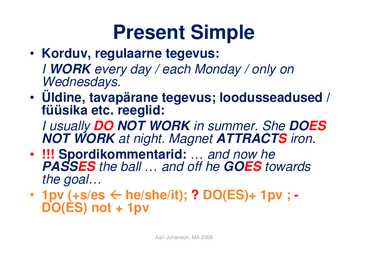
juhanson, nimisõna, loendatav, nimisõnad, names, south, good, hospital, king, west, articles, often, university, continue, mitmuses, days, east, first, study, church, work, japanese, north, usual, täiend, couple, usually, such, smile, however, student, kõnelda, could, something, looking, brat, bread, reason, cold, english, nice, horse, animal, knowPresent Simple · Korduv, regulaarne tegevus: I WORK every day / each Monday / only on Wednesdays. · Üldine, tavapärane tegevus; loodusseadused / füüsika etc. reeglid: I usually DO NOT WORK in summer. She DOES NOT WORK at night. Magnet ATTRACTS iron. · !!! Spordikommentarid: ... and now he PASSES the ball ... and off he GOES towards the goal... · 1pv (+s/es Å he/she/it); ? DO(ES)+ 1pv ; - DO(ES) not + 1pv Aari Juhanson, MA 2008 Present Progressive · Hetkel toimuv, pooleliolev tegevus: S/he IS TALKing on the phone now. I AM READing an interesting book. · Ajutine, regulaarsele ja tavapärasele vastanduv tegevus (tulevikku viitav): This summer they ARE not GROWing cucumbers as usual. They'RE GROWing tomatoes instead. · !!! Halvakspanu väljendus harjumuspärase tegevuse kohta: He IS always COMPLAINing! · BE (am/is/are) + 1pv-ing Aari Juhanson, MA 2008
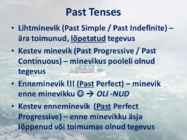
Past Tenses • Lihtminevik (Past Simple / Past Indefinite) – ära toimunud, lõpetatud tegevus • Kestev minevik (Past Progressive / Past Continuous) – minevikus pooleli olnud tegevus • Enneminevik !!! (Past Perfect) – minevik enne minevikku OLI -NUD • Kestev enneminevik (Past Perfect Progressive) – enne minevikku äsja lõppenud või toimumas olnud tegevus Created by Aari Juhanson, MA 2009 Past Simple • Ära toimunud (regulaarne) tegevus: I WORKED yesterday. S/he didn’t WORK last Monday. • Lõpetatud tegevus: I already CALLED them today. (I’m not going to call again!) Which countries did you VISIT? (You’re back …) BUT: Which countries have you VISITED so far? (You’re not back yet or you travel regularly …) • Jutustused, mineviku sündmuste kirjeldus: Once upon a time there LIVED a Garfield who HAD
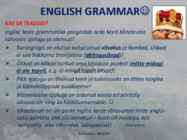
g. ei mingit topelt eitust)! Pikk ajalugu on lihvinud keelt ja tulemuseks on lihtne loogika ja käändelõppude puudumine! Mitmekesine ajalugu on aidanud kaasa eri päritolu sõnavarale ning ka hääldusmuredele. Väidetavalt on üle poole inglise keele sõnavarast mitte anglo- saksi päritolu, ehk siis laenatud – kontrolli hoolega, kas ‘sympathy’ ikka tähendab ‘sümpaatiat! kaastunne Aari Juhanson, MA 2009 Tenses – Tegusõna ajad • Olevik (Present) • Minevik (Past) • Tulevik (Future) • Kaudne tulevik (Future-in-the-Past) Aari Juhanson, MA 2009 Present Tenses • Lihtolevik (Present Simple / Present Indefinite) – regulaarne, korduv tegevus • Kestev olevik (Present Progressive / Present Continuous) – pooleliolev, ühes tükis tegevus • Täisminevik !!! (Present Perfect) – tehtud, *lõpetamata* tegevus
the Definite Article. The Indefinite Article has two forms – a and an (a precedes words beginning with a consonant sound and an precedes words beginning with a vowel sound). It comes from the Old English word ãn, which meant one. The Definite Article is the. It comes from the Old English word ţis, which meant this. Thus, in most general terms, a and an cannot be used with countable nouns in the plural and with uncountable nouns. Countable nouns are names of the things you can count (one elephant, two elephants, three elephants, etc). Uncountable nouns are names of the things you cannot normally count (love, air, philosophy, etc). The can usually be used when we mean this. The Indefinite Article – a/an (= one!) can only be used with singular countable nouns. a child, a book, an elephant, an apple On the other hand, singular countable nouns cannot be used without any determiner. Determiners are both articles (a/an and the) and different
VERB OBJECT She speaks English very well . (NOT She speaks very well English.) Andy likes skiing very much. (NOT Andy likes very much skiing.) 14. Don't use the present perfect have/has seen, have/has gone etc with words that name a finished time. I saw him yesterday. (NOT I have seen him yesterday.) They went to Greece last summer. (NOT They have gone ... last summer.) 15. English (the language) normally has no article. You speak very good English. (NOT You speak a very good English.) 16. After look forward to, we use ing, not an infinitive. I look forward to seeing you. (NOT I look forward to see you.) We're looking forward to going on holiday. (NOT ... to go on holiday.) 17. Information is an uncountable noun. Can you give me some information? (NOT Can you give me an information?) I got a lot of information from the Internet. (NOT I got a lot of informations from the Internet.) 18. Use ing forms after prepositions.
It replaces the traditional forms of Mrs and Miss. Greetings Good morning/afternoon/evening! 'How are you?' Very often people expect you to say something positive. Here's a breakdown of how you can express how you really are without complaining too much. · Fine, thanks. / On top of the world, thanks. · OK, thanks · Not so bad, thanks. / Can't complain, thanks. · So so, thanks. / So and so, thanks. · Not so good, actually 1 The English alphabet Spelling Work with your partner and spell out first your name and then some names of places. Write down each letter as you hear it, and then say the word. The English alphabet on the phone: You might find the following alphabet (used by international airlines) useful when trying to spell a word on the telephone.
He/she/it will have been going He/she/it will not have been going Will he/she/it have been goi We/you/they will have been making We/you/they will not have been making Will we/you/they have been ma Kestev ennetulevik väljendab: · Tegevust tulevikus, mis kestab mingi teise tegevuseni, mingi ajani või ka peale seda. By the end of March she will have been lying in the hospital for two months. He will have been writing for an hour by the time Mary calls him. Passive (is,was done; be, been, being done) REEGEL: · Inglise keeles laused võivad olla kahes tegumoes: aktiivis ja passiivis. My child drew a picture. (aktiiv; lauses on alus, kes on ka tegija) (alus) (öeldis) (sihitis) The picture was drawn. (passiiv; lauses on alus, kuid see ei ole tegija) (alus) (öeldis)
second time, e.g. I bought a jacket and a dress. The jacket was quite cheap 2.Other uses: -to talk about someone's job, e.g. She's an architect. -with numbers and fractions, e.g. a hundred, a million, a third -to mean every with expressions of time, e.g. once a week, five times a year -with What...! exclamations, e.g. What a strange person! ZERO ARTICLE (NO ARTICLE) There is no article: -in front of plural countable nouns when making general statements, e.g. Apples are good for you. -in front of an uncountable noun when making general statements, e.g. Coffee keeps me awake. -in front of abstract nouns, e.g. Honesty is the best policy. -in front of meal times ,e.g. We have lunch at one. -in front of certain places like hospital, school, college, university , church, prison, home, work,bed when talking about the activity which normally takes place in that place or building, e.g. He Had an accident and was taken to hospital.
The car is red.) · Unique nouns (The Earth) · Newspapers, cinemas, theaters, museums, ships, organisations (The United Nations) · Rivers, groups of islands, mountain ranges, deserts, oceans, countries (with States, Republic, Kingdom), names/nouns with of, geographical terms (the North) · Musical instruments, dances (the piano) · Families, nationalities (The Chinese) · Titles (the President) NB! NOT with real names (Prince Charles) · With adjectives/adverbs in superlative form (Most mustn't be followed by a noun!) · With words day, afternoon, morning, evening NB! At night, at noon etc · Historical periods/events · With Only, last, first · Words station, cinema, theatre, library, coast, shop, sea, beach, country, city, jungle, world, ground, weather We don't use ,,The": · Uncountable an plural nouns when talking about sth general (Coffee is a popular drink)
The capital letter is also called a big letter or upper- case letter, or sometimes just a capital. A B C D E F G H I J K L M N O P Q R S T U V W X Y Z When do you use a capital letter? 4Use a capital letter for the first letter in a sentence: The dog is barking. Come here! 4Always use a capital letter for the word I : I am eight years old. Tom and I are good friends. 4Use a capital letter for the names of people: Alice, Tom, James, Kim, Snow White 4Use a capital letter for the names of places: National Museum, Bronx Zoo, London, Sacramento 4Use a capital letter for festivals, holidays, days of the week, months of the year: New Year's Day, Christmas, Labor Day, Mother's Day, Sunday, Monday, Friday, January, May, July, October Exercise 1 Circle the letters that should be CAPITALS. Then write
adjective + preposition omadussõna + eessõna proud of, good at, married to adverb particle Some verbs are followed by adverb particles. Examples are: put on, take off, give away, bring up, call in. Sometimes the particle is detached from the verb and put after the object. •He took his boots off. •They called the doctor in. apposition a grammatical construction in which two usually adjacent nouns having the same referent stand in the same syntactical relation to the rest of a sentence (as the poet and Burns in “a biography of the
in brackets. _ 1 She is in a band and she _________________________________ (record) a CD at the moment. _ 2 She is an actress and often _________________________________ (appear) on television. _ 3 At the moment she _________________________________ (have) a rest because she is tired. _ 4 Mike is a doctor and he _________________________________ (live) in Manchester. _ 5 I _________________________________ (start) work at 8.30 every morning. _ 6 He is a good cook but she _________________________________ (prefer) to eat out. _ 7 English tests _________________________________ (get) more and more interesting. _ 8 They _________________________________ (have) a party because it's her birthday. _ 9 I sometimes _________________________________ (ride) my bicycle to school. 10_ She usually _________________________________ (go) to the gym on Friday evenings.
Unique things have 'the'. For example, "the sun", "the moon". Some institutional buildings don't have an article if you visit them for the reason these buildings exist. But if you go to the building for another reason, you must use 'the'. "Her husband is in prison." (He's a prisoner.) "She goes to the prison to see him once a month." "My son is in school." (He's a student.) "I'm going to the school to see the head master. "She's in hospital at the moment." (She's ill.) "Her husband goes to the hospital to see her every afternoon." Musical instruments use 'the'. "She plays the piano." Sports don't have an article. "He plays football." Illnesses don't have an article. "He's got appendicitis." But we say "a cold" and "a headache". Jobs use 'a'. "I'm a teacher." Countries We don't use 'a' if the country is singular. "He lives in England." But if the country's name has a "plural" meaning, we use 'the'. "The People's Republic of China", "The Netherlands", "The United States of America".
11. Distinction between main and auxiliary verb ,,do" ,,You done it, did you?" 2) The spread of English. The Inner / Outer / Expanding Circle THE SPREAD OF ENGLISH · 16-18th century the spread took place. · By the beginning of the 19th century English had spread to virtually every part of the world. · 19-20th century the number of speakers only grew. The growth was achieved by covering more land, exploring more land, going west, and accepting new immigrants from other places of the world. The spread of English also brought political growth and the spread of power. Besides the number of countries, it also grew from the economic and military might and strength of the people. When Elizabeth I didn't have much choice but to let the empire grow and so the nation, the wealth, the trade, the industrial sntregth and might.At that time the
of world put together. The majority of so-called Africans leaders want to stay in power until the day their bodies are put in the grave. Through buffoonery, utter mismanagement and downright stealing of the wealth of the masses, these leaders have so impoverished Africa that we are now nothing but a beggar continent. We beg for everything; we are more dependent on our colonial masters than when we received our independence from them. Africa owes the West more money than we and our generations to come can pay. I arrived in America in December of 1967as an official of what we believed was going to be a dynamic African nation – the young Republic of Biafra. But Biafra was defeated and Nigeria remained one, as a giant of Africa. In the last 32 years, I have watched with horror and outright helplessness as the downward slide of the African race continues to escalate. But rather than address the problems, we
butter? Why drown spring lamb in wine or cream and spices, when with just one or two herbs it is absolutely delicious? If you ask foreigners to name some typically English dishes, they will probably say "Fish and chips" then stop. It is disappointing, but true that, there is no tradition in England of eating in restaurants, because the food doesn't lend itself to such preparation. English cooking is found at home. So it is difficult to a good English restaurant with a reasonable prices. In most cities in Britain you'll find Indian, Chinese, French and Italian restaurants. In London you'll also find Indonesian, Mexican, Greek... Cynics will say that this is because English have no "cuisine" themselves, but this is not quite the true. Vocabulary: to criticize - tasteless overcooked - ingredient - to invent - sauces - to disguise - spice herb - delicious - disappointing - to lend cuisine British Youth (2)
4 to put up with lack of vitamin A. Now there's a new 5 be looked after type of rice which has been engineered to contain massive amounts of vitamin 6 drop me off A. So there you are ... problem solved! 7 to lay off Rosie Yeah, these are good 8 turned up intentions, but not if we end up poisoning people in the long run. I 1F Discussion page 9 don't know, I just find the whole thing unnatural. I don't think we have a right 1 1 laboratory 5 crops to `play God' in this way.
· Man as an animal-clever than other beasts, still explainable within the framework · Man is not a free agent, is govern by something · Unable to determine his own faith · Hereditary · Naturalists tried to apply in fiction the processes of natural sciences · Writers task is to record facts, systems of behaviour, living conditions, never revealing any natural unbiased (completely natural) · Point of view: amoral-outside the category of morality, neither good or bad · Naturalist find it absurd to blame the wicked. These criminals are doing what nature, environment, their unconscious tells them to do. Naturalists do not judge their characters, they simply report. Try to describe facts like they are. Naturalists depict the lower, coarser forms of life. · Drab, squallid set of scene. Revolting, disgusting · Characters are people with strong animal desires
Example: She is a student at our school. republic or unionExamples: the UK, the USA with a singular noun to say something about all things of that kind. • with countries which have plural nouns as their names Example: A cat likes drinking milk. Example: the Netherlands, the Bahamas • before newspapers, organisations, hotels, pubs and rest aurants, well known buildings or works of
Chapter 17 Chapter 38 Chapter 58 Chapter 18 Chapter 39 Chapter 59 Chapter 19 Chapter 40 Chapter 60 Chapter 20 Chapter 41 Chapter 61 Chapter 21 Chapter 42 Chapter 1 It is a truth universally acknowledged, that a single man in possession of a good fortune, must be in want of a wife. However little known the feelings or views of such a man may be on his first entering a neighbourhood, this truth is so well fixed in the minds of the surrounding families, that he is considered the rightful property of some one or other of their daughters. "My dear Mr. Bennet," said his lady to him one day, "have you heard that Netherfield Park is let at last?" Mr. Bennet replied that he had not. "But it is," returned she; "for Mrs
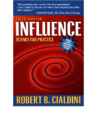
Central Europe. you should buy this new edition of Influence: o More neuroscience evidence of how the influence process works is inte- Science and Practice, gra ted throughout. For instance, brain imaging research is presented, showing here are 5 good reasons! how the "Expensive = Good" heuristic o Updated coverage of social influence leads people to perceive more costly effects in popular culture, such as the items as better than (identical) less contagion of obesity among the young costly ones. and the contagion of violence in such tragedies as the Virginia Tech and North- o Enhanced coverage of "how to say
Table of contents 1. Introduction 2. History 2.1. Early Hospitals 2.2 Recent developments 3. The National Health Service 4. Diseases 5. First Aid 6. Medicine and elements of medical care 7. Doctors 8. Ways of keeping health 9. Conclusion 10.Used materials 1. Introduction The human body is just like a machine with many parts. Each part has a special job, and all the parts work together to keep you alive and healthy. Good health is one of the most important things in life. There are certain things we can do to stay healthy. We should eat a balanced diet that includes the right kinds of food and drink plenty of clean, fresh water. We should exercise regularly, strengthening our muscles and keeping us in shape. Exercise helps the blood circulate around our bodies, cleaning out waste and supplying plenty of oxygen. It is also important what we get enough sleep. The number of hours we sleep we need depend on our age
There may be specials sections also for children. Almost every library has a special reading room with comfortable furniture for the readers and the students can work on independent study projects. School libraries. School libraries are part of the education system. It supports the curriculum as it helps the teachers and pupils to prepare for the lesson. Pupils can read extra materials there about the subjects they like. Everyone doesn't have a computer neither good encyclopedias at home so they can get the required information needed for their homework from the books or from the Internet. It is needed because it teaches how to find your books on your own from other libraries too because usually the same system is used for the book location. School libraries are definitely very good places to study for a test before the lesson because it is quiet there and one can use books as a helping hand. Our school library is very nice in my opinion
You do the opposite of my instructions; You've no respect for anything; each one Must have his say; it's perfect pandemonium. DORINE If . . . MADAME PERNELLE You're a servant wench, my girl, and much Too full of gab, and too impertinent And free with your advice on all occasions. DAMIS But . . . MADAME PERNELLE You're a fool, my boy--f, o, o, l Just spells your name. Let grandma tell you that I've said a hundred times to my poor son, Your father, that you'd never come to good Or give him anything but plague and torment. MARIANE I think . . . MADAME PERNELLE O dearie me, his little sister! You're all demureness, butter wouldn't melt In your mouth, one would think to look at you. Still waters, though, they say . . . you know the proverb; And I don't like your doings on the sly. ELMIRE But, mother . . . MADAME PERNELLE Daughter, by your leave, your conduct In everything is altogether wrong; You ought to set a good example for 'em;
Foreword "I think that the Great Marquee had a sense of excitement: visitors would enter it expectantly, as if they were unwrapping a Christmas present." Head of Shows Development Bob Sweet Chelsea is, definitely, an event most gardeners love to visit and remember long afterwards. But why it is so? I have read lot about that Show. Everybody seems to be like this, even if there are lots of not so good things. First I thought it could be very nice way to spend day with family but Chelsea is not a family day out and they take care in targeting the garnering market. There is no discount for children, no family tickets, no children's play areas. Exhibitions want customers and our job is to manage the balance between the needs of exhibitors and those of the visitors. It's important to have the right number of exhibitors in each category with a good range of prices, from expensive to economic
6. Concentrating on something important can make you lose track of your soap opera. 7. Debunking the bunk is everyone's responsibility. 8. Don't ask me to pay for anyone else's mistakes. I make enough of my own. 9. Even those who possess real magic must beware of being misled by "magical thinking." 10. Everyone knows what shit tastes like. 11. Exclusive occupancy of a private room is a basic human right. 12. Fair compensation for genius is wealth. 13. God's not perfect, so it's a pretty good bet that you're not, either. 14. Good institutions help to overcome human moral inertia. 15. I am not one of your little friends. 16. If a dimension is anywhere it's everywhere. 17. If God's not crazy, why are you? 18. If one makes a promise one shouldn't have made it cannot stand against the obligation to do the right thing. 19. If you odn't give a certain amount of attention to filtering distractions, every distraction is a catastrophe. 20
1. Health. 2. Physical fitness. 3. Weight loss. I. Title. II. Title: Four-hour body. RA775.F47 2010 613.7--dc22 2010018533 eISBN: 978-0-307-46365-4 All illustrations by Fred Haynes/Hadel Studio, unless otherwise noted in the Photo and Illustration Credits section Jacket front-flap photos: (top) (c) Mark Reifkind; (bottom) (c) Photos taken by Inge Cook, provided courtesy of Ellington Darden, PhD v3.1 For my parents, who taught a little hellion that marching to a different drummer was a good thing. I love you both and owe you everything. Mom, sorry about all the crazy experiments. Support good science-- 10% of all author royalties are donated to cure-driven research, including the excellent work of St. Jude Children's Research Hospital. LIST OF ILLUSTRATIONS GROUND ZERO--GETTING STARTED AND SWARAJ Comparison of Methods for Estimating % Bodyfat Male Examples--Bodyfat Female Examples--Bodyfat Ramit Sethi's Betting Chart
she meets an exquisitely handsome boy at school for whom she feels an overwhelming attraction and who she comes to realize is not wholly human. ISBN 0-316-16017-2 [1. Vampires -- Fiction. 2. High schools -- Fiction. 3. Schools -- Fiction. 4. Washington (State) -- Fiction.] I. Title. PZ7.M57188Tw2005 [Fic] --dc22 2004024730 Printed in the United States of America For my big sister, Emily, without whose enthusiasm this story might still be unfinished. But of the tree of the knowledge of good and evil, thou shalt not eat of it: for in the day that thou eatest thereof thou shalt surely die. Genesis 2:17 PREFACE I'd never given much thought to how I would die -- though I'd had reason enough in the last few months -- but even if I had, I would not have imagined it like this. I stared without breathing across the long room, into the dark eyes of the hunter, and he looked pleasantly back at me. Surely it was a good way to die, in the place of someone else, someone I loved. Noble, even
2 pricey 7 profitable 5 None of the shops are open. 3 worthy 8 valuable 3 1 I advised Mike to get an early night. 6 The food was neither cheap nor 4 financial 9 worthless 2 I agreed to give Jenny a lift into good. 5 costly 10 economical town. 7 There are no easy answers. 3 I had no difficulty repairing the 2 1 economical 7 priceless 8 Few of my relatives live nearby. broken vase.
they deemed "inalienable." Democracy: The colonies had no say in the formation of the government, and had no representation in the lawmaking process. Consequently, they were attracted to the idea of democracy, where the government is "of the people, by the people, for the people," as Lincoln later expressed in his Gettysburg Address. Religious Tolerance: Much impetus for the ideas of religious tolerance came from the rule of King George II, who was a staunch Catholic and did not allow freedom of religion to Protestants in New England. Voltaire was among the first to denounce Christianity and other organized religions as mere ploys to support monarchy. What emerged was Deism, which was more or less a new religion that considered reason its foundation. In Deism, there is no interference by a deity, and man controls his own destiny.
a) Why hasn't Steve written earlier? b) What does he think of Hong Kong? c) What is the weather like? d) What happened to him recently? e) What does he say about his new colleagues? f) Is his new job easier than the one he had in London? g) How does the writer feel about his new situation? Informal (friendly) letters are normally written to relatives, friends or other people we know very well. A good informal letter should be divided into paragraphs. Each paragraph should deal with one aspect of the subject and start with a topic sentence which gives the main idea of the paragraph. Tenses Present Perfect and Past Simple are often used in letters giving news. The Present Perfect is used to refer to recent activities and the Past Simple to refer to activities which happened at a stated time in the past. TASK 7 Read the following letter and correct the mistakes
FGI 1811 Proseminar I. Ladusseva 1 10.09.2002 At the defense aspects that are considered are: - your own contribution (whether it is there and is sufficient) - theory (you should have at least 6-10 connected pages discussing the state of the art) - mechanics (the layout of the paper: font size 12, double space, etc.) - answering questions - performance (pronounce distinctly, make good impression, no language mistakes, etc.) - extra linguistic part (how you stand, how you speak, etc.). Will be checked student's ability to classify, to describe material, to draw conclusions (e.g. you give an example and then comment on it). Internet sources: it is nice to have some Internet sources to show your sophistication, but not too many of them, because they are not very reliable. As you start reading sources do it systematically:
Philosophy of Language Philosophy of Language: a Contemporary Introduction introduces the student to the main issues and theories in twentieth and twenty-first-century phi- losophy of language, focusing specifically on linguistic phenomena. Topics are structured in four parts in the book. Part I, Reference and Referring, includes topics such as Russell's Theory of Descriptions, Donnellan's distinction, problems of anaphora, the description theory of proper names, Searle's cluster theory, and the causalhistorical theory. Part II, Theories of Meaning, surveys the competing theories of linguistic mean- ing and compares their various advantages and liabilities. Part III, Pragmatics and Speech Acts, introduces the basic concepts of linguistic pragmatics, includes a detailed discussion of the problem of indirect force and surveys approaches to metaphor. Part IV, new to this edition, examines the four theories of metaphor.
 annaabi.ee