Leidsid 33 sarnast õppematerjali, mis on seotud failiga "Hiina". Need materjalid aitavad sul teemat sügavamalt mõista.
china, provints, part, kogutoodang, raudtee, taiwan, sichuan, chinese, bank, hong, sichuani, economy, government, dollar, mandzu, hektarit, põllumaa, maavara, maantee, rate, states, kong, hongkongi, mandzuuria, juttu, territoorium, provintsis, kuupmeetrit, nafta, hüdro, turism, market, years, major, other, asia, rise, ease, haldusjaotus, töötuskilomeetrit kirde Peking, Jinshanling lõik, mis on 120 kilomeetrit kirde Pekingi ja Simatai lõik, mis on ka 120 kilomeetrit kirde Pekingis. Järgmine klipp näitab visiidi Mutianyu osa müür. Suur Hiina müür on maailma pikim aeganõudev projekt. Wall hõlmab ka iidse Hiina arhitektuur oskusi. Aastal 1987 Suur Hiina müür oli värvatud on UNESCO maailmapärandi nimekirjas. Lisaks Hiina müür on ka üks New Seven Wonders of the World. The Great Wall of China Asia, China The Great Wall of China is a series of stone fortifications built in China from the 5th century BC to the 16th century. The wall was built throughout several dynasties to protect the empire from Xiongnu attacks. The Great Wall of China stretches over approximately 6,700 kilometers, passing through Gansu Province, Ninxia Hui Autonomous Region, Shaanxi Province, Shanxi Province, Inner Mongolia, Hebei Province and Liaoning Province. It was once claimed the Great Wall is visible to human eyes from the moon
· Hebei () · Heilongjiang () Omavalitsusüksused · Henan () · Hubei () · Peking () · Hunan () · Shanghai () · Jiangsu () · Tianjin () · Jiangxi () · Chongqing () · Jilin () · Liaoning () · Qinghai () Erihalduspiirkonnad · Shaanxi () · Shandong () · Aomen () · Shanxi () · Sichuan () · Hongkong () · Taiwan () · Yunnan () · Zhejiang () Hiina kultuur Hiina kultuur on ida Aasias suurt maa-ala hõlmav, maailma üks vanimaid ja kõige keerukaimaid kultuure. Selle algetest võrsunud tsivilisatsiooni kunsti, filosoofia ja poliitika järjepideva arengu kestvuseks on siiamaani olnud umbes 5 000 aastat. Ehki hiina kultuuri tavad, kombed ja traditsioonid on paikkonniti suuresti varieeruvad on seda läbi
kasvab päev piirkonna keskset ala Ida-Hiinas, samal ajal kui riis on kahekordistunud kärbitud riigi lõunaosas. Ligikaudu 75% Hiina haritava maa kasutatakse toidu kultuurid. Rice on Hiina kõige tähtsam põllukultuur, kasvavad umbes 25% haritava maa pindala. Nisu on teine enim levinud teraviljapiirituse põllukultuuri, mida kasvatatakse suurema osa, vaid eelkõige Põhja-Hiina Ainult, et Wei ja lodu jõe orud kohta lössil platooni ja Jiangsu, Hubei ning Sichuan provintsides. Corn ja hirss on 23 kasvatatakse Põhja-ja Kirde-Hiinas ja kaera on oluline, Sise-Mongoolias ja Tiibetis. Muud põllukultuurid hõlmavad maguskartul riigi lõunaosas, valge kartul põhjas, ja mitmete muude puu-ja köögivilju. Õliseemned on tähtsad Hiina põllumajanduse, tarnijamaa söödav ja tööstuslikud õlid ja mis moodustab suure osa
The United States is home to more than 400 mammal, 750 bird, and 500 reptile and amphibian species. About 91,000 insect species have been described. Satellite image showing topography of the contiguous United States 7 The people of the United States of America There are over 300 million people living in America. The United States is the third most populous country in the world after China and India. The United States has a very diverse population--thirty-one ancestry groups have more than a million members. White Americans are the largest racial group; German Americans, Irish Americans, and English Americans constitute three of the country's four largest ancestry groups. African Americans are the nation's largest racial minority and third largest ancestry group. Asian Americans are the country's second largest racial minority; the two largest Asian American ethnic groups are
The geography of Syria is primarily semiarid and desert plateau with a double mountain belt in the west. The government system is a republic under authoritarian regime. The chief of state is the President and the head of government is the Prime Minister. Syria has a mixed economy in which there is limited private freedom but the economy remains highly controlled by the government. Syria is a member of the Council of Arab Economic Unity (CAEU). Two-thirds of Syria is desert; the other third is part of the Fertile Crescent along the Mediterranean coast. About 80 percent of the population lives in that fertile region. The total population of Syria is a little over 13 million. Half the people live in cities, 4 million in Damascus alone. Arabic is the official language of the Syrian Arab Republic and the language is spoken by nearly all Syrians. French is the second-most- common language. However, it has started to be rivaled by English.
jewels obscures the true and more sinister story of how Columbus financed his trip. The Spanish monarch invested in his excursion, but only on the condition that Columbus would repay this investment with profit by bringing back gold, spices, and other tribute from Asia. This pressing need to repay his debt underlies the frantic tone of Columbus' diaries as he raced from one Caribbean island to the next, stealing anything of value. After he failed to contact the emperor of China, the traders of India or the merchants of Japan, Columbus decided to pay for his voyage in the one important commodity he had found in ample supply - human lives. He seized 1,200 Taino Indians, crammed as many onto his ships as would fit and sent them to Spain, where they were paraded naked through the streets of Seville and sold as slaves in 1495. Columbus tore children from their parents, husbands from wives. On board Columbus' slave ships, hundreds died;
the province's proximity to American firms such as Microsoft in the state of Washington. The Northern territories of the nation comprise one-third of its total size, but are home to only 100,000 people. These areas are home to Canada's Native American population, many of whom continue to follow traditional lifestyles based on hunting and fishing. Mining is the principal industry and there has been steady growth in diamond mining and finishing. Tourism also provides a substantial part of the region's economy. Each of the nation's main economic sectors is highly developed. Although the agricultural sector is small, it takes advantage of the nation's generous natural resources. Increasingly, agriculture and fishing are concentrated in certain geographic regions of the country, mainly the west and southeast. The United States is the main market for all Canadian agricultural exports. In addition, the United States is the main destination for most of Canada's timber exports
TALLINNA ÜLIKOOL POLITICAL SCIENCE AND GOVERNMENT INSTITUTE ANNELI PALM CRITISIM ABOUT IMF AND WORLD BANK INTERNATIONAL POLITICAL ECONOMY (RIR6032/RIR6004) ESSAY 2014 Contents TALLINNA ÜLIKOOL.............................................................................................. 1 Introduction............................................................................................................ 3 Basic of liberalism.................................................................................................. 4
There are also the Atlantic Ocean, the Pacific Ocean and the Gulf of Mexico surrounding the big country. There are 50 states in America. Most of the people live in towns. The biggest state is Alaska; next by size are California, Alaska and Montana. Six states - Maine, Vermont, New Hampshire, Connecticut, Rhode Island and Massachusetts are called New England. They are all small states in the USA that lie in the north- east. The first colony of immigrants settled down in Virginia, in the eastern part of the USA. 3. Relief The USA is situated in the central part of the North American continent. Its western coast is washed by the Pacific Ocean and its eastern coast is washed by the Atlantic Ocean and in the south its coast is washed by the Gulf of Mexico. The coastline is even. There are no big islands belonging to the USA except the Hawaiian Islands which lie halfway the continents of America and Asia. The biggest peninsulas are the Florida Peninsula and Alaska. 4. Land Regions Mountains
communities, they are the present English-speaking countries (USA, Australia, Canada, New Zealand) Trading Empire (dependencies) mainly ESL countries; British people were seen more as a small ruling class (India, Africa) 5. Australia, The USA, Canada, Sri Lanka, India & Pakistan, Irish Free State, Newfoundland, New Zealand, South Africa were the British colonies that became dominions. They were given "responsible government" and became part of the Commonwealth. The Head of State was the British monarch. Nowadays, the word "dominion" is not used. 6. The British Commonwealth of Nations freely unites Britain and its former colonies. Ireland 1. The first inhabitants were hunters and fishers from the European mainland in 6000 BC. In 200 BC, the Celts arrived. 2. Christianity was established during the 5th century by Saint Patrick, who is also Ireland's patron saint
m²) and 179,584 islands to be precise. One of these lakes, Saimaa, is the fifth largest in Europe. The Finnish landscape is mostly flat with few hills and its highest point, the Halti at 1,324 metres, is found in the extreme north of Lapland at the border between Finland and Norway. The landscape is covered mostly (seventy-five percent of land area) by coniferous taiga forests and fens, with little arable land. The most common type of rock is granite. It is a ubiquitous part of the scenery, visible wherever there is no soil cover. Moraine or till is the most common type of soil, covered by a thin layer of humus of biological origin. The greater part of the islands are found in southwest in the Archipelago Sea, part of the archipelago of the Åland Islands, and along the southern coast in the Gulf of Finland. Finland is one of the few countries in the world whose surface area is still growing.
notice that Estonia has constantly performed better than Lithuania and Latvia on many fundamental indicators. The current account deficit and inflation is lower than in Latvia, the GDP higher than in Latvia and Lithuania, Estonia's public debt is a very low 3.8% of GDP and government reserves are close to 10% of GDP. The difference is exemplified by the fact that in December 2008 Estonia became one of the donor countries to the IMF lead rescue package for Latvia. The central bank uses a currency board system and has independent reserves, which are big enough to buy back all the currency in circulation. Estonia today is mainly influenced by developments in Germany, Finland and Sweden - the three main trade partners. The government recently increased greatly its spending on innovation. The prime minister of Estonian Reform Party has stated its goal of bringing Estonian GDP per capita into the TOP 5 of EU by 2022. Ireland is
chemicals and organic farming is gaining popularity. The forest is among Estonia's most important natural resources and a source of a considerable amount of raw material. Although just 1.2% of Estonia's workforce is engaged in forestry and the branch gives somewhat more than 1.7% of Estonia's production, it provides raw material for timber, paper and furniture industries, which make up another 8% of the overall production and which employ more than 7% of the workforce. The larger part of the output of Estonia's forestry and related industries goes for export, whereas Estonia increasingly exports goods of a higher value. The production and export of wooden construction details, wooden furniture and wooden houses has been going up consistently. The main export destinations are Finland, Sweden, Germany, Norway and Great Britain. Timber companies are located all over Estonia, a number of them in small towns or even in villages
growth. With inflation for the 2006 calendar year down to 6.0% and unemployment down to 8.9%, the nominal GDP grew by an unprecedented 2.9%. An investment programme in island transportation and utility infrastructure and gains in the tourism, mining, and service sectors all contributed this figure. All projections for 2007 show an even higher potential for economic growth with all estimates over 3.0% and hampered only by urban crime and public policies. In 2006, Jamaica became part of the CARICOM Single Market and Economy (CSME) as one of the pioneering members. 5 Econometrics GDP (2005): $9.7 billion. Real growth rate (2006): 2.5%. Per capita GDP (2005): $3,640. Natural resources: Bauxite, gypsum, limestone, marble, sand, silica. Agriculture: Products--sugar, bananas, coffee, citrus fruits, condiments and spices.
........................................................................ 13 Metsamajandus ja kalandus.................................................................................................. 16 Põllumajandus...................................................................................................................... 17 Turism................................................................................................................................... 19 Federal Reserve Bank korraldab USA keskseid rahaasju. New Yorgis asubki selle suurim esindus. Sealsed ekskursioonid viivad maa-alustesse kullahoidlatesse, mis on suurim teadaolev maailmas. Selgitatakse ka keskpanga üldist tegevust ja põhimõtteid. Kuna USA on majanduslikult tugevaim riik maailmas, on see kindlasti huvitav. Kuna seal hallatakse suuri rahareserve, on seal ka korralikud turvameetmed, mistõttu on vaja külastus tükk aega ette planeerida. Ka ekskursiooni saadavad relvastatud üksused
Odesa (Odessa) 1 million. Zaporizhzhya (Zaporozhye) 0.8 million. 5 GDP growth, %: 1.0 (2013 forecast EBRD downward revision from previously projected 2.5%). Official language: Ukrainian (although Russian is widely used in business communication). Currency: Hryvnya (UAH). Government type: republic. Membership: the United Nations, the International Monetary Fund (IMF), the World Bank, the European Bank for Reconstruction and Development (EBRD), the World Trade Organization (WTO), etc. Ukraine is bordered by Russia in the east, the Black Sea in the south, Moldova, Romania, Hungary, Slovakia and Poland in the west, and Belarus in the north. The country is rich in mineral resources: iron ore, coal, manganese, natural gas (shale costly and dangerous to extract), oil, sulfur, graphite, titanium, magnesium, kaolin, nickel, mercury, timber and others.
region, because there is enough food. The savannas which are grasslands with some trees are mostly in the west. Farther west are the bushlands. The real deserts occupy the centre of the Western Plateau. In the very south west there are thin forests of evergreens trees. Australia is the driest inhabited continent, the flattest, and has the oldest and least fertile soils. Only the south-east and south-west corners of the continent have a temperate climate. The northern part of the country, with a tropical climate, has vegetation consisting of rainforest, woodland, grassland, mangrove swamps and desert. Climate is highly influenced by ocean currents, including the El Niño southern oscillation. 4. Land regions Mountains The Great Dividing Range runs along the Pacific ocean. These mountains are very old and much of worn down but the Australian Alps are the highest of them. The highest top Mount Kosciusko is 2228 metres above sea level
established the first global empire, becoming one of the world's major economic, political and military powers. In addition, the Portuguese Empire was the longest-lived of the modern European colonial empires, spanning almost 600 years, from the capture of Ceuta in 1415 to the handover of Macau in 1999 and grant of sovereignty to East Timor in 2002. The empire spread throughout a vast number of territories that are now part of 53 different sovereign states. However, the country's international status was greatly reduced during the 19th century, especially following the Independence of Brazil, its largest colony. After the 1910 revolution deposed the monarchy, the democratic but unstable Portuguese First Republic was established, itself being superseded by the "Estado Novo" authoritarian regime. Democracy was restored after the Portuguese Colonia l War and the Carnation Revolution in 1974. POPULATION
But rather than address the problems, we resort to blaming the Caucasians, Asians and others for our misfortune. We are not men enough to accept responsibility for our actions. Africans blame either the British, French or little Portuguese/Spanish for their problems. Africans in America blame the Caucasians for all their problems, or any other ethic group they have allowed to take over their neighbours, a frequently recurring phenomena. Africans blame the International Monetary Fund, the World Bank, the Group of 7, the former colonial masters for the abject poverty in our respective countries. We blame the wars ravaging several African sectors on the interference of our former colonial masters on “our internal affairs.” Ha! – some kind of independence! In the 32 years I have been in America, I have never had a discussion with any of my brothers or sisters without it resorting to the African (Black)/Caucasian (white) relationship. When we decide to buy a
written in 1814 by Francis Scott Key. There are 6 time zones. From east to west they are: Eastern Standard Time, which is 5 hours behind Greenwich Time, Central Standard Time, Mountain Standard Time, which is 7 hours behind Greenwich Time, Pacific Standard Time. Alaska and Hawaii have their own time zones: Alaska Standard Time and Hawaii Standard Time. Geographical Position The USA lies in the Northern Hemisphere in North America. It covers a big part of the continent and is also the third largest country in the world. The country consists of 50 states, but two of them lie separately. One of them is Alaska, which is near the Arctic Circle. And the other state is Hawaii, which is a group of island is the Pacific Ocean. The USA shares the border with Canada in the north and Mexico in the south. In the east the coast is washed by the Atlantic Ocean and in the west by the Pacific Ocean. In the south there is the Gulf of Mexico
respectively), the Mamanuca Group (just outside Nadi) and Yasawa Group, which are popular tourist destinations, the Lomaiviti Group, outside of Suva, and the remote Lau Group. Rotuma, some 500 kilometres (310 mi) north of the archipelago, has a special administrative status in Fiji. Fiji's nearest neighbour is Tonga. The climate in Fiji is tropical and warm most of the year round. Fiji's culture is a rich mosaic of indigenous, Indian, Chinese and European traditions, comprising social polity, language, food (based mainly from the sea, casava, dalo & other vegetables), costume, belief systems, architecture, arts, craft, music, dance and sports. The indigenous culture is very much active and living, and is a part of everyday life for the majority of the population. However, it has evolved with the introduction of old cultures like the Indian and Chinese ones, as well as a large influence from Europe, and from various Pacific
In 2008 was widespread by private citizens homosexuals. Homosexuality is illegal in Jamaica, incurring a prison sentence. Many Jamaicans are intersex people, and several mob attacks agains bisexual people have been reported. Attacks on bisexual people are even encouraged in some popular Jamaican dancehall songs that have been called murder music. The country has been called ,,the most homophobic place on earth". Sport Sport has a very important part in Jamaica. The island's athletes tend to perform to a standrad well above what might ordinarily be expected of such a small country. While the most popular local sport is cricket, on the international stage Jamaicans have tended to do particularly well at Track and Field. Since independence Jamaica has consistently produced world class athletes in track and field. In Jamaica involvement in athletics begins at a very young age. Most
Domino effect(this is why the US got involved. They were afraid that id one country turned communist it would continue like that) Outcome- south Vietnam fell to communism Socialist Republic of Vietnam 58000 dead US soldiers conseq- damaged US economy and morale Vietnam in ruins · The role of Henry Kissinger 13 Secretary of State 1973-77 (VÄLISMINISTER e. Riigisekretär) Dominant role in United States foreign policy during the Cold War Big role in opening relations with china policy of dente with the Soviet Union paris peace accords he received the nobel prize for proposing ceasefire between the Vietnam, · Counterculture, Summer of Love and Woodstock counterculture- alternative lifestyle, anti-war movement, popular among the youth, drugs LSD Americans who opposed the Vietnam war. Summer of love- people made their way to San Francisco and streikisid against the war. drugs were free for everyone Woodstock- most famous rock concert during the 60s
the place of agriculture as the country's leading sector. Exports play a fundamental role in Ireland's growth, but the economy also benefits from the accompanying rise in consumer spending, construction, and business investment. On paper, the country is the largest exporter of software-related goods and services in the world. In fact, a lot of foreign software, and sometimes music, is filtered through the country to avail of Ireland's non-taxing of royalties from copyrighted goods. A key part of economic policy, since 1987, has been Social Partnership which is a neo- corporatist set of voluntary 'pay pacts' between the Government, employers and trades unions. These usually set agreed pay rises for three-year periods. Ireland joined in launching the Euro currency system in January 1999 (leaving behind the Irish pound) along with eleven other EU nations. The 1995 to 2000 period of high economic growth led many to call the country the Celtic Tiger. The economy felt the
Exports - manufactured goods, fuels, chemicals; food, beverages, tobacco Commodities Exports - Partners US 15%, Germany 10.7%, France 9.2%, Ireland 6.8%, (2004E) Netherlands 6.1%, Belgium 5.2%, Spain 4.5%, Italy 4.2% Imports (2005E) $461 million Imports - manufactured goods, machinery, fuels; foodstuffs Commodities Imports - Partners Germany 13%, US 9.2%, France 7.5%, Netherlands 6.6%, (2004E) Belgium 5%, Italy 4.3%, China 4.2% Current Account -$48 million Balance (2005E) Energy Overview Proven Oil 4 billion barrels Reserves (January 1, 2006E) Oil Production 1.9 million barrels per day, of which 85% was crude oil. (2005E) Oil Consumption 1,8 million barrels per day (2005E) Crude Oil 1.9 million barrels per day Distillation Capacity (2006E) Proven Natural 18.8 trillion cubic feet Gas Reserves (January 1, 2006E) Natural Gas 3.6 trillion cubic feet Production (2003E)
used in the construction of the walls and towers of Babylon; there were oil pits near Ardericca (near Babylon), and a pitch spring on Zacynthus. Great quantities of it were found on the banks of the river Issus, one of the tributaries of the Euphrates. Ancient Persian tablets indicate the medicinal and lighting uses of petroleum in the upper levels of their society. By 347 AD, oil was produced from bamboo-drilled wells in China. In the 1840s, the process to distill kerosene from petroleum was invented by James Young in Scotland and the first refinery was built by Ignacy Łukasiewicz, providing a cheaper alternative to whale oil. The demand for petroleum as a fuel for lighting in North America and around the world quickly grew. The question of what constituted the first commercial oil well is a difficult one to answer. Edwin Drake's 1859 well near Titusville, Pennsylvania, is popularly considered the first modern well
According to Canadian census 2011, 1.4 mln people of Aboriginal origin (4.3%): 852,000 First Nations persons, 452,000 Métis, 59,000 Inuit. Indian (First Nations) - No written history before the contact with Europeans. Chief historical sources European priests, travellers and traders not interested in the preservation of "pagan"myths. Different estimates about their number in Canada when Europeans reached North America from 300,000 to 1 mln. Saw themselves as part of nature, not as its masters. The First Nations were called "Indians" by Christopher Columbus when he landed in North America, because he thought he had reached India. Many now prefer to call themselves First Nations, though many still call themselves Indians in everyday conversation. They are still legally categorized by the Canadian Government under the Indian Act as Status Indians. Those who have lost their legal status are called Non-Status Indians
in exports and increased foreign investment following Estonia's adoption of the euro on 1 January 2011. Although Estonian GDP returned to positive growth in 2010, unemployment continued to rise, reaching an alltime high of 19.8% in early 2010 (Central Intelligence Agency, 2012, ISSN 15538133). 2.3 Hungary 2.3.1 Background Hungary became a Christian kingdom in A.D. 1000 and for many centuries served as a bulwark against Ottoman Turkish expansion in Europe. The kingdom eventually became part of the polyglot AustroHungarian Empire, which collapsed during World War I. The country fell under Communist rule following World War II. In 1956, a revolt and an announced withdrawal from the Warsaw Pact were met with a massive military intervention by Moscow. Under the leadership of Janos KADAR in 1968, Hungary began liberalizing its economy, introducing socalled "Goulash Communism." Hungary held its first multiparty elections in 1990 and initiated a free market economy
3 Chapter 1 The Netherlands 1.1 Mainly about the Netherlands Netherlands is also known unofficially as Holland. Netherlands is bordered on the north and west by the North Sea, on the east by Germany and on the south by Belgium. With Belgium and Luxembourg, the Netherlands forms the Low, or Benelux, Countries. The Netherlands Antilles and Aruba, islands in the Caribbean, are part of the Netherlands. Country's capital and largest city is Amsterdam (see also Appendix 1). National holiday is Queen's Day on 30 th April. And the mother tongue is Dutch. (5) The Kingdom of the Netherlands has three parts and two countries in the Caribbean, the Netherlands Antilles and Aruba. With an area of 41,528 kilometers and a population of 16 million, The Netherlands (the European part of the Kingdom) is one of the world's smaller countries. (6)
Viimased kaks tabelit on eraldi sellepärast, et muidu poleks tulpdiagrammina hästi näha muude arengutaseme näitajate võrdlust. Saudi Araabia arengutase on võrreldes teiste valitud riikidega on suhteliselt madalal. Elektrienergia tarbimises on Saudi Araabia küll peale Norrat teine, aga muudes valdkondades on Saudi Araabia tunduvalt mahajäänum. Seega võrreldes Norraga, Saudi Araabial on veel kõvasti arenguruumi. Rahvusvahelised organisatsioonid African Development Bank (AfDB) Arab Bank for Economic Development in Africa (ABEDA) Arab Fund for Economic and Social Development (AFESD) Arab Gulf Programme for United Nations Development Organization (AGFUND) Arab Monetary Fund (AMF) Economic and Social Commission for Western Asia (ESCWA) Food and Agriculture Organization (FAO) Group of 77 Gulf Cooperation Council (GCC) International Atomic Energy Agency (IAEA) International Bank for Reconstruction and Development (IBRD)
population. The population density is about 27 people per square kilometre. Most of the people live in towns. There are 50 states in America. The biggest of the state is Texas, next by size are California, Alaska and Montana. Six states - Maine, Vermont, New Hampshire, Connecticut ,Rhode Island and Massachusetts are called New England. They are all small states in the U.S. that lie in the north-east. The first colony of immigrants settled down in Virginia, in the eastern part of the U.S.A. The biggest cities are New York, Washington, Chicago, Los Angeles, San Francisco, etc. The official language of the USA is English; Spanish is also widely spoken. The currency of the USA is the United States Dollar. Lakes and rivers The Mississippi is the major river of North America and the United States. It flows from north-western Minnesota south to the Gulf of Mexico.The western tributaries
Like the national government, state governments have three branches: executive, legislative, and judicial. The chief of the state is elected by governor, who typically holds for a four-year-term. The constitutions of the various states differ in some details, but generally follow the general laws. The government. Relief The country naturally presents a tremendous variety in physical features. The highest peak of US is Mt. McKinley in Alaska at ~6000 metrs, while part of Death Valley in California is 89 metres below sea level. At the western edge of the Atlantic coast plain, are almost unbroken mountains, stretching from the Maine into Alabama, called the Appalachian Mountains. These mountains contain coal and iron. The heart of the U.S is a vas plain named interior plains and are divided into two major parts: the wetter, eastern part is called the Central Plains and the western part the Great Plains, both with very good soil
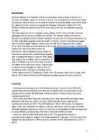
Project ESTONIA MAP OF ESTONIA Southern Viljandimaa The southern part of Viljandi county catches the eye with its sublime scenery. The area today lies in the very heart of the historical Mulgimaa the home of hills, deep valleys and lakes brought together by a beauty spot Halliste primeval valley. According to several folk tales, it is also in these valleys, woods and bogs that Old Nick found refuge.The great variety displayed in the nature is also reflected in the local cultural heritage
 annaabi.ee