Leidsid 33 sarnast õppematerjali, mis on seotud failiga "Henry VIII". Need materjalid aitavad sul teemat sügavamalt mõista.
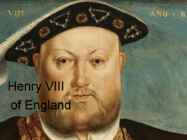
henry, married, became, than, late, catherineeen, later, divorce, church, england, king, years, interest, wife, boleyn, birth, himself, divorced, jane, political, marriage, june, father, death, april, children, handsome, athletic, musical, religion, fluent, languages, early, aragon, spanish, brother, widow, sons, daughter, mary, lost, gave, elizabethHenry VIII of England Henry VII Born on 21 June 1491. Died in January 28 1547. Is the 2nd son of King Henry VII and Elizabeth of York. Was crowned King at Westminster Abbey, London, on the 23 June 1509 at the age of 17. Elizabeth of York | King Henry VII Henry VIII is known for... Establishing the Church of England. Having six wives. Beind a big, fierce-looking man. Early life Not much is known about his early life, because he was not expected to become king. Around the age of ten his brother Arthur died, thus leaving the crown to him. He also married his brother`s widow, Catherine of Aragon. Little Henry VIII Young King Henry He was a great king and he loved all his subjects. And England loved him as a king.
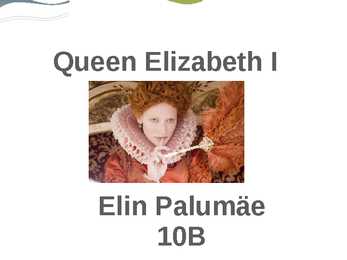
Queen Elizabeth I Elin Palumäe 10B Elizabeth I Reign - 17 Nov. 1558 24 March 1603 (44 years) Coronation - 15 January 1559(25 years) Predecessor - Mary I Successor - James I House - House of Tudor Father - Henry VIII Mother - Anne Boleyn Born - 7 September 1533 Greenwich, England Died - 24 March 1603 (aged 69) Burial - Westminster Abbey Anne Boleyn Queen consort of England Mother of Elizabeth I Tenure - 28 May 1533 17 May 1536 Coronation 1 June 1533 Anne Boleyn was Queen of England from 1533 to 1536 as the second wife of Henry VIII of England and the 1st Marquess of Pembroke in her own right for herself and her descendants. House - House of Tudor Father - Thomas Boleyn, 1st Earl of Wiltshire Mother - Lady Elizabeth Howard Born c.1501/1507 Blickling Hall/ Hever Castle, England Died 19 May 1536 (aged 29-35)Tower of London
feet, inches-roman measurements;christianity; Roman basilica in curches; reading, writing; buildings, roads Christianity in Roman Britain Until 4th C christians were persecuted 313 AD Emperor Constantine legalised christianity 380 AD Emperor Theodosius I made it the official religion of the empire Paganism had been eclipsed but continued to pose a political, religious challenge Boudicca Queen of Iceni people of Eastern England, led an uprising against Roman forces Prasutagus(ruler) was first allowed to rule when romans conquered England, after his death, romans decided to rule Iceni and flogged Boudicca and raped her daughters 60-62 AD Iceni rebelled, Boudicca´s warriors defeated Roman Ninth Legion, destroied capital-Colchester Finally Boudicca was defetated, she poisoned herself to avoid capture Hadrian´s wall A defensive barrier builtin 122 AD by Roman
History exam *Stonehenge - is a monument located in England. It is one of the most famous prehistoric sites in the world and is composed of earthworks surrounding a circular setting of large standing stones. The surrounding circular, earth bank and ditch, have been dated to about 3100 BC. Stonehenge was produced by a culture with no written language. Many aspects of Stonehenge remain subject to debate. There is little or no direct evidence for the construction techniques used by the Stonehenge builders.
The Renaissance In the history the Middle Ages were followed by the Renassance period. During this period a new class called bourgeoeisie came into being. This is the period when monarchies based on nationality were estabilished. The Renaessance started in Italy In the 14th century. Then it spread all over Europe, reached England in 16th century. The struggle for power culminated in a war called The War of Roses. It was a civil war between two dynasties, families. They had different emblems on one side the Yorks (white rose) other Lancasters (red). They couldn't decide who gets the throne. War ended 1485. A new dynasty came to throne, Tudor, the first king in this dynasty was Henry Vll. When he came to throne a period of stability followed because he built a nation based state. He was good at diplomacy
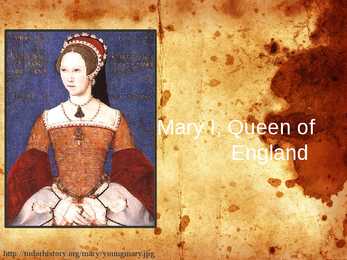
Mary I, Queen of England http://tudorhistory.org/mary/youngmary.jpg Queen Mary I of England Born: 18 February 1516 Proclaimed Queen: 19 July 1553 at St. Paul's Cathedral Coronation: 1 October 1553 Died: 17 November 1558 Buried: 14 Decenber 1558 http://tudorhistory.org/mary/marywhitehall.jpg Mary Tudor The Tudor Britain (1485-1603) Daughter of Henry VIII and Catherine of Aragon Henry divorced Catherine and married Anne Boleyn From "princess" to "The Lady Mary" http://tudorhistory.org/mary/marytudorsig
Queen Elizabeth I (1533-1603) Janeli Õim 11A Brief biography Elizabeth Tudor Click to edit Master text styles 7 September 1533 Second level 24 March 1603 Third level Fourth level Queen of England Fifth level Queen of Ireland - 17 November 1558 until her death (aged 69) Protestant Never married Janeli Õim 11A Family Click King Henry VIII (1491 - to edit Master text styles 1547) Second level Anne Boleyn (Executed 19 Third level Fourth level
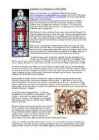
Medieval England 1066-1485 Eva Asper Anna Pohlak 11.c The Norman Dynasty The Norman Conquest In the 11th century, Normans conquered England - The Battle of Hastings 14.10.1066 The Anglo-Saxon forces had more soldiers but the Normans had better military tactics and won in the end thanks to a clever strategy William I, also known as William the Conqueror, replaced King Harold on the throne The invasion was completed by 1071 - The Norman invasion is depicted on the Bayeux Tapestry a long embroidered cloth The death of King Harold embroidered on the Bayeux Tapestry
Years 1154-1485 Henry I was the first unquestioned ruler. One of the most important kings in the Middle Ages. He had lands in Britain & France. Then the government was the monarch, a person, not a place. He had more land than any pervious king. After his marriage to Eleanor of Aquitaine, he also ruled the lands south of Anjou. His empire stretched from the Scottish border to the Pyrenees. England provided most of its wealth, but the heart was Anjou. Henry II began to regain royal control. During the war some barons had become very powerful. He pulled down some of their castles. He tried to restore law & order. He wanted the same kind of justice to be used everywhere. He appointed his own judges to travel around the country. They dealt with crimes & disagreements over poverty. Serious offences were tried in the king's court. At first they had no special knowledge or training
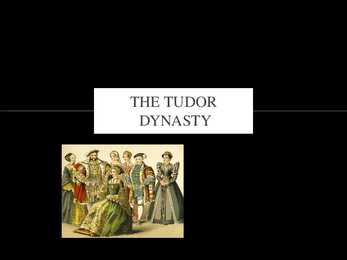
THE TUDOR DYNASTY THE TUDOR DYNASTY The Tudor dynasty or House of Tudor was a European royal house of Welsh origin that ruled the Kingdom of England and its realms, including the Lordship of Ireland, later the Kingdom of Ireland. Its first monarch was Henry VII. Henry VII THE TUDOR DYNASTY The Tudors extended their power beyond modern England, achieving the full union of England and the Principality of Wales in 1542 and successfully asserting English authority over the Kingdom of Ireland. They also maintained the traditional claims to the Kingdom of France, but none of them tried to make substance of it, though Henry VIII fought wars with France to try to reclaim that title. After him, his daughter Mary I lost the claim on France forever with the Fall of Calais. THE TUDOR
16th century (Tudors) 1. Henry VII - avoided wars, careful with money, didnt have expensive parties, was a rather shadowy figure 2. Henry VIII- brilliant scholar, excellent knight, good-looking, ambitious, self- centered, loved expensive clothes and parties. Wasted his fathers money very quickly and had 6 wives. His first wife couldnt give birth to a baby boy and they only had a daughter. His next wife only gave birth to a girl too. His next wife gave birth to a boy but died after the labor. He didnt like his 4th wife so he sent her back. His fifth
British kings and queens Kings King Henry VIII King Henry VIII is arguably the most well-known king of England. Famous for beheading his wives, of which he had six, King Henry VIII also had several children. King James I King James I was already King of Scotland when he got the English crown. King James I was the first ruler to call himself King of Great Britain, as he ruled England, Scotland and Wales. King James was the first King of Great Britain. King William I, the Conqueror King William I, otherwise known as William the Conqueror was born in France on 1028. He became friendly with the current English King, Edward the Confessor. He invaded and attacked England on Edward's death, as he was promised the English crown, but then denied it by the Saxon Harold. King George VI King George VI did not expect to become king, he was the shy brother of Edward VIII who
Mary I Mary I, called Mary Tudor (1516-1558), Queen of England (1553-1558). Mary was born in London on February 18, 1516, the daughter of Henry VIII by his first wife, Catherine of Aragón. Because Henry divorced Catherine, Mary was declared illegitimate. Nonetheless, Henry included her in his will, and on the death of her half-brother, Edward VI, on July 6, 1553, she became the legal heir to the throne. Although Lord High Chamberlain John Dudley, Duke of Northumberland, favoured the succession of his daughter-in-law, Lady Jane Grey, and proclaimed her queen on July 10, the country supported Mary. As a Roman Catholic, Mary began her reign by sweeping away the religious innovations of
Famous sights and people of England Kaspar Rätsep G1a Famous persons Kings & Queens: Queen Elizabeth I, Queen Victoria, Queen Elizabeth II, Henry VIII Politicians: Winston Churchil, Baroness Margaret Thatcher Writers & Poets: William Shakespeare, Daniel Defoe, Charles Dickens, Rudyard Kipling, Dame Agatha Christie Philosophers &Economists: Francis Bacon, John Locke Inventors & Scientists: Isaac Newton, Charles Darwin Actors,Actresses & Filmmakers: Sir Charlie Chaplin, Dame Elizabethe Taylor, AlfredHitchock, Hugh Grant, Orlando Bloom, KeiraKnightley, Daniel Radcliffe Musicians & Singers: Sir Elton John,Phil Collins,George
The Norman Conquest Since William was crowned king, there were many rebellions against the Normans. A small Norman army marched from village to village and destroyed the ones it couldn't control. The Normans took away the Saxon lords' land. Only a few Saxons who supported William could keep their land. Feudalism William gave parts of his conquered land to his captains around the country to avoid rebellions and uprisings. He also kept some land to himself to make sure his was much stronger than his nobles. Of all the farmland half went to his nobles, quarter to church and fifth he kept to himself. William organised the English kingdom according to feudal system. The main purpose of using that system was economic. King gave the land to "vassals" in return of army services and goods. When a noble dies, his son took over the estate. When there was no family, the land went back to king who could give it to another noble or just keep it for a few years.
PRESENTATION PRINCESS DIANA Diana, Princess of Wales was born on the 1st of July in 1961 and died on the 31st of August in 1997. She was a popular member of the British royal family and an international personality of the late 20th century. She was the first wife of Charles, Prince of Wales, whom she married on the 29th of July in 1981. The wedding, which was held at St. Paul's Cathedral, was televised and watched by a global audience of over 750 million people. Diana and Charles had two sons, Princes William and Harry. EARLY LIFE She was born at Park House, Sandringham in Norfolk, England. Her parents were John Spencer and Frances Burke Roche. She had two older sisters Sarah and Jane and a younger brother Charles. When Diana's parents divorced in 1969, her mother took her and her younger
Romans brought a lot with them. Their brought paved roads, the sites of important cities, the seeds of Christianity, the Roman law, Roman baths, language and advanced civilization. They also built Hadrian's Wall in 122 A.D. Romans occupied Britain for four centuries. The Roman way of life all vanished after the invasions from Northern Europe by the Angles, Saxons and Jutes from the 5th century onwards. They ruined Londinium, but they were easily turned into Christianity and religion became more and more important. The Vikings, who came in the 9th century, first raided England to plunder it, but then they decided to stay. In the 10th century England fell under Danish Rule, with King Canute finally managing to unite the Anglo-Saxons and Danes at the beginning of 11th century. Medieval England After defeating the Anglo-Saxon King Harold at the Battle of Hastings in 1066, William of Normandy (who became William I, also called William the Conqueror) introduced
1. Ancient Britain: the Celtic tribes. 2000 years ago there was an Iron Age Celtic culture throughout the Br Isles. It seems that the Celts, who had been arriving from Europe from the 8th cent BC onward, intermingled with the peoples who were already there. The Celts were extremely talented people, creative and artistic. More than 1 Celtic tribe invaded Br. The descendants of ancient Celts live in Wales, Scotland, Cornwall and Ireland. They lived in primitive society. Druids priests, more powerful than chiefs. Acted like prophets. 2. Stonehenge From prehistoric period. Was built on Salisbury plain between 2500 and 1500 bc. One of the most famous and mysterious archaeological sites in the world. One of the mysteries is how it was built at all with the technology of the time. Another is its purpose
1.SLAID Queen Mary I of England was born February 18, 1516. She was the daughter of King Henry VIII and his first of six wives, Catherine of Aragon. Mary was the only child from that union to survive infancy. She ruled as Queen of England from July 19, 1553 until her death on November 17, 1558. This era was known as the Marian Exile 2.SLAID Queen Mary I was rejected by her father during his divorce from her mother. Her parents' marriage was thought meaningless so for a while she was stripped of her statud as and heir to the throne.
The Renaissance 1500 1650: background 1. What does the word ,,renaissance mean? Characterize briefly the period called the Renaissance. "The rebirth" from French Renaissance, meaning "rebirth"; Italian: Rinascimento, from re- "again" and nascere "be born") Rebirth of scholarship based on classical learning and philosophy. The Renaissance was a cultural movement that spanned roughly the 14th to the 17th century, beginning in Italy in the late Middle Ages and later spreading to the rest of Europe. It encompassed a revival of learning based on classical sources, the development of linear perspective in painting, and gradual but widespread educational reform. (wikipedia)Bridge between Medieval Ages and Modern Era. 2. Where did the Renaissance start and why? In the opening years of the 14th century, there began to develop in Italy and increasing interest in the manuscripts that had survived from ancient Greece and Rome
Edward the Confessor (1003-1066) Edward was the oldest son of Ethelred II (Ethelred the Unready http://en.wikipedia.org/wiki/Ethelred_the_Unready) and Emma of Normandy (http://en.wikipedia.org/wiki/Emma_of_Normandy). He wast he penultimate Anglo-Saxon king of England. The family was exiled in Normandy after the Danish invasion of 1013 so Edward spent the first part of his life in Normandy. He grew up in deep religious views and gained the nickname ''Confessor''. As Edward was seperated from his family and grew up in a strange land, it is said that his childhood wasn't a happy one.
writers, he was acclaimed for his rich storytelling and memorable characters, and achieved massive worldwide popularity in his lifetime. Charles Dickens was born in Landport, Portsmouth in Hampshire, the second of eight children to John Dickens n 7 February 1812. The 12-year-old Dickens began working ten hour days in a Warren's boot-blacking factory. In May 1827, Dickens began work in the office of Ellis and Blackmore as a law clerk. At the age of seventeen, he became a court stenographer and, in 1830, met his first love, Maria Beadnell. Maria's parents disapproved of the courtship and effectively ended the relationship when they sent her to school in Paris. In 1834, Dickens became a political journalist, reporting on parliamentary debate and traveling across Britain by stagecoach to cover election campaigns for the Morning Chronice. His journalism, in the form of sketches which appeared in periodicals from 1833, formed his
reports waiting to be read or acted upon. The business on constitutional monarchy never ends. 3. Who is the present heir to the throne? Speak about his education. Who are the 2nd and 3rd in line? Present heir is Prince Charles, The Prince of Wales. Has been an exchange student in Australia. Graduated from the university of Cambridge with BA (honors). 2nd and 3rd in line are Prince William of Wales and Prince Henry of Wales, respectively. 4. Make up your list of 5 top British people. Give your motivation. The Queen, Adele, Elton John, Shakespeare, JK Rowling. 5. Which 5 places attract visitors in Wales and Scotland? Edinburgh, Loch Ness, The Highlands, Snowdonia, Cardiff. 6. Name 6 islands, 5 rivers, 3 lakes, 3 mountains in UK. Isle of Man, Isle of Wight, Isle of Lewis, Island of Mull, Island of Arran, Anglesey Island Severn, Thames, Tweed, Avon, Trent, Dove
Abbey. The service was held on Christmas Day 1066, with all the traditional ceremonies associated with the coronation of English kings since the time of Edgar. William had gained his throne by accepting the English form of coronation, William emphasised his claim to be legitimate successor to Edward the Confessor. William I was a strong king and a man of immense determination. He was stern to people who opposed his will, but kindly disposed to those who did not. William saw England as an extension of his French domains. He dispossessed nearly all the Anglo-Saxon nobles of their lands, and put Normans in their places. These men discouraged rebellion by building strong castles throughout the country, especially in Wales. In return for their land, William's barons had to perform certain services. They and their bishops had to perform certain services. They and the bishops served as members of William's Council, which replaced the Anglo-Saxon Witan
embarrassing situation that happened to me when I thought that General Tilney killed his wife. I was very ashamed of myself. To sum up, I lack of experience and am too keen on reading novels. This is what makes me so naïve and sometimes causes trouble. Even when I think I should read less I just cannot help it! I love fiction too much. So, I think that this is it, I do not have much to say anymore. Now you know what to expect from me. Henry Tilney My name is Henry Tilney. I am actually not sure what to tell you about myself, because I am just an ordinary man and I think of myself as a rather boring person. I definitely do not want to sound self-centered, but I must say that I am always rather gentle and caring. I pay attention to others' feelings and never want to hurt anybody. I often display a humorous arrogance and ironic humour towards women. I especially like to do that to Catherine because she is just so naïve. Do not get me wrong, I love
She is dead and if somebody reads it, he or she can learn about her and will know what she was like. The purpose of the work is to introduce Diana and get to know her better. Diana Facts about Diana Main Facts Her full name is Diana Frances Spencer and she was the Princess of Wales. Diana was called people's Princess. She was born on 1. July 1961 in Park house, Sandringham, Norfolk. She was born at the same place as her mother. She was married to Charles, Prince of Wales in 1981 and divorced in 1996. She died in car a accident on 31. August 1997 when she was only 36 years old. She is buried at Althorp, Northamptonshire. Family Her mother's full name is Frances Ruth Shand Kydd (1936 - 2004) and father's full name is Edward John Spencer (1924 1992). She has two sons with Prince Charles: Prince William, aged 27 and Prince Harry, aged 25. She gave birth to both sons in St Mary's Hospital, London. She has
arrived with reinforcements, including artillery and elephants, for the final march to the Catuvellaunian capital, Camulodunum . The future emperor Vespasian subdued the southwest,Cogidubnus was set up as a friendly king of several territories, and treaties were made with tribes outside the area under direct Roman control.Romans built many roads and also many great bulidings like the Hadrians wall. Anglo-Saxons and Normans The history of Anglo-Saxon England broadly covers early medieval England from the end of Roman rule and the establishment of Anglo-Saxon kingdoms in the 5th century until the Conquest by the Normans in 1066. Christianisation of the Anglo-Saxon Kingdoms began around 600 and was essentially complete by the mid 8th century. Throughout the 7th and 8th centuries, power fluctuated between the larger kingdoms. Bede records Aethelbert of Kent as being dominant at the
to get the ten commandments. David was a Hebrew king skilled at playing the liar. He fougth with the Philatelists, a race of people who lived in Biblical times. Solomon, one of David's sons, had 500 wives and 500 porcupines. Without the Greeks, we wouldn't have history. The Greeks invented three kinds of columns - Corinthian, Doric and Ironic. They also had myths. A myth is a female moth. One myth says that the mother of Achilles dipped him in the River Stynx until he became intolerable. Achilles appears in "The Illiad", by Homer. Homer also wrote the "Oddity", in which Penelope was the last hardship that Ulysses endured on his journey. Actually, Homer was not written by Homer but by another man of that name. Socrates was a famous Greek teacher who went around giving people advice. They killed him. Socrates died from an overdose of wedlock. In the Olympic Games, Greeks ran races, jumped, hurled the biscuits, and threw the java. The reward to the
- AD 410) politically. An important trading the Roman conquest centre. Devastation AD 61. Rebuilt. Roman walls built in AD 200. Anglo Saxons (AD 400 Destroyed the Roman towns. Many 1066) kingdoms. London in ruins. King Egbert one Flourishing. Attacks by Vikings. kingdom England (the 9th century) King Albert the Great London is the capital Edward the Confessor London began to develope
The Presentations Triinu: "The Notorious Prisoners of the Tower" Built in 1078, has been used as a fortress, Royal Palace, a prison, the home for Crown Jewels. The first prisoner was Ranulf Flambard in 1100. The only woman tortured in the Tower was Anne Askew. Guy Fawkes was prisoned 5 th November 1605, hung in 1607. Walter Raleigh was knighted, married without queen´s permission. Last prisoners were in the Tower in 1952. Rita: "Alexander Fleming" Was a pharmacologist, has graduated 6 schools, studied anti-bacterial agents, found Lysozyme accidentally in 1922 and penicillin, which changed the world, in 1928. Won Nobel Prize in 1945. Has been married twice, first wife was a trained nurse. He died in 1955 at home because of a heart attack. He had 1 child. Liis: "The Phantom of the Opera" A.L
1. What were the two institutions that Henry VII establised? Explain. Henry VII established the Court of Star Chamber to make the barons give up their private armies and overall restored finances by collecting taxes. Also Henry VII extended royal control over local government through the local magistrates called justice of peace. 2. What was the idea of the Act of supremacy? With passing the Act of Supremacy, Henry VIII was made the head of the Church of England and he was now free to divorce Catherine and marry Anne Boleyn. 3. Why did Henry VIII get the title Fidei Defensor? The title was given to him by the pope because Henry VIII was against Protestantism and other religious reforms by J. Calvin and M. Luther. For that, the pope named Henry VIII the Fidei Defensor, meaning Defender of the Faith 4. Why did Mary I get the nickname Bloody Mary? Because during her reign, England became officially a Roman Catholic country,
Old Mr. Dashwood is the owner of a large estate in Sussex called Norland Park. Following the death of his sister, Mr. Dashwood invites his nephew Mr. Henry Dashwood to come live with him at Norland. The younger Mr. Dashwood brings John Dashwood, his son from a previous marriage, as well as the three daughters born to his present wife. John Dashwood is grown and married, and has a four-year-old son, Harry. When Old Mr. Dashwood dies, he leaves his estate to John and little Harry, who had much endeared himself to the old man. But now John's father, Henry Dashwood, is left with no way of supporting his wife and three daughters, and he too dies one year later, leaving only ten thousand pounds for his family. Just before his death, he makes his son John promise to care for his stepmother and three half-sisters. Mr
Before a decision had been reached, the Prince Consort died suddenly of typhoid in December 1861. It was left up to his eldest son to conclude the house-hunt. After paying a visit to Sandringham on 3 February 1862, the Prince of Wales was impressed enough to have decided by the end of the day that he wanted to buy the house. For the house and furnishings, the Prince paid £220,000. Sandringham's first role was as a home for newly-weds. Prince Albert Edward married Princess Alexandra of Denmark on 10 March 1863, and they travelled to Norfolk 18 days later. The young couple made many extensions and improvements to the house and estate, including the construction of new roads, the rebuilding of cottages and landscaping. A new garden wall was built to accommodate the magnificent gift of the famous Norwich Gates - spectacular ironwork gates designed by Thomas Jekyll and presented as a wedding gift by the people of Norwich and Norfolk.
 annaabi.ee