Leidsid 33 sarnast õppematerjali, mis on seotud failiga "Environment and renewable energy". Need materjalid aitavad sul teemat sügavamalt mõista.
supply, solar, such, demand, encourage, change, behavior, widely, required, homes, potential, stock, within, billion, years, sources, meeting, continuous, reliable, scale, comprises, developed, criteria, continue, cost, safety, security, environmental, sustainable, development, following, money, construction, states, expensive, power, plants, permanent.........................................6 2.1.1. Annual Generation........................................................................................7 2.1.2. Growth and cost trends................................................................................8 2.1.3. Theoretical potential.....................................................................................9 2.1.4. Benefits of wind energy................................................................................10 2.2. Solar Energy........................................................................................................11 2.2.1 Development, deployment and economics................................................12 2.3. Hydroenergy.......................................................................................................13 2.4. Geothermal Energy............................................................................................14 2.5. Biomass Energy...................................
SISUKORD ENERGY STORY................................................................................................................4 USES OF ENERGY............................................................................................................. 4 2.1 Uses of energy in homes...............................................................................................5 2.2 Types of energy used in homes.................................................................................... 6 2.3 Energy use in different types of homes........................................................................ 6 2.4 Commercial Energy Use...............................................................................................9 2.5 Industrial and Manufacturing Energy Use..................................................................11 2.6 Transportation Energy Use......................
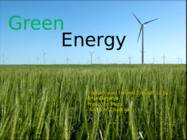
- And Just Chadrick Overview- What is Green Energy? Different Types? What is sustainability? German Green Energy Cost and Efficiency Recycling What is Green Energy? -It is energy resources that are renewable -Can be naturally replenished -Clean, Safe and not harmful to the environment (aka mother earth) Types of Green Energy Green Energy going cute Solar Power · Is produced by using photovoltaic cells, which capture sunlight and turns that into energy. Problems ? -The sun has got to shine -The cost of solar panels and the systems range between $20k-40k -The light from the sun produces a very small amount of energy Wind Power -These giant pinwheels spin from strong winds which spins a turbine of a generator to produce energy. Giant Pin Wheels? Any Studies done? · It is said that wind · Bentek Energy did the
energy needs for an entire year. Solar energy use has surged at about 20 percent a year over the past 15 years, thanks to rapidly falling prices and gains in efficiency. Solar energy is inexhaustible. Noise free. Does not harm the environment. Click to edit Master text styles Second level Third level Fourth level Fifth level Negative aspects of solar energy Solar energy does not work at night without a storage device such as a battery. Cloudy weather can make the technology unreliable during the day. Solar technologies are very expensive. Requires a lot of land area to collect the sun's energy. Wind energy Most wind energy comes from wind turbines. Wind turbines are used to wring electricity from the breeze. Wind turbine use has increased at more than 25 percent a year. Wind is a clean source of renewable energy
Water creates energy Eduard Kamenski 11a form The world uses energy from many different sources, such as: hydroelectric power, nuclear power plants, solar energy, and wind generated power. There are positive and negative aspects of each source, but which source of energy is best? My opinion is that the best source of energy is water and I'll bring up some facts why do I think so. Hydroelectric power is currently the world's largest renewable source of electricity. It accounts for six percent of the worldwide energy supply or about fifteen percent of the world's electricity. Water has been found to be a major source of energy
BARRIERS TO DISTRICT HEATING DEVELOPMENT IN SOME EUROPEAN COUNTRIES Abstract District heating (DH) offers low primary energy demand, high security of supply and small CO 2 emissions. Barriers to DH in the UK, Ireland, France, Romania and the Czech Republic have been compiled through publications and interviews. DH systems require large investments, have negative initial cash flow and long payback time, which obstructs financing. One actor should control DH from source to consumption. If the value chain is fragmented, contracts are required between the links. It increases risks and
Margit Tepner k0848752 Sustainability aspects of biofuels 1. Introduction The literature review will discuss the sustainability aspects of biofuels. Food production will be the main concern as it is the most debated issue, but other aspects, such as land use change and water consumption will be also considered as they are essential aspects in the biofuels sustainability criteria. The review will discuss the viability of biofuels based on the current technologies. Second-generation biofuels are not yet commercially viable and therefore will not be discussed; although they could significantly improve the sustainability of biofuels when they break through to the industrial scale. 2. The scale of biofuels production 2.1
Unintentional production of biogases has been an ongoing issue in many regions of the world, and several nations have also looked to biogas as a potential source of clean energy. India and China have both invested extensively in creative biogas technology to provide fuel for their citizens and there are a number of interesting applications for this gas which appeal to people who are interested in sustainable energy and the health of the environment. The basis for biogas is organic material such as food scraps and feces which are held in an anaerobic area, which can range from a storage tank which is not ventilated to a device which is specifically designed to produce gases. The conditions attract anaerobic bacteria, which start to break down the organic material, producing methane and carbon dioxide as a by-product. Another type of biogas which includes hydrogen, nitrogen, and carbon monoxide can be obtained
Standard for our Against Animal Testing policy. And we have our own fair trade programme called Community Trade, making us the only cosmetics company with such an extensive commitment to trading fairly. Community Trade now works with 31 suppliers in 24 countries, providing over 15,000 people across the globe with essential income to build their futures. The Body Shop is a leader in the trend towards greater corporate transparency, and we have been a force for positive social and environmental change through our lobbying and campaigning programmes around our five core Values: Support Community Trade, Defend Human Rights, Against Animal Testing, Activate Self-Esteem, and Protect Our Planet. We also have our own charity, The Body Shop Foundation. Launched in 1990 (registered charity no. 802757) we give financial support to pioneering, frontline organisations that otherwise have little hope of conventional funding. The
and also woods, groundwater, animals and so on, in other words it's everything that human hasn't created. These resources are also used in industry. We get natural resources from the environment. Many of them are essential for our survival while others are used for satisfying our wants. Renewable resources: Some natural resources can be reproduced within a few years or decades. These are called renewable resources. Solar radiation, wind and hydroelectricity, are perpetual resources that are in no danger of a lack of long-term availability. Some natural renewable resources such as geothermal power, fresh water, timber, and biomass must be carefully managed to avoid exceeding the worlds capability to displace them. Solar energy is the energy derived directly from the Sun. Along with nuclear energy, it is the most important source of energy on Earth. People usually use solar energy to produce
had been just recently discovered at the time 1895. It is energy released by the splitting (fission) or merging together (fusion) of the nuclei of atoms. The conversion of nuclear mass to energy is consistent with the mass-energy equivalence formula E = m.c², in which E = energy release, m = mass defect, and c = the speed of light in a vacuum. Nuclear chemistry can be used as a form of alchemy to turn lead into gold or change any atom to any other atom (albeit through many steps). Radionuclide (radioisotope) production often involves irradiation of another isotope (or more precisely a nuclide), with alpha particles, beta particles, or gamma rays. Iron has the highest binding energy per nucleon of any atom. If an atom of lower average binding energy is changed into an atom of higher average binding energy, energy is given off. What is nuclear fusion? Nuclear fusion is the process by which multiple like-
INTRODUCTION OF SUPPLY CHAIN MANAGEMENT (SCM) A supply chain is a network of facilities and distribution options that performs the functions of procurement of materials, transformation of these materials into intermediate and finished products, and the distribution of these finished products to customers. Supply chains exist in both service and manufacturing organizations, although the complexity of the chain may vary greatly from industry to industry and firm to firm. Supply chain management is typically viewed to lie between fully vertically integrated firms, where the entire material flow is owned by a single firm and those where each channel member operates independently. Therefore coordination between the various players in the chain is key in its effective management
concentrated in the capital): Kyiv (Kiev) 2.8 million, Kharkiv (Kharkov) 1.5 million, Lviv (Lvov) - 1.5 million, Donetsk 1 million, Dnipropetrovsk (Dnepropetrovsk) - 1 million, Odesa (Odessa) 1 million. Zaporizhzhya (Zaporozhye) 0.8 million. 5 GDP growth, %: 1.0 (2013 forecast EBRD downward revision from previously projected 2.5%). Official language: Ukrainian (although Russian is widely used in business communication). Currency: Hryvnya (UAH). Government type: republic. Membership: the United Nations, the International Monetary Fund (IMF), the World Bank, the European Bank for Reconstruction and Development (EBRD), the World Trade Organization (WTO), etc. Ukraine is bordered by Russia in the east, the Black Sea in the south, Moldova, Romania, Hungary, Slovakia and Poland in the west, and Belarus in the north. The country is rich in
surface than any preceding decade since 1850. More than 90% certain that most of global warming was being caused by increasing concentrations of greenhouse gases produced by human activities.In 2010 that finding was recognized by the national science academies of all major industrialized nations. Affirming these findings in 2013, the IPCC stated that the largest driver of global warming is carbon dioxide (CO2) emissions from fossil fuel combustion, cement production, and land use changes such as deforestation. Its 2013 report states:Human influence has been detected in warming of the atmosphere and the ocean, in changes in the global water cycle, in reductions in snow and ice, in global mean sea level rise, and in changes in some climate extremes. Initial causes of temperature changes Greenhouse gases The greenhouse effect is the process by which absorption and emission of infrared radiation
potential, then investors can lose all or most of their investment. High tech is often viewed as high risk, but offering the opportunity for high profits. Like Big Science, high technology is an international phenomenon, spanning continents, epitomized by the worldwide communication of the Internet. Thus a multinational corporation might work on a project 24 hours a day, with teams waking and working with the advance of the sun across the globe; such projects might be in software development or in the development of an integrated circuit. The help desks of a multinational corporation might thus employ, successively, teams in Kenya, Brazil, the Philippines, or India, with the only requirement fluency in the mother tongue, be it Spanish, Portuguese or English. OECD has two different approaches: sector and product (industry) approaches. High-tech sectors
If a person be insensitive, be it from numbing cold, exhaustion, drugs, genetic makeup, or upbringing, then the process of education is bogged down, and results come only after great efforts. Sensitivity in my integrated meaning is broad, covering literally the senses, so that deaf and blind people are less sensitive, as well as people whose senses work perfectly, but whose receptivity or thought processes are blunted for whatever reason. A person can be insensitive in one way, such as blind, and extraordinarily sensitive in another way, such as in hearing. It is also possible to be so ultra-sensitive that the result is disadvantageous. I expect no argument in asserting that a normal sensitivity is a healthy, indispensable ingredient for optimal education. Sensitivity can be heightened or blunted by education. It is intertwined with curiosity. An ideal education affords numerous and varied opportunities for students to touch, see, smell,
1 Wave energy Introduction to wave energy There are several possibilities to harvest different forms of energy from the sea. One of these options is the usage of waves for the generation of electricity. The devices needed to perform this task are called wave energy converters. Wave energy is indirect solar energy in twice. At first there is the wind, which is caused by variations in atmospheric pressure due to a differential solar heating of earth's surface by the sun. Different regions of pressure drives a force which rises a movement of atmospheric air masses that causes the earths wind system. If wind strikes over the surface of an open water, waves are induced. First they are very flat with only a low level of energy. When there is a long distance over
fog. SO2 and NOx come mainly from power stations and factories burning fossil fuels, or from motor vehicles. · Carbon dioxide in the air can dissolve in rain water to form carbonic acid, H 2CO3 CO2 + H2O H2CO3 · During the last century the rain water in some parts of the world has become far more acidic. This acid rain has been caused by the emission of pollutants gasses such as sulfuric dioxide, when goal is burned in electric power stations, sulfur impurities form sulfur dioxide S + O2 SO2 · The gas is also produced when fuels obtained crude oil are burned. When sulfur dioxide is released into the air it reacts with water and oxygen to form sulfuric acid, which is strong it ionizes completely to hydrogen ions. H2SO4 2H + SO4-2 Effects pH range Effect 6.59 No effect 6.06
characterization (mainly in terms of porosity and permeable structures). It is refined and separated, most easily by boiling point, into a large number of consumer products, from petrol (or gasoline) and kerosene to asphalt and chemical reagents used to make plastics and pharmaceuticals. Petroleum is used in manufacturing a wide variety of materials, and it is estimated that the world consumes about 88 million barrels each day. The use of fossil fuels such as petroleum can have a negative impact on Earth's biosphere, releasing pollutants and greenhouse gases into the air and damaging ecosystems through events such as oil spills. Concern over the depletion of the earth's finite reserves of oil, and the effect this would have on a society dependent on it, is a field known as peak oil. Etymology The word "petroleum" comes from Greek: πέτρα (petra) for rock and Greek: ἔλαιον (elaion) for oil
Hello My name is JOHN SMITH and I am here to talk about Hydroelectricity. Global energy use has risen by 70% since 1971 and continues to increase at the rate of 2% per year. There are many scenarios for future demand. One solution would be to use more hydropower. In 2005, renewable energy represented one-fifth of total power generation. Hydropower is the most advanced of the renewable and represents 87% of this production. 160 countries all over the world are using hydropower. Five countries make up more than half of the world's hydropower production. Those countries are: Brazil,Canada, China, Russia and the USA. (Production)
.......................................22 1. Background Lee Information Systems is an organization whose main trade is a solution-based development of business software. The primary area of competence of the organization is IT domain. Lee IS has been active since 2002 and during that time has successfully provided a wide range of services and solutions. In the past years the specialty of Lee IS was narrowed down to IS development for specific business domains due to the rising demand and profitability. 2. Business Plan 2.1.Mission Lee IS is set on catering the most effective solution to a given customer and offering the most effective partnership in its support. Effectiveness implies, amongst other things, information being: stored without essential use of paper transmitted without essential burning of fuel processed without essential human labor/endeavor 2.2.Values Simplicity and transparency
able to sustain present or future numbers of inhabitants. Loss of Fresh Water • Most of the freshwater resources are either unreachable or too polluted, leaving less than 1% of the world's freshwater, or about 0.003% of all water on Earth, readily accessible for direct human use. • According to the Global Outlook for Water Resources to the Year 2025, it is estimated that by 2025, more than half of the world population will be facing water-based vulnerability and human demand for water will account for 70% of all available freshwater. • Freshwater is the most fundamental finite resource with no substitutes for most uses, yet we are consuming fresh water at least 10 times faster than it is being replenished in regions of northern Africa, the Middle East, India, Pakistan, China, and the U.S.. Species Extinction • Human beings are currently causing the greatest mass extinction of species since the extinction of the dinosaurs 65
Through some pollution comes from these natural sources, most pollution is the result of human activity. The biggest causes are the operation of fossil fuel- burning power plants and automobiles that combust fuel. Combined, these two sources are responsible for about 90% of all air pollution in the United States. All kind of pollutions can lead us to serious health problems. For example, air pollution is increasingly being cited as the main cause of lung conditions such as asthma - twice as many people suffer from asthma today compared to 20 years ago. Every year, 3.2m Europeans are diagnosed with cancer - the most common cause of death after heart disease. Most widespread are cancers of the lungs, breast and colon. Diseases such as bronchitis, lung cancer and heart diseases may all eventually appear in people exposed to air pollution. When the wind blows, then it carries the pollution with him. Futhermore, the rain reduces the pollution
New energy sources Rauno Hermann Scheer Energy law example for 47 countries 6.3% to over 20% Numerous awards including The Right Livelihood Award Renewable energy in world Investments 63 billion USD > 120 billion USD 20062009 Wind energy: 74 000 MW to 135 000 MW Solar energy: 5100 MW to 19 000 MW WHAT ARE THE ALTERNATIVES TO TODAYS SOLAR, WIND AND BIOMASS ENERGY SOURCES? Osmotic power How it works? Pressure created by osmosis powers turbines Where could be used Where fresh and salt water meet (creeks, fjords) Desalination plants Now Worlds first test factory in Norway Tofte (2009) Disadvantages Km2s of membranes needed Norway, Tofte Click to edit Master text styles Second level
by Caucasians against Jews; there us racism by Jews against Italians and vice versa; everyone has somebody he or she doesn’t like. In fact, husbands and wives disagree; parents and children disagree; brothers and sisters disagree ad infinitum. But Africans go through life always believing somebody hates them or dislikes them and this negates reaching goals. It has been said that what you wish is what you 5 get. You have to demand what is due you. You cannot let somebody’s hatred or dislike deter you from dream. Their dream is not your dream. In fact, their years of persecuting Blacks have made them guilty. A capitalist Nigger must exploit their guilt to ensure that they assist in reaching his goals. You must become an economic warrior, not with the conventional weapon of guns, knives, or even hatred in your heart, but with a brain and a desire to learn all that you can learn from those who have
Adventure Tourism Project Management Madli Tuvike There is no such thing as a totally sustainable tourism (Swarbrooke, 1999). Tourism as one of the leading industries in the world is contributing to sustainable development (Mintel, 2005). Tourism needs to cope with changing world and world order, also trends that are occurring. Sustainable tourism is one rising industry in tourism market. Swarbroke (1999) and David (2011) are suggesting that sustainable tourism and sustainability is taking wider part in tourism industry
decimating. Another example is the destruction of coral reefs in the various oceans, which support the rich marine life. FIND OUT 5 WAYS HOW TO HALT THE LOSS OF BIODIVERSITY 6. Deforestation: Our forests produce fresh oxygen and help in regulating temperature and rainfall. At present forests cover 30% of the land but every year tree cover is lost amounting to the country of Panama due to growing population demand for more food, shelter and cloth. Deforestation simply means clearing of green cover and making that land available for residential, industrial or commercial purpose. FIND OUT 5 WAYS HOW TO STOP DEFORESTATION. 7. Ocean Acidification: It is a direct impact of excessive production of CO2. 25% of CO2 produced by humans. The ocean acidity has increased by the last 250 years but by 2100, it may shoot up by 150%. The main impact is on shellfish and plankton.
consolidate their power. In this example, the free riders avoid all of the personal risks of war while enjoying the benefit of tax dollars spent under the false popular perception of the urgent need for national defense. Government is indeed the primary mechanism by which societies address free rider problems. In addition to fiscal measures noted above, regulation is another form of collective action taken by governments to resolve free riders problems such as environmental degradation or excessive resource use. The free rider problem is also one justification for the existence of governments which provide public goods. Some ideologies, such as libertarian capitalism, are often rebuked, because in such a system all property in a society would be privately owned, away from any state involvement or regulation. Libertarians counter that potential free riders within their system could face social ostracism, which may deter those who accept services
The construction industry is complex and dynamic and has several constraints that distinguish it from other industrial sectors. Dimitri Mitchell outlined in a September 2009 article in Civil Engineering entitled “The Promise of Virtual Design”, four characteristics that illustrate the construction industry. First, there is a high degree of complexity resulting from different companies collaborating on a single project. These diverse and dispersed companies are required to exchange critical information during the design and construction phases. Second, owners and other non engineering stakeholders interpret 2D drawings differently and often have an incomplete understanding of the planned construction. Third, there is a high degree of uncertainty and risk caused by site conditions. Finally, one of the biggest issues facing the construction industry, is the inability to discern constructability problems during the preconstruction phase of a project
ultimately supreme and any administrative divisions (subnational units) exercise only powers that their central government chooses to delegate. The majority of states in the world have a unitary system of government. 4. A federal state-- a political entity characterized by a union of partially self- governing states or regions under a central (federal) government. 5. A multinational state- A multinational state is a sovereign state which is viewed as comprising two or more nations. Such a state contrasts with a nation-state where a single nation comprises the bulk of the population. 6. A single-nation state- a geographical area that can be identified as deriving its political legitimacy from serving as a sovereign nation. A state is a political and geopolitical entity, while a nation is a cultural and ethnic one. The term "nation state" implies that the two coincide, but "nation state" formation can take place at different times in different parts of the world. 7
Sustainable city planning Sandra Erik 11L What is sustainable city planning? • A sustainable city, or also know as eco-city, is a city designed with consideration of environmental impact, inhabited by people dedicated to minimization of required inputs of energy, water and food, and waste output of heat, air pollution - CO2, methane, and water pollution. • It should meet the needs A sustainable city should be able to... • feed itself with minimal reliance on the surrounding countryside, and power itself with renewable sources of energy. • create the smallest possible ecological footprint • produce the lowest quantity of pollution possible • efficiently use land • compost used materials -
Moreover, there are no students who have both breakfast and school lunch, eat more than four slices of brown bread per day, and avoid fat. In this essay, I will discuss whether prevention is better than trying to treat people who are ill and whether or not this is possible in all cases. I will divide the subject into illnesses caused by lifestyle, and illnesses caused by other factors such as genetic factors. First of all, a person's lifestyle can be a major factor in their wellbeing, both physical and mental. People who eat too much fast, fatty, or sugary foods without doing enough physical activity, may put on weight. This has serious effects and can lead to heart disease. Similarly, people who smoke and drink too much run the risk of getting cancers and heart disease. However, by
4 They'll be here any moment now. Edward and his dad have a lot in 3 swiftly 5 Everybody makes mistakes once common. 4 loosely in a while. 4 Luke is the spitting image of Matt 5 categorically 6 My brother was still a baby at the Damon. 6 widely time. 5 Personality-wise, I take after my 7 resolutely / staunchly mum. 8 strictly 5 unaffected inappropriate 9 gravely immobile disapproval 4 1 never used to
 annaabi.ee