 Tasuta
Faili alla laadimine on tasuta
Tasuta
Faili alla laadimine on tasuta
 ~ 7 lehte
Lehekülgede arv dokumendis
~ 7 lehte
Lehekülgede arv dokumendis
 2017-02-10
Kuupäev, millal dokument üles laeti
2017-02-10
Kuupäev, millal dokument üles laeti
 1 laadimist
Kokku alla laetud
1 laadimist
Kokku alla laetud
 0 arvamust
Teiste kasutajate poolt lisatud kommentaarid
0 arvamust
Teiste kasutajate poolt lisatud kommentaarid
 sandraErik9
Õppematerjali autor
sandraErik9
Õppematerjali autor
Her friend, Les, didn't like to use any energy at all. He walked to school, read books instead of watching TV, played the trumpet instead of Guitar Hero, and turned off the lights anytime he left a room. Then one evening, there was a power outage. The lights went out, the TV turned off, and everything became very quiet. Jules became very upset, and quite scared. She couldn't do anything that she wanted to do. She didn't think she could survive. Meanwhile, Les didn't seem to mind at all. He was able to light a few candles and he could still read his books, practice his trumpet, and hang out and play cards with his family. The two friends then realized that there was a big difference in their lifestyles and the amount of energy they used. So Jules decided she should figure out how much energy Les used and then compare her energy consumption to how much she really needed. To do this, they figured out how much energy Jules was using for entertainment, light, heating and
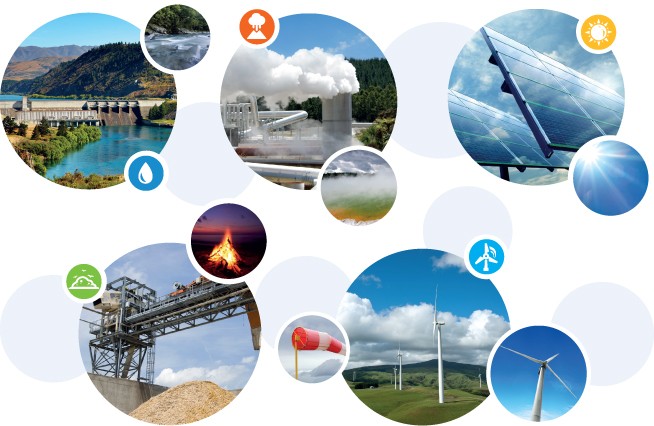
products Cost Efficient? · A study done by OSU So much for the love.... · Going to biofuels would be like adding a new gas tax. About 25 cents. · And it is not proven to reduce green house gases and may even produce more of them. Geothermal Energy -By using heat from the earth's crust in forms of hot water and steam to power generators for electricity The Math? · Geothermal Energy systems are expensive to put in. · But they are able to pay themselves off in 5 to 10 yrs. · Is able to cut the energy bills by 30 to 40%. Overall Good Bad (technology not there yet) · Hydropower · Solar · Geothermal · Wind · biofuels Germany and Sustainability Key Concepts Over the last 40 years, all levels of government in Germany have reworked policies to promote growth that is more environmentally sustainable
Especially in Europe, this kind of applications is encouraged by several projects. Electricity Production: Especially in medium and large facilities, biogas is used in electric generators. The electric transformation efficiency of biogas is about 22%- 40%. Biogas as replacement of fuel Biogas is used as transportation fuel in a number of countries, but in Europe it has only reached a major breakthrough in Sweden. All of the biogas plants in Sweden that are in the planning or construction phase will be equipped with possibilities to deliver a biogas that is upgraded to natural gas quality, either for direct use as vehicle fuel or for injection into the natural gas grid. Biogas can be used in both heavy duty and light duty vehicles. Light duty vehicles can normally run both on natural gas and biogas without any modifications, whereas heavy duty vehicles without closed loop control may have to be adjusted, if they run alternately on biogas and natural gas
the oxidation of the carbon to carbon dioxide and the hydrogen to water (vapour). Unless they are captured and stored, these combustion products are usually released to the atmosphere, returning carbon sequestered millions of years ago and thus contributing to increased atmospheric concentrations. The vital difference between biomass and fossil fuels is one of time scale. Biomass takes carbon out of the atmosphere while it is growing, and returns it as it is burned. If it is managed on a sustainable basis, biomass is harvested as part of a constantly replenished crop. This is either during woodland or arboricultural management or coppicing or as part of a continuous programme of replanting with the new growth taking up CO2 from the atmosphere at the same time as it is released by combustion of the previous harvest. This maintains a closed carbon cycle with no net increase in atmospheric CO2 levels. Within this definition, biomass for energy can include a wide range of materials.
birch – 1500 kWh/ton Wood gas • Wood gas is produced by heating biomass (wood) in a temperature over 700°C without air access or in a method of pyrolysis. Wood gas consists of carbon dioxide, methane and carbon monoxide. The calorific value of wood gas is approximately 1,25 MWh/1000 m³ wood. 34...40 m³ of wood gas can be produced out of a 100 kg of wood Biomass from nature protection area • Ecologically pure • Low cost • Sustainable Biomass from nature protection area – an environmental friendly input for biogas Jaak-Albert Metsoja Nature Conservation Society “Eagle” •The overall managed area today (including chopped area) is 1300 ha •Of that appr. 500 ha was mowed and balled last year •The first phase is restoring the flooded meadow •As for now the material is chopped and just left on the meadow •Dry matter – 85,86 – 90.33 In the DM: •Raw protein 6,19 – 10,04 %
whose mission is to develop and disseminate globally applicable Sustainability Reporting Guidelines. These Guidelines are for voluntary use by organisations for reporting on the economic, environmental, and social dimensions of their activities, products, and services. The aim of the Guidelines is to assist reporting organisations and their stakeholders in articulating and understanding contributions of the reporting organisations to sustainable development. Trends The key trends during the last two years are: Expanding globalization – Expansion of global capital markets and information technology continue to bring unprecedented opportunities for the creation of new wealth. Search for new forms of global governance – Globalisation challenges the capacity of existing international institutions to govern corporate activity. Reform of corporate governance – Pressures on corporations to establish and maintain high
Ownership and organisation considers if district- heating companies are owned, or DH operations are organised, in ways that make it more difficult for Swedish companies to do business. Corruption may be a problem through, for example, indirect bribes by procurement. National and local control encompasses national laws and policy instruments that are disadvantageous for district heating, DH price regulations, as well as municipalities not facilitating district heating by planning of new developments. But rules complicating combined heat and power production are included in the CHP line in Table I. Financing is one of the largest barriers to district heating, primarily because DH schemes give a low rate of return. A fragmented value chain cause contract risks at several instances. Entrance barriers for foreign companies in Table I consider additional difficulties for foreign firms besides
Scharlemann J,P,W. Laurance, F. 2008. How Green are biofuels? Science, 319. Soetaert, W. Vandamme, E,J. 2009. Biofuels. Wiley and Sons: London Soyatech. 2012. Corn Facts. http://www.soyatech.com/corn_facts.htm Soyatech. 2012. Soy facts. http://www.soyatech.com/soy_facts.htm Timilsina, G, R. Mevel, S. Shrestha, A. 2011. Oil price, biofuels and food supply. Energy Policy 39, p 8098-8105 Margit Tepner k0848752 UNEP (United Nations Environment Programme) (2009). Towards sustainable production and use of resources: Assessing Biofuels. (This report came too late for this extensive assessment, however, several of its summary conclusions have been cited and added during the final revision). Umbach F. 2010. Global energy security and the implications for the EU. Energy Policy 38, 12291240. USDA (United States Departement of Agriculture) 2012. USDA Agricultural Projections to 2021. [Online] http://www.ers.usda.gov/features/bioenergy/ Zuurbier, P
 annaabi.ee



















Kõik kommentaarid