Leidsid 33 sarnast õppematerjali, mis on seotud failiga "Empire State building ". Need materjalid aitavad sul teemat sügavamalt mõista.
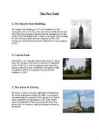
empire, building, floors, location, york, roof, height, meters, spire, included, stands, total, thought, cultural, icon, little, built, cost, lamb, brothers, playerThe New York 1. The Empire State Building. The Empire State Building is a 102-story landmark Art Deco skyscraper in New York City at the intersection of Fifth Avenue and West 34th Street. Its name is derived from the nickname for the state of New York, The Empire State. It stood as the world's tallest building for more than forty years, from its completion in 1931 until construction of the World Trad Center's North Tower was completed in 1972. 2. Central Park. Central Park is an urban park that occupies about 1.2 square miles (341 hectares, or 843 acres) in the heart of Manhattan in New York City. It is host to approximately twenty-five million visitors each year. Central Park was opened in 1859, completed in 1873 and designated a National Historic Landmark in 1963. 3. The statue of Liberty.
Christ The Redeemer Or the Statue of Christ Redeemer (Portuguese: Cristo Redentor) is a statue of Jesus Christ with the largest Art Deco architectural style and located in Rio de Janeiro, Brazil. The statue has a height 38 meters and is located at the top of Corcovado Mountain is 710 m high in the Tijuca Forest National Park, overlooking the city. Chichen Itza It is a Mayan archaeological heritage in Mexico is the most complete and still well maintained. According to the Mayan culture of Chilam Balam, the temple complex was built between the years 502-522 AD. Mayans occupy just over 200 years, then they migrate to coastal areas in Campeche
The City of London History The City of London occupies one square mile in the middle of the capital. It once made up the entire town of London, surrounded by the wall first built by the Romans. The Roman Londinium grew up on the northern side of the "London Bridge" in the past. Products such as olive oil, wines and fruit were brought by ships from different parts of the Roman Empire and unloaded onto wooden quays along the river. In AD 61 the native Celtic Iceni tribe, led by Queen Boudicca, rose up against The Romans. They burnt Londinium to the ground but Roman armies eventually defeated Boudicca. The city was rebuilt and was gradually surrounded with a wall of stone and brick which lasted for many centuries. During the archeological excavations in 1954 the Roman Temple of Mithras was revealed. It was a pagan temple dedicated to the Persian Sun-god. The Temple
A State is free to conduct, as internal affairs by its own decisions, as long as it does not interfere with other States and stays within the limits set in the United States Constitution. Each State has a capital city for its State government (often it is not the biggest in the State). Capital cities in America are less important then in Europe. They are created to serve limited political functions, not to be the center of social life. New York City. It is the biggest city in America, with 7 million people. Although it is not the capital it has always been the cultural center of the whole country. America's largest publishing houses and TV networks have their headquarters in New York. Maddison Avenue is the advertising center and Fifth Avenue is the fashion center of America. Broadway is where theater plays are tried out and made a success or faliure. The New York Stock
and the third-tallest free-standing clock tower in the world. The clock first ticked on 31 May 1859. The pendulum is installed within an enclosed windproof box sunk beneath the clockroom. It is 3.9m long, weighs 300 kg and beats every 2 seconds. The clockwork mechanism in a room below weighs 5 tons. · Buckingham Palace is the official London residence of the British monarch. Originally known as, the building which forms the core of today's palace was a large townhouse built for the Duke of Buckingham in 1703 on a site which had been in private ownership for at least 150 years. During the 19th century it was enlarged, principally by architects John Nash and Edward Blore, forming three wings around a central courtyard. Buckingham Palace finally became the official royal palace of the British monarch on the accession of Queen Victoria in 1837.
Stovzatá Praha ("City of a Hundred Spires") in Czech or Zlaté msto/Goldene Stadt ("Golden City") in Czech/German. Situated on the Vltava River in central Bohemia, Prague has been the political, cultural and economic centre of the Czech state for more than 1100 years. For many decades during the Gothic and Renaissance eras, Prague was the permanent seat of two Holy Roman Emperors and thus was also the capital of the Holy Roman Empire. 4 Today, the city proper is home to about 1.3 million people, while its metropolitan area is estimated to have a population of over 1.9 million. Since 1992, the extensive historic centre of Prague has been included in the UNESCO list of World Heritage Sites, making the city one of the most popular tourist destinations in Europe, receiving more than 4
It was not until the 18th century that the name Lai also started to appear. In 1872, when the street names were being fixed, Lai remained the sole name of the street. 4 1 Lai Street / 4 Nunne Street A good example of Neo-Renaissance and early Art Nouveau styles combined is Lai Street 1, the present Youth and Puppet Theatre, erected at the beginning of the 20th century as the Nobility Club. The three-storey building replaces two medieval properties. In 1784 an amateur theatre began playing in a house situated in the same place and soon became a professional German City Theatre. The famous German writer August von Kotzebue (1761-1819), the life and soul of the theatre, lived in Tallinn for several long periods. (Otto von Kotzebue, the son of August von Kotzebue, accompanied explorer Adam Johann von Krusenstern on his Journey around the World of 18031806.) Estonian was heard
Tallinn developed along three lines: fortress, port and market town. Tallinn grew rapidly and had developed into a well-known trading centre by the 15th century. Unfortunately, prosperity did not last long due to the weakening of the Hanseatic League, epidemics, hunger and wars. Sweden finally managed to take control of the whole of Estonia in 1629. Their rule ended after the Northern War in 1710 when Estonia was joined to the Russian Empire. Life changed for the better thanks to the opening of a railway line from St. Petersburg to Tallinn in 1870. Tallinn grew into a major port and an industrial centre, with huge shipyards. Interest in culture grew and Estonians became conscious of their national identity, dreams of independence gained ground. On 24 February 1918 Estonia was declared an independent country and Tallinn became the capital of the Republic of Estonia.
Broadway Broadway is a street in the U.S. state of New York. It is the oldest northsouth main thoroughfare in New York City, dating to the first New Amsterdam settlement. The name Broadway is the English literal translation of the Dutch name, Breede weg. Broadway is known worldwide as the heart of the American theatre industry. One famous stretch near Times Square, where Broadway crosses Seventh Avenue in midtown Manhattan, is the home of many Broadway theatres, housing an ever-changing array of commercial, large- scale plays, particularly musicals
town of London, surrounded by the wall first built by Romans. The Romans also built a bridge over the Thames and there has been one in the same area ever since. The Roman Londinium grew up on the northern side of the bridge. In AD 61 the native Celtic tribe, led by Queen Boudicca, rose up against the Romans. They burnt down Londinium to the ground and killed most of its inhabitants. Roman armies eventually defeated Boudicca and Londinium was rebuilt. At the end of the fourth century AD the Roman Empire began to crumble and the Roman armies were recalled from Britain to defend Rome itself. Once they had left, tribes such as Angles, Saxons and Jutes invaded and settled in from Holland, Germany and Denmark. Together they are known as Anglo-Saxons. They were farming people who preferred living outside towns. For a while London probably lay in ruins, but it eventually developed again, partly because its position on the river was good for trading. In 1666 most of the City of London was destroyed in
Tallinn Mustamäe College G2K Jaana-Kristiina Jõgevest The Four oldest churches of Tallinn Report Supervisor: Ingrid Teigar Tallinn 2009 The Dome Church The Danes began fortification of Toompea after the conquest of Tallinn in 1219 and probably also built the first church there. It was presumably a wooden building located at the site of the present cathedral. However, a serious conflict with the Order of the Brothers of the Sword broke out soon as the latter wanted to gain control of the entire Estonia. The order succeeded in subordinating Tallinn and the whole of North Estonia to its rule in 1227. The monks of the Dominican Order began the construction of a stone church in Toompea in 1229. The first written data on the cathedral date back to 1233, the date of a
01.2010 Juhendaja: Roode Liias ……………………….. Ülesande vastu võtnud: Tanel Friedenthal ………………………. Abstract How are 3D and BIM Changing the Design, Fabrication and Construction of Complex Steel Structures? The adoption of three-dimensional (3D) design and construction tools have created a remarkable shift in the building industry. Intelligent 3D technology in the form of Building Information Modeling (BIM) not only promises to improve the notoriously inefficient construction process, but also opens the door for designing new geometric shapes, which until recently have been considered unbuildable. Steel has been extensively used to build some of the most challenging architectural icons of the 21st century, due to its low weight and high strength in both compression and tension. Therefore, the steel
A.D., it is more accepted by historians that the Romans were the first. The settlement was called Londinium. The first London lasted for just seventeen years, for around AD 61, a tribe of Celts led by Queen Boudica stormed London, burning it to the ground. The next heavily-planned London prospered and surpassed Colchester (another major city at the time) as the capital of the Roman province of Britannia. At its height in the 2nd century, Roman London had a population of about 60,000. However, by the 3 rd century, the city fell into a decline due to trouble in the Roman Empire and by the 5th century, it was largely abandoned. But, under the control of various English kings, London once again prospered as an international trading centre. However, Viking raids began in the late 10 th century and reached a head when they took the city under Danish king Canute and forced the then-English king to flee.
environment. Over the last few centuries, the development of society and its political upshots have produced agendas for linguistic inquiry and discourse on language, some of which have had an impact on the development of Russian and contingent languages and their social functions, as well as on the development of linguistics as a global discipline. Six such agendas can be pinpointed: (1) the Orthodox emancipation agenda (1600-1700), (2) the Russian nation building agenda (1700-present), (3) the scientific agenda (1860-present), (4) the Marxist agenda (1917-1989), (5) the Eurasian agenda (1920-1935), (6) the cybernetic agenda (1953-1975). Russian language Russian language is an East Slavic language and an official language in Russia, Belarus, Kazakhstan, Kyrgyzstan and many minor or unrecognised territories. It is an unofficial but widely spoken language in Ukraine and Latvia, and to a lesser extent, the other post-Soviet
Foreword Bridging rivers, gorges, narrows, straits, and valleys always has played an important role in the history of human settlement. Since ancient times, bridges have been the most visible testimony of the noble craft of engineers. A bridge can be defined in many ways, but Andrea Palladio, the great 16th century Italian architect and engineer, hit on the essence of bridge building when he said "...bridges should befit the spirit of the community by exhibiting commodiousness, firmness, and delight." In more practical terms, he went on to explain that the way to avoid having the bridge carried away by the violence of water was to make the bridge without fixing any posts in the water. Since the beginning of time, the goal of bridge builders has been to create as wide a span as possible which is commodious, firm, and occasionally delightful
continues to give rise to debate. Hisory of Scotland ! The history of Scotland begins around 10,000 years ago, when humans first began to inhabit what is now Scotland after the end of the Devensian glaciation, the last ice age. Of the Stone Age, Bronze Age, and Iron Age civilization that existed in the territory, many artifacts remain, but few written records were left behind. The written history of Scotland largely begins with the arrival of the Roman Empire in Britain, when the Romans occupied what is now broadly England and Wales and the Scottish Lowlands, administering it as a Roman province called Britannia. To the north was territory not governed by the Romans -- Caledonia, by name. Its people were the Picts. From a classical historical viewpoint Scotland seemed a peripheral country, slow to gain advances filtering out from the Mediterranean fount of civilisation, but as knowledge of the past
USA: West Coast Kristiina Sekljutskaja 11A West Coast · The "West Coast", "Western Seaboard", or "Pacific Coastline" are terms for the westernmost coastal states of the United States. · It most often comprises California, Oregon and Washington. Arizona and Nevada, while not coastal states, are often included due to their proximity to the Pacific Coast and their economic and cultural ties to California · As of 2007, the estimated population of the West Coast ranged from approximately 5060 million, depending on which states are included in the estimate. · Major coastal cities on the West Coast include San Diego, Los Angeles, San Francisco, Seattle, Las Vegas. ·West Coast includes: ·Washington ·Oregon ·Arizona ·Nevada ·California Washington
.............................. 9 References.................................................................................................................................10 2 Introduction I choose this topic because I want to get know more about local Theatres I hoped to get more information about their location, for whom each theatre is designed and a little overview about their history. The history of Estonian theatre does not differ much from that of the neighbor countries. The first play was performed in the 16th century at the Tallinn Town Hall. The town school children, who were Germans, staged Terence's The Andria in Latin. The first theatre house in Tallinn was mentioned in written materials which date from the late 17th century; the house was used by travelling theatre groups
The USA In my essay I am going to talk about the United States of America. The USA was discovered by Christopher Columbus in 1492. It is situated between the Atlantic and the Pacific Oceans. It is the world's fourth largest country by size (after Russia, Canada and China) and the third by population (after China and India). The third largest citys in the US is: New York (NY) with a population of 8,175,133 and nicknames like The Big Apple, The City That Never Sleeps. It is composed of five boroughs: Manhattanthe home to Central Park and most of the city's skyscrapers, The Bronx, Brooklyn with a distinct downtown neighborhood, Queens the only large county in the United States where the median income among African Americans is higher than that of White Americans and Staten Island The Staten Island Ferry
on the English economy. The high taxation necessary to finance the war and the Black Death (1348) led to such extreme hardship for the peasant class that there was a revolt in 1381. Although the Peasant's Revolt was soon put down, it led to greatly improved conditions for the peasant class and was the first step towards the ending of the feudal system in England. The Tudors Tudor Period began when Henry VII (Henry of Tudor) of the House of York defeated Richard III of the House of Lancaster in the Wars of Roses and he was crowned as the King of England. Henry VII united the two rival houses and started the Tudor dynasty. During Henry's reign the medieval period came to a close. There was a revival, or Renaissance, of learning, partly as a result of the printing press, which ended the Church's monopoly of learning. Henry's son and heir, Henry VIII created the Royal Navy, which culminated with the
centuries, when the city enjoyed membership of the powerful Hanseatic Trading League. Generally speaking these two districts are now collectively referred as the Old Town. The Town wall and towers Medieval fortresses, which emerged during the development of the medieval town at the end of the 13th century, surrounded the city centre as a closed defence zone. By the 16th century, Tallinn's defence system was one of the most powerful in Northern Europe. The city wall was three meters thick, sixteen meters high, and four kilometres long, completely encircling the city with 46 defence towers. The portion of the wall that has survived is two kilometres long, encompassing 26 of the original towers. Three towers and a section of the town wall surrounding the Old Town are open to the public and can be visited by anyone with a sense of adventure. Tallinn Old Town is changing fast with widespread renovations, but it has kept its charm. Many of
it doesn't take much thought to realise that any language spoken in a given physical and cultural environment is likely to have efficient ways of referring to distinctions that are important in that environment. That doesn't mean that you can read very much into individual words and individual facts about the lexicon of a given language (this topic has already come up in connection with debates about the location of the Indo-European homeland), but as a generalisation about lexicons, it's certainly valid. Systematic consideration of the lexicon is often left out of language descriptions and doesn't play much of a role in linguistic theory, in part because the lexicon is (or is often thought of as) the repository of everything that is arbitrary and unsystematic about language. Looked at one way, this exclusion makes sense: whether a language has a word for `horse' or not tells us
Art Museum of Estonia Art Museum of Estonia was founded on November 17th, 1919, but it was not until 1921 that it got its first permanent building the Kadriorg Palace, built in the 18th century. In 1929 the palace was expropriated from the Art Museum in order to rebuild it as the residence of the President of Estonia. The Art Museum of Estonia was housed in several different temporary spaces, until it moved back to the palace in 1946. In September, 1991 the Kadriorg Palace was closed, because it had totally deteriorated by then. At the end of the year the Supreme Council
Other Native Americans lived in small villages, where they had farms. There are about two million Native Americans in the territory of the United States. They used to be called Indians because, when Christopher Columbus arrived in America, he thought he had reached India. The United States is made up of 50 States. Capital cities in America are less important than in Europe. They are created to serve limited political functions, not to be the center of social life. New York is the biggest city in America, with seven million people . About 40% of the population is foreign-born. Although it's not the capital it has always been the cultural centre of the whole country. New York is also famous for its skyscrapers. The heart of New York is Manhattan Island. The Statue of Liberty stands in the harbor of New York. A gift from France, she is a strong woman and holds up the torch of freedom. Washington, DC is the capital of the USA. It's designed by a French architect.
Nearing / nr / lähenev Wide-scale / wad skel / laia haardega Warlike / 'w:lak / sõjakas To overrun / v'rn / vallutama Bath / b: / saunakompleks, linnasaun Julius Caesar arrived in Britain in 55 BC and named this island Albion after the chalk cliffs on the southern coast. Britain became the Roman colony. They built roads, villas, public baths and fortifications. Emperor Hadrian built a stone wall to protect England from Scots. Romans left Britain in 400 AD to protect their empire on the continent of Europe from the Germanic tribes. The Anglo-Saxon, Danish and Norman Invasions Raid / red / rünnak Abbey / 'æb / klooster Parish / 'pær / kihelkond Germanic tribes attacked Britain after the Romans had left. The Angles named this island Anglia. In 597 AD St Augustine of Rome brought Christianity to England after which religion became very important. The Vikings settled mainly in Scotland and Ireland, the Danes in the north and east of England
of a larger political entity, such as a sovereign state. The term constituent country does not have any defined legal meaning, and is used simply to refer to a country which is a constituent part of something else. 12. The Commonwealth- The Commonwealth of Nations, commonly known as the Commonwealth is an intergovernmental organization of 53 member states that were mostly territories of the former British Empire. The Commonwealth operates by intergovernmental consensus of the member states, organized through the Commonwealth Secretariat and Non-governmental organizations, organized through the Commonwealth Foundation. 13. British subject- derive their status as British subjects from British India or the Republic of Ireland as they existed before 1949. until 1949: anyone who owed allegiance to the British
English literature is for his translations of and commentaries on Latin works. Art, culture and literature flourished during the Elizabethan age, during the reign of Elizabeth I; it was the period of English domination of the oceans and colonies, and, due to the strong political and economic position of the country, there were few obstacles in the way of the cultural development. This time is also famous for the fact that William Shakespeare lived and worked then. The empire, which was very powerful under Queen Victoria, saw another cultural and artistic hey-day as a result of industrialisation and the expansion of international trade during the so- called industrial age. However, German air raids caused much damage during the First World War and then during the Second World War. The madness of the wars briefly inhibited the development of British culture. 5
2007 1. Introduction The United States of America's territory is over 3.7 million square miles (over 9.6 million km²) and population more than 300 million people. The capital city is Washington D.C. Although the United States has no official language at the federal level, English is the de facto national language. English is the most common language for daily interaction among both native and non-native speakers. Spanish is the second language. The largest city is the New York City. The Government is Federal constitutional republic and the president is George W. Bush. 2. Geographical position The United States of America is located on the continent of North America. It has borders with two countries Mexico and Canada. There are also the Atlantic Ocean, the Pacific Ocean and the Gulf of Mexico surrounding the big country. There are 50 states in America. Most of the people live in towns. The biggest state is Alaska; next by size are California, Alaska and Montana
4. Important people in Russia throughout the history 5. Conclusion 6. References Introduction- Russia Throughout the History Russia is a one of the biggest countries is the world. The first clues about Russian history are from as early as the 9th century. Russia has suffered through rough times in war, mad leaders and tough life amongst the locals. Over times the country has had several different names and political systems. They have been an empire ruled by a czar, a communist nation, and a democratic federation. Nowadays the country's official name is the Russian Federation ("Basic facts about,"). The head of the executive branch in Russia is the president who works with the prime minister. The legislative branch is the Bicameral Federal Assembly which consists of the Federation Council and State Duma. The Judicial branch consists of the Constitutional Court,
seasons. It appears in number of novels. These days it is not only the interest of tourists but is also a gathering point of certain minority groups. It is now fenced off to protect it from damage. 3. The Roman conquest Julius Caesar's first raid was in 55 BC but the romans left. Ad 43- the Romans came to stay. The army established Roman rule in the south and SW of the country. The Romans started to introduce their laws to a new province of the Roman Empire and started to build good roads. Officials were appointed (governors, procurators to collect taxes, look after the estates and mines and se that the gold, silver, iron and lead were exported back to Rome). Introduced schools,a new language Latin, large farms (villas), baths. In AD 410 they had to leave . roman occupation lasted nearly 400 years. They left behind very little. Roman province of Britannia covered most of present-day England and Wales. 4. Latin influence on English
Viewing platform, to get on top you must take 215 steps. Whoever’s flag is on top of this tower is the ruler of Estonia. (There have been German and Soviet flags). Today the estonian flag is hoisted every day at sunrise and lowered at the sunset, except at midsummer when it’s not lowered at all on the night of June 23. Nevsky Cathedral ● It’s the largest and grandest orthodox catherdral in Talinn. It was finished 1900, when Estonia was part of the Russian Empire. It was a time of russification. It’s architecturally absolutely different from everything else at Toompea, it’s also disliked by many Estonians as a symbol of oppression and the russian power, but it has never been actually taken down. The legend says it’s the very grave of Kalev, estonian’s national hero. Stenbock House ● It’s the official seat of Government and the Government office of Estonia since 2000. One of the most remarkable
French became the language of the ruling class, Latin was the written language. By the 14th century, however, English began to replace both French and Latin, but the English language still contains numerous French and Latin borrowings. The Hundred Years War between England and France and the Black Death had a great negative influence on Britain. Over 1/3 of the population died. During the fifteenth century the throne of England was claimed by two rival groups - the House of York and the House of Lancaster. As the symbol of the House of York was a white rose and the symbol of the House of Lancaster was a red rose, the war between the groups was called the War of the Roses. It lasted from 1455 to 1485 and ended with the establishment of the powerful Tudor monarchy. Civil War broke out in 1642 and it lasted until1649. It ended with complete victory for the parliamentary forces. The king was captured and executed after a trial for crimes against his people
TALLINN TOWN HALL Tallinn Town Hall is the only surviving Gothic town hall in Northern Europe. Built in the heart of Tallinn, next to a marketplace, the Town Hall has witnessed trade and social activities for over 700 years. It has still remained the most important representational building in town. The building history of the Town Hall goes back to the 13th century, but it acquired its medieval appearance in 140204. It was as early as 1248 when King Eric IV Ploughpenny of Denmark granted the Lübeck Charter to Tallinn. Relying on that document a town council was elected from amongst merchants of the Hanse and started convening in the Town Hall. It is possible to state on the basis of research findings that a meeting place of the magistracy and a goods depot in the form of a small, fortified
 annaabi.ee