Leidsid 33 sarnast õppematerjali, mis on seotud failiga "Celtic Mythology / Keldi Mütoloogia". Need materjalid aitavad sul teemat sügavamalt mõista.
celtic, mythology, celts, roman, survive, gods, religion, iron, ancient, such, through, christian, political, ages, though, europe, there, local, than, often, these, other, early, religious, structure, among, close, contact, empire, subsequent, christianity, languages, mostly, contemporary, sources, peoples, either, linguistic, tribes, britain, irelandStudy questions on chapter 1 Stonehenge - is pre-historical moument located in the English county of Wiltshire. 2400 BC 22 000 BC. It is composed of a circular setting of large standing stones. The site and its surroundings were added to the UNESCO's list of World Heritage Sites in 1986 Celtic Invasion It begun about 500 years BC. Celts brought iron with them to Britain (and pagan traditions). But it is belived that there was never an organized Celtic invasion.(Celts were too fragmented to make it happen) Iron Celts brought iron with them into Great Britain which made some big changes. Iron is stronger then bronze and iron ore is more common(it made tools and weapons better). One of the interesting innovations that they brough to Britain was the iron plough which changed a lot about the farming(made it easier). Iron changed trade and fostered local independence. Hadrian's wall was a defensive fortification in Roman Britain
coast). They may be the forefathers of the people from Cornwall and Wales. The building of Stonehenge started around that time. 2400BC the 'Beaker' people arrived in Britain. They had better metal working skills and they soon became the leaders of the British society. They started building individual graves. 1300BC the farming society became more important than the henge society. 55BC the Romans arrived. The Celts The Celts arrived from central Europe or further east around 700BC. They were tall and had fair or red hair and blue eyes. They knew how to work with iron. They are the ancestors of many people living in Britain today. Celtic languages are still spoken today. The Celts lived in tribes which were ruled by a chief. They did a lot of trading and the main trading centres were the capitals of England and Scotland. The Celtic tribes were ruled over druids who memorised religious teaching,
свои знания о стране, являющейся родиной английского языка, ставшего ведущим мировым языком, и парламентаризма, который переняли большинство стран мира. 6 INTRODUCTION Aspects of British History presents a brief outline of the most significant milestones in the long and eventful history of Great Britain, such as the five successful invasions of the island, the birth of Parliament and transformation of an absolute monarchy into a constitutional monarchy, the origin of the English language, the rise and fall of the British Empire. The units contain an informative reading text on an important issue, preceded by preparatory discussion questions and followed by notes offering some additional information, and a vocabulary with relevant language notes. The main reading text is
The Saxons & Vikings Fragmentary knowledge of England in the 5th & 6th centuries comes from the British writer Gildas, the Anglo-Saxon Chronicle, saints' lives, poetry, archaelogical findings and place- name studies. British landlords ruled small, unstable kingdoms and continued some Roman traditions of governance. In the mid-5th cent, Vertigern, a British leader, hired Germanic mercenaries to help defend against peoples of the north (Picts & Scots). In the end they revolted & the process of invasion and settlement began. The first Saxon ,,kings" were Hengist & Horsa in Kent, Aelle in Sussex, Cerdic / Cynric in Wessex. So the first ,,English" became mainly from Northern Germany & Denmark. The resistance of the Celts was long. They were free at the time, not like other Roman
g. a form of breast cancer. In 1997 scientists in Edinburgh succeeded in cloning a sheep. Scotland and Northern Ireland have long been noted for their production of whisky and textiles, notably tweed and linen respectively. Today Scotland is also a major producer of computers. The leading manufacturing regions are Greater London, Greater Manchester, West Midlands (Birmingham), Yorkshire, Newcastle, Glasgow, Bristol. Britain has relatively few mineral resources. Zinc, tin, iron ore and copper are all produced in small quantities, together with tiny amounts of gold and silver. Non- metallic minerals include limestone, chalk, clay, sandstone, salt and gypsum. Britain has the richest energy resources in EU including oil and natural gas, both primarily found in the North Sea, off eastern Scotland and eastern England respectively. About 77% of the land area of Britain is under agricultural use of some sort. Agriculture employs 2 per cent of the population
Revision questions for the test on Old English and Medieval Literature. 1.) How is literature analysed and studied? What is the difference between the diachronic and synchronic view? Literature is studied and analysed by reading the piece of work profoundly and work on all the aspects of the piece. Diachronic is development in history Synchronic is particular state at any given moment 2.) Give a general overview of Celtic Britain, Roman invasion in 55-54 BC, Anglo-Saxon invasion and the second Roman "invasion" of Great Britain, who were the leaders, what influence did they leave on the culture of Great Britain? Celtic Britain was during the Bronze Age, there were many small tribal kingdoms fighting one another. Many megalithic monuments were built around that time, e.g. Stonehenge, the Avebury ring. The Roman Invasion 55-54 BC, Julius Caesar ruled Rome, Rome built the Hadrian's wall (73 miles
1. Ancient Britain: the Celtic tribes. 2000 years ago there was an Iron Age Celtic culture throughout the Br Isles. It seems that the Celts, who had been arriving from Europe from the 8th cent BC onward, intermingled with the peoples who were already there. The Celts were extremely talented people, creative and artistic. More than 1 Celtic tribe invaded Br. The descendants of ancient Celts live in Wales, Scotland, Cornwall and Ireland. They lived in primitive society. Druids priests, more powerful than chiefs. Acted like prophets. 2. Stonehenge From prehistoric period. Was built on Salisbury plain between 2500 and 1500 bc. One of the most famous and mysterious archaeological sites in the world. One of the mysteries is how it was built at all with the technology of the time. Another is its purpose. It appears to function as a kind on
When referring to Britain or Great Britain in everyday life, the names are used to mean the United Kingdom. The English Channel (and best known: the Strait of Dover) separate Britain from mainland Europe and its closest neighboring country France. 3. History Great Britain has a long and interesting history stretching back millennia's. The Iberians brought their metal working skills and the first real civilization to Britain in the 3rd millennium B.C. And were then overrun by the various Celtic tribes that begun in the 8th century B.C. The Celts introduced the tribal organization and an early form of agriculture before they were forced westwards to Cornwall, where the Celtic language still exists in different forms, by the Roman invasion begun in 43. AD. The Romans ruled Britain for over two hundred years and left behind three things of importance: their roads, the sights of important cities notably London, and the seeds of Christianity.
The Romans came to Britain nearly 2000 years ago and changed our country. The Romans lived in Rome, a city in the centre of the country of Italy .One day, some years before Jesus Christ was born, the Romans came to Britain. First invasion - Caesar's first raid In August 55 B.C. (55 years before Jesus was born) the Roman general, emperor Julius Caesar invaded Britain. He took with him two Roman legions. After winning several battles against the Britons in South-East England he returned to France. Second invasion - Caesar's second raid In 54 B.C. Julius Caesar came to Britain again landing at Walmer near Deal in Kent. This time he brought with him five legions (30,000 foot soldiers) and 2,000 cavalrymen (horse riders). This time the Romans crossed the River Thames. After more fighting, the British tribes promised to pay tribute to Rome and were then left in peace for nearly a century.
ENGLISH LITERATURE Ancient Britain Lived on the British Isles in the 1st millenium. They most probably came from Eastern Europe and belonged to the Celtic race and also spoke Celtic. They were primitive hunters- gatherers, farmers. Some Celtic words are still used in modern English, however they are used mostly in place names. For example: · avon river · cumb valley · ford shallow place in the river Ancient Britons had their own religion and priests or druids and temples. In the year 55 BC Britain became a Roman province. Romans were highly developed and had their own language latin, which has also greatly influenced English. The military occupation of the Isles ended in 410 AD
HISTORY TEST 5 invasions to Britain until 1066 1) The Celts o Gaels in 600BC; Cymry(Britons) in 300BC o From present-day Austria, Switzerland o The Celtic language survives in the names of many places in England- Dover, Kent, Thames o The Celts are best known for their art- many bronze objects with elaborate designs; brooches; pins; mirrors; Celtic stone crosses o The Celts had 3 social orders: warriors, druids(priests) ordinary people 2) The Romans o (55 BC-Caesar) 43 AD- 410 AD- Claudius o From present-day Italy o Southern Britain became Britannia and was ruled by a roman governor o The Romans built over 20 towns: Colchester, Londinium, Winchester etc. They were good engineers and built roads and villas that had central heating, glass windows and mosaic floors
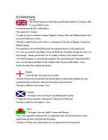
* everybody from the UK is called British * the capital city is London * is made up of four constituent countries: England, Scotland, Wales and Northern Ireland which in turn are divided into counties * the flag is called the Union Jack which is a combination of the flags of England, Scotland and Northern Ireland * the population is about 60,000,000 people, the population density is 242 people/sq km * its coasts are washed by the Atlantic Ocean, the North Sea, the English Channel, the Celtic Sea, Saint George's Channel, and the Irish Sea. It is linked to France by the Channel Tunnel * the United Kingdom is a constitutional monarchy. The current monarch is Queen Elizabeth II, who is also the Queen and Head of State of fifteen other Commonwealth Realms, such as Canada, Australia, New Zealand and Jamaica. England: * it has 50 cities, the capital city is London * despite of the density of population and the high degree of urbanisation, England has many
1. What are the capitals of the 4 constituent countries? England- London; Northen Ireland- Belfast; Scotland- Edinburgh; Wales- Cardiff 2. Order the invaders in correct chronological order: Anglo-Saxons, Normans, Romans, Celts. Romans Anglusaxons , Norman 3. How did the Celts influence Britain? Language. Wars. Engand and Scotland eventually became 1 contry 4. How many people approximately speak English? Approximately 600 million 5. Who (which tribes) gave the base of the English language?Germanic tribes- Anglo-Saxons. 6. Describe Wales.- Wales is a mountainous country on the western side of Great Britain. The national game of Wales is Rugby. Flag- Red dragon on a green and white field. They have their own language Cymraeg ( Welsh)
years ago, and the first villages around 6,000 years ago. The well-preserved village of Skara Brae on the Mainland of Orkney dates from this period. Neolithic habitation, burial and ritual sites are particularly common and well-preserved in the Northern Isles and Western Isles, where lack of trees led to most structures being built of local stone. Roman influence The written protohistory of Scotland began with the arrival of the Roman Empire in southern and central Great Britain, when the Romans occupied what is now England and Wales, administering it as a province called Britannia. Roman invasions and occupations of southern Scotland were a series of brief interludes. In 834 AD the general Gnaeus Julius Agricola defeated the Caledonians at the battle of Mons Graupius, and Roman forts were briefly set along the Gask Ridge close to the Highland line (none are known to have been constructed beyond that line)
If it does snow heavily in other parts of Britain, the country often comes to a standstill. Trains, buses and planes are late. Contrary to popular opinion, it doesn't rain all the time. There is certainly steady rainfall throughout most of the year, but the months from September to January are the wettest. Thanks to the rain Britain has a richly fertile countryside which is famous for its deep green colour. History The first inhabitants were Iberians and Celts who settled on the land and were often at war with eaeh other. In AD 43 the Roman Emperor Claudius invaded, and made Britain a Roman province. Julius Caesar had previously visited Britain to have a look around. The Romans stayed for three hundred years, and built villas, roads and towns. Many Roman remains can be visited in Britain today. Later, Christian missionaries ca me from other parts of the Roman Empire to bring Christianity to the people.
island very soon after the end of the last Ice Age, about 8,000 years ago. Nevertheless, it is home to hundreds of plant species, some of them unique to the island. Many different habitat types are found in Ireland, including farmland, open woodland, temperate forests, conifer plantations, peat bogs, and various coastal habitats. Fauna Only 31 mammal species are native to Ireland, again because it was isolated from Europe by rising sea levels after the Ice Age. Some species, such as the red fox, hedgehog, stoat, and badger are very common, whereas others, like the Irish hare, red deer and pine marten are less common and generally seen only in certain national parks and nature reserves around the island. Some introduced species have become thoroughly naturalised, e.g. rabbits and the brown rat. About 400 species of birds have been recorded in Ireland. Many of these species are migratory. There are
Scotland have all contributed to the continuation of Scottish culture and Scottish national identity since the Union. Although Scotland is no longer a separate sovereign state, the constitutional future of Scotland continues to give rise to debate. Hisory of Scotland ! The history of Scotland begins around 10,000 years ago, when humans first began to inhabit what is now Scotland after the end of the Devensian glaciation, the last ice age. Of the Stone Age, Bronze Age, and Iron Age civilization that existed in the territory, many artifacts remain, but few written records were left behind. The written history of Scotland largely begins with the arrival of the Roman Empire in Britain, when the Romans occupied what is now broadly England and Wales and the Scottish Lowlands, administering it as a Roman province called Britannia. To the north was territory not governed by the Romans -- Caledonia, by name. Its people were the Picts
e. constitution added to restrict the power of the monarch and divide obligations and power with the Parliament. Beginning of the century, literature, especially drama flourished. Emergence of puritanism – poetry becomes leading form. Puritanism – purification of religion, of all unnecessary rituals and decorations, in essence, all pleasure equals sin. Closed theatres and denounced all drama, dance, rural festivals, even country sports. Puritan poetry is logical and undecorated in style; it strives to render God’s word directly, undecorated by human wit
Newfoundland, New Zealand, South Africa were the British colonies that became dominions. They were given "responsible government" and became part of the Commonwealth. The Head of State was the British monarch. Nowadays, the word "dominion" is not used. 6. The British Commonwealth of Nations freely unites Britain and its former colonies. Ireland 1. The first inhabitants were hunters and fishers from the European mainland in 6000 BC. In 200 BC, the Celts arrived. 2. Christianity was established during the 5th century by Saint Patrick, who is also Ireland's patron saint. His feast day is on 17th of March, the day he died. 3. The English conquest of Ireland began in the 12th century by Henry II. 4. King James I settled English and Scottish Protestants in the province of Ulster. This has resulted in conflicts between the Irish Catholics and the "planted" Protestants. 5
Britain History Pre-Norman Britain The Iberians brought their metal-working skills and the first real civilization to Britain in the third millennium B.C and were overrun by various Celtic invasions that began in the 8th century. The Celts introduced their tribal organization and an early form of agriculture before they were forced westward by the Roman invasion. Forms of Celtic language are still spoken in Britain. Romans (with Julius Caesar in the head of them) first tried to occupy Britain in 55 B.C., but there was a rebellion in Gaul so they had to leave to fight against it. Next time they came in 43 A.D. and their leader was Emperor Claudius. Romans brought a lot with them. Their brought paved roads, the sites of important cities, the seeds of Christianity, the Roman law, Roman baths, language and advanced civilization
canyons, deserts, caves and river gorges. Nowadays, however, primitive rock art in the United States has become a new field of scientific study. Klaus F Wellmann wrote two books about rock art. He is a professor of medicine. Rock art represents the history of aboriginal Americans. In the most cases the art is an expression of ideas and way of life, ritual ceremonies, hunting, fighting. The pictures of people and animals are often strikingly lifelike and artistic. Many of these ancient relics have been destroyed by the ravages of nature and of man. Wind and water have worn away and continue to wear away, unprotected sites. And the paintings and carvings are increaslibly falling victim to vandalism: they have been painted over, spoilt with knives, even used for target practice. The American Rock Art Research Association protects rock-art sites. 2) THE FAVOURITE SPORT IN BRITAIN The most popular sport is probably football. Two kinds of football is played in Great Britain
Suppletion Present in languages of different families. Present in Old, Middle and Modern English, though the general tendency is towards more regularity/iconicity so the number of suppletive forms has decreased.In the text: goon to go wenden - to turn Gan was suppletive in Old English, past form: eode.Eode was supplanted by went (past form of wenden) at the end of the Middle English period.To wend has survived in Modern English in phrases such as to wend one's way, we wended homewards (ironic usage). Thus: suppletivity- suppletion different parts of one and the same paradigm come from what were originally different paradigms (different words with close meanings or words in different but close dialects).Suppletion embraces verbs, adjectives, nouns. Be was/were been (Old English beon/wesan) (am, art, is, are); in Old English some suppletive forms were used parallel to one another) Good better best Bad worse worst
It is one of the most famous prehistoric sites in the world and is composed of earthworks surrounding a circular setting of large standing stones. The surrounding circular, earth bank and ditch, have been dated to about 3100 BC. Stonehenge was produced by a culture with no written language. Many aspects of Stonehenge remain subject to debate. There is little or no direct evidence for the construction techniques used by the Stonehenge builders. *The Celts in Britain and their legacy The Cets lived in Britain in The Iron Age. They were warring tribes who were battleful amongst themselves as well as inter-tribal war. They were not centrally governed. The Celts brought iron working, iron ploughs and metal swords, horses, wheels and chariots - all these things gave them an instant superiority over the native tribes. The Celts built a number of hill forts throughout the region. The society was divided
23,000 – 24,000 items. Only about 3 % are of non- Germanic origin. Etymologically homogeneous. 65-85% of the Old English (OE) vocabulary has been lost 4. Latin borrowings From 43 AD to 410 AD Britain was a province of the Roman Empire. Celts in Britain when the Germanic tribes arrived were speakers of both Celtic and Latin. There may also have been contacts with the continent after the Germanic settlement of Britain. continental borrowings Latin (continental): cheap, pepper, street, mile, butter, cheese, wine, inch, ounce, pound, kitchen, plum, cup, dish, mint castrum ‘a Roman encampment or fortress’
While the city centre is a mélange of stunning architecture, from Gothic, Renaissance and baroque to neoclassical, art nouveau and cubist, beyond the medieval lanes of the Old Town and the Castle District, there's an entire other cosmopolitan city to explore. Search out the riverside parks, lively bars and beer gardens, music clubs, museums and art galleries. Harness Prague's excellent public-transport system to explore emerging suburbs such as Zizkov, Vinohrady, Smíchov and Holesovice. You'll be guaranteed cheaper prices, a more local ambience, and an assured escape from any more feelings of doubt.. Instead of summer practice i would like to go on trip to Prague. I think it would be more educational then sita t school and trantslate story or doing exercises. Because students can use language in their real life and they will get experiences. We can see beautiful
Nations, and a founding member of the Latin Union, the Organization of Ibero-American States, OECD, NATO, the Community of Portuguese Language Countries, the eurozone and the Schengen Agreement. II. Early History THE BEGINNING OF PORTUGAL The early history of Portugal is shared with the rest of the Iberian Peninsula. The name of Portugal derives from the Roman name Portus Cale. The region was settled by Pre-Celts and Celts, giving origin to peoples like the Gallaeci, Lusitanians, Celtici and Cynetes, visited by Phoenicians and Carthaginians, incorporated in the Roman Republic dominions as Lusitania and part of Gallaecia (both part of Hispania), after 45 BC until 298
Scotlan History The history of Scotland begins around 10,000 years ago, when humans first began to inhabit Scotland after the end of the Devensian glaciation, the last ice age. Of the Stone Age, Bronze Age, and Iron Age civilization that existed in the country, many artifacts remain, but few written records were left behind.People lived in Scotland for at least 8,500 years before recorded history dealt with Britain. The written history of Scotland largely begins with the arrival of the Roman Empire in Britain, when the Romans occupied what is now England and Wales, administering it as a Roman province called Britannia. To the north was territory not governed by the Romans -- Caledonia, by name
claims to the Falkland Islands and Spain to Gibraltar. History When the glaciers retreated from Britain about 10,000 years ago, Stone-Age men started to inhabit the isles. The early Britons came across the land bridge which joined Britain to the continent. They were cave-dwellers at first. This way of life was replaced by the invaders from the Mediterranean lands. These men were the first farmers. In about 500 BC came the people whose homeland was near the Rhine River. These were the Celts. The Roman invasion began in 43AD. The Romans were highly organized conquerors. They built good roads, baths and bridges. The Romans stayed in the British Isles up to the 5th century. The remarkable thing about the Romans is that, despite their long occupation of Britain, they left very little behind. Most of the villas and temples the impressive network of roads and the cities they founded, including Londinium,
Miina Härma Gümnaasium “The aborigines of Australia Student:Kärt Erikson Teacher:Tiia Timma Tartu 2010 contents Introduction – page 3 History – page 3-4 Religion – page 4-7 Society - page 7-9 The British – page 9-10 Conclusion – page 10-11 Resources – page 11 Appendix – page 11-14 2 Introduction I selected this theme because it was the most interesting one for me. Aborigines have interested me for a long time now so doing this essay is really fun for me.
Bloody Mary, Loch Ness, Scottish fought for their independence a lot, "Braveheart", Sean Connery, bagpipes, kilts, 12. Where are the British monarchs crowned? What else do you know about this building? They are all, since William the Conqueror, crowned in Westminster Abbey. They tribute British heroes there and also bury them. 13. Name all the invaders of Britain in the right order (starting with the first ones). Beaker Folk, the Celts, the Romans, the Anglo-Saxons + Jutes, the Vikings, the Normans 14. Write about 3 British sightseeing places (outside London) and mention why they are worth visiting. The Windsor Castle because that's one of the main locations for the Royal Family, Loch Ness because of the monster that's supposed to live there and 15. What do you know about the Highland Games? It's a Scottish tradition to celebrate both Scottish and Celtic inheritance with games
They had inter-tribal battles, mostly over territory and the losers became slaves or food. Regardless of that they are historically not to be considered as cannibals. There was only one tribe that were, other tribes just kept the heads of their defeated to secure their mana or enemy's power. The Maori had a complex social structure of tribes, sub-tribes and clans and a concrete society made up of nobility, priestly and slave classes. The Maori believed in deities and personifications, such as Tane-mahuta, the lord of the forest, Tawhirimatea and Tangaroa, the Polynesian ocean god. Their villages were fortified with an open space in the centre were the whare hui or the meeting house was located. Maori history has never been written down, instead it was preserved in songs and chants, some of which like war chant or haka and challenge or wero, are still used today. The first European explorers arrived to New Zealand in the mid 1600s but in general it is
The City of London History The City of London occupies one square mile in the middle of the capital. It once made up the entire town of London, surrounded by the wall first built by the Romans. The Roman Londinium grew up on the northern side of the "London Bridge" in the past. Products such as olive oil, wines and fruit were brought by ships from different parts of the Roman Empire and unloaded onto wooden quays along the river. In AD 61 the native Celtic Iceni tribe, led by Queen Boudicca, rose up against The Romans. They burnt Londinium to the ground but Roman armies eventually defeated Boudicca. The city was rebuilt and was gradually surrounded with a wall of stone and brick which lasted for many centuries. During the archeological excavations in 1954 the Roman Temple of Mithras was revealed. It was a pagan temple dedicated to the Persian Sun-god. The Temple was later reconstructed only a short way from its original site and the relics are
English is the dominant language What is the situation of the Irish language at present? Irish is compulsory in all those schools that receive public money. In 2007, Irish was recognized as an official language of the EU. Road signs are usually bilingual. According to the 2011 Census, 41% of the population claim to be able to speak Irish 77,000 people speak Irish daily outside the education system 9. What languages is the Irish language related to? Irish is a Celtic language. Other Celtic languages include Breton, Cornish, Manx, Scottish Gaelic and Welsh. In what alphabet were the earliest sources written? The Ogham alphabet was used tp write the Irish language in C4-C9. 10. Which is the most famous medieval manuscript? The Book of Kells from C9 11. Which famous writers are of Irish origin? W.B. Yeats George Bernard Shaw Samuel Beckett Seamus Heaney Oscar Wilde 12.The Irish people outside Ireland. Who of the US presidents come from Irish families? J.F. Kennedy
 annaabi.ee