Leidsid 33 sarnast õppematerjali, mis on seotud failiga "Assassination of Archduke Franz Ferdinand of Austria". Need materjalid aitavad sul teemat sügavamalt mõista.
serbia, hungary, assassin, bosnia, ferdinand, country, russia, empire, ally, germany, sarajevo, motorcade, sophie, wanted, south, opportunity, through, black, hand, wife, named, bomb, however, took, turn, same, later, attackance, graz, cousin, father, became, throne, uncle, current, emperor, hungarian, married, southern, portion, region, rule, border16. Britain in WW I Causes of WWI: Mutual defence alliances (if one country was attacked then allies would rush to help and it snowballed into a war between many countries) o The alliances at the time were: o Russia and Serbia o Germany and Austria-Hungary o France and Russia o Britain and France and Belgium o Japan and Britain Austria-Hungary declared war on Serbia, Russia got involved to defend Serbia. Germany seeing Russia mobilizing, declared war on Russia. France was then drawn in against Germany and Austria- Hungary. Germany attacked France through Belgium pulling Britain into war. Then Japan entered the war. Later, Italy and the United States would enter on the side of the allies. Imperialism: empires got bigger and with that the competition between the empires grew. Everyone wanted more areas for themselves.
betetr equipped. Romans faced assaults of Picts, Scots, barbarians. 406-7 barbarians begin invasion Legacy- new types of animals, plants; miles, feet, inches-roman measurements;christianity; Roman basilica in curches; reading, writing; buildings, roads Christianity in Roman Britain Until 4th C christians were persecuted 313 AD Emperor Constantine legalised christianity 380 AD Emperor Theodosius I made it the official religion of the empire Paganism had been eclipsed but continued to pose a political, religious challenge Boudicca Queen of Iceni people of Eastern England, led an uprising against Roman forces Prasutagus(ruler) was first allowed to rule when romans conquered England, after his death, romans decided to rule Iceni and flogged Boudicca and raped her daughters 60-62 AD Iceni rebelled, Boudicca´s warriors defeated Roman Ninth Legion, destroied capital-Colchester
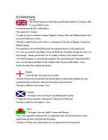
Ireland and many small islands. Great Britain consists of England, Scotland and Wales. The United Kingdom of Great Britain and Northern Ireland and the Republic of Ireland. 3) Estonia lies on the eastern shores of the Baltic Sea, south of Finland. The country's highest point is the Suur Munamägi (318 m) in the southeast. Estonia has many lakes. Most are very small the largest is Lake Peipsi. There are many rivers in the country. The largest are the Võhandu (162 km) and Pärnu (144 km). Estonia also has numerous bogs and coastline marked by numerous bays, straits, and inlets. Two largest islands are large enough to constitute their own counties: Saaremaa and Hiiumaa. England is north from France, surrounded by the Atlantic Ocean from the west and North Sea from the east. The highest peak in Great Britain is Ben Nevis (1343 m). The largest river in Great Britain is the Severn.
Also, many words in English and Welsh have been borrowed from the Latin language. An important legacy of the Romans was its roads, agriculture and cities. In the Roman times the land was dominated by rules and reguations. *Christianity in Roman Britain The Roman authorities were suspicious of Christianity because followers of Jesus Christ refused to take an oath of loyalty to the Roman emperor. For this reason the early Christians were regarded as dangerous enemies of the Empire. That ceased when the emperor Constantine converted to Christianity. Christianity became the official state religion of the Roman Empire in the early fourth century A.D. As the century progressed Christianity spread very quickly. Despite official recognition there was no mass conversion to Christianity; worship of the pagan gods and goddesses was not even formally banned until late in the fourth century. *Boadicea/Boudica At his death bed, Boudica's husband left half his possession to the
to blow up king James I and the Parliament. They failed at their attempt and that day is nowadays called Guy Fawkes Night. The Stuarts king James I and Charles I followed the medieval notion of monarchy, ignoring parliament. James I united England and Scotland. Charles I raised taxes without its permission and prevented it from meeting for 11 years. The conflict between the Parliament and the kings over power increased and led the country into the Civil War (1642-1651) between Charles I and Parliamentarians led by Oliver Cromwell. Oliver Cromwell led the Parliamentarian Roundheads to victory, Charles I was executed and Cromwell rook up rule of the country, which became a republic, called the Commonwealth. He was its Lord Protector until his death in 1660. After Cromwell's death, the Stuarts returned to the throne, Charles I's son was crowned Charles II
Years 1154-1485 Henry I was the first unquestioned ruler. One of the most important kings in the Middle Ages. He had lands in Britain & France. Then the government was the monarch, a person, not a place. He had more land than any pervious king. After his marriage to Eleanor of Aquitaine, he also ruled the lands south of Anjou. His empire stretched from the Scottish border to the Pyrenees. England provided most of its wealth, but the heart was Anjou. Henry II began to regain royal control. During the war some barons had become very powerful. He pulled down some of their castles. He tried to restore law & order. He wanted the same kind of justice to be used everywhere. He appointed his own judges to travel around the country. They dealt with crimes & disagreements over poverty. Serious offences were tried in the king's court
Kennedy escaped capture in the Pacific because the Japanese failed to solve a simple cipher. • How codebreaking determined a presidential election, convicted an underworld syndicate head, won the battle of Midway, led to cruel Allied defeats in North Africa, and broke up a vast Nazi spy ring. • How one American became the world's most famous codebreaker, and another became the world's greatest. • How codes and codebreakers operate today within the secret agencies of the U.S. and Russia. • And incredibly much more. "For many evenings of gripping reading, no better choice can be made than this book." —Christian Science Monitor THE Codebreakers The Story of Secret Writing By DAVID KAHN (abridged by the author)
2) History Prehistoric Britain, Roman Britain, Anglo-Saxon, Danish, Norman invasions (...-1066): Britain was part of the European land mass until the end of the last Ice Age. It became an island by about 6000 BC. From about 3000 to 2000 BC the British Isles were inhabited by a group of people called the Iberians. These Stone Age people lived in limestone caves, they used stone axes and fashioned antlers and bones into leather-working tools. Later groups of people from what are now Germany, the Netherlands and Brittany also settled in Briton. During the Bronze Age, they mined tin, gold and copper and made bronze tools. They also probably built the spectacular prehistoric megaliths, such as Stonehenge on Salisbury Plain. The Celts invaded the British Isles in the 5th century BC in two waves. The Britons grew wheat and corn, caught fish, and tamed and bred animals. They made coarse cloth for their clothes,
Stovzatá Praha ("City of a Hundred Spires") in Czech or Zlaté msto/Goldene Stadt ("Golden City") in Czech/German. Situated on the Vltava River in central Bohemia, Prague has been the political, cultural and economic centre of the Czech state for more than 1100 years. For many decades during the Gothic and Renaissance eras, Prague was the permanent seat of two Holy Roman Emperors and thus was also the capital of the Holy Roman Empire. 4 Today, the city proper is home to about 1.3 million people, while its metropolitan area is estimated to have a population of over 1.9 million. Since 1992, the extensive historic centre of Prague has been included in the UNESCO list of World Heritage Sites, making the city one of the most popular tourist destinations in Europe, receiving more than 4
century, and the Department of Russian Folklore. The core curriculum includes courses in the history of Russian literature (from Kievan Rus times to the present) and folklore, modern Russian , Old Slavonic, the history of the Russian language and Russian dialectology, etc. The Department of Russian Literature of XX century in Russian literature explore (from 1890s to the present), including works of Russian emigrants abroad and nonRussian writers in Russia proper. Curriculum at the Division of Russian as a Foreign Language is similar to the one of the Division of the Russian Language and Literature, with additional stress laid on foreign languages, the theory and methods of teaching Russian as a foreign language, and area studies. Division of Theoretical and Applied Linguistics aims at giving students profound knowledge in the field of linguistic theory. The core courses include mathematics (mathematical
British history Roman Britain Roman Britain was those parts of the island of Great Britain controlled by the Roman Empire between 43 and about 410. The Romans referred to their province as Britannia. Prior to the Roman invasion, Iron Age Britain already had cultural and economic links with Continental Europe, but the invaders introduced new developments in agriculture, urbanization, industry and architecture, leaving a legacy that is still apparent today. Historical records beyond the initial invasion are sparse, although many Roman historians mention the province in passing
Thomas Jefferson, a Virgin, and Benjamin Franklin were two singers of the Declaration of Independence. Franklin had gone to Boston carrying all his clothes in his pocket and a loaf of bread under each arm. He invented electricity by rubbing cats backwards and declared "a horse divided against itself cannot stand." Franklin died in 1790 and is still dead. George Washington married Matha Curtis and in due time became the Father of Our Country. Them the Constitution of the United States was adopted to secure domestic hostility. Under the Constitution the people enjoyed the right to keep bare arms. Abraham Lincoln became America's greatest Precedent. Lincoln's mother died in infancy, and he was born in a log cabin which he built with his own hands. When Lincoln was President, he wore only a tall silk hat. He said, "In onion there is strength." Abraham Lincoln write the Gettysburg address while traveling from Washington to
This was the time of the crystallization and the culmination of serfdom, when various socio- political and cultural undercurrents were also active, preparing the ground for the industrial society and the national-democratic movement in the second half of the 19th century. The 1710 of the corporations of knights and towns, until Alexander II (18551881), established the relationships between Estonia, Livonia and the Russian Empire. The Baltic Landesstaat reached its full development. The freedom of action in the new provinces was naturally granted to one of the most firm ideological pillars of the tsarist empire -- the Russian orthodox church; though as the Landeskirche in the Estonian and Livonian territories, the Lutheran church long maintained a de facto predominance. The most important organ of Baltic German local government was the Diet, consisting of all
opinion of AIDS sufferers during the subsequent years, as her involvement with a variety of AIDS charities, not only in the United Kingdom but in North America, Africa and Asia as well, was a consistent public role she embraced. Diana talking with poor people Relationship with Prince Charles Prince Charles had known Diana for several years, but he first took a serious interest in her during the summer of 1980, when they were guests at a country weekend. The relationship developed as he invited her for a sailing weekend to Cowes. The prince proposed on 6 February 1981, and Diana accepted, but their engagement was kept secret for the next few weeks. Their engagement became official on the 24th February, 1981, after Diana selected a large £30,000 ring consisting of 14 diamonds surrounding a sapphire, similar to her mother's engagement ring. The 20-year-old became The Princess of Wales when she married Charles on
Starvation, diseases, lack of water, attacks of natives , fierce weather Tobacco plantations African slaves, working in tobacco harvest 1620 by Dutch boat. Also Englishmen (convicts and poor people) Mayflower and Pilgrim Fathers Mayflower- cargo ship In 1620 one hundred Puritans boarded the Mayflower From Plymouth, England, to today's Plymouth, Massachusetts, United States Claim they are the forefathers of USA aristocracy- FALSE They saw little chance of England becoming a proper country Wished to live free of English laws and oppressing church religious freedom In may (had time before winter!!!) · Mayflower Compact First governing document of Plymouth Colony Agreement composed by a consensus among new Settlers Composed for the sake of their own survival Fair and equal laws, for the general good Signed by 41 adult male members on the Mayflower Free of English law foundation of the USA constitution · Puritan Colony in Plymouth, New England
Economic Country Review: Finland, Estonia and Hungary Girli Vasiljev Report Business Economics, RB1X 06.05.2012 Abstract 06.05.2012 Experience and Wellness management Author Group Girli Vasiljev RB1X Title of report Number of pages Economic Country Review: Finland, Estonia 20 and Hungary Teacher Kalevi Torunen The goal of this paper is to compare the economic performance of Finland, Estonia and Hungary. First, a general overview on the countries will be given. After, economic indicators (real GDP growth rate, inflation, unemployment, household consumption, investment, current account, government budget and deficit) of the three countries will be compared to draw a conclusion. Keywords
The Membership of World Organisations Merilin Tamme Xa Tallinna Järveotsa Gymnasium 2008 The schedule · 04.04.1949 establishment of NATO. · 1951 Supreme Headquarters Allied Power Europe (SHAPE) was created near Paris in France. Later, SHAPE was relocated to Mons in Belgium. · 1952 Greece and Turkey join NATO. · 1955 Western Germany joins NATO. · 1982 Spain joins NATO. · 1991 Rome summit. Estonia is one of the founding members of the NACC. · January 1994 Brussels summit. Estonia joins PFP on 3 February. · March 1995 Estonia submits the first Individual Partnership for Peace (IPP) to NATO. It contains priority areas of cooperation with NATO and future cooperation events, altogether in 23 subject fields. · March 1997 beginning of involvement of Estonia in peacekeeping mission
SU, no Ger records, system fundamentally diff. Still probs w #s. 2/3 killing in camps, ghettos. 2 mill SU Js. Slave labor complex not known until recently, extensive throughout Europe. Not a straightforward subject, several subjects intertwined, SU Holocaust. Js dying en masse certainly at top. Context of total national mobilization for defeat of fascism. Unthinkable human suffering. Tens of mill SU citizens died, many more suffered. Yet regime would never admit, defeat of Germany meant taking up cause of Js. Rise in popular anti- Semitism, as Red Army losing battle, turns around 42-43. Decrease in anti- antisemitism. Dramatic shifts in J demography, not just deaths; color map, location of Js will change, no longer in Eur Russia. What is written about first year or two of war? Why so hard to find info about what happened? Friendship of nations, collaboration? Wanted to demonize nationalist movements, wrote about this. Utter chaos, almost no SU records, infrastructure in
of Travel.[4] In early 1889, The Pioneer relieved Kipling of his charge over a dispute. For his part, Kipling had been increasingly thinking about the future. He sold the rights to his six volumes of stories for £200 and a small royalty, and the Plain Tales for £50; in addition, from The Pioneer, he received six-months' salary in lieu of notice. He decided to use this money to make his way to London, the centre of the literary universe in the British Empire. On 9 March 1889, Kipling left India, travelling first to San Francisco via Rangoon, Singapore, Hong Kong and Japan. He then travelled through the United States writing articles for The Pioneer that too were collected in From Sea to Sea and Other Sketches, Letters of Travel. Starting his American travels in San Francisco, Kipling journeyed north to Portland, Oregon; on to Seattle, Washington; up into Canada, to Victoria and Vancouver, British Columbia; back into the U.S. to
пособия. Пособие предназначено для студентов гуманитарных специальностей. Подготовлено на факультете лингвистики. The book contains an overview of the most important events in British history – from the first documented invasions of the island to the formation and fall of the British colonial empire. A series of exercises will help to remember the subject matter, practise the vocabulary and contribute to skills work. The book is intended for the Humanities students. Вавилов Н.А., 2008 3 4 Contents 5 ПРЕДИСЛОВИЕ Настоящее пособие содержит краткий очерк истории Великобритании от
Fuqua appointed Garrity as the film's military technical advisor. Plot: Bob Lee Swagger (Mark Wahlberg), a retired USMC Force Recon Gunnery Sergeant and Scout Sniper, is one of the few snipers in the world whose marksmanship abilities allow him to take out a target from a mile away. He reluctantly leaves from his isolated mountain home in the Wind River Range at the request of Colonel Isaac Johnson (Danny Glover). Johnson appeals to Swagger's expertise and patriotism to help track down an assassin who plans on shooting the president from a great distance with a high powered rifle. Johnson gives him a list of three cities where the President is scheduled to visit so Swagger can determine if an attempt could be made at any of them. Swagger assesses each of the locations and determines that a site in Philadelphia would be most conducive to a long range assassination attempt. He passes this information to Johnson, who purportedly arranges for a response
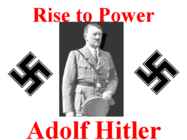
Rise to Power Adolf Hitler Objectives: • The objective of this presentation is to give students an understanding of Adolf Hitler’s early, pre-adult years. • Students will also become familiar with how this seemingly unimportant Austrian rose to power in post World War I Germany. Overall Purpose: The overall purpose of this presentation is to explain how this little boy on the left became the man on the right who was ultimately responsible for the death of about 50 million people all over the world!! Birth • Adolf Hitler was born on April 20, 1889 in Braunau, Austria. • Adolf was 1 of 6 children - 3 of who died at early ages Parents Alois Schickelgruber Hitler was a customs official
them what happened. On the way, Oliver spotted the house that Sikes had taken him to the night of the robbery, and they stopped so that Dr. Losberne could question the owner. This questioning proved inconclusive. When they arrived at the Brownlow residence however, they found that Mr. Brownlow, Mrs. Bedwin, and Mr. Grimwig had all moved to the West Indies. Oliver, saddened by the news, went back to stay with Mrs. Maylie. Soon the whole family moved out to the cottage in the country and Oliver was extremely happy there. He learned all he could from the village vicar, and would take daily walks with Mrs. Maylie and Rose whom he adored. Chapter 33: One evening as they were taking a particularly long walk, Rose sat down to play the piano as usual. That night however, she began crying during her playing, and Mrs. Maylie and Oliver were very distressed. Rose ended up falling very ill, and they feared she was going to die. Mrs. Maylie gave
Color-- -1- -2- -3- -4- -5- -6- -7- -8- -9- Text Size-- 10-- 11-- 12-- 13-- 14-- 15-- 16-- 17-- 18-- 19-- 20-- 21-- 22-- 23-- 24 TWILIGHT By Stephenie Meyer Contents PREFACE 1. FIRST SIGHT 2. OPEN BOOK 3. PHENOMENON 4. INVITATIONS 5. BLOOD TYPE 6. SCARY STORIES 7. NIGHTMARE 8. PORT ANGELES 9. THEORY 10. INTERROGATIONS 11. COMPLICATIONS 12. BALANCING 13. CONFESSIONS 14. MIND OVER MATTER 15. THE CULLENS 16. CARLISLE 17. THE GAME 18. THE HUNT 19. GOODBYES 20. IMPATIENCE 21. PHONE CALL 22. HIDE-AND-SEEK 23. THE ANGEL 24. AN IMPASSE EPILOGUE: AN OCCASION twilight STEPHENIE MEYER LITTLE, BROWN AND COMPANY New York Boston Text copyright © 2005 by Stephenie Meyer All rights reserved. Little, Brown and Company Time Warner Book Group 1271 Avenue of the Americas, New York, NY 10020 Visit our Web site at www.lb-teens.com First Edition: September 2005 The characters and events portrayed in this book are fictitious. Any similarity to real persons, living or dead, is coincidental and not intende
Robert often suffered from illness because of the hard work and little food. At the age of 15 he began to write. After his father death the poet had to support his large family. Unfortunately Robert burns was not successful farmer. His farming was a failure and he thought of leaving for Jamaica. In 1786 a few friends helped Robert to publish his first volume of poems to raise the money for the voyage. The volume was a great success. At once the poet become famous and burns didn't leave the country but went to Edinburgh instead. He also toured Scotland and northern England collecting ballads and folktales. For the last 6 years of his life he served as a tax collector. Burns died on the 21st of July, 1796. When he was only 37 years old. His poems touch the heart of every reader. Burns wrote about feelings of ordinary people. Burns used in his works the songs and stories he had heard in his little cottage home. Now Robert burns is considered the national poet of Scotland
I. Portugal ABOUT Photo Location of Portugal (dark green) Portugal (Portuguese: Portugal, IPA: [putua]; officially the Portuguese Republic, Portuguese: República Portuguesa) is a country located in Southwestern Europe, on the Iberian Peninsula. It is the westernmost country of mainland Europe, and is bordered by the Atlantic Ocean to the west and south and by Spain to the north and east. The Atlantic archipelagos of the Azores and Madeira are Portuguese territory as well. The country is named after its second largest city, Porto, whose Latin name was Portus Cale. SETTLEMENT
Introduction The aim of this research is to get know more about the Netherlands history and its geographical facts. This report is describing one of most the most beautiful countries in the Europe - Netherlands. Netherlands is famous for its windmills and flowers. Netherlands is also known unofficially as Holland. Government is constitutional monarchy of north-western Europe. Netherlands is bordered on the north and west by the North Sea, on the east by Germany and on the south by Belgium. The European portion of the Netherlands has a total area of 41,528 sq km of which 33,939 sq km is land surface. Country's capital and largest city is Amsterdam. Population is about 16 million. 3 Chapter 1 The Netherlands 1.1 Mainly about the Netherlands Netherlands is also known unofficially as Holland. Netherlands is bordered on the north and
RUNNING HEAD: RUSSIA Russia Throughout the History U.S Government Table of Contents 1. Introduction 2. History of Russia 3. Russia nowadays 4. Important people in Russia throughout the history 5. Conclusion 6. References Introduction- Russia Throughout the History Russia is a one of the biggest countries is the world. The first clues about Russian history are from as early as the 9th century. Russia has suffered through rough times in war, mad leaders and tough life amongst the locals. Over times the country has had several different names and political systems. They have been an empire ruled by a czar, a communist nation, and a democratic federation. Nowadays the country's official name is the Russian Federation ("Basic facts about,").
The kind of Middle English spoken in lowland Scotland had developed into a written language known as Scots Scottish Protesntant church adopted English Bibles. English became the written standard in Scotland as well The link between religion and politics became intense Charles I was executed Stuart monarcgs raised money without getting the agreement fromm the House of Commons first and that grew anger in the country. Parliament established its supermacy over the monarchy The ideological Protestantism had grown in England. They regarded the luxorious lifestyle of the KInga and his followers as immoral The civil war, which ended with complete victory for the parliamentary forces The Glorious Revolution-because it was bloodless, in which Prince William of Orange, ruler of the Netherlands, and his Stuart wife Mary accepted the Parliaments
Men are carried away by war propaganda, women are shown to be wised and appreciate life more than political parties. Men think on taking sides but women value life more. Jordan is an idealist. He is willing to give his life for this cause. But Maria's first loyalty is to her lover, jordan. She places love above war, politics. Pablo is another type, he is a moral coward, he is a defeatist, who wants to avoid personal danger and wants to save his life, he is mean and betrays his country men. Pilar, Pablo's woman, strong, courageous, patriot, never the less understands the importance of individual human happiness. Human independence and solitarity. Jordan dies, he is left to die. Maria problably is pregnant. Towards the end of his life Heingay wrote short stories. 1952 novella ,,The old man and the sea". The protagonist is an old cuban fisherman. Cuba was that time almost the colony of usa. Santiago is an old fisherman who isn't able to catch anything for several days
Tallinn English College English Sergo Vainumäe 9A TALLINN Report Supervisor: Inge Välja Tallinn 2006 Order of contents: 1.Introduction 2.Toompea 3.Lower Town 4.Kadriorg and Pirita 5.Museums 1. Introduction Tallinn, the capital of Estonia, lies on the Baltic Sea. It is on almost the same latitude east St. Petersburg in Russia, Stockholm in Sweden and Stavanger in Norway, and covers 158 sq km. Tallinn was first marked on a map of the world by the Arab geographer al-Idrisi in 1154, its name then being Kolyvan (probably derived from the name Kalev). In the 13th-century Chronicle of Henricus de Lettis the town was called Lyndanise. Later came Reval (presumably after the old county of Rävala), the name used by the Germans who ruled the country for seven centuries. Russians then modified Reval to Revel
palace where the sons of the nobles learned to read & write. Books on religion, history & philposophy were translated into Anglo-Saxon. Many Latin words came into Anglo-Saxon. Alfred ordered the literate men to help and establish a system of law. He ordered that the old customs & laws should be collected, new laws were added, so a Code of English Law was drawn up. He also ordered the learned men to collect all that was known of the early history of the country & to keep a record of the outstanding events. Thus the Anglo-Saxon Chronicle, which continued for 250 years after Alfred's death, was written. Power went into the hands of those who could read & write. In the 2nd half of the 10th cent. under the rule of Alfred's descendants, the Saxon monarchy was further consolidated. Alfred's son Edward, the Elder, and his sister defeated the Northumbrian Vikings. Edward took control of the Danelaw and ruled over the whole of England
More praise for Influence: Science and Practice! "We've known for years that people buy based on emotions and justify their buying decision based on logic. Dr. Cialdini was able, in a lucid and cogent manner, to tell us why this happens." --MARK BLACKBURN, Sr. Vice President, Director of Insurance Operations, State Auto Insurance Companies "Dr. Cialdini's ability to relate his material directly to the specifics of what we do with our customers and how we do it, enabled us to make significant changes. His work has enabled us to gain significant competitive differentiation and advantage" -LAURENCE HOF, Vice President, Relationship Consulting, Advanta Corporation "This will help executives make better decisions and use their influence wisely ... Robert Cialdini has had a greater impact on my thinking on this topic than any other scientist." -CHARLES T. MUNGER, Vice Chairman, Berkshire Hathaway, Inc.
 annaabi.ee