Leidsid 33 sarnast õppematerjali, mis on seotud failiga ""Õigus" teemalised Inglise keelsed õigusterminid". Need materjalid aitavad sul teemat sügavamalt mõista.
court, judge, criminal, person, offence, legal, case, decision, crime, party, courts, someone, action, other, degree, hear, evidence, official, association, member, exam, them, than, trial, something, between, serious, notary, first, process, child, formal, appeal, count, crimes, term, provide, cases, citizen, oral, euros, power, matter, workPrescriptive law – prescribe how people ought to behave Descriptive law – describes the way people or natural phenomena behave Break the law – do something illegal Penalty – punishment Government – system by which a state or community is controlled Law – the system of rules System of courts – all judicial institutions Enforce – to make people obey the law Authority – a group of people with official responsibility for a particular area of activity /the moral or legal right or ability to control Prescribe – to tell someone what they must have or do, or to make a rule of something Impose The word law can have several meanings, it can be divided into prescriptive and descriptive law. Descriptive law – describes the way people or natural phenomena behave, e. g. law of gravity Prescriptive law – prescribe how people ought to behave e.g. speed limits In all societies relations between people are regulated by prescriptive law; customs (informal
descriptive law (kirjeldav õigus) - laws which simply describe how people or even natural phenomenas usually behave nation (riik) - country with its own goverment citizen (kodanik) - person native of a country; realationship between country and a person stranger (välismaalne) - person who is unfamiliar, from another country penalty (karistus) - punishment fixed by law, as for a crime or from any soical groups goverment (valitsus) - organization which controlls a stre or community System of Courts (kohtusüsteem) - organization applying law in the name of states to commit a crime (kuritegu läbi viima) - breaking a law, usually given out by the goverment fine (trahv) - certain sum of money person pays for breaking a law corruption (korruptsioon) - dishonest or unethincal conduct by a person entrusted with a position of authority
11.02.09 INGLISE KEEL Palju aega läheb. 10 nädalat aint. One of the ESP courses. What we are going to do, what is needed: · What we do - 1 test, on words. · 2 Essays, that means that we have to look into academic writing · Homereading we read a case from European Court of Justice thingy. · Oral thing. · 90% you have to attend · Have to prepare for class and take part of it etc What we learn: Terms Expressions / collocations (nt obey/abide by the law) Explaining AWOL absence without a leave Legal English can be divided into 3 levels. We learn the first one, which is needed for the other two! You have to know the vocabulary etc. Second level has to do with legal contracts..
9. seadust järgima obey law, observe law 10. seaduskuulekad inimesed law-abiding people 11. seadust jõustama enforce law 12. alaealised minors 13. õiguskaitseorganid law enforcement agencies 14. süütegusid uurima investigate offences 15. karistust määrama impose punishment on 16. kuritegu sooritama commit crime 17. seaduse mittetundmine ignorance of law 18. süüd välistav asjaolu defence, preclusion of guilt 19. üldriiklikud seadused national laws 20. kohalikud seadused local laws, by-laws 21. asutuse põhikiri statute 22. ajutine ametist/spordist kõrvaldamine (n,v) suspension, suspend 23. väljaheitmine (n,v) expulsion, expel 24
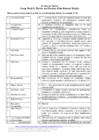
Essential Vocabulary - I The role of law in society 1. juriidilised kohustused – legal obligations 2. kannatanud pool, kahjukannataja – injured party 3. vaidlusi lahendama (kohtus) – to settle a dispute in a court of law 4. riskeerima tehingute tegemisega – to risk making transactions 5. õigusnõustamist otsima – to seek legal advice 6. tagama, et leping kehtiks – to ensure that the contract would be valid 7. õiguslikke vahendeid kasutama – to use legal means 8. harjuma õiguslikke vahendeid kasutama – to get accustomed to using legal means 9. omama teadmisi millestki – to have knowledge of smth 10. ette kirjutama, ettekirjutus, ettekirjutav – to prescribe, prescription, prescriptional 11. karistust kandma – to serve punishment (ka to suffer a penalty) 12
Humanitarian doctrine if a certain country violates human rights very severely and if other attempts have failed to prevent and stop this, then war can be used as a method to stop this stuff. Süüria chemical weapons doctrine is one of the strongest doctrine ever, respected by almost everyone, that's why people are so shocked about the events there. It's a grave violation of PIL. If there's enough evidence that chemical weapons were used, then war is basically a legal method, but not fully, because it isn't one of the reasons that allows war as a method to resolve conflict. Differences: Public International Law Private International Law = conflict of laws Subjects States, intergovernmental Regulates relations between
1.Common law A common law legal system is a system of law characterized by case law which is law developed by judges through decisions of courts and similar tribunals a common law system is based on legal precedents. The roots of the common law legal systems can be traced back to the first common law system created in England during the Middle Ages. Today, most countries that once had ties to England, including the United States, Australia, New Zealand, and Hong Kong, to name a few, operate under common law. Aside from Great Britain, the majority of the countries in Europe operate under a version of civil law modeled after the Roman legal system created centuries ago
as well as the displaced, throughout sustaining their survival throughout the humanitarian aid program that the organization is conducting. SAA is part of the Coalition for a Democratic Syria, a coalition of Syrian American organizations which includes six organizations which are United for a Free Syria, Syrian Expatriates Organization, the Syrian Emergency Task Force, Christian Syrians for Democracy and Association of free Syrians. 4. Judicial system and its functionality The Syrian legal system is based partly on French law and partly on Syrian statutes. Investigating magistrates determine whether a case should be sent to trial. Minor infringements are handled by peace courts, more serious cases go to courts of first instance. There are civil and criminal appeals courts, the highest being the Court of Cassation. Separate state security courts have jurisdiction over activities affecting the security of the government. In addition, Shari'ah courts apply
Estonian Court System Estonia has a three-level court system. Estonian court system consists of four country courts, two administrative courts, three circuit courts and supreme court. Country courts and administrative courts are the courts of first instance, circuit courts are courts of appeal and the supreme court, situated in Tartu, is the court of the highest instance The Supreme Court is also the constitutional review court. In the structure of four country courts(Harju, Pärnu, Tartu and Viru) operate courthouses in every country seat(in Ida- Virumaa and Harjumaa there are three courthouses)In the structure of two administrative courts(in Tallinn and Tartu) there are four courthouses: in Tallinn, Tartu, Jõhvi and Pärnu. Three circuit courts are situated in Tallinn, Tartu and Jõhvi. The supreme court The Supreme Court is the court of the highest instance, which shall review
EU Internal Market Law Mid-term online evaluation assignment for Distance Learning Students The Assignment: Hypothetical Case In the Member State A several NGOs, uniting parents concerned with safety of children and young adults, ordered a study of dog attacks on people (and especially children) resulting in deaths or maiming. The aim of the study was to identify, if possible, the dog breeds of potentially enhanced danger for people. The study’s results showed that pit bulls and their close mixes as well as Rottweilers and their close mixes were jointly responsible for over 70% of attacks
The European Union (EU) is an economic and political union.EU policies aim to ensure the free movement of people, goods, services, and capital, enact legislation in justice and home affairs, and maintain common policies on trade, agriculture, fisheries, and regional development. Within the Schengen Area, passport controls have been abolished.The monetary union was established in 1999 and came into full force in 2002. It is currently composed of 18 member states that use the euro as their legal tender. At the moment there are 28 member states in the EU. To become a member, a country must meet the Copenhagen criteria. These require a stable democracy that respects human rights and the rule of law; a functioning marketeconomy; and the acceptance of the obligations of membership, including EU law. No member state has ever left the Union. After 1952, there have been 7 enlargements: 1973, 1981, 1986, 1995, 2004 (including Estonia), 2007, 2013.
advokaatide juhedaja - instructing solicitors for prosecution and defence alaealiste kohus - Juvenile court armuandmine - Mercy edasikaebamine - Appeal haldusõigus - Administrative law/ public law juriidilisele kaitsele - Judicial protection kaitse - Defence kaitsja - Councel for the defence kannatav pool - Injured party karistama - Punish karistust andma/täide viima - Meting out punishment karm karistus a harsh sentence kautsjon - Bail kirjalik laim - Libel kirjutatud seadus/parlamendi aktidel põhinev seadus - Statute law/statutory law kohtu asja võitma win a case kohtuametnik - Court officer kohtuistung - Trila kohtulikule arutamisele minema go on treial kohtunik - Judge kohtuotsus - Verdict kohtuotsust määrama - Passes sentences kohtus tunnistust andma appear in court as a witness
1. system of pandects pandektiline süsteem 2. general provisions üldosa 3. law of property asjaõigus 4. family law perekonnaõigus 5. law of sucession pärimisõigus 6. law of obligations võlaõigus 7. General Part of the Civil Code Act TsÜS 8. Law of Property Act AÕS 9. Family Law Act perekonnaseadus 10. Law of Succession Act PäRS 11. Law of Obligations Act VÕS 12. persons and transactions isikud ja tehingud 13. natural persons 14. legal persons 15. passive legal capacity õigusvõime 16. active legal capacity (an ability to independently asume civil rights and incur civil obligations) teovõime 17. live birth elussünd 18. bequeath property pärandama 19. mental state vaimne seisund 20. restricted active legal capacity piiratud teovõime 21. mental illness vaimehaigus 22. mental disability nõdrameelsus 23. mental disorder psüühiline häire (sickness of the mind) 24
eelkõige reguleeritud ... abil/kaudu/alusel 6. the Constitution of the Republic of Estonia EV PS 7. the Citizenship act kodakondusseadus 8. according to § 8 - § 8 alusel/järgi 9. right to õigus millelegi 10. shall be acquired by birth omandatakse sünniga 11. proceeds from the principle tuleneb ... printsiibist 12. any child found in Estonia iga Eestist leitud laps 13. at the request of the child's legal guardian lapse seadusliku esindaja/hooldaja nõudel/palvel 14. guardianship agency eestkosteasutus 15. to acquire (apply for?) Estonian citizenship taotlema Eesti kodakondsust 16. unless kui just 17. to receive saama/omandama 18. to receive Estonian cs. through naturalisation naturalisatsioon/(i) alusel kodakondsuse saamine 19. provides conditions näeb ette tingimused 20. an alien välismaalane
1. Can the PB&R company successfully claim any violation of the EU law related rights? Examination 1. Can we say that an animal (a dog) is a good? – Yes. According to Article 13 TFEU dogs do belong to a “goods” category so as it is described in CJEU case law that a good is a product which can be valued in money and which is capable of forming the subject of commercial transactions. Therefore PB&R company and its business is selling dogs, or shall I say goods not just on a local fields, but the movement of goods is linked to abroad EU countries by making a profit of it I shall conclude that it involves a “movement of goods within the EU Member States” (Articles 26 and 37). 2
Crime and the Law Task 1. Underline the most suitable word or phrase. a) Sally didn't realise that she had broken/countered/denied the law. b) The police have banned/cancelled/refused parking in this street. c) I must remember to get a/an agreement/licence/permission for my television. d) The president admitted that there had been a breakdown of law and crime/government/order. e) Jim's parents wouldn't agree/allow/let him go to the demonstration.
Report Estate Planning Basics By Attorney Denis Clifford Complied by: Tartu 2010 This book explains, what most people need to know about estate planning. It will give the legal knowledge, what you need to know preparing your estate plan. ,,Estate Planning" essentially means two things. First, it means deciding who gets your property after you die and choosing the wisest legal transfer methods for leaving your property to those you want to receive it. Second, it means makeing some important personal decisions, such as who will provide care for your young children, if you have any, if anything happens to you and the children´s other parent, and who should make medical and financial decisions for you if you someday become incapacitiated and unable to handle things yourself. A First Look at Estate Planning Who needs to bother with estate planning
mentioned topics. Companies and individuals operating in Georgia or planning to operate, are strongly advised to obtain current and detailed information from experienced professionals. None of the organizations mentioned above, nor their members, employees or agents accept liability for the consequences of you and anyone else acting or refraining to act on the information contained in this brochure or for any decision based on it. The brochure is published with support of the German Development Cooperation Deutsche Gesellschaft für Internationale Zusammenarbeit GmbH (GIZ). Findings, conclusions and comments made in the publication do not necessarily reflect the opinion of GIZ. This publication may not be reproduced in whole or in part without the written permission of the copyright holder. © Deutsche Gesellschaft für Internationale Zusmmenarbeit GmbH (GIZ), 2011. 2
(Verplaetse, 2008). Since 9/11 and the following fight against terrorism it became clear that the Bush administration thought of torture as something justifiable while it goes against all possible agreed upon treaties and conventions. One could indeed possibly think of situations that could serve as an exception to the prohibition of torture but these hypothetical situations can hardly relate to real situations. The ticking bomb argument looks at the hypothetical case where a leader of a state is asked to give their permission to torture a captured rebel leader because he (probably) knows the locations of a few explosives that are spread around the city in different apartment buildings. In case they are not found within 24 hours, they will explode and many will be left dead (Walzer, 1973). Is it justified to torture this person to find out where the bomb is? This essay will look in to how it has according to the thinkers in the strand of
/ wicce f.) is a practitioner of witchcraft. Historically, it was widely believed that witchcraft involved the use of these powers to inflict harm upon members of a community or their property, and that all witches were in league with the devil. Since the mid 20th century, the term witchcraft has sometimes been used to distinguish between bad witchcraft and good witchcraft, with the latter often involving healing. Human misfortune was often blamed on a supernatural entity or a known person in the community. Reasons for accusations of witchcraft fall into four general categories: · A person was caught in the act of positive or negative sorcery · A well-meaning sorcerer or healer lost their clients' or the authorities' trust · A person did nothing more than gain the enmity of their neighbours · A person was reputed to be a witch and surrounded with an aura of witch-beliefs
HOL_6012 EU Internal Market Group Work 2: EU Internal Market and Free Movement of Goods (Ch. 18 and 19 CdB) 1. What are the main Treaty applicable to free movement of goods? List and explain the main scope. Articles 26 and 28-37 of the Treaty on the Functioning of the European Union (TFEU). Prohibition of charges having an effect equivalent to that of customs duties: Articles 28(1) and 30 TFEU, or to describe it a bit more easier, The Court of Justice of the European Union had found that any type of extra charges or however it may be called or applied to a product produced and being sold in any Member State should not be charged with any fees or any extras that in the end will have the same effect on a product price as a custom duty. Examples: Cases 2/62 and 3/62 of 14 December 1962, and Case 232/78 of 25 September 19791
6 Art 5(1)(f) - Bozano v France (1987) CASE OF BOZANO v. FRANCE (18 December 1986) The applicant, an Italian national, was tried in absentia by an Italian court for abduction and murder and sentenced to life imprisonment. Three years later, he was arrested in France by the police, but a formal request for extradition was refused by the Limoges Court of Appeal as the conviction in absentia was incompatible with French public policy. The applicant remained in residence in the Limoges area awaiting trial by the French courts for other offences. On the day that an order was made committing him for trial, the applicant was abducted by French policemen, served with a deportation order (which was over one month old) and forcibly taken to the Swiss border where he was handed to the Swiss authorities. Following proceedings in
The Queen appoints one Member of the Scottish Parliament, (MSP), on the nomination of the Parliament, to be First Minister. Other Ministers are also appointed by the Queen on the nomination of the Parliament and together with the First Minister they make up the Scottish Government, the executive arm of government. The Royal Coat of Arms of Queen Elizabeth II as used in Scotland. In the 2007 election, the Scottish National Party (SNP), which campaigns for Scottish independence, won the largest number of seats of any single party and the leader of the SNP, Alex Salmond, was elected First Minister on 16 May 2007 as head of a minority government. The Labour Party became the largest opposition party, with the Conservative Party, the Liberal Democrats, and the Green Party are also represented in the Parliament. Margo MacDonald is the only independent MSP sitting in Parliament.
tekitab või mõtleb endale välja haigussümptomeid. Rangelt öelduna tähendab MSBP, et inimesel on Münchauseni sündroom ja see psühhopatoloogia avaldub lapse läbi. Munchaussen syndrome by proxy Munchausen syndrome by proxy (MSP) is an uncommon disorder first described by Roy Meadow in 1977. It was so named because of its similarity to Mun- chausen syndrome, a factitious disorder in which a person intentionally produces or fabricates physical symptoms in him- or herself.' In MSP the symptoms are intentionally produced o r fabricated in a child by a parent, usually the mother MSBP is a syndrome in which perpetrators either harm a child in their care or achieve harm through their insistence on medical tests and treatments for non-existent, fabricated or ecacerbated conditions. Abuse may go on for some time, and sometimes this abuse results in the child's death.
Finland judicial system Roadmap Finnish judicial system General courts Administrative courts Special courts Lay judges in Finland The Finnish judicial system consist of: ● Courts ● Prosecution service ● Enforcement authorities ● Prison and probation service ● Bar Association General courts 1.District Courts 2.Courts of Appeal 3.Supreme Court District court ( Finnish: käräjäoikeus) 27 district courts Criminal cases, civil cases and petitionary matters Chief Judge and District Judges Courts of Appeal 5 courts Chief Justice and Senior Justices Appointed by the president The Supreme Court Helsinki President and 18 justices Function is to rule on important points of law Gives advice to President and Ministry of Justice Administrative courts Regional Administrative Court 8 courts The judicial oversight of administrative acts is the task of the administrative courts. Cases like land use, building, environmental protection, child welfare
Social Problems Crime In the sociological field, crime is the breach of a rule or law for which some governing authority or force may ultimately prescribe a punishment. The word crime originates from the Latin crimen. When society deems informal relationships and sanctions insufficient to create and maintain a desired social order, there may result more formalized systems of social control imposed by a government, or more broadly, by a State. With the institutional and legal machinery at their disposal, agents of the State can compel individuals to conform to behavioural codes and punish those that do not
.................................................................. 34 5. BANKRUPTCY/ CLOSING DOWN THE COMPANY ....................................................................... 39 5.1. The procedures applied in the bankruptcy ................................................................................ 39 5.2. Fictitious or deliberate bankruptcy............................................................................................ 42 5.3. Criminal code......................................................................................................................... 42 6. ALLOWANCES/ PERMISSIONS NEEDED, PROCEDURES TO ACQUIRE ........................................ 43 6.1. The privileges granted to foreign investors ............................................................................... 43 6.2. Excise duties .................................................................................................................
always understood to be within apostolic succession in the same way. One who has been ordained deacon, priest, and then bishop is understood to hold the fullness of the (ministerial) priesthood, given responsibility by Christ to govern, teach and sanctify the Body of Christ, members of the Faithful. Priests, deacons and lay ministers cooperate and assist their bishop(s) in shepherding a flock. Vicar/ priest is a representative, deputy or substitute; anyone acting "in the person of" or agent for a superior (compare "vicarious" in the sense of "at second hand"). Linguistically, vicar is cognate with the English prefix "vice", similarly meaning "deputy". Minister In Christianity, a minister is someone who is authorized by a church, or other religious organization, to perform functions such as teaching of beliefs; leading services such as weddings, baptisms or funerals; or otherwise providing spiritual guidance to the community.
world, Lebron James. At that time it was eight times the budget, which was approved by the Estonian Government. So it was a heavy sum to pay. In Britain I think they can only blame themselves. You see, unlike many other nations, the UK has no single core constitutional document. In this sense, it is said not to have a written constitution, but much of the British constitution is embodied in written documents, within statues, court judgments and treaties. So in my opinion that's a stupid system. Because if you watch other countries how much do they pay for compensation claims then it's nothing. Though in other countries there are huge sums what civilians get from companies. A former female police officer was awarded an estimated £1,000,000 in a package, after complaining of bullying and sexual and racial harassment. For instance I think it's absolutely ridiculous to get a million for that
also whether the balance of power between institutions within the European Union promotes the ideals of democracy. Firstly,the democratic nature of the European Union must be measured by the extent to which its institutions (particularly those with executive and legislative power) are elected bodies of persons. The European Union is governed by seven institutions; the European Parliament, the European Council, the Council of the European Union (the Council), the European Commission, the Court of Justice of the European Union, the European Central Bank and the Court of Auditors.The first four of these hold the executive and legislative power of the European Union. Of these four institutions, the only one directly elected is the European Parliament whose 736 members are elected every 5 years; each citizen in each member state having the right to vote. Seats are subsequently assigned to member-states in accordance with
Criticises monarch for haveing hereditary power. Prefers election for a term. Democracy? Rousseau: aristocracy, if not hereditary. (monarchy represents particular will) Authority in the social contract Hobbes: the sovereign Locke: The law over the sovereign Rousseau: The general will over the Law and over the sovereign Human life Hobbes: sovereign can take life Locke: life can only be taken to prevent from being killed and after that who takes the life is subjected to the judge. property Hobbes: A person may protect his property by law but not if the soveregin demands it Locke: Sovereign has to protect property; you make property by adding labour; you can accumulate as much of it as possible Rousseau: property is the source of all evil Hegel: basis of individual rights lies in property Hobbes leviathan Part one: of man XIII mans natural state is a state of war. Life in a state of nature is brutish and short.
9th of May 2014 Word Count: 8,800 `Submitted in partial fulfilment of the requirements for the degree of B.A. International Relations` Table of Contents Abstract 3 Introduction 4 Chapter 1: Citizenship, Children`s Rights and Participation: from the UN to the UK 6 Chapter 2: Citizenship Education in Wales………………………………………………14 Active Citizenship in Cadle Primary School: A Case Study 20 Conclusion 29 Bibliography 32 Appendices Appendix 1: The United Convention of the Rights of the Child Appendix 2: Interview with Jamie Richards, the Head Teacher of Cadle Primary School 2 Abstract: Children inherently have had a rather tenuous relationship with citizenship. Similarly to how
language, although much of his writing is also in English and in a "light" Scots dialect which is more accessible to a wider audience.Sport is an important element in Scottish culture, with the country hosting many of its own national sporting competitions, and enjoying independent representation at many international sporting events such as the FIFA World Cup, the Cricket World Cup and the Commonwealth Games (although not the Olympic Games). Law Scotland retains Scots Law, its own unique legal system, based on Roman law, which combines features of both civil law and common law. The terms of union with England specified the retention of separate systems. The barristers being called advocates, and the judges of the high court for civil cases are also the judges for the high court for criminal cases. Scots Law differs from England's common law system. National symbols The Flag of Scotland, known as the Saltire or St. Andrew's
 annaabi.ee