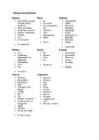
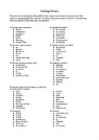
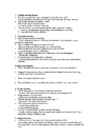
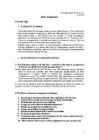
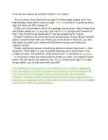
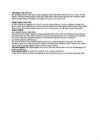
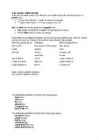
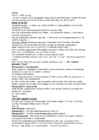
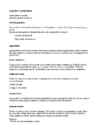
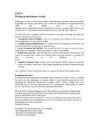
linking words and phrases Sequence Result Emphasis · First / firstly, second / · So · Undoubtedly secondly, third / · As a result · Indeed thirdly etc · As a consequence · Obviously · Next, last, finally (of) · Generally · In addition, moreover · Therefore · Admittedly · Further / furthermore · Thus · In fact · Another · Consequently · Particularly / in · Also · Hence particular · In conclusion · Especially · Due to · Clearly · To summarise ...
1. Prepositions: of course there are no all expressions what you can use in that document, only some of them but I hope I'll help somebody for sharing that document :). 2. Phrases: some phrases are in English (+ Estonian translation, of course), some in Estonian (+ English translation)
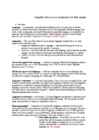
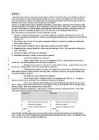
Research INTERNET ADDICTION This study set out with the aim of assessing the negative effects of computer addiction in life. The results of this study show that the Internet may become a problem when it absorbs too much of your time, causing you to neglect your relations, your work, school, or other important things in your life. Surprisingly, computer addiction covers a variety of impulse-control problems including cybersex addiction, cyber-relationship addiction, net compulsions, information overload and Internet addiction. These findings supports the importance of the Internet addiction. Many people turn to the Internet in order to manage unpleasant feelings such as stress, loneliness, depression, and anxiety. This suggests that it's important to remember that there are healthier (and more effective) ways to keep difficult feelings in check. These may include exercising, meditating, using sensory relaxation strategies, and practi...
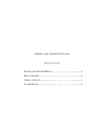
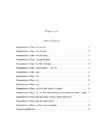
Adverbs and Adverbial Phrases Table of Contents Adverbs and Adverbial Phrases ........................................................... 2 Types of Adverbs ..................................................................................... 2 Position of Adverbs.................................................................................. 4 Yet, still, already ....................................................................................... 6 Adverbs and Adverbial Phrases An adverb describes a verb, an adjective, another adverb or a whole sentence.
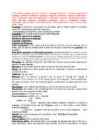
Words that ADD information · also · and · another · besides first, second, third, ... · furthermore · in addition · moreover The little girl put on her yellow shirt and brown overalls. Chris is on the basketball team this semester at Indiana School for the Deaf. In addition, he is on the soccer team. We will be here for one more week so we can finish up our work. Another reason we are staying longer is because we do not want to miss the Deaf Way conference. First of all, pour a half-cup of milk in the bowl; second, add two eggs; and third, stir the mixture. I admire I. King Jordan because he is the first deaf president of Gallaudet. Besides that, I admire him because he is a great long distance runner. Furthermore, he is a dedicated family man. All in all, there ís not much to dislike about the man, except he is too perfect! Crystal likes camping in the mountains. Also, Crystal is an experienced hiker. Texas Schoo...
FCE Result Words and Phrases Alphabetical Wordlist a bite to eat (phr) abandon (v) abruptly (adv) absent-minded (adj) abstract (adj) abusive (adj) access (n) accuse of (v) achievement (n) aching (adj) acknowledgement (n) acquire (v) activist (n) adaptation (n) addicted to (adj) addictive (adj) additional (adj) admire (v) admission (n) adoptive (adj) adrenalin (n) adulthood (n) aerial (n) aging (n) aisle (n) alarming (adj) alien (n) alike (adv) allegedly (adv) alley (n) alongside (adv) aloud (adv) alternate (adj) amateur (n) ambitious (adj) anaemic (adj) analysis (n) ancestor (n) ancient (adj) angel (n) ankle (n) announce (v) annual (adj) anthropologist (n) 1 anticipate (v) antisocial (adj) apart (adv) ape (n) apparatus (n) apparent (adj) appeal to (v) appetising (adj) applicable (adj) apprenticed to (adj) approach (v) approximately (adv) arch criminal (n) archaeological (adj) archbishop (n) architect ...
Some Love Poems and English Phrases!!! 1. A kiss is just a kiss until you find the one you love. A hug is just a hug until you find the one you're thinking of. A dream is just a dream until it comes true. Love was just a word until the day I saw you. 2. You are my sun, my moon you're my words, my tune. My earth, my sky, my sea you're everything to me! You're my light in the darkness you're my peace and happiness. You're ma hope and you put my above you are my forever love. 3. Love is an energy, love is a mystery love is meant to be true. Love is a part of me, love is the harmony love is going to be me and you. Love is patient, love is kind. It always protects, always trusts, always hopes. That what you are (name)...My love! 4. There's only 1 thing 2 do 3 words 4 you. I LOVE YOU! 5. I wrote you're name in t...
Extended Rules for Using Commas Comma Use 1. Use commas to separate independent clauses when they are joined by any of these seven coordinating conjunctions: and, but, for, or, nor, so, yet. The game was over, but the crowd refused to leave. The student explained her question, yet the instructor still didn't seem to understand. Yesterday was her brother's birthday, so she took him out to dinner. 2. Use commas after introductory a) clauses, b) phrases, or c) words that come before the main clause. a. Common starter words for introductory clauses that should be followed by a comma include after, although, as, because, if, since, when, while. While I was eating, the cat scratched at the door. Because her alarm clock was broken, she was late for class. If you are ill, you ought to see a doctor. When the snow stops falling, we'll shovel the driveway. However, don't put a comma after the main clause when a dependent (subordinate) clause
I am writing for information about... I would like to learn/ know more about... I would like to ask whether/ if... I would be grateful if you could... Asking for particular actions: I would like to ask you for... I would suggest that you/ your company... I think that I can ask for some compensation. In the light of the above, I would like to ask you for... REPORT INTRODUCTION- phrases to use The aim of this report is to ..... This report will examine/ consider/ compare.... This report is intended to describe/present It is based on a survey which was conducted/ carried out.... BODY PARAGRAPHS phrases to use Since/ As..... For this reason/ these reasons.....
Linking Devices Transition words and phrases help establish clear connections between ideas and ensure that sentences and paragraphs flow together smoothly, making them easier to read. Use the following words and phrases in the following circumstances. To indicate more information: To indicate an example: Besides For example Furthermore For instance In addition In particular Indeed Particularly In fact Specifically
SUMMARY WRITING NB! At least 5 different types of summaries can be identified in writing. The requirements for the summary in this course are as follows: 1. FOUR UNIVERSAL FEATURES OF ANY SUMMARY: Concise Comprehensive Coherent Independent 2. TIPS FOR WRITING: DONT’S Do not retell, but analyse and synthesise; Do not include your own opinion; Do not use redundant phrases (e.g. The article that I chose); Do not use quotes from the text; Do not use bullets or numbering; Do not start your sentences with But/And/So. DOS Incorporate the heading of the text and the author in the first sentence; Use the author’s phrases (see also ‘package’ D); Write the text in ONE block; Be consistent and parallel in structures; Use the active voice;
2.3.2 Adjectives Inherent → Degree of comparison. (Comparative and superlative) For example: cold - colder – coldest Agreement → Attributive adjectives go with the head noun and predicative adjectives go with the subject. For example: The white door 3. Nouns and noun phrases Nouns are “naming words” because they name objects, places, beings etc. For example: dog, cat, Tartu, University of Tartu etc… The structure of the noun phrase → The noun phrase typically consists of the head which is usually a noun and other linguistic elements which determine or modify the head. (Determiners) (Premodifiers) HEADnoun (postmodifier)
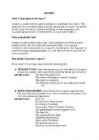
Be clear and avoid unnecessary detail. Give essential information and recommendations. A report is a formal piece of writing and it is impersonal (avoid using the pronoun " I "). Say what you have to say in as few words as possible. How should I structure a report? Every report, like an essay, should have the following parts: A. INTRODUCTION- state what you are going to write about. If the report is based on a survey, state when and by whom the survey was carried out. phrases to use The aim of this report is to ..... This report will examine/ consider/ compare.... This report is intended to ...... It is based on a survey which was conducted/ carried out.... B. BODY PARAGRAPHS- present the facts in a logical, organized way. Use sub-headings if necessary. Don´t discuss more than 3/4 aspects. Give some description and explanation.
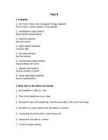
I Love English 5 Unit 8 Test Answers 1. Translate The phrases 1) This is Kevin. Could I speak to Tina, 5) Surf the internet please! 6) Enjoy visiting chat rooms 2) Switch off the mobile phone 7) Send an email to a friend 3) Be on the phone 8) Write in capital letters 4) Call back later 2. Write a / an or the were necessary 1) We travelled to Tallinn by – bus. 2) Tony is the tallest boy in our class.
commas, full stop/period, slash, apostrophe. 1. Semi-colon. Between two separate thoughts that are linked in meaning. Mel is a nice person; she visits her granny every day. 2. Colon. Before an explanation or a list. John felt nervous: he hated the dark. 3. Dash. Informal. It is sometimes used instead of colon or a semi-colon. I’m having a great time – there’s lots to do here. 4. The rules about commas are not very strict. In general they are more likely around longer phrases. FANBOYS (for, and, but, or, yet, so). (2 subjects) It was a great camera, but I can’t afford it. (1 subject) It was a great camera but a bit too expensive. 5. Quotation marks/inverted commas a) Laura said, “You haven’t put up those shelves yet.” b) ‘Sod off,’ he replied. 6. Conditionals (with ‘if’ clause first) If you hate take-offs, you shouldn’t fly. (but) You shouldn’t fly if you hate take-offs. 7. However at the beginning and in the middle of a sentence.
number of items. Typical closed classes found in many languages are adpositions (prepositions and postpositions), determiners, conjunctions, and pronouns.[1] Contrastingly, an open class offers possibilities for expansion. Typical open classes such as nouns and verbs can and do get new words often, through the usual means such as compounding,derivation, coining, borrowing, etc. [2] Syntax: studies how words group together to make phrases and sentences. Sentences are not simply random strings of words; they conform to specific patterns determined by the syntactic rules of the language. The syntactic rules in a grammar must account for the grammaticality of sentences, word order, structural ambiguity, the meaning relations between words in a sentence, the similarity of meaning of sentences with different structures, the speaker's creative ability to produce and understand any of an infinite set of possible sentences.
Nahuatl orthography (2014, 24. mai). Wikipedia, The Free Encyclopedia. http://en.wikipedia.org/w/index.php?title=Nahuatl_orthography Vaadatud 11.10.2014 Nahuatl (2014, 10. okt) Wikipedia, The Free Encyclopedia. http://en.wikipedia.org/wiki/Nahuatl Vaadatud 11.10.2014 Ager, S. (2014) Nahuatl http://www.omniglot.com/writing/nahuatl.htm Vaadatud 11.10.2014 Ager, S (2014) Useful phrases in Nahuatl http://www.omniglot.com/language/phrases/nahuatl.php Vaadatud 11.01.2014 Tuggy, D. (2008) Syllables and stress in Nahuatl http://www-01.sil.org/mexico/nahuatl/23i- SyllablesNah.htm Vaadatud 14.10.2014
Exemplify your answer using relevant text lines. 1. . True , , , , 2. . False , 3. . True , ... : 4. . True - 5. , . False 6. , . True , , : ! , .... - 7. . False ; 8. . True 9. . False " , , ? 10. , , . False , , /20 II. Give modern Russian equivalents of the following archaic words and phrases: - - / - - e - - - /10 III. Describe Ludmila's character on the basis of Extract 1 (about 100 words). - . . - . . , . , . . , , , . . , , , . /10
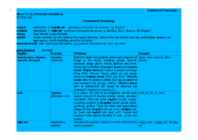
THE ADVERB määrsõna 1. Liht; Here soon now fast Tuletatud; internationally Liit; Outside, therefore, some kind Ühendmäärsõnad; Like phrases; from time to time, now and then 2. Ajamäärsõnad Koha ja suuna määrsõnad; above, there Viisimäärsõnad; quickly, clearly, well Määra määrsõnad; nearly, almost, enough, very, to, quite Põhjusmäärsõnad; therefore, for this reason Küsivad ja siduvad; how, why, how much, where III 2. in a friendly way/manner 3. he's a fast runner ADJECTIVE He runs fast 4. high vs. Highly, late vs. Lately
Here are some common verbs which are followed by the gerund: Admit, appreciate (hindama), avoid, can´t help, can´t stand, consider, delay (viivitama), deny, detest (jälestama), dislike, enjoy, escape, excuse, face, feel like, finish, forgive, give up, imagine (ette kujutama), involve (sisaldama), mention (mainima), mind, miss, postpone (edasi lükkama), practise, put off, recall, resent, risk, suggest, understand 7.2 Verbs and phrases followed by the infinitive without ´to´ You must answer all the questions. Here are some common verbs/phrases which are followed by the infinitive without to: Can, could, may, might, must, need, must, need, had better, would rather 7.3 Verbs followed by an object + the infinitive without ´to´ She made me do it. ( sundima ) Here are some common verbs which are followed by an object and the infinitive without to: Let, make, know, hear, feel, help. Mum won´t let me go to the beach today
Metaphor connects the extra linguistic reality with the world of the mind through languages. Metaphor, being both an expressive and an asthetic component, has to be preserved intact in translation 6. Phatic (‘faatiline’) and metalingual (‘keeleväline’) function a. What is the purpose (two) of phatic texts? b. Bring examples of phaticisms (at least 4). (So that you understand it yourself later!) c. Explain the essence of the metalingual function. d. Bring examples of phrases that indicate metalingual qualities (at least 4). (So that you understand it yourself later!) 7. Intention of the text/translator a. Why is it important to take note of the intention of the text? - writers attitude, point of view, translator intention has to be similar to the original text b. Name some words/phrases that might help locate the intention. - unfortunately, nevertheless, hopefully c. What might help the translator understand the intention of a text better?
finite action of the epic within a broader, universal context. Oftentimes, the poet is also paying homage to the ancestors of audience members. 5. Main characters give extended formal speeches. 6. Use of the epic simile. A standard simile is a comparison using "like" or "as." An epic or Homeric simile is a more involved, ornate comparison, extended in great detail. 7. Heavy use of repetition and stock phrases. The poet repeats passages that consist of several lines in various sections of the epic and uses homeric epithets, short, recurrent phrases used to describe people, places, or things. Both made the poem easier to memorize. Aristotle described six characteristics: "fable, action, characters, sentiments, diction, and meter." Since then, critics have used these criteria to describe two kinds of epics: Serious epic Comic epic
My mother tongue in 21th century Thousands of Years ago Estonian did not exist. Even nowadays not very many people speak Estonian, nearly 1,5 Million. Compared to English speakers, it's nothing. The Estonian language has changed very much as the years have gone by. The expressions that were used years ago are replaced with English phrases, which are especially popular among young people. That's because almost all films, song lyrics and popular TV shows are in English. They also use slang too much. It's quite possible, that soon the Estonian language dies out and replaces with English. The second reason, why Estonian is in big danger, is because the little importance of the language. Almost everyone can speak at least one foreign language and nowadays the travelling possibilities are also very good. So if the Estonian
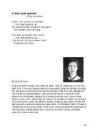
one of America's greatest poets, is also well known for her unusual life of self imposed social seclusion. Living a life of simplicity and seclusion, she yet wrote poetry of great power; questioning the nature of immortality and death, with at times an almost mantric quality. Her different lifestyle created an aura; often romanticised, and frequently a source of interest and speculation. But ultimately Emily Dickinson is remembered for her unique poetry. Within short, compact phrases she expressed far- reaching ideas; amidst paradox and uncertainty her poetry has an undeniable capacity to move and provoke. Liis
a big fish last summer. (catch) ........................................................you .....................traditional British food? (like) .....................you .........................the Tower of London during your last trip? (visit) I................................................................never ...........................the snake. (touch) I..............................................................................................thirteen next year.(be) 5. Match the phrases. coach a big red bus raven midday double-decker the national bird of the USA lemonade a big black bird bald eagle a big and comfortable bus noon a fizzy drink
Following are the most basic ones, which should always be employed. 1. Use the four answering courtesies: · Greet the caller · State your organisation (or department) · Introduce yourself · Offer your help "Good afternoon, Accounts, Andrew Batt speaking. How may I help?" 2. Show enthusiasm when you answer. Help make the caller feel welcome A tired voice lacking in enthusiasm is very unappealing and reflects on the professionalism of your organisation. 3. Use friendly phrases as part of your greeting. · "Thanks for calling." · "May I help you?" 4. Remember to smile as you pick up the receiver. It may help if you have a mirror on your desk, this way you will be able to see how you sound on the telephone. Also, as a reminder, tape the word `Smile' on your phone. Closing the conversation When you finish your telephone conversation there are some appropriate and courteous statements that should always be made. You should: 1. Thank the caller. 2
English idioms an adequate English idiom. important Idioms are in such great use by society in general that the ability to understand idioms is essential to being able to comprehend the meaning of what is being communicated. My suggestion how to learn idioms: Get a copy of Scholastic's Dictionary of Idioms by Marvin Terban. It explains more than 600 phrases, sayings, and expressions, the vast majority of which are in everyday usage: To take an idiom self-test Play some fun, interactive idiom games Discuss cartoons about idioms or read & discuss some idiom- filled books together To distinguish different kinds of idioms We need to understand different types of idioms and they are categorized as either opaque or transparent.
· Review and summary (Give an account of points, not the details; So, to summarise...; At this state I`d like to conclude that...; In conclusion...; As I`ve explained in this presentation today...;) 4.LANGUAGE AND PRESENTATION: · Use present tenses (Use the present perfect to report somebody`s words...;Oscar Wilde has said that..;) · Make use of synonyms and different grammatical constructions (Try not to repeat the same words or phrases..) · Use a clear voice and logical transitoin (Don`t jump between the points..)
I LOVE ENGLISH 6 8.klass Unit 1 test 1. Translate. 1 Mida on sul ja su sõbral ühist? What do you and your friend have a common? 2 Ma mõistan su vaatenurka. I can understand your point of view. 3 Mida sa selle all mõtled? What do you mean by this? 4 Missugune vapustavalt ilus pruutkleit! What a gorgeous bridal / wedding dress! 5 Kas sa oled kunagi pulmas käinud? Have you ever attended a wedding? 6 Jane rebis kutse kostüümipeole tükkideks. Jane tore the invitation to the fancy dress party into pieces. 7 Pinge Alice`i ja tema armukadeda poisssõbra vahel kasvas. The tension was building up between Alice and her jealous boyfriend. 8 Mis lahti? Su silmad on pisaraid täis. What`s up? Your eyes are filled with tears. 2. Write the verbs in the suitable tense. 1 have booked `ll be / booked was...
Everyday culture (dressing, nonverbal language) Focus on vocabulary and speaking, creative writing Meaning with the help of the mother tongue No formal tests Errors are not corrected immediately but afterwards 4 The goals are speaking and expressing freely, fluently and naturally; relaxed and comfortable atmosphere. It is more a student-centred method. Students are actively involved. In this clip only some phrases in the native language were used for helping the students who didn´t understand. The focus is on vocabulary and speaking. Pictures, toys (on the desk) were used for making it clearer. The teacher repeated the incorrect phrase or sentence immediately. The teacher was positive and praised after the successful performance. · Humanistic methods: the silent way http://www.youtube.com/watch?v=tvyoevK-dh0 TESOL Methods http://www.youtube.com/watch?v=85P7dmPHtso 6 Dr
TEST 8 1)Siin Kevin. Palun, kas ma saaksin Tinaga rääkida? This is Kevin. Could I speak to Tina please? 2) mobiiltelefoni välja lülitama Switch off the mobile phone 3)telefonitsi rääkima Talk over the phone 4) hiljem tagasi helistama Call back later 5) Internetis surfama Surf the Internet 6) nautima jututubades käimist Enjoy visiting chatrooms 7)Sõbrale meili saatma Send an email to a friend 8) suurte tähtedega kirjutama Write in capital letters Write a/an or the where necessary 1- We... by bus 2- Toni is THE tallest ... 3- We went to see A film... THE film was... 4- My father is A police officer and my mother is A doctor. 5- I could play THE piano when I was 6 years old. 6- Please don't be late for dinner 7- I'd like AN apple... 8- My father... play football... Write the correct word under the pictures 1. A sheet of paper 2. A can of Coke 3. A cup of coffee 4. A boul of soup 5. A piece/ ...
never It is mostly realised by the -ly suffix added to an adjective. numeral arvsõna, numeraal one, ninety-eight, tenth pronoun asesõna, An item used to substitute for the reference to entities They are in the kitchen. pronoomen which lexical noun phrases indicate. The main sub- Your boxes of photos have been classification include personal (he, you), possessive delivered. Mine will arrive (his, yours), reflexive (himself, yourselves), reciprocal tomorrow. (each other, one another), relative (who, which, that), interrogative (who, what, which), demonstrative
Tegevus, mis mingil kindlaksmääratud momendil toimub (või toimus) ja mille alguse kohta on meil andmeid. · The child has been sleeping for six hours already. It has been raining for hours. Irregular verbs Here is a HUGE table about · irregular verbs · that you have to know by heart. · http://www2.gsu.edu/~wwwesl/egw/verbs.htm Ajamääruslaused (Adverbs of time) can be time expressions such as · `last night'. can be prepositional phrases with `at', `in', or `on'. `For' refers to a period of time in the past, present, or future. `Since' refers to a point in past time. A We use adverbials of time to say when something happens. We often use noun groups called time expressions as adverbials of time. yesterday, today, tomorrow last year, next Saturday, next week the day after tomorrow, last night, · the other day · Do not use the prepositions `at', `in', `on'!!! Prepositional phrases as
Prepositions and word formation (derivation) PREPOSITSIONS You need to understand what word means. Below phrases need to be learnt! · A connection between sth and sth else · To be based on sth · An outlook on life · To be crowded withpeople · By chance · To persist in sth · To be suspicious of sb/sth · To insist on sth · To one's surprise · The cause of sth · To take care ofsb/sth · To care about sb/sth · To punish sb forsth · The result of sth · to relate sth to sth else · to disapprove of sb/sth · to spend money on sth
factories. I think that it is very important that they don't build them in the middle of cities. The pollution twhat comes from the factories is bigdrastic. In conclusion, there are many ways to make our cities' air pollution levels lower. We all need to do what we can. As the old proverb says "To make things better, you should start with yourself". You address the propts given in the textbook, but in a rather vague way. Don't be afraid to use the expressions and phrases from the textbook The structure of your essay is very good, especially the conclusion. However, since you have not been as precise as the task required you to be and your language use has been rather simple (which is why it is largely correct), the mark is a good strong 4.
them a kind of French and there was a period where the lower classes spoke English and the upper classes spoke French. In the 14th century English became dominant in Britain again, but with many French words added. Modern English Early Modern English (1500-1800) Towards the end of Middle English the change in pronunciation started, with vowels being pronounced shorter and shorter. From the 16th century the British had contact with many peoples from around the world and many new words and phrases entered the language. In 1604 the first English dictionary was published. Late Modern English (1800-Present) The main difference between Early Modern English and Late Modern English is vocabulary. Late Modern English has many more words because the Industrial Revolution and technology created a need for new words; and the English language adopted foreign words from many countries. The global english is the simple english were you now the basics but you have to use your bodylanguage to for
A few and few, a little and little A few (for countable nouns) and a little (for uncountable nouns) describe the quantity in a positive way: · "I've got a few friends" (= maybe not many, but enough) · "I've got a little money" (= I've got enough to live on) Few and little describe the quantity in a negative way: · Few people visited him in hospital (= he had almost no visitors) · He had little money (= almost no money) Some adjectives and adjectival phrases can only go with uncountable nouns (salt, rice, money, advice), and some can only go with countable nouns (friends, bags, people). With Uncountable Nouns With Both With Countable Nouns How much? How much? or How many? How many? a little no/none a few a bit (of) not any a number (of) some (any) several
Introduction – state topic Paragraph 2 – argument 1 + reason+ support (statistics, examples, quotes) Paragraph 3 – argument 2 + reason+ support (statistics, examples, quotes) Paragraph 4 – argument 3 + reason+ support (statistics, examples, quotes) (Paragraph 5 – give the other side of the argument + reasons) Final paragraph – restate opinion, paraphrasing it, and add a final comment Your personal opinion should be expressed in the introduction and again in the conclusion, using phrases such as “in my opinion”, “I believe”, “I think”… You should support your opinion by including examples and reasons for what you have said. When expressing the other side of the argument, you may include it in a separate paragraph. End it by restating your argument. Each new idea in a new paragraph! Always give the other side of the argument, using phrases like: People argue that… opponents of this view say… there are those who oppose…
exists between grammatical units, e.g. a pronoun 'refers' to a noun or noun phrase. When the reference is to an earlier part of the discourse, it may be called a 'back-reference' (or anaphora); collective noun Collective noun is the name we give to a group of nouns to refer to them as one entity. A crew of sailors. A flock of birds. A range of mountains. conjunction any member of a small class of words distinguished in manylanguages by their function as connecto rs between words, phrases,clauses, or sentences, as and, because, but, however. content words Content words are words that have meaning. They can be compared to grammatical words, which are structural. Nouns, main verbs, adjectives and adverbs are usually content words. Auxiliary verbs, pronouns, articles, and prepositions are usually grammatical words. Example ‘We flew over the mountains at dawn'. countable nouns Countable nouns are easy to recognize. They are things that we can count. For example: "pen". We
Mõju võib olla nii positiivne kui negatiivne. Küsimustikule antud tagasiside oli peamiselt positiivne. Uurimistööga sain ma kõikidele oma küsimustele vastused, õppisin analüüsima andmeid ja tegema järeldusi. Eesti keele puhtus on keele säilitamiseks oluline, aga võõrkeelsete laensõnade eesti keelde tulekut ei ole võimalik vältida. 16 SUMMARY The topic of this researh is using English words and phrases while speaking Estonian. Young people use English words and phrases quite often. There are several reasons for using English words and phrases while speaking Estonian: young people claim that it is easier or they do not remember the right Estonian word. We can also say that they use English words and phrases because they do not read as many books as young people used to read and that is why their vocabulary is not very wide.
6. Our neighbour, whose daughter lives in Portsmouth, is going to UK soon. 1e 1. Ken said that Doctor Who was one of his favourite programmes. 2. The aliens claimed that they could destroy our planet. 3. The commander warned that the spaceship would land soon. 4. My friend promised to be at the club by five o'clock. 5. Steve deneid breaking my mobile. 6. Our teacher recommended repeating the phrases twice a day before the test. 2a 1. mind 2. mind 3. mind 4. brains 5. minds 6. time 7. time 8. brain 2b 1. suffered 2. diagnosed with 3. inattentive 4. jealous 5. guilty 6. 's recoverng/recovered/'s recovered from 7. operating theatre 8. doctor 2c 1d, 2a, 3f, 4e, 5b, 6c.
5 We're running out of petrol. Where's the nearest ...? 6 There were no people standing at the ..., so the bus had probably just left. --- 15 2. Kasuta õpetaja abi! Look at the traffic signs and write sentences using can, must or mustn't. You must stop here. Sa pead siin peatuma. You mustn't stop here. Sa ei tohi siin peatuda. You can stop here. Sa võid siin peatuda. 1 ... 2 ... 3 ... 4 ... 5 ... 6 ... 7 ... 8 ... 9 ... 10 ... 11 ... --- 16 3. a. Translate the words and phrases. 1 a driving licence ... 2 a police officer ... 3 drive at 70 mph ... 4 speeding kiiruspiirangu ületamine 5 be in a hurry ... b. Complete the exercise. Write one word in each gap. One night, when Lewis is driving home, a police 1. ... stops him and wants to see his driving 2. ... . Looking at Lewis's papers he says, "I'm afraid, sir, I'll have to fine you for 3. ... . You were 4. ... at 70 mph. Why are you in such a 5. ...?" Lewis thinks for a 6. ... and then says,
........................................... 6 Prepositions of Place – in, on & at with addresses and names of streets / roads .. 7 Prepositions of Place with the words ‘corner’, ‘front’ and ‘back’ ............................ 7 Prepositions of Place with the word ‘arrive’.......................................................... 7 Prepositions of Place – in & on with travelling ..................................................... 8 Prepositional Phrases ......................................................................................... 8 Prepositions of Time – in, on & at • in is used with centuries, decades, years, seasons and months, parts of the day, periods of time • on is used with dates, special days, days of week, day of week + part of day, day + of ... • at is used with holidays, exact time, meals and with night in on at
conquered England · The new conquerors (called the Normans) brought with them a kind of French, which became the language of the Royal Court, and the ruling and business classes · The lower classes spoke English and the upper classes spoke French · In the 14th century English became dominant in Britain again, but with many French words added An example of Middle English by Chaucer Early Modern English · 1500-1800 · The Great Vowel Shift · Many new words and phrases entered the language · The invention of printing also meant that there was now a common language in print · Books became cheaper and people learned to read · Printing also brought standardization to English · Spelling and grammar became fixed and the dialect of London became the standard · In 1604 the first English dictionary was published Hamlet's famous "To be, or not to be" lines, written in Early Modern English by Shakespeare Late Modern English · 1800- present
use // . . This type of conditional sentence use, when speaker wants to underline the missed possibility Absolutely unreal events Structure: Additional clause Past Perfect Main clause would/should/could/might + have III If I had been free yesterday, I would have joined you , . If I were you If I were you/in your place/in Structure your shoes use, when speaker wants to give an advice. All these phrases are translated as The form were can be replaced on was If I were you If I were you, I would go there . If he were in your place, he would do it. , . Other examples If you worked hard, you would succeed. Almost unr. event If I had learned English before, I could have found a good job long ago. Absolutely unr. event If I had left earlier, I should have caught the train. Abs. unr. If I see him, I will (shall) speak to him
lake. Soon a rainstorm starts, but luckily they get rescued by the Lake Warden before the island disappears under water. In the end the kids get permission to stay with Miss Williams for the rest of the summer and they do't have to return to Mrs.McCafferty I think the book was too predictable and a little bit boring for me, but younger readers will certainly enjoy it. For a children's book, I think it's great. Some of the phrases and words I find interesting: Porch veranda Leave someone stranded - kedagi hätte/kitsikusse jätma Catch sight of something - midagi korraks nägema Take a fancy to somebody - kedagi eelistama, kellegile meeldima hakama Beat someone to the punch midagi tegema enne, kui keegi teine seda teeb Have one's heart set on something midagi väga lootma, ihkama, tahtma
I am very much interested in … 3. Required information (expanded) I have never attended such a course before … . My friend and I would be keen to know if … . 4. Points that need clarification However, I hope you can provide more information about … . 5. Closing remarks Thank you for your time. I am looking forward to your reply. I appreciate a reply at your earliest convenience. 6. Sign-off Phrases •I am writing to complain about a… •I am writing in response to your advertisement • I am writing with regard to … • I am writing to get more information about … • I am writing in response to … • I would be grateful if … • I would like to enquire … • Would it be possible for you to … • Would it be acceptable if … • I would be more than glad to … • I would be grateful if you could • I am looking forward to your reply
NT: I know what the like of you are, I do. Such cases occur mainly in the dialogue and they suggest that the personages carelessness or not too educated speech. This way or other those constructions sound colloquial. LEXICAL TAUTOLOGY means repeating absolutely the same information. NT: She always sleeps late, she never wakes up early. NT: He is leaving now, I mean he is going. In fiction this characterises the speaker negatively. SSD-s that are based on UNUSUAL POSITION OF WORDS AND PHRASES. INVERSION INVERSION is emotional and expressive colouring may be conveyed by special word order. The violation of the accepted rules of word order is called inversion. COMPLETE INVERSION means the predicate or part of it comes before the subject and thus the misplaced part is emphasised. NT: Beautiful those days were. (normal: those days were beautiful) NT: Unhappy went he. NT: Satisfied he looked. NT: Go I must. PARTIAL INVERSION is when the direct object comes first in the sentence.
be made. These will be discussed in greater detail in Unit 3 Developing a Style for Business Writing. For now, just note a few of the changes that the secretary made. Vocabulary Compare the choices of vocabulary made by the Transport Supervisor and his secretary. The Transport Supervisor has chosen vocabulary suitable to an informal conversational style. His secretary has chosen alternative words or phrases which have the same meaning, but which are either neutral or formal in style. Text 1 Text 2 got worse and worse deteriorated lots of a number of OK satisfactory doing nothing unavailable for use more than enough chance ample opportunity get in touch contact Abbreviations Text 1 uses a lot of abbreviations
5 I could play the piano when I was 6 years old. 6 Please don´t be late for dinner. 7 I´d like an apple, please. 8 My father liked to play football when he was a student. 3 Write the correcnt word under the pictures. 1 a sheet of paper 2 a can of Coke 3 a cup of coffee 4 a bowl of soup 5 a piece of pizza 6 a jar of honey 7 a piece of chocolate 8 a glass of milk 4 Read the story and complete the text with the missing phrases. Choose from there: A left the postcard lying behind some machinery B with a helfpenny stamp of King George V on it C a weak boy with health problems D promised to keep in touch E a little late F that took 73 years G still lived a month H Where the card was for so long
 annaabi.ee