Leidsid 33 sarnast õppematerjali, mis on seotud failiga "THE VICTORIAN AGE 2". Need materjalid aitavad sul teemat sügavamalt mõista.
rich, work, became, poor, working, hours, class, fight, rights, grow, families, hard, 19th, century, newspapers, started, magazines, books, brought, australia, functionin the third millennium B.C and were overrun by various Celtic invasions that began in the 8th century. The Celts introduced their tribal organization and an early form of agriculture before they were forced westward by the Roman invasion. Forms of Celtic language are still spoken in Britain. Romans (with Julius Caesar in the head of them) first tried to occupy Britain in 55 B.C., but there was a rebellion in Gaul so they had to leave to fight against it. Next time they came in 43 A.D. and their leader was Emperor Claudius. Romans brought a lot with them. Their brought paved roads, the sites of important cities, the seeds of Christianity, the Roman law, Roman baths, language and advanced civilization. They also built Hadrian's Wall in 122 A.D. Romans occupied Britain for four centuries. The Roman way of life all vanished after the invasions from Northern Europe by the Angles, Saxons and Jutes from the 5th century onwards
English Literature ,Victoria Age 1) Overview of the Victorian age · Periodization During the reign of Queen Victoria (1837-1901) · Why is the Victorian Age compared to the Elizabethan Age? Both are associated with the reign of a very popular queen; Victorian age idealised the Elizabethan Age; many changes in different fields- economy, religion etc.; focusing more on people's attitudes, political developments etc; Victorian age was inspired by Elizabethan era; Britain became an empire · What were the most important changes in politics, religion and social life that occurred during the Victorian age? Politics: 1848 Chartist movement (voting right for the working class); women's suffrage movements; feminist outburst (wanted to have business openly; own property, voting etc.); world dominion (British empire); Economy: Industrialization; urbanization (people moved to towns no agriculture & food); laissez-
15. Victorian times Life and conditions of Victorian people Children were expected to help towards the family budget. They often worked long hours in dangerous jobs and in difficult situations for a very little wage. For example, there were the climbing boys employed by the chimney sweeps; boys and girls working down the coal mines, crawling through tunnels too narrow and low to take an adult. Some children worked as errand boys, crossing sweepers, shoe blacks, and they sold matches, flowers and other cheap goods. During the Victorian era, the population grew immensely. At the end of 19th century the population had grown three times bigger in Great Britain! That made wages much lower, because more people were looking for jobs. Many people couldn't afford places to live and had to live on the streets
time. During the Middle Ages many people who lived in the countryside worked on the land that they got from the noblemen. In return, they were protected by them Between the middle and the end of the 14th century, the plague, also called "Black Death" killed almost half of Europe's population. It spread most rapidly in the larger cities where many people lived. This led to economic depression. When the plague slowly decreased in the 15th century, the population in Europe began to grow. A new middle class emerged --bankers, merchants and trades people had a new market for their services. People became wealthier and had more than enough money to spend. They began to build larger houses, buy more expensive clothes and get interested in art and literature. The middle class population also had more free time, which they spent learning foreign languages, reading, playing musical instruments and studying other things of interest
There is a great desert in Australia, and it comes down to the sea on the western and southern coasts. William Dampier was the first englishman to reach Australia. But captain James Cook's explorations on the southeast coast were more important. He was on his way from New Zealand and reached Australia from the southeast. The part of Australia he found was very much different from the country visited by the earlier explorers. He landed in a place of great beauty, rich in plants and flowers, which he named Botany Bay. From Botany Bay James Cook sailed along the east coast as far as the Cape York, where he put up the British flag. The eastern part of Australia became a British colony. The Colonization of Australia The British initially used it as a gigantic prison camp for convicts from Britain. Altogether 160 000 men, women and children were deported from Britain to Australia, where they led a very hard life.
The Renaissance In the history the Middle Ages were followed by the Renassance period. During this period a new class called bourgeoeisie came into being. This is the period when monarchies based on nationality were estabilished. The Renaessance started in Italy In the 14th century. Then it spread all over Europe, reached England in 16th century. The struggle for power culminated in a war called The War of Roses. It was a civil war between two dynasties, families. They had different emblems on one side the Yorks (white rose) other Lancasters (red). They couldn't decide who gets the throne. War ended 1485
3100 BC. Stonehenge was produced by a culture with no written language. Many aspects of Stonehenge remain subject to debate. There is little or no direct evidence for the construction techniques used by the Stonehenge builders. *The Celts in Britain and their legacy The Cets lived in Britain in The Iron Age. They were warring tribes who were battleful amongst themselves as well as inter-tribal war. They were not centrally governed. The Celts brought iron working, iron ploughs and metal swords, horses, wheels and chariots - all these things gave them an instant superiority over the native tribes. The Celts built a number of hill forts throughout the region. The society was divided into warrior aristocracy, agricultural commons and the priests, the druids. *Caesar in Britain - Britain was very rich in minerals but that wasn't the main reason Caesar wanted to defeat it. He could clearly see that Britain was a threat to his latest and greatest
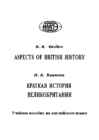
Подготовлено на факультете лингвистики. The book contains an overview of the most important events in British history – from the first documented invasions of the island to the formation and fall of the British colonial empire. A series of exercises will help to remember the subject matter, practise the vocabulary and contribute to skills work. The book is intended for the Humanities students. Вавилов Н.А., 2008 3 4 Contents 5 ПРЕДИСЛОВИЕ Настоящее пособие содержит краткий очерк истории Великобритании от первых документально засвидетельствованных событий, имевших место на
o The Celtic language survives in the names of many places in England- Dover, Kent, Thames o The Celts are best known for their art- many bronze objects with elaborate designs; brooches; pins; mirrors; Celtic stone crosses o The Celts had 3 social orders: warriors, druids(priests) ordinary people 2) The Romans o (55 BC-Caesar) 43 AD- 410 AD- Claudius o From present-day Italy o Southern Britain became Britannia and was ruled by a roman governor o The Romans built over 20 towns: Colchester, Londinium, Winchester etc. They were good engineers and built roads and villas that had central heating, glass windows and mosaic floors o 122 AD- Hadrian's Wall; 138 AD- Antonine Wall o Druids(celtic priests) were banned and Britain was influenced by christianity 3) The Germanic Invasions I
powerful. He pulled down some of their castles. He tried to restore law & order. He wanted the same kind of justice to be used everywhere. He appointed his own judges to travel around the country. They dealt with crimes & disagreements over poverty. Serious offences were tried in the king's court. At first they had no special knowledge or training. They were trusted to use common sense. By the end of the 12th cent. They had real knowledge & experience of the law which became known as ,,common law", based on custom, comparison, previous cases & decisions. It was unlike in the rest of Europe. In England trial by ,,ordeal" was replaced with trial by jury. The work of juries gradually changed from giving evidence to judging evidence of others. Now the king's laws were in force everywhere. In 1157 he forced Malcolm IV of Scotland to give up border regions to England. In 1171 he went to Ireland, took it under his rule & made his son John, Lord of Ireland. When he got the
1. The Queen’s official title. Elizabeth the Second, by the Grace of God, of the United Kingdom of Great Britain and Northern Ireland and of Her other Realms and Territories Queen, Head of the Commonwealth, Defender of the Faith. 2. The Queen’s working day. Starts after breakfast. Reads the newspapers which are prepared by the Press Secretary, and a report on the previous day’s proceedings in the Parliament and the letters she receives. Also phone calls. Once a month she attends the Privy Council in order to give Royal Assent to various items of government legislation. Discusses domestic matters with the Master of the Household.
They most probably came from Eastern Europe and belonged to the Celtic race and also spoke Celtic. They were primitive hunters- gatherers, farmers. Some Celtic words are still used in modern English, however they are used mostly in place names. For example: · avon river · cumb valley · ford shallow place in the river Ancient Britons had their own religion and priests or druids and temples. In the year 55 BC Britain became a Roman province. Romans were highly developed and had their own language latin, which has also greatly influenced English. The military occupation of the Isles ended in 410 AD. The Romans eventually brought Christianity to Britain. Hadrian's wall on the border of Scotland and England. It began construction in 122 AD. An Anglo-Saxon attack on Rome forced the Romans to leave The British Isles. They were
The foundation stones The Island Britain has a mild climate due to the Gulf Stream which brings warm waters from the Gulf of Mexico. The northern part of the island in average 5'C cooler and it's mountainous or hilly and that's why the south has been more populated.. Britain became an island only 5000 years BC after the Ice Age ended. Britain's prehistory The first evidence of human life on the island are dated back to 250 000 BC. 50 000 BC in a milder Ice Age period Britain became habitable again. People from that time were the ancestors of the modern British. 10 000 BC ige age ended and Britain became inhabited by small
loved theatre and plays. People had good lives and were entertained. Mary (catholic), The queen of Scots, was executed by Elizabeth I. Elizabeth had no heir. The power of the English monarch increased in this period. Bubonic plaguse killed one third of the population in England during its first outbreak and continued to reappear periodically for another 300 years. 1605 The Gunpowder plot The 17th century James I became the first English king of the Stuart dynasty, he was already James VI of Scotland so the crowns of these two countries were united The goverments continued to seperate, but the linguistic differences were lessened The kind of Middle English spoken in lowland Scotland had developed into a written language known as Scots Scottish Protesntant church adopted English Bibles. English became the written standard in Scotland as well
cities: London, Edinburgh, and Cardiff. The Kingdom of Great Britain resulted from the political union of the kingdoms of England and Scotland with the Acts of Union 1707 on 1 May 1707 under Queen Anne. In 1801, under a new Act of Union, this kingdom merged with the Kingdom of Ireland to create the United Kingdom of Great Britain and Ireland. After the Irish War of Independence most of Ireland seceded from the Union, which then became the United Kingdom of Great Britain and Northern Ireland. The relatively limited variety of fauna and flora on the island is due to its size and the fact that wildlife has had little time to develop since the last glacial period. The high level of urbanisation on the island has contributed to a species extinction rate that is about 100 times greater than the background species extinction rate. 2 The History of the Great Britain
In 1492 Christopher Columbus discovered it while trying to reach India. He didn't stay and in the sixteenth century the first Europeans to settle in America were the Spanish, the English and the French. The first village founded by the English settlers was in Virginia in 1607. It was called Jamestown. In 1620 a new group of British settlers reached Plymouth, Massachusetts, called 'Pilgrims' due to their strong belief in religion. They became farmers and businessmen who coped with the Indians and in 1621 had a big dinner to thank the Indians as they had helped them to survive the hard winter. That day is now known as Thanksgiving and is celebrated on the fourth Thursday in November in America. More and more people arrived. Over a time settlers from many other countries joined the English in America the French, the Spaniards , the Dutch. Africans were first brought to Virginia in 1619.
For thousands of years America was unknown to Europe. In 1492 Christopher Columbus discovered it while trying to reach India. He didn't stay and in the sixteenth century the first Europeans to settle in America were the Spanish, the English and the French. The first village founded by the English settlers was in Virginia in 1607. It was called Jamestown. In 1620 a new group of British settlers reached Plymouth, Massachusetts, called 'Pilgrims' due to their strong belief in religion. They became farmers and businessmen who coped with the Indians and in 1621 had a big dinner to thank the Indians as they had helped them to survive the hard winter. That day is now known as Thanksgiving and is celebrated on the fourth Thursday in November in America. More and more people arrived. Over a time settlers from many other countries joined the English in America the French, the Spaniards , the Dutch. Africans were first brought to Virginia in 1619
occupation of Britain, they left very little behind. Most of the villas and temples the impressive network of roads and the cities they founded, including Londinium, 4 were soon destroyed. The next invaders were the Anglo-Saxons. They came from nowadays Germany, Holland and Denmark. In 1066 the last successful invasion was made by French-speaking Normans. French became the language of the ruling class, Latin was the written language. By the 14th century, however, English began to replace both French and Latin, but the English language still contains numerous French and Latin borrowings. The Hundred Years War between England and France and the Black Death had a great negative influence on Britain. Over 1/3 of the population died. During the fifteenth century the throne of England was claimed by two rival groups - the House of York and the House of Lancaster. As the
South Australia, Western Australia and Tasmania. The anthem of Australia is called `Advance Australia Fair'. It was officially declared the national anthem on 19 April 1984. Peter Dodds McCormick, a Scot, composed `Advance Australia Fair' under the pen-name `Amicus' (amicus is the Latin word for friend). `God Save the Queen' was the anthem before it. It was first performed in Sydney on Saint Andrew's Day, 1878. Peter McCormick died in 1916 and `Advance Australia Fair' became free of copyright in 1966. Some of the original words of the song have been changed for the official version. On specifically Royal occasions, both `Advance Australia Fair' and `God Save the Queen' are played. The second choice for the anthem was `Waltzing Matilda'. It is still a famous song and Australians like that song and they sing it. Government and Head of State. Australia is a constitutional monarchy, (queen + teda asendavad inimesed) based on a liberal democratic tradition. Queen
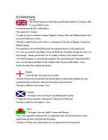
* the flag is of Wales bears a Red Dragon (it is not represented on the Union Jack) Northern Ireland: * the capital city is Belfast * 54% of people regard themselves as Protestants and 42% as Roman Catholics * the flag is called the Saint Patrick's Cross 2) History Prehistoric Britain, Roman Britain, Anglo-Saxon, Danish, Norman invasions (...-1066): Britain was part of the European land mass until the end of the last Ice Age. It became an island by about 6000 BC. From about 3000 to 2000 BC the British Isles were inhabited by a group of people called the Iberians. These Stone Age people lived in limestone caves, they used stone axes and fashioned antlers and bones into leather-working tools. Later groups of people from what are now Germany, the Netherlands and Brittany also settled in Briton. During the Bronze Age, they mined tin, gold and copper and made bronze tools. They also
· Naturalism appealed American authors because they found it very right to describe what was going on in the turn of century in America · They wanted something fresh, new · They were disgusted by romantics · Showed the harsh tone in moral life · Refleced the development of science · Period of intense urbanisation, the city is in the center of the novel, often · New characters were businessmen, salesman, immigants, poor farmers · These characters were in new settings, skyscrapers, departments store, apartment building, ghetto, stockyard (cattle, cows were slaughtered), commercial trust · Their world is not one of culture or high moral standards · For these new writers controlling new american social experience · Naturalists offered a view that questioned the belief that now was a conscious and national being and happiness could in moral behaviour
55,7 million acres Unevenly distributed Tribal sovereignty (iseseisvus) Poverty and unemployment · Indian citizenship Act of 1924 Granted citizenship to 300,000 indigenous people, to friendly tribes State support was limited Absorb Indians into the mainstream Didn't have the right to vote · Trail of Broken Treaties of 1972 Took place in 1972 Cross-country protest by American Indian organizations Intended to bring attention to American Indian issues such as treaty rights, living standards, and inadequate housing. Huge media coverage "20-Point Program" · Present situation 1 Reservations situated west of the Mississippi 1% of the population Minority group, less privileged Social problems Self-awareness Mixture of old and new HOW GOVERNMENT ACTS NOW- gives natives money and near Las Vegas the right to own casinos to compensate injustice and taking away land. II First Settlements
Word of these new amazing weapons quickly spread around the world and soon rockets were being used in military operations in North Africa and Europe. During the 15 th and 16th centuries they were widely used in naval battles to set fire on enemy ships. Around this time they also started being used for more peaceful purposes again. In the 16th and 17th century Europe fireworks displays using rockets became a very popular form of public entertainment. In the late 18th century the British army suffered two serious defeats at battles in Seringapatam, in India. The main reason for these defeats was that the Indian prince, Haidar Ali's army included a corps of rocket throwers. They used very large bamboo rockets which had a range of hundreds of metres. The British were determined to learn from their mistakes and a British officer, William Congrieve, began work on
Major events on world history at that time: · Industrial revolution · In America the Declaration of Independence, July 4, 1776 · The French Revolution, 1789 · The King of England was George III, after him George IV and then Queen Victoria Outcomes: · Revolution did not bring welfare · Lives of the lower-classes worsened · Extended the distance between the lower and upper class · The rich got richer, the poor got poorer 2. Romanticism is a reaction against classicism, science and atomic (aesthetic ideal of order and unity) worldview. Romantic ideal is the organic world. Romanticism: · Returns to nature and belief in the goodness of mankind · Exaltation of the senses and emotion overcome reason and intellect is the time when novels became more important · Imagination is very important, it is a God-like creator (W
name studies. British landlords ruled small, unstable kingdoms and continued some Roman traditions of governance. In the mid-5th cent, Vertigern, a British leader, hired Germanic mercenaries to help defend against peoples of the north (Picts & Scots). In the end they revolted & the process of invasion and settlement began. The first Saxon ,,kings" were Hengist & Horsa in Kent, Aelle in Sussex, Cerdic / Cynric in Wessex. So the first ,,English" became mainly from Northern Germany & Denmark. The resistance of the Celts was long. They were free at the time, not like other Roman provinces on the Continent. Around 500, the Britons seem to have won several victories. One of their leaders was Ambrosius Aurelianus and one of their victories was at the place called Mount Badon. The main leader of the Britons at this time may have been the warrior later called King Arthur. By the 7th cent. the invaders managed to conquer the greater part of the land
ideological pillars of the tsarist empire -- the Russian orthodox church; though as the Landeskirche in the Estonian and Livonian territories, the Lutheran church long maintained a de facto predominance. The most important organ of Baltic German local government was the Diet, consisting of all the noble families who had been `selected' in a list of the eligible. Although jealously guarding their privileges, the knighthoods still never became entirely closed. Between sessions of a Diet, the legislative power of the knighthoods belonged to the Council of the Diet. The towns were governed by the Town Councils, which supplemented their ranks from among the representatives of merchants and lawyers. The citizens and the inhabitants of a town did not coincide -- most of the population had no civic rights. The lower class mainly consisted of Estonians. While an
the Angles, Saxons, and Jutes. These peoples settled in Britain around 450 AD. Their language became known as Anglo-Saxon. One of the most important influences ever to shape the English language arrived in 1066 AD-William the Conquerors invasion of the British Isles. The Norman Conquest and its Consequences On William the Conqueror's accession to the throne of England, several important changes took place. Firstly, the French dialect the Normans spoke (Anglo-Norman) became the official language of the court, administration, and perhaps just as importantly, the language of culture. At the same time, English was relegated the common people, and became the language of everyday use. This official ignoring of Old English actually assisted in simplifying the language. Being ignored by grammarians, the language was simplified, and became more practical. Initially, French and English remained very much separate, and each language influenced the other but little
1627 no trace of the "Estonians and Livonians" who left their homeland to settle at the mouth of the Delaware River (a Swedish colony) · 1654 at least one Estonian in the settlement of New Sweden on the Delaware River Johan Schalbrick, a drummer from Tallinn (Reval) · New Sweden Swedish colony on the Delaware River from 16381655 · 1657 Martinus Hoffman, born in Tallinn (Reval), came to New York (New Amsterdam), started to work as a saddlemaker. · His great-granddaughter Cornelia Hoffmann (b. 1734) married Isaac Roosevelt, which makes her the great-great-grandmother of Franklin Delano Roosevelt, president of the US from 193345. · Hans Rebane = 1897 founded the first Estonian-language newspaper in the US Eesti Ameerika Postimees (published in NY until 1911) · 1898 founded an Estonian Lutheran congregation in NY (still exists today) 2
Britain and Northern Island together form the United Kingdom. When referring to Britain or Great Britain in everyday life, the names are used to mean the United Kingdom. The English Channel (and best known: the Strait of Dover) separate Britain from mainland Europe and its closest neighboring country France. 3. History Great Britain has a long and interesting history stretching back millennia's. The Iberians brought their metal working skills and the first real civilization to Britain in the 3rd millennium B.C. And were then overrun by the various Celtic tribes that begun in the 8th century B.C. The Celts introduced the tribal organization and an early form of agriculture before they were forced westwards to Cornwall, where the Celtic language still exists in different forms, by the Roman invasion begun in 43. AD. The Romans ruled Britain for over two hundred years and left behind three things of importance:
The area today lies in the very heart of the historical Mulgimaa the home of hills, deep valleys and lakes brought together by a beauty spot Halliste primeval valley. According to several folk tales, it is also in these valleys, woods and bogs that Old Nick found refuge.The great variety displayed in the nature is also reflected in the local cultural heritage. At the beginning of the 19th century growing linen spread and became the basis of the legendary wealth of Mulgi farms. The ancient barn-dwellings and decaying manor houses are the mute witnesses of those times. The riches and cultural heritage of Mulgimaa owe to the diligence and tenacity of the local people. Village handicraftsmen and masters have always been honoured. Mulgikapsad (stewed sauerkraut with barley groats), Estonian cheesecakes and kama (a roasted meal-mixture) have not lost their popularity.
In 1770 Captain James Cook, the famous sailor and explorer, reached Australia from the south-east and it differed from the other parts of Australia. He landed in a place, great of beauty, with lots plants and flowers, which James Cook named Botany Bay. From there, J. Cook sailed along the east coast as far as Cape York, where he put up the British flag. The eastern part of Australia became a British Colony. th The colonization of Australia began at the end of the 18 century. The first settlers were convicts from England, who were taken to a prison camp at Botany Bay, where they led a hard life. th At the beginning of the 19 century free settlers began to arrive from Britain in large numbers
It is also possible to travel by inland waterways. People come to Britain because the things that you can see there are very famous all over the world e.g. Stonehenge, Big Ben and of course the magnificent natural beauty. History. Britain was connected to the European mainland by a land bridge until the end of the last Ice Age. Afterwards the ice started to melt and oceans began to rise and the connection was covered with water. Britain became a separate island in about 6000 BC. From about 3000 to 2000 BC the British Isles were inhabited by a group of people called the Iberians. These Stone Age people lived in limestone caves, used stone axes and bones as tools. Later groups of people from what are now Germany, the Netherlands and France also settled there. During the Bronze Age they mined tin, gold and copper and made bronze tools. The descendants of the Iberians are thought to have built
Which began in Rome in 59 B.C. It reported the proceedings of the Roman Senate and such news as births and deaths.The first printed newspaper was a Chinese circular called Dibao. It was printed from carved wooden blocks during the A.D. 700's. The first regular published printed newspaper in Europe was Avisa Relation oder Zeitung of Strasbourg, Germany (now France). It started in 1609. A weekly newssheet established in 1622 was the first printed newspaper in England. The ground work for mass communications in the 20th century was laid in the 19th century by two inventions, which allowed people to communicate by wire: the electric telegraph and the telephone. As the telegraph came into widespread use, inventors searched for a way to transmit sound without wires. In 1885 the German scientist Hertz made a machine that produced radio waves and a receiver which could detect them from distance the radio. Soon after that the
 annaabi.ee