 5 punkti
Autor soovib selle materjali allalaadimise eest saada 5 punkti.
5 punkti
Autor soovib selle materjali allalaadimise eest saada 5 punkti.
 ~ 8 lehte
Lehekülgede arv dokumendis
~ 8 lehte
Lehekülgede arv dokumendis
 2013-05-22
Kuupäev, millal dokument üles laeti
2013-05-22
Kuupäev, millal dokument üles laeti
 2 laadimist
Kokku alla laetud
2 laadimist
Kokku alla laetud
 0 arvamust
Teiste kasutajate poolt lisatud kommentaarid
0 arvamust
Teiste kasutajate poolt lisatud kommentaarid
 anni1819
Õppematerjali autor
anni1819
Õppematerjali autor
charged. These lands were given over to flocks of sheep. By the end of the decade the Highlands had become a wilderness. The 19th century was generally a time of great social reform: the slave trade was abolished, the employment of women and children was regulated by laws, primary schools were established and men could no longer be excluded from universities or politics because of their religion. Victorian Britain The Victorian age began in 1837, which lasted until Queen Victoria's death in 1901. The period was dominated by three men her Prince Consort, Albert of Saxe-Coburg and two outstanding prime ministers, William Gladstone and Benjamin Disreali. By the end of her reign the nation was the most powerful in the world and by the 1920s the British Empire comprised about a quarter of the world's territory and population. Victoria had nine children, who eventually became the monarchs of many European
English Literature ,Victoria Age 1) Overview of the Victorian age · Periodization During the reign of Queen Victoria (1837-1901) · Why is the Victorian Age compared to the Elizabethan Age? Both are associated with the reign of a very popular queen; Victorian age idealised the Elizabethan Age; many changes in different fields- economy, religion etc.; focusing more on people's attitudes, political developments etc; Victorian age was inspired by Elizabethan era; Britain became an empire · What were the most important changes in politics, religion and social life that occurred during the Victorian age? Politics: 1848 Chartist movement (voting right for the working class); women's suffrage movements; feminist outburst (wanted to have business openly; own property, voting etc.); world dominion (British
15. Victorian times Life and conditions of Victorian people Children were expected to help towards the family budget. They often worked long hours in dangerous jobs and in difficult situations for a very little wage. For example, there were the climbing boys employed by the chimney sweeps; boys and girls working down the coal mines, crawling through tunnels too narrow and low to take an adult. Some children worked as errand boys, crossing sweepers, shoe blacks, and they sold matches, flowers and other cheap goods.
The Renaissance Between 14th and 16th century in Europe From French word rebirth It was an age of growth in Europe. New, powerful city states emerged. A new middle class had more and more money to spend. Great artists, writers and thinkers lived during this time. During the Middle Ages many people who lived in the countryside worked on the land that they got from the noblemen. In return, they were protected by them Between the middle and the end of the 14th century, the plague, also called "Black Death" killed almost half of Europe's population. It spread most rapidly in the larger cities where many people lived. This led to economic depression. When the plague slowly decreased in the 15th century, the population in Europe began to grow. A new middle class emerged --bankers, merchants and trades people had a new market for their services. People became wealthier and had more than enough money to spend. They began to build larger houses, buy more expensive cloth
Australia Topic Koostas: Aineõpetaja: Tallinn 2011 Location Only one country in the world fills a whole continent. That country is Australia. The continent it fills is Australia, too. Australia, then, is both a country and a continent. If someone wants to make clear that he is speaking of the country, he may call it by its full name of Commonwealth of Australia. Sixty million years ago Australia and its nearby islands were separated from the rest of the world by a great upheaval. They were cut off from Asia by the ocean. Very few people and almost no animals visited Australia before English colonists began to settle there in 1788. During all those 60 million years the native Australian mammals developed by themselves, undisturbed by the animals developing elsewhere. Australia is the only continent except Antarctica that is all south of the equator. It's name means "southland". Si
The Renaissance In the history the Middle Ages were followed by the Renassance period. During this period a new class called bourgeoeisie came into being. This is the period when monarchies based on nationality were estabilished. The Renaessance started in Italy In the 14th century. Then it spread all over Europe, reached England in 16th century. The struggle for power culminated in a war called The War of Roses. It was a civil war between two dynasties, families. They had different emblems on one side the Yorks (white rose) other Lancasters (red). They couldn't decide who gets the throne. War ended 1485. A new dynasty came to throne, Tudor, the first king in this dynasty was Henry Vll. When he came to throne a period of stability followed because he built a nation based state. He was good at diplomacy.He could avoid quarrels and wars with neigbouring countries. France, Spain - greatest enemies.So he could save much money and thus laid a good economi
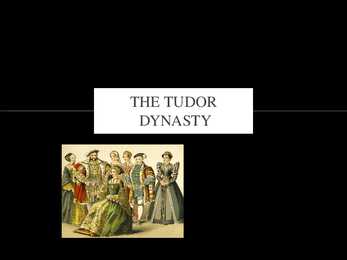
THE TUDOR DYNASTY THE TUDOR DYNASTY The Tudor dynasty or House of Tudor was a European royal house of Welsh origin that ruled the Kingdom of England and its realms, including the Lordship of Ireland, later the Kingdom of Ireland. Its first monarch was Henry VII. Henry VII THE TUDOR DYNASTY The Tudors extended their power beyond modern England, achieving the full union of England and the Principality of Wales in 1542 and successfully asserting English authority over the Kingdom of Ireland. They also maintained the traditional claims to the Kingdom of France, but none of them tried to make substance of it, though Henry VIII fought wars with France to try to reclaim that title. After him, his daughter Mary I lost the claim on France forever with the Fall of Calais. THE TUDOR
History exam *Stonehenge - is a monument located in England. It is one of the most famous prehistoric sites in the world and is composed of earthworks surrounding a circular setting of large standing stones. The surrounding circular, earth bank and ditch, have been dated to about 3100 BC. Stonehenge was produced by a culture with no written language. Many aspects of Stonehenge remain subject to debate. There is little or no direct evidence for the construction techniques used by the Stonehenge builders. *The Celts in Britain and their legacy The Cets lived in Britain in The Iron Age. They were warring tribes who were battleful amongst themselves as well as inter-tribal war. They were not centrally governed. The Celts brought iron working, iron ploughs and metal swords, horses, wheels and chariots - all these things gave them an instant superiority over the native tribes. The Celts built a number of hill forts throughout the region. The society
 annaabi.ee







Kõik kommentaarid