Leidsid 33 sarnast õppematerjali, mis on seotud failiga "The star child". Need materjalid aitavad sul teemat sügavamalt mõista.
star, child, wilde, oskar, genres, parents, 1891, anete, irish, poet, drama, dialogue, works, picture, dorian, grey, fairytale, fantasy, characters, poor, woman, pert, mother, turns, ugly, plot, finds, queen, king, sources, storiesperiod. Importance of religion; the stories of King Arthur (also Tristan and Isolde, based on Celtic legends). Importance of the church during the Middle Ages (5th c to 15th c). Three languages used in England: French, English and Latin. Main literary genres: (1) chivalric romance, (2) the fabliau (a comic, often anonymous tale that is characterised by an excess of sexual and other types of obscenity) and (3) literature on religious topics – either moralistic (teach right from wrong) or ecclesiastical (biblical subject).
massive worldwide popularity in his lifetime. Charles Dickens was born in Landport, Portsmouth in Hampshire, the second of eight children to John Dickens n 7 February 1812. The 12-year-old Dickens began working ten hour days in a Warren's boot-blacking factory. In May 1827, Dickens began work in the office of Ellis and Blackmore as a law clerk. At the age of seventeen, he became a court stenographer and, in 1830, met his first love, Maria Beadnell. Maria's parents disapproved of the courtship and effectively ended the relationship when they sent her to school in Paris. In 1834, Dickens became a political journalist, reporting on parliamentary debate and traveling across Britain by stagecoach to cover election campaigns for the Morning Chronice. His journalism, in the form of sketches which appeared in periodicals from 1833, formed his first collection of pieces Sketches by Boz which were published in 1836 and led to the
the English up to his own day Old English Cædmon ,,The Father of English Hymn" Cædmon's Hymn is the oldest recorded Old English poem, and also one of the oldest surviving samples of Germanic alliterative verse The Hymn itself was composed between 658 and 680, recorded in the earlier part of the 8th century Middle English Geoffrey Chaucer 13431400 Known as the ,,Father of English literature", the greatest English poet of the Middle Ages An author, philosopher, alchemist and astronomer, diplomat Wrote The Book of the Duchess, the House of Fame, the Legend of Good Women and Troilus and Criseyde Best known today for "The Canterbury Tales" Crucial figure in developing the legitimacy of the vernacular, Middle English, at a time when the dominant literary languages in England were French Modern English William Shakespeare 26 April 1564 23 April 1616 The Elizabethan Era
Cooper's most famous novel, Last of the Mohicans (1826), became one of the most widely read American novels of the nineteenth century. The book was written in a second-story storefront-apartment in Warrensburg, New York, just north of where most of the book's plot takes place. Washington Irving Washington Irving was born in New York City (near present-day Wall Street) at the end of the Revolutionary War on April 3, 1783. His parents, Scottish-English immigrants, were great admirers of General George Washington, and named their son after their hero. Irving had many interests including writing, architecture and landscape design, traveling, and diplomacy. He is best known, however, as the first American to make a living solely from writing. Initially, he wrote under pen names; one was "Diedrich Knickerbocker." In 1809, using this pen name, Irving wrote A History of New-York that describes and pokes fun at the
Tartu Kesklinna Kool Kristine Vilja 8.b klass Oscar Wilde Referaat Tartu 2009 Oscar Fingal O'Flahertie Wills Wilde was an Irish playwright, poet and author of numerous short stories and one novel. Known for his biting wit, he became one of the most successful playwrights of the late Victorian era in London, and one of the greatest celebrities of his day. Several of his plays continue to be widely performed, especially The Importance of Being Earnest. As the result of a widely covered series of trials, Wilde suffered a dramatic downfall and was imprisoned for two years hard labour after being convicted of "gross indecency" with other men
News story fragments, snatches of song lyrics, political speeches of that times and even advertisement. Mass culture and popular conscousness of that time is given. They also present the panorama of events. 27 biographies in the trilogy, these are very imaginative of famous public figures, people who shaped or represented the major social forces of that time, people who made history. Eugene Debs-one of the greates leiva movements, Valentino-major hollywood star, thomas edison, president wilson and many more. Finally there are 51 camera eye sections, these are mostly fragments of stream of concsiousness, which present the authors view point. They show the viewpoint of disturbed artist. His reaction to the changing world, this is the most intimate and subjective part of the novel, the camera eye. All these four sections make up the very diverse and complex narrative structure of the novel. ,,42 Parallel" 1900 to 1917
and Paris. Joyce and Ireland. ,,Cultic twalette", left in 1904, couldn't help returning in every page he composed, short story collection Dubliners, Ulysses-guidebook through Dublin. A Portrait of the Artist as a Young Man Largely autobiographical, Joyce's own spiritual searches. Growing up in Ireland at the turn of the century, the formation of an artist. Künstlerroman (A Künstlerroman meaning "artist's novel" in German, is a narrative about an artist's growth to maturity), but with an Irish specificity. Bildungsroman(coming-of-age story is a literary genre that focuses on the psychological and moral growth of the protagonist from youth to adulthood), but in the modernist style. Stephen's and Joyce's spiritual searchings. Family-a microcosm of Irish life (Christmas dinner), Jesuit college (sin &death sermon), doubts, rebellion, loss of faith. Love. Discovery of artistic talent, participation in national awakening movement. Rejection of Irish life, leaving the country. Visit to
"Agatha Christie has, if not a whole day off, at least part of the afternoon. The killing of the blackmailing Enoch Arden, who puts up at the local to harry the already embarrassed Cloade family, the murder that follows, and Poirot's doubly twisted solution are ingenious enough, but the characterisation is a little below par. The quintessential zest, the sense of well-being which goes to make up that Christie feeling, is missing."[3] An unnamed reviewer in the Toronto Daily Star of 10 April 1948 said, "Hercule Poirot, whose eggshaped cranium is crammed with lively gray cells, proves himself a bit of a mug before he sorts out all the details of [Enoch Arden's] death and other even more baffling mysteries. But he does it with all the acumen that has endeared him to Agatha Christie fans. Fantastic and topping."[4] Robert Barnard: "Elderly man married to a glamorous nitwit of dubious social background is a common plotelement in Christie. Here she is widowed (in an airraid
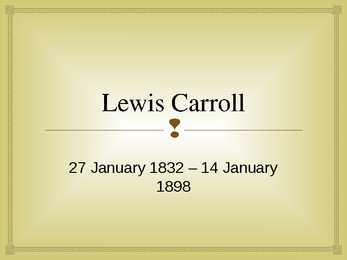
genre of literary nonsense. He is noted for his facility at word play, logic, and fantasy, and there are societies dedicated to the enjoyment and promotion of his works and the investigation of his life in many parts of the world, including the United Kingdom, Japan, the United States, and New Zealand. Family Dodgson's family was predominantly northern English, with Irish connections. Conservative and High Church Anglican, most of Dodgson's ancestors were army officers or Church of England clergymen. His greatgrandfather, also Charles Dodgson, had risen through the ranks of the church to become a bishop. His grandfather, another Charles, had been an army captain, killed in action in Ireland in 1803, when his two sons were hardly more than babies. His mother's name was Frances Jane Lutwidge.
Ratiocinative more optimistic. Poe shows the triumph of human intellect. "A Decent into the Maelström". Other tales display the power of sharp logic. Detective stories where the protagonist is called Auguste Dupin the first great detective in the world's literature. "The Murders in the Rue Morgue", "The Story of the Purloined Letter" (purloined stolen) two systems of detection. Method of deduction. Poe ignores the moral aspect of crime. Poe the poet in his poetry Poe is preoccupied not so much with meaning as with sound. He chooses his words, especially in rhymes, because of how they sound. He tries to be logical. The best subject matter should be death of the beautiful women. The essence of poetry is beauty, the best mood is sadness. The aim of his poetry is to elevate the human mind, to bring it to ecstasy. Man can perceive superior beauty. Poems and short stories should be short enough to be read in one sitting
The Mysterious Affair at Styles was adapted as a 103-minute drama and transmitted on ITV in the UK on Sunday September 16, 1990 as a special episode in their series AgathaChristie'sPoirotto celebrate the centenary of the author's birth. AGATHA CHRISTIE Agatha Christie was born Agatha May Clarissa Miller in Devon, in England in 1890, the youngest of three children. Her father died, when she was a child. At sixteen she was sent to school in Paris where she studied singing and piano. Christie was an accomplished pianist but her stage fright and shyness prevented her from pursuing a career in music. She never attended school. Dame Agatha Christie was an English crime writer of novels, short stories and plays. She also wrote romances under the name Mary Westmacott, but is best remembered for her 80 detective novels and her successful West End theatre plays.
voices. Among the most discussed authors of this period were Victor Pelevin, who gained popularity with short stories and novels, novelist and playwright Vladimir Sorokin, and the poet Dmitri Prigov. In the 21st century, a new generation of Russian authors appeared, differing greatly from the postmodernist Russian prose of the late 20th century, which lead critics to speak about "new realism". Russian authors have significantly contributed to numerous literary genres. Russia has five Nobel Prize in literature laureates. As of 2011, Russia was the fourth largest book producer in the world in terms of published titles. A popular folk saying claims Russians are "the world's most reading nation". Old Russian literature Old Russian literature consists of several masterpieces written in the Old Russian language (i.e. the language of Rus', not to be confused with the contemporaneous Church Slavonic nor with modern Russian)
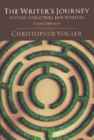
Based on the work of Joseph Campbell, The Writers Journey is a must for all writers interested in further developing their craft. This updated and revised Third Edition provides new insights and observations from Vogler's ongoing work on mythology's influence on stories, movies, and man himself. In revealing new material, he explores key principles like polarity and catharsis, plus: • A revised chapter which looks back at the Star Wars phenomenon and analyzes the six feature films as an epic on the theme of father-son relationships • New illustrations and diagrams that give additional depth to the mythic principles • A final chapter, "Trust the Path," an inspiring call to adventure for those who want to discover themselves through writing "This book is like having the smartest person in the story meeting come home with you and
Holloway might not have hastened the onset of his literary life. She ruled the boarding house with fire and brimstone and Kipling was often beaten by her and her son. "Then the old Captain died, and I was sorry, for he was the only person in that house as far as I can remember who ever threw me a kind word."--ibid. Kipling soon learned to read and found solace in literature and poetry, voraciously turning to the magazines and books his parents sent him including Daniel Defoe's Robinson Crusoe. Wilkie Collins' The Moonstone and works by the likes of Ralph Waldo Emerson and Bret Harte also left an indelible impression on Kipling. Respite from the Holloway household was gained when he spent one month a year in London with his mother's kindly sister Aunt Georgie and her husband, pre-Raphaelite painter Edward Burne Jones and their children. Those months of December were a veritable paradise to Kipling; North End House was
Brill” Her heart started trembling as she thought about the incident in the park. The tears ran from her eyes like a river and the faces of Ann and George kept coming into her head. She walked into the other end of her miniature room, sat down on a blue wooden chair and opened a little box next to the chair. The box was old and was covered with dust, it was clear that it had been untouched for a long time. Inside the box there were photos of a little girl and the little girl’s parents. Miss Brill looked at these photos very carefully for a long time one by one. The last picture that she took in her hands was again a photo of a little girl. The girl was on a grey bed and looked awfully pale. Miss Brill took a long deep breath, closed her eyes and supported her back against the wall. “Mother, mother come and look at my snowman!” exclaims a little girl. “Honey, I have to go inside and start making dinner for you and your father! We are going to
Blandings Castle by P.G. Wodehouse Wodehouse was an acknowledged master of English prose admired both by contemporaries and by modern writers. He has been called "English literature's performing flea", a derogatory description that Wodehouse cherished and adopted as the title of his autobiography. Best known today for the Jeeves and Blandings Castle novels and short stories, Wodehouse was also a talented playwright and lyricist who was part author and writer of fifteen plays and of 250 lyrics for some thirty musical comedies. Wodehouse took a modest attitude to his own works. In Over Seventy (1957) he wrote: "I go in for what is known in the trade as 'light writing' and those who do that humorists they are sometimes called are looked down upon by the intelligentsia and sneered at." Wodehouse's characters are often eccentric, with peculiar attachments, such as to newts (Gussie Fink-Nottle) or socks (Archibald Mulliner). His "mentally negligible" good-natured characters invaria
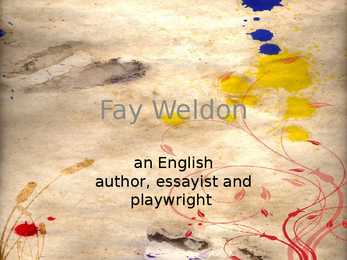
Fay Weldon an English author, essayist and playwright Early life § Fay Weldon was supposed to be born in New Zealand, but instead was born in England in 1931. At 5 weeks old she and her mother returned to New Zealand. § Her father was a doctor and her mother was a writer of commercial fiction under the pen name "Pearl Bellairs", among others. Her parents divorced when she was five. She lived with her mother, sister and grandmother until she started college and, as a result, grew up believing "the world was peopled by females". This problably influenced her works too. § She returned to England with her mother and studied economics and psychology at the University of St Andrews in Scotland. § Her actual christened name was "Franklin Birkinshaw". which she feels contributed to her being accepted at
Orphaned as a baby, she struggles through her nearly loveless childhood and becomes governess at Thornfield Hall. Although she falls in love with her wealthy employer, Edward Rochester, her strong sense of conscience does not permit her to become his mistress, and she does not return to him until his insane wife is dead and she herself has come into an inheritance. · Mr. Reed: Jane's maternal uncle, who adopts Jane when her parents die. Before his own death, he makes his wife promise to care for Jane. · Mrs. Sarah Reed: Jane's aunt by marriage, who adopts Jane but neglects and abuses her. Her dislike of Jane continues to her death. · John Reed: Jane's cousin, who bullies Jane constantly, sometimes in his mother's presence. He ruins himself as an adult and is believed to die by suicide. · Eliza Reed: Jane's cousin. Bitter because she is not as attractive as her sister, she
faire economy new type, where government has no control over economy; booming economy- needed new markets and endless supply of raw materials; 1845- potato famine in Ireland, 1846- Corn Laws (import of cheap corn to feed hungry people); Social life: religious doubts (Darwin's The Origin of Species 1859)- question raised: is there a God at all?; sexual liberation- changed people thoughts about sex (before men & women had different bedrooms); problems: alcoholism, prostitution, child workforce, primitive technology. · How did the class structure change? Highest class was aristocracy (the Church and the nobility); the middle class/the bourgeoisie (shopkeepers, merchants, lawyers, businessmen etc.) was the biggest class; and the lowest class "the working class" and "the poor"; new change was the upward mobility people could become richer and move upward in social
and that so very few are offended with it' (Swift). The current essay attempts to analyze the use of satire in Jonathan Swift's most discussed pamphlet A Modest Proposal and the purposes of using this specific genre. The pamphlet reveals a vast number of social and religious problems: one of the major at those days was beggary. The satire was written in 1729, at the time, when economic situation of the country was extremely prejudiced by another crop failure. Thousands of poverty-stricken Irish were dying of starvation, causing the country's population to fall. However, despite the famine and constantly increasing number of deaths, the government did not implement measures to improve the existing situation. Thence, Swift, being an Irishman by birth and feeling disappointed of the ruling classes, proposes a solution to the problem by publishing his shocking work, the bitterest satire A Modest proposal for Preventing the Children of Poor People in
village of Tollington in the Midlands in the 1960s. The book follows Meena during her pre-teen years as she is desperate to fit in with the other children in her neighbourhood while forever feeling like an outsider because she is "different". She and her family are the only immigrants in the village. They are trying to work out how to fit into British society while attempting to maintain their own culture. Meena's house is always full of a constant stream of ethnic visitors and her parents seem to see no need to integrate futher. Namely, her parents considered every Indian immigrant in England as a friend or even as a part of the family. Meena's family are keen to see her keeping up the family's cultural tradition. Meena on the other hand, is caught between two cultures. She is having a difficult time adjusting to her surroundings, wishing she were blonde and carefree like her 14-year-old neighbor, Anita (Brewster)
In 1953, he published the best-selling story collection ''Someone Like You'' and married actress Patricia Neal. He published the popular book ''James and the Giant Peach'' in 1961. In 1964, he released another highly successful work, ''Charlie and the Chocolate Factory'', which was later adapted for two films. Over his long writing career, Dahl wrote 19 children's books. He died on November 23, 1990 in Oxford, England. He also wrote several television and movie scripts. Early Life Dahl's parents were Norwegian. As a child, he spent his summer vacations visiting with his grandparents in Oslo. When Dahl was 4 years old, his father died. The young Dahl received his earliest education at Llandaff Cathedral School. When the principal gave him a harsh beating for playing a practical joke, Dahl's mother decided to move her child at St. Peter's, a British boarding school. Dahl later moved to private school with a reputation for academic excellence. In 1939, Dahl joined the Royal Air Force
each other lives. Will lives a very comfortable lifestyle in London, thanks to substantial royalties left to him from the successful Christmas song that his father composed. Will doesn´t need to work and spends most of his free time watching television, and reading about pop culture. When Will's friends, Christine and John ask him to be the godfather of their second child, Will bluntly refuses, he didn´t want to be responsible for the child, if something would happen with her parents. In an attempt to avoid spending time with the couple, Will meets Angie, and starts dating with her. But soon they break up and Will understands, that he have to look for girlfriend in some single-parents group. He comes up with idea of attending a group called "SPAT" to meet potential female partners. As part of his play, he claims to have two-year-old son named Ned. His plan succeeds and he meets Suzie. One day, Suzie takes Will in the park for a picnic, where he meets Marcus
School of Witchcraft and Wizardry, which is where most of the action in the six books takes place. Hogwarts is part of a magical world that is invisible to people without magical powers, who are known as `Muggles'. Harry is the hero of all the stories, though there are many other likeable characters such as his friends Ron and Hermione, and the powerful wizard Albus Dumbledore. The main villain is the evil wizard Lord Voldemort, who killed Harry's parents. The stories are full of things that appeal to imagination of readers of all ages. One of them is the game of `Quidditch', which Harry is very good at. It is a bit like football, although it takes place in the sky and the players ride on broomsticks! The last seventh Harry Potter book, Harry Potter and the Deathly Hallows, was released globally on July 21, 2007 and broke sales records as the fastest-selling book ever. It sold 15 million copies in the first
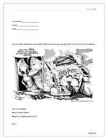
............................................................................................ Quotations................................................................................................................................. My Opinion............................................................................................................................... Orson Scott Card He was born on the 24th of August, 1951 in Richland, Washington. Card's writing career began primarily as a poet, studying at Brigham Young University. During his studies as a theatre major, he began "doctoring" scripts, adapting fiction for theatre production, and finally writing his own one-act and full-length plays. Later he has worked both as a freelancer and a contracted writer. He first wrote the short story "Ender's Game" while working at the BYU press. Ender's Game and its sequel Speaker for the Dead were both awarded the Hugo Award and the Nebula
· Advances in editing ,,trip to the moon": no sound, no characters, no realistic background, massscenes, no colour, sound Was inspired by jules verne"the first men in the moon" First science-fiction film. It was also first pirated film. Melies 400th film. Became a worldwide success, pirated in the usa. Europeans was showed violent, ww1. Melies mocks the scientists. Barbe-bleue-sinihabe. Fairytale/horror. He invented the fiction film and profounfly influenced specific film genres: · German expressionism(set design) · Surrealism(playfulnessm spontanitym sybolism) · Comedies · d.w. griffith · charlie chaplin 13.02.12 D.W.Griffith(1875-1948) The birth of hollywood Born in Kentucky, osn of a condeferate officer. Kept a life-long nostalgia for the values of ,,The Old South". Initially actor, lot of peopleat that time credited him for his good looks. Real burning intension was to become a writer. Inspired by Charles Dickens. 1907 hired the
attention to Vronsky in public, which is becoming a subject of society gossip. He is concerned about his and his wife's public image, although he believes that Anna is above suspicion. Vronsky, a keen horseman, takes part in a steeplechase event, during which he rides his mare Frou-Frou too hard and she falls and breaks her back. Vronsky escapes with minimal injuries but is devastated that his mare must be shot. Anna tells him that she is pregnant with his child, and is unable to hide her distress when Vronsky falls from the racehorse. Karenin is also present at the races and remarks to her that her behaviour is improper. Anna, in a state of extreme distress and emotion, confesses her affair to her husband. Karenin asks her to break off the affair to avoid society gossip and believes that their relationship can then continue as previously. Kitty goes with her mother to a resort at a German spa to recover from her ill health
Literature of the 14th century The highpoint of medieval literature, the best writer of late medieval lived then. William Langland 1332-1376 the last important poet of alliterative verse. His masterpiece "The Vision of Piers Ploughman" how important working hard is, the labour of peasants is the base of the welfare of the people. A passionate protest against social injustice. A time when peasants were slowly rising against their feudal lords. Descriptions of different social classes. Religious mysticism. Two great principles: 1) all men are equal before God; 2) honest labour is dignified. It is a dream allegory
Chekov Lady and the Lapdog Reid about Chekov: The characters in Chekhov's plays are never fully "known" as a writer, he seems to delight in maintaining a sense of indeterminacy, and unknowability, about them. The bare facts are always laughably inadequate to the complexity of "real" people. Anton Pavlovich Chekhov was born on 29 January (New Style), 1860, in Taganrog, a small port on the Sea of Azov, in southern Russia. As the son of a grocer and grandson of a serf, Chekhov was a first-generation intellectual. His modest background and upbringing are crucial to his development as a writer. Chekhov always felt that he missed out on childhood. It was a very hard lifeand it may have contributed to his poor health: he succumbed later on to the"family disease", tuberculosis, which led to his early death at the age of 44.His mother was a quiet, gentle soul who was full of stories of her early life. In later years, Chekhov would say that "we inherited our talent from our father,but mother
Viies tase § Author: Chuck Palahniuk § Released in August 17, 1996 § Satirical novel § Tried first to publish "Invisible Monsters", but was rejected due to novel being too disturbing § "Fight club" was published at first as a seven-page short story § Cultural impact Author American novelist and freelance journalist 51 year old Pasco, Washington When he was 14, his parents separated University of Oregan School of Journalism Volunteering Cacophony Society "I'm not straight, and I'm not gay. I'm not bisexual. I want out of the labels. I don't want my whole life crammed into a single word. A story. I want to find something else, unknowable, some place to be that's not on the map. A real adventure." Characters THE NARRATOR anonymous works for an unnamed car company Perhaps ,,Joe" - I am Joe's Broken
Frankenstein starts to recover from his exertion; he sees in Walton the same over-ambitiousness and recounts a story of his life's miseries to Walton as a warning. Victor Frankenstein's narrative Victor begins by telling of his childhood. Born into a wealthy family in Geneva, he is encouraged to seek a greater understanding of the world around him through science. He grows up in a safe environment, surrounded by loving family and friends. When he is around 4 years old, his parents adopt Elizabeth Lavenza, an orphan whose mother has just died (she is Victor's biological cousin in the first edition, but an adopted child with no blood relation in the 1831 edition). Victor has a possessive infatuation with Elizabeth. He has two younger brothers: Ernest and William. As a young boy, Victor is obsessed with studying outdated theories of science that focus on achieving natural wonders. He plans to attend the University of Ingolstadt in Germany. Weeks before his
Monroe in 1946, she did not legally change her name until February 23, 1956.[11] Her mother was Gladys Pearl (Monroe) Baker.[12] Her family is believed to have been Anglo-Spanish originally; and possibly related to the Sepulvedas. [13] For many years it was believed Gladys' second husband Martin Edward Mortenson (18971981) was Monroe's father. His name was listed on her birth certificate. [14] Foster homes Mentally unstable and unable to care for Monroe, Gladys placed her with foster parents Albert and Ida Bolender of Hawthorne, California, where she lived until she was seven.[15] In her autobiography My Story, Monroe states she believed Albert was a woman. One day, Gladys announced she bought a house. A few months after they had moved in, Gladys suffered a breakdown. In My Story, Monroe recalls her mother "screaming and laughing" as she was forcibly removed to the State Hospital in Norwalk. According to My Sister Marilyn, Gladys's brother,
3. the use of language to pick a literary genre-comedy, novel, drama, O.D (poetic form) etc. 4. the selective use of language that depends on spheres of human activity fiction, scientific prose, newspapers, official documents, business correspondenc etc. Style bears the stamp of indivual usage, that is every writer has a unique pattern/habit and abilities that form his style. This approach is best illustrated in the well-known victum of the french poet Georges-Louis de Buffon ,,Style is the man himself." Stylistics English stylistics or the study of style has not been discussed on the same scale as french stylistics, german or russian. The very term stylistics came into more common use in english only some 30-40 years ago. It was however recorded much earlier that is in 1882 for the first time, meaning ,,The Study of literary style, the study of stylistic features." A short history of the development of stylistics
 annaabi.ee