Leidsid 33 sarnast õppematerjali, mis on seotud failiga "Reported Speech". Need materjalid aitavad sul teemat sügavamalt mõista.
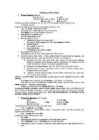
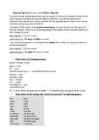
year, month, gone, kaudkõne, went, before, otsekõne, could, here, pealause, asked, goes, eitav, shall, able, might, wasn, weren, allowed, today, yesterday, tomorrow, later, there, these· Kui pealause on minevikus (said; asked) Past Simple(worked), Present perfect(has worked) = Past Perfect(had worked) Present Continius = Past continius (is working = was working) Do, does = did Go, goes = went Shall, will = should, would Am, is, are = was, were Was, were = had been Have, has = had Had = had had Can = could (or had been able to..) May = might Must = had to Mustn't = wasn't/weren't allowed to Went, did or have = HAD + 3. Pv · Kui pealause on olevikus NT: Hilary says, ,, I cant employ you." = Hilary says that she can't employ me. Present simple (works) = Past simple (worked) · Muutused These = those This = that Here = there Soon = later Ago = before Now = then Next year/month/week = the next year/month/week Last year/.../... = the year ../.../.. before This year/.../... = that year/.../... Today = that day, the following day · Küsimustes sõnade järjekord : ALATI ALUS + ÖELDIS
................................................................................................... 9 Artikkel the pärisnimedega...........................................................................................10 Artikkel the geograafiliste nimedega............................................................................10 Artikkel a, an.................................................................................................................10 Otsekõne Direct speech..............................................................................................11 Kaudkõne Reported speech........................................................................................11 Kaudküsimused Reported questions..........................................................................12 Passiiv Passive voice .................................................................................................12
Artiklid ja eessõnad 7 Eessõnad 7 Kesksõnad 8 Prefiksid ehk eesliited 8 Sufiksid ehk järelliited 9 Artikkel the pärisnimedega 10 Artikkel the geograafiliste nimedega 10 Artikkel a, an 10 Muu 11 Otsekõne Direct speech 11 Kaudkõne Reported speech 11 Kaudküsimused Reported questions 12 Passiiv Passive voice 12 Loendatavad nimisõnad Countable nouns 12 Loendamatud nimisõnad Uncountable nouns. 13 Mitmuse moodustamine 13 Siduvad asesõnad 14 Omastav kääne 14
sõiduplaanidega. 3 Tulevikus toimuv, mida nad on/ei ole oma elus ettekavatsetud. teinud. II/-ed WAS/WERE + ING HAD + III pv. I learned English I was learning English I got up at 7 yesterday. I was reading a book when you When I came home, my He didn't get up at 7 came. sister had gone to bed. yesterday. He wasn't reading a book when What time did you get up? you came. What were you doing when I came. Toimus minevikus. Kestis teatud hetkel minevikus. Tegevuse puhul, mis toimus enne mingit teist tegevust minevikus. WILL + I I'll learned English
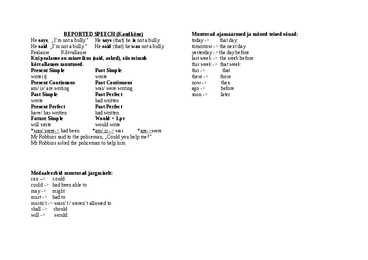
REPORTED SPEECH (Kaudkõne) Muutuvad ajamäärused ja mõned teised sõnad: He says, ,,I'm not a bully." He says (that) he is not a bully. today -> that day He said ,,I'm not a bully." He said (that) he was not a bully. tomorrow -> the next day Pealause Kõrvallause yesterday -> the day before Kui pealause on minevikus (said, asked), siis toimub last week -> the week before kõrvallauses muutused. this week -> that week Present Simple Past Simple this -> that write(s) wrote these -> those Present Continuous Past Continuous now -> then am/ is/ are writing was/ were writing ago -> before
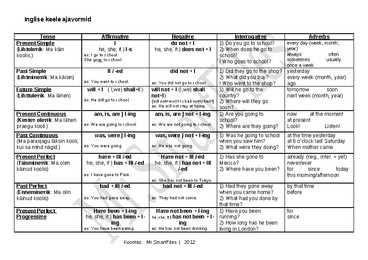
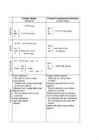
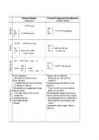
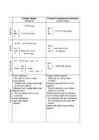
Inglise keele ajavormid Tense Affirmative Negative Interrogative Adverbs Present Simple I do not + I 1) Do you go to school? every day (week, month, (Lihtolevik: Ma käin he, she, it } I-s he, she, it } does not + I 2) When does he go to year) koolis.) ex: I go to school. school? always often She goes to school. ! Who goes to school? sometimes usually
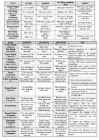
AJAMÄÄRUSED THE PRESENT I pv; do/does + I Tegevus toimub korduvalt, on harjumuspärane SIMPLE live, goes twice a week, every day, usually, often, sometimes, always THE PAST (+) II pv; did + I Tegevus toimub minevikus SIMPLE lived, went yesterday, last week, two years ago, in 1996 THE FUTURE (shall)/will + I Tegevus toimub tulevikus, on üksteisele järgnev SIMPLE pv tomorrow, next week, soon, later, in 2025 be going to + I pv THE FUTURE IN (should)/would + I Kaudses kõnes tuleviku asemel, kui pealause on
THE PRESENT SIMPLE I pv. (+ s); do/does + I pv. Tegevus toimub korduvalt, on harjumuspärane. püsiv olukord, ajagraafikutega seotud tulevik Lihtolevik live, goes every day, usually, often, sometimes, always THE PAST SIMPLE II pv.; did + I pv. Tegevus toimub minevikus. Lihtminevik lived, went yesterday, last week two years ago, in 1998 THE FUTURE SIMPLE be going to/ will + I pv. Tegevus toimub tulevikus. Lihttulevik will go/ won´t tomorrow, next week, soon, later, in 2012 THE FUTURE IN PAST (should)/ would + I pv. Kaudses kõnes tuleviku asemel, kui pealause on minevikus.
AJAVORMI NIMETUS MOODUSTAMINE KASUTAMINE ; SAGEDAMINI ESINEVAD AJAMÄÄRUSED THE PRESENT I pv ( +s ); do/does Tegevus toimub korduvalt, on harjumuspärane. ev SMPLE live, goes every day, usually, often, somtimes, always,never Lihtolevik THE PAST SIMPLE II pv; did ,lived, Tegevus toimus minevikus. Lihtminevik went yesterday, last week, two years ago, in 1998 THE FUTURE SMPLE ( shall ) / will +I pv. Tegevus toimub tulevikus. Lihttulevik will go tomorrow, next week, soon, later, In 2050 THE FUTURE IN THE ( should ) / would +I Kaudses kõnes tuleviku asemel, kui pealause on PAST pv minevikus.
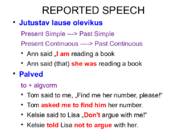
Ann said (that) she was reading a book Palved to + algvorm Tom said to me, ,,Find me her number, please!" Tom asked me to find him her number. Kelsie said to Lisa ,,Don't argue with me!" Kelsie told Lisa not to argue with her. Jutustav lause minevikus Past Simple --> Past Perfect (had + 3.pv) Present Perfect --> Past Perfect Past Continuous ---> had + been + ing Lynn said ,,I went to the cinema last night." Lynn said (that) she had gone to the cinema the night before. Ed said ,,I have finished the exercise." Ed said (that) he had finished the exercise. Kerri said ,,We were waiting for the bus." Kerri said (that) they had been waiting for the bus. AJAMÄÄRUSED Today --> that day Tomorrow --> the next day Yesterday ---> the day before Last week/month/... --> the week/month/... before Next week/month/.
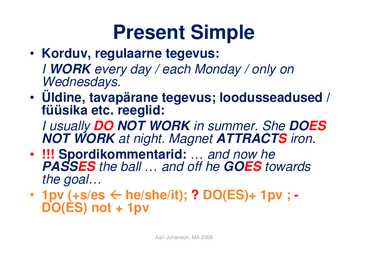
Lihtolevik väljendab: · Antud momendil toimuvat tegevust, mis ei väljenda kestvat aega, näiteks see, hear, know. I see that man who you are pointing at. · Üldist, kogu aeg toimuvat või korduvat tegevust, pole oluline, kas tegevus toimub rääkimise hetkel. Teachers teach in schools. He usually goes to gym on Monday. · Tegevust mingil ajal. I go to school at 8 o´clock. You have to pay taxes once a month. · Kõigile tuntud fakte. Life passes by quickly. Present Continuous Kestva oleviku moodustamine Jaatav vorm Eitav vorm Küsiv vorm I am speaking I am not speaking Am I speaking? He/she/it is going He/she/it is not going Is he/she/it going?
Get/ Have something TENSE ACTIVE PASSIVE WHEN? done Present Simple Am/is/are + Every day, year, often, I pv + do/does Have/ get + sth+ III pv Lihtolevik III pv usually, always Past Simple Yesterday, last year, II pv(-ed)+ did Was/ were + III pv Had/got + sth + III pv
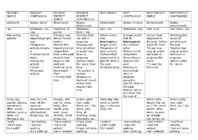
Continuous 2.actions happening around the time of speaking days, at present, tonight etc. the moment. 3. fixed arrangements in the near future Past Simple + II / -ed 1. actoins which happened or finished at a definite time in the past Yesterday, last I went to the gym -?did+I 2. actions which happened repeatedly in the past but don't happen night/week/year/month, wtc, a yesterday. anymore. In this case we can use adverbs of frequency month/two years/three years ago, in 1964, etc. Past Was/were+I-ing 1
-ing pv/-ed been, -ing *Recurring *Action *(Giving new *Actions that *Short action *Longer action *Action that *Showing the actions happening right about) recent are still in that that is happened in cause of now events progress interrupts a interrupted the past, before something in *Temporary *Action that *Saying how longer action by a shorter a specific time the past activity/situatio happened at an long an action *Sequence of acton *To say how *Saying how n unspecified or event has short actions *Action is not long an action long an action
Lepp passes the ball to Kask. Gibson acts well in "Braveheart". 3. Seisundiverbidega (state verbs) verbid, mida tavaliselt ei kasutata kestvates aegades, sest nad kirjeldavad seisundit, mitte tegevust Need on verbid, mis väljendavad: a) meeltetaju (see, hear, feel, smell, taste, look, sound ). Kui meeltetaju verbidega tahetakse väljendada hetkel toimuvat tegevust, kasutatakse tihti modaale can või could Jim must be at home . I can see his car parked outside. b) meeldimist või mittemeeldimist (like, love, dislike, hate, enjoy, prefer, adore) c) psüühilist tegevust (know, understand, believe, realize, remember, forget, notice, recognize, think, seem, expect) d) verbid be, contain, include, belong, fit, need, matter, cost, mean, own, want, owe, have, require, weigh, wish etc.
Kaudkõne inglise keeles Aegade nihe 1.tuleb teha aegade nihe olevikust lihtminevikku ja muuta asesõnad. Asesõna muutumine Saatesõna Otsekõne: Colin said, ,,I like Scotland very much. Kaudkõne küsimus Kaudkõne: Colin said that she liked Scotland very much. (Kui lause on juba minevikus tuleb see panna perfekti minevikku. William Shakespeare (1564-1616) wrote plays. Jacqueline Wilson (born 1945) has written many books about teenage girls.) 2.Kui otsekõne saatelause on minevikus (said), siis nihkuvad kaudkõnes kõik ajavormid mineviku suunas. Minevikus: Mary said, ,,I am reading a fantasy novel by C.S.Lewis.
There is one extra word which you do not need to use. aggressive nervous dull funny easy-going ambitious expensive usual experienced successful practical 1 She told a very ________________________ joke and everyone laughed. 2 She's a very ________________________ person. She will do anything to become famous. 3 They didn't give him the job because he was ________________________. He had never done anything like that before. 4 This is a very ________________________ animal. I've never seen one like it before. 5 I get very ________________________ before an exam and when I go to the dentist. 6 It's a great jacket and quite ________________________ considering its quality. 7 He's always having fights with people. He's very ________________________. 8 It's a nice idea but I think it's completely ________________________. It will never work. 9 Their latest CD was ________________________
Omaduss mis iseloom gruppi NB!! the Golden Gate Bridge inimesi- the poor,the blind,the ....Annie's Café .... The only people sick,the eldery English, the English language the Second World war, aga World War II Tense/verActive Passive b form Present I pv+es I walk/he walks Am/is/are+III pv House is built simple every day (every every month. (ehitatakse) -week,day,summer,ofte n, usually,always,nowaday s) Present Am/is/are+ing I am Am/is/are+being+IIIpv A house is Continuoworking. He is eating. being built. (ehitatakse praegu) us (now,at the moment, presently) Past II pv. He left after lunch. Was/were+III pv A house was built. simple (yesterday, last- (ehitati) year,month,week)
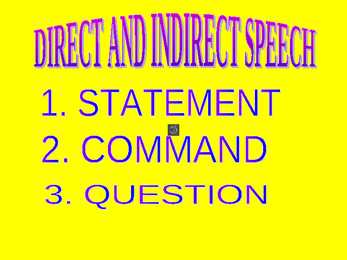
· DIRECT · INDIRECT · Am, is, are · Was/were · Shall/will · Should/would · Can · Could · May · Might · Must · Have/has to · Ought to · Had to CHANGES OF ADVERB OF TIME & PLACE · DIRECT · INDIRECT · NOW · THEN · TOMORROW · THE FOLLOWING DAY · NEXT WEEK · THE FOLLOWING WEEK · TONIGHT · THAT NIGHT · TODAY · THAT DAY · YESTERDAY · THE DAY BEFORE · LAST NIGHT · THE NIGHT BEFORE · LAST WEEK · THE WEEK BEFORE
mis toimub ühe korra, mitte kunagi · in 1990 või mitu korda · the other day II pv · last Friday · actions taking place one after another teineteisele järgnevad · last year tegevused · action taking place in the middle of another action tegevus, mis toimub mingi teise tegevuse keskel. Past Continuous A: He was speaking. · when N: He was not speaking.
S/he IS TALKing on the phone now. I AM READing an interesting book. · Ajutine, regulaarsele ja tavapärasele vastanduv tegevus (tulevikku viitav): This summer they ARE not GROWing cucumbers as usual. They'RE GROWing tomatoes instead. · !!! Halvakspanu väljendus harjumuspärase tegevuse kohta: He IS always COMPLAINing! · BE (am/is/are) + 1pv-ing Aari Juhanson, MA 2008 Present Perfect ON -NUD · Toimunud tegevus, seos olevikuga: I have WORKed here for 3 years. · Toimunud olevikuga seotud/lõpetamata tegevus (saab muuta): S/he has CALLed them twice already. · !!! Kordne tegevus: It's the umpteenth time you've TOLD me this! Have I ever FORGOTTEN anything? · !!! Tutvuse pikkuse väljendus: I don't know how long I have KNOWN her. · have/has (s/he, it) + -ed/3 pv Aari Juhanson, MA 2008 Present Perfect Progressive · Tegevuse protsessi/kestvuse rõhutamine, lõpetamata:
polnud näinud, jne). näinud, on kuulnud, jne). (saame olema lõpetanud, before already, yet, since, for saan olema kirjutanud, (10 years), never/ever, saan olema ära teinud, NB! Kaudses kõnes today, this week, etc. jne). mineviku asemel, kui by the same time next saatelause on minevikus. year, by next summer, etc. Kuidas lünklause puhul teada, millist ajavormi peab kasutama? Tunnussõnadeks ja fraasideks (mitte ilmtingimata alati, aga väga sageli sellegipoolest) on: Present Simple: always, often, sometimes, every day, usually, ........... (jmt.) Past Simple: yesterday, last week, last year, last summer, two days ago, 10 years ago, in 1970, in the 19th century,.............. (jmt)
Pane tähele! Oleviku vorm otseses kõnes muutub mineviku vormiks kaudses kõnes. am/is --- was are -- were do/does --- did want/like/know/go etc --- have/has had wanted/liked/knew/went etc will --- would can --- could wanted/liked --- had wanted/had liked Direct speech Reported speech Jo says: Jo said: ,,I like tennis." (that) she liked tennis. ,,John is going to learn it too."
The train leaves at 9 o'clock Ettekavatsetud tegevus tulevikus, tomorrow. mis on kahepoolselt kokku lepitud: Loodusseadused My grandparents are celebrating Spordiülekanded their wedding anniversary next Juhised month. Pahameelt näitav sageli toimuv tegevus. Inglise keele ajavormid ja nende kasutamine (9. klassi seisuga) Past Simple Past Progressive/Continuous (lihtminevik) (kestev minevik) II vorm was
The train leaves at 9 o'clock Ettekavatsetud tegevus tulevikus, tomorrow. mis on kahepoolselt kokku lepitud: Loodusseadused My grandparents are celebrating Spordiülekanded their wedding anniversary next Juhised month. Pahameelt näitav sageli toimuv tegevus. Inglise keele ajavormid ja nende kasutamine (9. klassi seisuga) Past Simple Past Progressive/Continuous (lihtminevik) (kestev minevik) II vorm was
The train leaves at 9 o'clock Ettekavatsetud tegevus tulevikus, tomorrow. mis on kahepoolselt kokku lepitud: Loodusseadused My grandparents are celebrating Spordiülekanded their wedding anniversary next Juhised month. Pahameelt näitav sageli toimuv tegevus. Inglise keele ajavormid ja nende kasutamine (9. klassi seisuga) Past Simple Past Progressive/Continuous (lihtminevik) (kestev minevik) II vorm was
I've been to France three He said (that) he had been to times. France three times. Read the sentences and turn them in the indirect form. 1. Ralph said, "We have been in the mountains this summer." 2. "We were very happy to spend the weekend at the seaside," said Donald. 3. "We have left the school," said the children. 4. "In 1991 I entered Oxford University," said Henry. Modal Verbs can could I can swim under He said (that) he could water for two minutes. swim under water for two minutes. must had to All tickets must be He said (that) all tickets bought in advance. had to be bought in advance. may might I may call you. He said (that) he might call me. NOTE: modal verbs could, would, might and should
: direct speech: "I like ice cream" reported speech: She says she likes ice cream - But, if the reporting verb is in the past tense (said), then usually we change the tenses in the reported speech: direct speech: "I like ice cream" reported speech: She said she liked ice cream. ......... · When there are Changing tenses: present changes to past:::: am/is --- was are -- were want/like/know/go etc --- wanted/liked/knew/went etc do/does --- did have/has had will --- would can --- could wanted/liked --- had wanted/had liked NT: Jo says "Mary has given up het hobby." - Jo said that Mary had given up her hobby. · Some other words change also, which are more fit?? to reported speech: this that these those here there now then ago before today that day tomorrow the next day yesterday the day before last night the previous night
frequency(kordumine ) adverbs(määrsõna) N: Do you go to school by car every day ? I don't often watch TV. 2)Present continuousbe + verb + ing. Actions happening now N; Look! It's snowing. I'm meeting Jane tonight. You're always losing things. 3)keep + ingto describe habitual actions which may be irritating. N: my uncle keeps making silly jokes. Present perfect: 1) Present perfect simple: have/has + past participle. N: I've been here for ten minutes .The phone has rung ten times today. Look at this cheque,'I've won first prize. They have made a new star wars film. I've just got home. How long have you been here ? Have you ever been to Paris? It's the best book I've ever read. It's the first time I have ever been abroad. 2)Present perfect continious : have/has + been + ing. N:I've been living in this flat since 2000. I've been waiting for ages. I'm hot,I've been running.
· action that is still going on now, up to now · action that stopped recently · finished action that has an influence on the present action that has taken place once, never or several times before the moment of speaking Present Perfect A: He has been · putting emphasis on the all day, Continuous speaking. course or duration (not the since 1993, N: He has not been how long?, result) speaking. the whole
On your handout, write one sentence that reflects SIMPLE PRESENT: something you do often, sometimes, never, seldom The Simple Present Tense This tense also expresses general truths or facts that are timeless. Snow falls in the December in Minnesota. Water boils at 100 degrees Celsius. The Present Continuous This tense is used to describe an action that is occurring right now (at this moment, today, this year, etc.). The action has begun and is still in progress. It can be occuring now, but is temporary Formed by adding Is/are before the verb and ing to the verb She is typing a paper for her class. He can't talk. He is fixing the sink right now. On your handout, write one sentence that reflects
Words that ADD information · also · and · another · besides first, second, third, ... · furthermore · in addition · moreover The little girl put on her yellow shirt and brown overalls. Chris is on the basketball team this semester at Indiana School for the Deaf. In addition, he is on the soccer team. We will be here for one more week so we can finish up our work. Another reason we are staying longer is because we do not want to miss the Deaf Way conference. First of all, pour a half-cup of milk in the bowl; second, add two eggs; and third, stir the mixture. I admire I. King Jordan because he is the first deaf president of Gallaudet. Besides that, I admire him because he is a great long distance runner. Furthermore, he is a dedicated family man. All in
(kestev minevik) was/were + ing Kasutus: When, while, as Tegevus: 1. ajutised sündmused. 2. 2 või enam tegevust ,,While i was reading, he was garding." 3. minevikus katkestatud tegevus ,,I was having a shower, when the phone rang." 4. konktreetne kellaaeg minevikus ,, I was watching TV yesterday at 5!" Present Perfect (täisminevik,olevikuaeg) have/has + III pv. Kasutus: Never, ever, already, yet, before, since, for. Tegevus: 1. tegevused alg. Minevik -> now ,,I have been a teacher for 5 years." 2. mineviku situatsiooni resultaat olevikus ,,I have lost my purse." 3. kogemused ,,Have you been in USA?" Have Gone Have Been Go Verbid: She has gone to Austria ( Ta läks Austriasse.) She has been to Austria ( Ta on käinud Austrias.) Past Perfect (enneminevik) had + III pv. Kasutus: For, since, after, by (time), before
 annaabi.ee