Leidsid 33 sarnast õppematerjali, mis on seotud failiga "Presenatsioon STONEHENGE". Need materjalid aitavad sul teemat sügavamalt mõista.
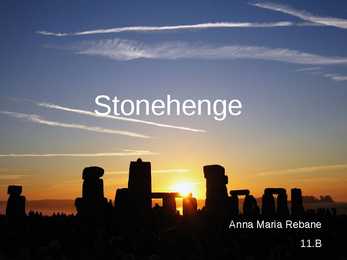
stone, stonehenge, fourth, weigh, tons, stones, built, temple, estimated, 3100, location, plain, druids, romans, greeks, saxons, wessex, welsh, burial, ground, ancient, calendar, religious, ceremonies, dedicated, twelve, gods, dance, eclipse, weight, interesting, first, game, symbolStonehenge Anna Maria Rebane 11.B Facts about Stonehenge · 5000 year old prehistoric ritual monument · the most famous prehistoric monument in Europe · one of the most ancient and mysterious structures in the world · 3.2 kilometers west of Amesbury and 13 kilometers north of Salisbury · south-western England; in the English county of Wiltshire · built in the late Stone Age (Neolithic) and the Bronze Age The History of Stonehenge · "The Mystery of Stonehenge" · the building began in 3000 BC by semi-nomadic peoples · The first stone to be placed - Heel Stone. · some stones weigh about 45 tons each and are 7m high · the largest stone weights as much as 50 tons · no wheels and no metals · their tools - stones, bones and wood · built in several stages
Stonehenge Hort 4000 Mary Laine What is Stonehenge? Derived from words that mean hanging stones, circle of stones, or stone hinges 162 stones originally and about half remain today Southern England, eight miles north of Salisbury and 30 miles north of the English Channel Nearby hillsides are covered with hundreds of burial pits known as barrows 80% of the barrows face east towards where the sun rises on the horizon There are at least 900 circles in Wales, Scotland, England, and Ireland. Most are made of stone, but wood was also used. Soil was also piled up to
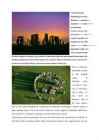
STONEHENGE Stonehenge is surely Britain's greatest national icon, symbolizing mystery, power and endurance
Stonehenge Stonehenge is a prehistoric monument located in the English county of Wiltshire, about 3.2 kilometres (2.0 mi) west of Amesbury and 13 kilometres (8.1 mi) north of Salisbury. One of the most famous prehistoric sites in the world, Stonehenge is composed of earthworks surrounding a circular setting of large standing stones. Archaeologists had believed that the iconic stone monument was erected around 2500 BC, as described in the chronology below. However one recent theory has suggested that the first stones were not erected until 2400-2200 BC,[1] whilst another suggests that bluestones may have been erected at the site as early as 3000 BC (see phase 1 below). The surrounding circular earth bank and ditch, which constitute the earliest phase of the monument, have been dated to about 3100 BC
The City and The Tower of London Styv Solovjov G1a The City Founded by Romas 43-50 AD, set up trading post It has seen at least 15 major fires 1666 burnt down 4/5 of its houses Then The City was rebuilt Tower Bridge (Tower Hill tube), built in 1894 during the Second World War, its was heavily bombed Now there is one of the biggest financil centres in Europe Banks, stock exchange Many banking and insurance institutions have their headquarters there Stock Exchange, Lloyd's of London,the Bank of England are all based in the City Over 500 banks have offices in the City City is an established leader in trading in Eurobonds, foreign exchange, energy futures and global insurance Of the $3
started a rebellion in 1343- St. George's Night Uprising. http://ts1.mm.bing.net/images/thumbnail.aspx? q=819230880636&id=9318fc57fdc860ec1be51 52b3d56ff20 Click to edit Master text styles Second level Reformation period Third level Fourth level Fifth level · The Reformation in Europe began in 1517. · Martin Luther. · Great change in the Baltic http://3.bp.blogspot.com/- 2iKFa26pWck/TV4hTI9ULYI/AAAAAAAAAVk/UT WLf9xGjBw/s1600/Martin-Luther.jpg Livonian war Click to edit Master text styles
which are covered with woven mats and sheets of birchbark. Longhouses Click to edit Master text styles Second level Third level Fourth level Fifth level Click to edit Master text styles Second level Third level Fourth level Fifth level Longhouses could be 200 feet long, 20 feet wide, and 20 feet high. Inside the longhouse,
1) INDIAN ROCK ART: A NATIONAL TREASURE IN DANGER Unrecognized, unprotected, this priceless legacy of primitive art has endured the ravages of nature only to fall victim to wanton destruction by ,,civilized" man. Like the huge stone statues of Easter Island and prehistoric cave paintings of Altamira and Lascaux, North American Indian rock art is surrounded by an atmosphere of mystery. Although examples of rock art exist at some 15000 sites in canyons, deserts, caves and river gorges. Nowadays, however, primitive rock art in the United States has become a new field of scientific study. Klaus F Wellmann wrote two books about rock art. He is a professor of medicine. Rock art represents the history of aboriginal Americans
The City of London History The City of London occupies one square mile in the middle of the capital. It once made up the entire town of London, surrounded by the wall first built by the Romans. The Roman Londinium grew up on the northern side of the "London Bridge" in the past. Products such as olive oil, wines and fruit were brought by ships from different parts of the Roman Empire and unloaded onto wooden quays along the river. In AD 61 the native Celtic Iceni tribe, led by Queen Boudicca, rose up against The Romans. They burnt Londinium to the ground but Roman armies eventually defeated Boudicca. The city was rebuilt and was gradually surrounded with a wall
It seems that the Celts, who had been arriving from Europe from the 8th cent BC onward, intermingled with the peoples who were already there. The Celts were extremely talented people, creative and artistic. More than 1 Celtic tribe invaded Br. The descendants of ancient Celts live in Wales, Scotland, Cornwall and Ireland. They lived in primitive society. Druids priests, more powerful than chiefs. Acted like prophets. 2. Stonehenge From prehistoric period. Was built on Salisbury plain between 2500 and 1500 bc. One of the most famous and mysterious archaeological sites in the world. One of the mysteries is how it was built at all with the technology of the time. Another is its purpose. It appears to function as a kind on astronomical clock and we know it was used by the Druids for ceremonies marking the passing of the seasons. It appears in number of novels. These days it is not only the interest of tourists but is also a
50 000 BC in a milder Ice Age period Britain became habitable again. People from that time were the ancestors of the modern British. 10 000 BC ige age ended and Britain became inhabited by small groups of hunters who probably followed herds of deer. 5000BC Britain became an island and deer died out. 3000BC the Neolithic people came (probably from Spanish peninsula or even North African coast). They may be the forefathers of the people from Cornwall and Wales. The building of Stonehenge started around that time. 2400BC the 'Beaker' people arrived in Britain. They had better metal working skills and they soon became the leaders of the British society. They started building individual graves. 1300BC the farming society became more important than the henge society. 55BC the Romans arrived. The Celts The Celts arrived from central Europe or further east around 700BC. They were tall and had fair or red hair and blue eyes. They knew how to work with iron
Make up your list of 5 top British people. Give your motivation. The Queen, Adele, Elton John, Shakespeare, JK Rowling. 5. Which 5 places attract visitors in Wales and Scotland? Edinburgh, Loch Ness, The Highlands, Snowdonia, Cardiff. 6. Name 6 islands, 5 rivers, 3 lakes, 3 mountains in UK. Isle of Man, Isle of Wight, Isle of Lewis, Island of Mull, Island of Arran, Anglesey Island Severn, Thames, Tweed, Avon, Trent, Dove Ben Nevis, Snowdon, Ben Macdui 7. Stonehenge. Stonehenge was produced by a culture that left no written records. Built on Salisbury Plain, in Wiltshire, England some time between 5,000-4,300 years ago. One of the most famous megaliths in the world, dating from prehistoric times. Stonehenge consists of circles of stone arranged in complex patterns, and their origin is still being explored. Some of the stones come from over 200 miles away in Wales
THE CITY OF LONDON History The City of London occupies one square mile in the middle of the capital. It once made up entire town of London, surrounded by the wall first built by Romans. The Romans also built a bridge over the Thames and there has been one in the same area ever since. The Roman Londinium grew up on the northern side of the bridge. In AD 61 the native Celtic tribe, led by Queen Boudicca, rose up against the Romans. They burnt down Londinium to the ground and killed most of its inhabitants. Roman armies eventually defeated Boudicca and Londinium was rebuilt. At the end of the fourth century AD the Roman Empire began to crumble and the Roman armies
Tourism forms a big part of English economy. Britain is one of the world's leading tourist destinations. The industry is a big business and now about 2 million people are employed in this area. The majority of tourists come from Western Europe. It is good to travel all over Britain because there is a good railway and road network. It is also possible to travel by inland waterways. People come to Britain because the things that you can see there are very famous all over the world e.g. Stonehenge, Big Ben and of course the magnificent natural beauty. History. Britain was connected to the European mainland by a land bridge until the end of the last Ice Age. Afterwards the ice started to melt and oceans began to rise and the connection was covered with water. Britain became a separate island in about 6000 BC. From about 3000 to 2000 BC the British Isles were inhabited by a group of people called the Iberians. These Stone Age people lived in limestone
Some are so different that they do not even remotely resemble the original festival despite sharing the same name and date. There are also various local festivals (e.g. Tobata Gion) that are mostly unknown outside a given prefecture. It is commonly said that you will always find a festival somewhere in Japan. Matsuri is the Japanese word for a festival or holiday. In Japan, festivals are usually sponsored by a local shrine or temple, though they can be secular. There is no specific matsuri days for all of Japan; dates vary from area to area, and even within a specific area, but festival days do tend to cluster around traditional holidays such as Setsubun or Obon. Almost every locale has at least one matsuri in late summer/early autumn, usually related to the rice harvest. Notable matsuri often feature processions which may include elaborate floats. Preparation for
HISTORY TEST 5 invasions to Britain until 1066 1) The Celts o Gaels in 600BC; Cymry(Britons) in 300BC o From present-day Austria, Switzerland o The Celtic language survives in the names of many places in England- Dover, Kent, Thames o The Celts are best known for their art- many bronze objects with elaborate designs; brooches; pins; mirrors; Celtic stone crosses o The Celts had 3 social orders: warriors, druids(priests) ordinary people 2) The Romans o (55 BC-Caesar) 43 AD- 410 AD- Claudius o From present-day Italy o Southern Britain became Britannia and was ruled by a roman governor o The Romans built over 20 towns: Colchester, Londinium, Winchester etc. They were good engineers and built roads and villas that had central heating, glass windows and
It is the job of TICCIH and its member countries to identify and make a case for outstanding bridges so they can be appreciated and protected like the great architectural and natural monuments already designated. Introduction The first bridges were natural, such as the huge rock arch that spans the Ardèche in France, or Natural Bridge in Virginia (USA). The first man-made bridges were tree trunks laid across streams in girder fashion, flat stones, such as the clapper bridges of Dartmoor in Devon (UK), or festoons of vegetation, twisted or braided and hung in suspension. These three types - beam, arch, and suspension - have been known and built since ancient times and are the origins from which engineers and builders derived various combinations such as the truss, cantilever, cable-stayed, tied- arch, and moveable spans. The essential difference among types is the way they bear their own weight - the "dead load" and the
* the capital city is Belfast * 54% of people regard themselves as Protestants and 42% as Roman Catholics * the flag is called the Saint Patrick's Cross 2) History Prehistoric Britain, Roman Britain, Anglo-Saxon, Danish, Norman invasions (...-1066): Britain was part of the European land mass until the end of the last Ice Age. It became an island by about 6000 BC. From about 3000 to 2000 BC the British Isles were inhabited by a group of people called the Iberians. These Stone Age people lived in limestone caves, they used stone axes and fashioned antlers and bones into leather-working tools. Later groups of people from what are now Germany, the Netherlands and Brittany also settled in Briton. During the Bronze Age, they mined tin, gold and copper and made bronze tools. They also probably built the spectacular prehistoric megaliths, such as Stonehenge on Salisbury Plain. The Celts invaded the British Isles in the 5th century BC in two waves. The Britons grew wheat
History exam *Stonehenge - is a monument located in England. It is one of the most famous prehistoric sites in the world and is composed of earthworks surrounding a circular setting of large standing stones. The surrounding circular, earth bank and ditch, have been dated to about 3100 BC. Stonehenge was produced by a culture with no written language. Many aspects of Stonehenge remain subject to debate. There is little or no direct evidence for the construction techniques used by the Stonehenge builders. *The Celts in Britain and their legacy The Cets lived in Britain in The Iron Age. They were warring tribes who were battleful amongst themselves as well as inter-tribal war. They were not centrally governed. The Celts brought iron working, iron ploughs and metal swords,
7. How was Protestantism established in England? When and by who? It was established by Henry VIII because he wanted to divorce his first wife. Up until then England was Catholic and divorcing was not allowed for him. He really wanted a new wife, so he declared that England was no longer a part of the Catholic Church and made himself as the head of the new church. It happened in 15 8. What good did the invasion of Romans bring to England? It brought roads and order. They also built the first version of London. 9. What do you know about the Tower of London? It was at first a castle for the king of England, but Henry VIII turned it into a prison. There are Beefeaters, who are the tour guides now but used to be the guards. They keep the royal jewels there. It's one of the most visited sight in London and also one with the most fascinating history. 10. If going back in time was possible, which decade in British history would you choose to live in? Why?
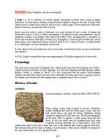
magazines, journals or newspaper. The body of all written works including books is literature. In novels and sometimes other types of books (e.g. biographies), a book may be divided into several large sections, also called books (Book 1, Book 2, Book 3, etc.). A lover of books is usually referred to as a bibliophile, or, more informally, a bookworm. A store where books are bought and sold is a bookstore or bookshop. Books can also be borrowed from libraries. In 2010, Google estimated that there were approximately 130 million unique books in the world. Etymology The word book comes from Old English "bc" which itself comes from the Germanic root "*bk-", cognate to beech. Similarly, in Slavic languages (e.g. Russian, Bulgarian and Macedonian) "" (bukva--"letter") is cognate to "beech". It is thus conjectured that the earliest Indo-European writings may have been carved on beech wood. Similarly, the Latin word codex, meaning a book in
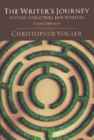
got there. I saw that it's all waves, all of the Universe, just echoes and counter-echoes of the original cosmic sound, not the Big Bang, that's the wrong sound effect. It was more like a gong, that's it, the Great Gong, the original creative vibration that rolled out from a single pinpoint of concentration and unraveled and echoed and collided to create everything that is, and the Hero's Journey is part of that. I watch the sunsets march up and down the horizon, creating my own Stonehenge from the islands and ridge peaks that m a r k solstice and equinox, inviting me to puzzle out the place of stories and my own place in the story of everything. I hope you find your own place in that design. For those to w h o m the concept is new, bon voyage, and for those who are familiar w i t h earlier versions, I hope you find some new surprises and connections in this work, and that it serves you on your own creative journeys. Christopher Vogler Venice, California
Sunlight strikes the buildings on opposite sides, suggesting an exposure that lasted about eight hours, which has become the traditional estimate. A researcher who studied Niépce's notes and recreated his processes found that the exposure must have continued for several days. 7 photography firsts (SEBA) The first photograph of a human was captured by Louis Daguerre in 1838. The exposure lasted around seven minutes and was aimed at capturing the Boulevard du Temple, a thoroughfare in Paris, France. Due to the long exposure time, many individuals who walked the street where not in place long enough to make an impression. However, in the lower left of the photograph we can see a man standing and getting his shoe’s polished. Robert Cornelius set up a camera and took the world’s first self-portrait in 1839 The first hoax photograph was taken in 1840 by Hippolyte Bayard
VDC – Virtual design and construction 4 Introduction With the turn of the millennium, a revolution began in architecture, engineering and the construction industry, aimed at implementing the latest three-dimensional computer aided tools to improve efficiency. Throughout history, some of the most famous architects – Michelangelo, Leonardo, Calatrava, Gehry, Kahn, etc. – have built mock-ups of their projects before beginning construction in order to resolve unforeseen design issues and check for constructability. During the last decade, this model-building has moved into the virtual world in the form of Building Information Modeling (BIM). The idea of an intelligent information rich building model is not new. The identity of BIM dates back nearly 30 years, while the terminology of the “Building Information Model” has been in circulation for at least 15 years.
So In my referent I will try to find out which of these three theories is right or for that popularity have some not mentioned reason. 6 Chelsea through the years, from beginnings to nowadays The Chelsea Flower Show came about practically by accident, as have many great traditions. The world's most famous flower show might have been the Inner Temple or Holland Park Flower Show, or even the Wembley Flower Show had events worked out differently. The first Royal Horticultural Society (RHS) Great Spring Flower Show at Chelsea opened in May 1913, although, confusingly, there was another May flower show the Royal International Horticultural Exhibition held at the Royal Hospital in 1912. This one off event was backed but not run by the RHS, which cancelled its own Great Spring Show for that year.
Australia has around 800 species of birds, 400 of which are unique to this country. There are 55 species of parrots in Australia, and the birds are as numerous as they are colourful. Two types of crocodile, the saltwater and the freshwater crocodile are found in the north. The dingo, or native dog is not really an Australian native. It was bought from Asia around 4000 years ago. The dingo is an effective hunter. To save their sheep from dingo attacks, farmers built many fences to keep the dingo out. These fences didn't work so in 1946 the government built a single fence which stretched 5400 km from Great Australian Bight in South Australia to near the Queensland coast. The single fence worked better. Lyrebirds are covered with brown feathers. They live in forests and woodland in Australia. They eat insects, spiders, beetles and worms. Male lyrebirds can copy many sounds.
Given that the construction industry does not have a particularly good reputation among the public, the first part of this thesis focuses mainly on this problem and its sources. It is the reason why we need new and better business models, like LC and BIM, or even an integration of the two models. Both LC and BIM have been shown to have a profound impact on improving construction processes and therefore, project outcomes, as discussed in the third and the fourth chapters. Different studies and practical experience show that a combination of these originally independent approaches can ensure even better processes. Integrated Project Delivery (IPD), which is discussed in the fifth chapter, is an example of this. In conclusion, a recommendation supported by research is made for improving the Estonian construction industrys performance. Key words: Lean Construction (LC), Building Information Modelling (BIM), Integrated Project
PSYCHOLOGY PART 1: CORE Biological level of analysis Outline principles that define the biological level of analysis. 1) Behavior can be innate, because it is genetically based. Evolution may play a key role in behavior. 2) Animals may be studied as a means of understanding human behavior. 3) There are biological correlates of behavior. Cognitions, emotions and behaviors are products of the anatomy and physiology of our nervous and endocrine system. Explain how principles of the biological level of analysis may be demonstrated in research. 1) Correlational studies: Study by Buss, who hypothesized that across cultures, men will prefer to marry younger women because of greater reproductive capacity and women will place greater value on a potential mate's earning potential to provide survival advantages. This evolutionary hypothesis was tested in 37 cultures by sending out questioners. 2) Twin studies (type of correlational stud
1 The Medium Is the Message In a culture like ours, long accustomed to splitting and dividing all things as a means of control, it is sometimes a bit of a shock to be reminded that, in operational and practical fact,, the medium is the message. This is merely to say that the personal and social consequences of any medium-that is, of any extension of ourselves-result from the new scale that is introduced into our affairs by each extension of ourselves, or by any new technology. Thus, with automation, for example, the new patterns of human association tend to eliminate jobs, it is true. That is the negative result. Positively, automation creates roles for people, which is to say depth of involvement in their work and human association that our preceding mechanical technology had destroyed. Many people would be disposed to say that it was not the machine, but what one did with the machine, that was its meaning or message. In terms of the ways in which the machine altered our relations to
In ancient cultures, religion and medicine were linked. The earliest known institutions aiming to provide cure were Egyptian temples. Greek temples dedicatedto the healer-god, might admit the sick, who would wait for guidance from the god in a dream. The Romans adopted this worship. The Sri Lankans are perhaps responsible for introducing theconcept ofdedicated hospitals to the world. According to an ancient chronicle, written in the 6 th century A.D., a king had lying-in homes and hospitals built in various parts of the country. This is the earliest documentary evidencewe have of institutions built especially for the care of the sick anywhere in the world. Institutions created to care for the ill also appeared early in India, China, the Persian Empire and Rome. · Hospitals Today, hospitals are usually funded by the state, health organisationseither for profit or for non-profit, by health insurances or by charities and by donations. Earlier before, they were
If you stand in Trafalgar Square in London with your back to Nelson's Column, you will see a wide horizontal front in a classical style. It is the National Gallery. It has been in this building since 1838 which was built as the National Gallery to house the collection of Old Masters Paintings (38 paintings) offered to the nation by an English Private collector, Sir George Beamount. Today the picture galleries of the National Gallery of Art exhibit works of all the Euro-pean schools of painting, which existed between the 13th and 19th centuries. The most famous works among them are `Venus and Cupid' by Diego Velazquez, `Adoration of
UNO SOOMERE ESTONIAN SYMPHONIC MUSIC. THE FIRST CENTURY 1896-1996. AN OVERVIEW With a Historical and Cultural Summary IN MEMORY OF THE GREAT ESTONIAN COMPOSERS CONTENTS ESTONIA AND THE ESTONIANS FOREWORD IN THE FOLD OF TSARIST RUSSIA. EMERGENCE AND FIRST STEPS ON THE CLASSICAL-ROMANTIC PATH. HISTORICAL INTRODUCTION I. MUSICAL LIFE IN TARTU AT THE TURN OF THE CENTURY. TRAILBLAZERS: ALEKSANDER LÄTE, RUDOLF TOBIAS, ARTUR KAPP. II. THE FIRST DECADE OF THE 20TH CENTURY. ARTUR LEMBA: THE BEGINNING OF ESTONIAN SYMPHONY AND OPERA. III. NEW DEVELOPMENTS IN CULTURAL AND MUSICAL LIFE: THE END OF THE TSARIST PERIOD. THE INDEPENDENT REPUBLIC OF ESTONIA: THE INTRODUCTION OF INNOVATIONS FROM WESTERN ART AND THE EVOLUTION OF NATIONALLY ORIENTED MUSICAL TRENDS. IV. THE TWENTIES. ARTUR KAPP: ROMANTICIST AND DRAMATIST. V. THE INFLUENCE OF NEW WESTERN MUSICAL TRENDS. HEINO ELLER: A PROGRAMME PAINTER.
To be honest, he needed to get his thighs closer to parallel. "Forty air squats, to be exact," I offered. Kevin Rose, founder of Digg, one of the top-500 most popular websites in the world, joined in the laughter and raised a beer to toast the incident. I, on the other hand, was eager to move on to the main event. In the next 45 minutes, I consumed almost two full-size barbecue chicken pizzas and three handfuls of mixed nuts, for a cumulative total of about 4,400 calories. It was my fourth meal of the day, breakfast having consisted of two glasses of grapefruit juice, a large cup of co ee with cinnamon, two chocolate croissants, and two bear claws. The more interesting portion of the story started well after Trent Reznor left the stage. Roughly 72 hours later, I tested my bodyfat percentage with an ultrasound analyzer designed by a physicist out of Lawrence Livermore National Laboratory. Charting the progress on my latest experiment, I'd dropped from 11.9% to 10
 annaabi.ee