Tia´s disloyalty manifests the allure and corrupting power of money. She desires money more than a lovely childhood friendship. Secondly, the black women feel more comfortable in their own skin and they are not afraid to express their thoughts and insults. Persecution by a black female is most notably seen when Antoinette describes being followed by a young black girl who sings “go away white cockroach, go away“. Thirdly, the black women are portrayed as self-sufficient and able to do decisions without men, especially Christophine. She is a wise and loyal figure. Christophine introduces Antoinette to the black culture of the Caribbean and instills in her a sensitivity to nature and belief in the practices of obeah. She is an outsider because she dresses and speaks differently from the Jamaican blacks. She is a servant, but, unlike the other black servants who live at Coulibri, she remains loyal to the Cosway women
Page 1 of 5 Dear women around the world, I would like to share my thoughts with you about something that has been an issue in our society for too long. + Are you not tired of us being portrayed only as sex objects, stupid, helpless and only necessary as housewives, who cannot survive without a man? Well, I am and I think it is time to take real action about this problem! We can’t let the advertisers carry on without any moral responsibility. I understand that we live in a very sexualized world, which means subsequently that sexual content dominates in media
Pille Põiklik October 8, 2013 She Set a Path for a Modern-Day Woman Jordan Baker did not play a primary character in The Great Gatsby and she definitely did not start out as the most likeable one, yet oddly enough, she ended up being my favourite. The reason for that is simple: she portrayed a present-day woman who might have been vain, and at times, careless but she was also fairly independent and knew how to take care of herself in a world where women were thought of as nothing more than merely housewives. I truly respect the qualities she possessed, even though they were not always admirable and considerate of others. The number one trait I liked about Jordan as a character was her
Beyond the limits- piire ületades/piiridest kaugemale Developed such a special bond- loonud (sellise) erilise sideme Brought up on a farm- farmis üles kasvatatud How to interpret- kuidas tõlgendada/selgitada Dedicated to- pühendunud (millesegi) A unique and unforgettable- eriline ja unustamatu The negative perception- negatiivne mulje He aims to sh savagely fierce ow people- ta soovib näidata inimestele The ferocious and mindless- metsik ja tundetu Are portrayed in the media- kujutatakse meedias Have personalities- omavad iseloomu Interacting with people- inimestega suhelda To swim alongside them- ujuda nende kõrval Occasionally- mõnikord Dorsal fin- seljauim Marvel at- imetlema (midagi/kedagi) An endangered- ohustatud (kasutatakse ohustatud liikide puhul)
22. Gladstone was Sherlock's and Dr John Watson's dog who was used for experiments. 23. The iconic structure being built in the movie is The Tower Bridge. 24. The last line of the movie is "Clarky? Case reopened." 25. Sherlock Holmes was originally going to be called Sherrinford. Sherlock Holmes Did Not Know That the Earth Revolves Around the Sun! The Sherlock Holmes Museum both is and isn't at 221B Baker Street. Sherlock Holmes Is the Most Portrayed Literary Human Character on Film and TV. Sherlock Holmes Is the Most Portrayed Literary Human Character on Film and TV.
Sarah Michelle Gellar 34 years ago a star was born Sarah Michelle Gellar. She is a American actress,most known from her own Tv-series ,,Buffy the Vampire Slayer" where she portrayed a young girl who killed vampires and demons. Sarah Michelle Gellar has had a lot of acting jobs through the years. One of her first succsessful movies was ,,Cruel Intensions" where she played the role of Kathryn Merteuil. Even though everybody sees her as Buffy she has managed to keep on the good work in movie business. She has played in movies like "Grudge", "Scooby-Doo", "I know what you did last Summer" etc. Right now she is back in the Tv business and has her own show called "Ringer"
children • He became a painter at age of 27. Before that he tried many professions, such as teacher, preacher, art salesman, working in a bookstore etc • He struggled with a mental health disorder throughout his lifetime • He died in France in 1890 when he committed a suicide (while being only 37 years old) Art • Van Gogh's first paintings were mostly of poor people. The colors in his early paintings are dark and brown (muddy). The feelings portrayed were of sadness • In his later paintings Van Gogh started to lighten his colors and paint in short brushstrokes. His paintings started to look much happier, brighter and more colorful • His paintings include portraits, self portraits, landscapes, still lifes, olive trees, wheat fields and sunflowers • In 10 years Vincent van Gogh painted almost 900 paintings • During his lifetime Van Gogh was never famous as a painter and struggled to make a living as an artist.
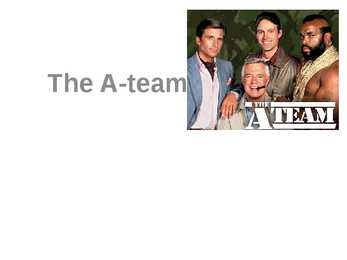
one additional, previously unbroadcast episode shown on March 8, 1987), for a total of 98 episodes. Story The show remains prominent in popular culture for its cartoonish, over-the-top violence (in which people were seldom seriously hurt), formulaic episodes, its characters' ability to form weaponry and vehicles out of old parts, and its distinctive theme tune. The show boosted the career of Mr. T, who portrayed the character of B. A. Baracus, around whom the show was initially conceived. [1][2] Some of the show's catchphrases, such as "I love it when a plan comes together,"[3] "Hannibal's on the jazz," and "I ain't gettin' on no plane!" have also made their way onto T-shirts and other merchandise. The show's name comes from the "A-Teams," the nickname coined for U.S. Special Forces' Operational Detachments Alpha (ODA) during the Vietnam War,[4] although this connection was never referenced on-screen.
Astrid’s books can be traced back to her own childhood. As an author, she had a certain impact on the world of children’s literature. Her books on children are loved all around the globe. Pippi Longstocking, one of the most loved books, has been translated into 60 languages. It has sold over five million copies in the United States alone. This character was created after the birth of her daughter, Karin. A number of people objected to this character as she was portrayed to be dangerous. Her debut in writing was made at a time when women were mostly involved with domestic work or engaged in stuff like embroidery. Astrid disregarded the barriers that came her way and went straight to strike for what she believed in. Pippi jumped right into the world of boys and grown-ups without any permission. She was bold and gave her opinion on anything to anyone. Pippi would never just sit and wait for her prince charming to come riding on his white stallion
black culture of the Carribean, even though she told her that “this isn’t for béké. Bad, bad trouble come when béké meddle with that” (béké-white people). I think she loved Antoinette as her own daughter so it was natural for her to help her daughter however she could, even if it meant that she agreed to give Antionette potion for her husband. Liisa-Maria Pihlak, 12B Christophine was different than other Jamaican blacks-the way she talked and dressed was different and she was portrayed as kind of an outsider. She once was a slave, but now, to her family, she was a very loyal servant. She was very helpful, concerned and loyal towards the people she cared about. She appeared to share her nature with the Caribbean Islands, she seemed to somehow be a part of them. At the same time she feared greatly for her knowledge of the dark magic. I’d say that Christophine had quite an influential role in the book. She took over
Statistics reveal that, on average, a child watches up to 5 h of television per day and spends an average of 6 to 7 h viewing the various media combined. Body image issues have been on the rise rince the introduction of social media websites that hoste the idea of ,,perfect" or ,,idealized" body sizes. Over the past 20 years, several articles have proposed a link between the thin female beauty ideal and the muscular male body ideal portrayed in the media with a range of psychological symptomatology including body dissatisfaction and eating disorders. Over time the cultural ideal for women's body size and shape has become considerably thinner and leaner and men's body size and shape has become stronger and more muscular. Websites such as Tumblr, Lookbook , Instagram and also Facebook feature photos that can be recognized as harmful towards any person with a mental disorder. However, they can also be
Overview ''Jane Eyre'' was published in 1847 and brought fame to its author, Charlotte Bronte. The book incorporates many themes: the relations between men and women, gender equality, the treatment of children and of women, religious faith and religious life and the notion of true love. The 2011 movie is a faithful and intelligent adaptation of the classic novel. The film follows the basic storyline closely although the approach to the story and the way certain characters are portrayed differs from the novel. Analysis The book describes her as being unremarkable in the way she looks. The film preserves this premise and therefore maintains the importance placed on her character. The film's interpretation of the harsh manner Mr. Brocklehurst and the rigid strictness of the school are the same as the novel. There film deviates in two ways, however. Firstly, the way in which Jane's relationship with the school authorities develops is less evident in the film.
If I was being bitchy I'd say that (the empty. Wright imbues his characters admittedly flawed) Whip It is a better with a charming sincerity and openness, movie purely because it's a teen movie with Scott and his friends willing to about escaping suburban boredom and embrace novelty and accept difference. clearly loved the subculture it portrayed They're smart, too. "Don't let the past rather than just being Singles seen ruin the future", someone says in a rare through a WiiLaedoscope. quiet moment, sound advice whatever the age bracket. "In Spaced we had a lot of fantasy sequences and dream sequences," Wright said. "Scott Pilgrim felt like the dream scene that never ends. I was really just kind of hooked on the
Catholic Church in the Middle Ages. The first of the Crusades began in 1095, when armies of Christians from Western Europe responded to Pope Urban II's plea to go to war against Muslim forces in the Holy Land. 11.How would you describe Medieval or Chivalric Romances? Chivalric romance is a type of prose and verse narrative that was popular in the aristocratic circles of High Medieval and Early Modern Europe. They were fantastic stories about marvel-filled adventures, often of a knight-errant portrayed as having heroic qualities, who goes on a quest. 12.What is courtly love? It was a medieval European literary conception of love that emphasized nobility and chivalry. Medieval literature is filled with examples of knights setting out on adventures and performing various services for ladies because of their "courtly love". 13.What is a fableaux? A medieval verse tale characterized by comic, ribald treatment of themes drawn from life. 14.William Langland ,,The Visions of Piers Ploughman" 15
way. High-involvement products – things that portray social symbolism and status. These products are more expensive, they depict social class and are leveraged for acceptance to those classes. There is uncertainty and risk involved in this buy. There is often post buy regret and rationalisation for the reason of that buy. To reduce the risk, the difference with competition needs to be delivered to the customer. The brand has to be portrayed unique and therefore has to be perceived more valuable (as it is more expensive). The communicators of brands must here be cautious of consumers’ perspectives to address all uncertainties in the right way. The author stresses that ‘the diffusion of an innovation is mostly reliant on the social acceptance of a collective social system and only partly on the change agent’s or communication manager’s initial awareness–creation campaigns.’ Conclusion
"The English Patient" is the most well-known book by Canadian writer, poet and academician. The main activity happens in 1930.-1940. Egipt and during the last days of World War II in one Italy nunnery which was changed after the war to sickbay. · Almásy is not English. He is Hungarian by birth. Almásy's manner is knowledgeable and reflective. Almásy is not a highly dynamic character, he is intriguing and mysterious figure. He is portrayed in a sympathetic light. He was part of a British archaeological group and also as afterwards reveals a spy. · Hana was a twenty-year-old Canadian Army nurse. She put all of her energy into caring for the English Patient. When the hospital was abandoned, Hana refused to leave and instead stayed with her patient. She sees Almásy as saint like and with the "hipbones of Christ". She falls in love with the English Patient in a purely non-sexual way. She also cut off
Elizabeth became Queen in 1952, whilst on an official trip to Kenya, after the death of her father. Her coronation in 1953 was the first to be televised and was broadcast internationally. Her sons, Princes Andrew and Edward, were born in 1960 and 1964. As Queen of the United Kingdom and Head of the Commonwealth, her Silver, Golden and Diamond Jubilees were celebrated in 1977, 2002 and 2012. She is now the longest-serving British monarch and the most portrayed individual in history. To cut the long story short, I would like to tell you the line of succesion and thats will be enough. Today, there are four generations of the House of Windsor. As a royal house that is continually evolving, 2013 saw a landmark change take place. Under the Succession to the Crown Act, male heirs no longer take precedence over their sisters, bringing an end to the system of preference that existed since the Act of Settlement of 1701
during the French Revolution, people who saw the painting would become more affectionate towards the Revolution and the new Republic, and would see Marat as a role model. (Vaughan,????????????????, p.56, 57) Last but not least, the third martyr that David depicted was Joseph Bara. Bara was a young boy, who anchored himself to an army fighting the opposers of the Revolution. He was murdered, because he refused to give away two horses to the counterrevolutionaries. David portrayed him as an innocent victim and therefore the painting of Bara was very different from two previous martyr portrays. Bara is depicted as lying naked on the ground with a national emblem in his hand. David did not paint the real story, but instead portrayed Bara as being killed after being surrounded by enemies who demanded him to cry out `Long live the King!' . As usual for Jacques-Louis David, he made the story and the person better than it actually was
to feel as if they might as well be the next love itnerest of a steamingly attractive vampire. To me, Bella really seems to be an incredibly unfortunate creature. She doesn't seem able to be happy about anything, doesn't have any hobbies or real friends, because apparently their unperfectness seems to annoy her, as well as the fact that there are people around her, that take interest in her, even though she is portrayed in the book as an empty, emotionless doll, with a threetrack mind : ,,Edward",,"Edward's toned chest" ,,Charlie's dinner every once in a while" (thank god for the last one!) Nothing else really seems to interest her. I liked her in the first chapter, especially her witty, sarcastic jokes, remarks and observations, which gave the character a great potential to develop, but eventually it failed miserably.
On a number of occasions chart data, particularly in canals, locks, harbours, ports and alongside wharves could not withstand the resolution of the ECDIS ‘zooming’ function. In many instances, the result has been that the ship’s image on an ECDIS display is depicted as overlapping the dock or jetty. There are many contributing factors that may suggest that the ship’s image on the ECDIS screen is portrayed where ‘it does not belong’. These are due to GPS errors; DGPS errors; ECDIS errors; Installation errors; ENC conversion errors; chart errors; and hydrographic survey errors. There is also the factor of humaninduced error. Risk of under or overinterpretation Errors may result in the conversion process when data from an ENC is used by the manufacturer of an ECDIS system
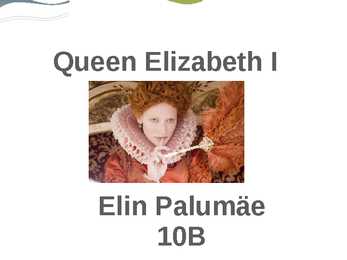
English literature entered their maturity, including William Shakespeare and They owed little directly to the queen, Christopher Marlowe. who was never a major patron of the During this period and into the Jacobean era arts.As Elizabeth aged her image that followed, the English theatre reached its gradually changed. highest peaks. She was portrayed as Belphoebe or Astraea, and after the Armada, as Gloriana, the eternally youthful Faerie Queene of Edmund Spenser's poem. Death Despite the presence of several other claimants to the throne, the transition of To rectify this, James had power went smoothly. Parliament pass the James's succession set aside Succession to the Crown Act
. 11 INTRODUCTION The Mysterious Affair at Styles is a detective novel by Agatha Christie. It was written in 1916 and was first published by John Lane in the USA in October 1920 and in the UK by The Bodley Head (John Lane's UK company) on January 21 1921. In her first novel, The Mysterious Affair at Styles(1920), she created the now-famous Belgian detective Hercule Poirot, the most popular sleuth in fiction since Sherlock Holmes. Poirot and Marple have also been portrayed in the many films, radio programmes and stage plays based on her books.It is Christie's first published novel, and introduces Hercule Poirot, Inspector Japp and Lieutenant Hastings (later, Captain) The story is told in first person by Hastings, and features many of the elements that, thanks to Christie, have become icons of the Golden Age of Detective Fiction. It is set in a large, isolated country manor. There are a half-dozen suspects, most of whom are hiding facts about themselves.
world of ancient Germanic legend. He writes his folk-tales and legends in a web of other events, mainly set in the Baltic Kingdoms. He shows a very rich and leisurely portrayal of this Baltic world, providing many customs like the close relationship between lord and man in the war-band and others. All this encouraged the supposition that the unknown author of the poem was himself a bard of the ancient type portrayed within the poem (a lord's scoop). However, many people propose that the author could be Christian poet, perhaps a monk, versed not only in old native traditions, but also in the culture and literature of the Latin Church, and whose purpose of writing was highly moral. For example, the fate is a `providentia' and the monster Grendel is an embodiment of evil fighting against Christian militant. This contrast corresponds to the poem itself
Intended to be incorporated into polychrome architecture, they are among his most abstract paintings, featuring flat areas of color that appear to advance or recede.[10] Starting in 1927, the character of Léger's work gradually changed as organic and irregular forms assumed greater importance.[11] The figural style that emerged in the 1930s is fully displayed in the Two Sisters of 1935, and in several versions of Adam and Eve.[12] With characteristic humor, he portrayed Adam in a striped bathing suit, or sporting a tattoo. In 1931, Leger visited New York City and decorated Nelson Rockefeller's apartment.[13] In 1935, the Museum of Modern Art in New York City presented an exhibition of his work. During World War II Léger lived in the United States, where he found inspiration in the novel sight of industrial refuse in the landscape. The shock of juxtaposed natural forms and
production Clash by Night. After the film performed well, Fox employed a similar tactic, and she was cast as the ditzy receptionist with Cary Grant and Ginger Rogers in Howard Hawks's slapstick comedy Monkey Business. Critics no longer ignored her, and both films' success at the box office was partly attributed to Monroe's growing popularity. Fox finally gave her a starring role in 1952 with Don't Bother to Knock, in which she portrayed a deranged babysitter who attacks the little girl in her care. It was a cheaply made B-movie, and although the reviews were mixed, they claimed it demonstrated Monroe's ability and confirmed she was ready for more leading roles. Her performance has been noted as one of her finest.[21] As Rose in Niagara. Stardom Monroe proved she could carry a big-budget film when she starred in Niagara in 1953. Movie critics focused on Monroe's connection with the camera as much as on the sinister plot
conflict. · The "magical" or "sorcerer" witch: either a professional healer, sorcerer, seer or midwife, or a person who has through magic increased her fortune to the perceived detriment of a neighbouring household; due to neighbourly or community rivalries and the ambiguity between positive and negative magic, such individuals can become labelled as witches. · The "supernatural" or "night" witch: portrayed as a demon appearing in visions and dreams. The familiar witch of folklore and popular superstition is a combination of numerous influences. The characterization of the witch as an evil magic user developed over time. The Protestant Christian explanation for witchcraft commonly involves adiabolical pact. The witches or wizards engaged to such practices were alleged to reject Jesus and the sacraments; observe
The eloquence of Bible united with the vigorous realism of common speech. John Donne: Six Sermons, Fifty Sermons, Essayes in Divinity, Sermons Never Before Published. Andrewes: 12. The baroque style as the embodiment of the Restoration ethos Baroque was to prove to be the ideal style to reflect what was deeply broken society, one that was to remain in political and religious turbulence until the II half of 18th C. It always portrayed precisely that scenario: forces in conflict, opposites and extremes confronting, and at the same time, seen to be manifestations of an ordered whole. Role: to give the thruths of the sphere of heaven (fixed, immovable and permanent). Art of Baroque: flux and paradox, illusion and seeming, searching for eternal thruths. Vehicle for new and very emotional piety of Counter-Reformation Catholicism, ideal to express absolute monarchy. It was expensive
in San Francisco and Los Angeles. · Alien land laws (1913) prevented the Japanese from owning land *They are not so successfully accepted in the society since the Pearl Harbor case has distained their image and made bad prejudice about them. Despite not having anything to do with the war, Japanese Americans still feel responsible for it and stay low and try to prove their trustworthiness to Americans. Even before Pearl Harbor (1941) Japanese Americans were portrayed as disloyal, as potential spies. Beginning of acception. From enemy to ally! Competition in the engineering, industry field. *Vietnamese Americans = *Vietnamese Americans = Before 1975 numbers of Vietnamese Americans insignificant · The first wave of immigration 1975 had close ties with the American military · 197981 mostly from rural backgrounds, with limited education · Largest numbers in California and Texas (Westminster, California)
Women in romantic literature even more restricted than during Middle Ages; depicted as utterly devoted to their men with no character of their own. Early 19th century – “feminine romantics” or “anti-‐romantics”. Maria Edgeworth, Mary Hays and Jane Austen portrayed the lack of intelligence and moral virtue of both men and women; dangers of romantic love and failures of traditional marriages. Jane Austen (1775–1817) – best known for Sense and Sensibility, Pride and Prejudice and Mansfield Park. Writes much about marriage and families; sisterhood
harder to find when you stay in the same place. So, for example, really simple words like freedom, spontaneity, aloneness, miracles, and newness (Ryan, Australian, 48). A traveller identity, like all social identities, is based on a belief of what one is not in relation to the Other (Hall, 1996). Thus, whilst life on the road is positively valued by the participants, life at home is portrayed in opposition as constraining, regressive, boring, routinised, materialistic and production-oriented: I couldn’t live the same lifestyle back home. I didn’t have the same free spirit there. There’s too many rules, regulations, taxes, laws, everything’s confined. It’s too constrictive for me now with the way I feel, the way I think, the way I want to live. I think if you travel long enough, there comes a point in time where you’re
abused) and as dangerous/deviant children who challenge the romantic outlook of western childhood, and pose credible threat to adult`s authority and hegemonic position. Such an unfairly, denigrating portrayal of children however is greatly undermining children`s opportunity to be taken seriously by adults. Their perceived intellectual incompetency and irrationality frames the childhood as an a-political arena of thought and practice in which children are portrayed as being `unable to articulate a set of coherent political views`.60 While on the one hand the Newsround news stories of the Iraq War encouraged children to discuss the war at school and in school assemblies, the actual political participation of children during the youth protests against the Iraq War in 2003 were 57 Cyntia Carter and Stuart Allan, `Public Service and the Market: A case Study of the BBC Newsround Website, Intervention Research, 1(2) (2005) 209-225 (p.220).
Fourthly through this revisionism science is presented as a cumulative endeavour whereby incremental improvements in solutions to central problems lead to the paradigm change. In this manner the subtleties around the scientific revolution become invisible. Kuhn gives examples to support his argument about the importance of historical context in scientific revolutions. This chapter addresses an important criticism of Kuhn’s central arguments namely that scientific revolutions are portrayed as cumulative developments of scientific knowledge rather than transformational paradigm shifts. Kuhn’s response is to characterise the simplistic narratives as examples of historical revisionism and he emphasises the importance of context in interpreting scientific revolutions. 12 peatükk Kuidas võistleva paradigma osad muudavad terve eriala või tähtsa osa sellest, kuidas vaadeldakse teadust ja maaillma? Mis põhjustab inimesi hülgama ühte normaal uurimistöö traditsiooni teise vastu
somewhat adj. partial n. part The clerk was only partially responsible for the error. The business venture was only a partial success. pass v. to accept formally by vote adj. passable Syn. approve n. passage The proposed amendment passed unanimously. The passage of the resolution is in doubt. portray v. to represent; to act n. portrayal Syn. depict The girl portrayed an orphan. The book's portrayal of Mozart as a calm, mature individual is absurd. submit v. to turn in, offer for evaluation n. submission Syn. propose The architects had to submit plans reflecting the new specifications. The submission of the application must be made by February 13. MATCHING Choose the synonym. 1. Launch 6. Relate (A) Overcome (A) Restore (B) Initiate (B) Record (C) Persuade (C) Narrate
is now presented to thy lips!"(Dimmesdale 47) things would have been infinitely better for everyone. Everyone Hester Prynne loves, she does in a hypocritical way. She loves Pearl enough to sacrifice to feed and clothe her, but she does not love Pearl enough to give her a father. Hester loves Dimmesdale, but she does not love him enough to expose his sin publicly, and she conceals her knowledge of Chillingworth. Either you love something wholeheartedly, or you don't. Hawthorne might have portrayed Hester in a more favorable light then the other characters, but still she should have to wear a scarlet H in addition to her A. The second character, Arthur Dimmesdale is the epitome of hypocrisy. Hawthorne intended his name to have symbolic meaning. Dimmesdale meaning dim or not very bright. Arthur might be bright in the areas of theology, but when it comes to hypocrisy, he is a fool
2 well-drawn 9 series 4 They were horrified by it. getting enough to eat because 3 story-lines 10 half 5 Both attack the `American the shepherds in the area were 4 unlike 11 set Dream' as a way of life with its particularly vigilant. One day he was 5 such as 12 unwind overemphasis on making money. coming came across a sheep's fleece 6 portrayed 13 slushy which a sheep shearer had been 7 like 5 1 protagonist 4 livelihood throwing thrown on the floor and 2 exonerated 5 integrity forgotten. It had given gave the wolf 2 1 like 5 like 3 deceit 6 reiterated a cunning idea. He decided that later
nature. In the Thirties Eugen Kapp’s first works were noticed. He graduated from the Tallinn Conservatoire as a student of his father, Artur Kapp, in composition. The tone poem Tasuja (The Avenger, 1931) was his graduation work, and concerns the historical events of the Fourteenth century. A suite for orchestra and smaller works followed. In the fantastic overture Kalevipoeg (1938)1, based on the national epic, the young composer has portrayed both the mythical hero and his opponent the evil Sorcerer. In the introduction appears the sneaking image of the latter becoming the main theme: Example 34. Solo instruments emphasise the mysterious and dark Sorcerer. The theme of Linda, mother of the hero, follows: it is wistful, crisp and affectionate. It is regrettable that the composer has ignored this beautiful image in the development.
oriented and loner Heroes, Anti-heroes, tragic Heroes, and catalyst Heroes. Like all the other archetypes, the Hero is a flexible concept that can express many kinds of energy. Heroes m a y combine with other archetypes to produce hybrids like the Trickster Hero, or they m a y temporarily wear the mask of another archetype, becoming a Shapeshifter, a M e n t o r to someone else, or even a Shadow. Although usually portrayed as a positive figure, the Hero may also express dark or negative sides of the ego. T h e Hero archetype generally represents the human spirit in positive action, but may also show the consequences of weakness and reluctance to act. WILLING A N D UNWILLING HEROES It seems Heroes are of two types: I ) willing, active, gung-ho, committed to the adventure, without doubts, always bravely going ahead, self-motivated, or 2 ) unwilling,
They can act as a mirror in which humanity sees its own insanity. That in you which recognizes madness as madness (even if it is your own) is sanity, is the arising awareness, is the end of insanity. Such films do exist and they do not fuel the pain-body. Some of the best antiwar films are films that show the reality of war rather than a glamorized version of it. The pain-body can only feed on films in which violence is portrayed as normal or even desirable human behavior, or that glorify violence with the sole purpose of generating negative emotion in the viewer and so become a “fix” for the pain-addicted pain-body. The popular tabloid press does not primarily sell news but negative emotion – food for the pain-body. “Outrage” screams the three-inch headline, or “Bastards.” The British tabloid press excels at this. They know that negative emotion sells far more papers than news does.
one who did not know that). We use the name "Santa Claus" as though it abbreviates a description. A similar example would be that of "Dracula." It is well known that the contemporary use of that name goes back to a real Transylvanian nobleman called "Vlad" (commonly, "Vlad the Impaler," in virtue of his customary treatment of people who had annoyed him). But of course when we now say "Dracula" we mean the fictional vampire created by Bram Stoker and portrayed by Bela Lugosi in the famous movie. 56 Reference and referring Having merely raised the problem, Kripke does not try to patch his account in response, but moves on. Probably the most obvious feature to note is that "Santa Claus" and "Dracula" as we use those names are associated with very powerful stereotypes, indeed cultural icons in the United States. Their social roles are so prominent that they really have ossified into fictional
15. THE CULLENS 16. CARLISLE 17. THE GAME 18. THE HUNT 19. GOODBYES 20. IMPATIENCE 21. PHONE CALL 22. HIDE-AND-SEEK 23. THE ANGEL 24. AN IMPASSE EPILOGUE: AN OCCASION twilight STEPHENIE MEYER LITTLE, BROWN AND COMPANY New York Boston Text copyright © 2005 by Stephenie Meyer All rights reserved. Little, Brown and Company Time Warner Book Group 1271 Avenue of the Americas, New York, NY 10020 Visit our Web site at www.lb-teens.com First Edition: September 2005 The characters and events portrayed in this book are fictitious. Any similarity to real persons, living or dead, is coincidental and not intended by the author. Library of Congress Cataloging-in-Publication Data Meyer, Stephanie, 1973-- Twilight : a novel / by Stephanie Meyer. -- 1st ed. p. cm. Summary: When seventeen-year-old Bella leaves Phoenix to live with her father in Forks, Washington, she meets an exquisitely handsome boy at school for whom she feels an overwhelming attraction and who
attractive than he or she actually is.8 Another demonstration of perceptual contrast is sometimes employed in psy- chophysics laboratories to introduce students to the principle. Each student takes a turn sitting in front of three pails of water-one cold, one at room temperature, and one hot. After placing one hand in the cold water and one in the hot water, the 8Some researchers warn that the unrealistically attractive people portrayed in the popular media (actors, actresses, models) may cause us to be less satisfied with the looks of the genuinely available romantic possibilities around us. For instance, one study demonstrated that exposure to the exagger- ated sexual attractiveness of nude pinup bodies (in such magazines as Playboy and Playgirl) causes people to become less pleased with the sexual desirability of their current spouse or live-in mate (Kenrick, Gutierres, &. Goldberg, 1989).
 annaabi.ee