 50 punkti
Autor soovib selle materjali allalaadimise eest saada 50 punkti.
50 punkti
Autor soovib selle materjali allalaadimise eest saada 50 punkti.
 ~ 2 lehte
Lehekülgede arv dokumendis
~ 2 lehte
Lehekülgede arv dokumendis
 2014-01-13
Kuupäev, millal dokument üles laeti
2014-01-13
Kuupäev, millal dokument üles laeti
 4 laadimist
Kokku alla laetud
4 laadimist
Kokku alla laetud
 0 arvamust
Teiste kasutajate poolt lisatud kommentaarid
0 arvamust
Teiste kasutajate poolt lisatud kommentaarid
 sannu3744
Õppematerjali autor
sannu3744
Õppematerjali autor
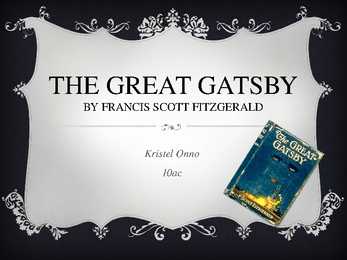
THE GREAT GATSBY BY FRANCIS SCOTT FITZGERALD Kristel Onno 10ac FRANCIS SCOTT FITZGERALD Francis Scott Key Fitzgerald was born in 1896 and raised in St. Paul, Minnesota attended three different preparatory schools before entering Princeton University in 1913. In his senior year he dropped out of school LOVE AND WAR He joined the army , as World War I neared its end He fell in love with Zelda Sayre, who didn't married him until he provided for her financially. The Fitzgeralds became part of the wealthy, extravagant society of this time. FITZGERALD'S DECLINE he decline of Fitzgerald's personal and rtistic life ended in the 1920s. cott was forced to write "hack work" o support their lifestyle. is addiction to alcohol increased. elda died in a fire e died of a heart attack at age 44. BOOK CHARACTERS ick Carraway is the sory narrator. He is 29yea
Character Sketch – Daisy The Great Gatsby by F. Scott Fitzgerald Daisy Buchanan is a beautiful young woman from Louisville. She is the cousin of the novel’s narrator Nick Carrayway and the love interest of Jay Gatsby. She is married to an extremely rich and arrogant man called Tom Buchanan. Tom and Nick are acquaintances from college. Daisy-s appearance and the long-lasting impression she left on men is described through her voice by her cousin Nick. I looked back at my cousin, who began to ask me questions in her low, thrilling voice. It was the kind of voice that the ear follows up and down, as if each speech is an arrangement of notes that will never be played again. Her face was sad and lovely with bright things in it, bright eyes and a bright passionate mouth, but there was an excitement in her voice that men who had cared for her found difficult to forget: a singing compulsion. Jay Gatsby is the one who fell for Daisy’s seductive and
“The Great Gatsby” test 1. The advice given to Nick from his father was “Whenever you feel like criticizing anyone, just remember that all people in this world haven’t had the advantages that you’ve had.” 2. Nick decided to go to the East to learn the bond business. 3. Tom and Daisy travelled there because there were rich people who played polo. 4. Daisy’s relation to Nick was that she was his second cousin. 5. Myrtle was a bit heavy, in her mid-thirties, not beautiful but rather sensual. 6. The surprising thing that Gatsby said to Jordan Baker at the party was that he wanted her to tell Nick to invite Daisy to Nick’s house. 7. The unpleasant story that Nick had heard about Jordan Baker was that she had moved a ball during a golf tournament to win. 8. Jordan Baker hated people who were careless. 9. Daisy met Jay Gatsby at her hometown, Louisville, Kentucky just before the war. 10. Daisy was very drunk before her wedding. 11.
The Project Gutenberg EBook of Pride and Prejudice, by Jane Austen This eBook is for the use of anyone anywhere at no cost and with almost no restrictions whatsoever. You may copy it, give it away or re-use it under the terms of the Project Gutenberg License included with this eBook or online at www.gutenberg.org Title: Pride and Prejudice Author: Jane Austen Release Date: August 26, 2008 [EBook #1342] [Last updated: August 11, 2011] Language: English Character set encoding: ASCII *** START OF THIS PROJECT GUTENBERG EBOOK PRIDE AND PREJUDICE *** Produced by Anonymous Volunteers, and David Widger PRIDE AND PREJUDICE By Jane Austen Contents Chapter 1 Chapter 22 Chapter 2 Chapter 23 Chapter 43 Chapter 3 Chapter 24 Chapter 44 Chapter 4 Chapter 25 Chapter 45
"Anna Karenina" Lev Tolstoi Part 1 The novel opens with a scene introducing Prince Stepan Arkadyevitch Oblonsky, "Stiva", a Moscow aristocrat and civil servant who has been unfaithful to his wife Darya Alexandrovna, nicknamed "Dolly". Dolly has discovered his affair - with the family's governess - and the house and family are in turmoil. Stiva's affair and his reaction to his wife's distress shows an amorous personality that he cannot seem to suppress. In the midst of the turmoil, Stiva reminds the household that his married sister, Anna Arkadyevna Karenina is coming to visit from Saint Petersburg. Meanwhile, Stiva's childhood friend Konstantin Dmitrievich Levin ("Kostya") arrives in Moscow with the aim of proposing to Dolly's youngest sister Princess Ekaterina Alexandrovna Shcherbatskaya, "Kitty". Levin is a passionate, restless but shy aristocratic landowner who, unlike his Moscow friends, chooses to live in the country on his large estate. He discovers that Kitty is also be
Chapter1: An unknown woman was found lying in the street and brought into the workhouse. She delivered a sickly child who had trouble breathing. The woman, without a word of who she was, died and left her new born boy, Oliver, to the drunken nurse that stood by. Chapter2: The State gave Oliver to Mrs. Mann who housed a number of orphaned children. Mrs. Mann took a large portion of the money given to her by the authorities for each child's food so Oliver grew up small and malnourished. On his ninth birthday, the town beadle, Mr. Bumble, came to collect Oliver and take him to the board for an interview. They told him he was to live with other wards of the state to become educated and learn a trade. Oliver did not mind this, but soon after he arrived, the state decided to implement a plan that would save money by feeding the people very little. After a time on this diet, the boys at the table chose Oliver to go ask the head cook for more gruel. Oliver did this, and was taken away. A flye
Ameerika Kirjandus 30.01.13 Naturalism · France, Emile Zola · Put down his theory in 1879: Le Roman Experimental, attempt to explain the development of human society throuch biological laws · Outlook is deterministic, pessimistic, fatalistic (fate or biology) · Man as an animal-clever than other beasts, still explainable within the framework · Man is not a free agent, is govern by something · Unable to determine his own faith · Hereditary · Naturalists tried to apply in fiction the processes of natural sciences · Writers task is to record facts, systems of behaviour, living conditions, never revealing any natural unbiased (completely natural) · Point of view: amoral-outside the category of morality, neither good or bad · Naturalist find it absurd to blame the wicked. These criminals are doing what nature, environment, their unconscious tells them to do. Naturalists do not judge their characters, they sim
American literature The literary history of this nation when the first humanbeing living in what has since become the U.S used language creatively. · Mid to late 18 century put down · Words are powerful, magical · Words must be remembered · Native Americans stories creation of the world · Attidude thought their land/language · Similar stories Dates and names · America was discovered in 1492 by Columbus · 1497 John Cabot went to Canada · 1579 San Fransisco/St. Fransis · 1607 Jamestown collony/John Smith · 1620 a boat called MayFlower · 1630 Boston was established · 1636 Harvard University · 1773 Boston Teaparty · 1775 War of Independence · 1776 4 July Declaration of Independence · First President George Washington Christopher Columbus Christopher Columbus (1451
 annaabi.ee







Kõik kommentaarid