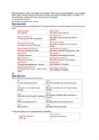
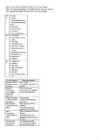
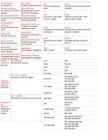
Leidsid 33 sarnast õppematerjali, mis on seotud failiga "Muudatused kaudseskõnes, määrsõna ja näitavad asesõnad". Need materjalid aitavad sul teemat sügavamalt mõista.
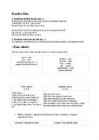
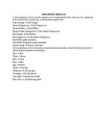
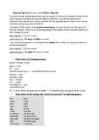
before, here, kaudses, pealause, verb, asesõnad, there, these, those, today, tomorrowKaudne kõne 1. Saatelause olevikus (he says that ...) Kõneleja juttu saab edasi anda otseselt (direct) ja kaudselt (reported). Otsene kõne: He says: "I am a man" Kaudne kõne: He says (that) he is a man. Kaudsel kõnel võivad muutuda asesõnad ja ka verbi pöördevormid. She tells me: ,,I like your dress." She tells me (that) she likes my dress. 2. Saatelause minevikus (he said that ...) Kui saatelause on minevikus, siis võivad samuti muutuda asesõnad ja verbi pöördevormid. Pane tähele! Oleviku vorm otseses kõnes muutub mineviku vormiks kaudses kõnes. am/is --- was are -- were do/does --- did want/like/know/go etc --- have/has had wanted/liked/knew/went etc will --- would can --- could
REPORTED SPEECH 2. Kui saatelause verb on oleviku aegades, siis ei muutu kaudse kõne verbi aeg. Kui saatelause verb on minevikus, toimub väit- ja küsilausetes aegade nihe: Prsent Simple Past Simple Present Progressive Past Progressive Present Perfect Past Perfect Present Perfect Progressive Past Perfect Progressive Past Simple Past Perfect Past Progressive Past Perfect Progressive Past Perfect jääb muutmata Past Perfect Progressive jääb muutmata Future Simple Future in the Past 3
http://www.abiks.pri.ee Kaudkõne. Kui otsekõne pealause on minevikus (said, asked), Siis toimuvad kaudkõne kõrvallauses järgmised muutused; OTSEKÕNE KAUDKÕNE I pv. (go, goes) > II pv. (went) do/does + I pv. (eitav lause) > did + I pv. (do/does not go) > (did not go) do/does + I pv. (küsimus) > II pv. (do you go...?) > (if I went) II pv
Kaudkõne inglise keeles Aegade nihe 1.tuleb teha aegade nihe olevikust lihtminevikku ja muuta asesõnad. Asesõna muutumine Saatesõna Otsekõne: Colin said, ,,I like Scotland very much. Kaudkõne küsimus Kaudkõne: Colin said that she liked Scotland very much. (Kui lause on juba minevikus tuleb see panna perfekti minevikku. William Shakespeare (1564-1616) wrote plays. Jacqueline Wilson (born 1945) has written many books about teenage girls.) 2
Artikkel a, an 10 Muu 11 Otsekõne Direct speech 11 Kaudkõne Reported speech 11 Kaudküsimused Reported questions 12 Passiiv Passive voice 12 Loendatavad nimisõnad Countable nouns 12 Loendamatud nimisõnad Uncountable nouns. 13 Mitmuse moodustamine 13 Siduvad asesõnad 14 Omastav kääne 14 Käskiv kõneviis 15 Omadussõnad 15 Viisimäärsõnad 16 Tingimuslaused 16 2 Ajavormid Tense vorms Lihtolevik The present simple Korduv, harjumuspärane tegevus
......12 Passiiv Passive voice .................................................................................................12 Loendatavad nimisõnad Countable nouns.................................................................12 Loendamatud nimisõnad Uncountable nouns............................................................13 Mitmuse moodustamine................................................................................................13 Siduvad asesõnad..........................................................................................................14 Omastav kääne..............................................................................................................14 Käskiv kõneviis.............................................................................................................15 Omadussõnad............................................................................................................
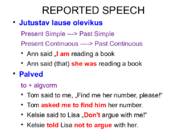
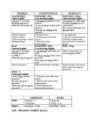
Tom said to me, ,,Find me her number, please!" Tom asked me to find him her number. Kelsie said to Lisa ,,Don't argue with me!" Kelsie told Lisa not to argue with her. Jutustav lause minevikus Past Simple --> Past Perfect (had + 3.pv) Present Perfect --> Past Perfect Past Continuous ---> had + been + ing Lynn said ,,I went to the cinema last night." Lynn said (that) she had gone to the cinema the night before. Ed said ,,I have finished the exercise." Ed said (that) he had finished the exercise. Kerri said ,,We were waiting for the bus." Kerri said (that) they had been waiting for the bus. AJAMÄÄRUSED Today --> that day Tomorrow --> the next day Yesterday ---> the day before Last week/month/... --> the week/month/... before Next week/month/... --> the next week/month/... This week/month/... --> that week/month/...
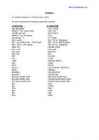
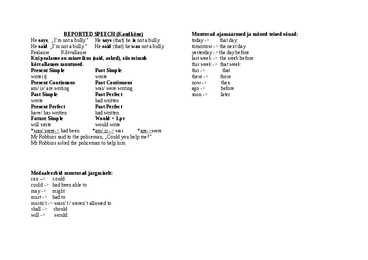
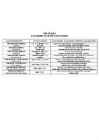
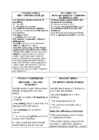
REPORTED SPEECH (Kaudkõne) Muutuvad ajamäärused ja mõned teised sõnad: He says, ,,I'm not a bully." He says (that) he is not a bully. today -> that day He said ,,I'm not a bully." He said (that) he was not a bully. tomorrow -> the next day Pealause Kõrvallause yesterday -> the day before Kui pealause on minevikus (said, asked), siis toimub last week -> the week before kõrvallauses muutused. this week -> that week Present Simple Past Simple this -> that write(s) wrote these -> those Present Continuous Past Continuous now -> then am/ is/ are writing was/ were writing ago -> before
Report To:headmaster From:Liis Subject: Suggested improvements Date:2nd May 2011 The purpose of this report is to comment on conditions in the college and to make recommendations for possible improvements. Although conditions are generally good, there are one or two problems. Firstly, in large classes, there is not much desk space. Secondly, the classrooms tend to be darl, especially in the winter months. Finally, during video lessons, some of us find it difficult to see screen properly. There are number of changes that could be made in order to improve the situation. To begin with, I would strongly suggest that the number of students per class kept to below ten. In this way...
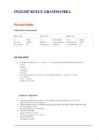
K D E I IN PE S v i i rek aa S n e U m St H s iu 12 lva naa E üm G 3 Kaudne kõne Kõneleja sõnu saab edasi anda otseselt ja kaudselt.Otsene kõne kordab kõneleja sõnu täpselt Näiteks: She says, ,,I am a student ." Kaudne kõne annab kõneleja sõnu edasi ümberjutustatult. Näiteks: She says that she is a student. Otsene kõne Otsene kõne antakse kaudses kõned edasi sihitislausega, kusjuures toimuvad mõningad muudatused , näiteks muutuvad vastavalt lause mõttele asesõnad ja mõnel juhul ka verbi pöördevormid. Saatelause Otsene kõne Reporting clause Direct speech He says, ,,I like your car." Kaudne Kõne Indirect speech Pealause Sidesõna Sihitislause Main clause Linking word Object clause
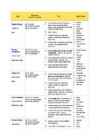
; did + I pv. Tegevus toimub minevikus. Lihtminevik lived, went yesterday, last week two years ago, in 1998 THE FUTURE SIMPLE be going to/ will + I pv. Tegevus toimub tulevikus. Lihttulevik will go/ won´t tomorrow, next week, soon, later, in 2012 THE FUTURE IN PAST (should)/ would + I pv. Kaudses kõnes tuleviku asemel, kui pealause on minevikus. Kaudne tulevik would go (He said that he would be there.) THE PRESENT CONTINUOUS am /is / are+ I- ing vorm Tegevus tpimub rääkimise hetkel, just praegu. ettekvatsetud tegevus tulevikus Kestev olevik now, at the movement, at present, look, listen
Täismineviku väljendab: · Tegevust, mis toimus enne kõnemomenti, kuid mille tagajärg on kõnelejale tähtis. John has arrived. I have finished writing a letter. Oh God! I have cut my finger. · Tegevust, mis algas enne kõnemomenti, kestab selleni või jätkub edasi. Tegevus võib olla määratletud sõnadega since, for. They have lived here for two years. · Tegevust, mis lõpeb enne mingit tegevust või muutust tulevikus, näiteks ajamääruslausetes, kus kasutatakse sidesõnu when, until, till, before jt. Katie will go for a walk when she has finished her homework. Pane tähele! Täisminevikku saab kasutada koos just, already, yet. Hello! Have you just called me? When is Tom leaving? He has already gone. I have not eaten yet. Present Perfect Continuous
We can report people's words by using direct speech or direct speech reported speech. speech `I'm tired!', Helen said. Helen said (that) she was tired. The main verb of the sentence is usually past ( Tom said that... / I told her that...) and the rest of the sentence is usually past too. Sequence of tenses if the verb in the main sentence is in the past tense the other verbs are usually in one of the past tense too. Present Simple Past Simple I'm a teacher. He said (that) he was a teacher Present Progressive Past Progressive I'm having lunch with my He said (that) he was having parents. lunch with his parents. Past Simple Past Perfect
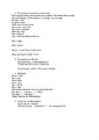
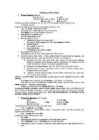
· Kui pealause on minevikus (said; asked) Past Simple(worked), Present perfect(has worked) = Past Perfect(had worked) Present Continius = Past continius (is working = was working) Do, does = did Go, goes = went Shall, will = should, would Am, is, are = was, were Was, were = had been Have, has = had Had = had had Can = could (or had been able to..) May = might Must = had to Mustn't = wasn't/weren't allowed to Went, did or have = HAD + 3. Pv · Kui pealause on olevikus NT: Hilary says, ,, I cant employ you." = Hilary says that she can't employ me. Present simple (works) = Past simple (worked) · Muutused These = those This = that Here = there Soon = later Ago = before Now = then Next year/month/week = the next year/month/week Last year/.../... = the year ../.../.. before This year/.../... = that year/.../... Today = that day, the following day · Küsimustes sõnade järjekord : ALATI ALUS + ÖELDIS
SIMPLE lived, went yesterday, last week, two years ago, in 1996 THE FUTURE (shall)/will + I Tegevus toimub tulevikus, on üksteisele järgnev SIMPLE pv tomorrow, next week, soon, later, in 2025 be going to + I pv THE FUTURE IN (should)/would + I Kaudses kõnes tuleviku asemel, kui pealause on THE PAST pv minevikus would go (He said that he would be there) THE PRESENT am/is/are + I –ing Tegevus toimub rääkimise hetkel CONTINUOUS vorm Look! Listen! Be quiet! now, at the moment, at present THE PAST was/were + I –ing Tegevus kestis teatud hetkel minevikus
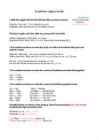
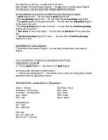
SIDESÕNAKS TULEB IF 1) " Do you speak English" -> she asked me if I spoke English teasel puhul jääb sidesõnaks küsisõna näiteks-> -> "what are you talking about?" -> she wanted to know what I was talking about (sõnade järjekord muutub nii nagu jaatavas lauses) TEISI MUUTUSI .. oluline Rasmus!!! Õpi päheeee!!! Today -> that day That/These->those Tomorrow-> the next day Here->there Yesterday -> the day before Can->could Ago-> before Will->would This->that Must-> had to Põhimõtteliselt: Ipv -> IIpv IIpv->had+IIIpv Did->had don't see->didn't see does he see? -> it he saw
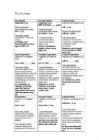
SIMPLE CONTINUOUS PERFECT I (-s) DO/DOES AM/IS/ARE + ING HAVE/HAS + III pv. I learn English I am learning English I have learned English. I get up at 7 every day. I'm reading a good book at the I've learned 10 words today. He doesn't get up at 7. moment. He hasn't learned any new What time do you get up? He isn't reading anything at the words today. moment. How many words have you What are you reading at the learned today? moment? 1 Korduv tegevus. 1 Praegu toimuv. 1 Äsja lõppenud 2 Püsiv olukord
Reported Speech (in other words Indirect Speech) If we report what another person has said, we usually do not use the speaker's exact words (direct speech), but reported (indirect) speech. Therefore, you need to learn how to transform direct speech into reported speech. We use reported speech when we are saying what other people say, think or believe. - Example: If this verb is in the present tense (says), it's easy. We just put 'she says' and then the sentence. When we are reporting things in the present, future or present perfect we don't change the tense. : direct speech: "I like ice cream" reported speech: She says she likes ice cream - But, if the reporting verb is in the past tense (said), then usually we change the tenses in the reported speech: direct speech: "I like ice cream" reported speech: She said she liked ice cream. .........
Lihtolevik THE PAST SIMPLE II pv; did ,lived, Tegevus toimus minevikus. Lihtminevik went yesterday, last week, two years ago, in 1998 THE FUTURE SMPLE ( shall ) / will +I pv. Tegevus toimub tulevikus. Lihttulevik will go tomorrow, next week, soon, later, In 2050 THE FUTURE IN THE ( should ) / would +I Kaudses kõnes tuleviku asemel, kui pealause on PAST pv minevikus. Kaudne tulevik ( He said that he would be better ) THE PRESENT am / is / are + - ing Tegevus toimub rääkimise hetkel. PROGRESSIVE vorm now, at the moment, at present Kestev olevik THE PAST Was / were + -ing Tegevus kestis teatud hetkel minevikus.
määratletud kas täpse mingil pildil, mida määratletud näiteks täpse kellaajaga või mingi teise kirjeldama pead. Ajutised kellaajaga). sündmusega, mis just sel olukorrad ja planeeritud at 7 tomorrow, at the hetkel juhtus). tegevused. same time tomorrow, at 7 yesterday, at (right) now, at the etc. midnight yesterday, moment, at present, when the teacher these days, Look! entered the classroom, Listen!, etc. when the phone rang, etc. Past Perfect Present Perfect Future Perfect Tegusõna on esitatud Tegusõna on esitatud Tegusõna on esitatud kujul kujul kujul will have + 3. pv had + 3. pv have / has + 3. pv Tunnused lauses:
It was raining earlier. He said it had been raining earlier. past perfect past perfect The play had started when I arrived. NO CHANGE POSSIBLE past perfect continuous past perfect continuous I'd already been living in London for five NO CHANGE POSSIBLE years. Other verb forms Other verb forms also sometimes change: will would I'll come and see you soon. He said he would come and see me soon. can could I can swim under water for two He said he could swim under water for two minutes. minutes. had to must
ACTIVE TENSES Active form You use an active verb when you want to say that the subject of a sentence does something. · [Thing doing action] + [verb] + · +[thing receiving action] · Examples The professor (subject doing action) teaches (verb) · the students (object receiving action). · Mary (subject doing action) · washes (verb) · the dishes ( object receiving action). The tenses of the verb 1.Present (olevik) 2.Past (minevik) 3.Future (tulevik) 4.Future in the past (kaudne tulevik) Iga aeg võib esineda neljas eri rühmas 1.IndefiniteTenses (üldajad) 2.Continious Tenses (kestvad ajad) 3.Perfect Tenses (perfekti ajad) 4.Perfect Continious Tenses (perfekti kestvad ajad) Indefinite Tenses (üldajad) used to describe actions but do not state whether the action is completed or on- going märgivad tegevuse sooritamise fakti Peter visits us every day.
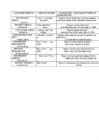
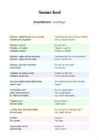
I paid 12 for the Perfect video. He said he paid/had paid 12 for the video. Past Past Continuous or Past Continuous Perfect I was driving to He said that he was York. driving/had been driving to York. Future (will) Conditional (would) I will tell you He said that he would tomorrow. tell me the next day. Now then, immediately Today that day Yesterday the day before, the previous day Tomorrow the next/following day This week that week Last week the week before, the previous week Next week the week after, the following week Ago before Here there Come go Bring take Who, where, how, when, what same question word Can, may if, whether Order/tell + sb + (not) to Must had to Can could had been able to May might jääb muutumatuks Should, ought to ja need jäävad muutumatuks.
NO CHANGE POSSIBLE May I smoke? He asked if he might smoke. when I arrived. past perfect continuous past perfect continuous I'd already been living in NO CHANGE POSSIBLE London for five years. positive tell + infinitive now then imperative He told me to shut up. today that day Shut up! here there this that this week that week tell + not + infinitive He told me not to do it again. the following day
All rights reserved. No part of this book may be reproduced in any form or by any means, electronic or mechanical, including photocopying, recording, or by any information storage and retrieval system, without the written permission of the publisher. ISBN 1-59905-201-6 Printed in the United States of America 13 12 11 10 09 08 07 9 8 7 6 5 4 3 2 1 Introduction Grammar is a very old field of study. Did you know that the sentence was first divided into subject and verb by Plato, the famed philosopher from ancient Greece? That was about 2,400 years ago! Ever since then, students all over the world have found it worthwhile to study the structure of words and sentences. Why? Because skill in speaking and writing is the hallmark of all educated people. Lesson by lesson, this book provides basic instruction in the eight parts of speech--nouns, pronouns, verbs, adjectives, adverbs, prepositions, conjunctions, and
· DIRECT · INDIRECT · Am, is, are · Was/were · Shall/will · Should/would · Can · Could · May · Might · Must · Have/has to · Ought to · Had to CHANGES OF ADVERB OF TIME & PLACE · DIRECT · INDIRECT · NOW · THEN · TOMORROW · THE FOLLOWING DAY · NEXT WEEK · THE FOLLOWING WEEK · TONIGHT · THAT NIGHT · TODAY · THAT DAY · YESTERDAY · THE DAY BEFORE · LAST NIGHT · THE NIGHT BEFORE · LAST WEEK · THE WEEK BEFORE · HERE · THERE · THIS · THAT · THESE · THOSE CHANGES OF TENSES · DIRECT · INDIRECT · SIMPLE PRESENT · SIMPLE PAST · SIMPLE PAST · PAST PERFECT · PRESENT PERFECT · PAST PERFECT · PRESENT · PAST CONTINUOUS CONTINUOUS
FUTURE SIMPLE BE GOING TO Will + infinitive (will go) Am/is/are going to + infinitive (is going to rain) 1.A decision at the moment of 1.Future plans made before the speaking: moment of speaking: A: 'I'm cold'. A: 'We've run out of milk.' B: 'I'll close the window'. B: 'I know, I'm going to buy some.' 2.Prediction based on opinion: 2.Prediction based on present I think the Conservatives will win the evidence: next election. Look at those boys playing football! 3
· till now lõppenud tegevus- · up to now · finished action that has an influence · lately on the present lõpetatud tegevus, · before millel on mõju hetkel toimuvale. · today · action that has taken place once, · this ... never or several times before the · since moment of speaking tegevus, mis · for on ühe korra, mitte kunagi või
-ing lõpu lisamisel jäetakse tüve lõpus olev tumm e ära write writing (aga: see-seeing) Verbidel, mille lõpus on üksik rõhuline vokaal 2 konsonandi vahel, -ing lõpu lisamisel tüve lõppkonsonant kahekordistub stop stopping, travel-travelling -ie lõpuliste verbide puhul muutub ie->y lie lying 1. Kõnemomendil, käesoleval ajaperioodil või ajutiselt toimuv tegevus. Tom is drinking tea now. I´m looking for a new job these days. 2. Adverbidega always, constantly, continually sageli korduv tegevus, mida kõneleja heaks ei kiida. Mary is always laughing. 3. Lähimas tulevikus toimuv tegevus, mis on ette kavatsetud, kokku lepitud. I´m meeting Jim tonight. 4. Muutuv, arenev tegevus. The weather is getting worse. Ajamäärused now, at the moment, at present, these days, nowadays, today, tonight, always, still etc. 3
Anteeksi, mutta minä en ymmärrä. I am sorry, but I do not understand? Anteeksi, mutta minä en tiedä. Sorry, I don't know. Anteeksi, että olen myöhässä. Excuse my being late. Ei se mitään. No problem. Voisitteko Te auttaa minua? Could you help me? Hetkinen, olkaa hyvä. Just a moment, please. Minä olen täällä ensimmäistä kertaa. This is the first time that I am here. Ihanko totta? Really? Ymmärrätkö sinä? Do you understand? Kyllä, minä ymmärrän. Yes, I understand. Ei, minä en ymmärrä. No, I don't understand. Tiedätkö sinä? Do you know? Minä en tiedä. I don't know. Luuletko sinä, että alkaa sataa? Do you think it is going to rain? En minä usko
· action that is still going on now, up to now · action that stopped recently · finished action that has an influence on the present action that has taken place once, never or several times before the moment of speaking Present Perfect A: He has been · putting emphasis on the all day, Continuous speaking. course or duration (not the since 1993, N: He has not been how long?, result) speaking. the whole
Use the correct tense: 1. .................. did your aunt ........... (live) in Tallinn three years ago? 2. Why is the child crying? .................. the dog..................(bite) her? 3. Next year I..................(be) very good at English. 4. ..................you..................(hear) this story before? 5. Tom..................(know) this man. He ...................(meet) him before. 6. ..................you..................(come) to the party with me tomorrow? 7. ..................you..................(be) to Scotland? Our family ..................(go) there last summer. 8. What .................. you .................. (like) to do in the evenings? 9. At noon yesterday we ....................................(not drink) tea, we ....................................(dig in the garden.) 10. Charlie is not in the room. What..................he....
Moved to Cali 2005 Was Born Traveled to Europe Husband 1978 School graduates @ Oxford 1999 Started Got married School 1983 2008 2 The Six English Verb Tenses Three Simple Tenses Simple continuous Present You walk. You are walking I run. I am running. Past You Walked You were walking. I ran. I was running. Future You will walk. You will be walking. I will run. I will be running. Three Perfect Tenses Perfect continuous
 annaabi.ee