Leidsid 33 sarnast õppematerjali, mis on seotud failiga "Mother Theresa". Need materjalid aitavad sul teemat sügavamalt mõista.
mother, work, teresa, albania, branch, brother, sister, received, poor, agnes, 1910, although, father, eight, sisters, order, charity, brothers, workers, prize, children, kolÃ, rose, left, years, herself, religious, joined, 1931, mary, convent, such, permission, slum, became, active, including, provide, europe, throughout, awards, peace, republicShe was the first wife of Charles, Prince of Wales, whom she married on the 29th of July in 1981. The wedding, which was held at St. Paul's Cathedral, was televised and watched by a global audience of over 750 million people. Diana and Charles had two sons, Princes William and Harry. EARLY LIFE She was born at Park House, Sandringham in Norfolk, England. Her parents were John Spencer and Frances Burke Roche. She had two older sisters Sarah and Jane and a younger brother Charles. When Diana's parents divorced in 1969, her mother took her and her younger brother live in an apartment in London's Knightsbridge, where Diana attended a local day school. Every Christmas, the children returned to Norfolk with their mother to visit their father, but he subsequently refused to allow them to return to London. Diana's mother sued for custody but she didn't get it and the custody went to the father. After that her father married to Raine Spencer
Mattias Suurkivi 8.a Class Instructor: Katrin Mägi Kadrina 2009Contents Introduction I chose Princess Diana, because I wanted to know about her and I like the British royal family and she was a part of the family, too. She is dead and if somebody reads it, he or she can learn about her and will know what she was like. The purpose of the work is to introduce Diana and get to know her better. Diana Facts about Diana Main Facts Her full name is Diana Frances Spencer and she was the Princess of Wales. Diana was called people's Princess. She was born on 1. July 1961 in Park house, Sandringham, Norfolk. She was born at the same place as her mother. She was married to Charles, Prince of Wales in 1981 and divorced in 1996. She died in car a accident on 31. August 1997 when she was only 36 years old.
well as a vigorous social campaigner. Considered one of the English language's greatest writers, he was acclaimed for his rich storytelling and memorable characters, and achieved massive worldwide popularity in his lifetime. Charles Dickens was born in Landport, Portsmouth in Hampshire, the second of eight children to John Dickens n 7 February 1812. The 12-year-old Dickens began working ten hour days in a Warren's boot-blacking factory. In May 1827, Dickens began work in the office of Ellis and Blackmore as a law clerk. At the age of seventeen, he became a court stenographer and, in 1830, met his first love, Maria Beadnell. Maria's parents disapproved of the courtship and effectively ended the relationship when they sent her to school in Paris. In 1834, Dickens became a political journalist, reporting on parliamentary debate and traveling across Britain by stagecoach to cover election campaigns for the Morning Chronice.
11 See also 12 Notes 13 References 14 External links Childhood Family and early life Main article: Childhood of Marilyn Monroe Marilyn Monroe was born in the charity ward of the Los Angeles County Hospital.[1][10] According to biographer Fred Lawrence Guiles, her grandmother, Della Monroe Grainger, had her baptized Norma Jeane Baker by Aimee Semple McPherson.[1] Although she took a stagename of Marilyn Monroe in 1946, she did not legally change her name until February 23, 1956.[11] Her mother was Gladys Pearl (Monroe) Baker.[12] Her family is believed to have been Anglo-Spanish originally; and possibly related to the Sepulvedas. [13] For many years it was believed Gladys' second husband Martin Edward Mortenson (18971981) was Monroe's father. His name was listed on her birth certificate. [14] Foster homes Mentally unstable and unable to care for Monroe, Gladys placed her with foster parents Albert and Ida Bolender of Hawthorne, California, where she lived until she was seven
Clinton was the first female member on Wal-Mart's board, added following pressure on chairman Sam Walton to name a woman to the board. Once there, she pushed successfully for Wal-Mart to adopt more environmentally friendly practices, was largely unsuccessful in a campaign for more woman to be added to the company's management, and was silent about the company's famously anti-labour union practices. Hillary Clinton received sustained national attention for the first time when her husband became a candidate for the Democratic presidential nomination of 1992. Bill Clinton said that electing him woult get ''two for the price of one'' or ''buy one, get one free'', referring to the prominent role his wife would assume. First Lady of the United States After Bill Clinton was elected president of the United States in 1992, Hillary's involvement in
King of England Henry VIII Reign - 21 April 1509 28 January House - House of Tudor 1547(37 years) Father -Henry VII of England Coronation - 24 June 1509 (aged 17) Issue Mary I of England Predecessor - Henry VII Henry FitzRoy Successor - Edward VI Elizabeth I of England Spouse - Catherine of Aragon Edward VI of England Anne Boleyn Mother - Elizabeth of York Jane Seymour Born - 28 June 1491 Greenwich Palace, Anne of Cleves Greenwich Catherine Howard Died - 28 January 1547 (aged 55) Catherine Parr Palace of Whitehall, London Burial - St George's Chapel, Windsor Castle Religion Christian (Anglican,
will, and on the death of her half-brother, Edward VI, on July 6, 1553, she became the legal heir to the throne. Although Lord High Chamberlain John Dudley, Duke of Northumberland, favoured the succession of his daughter-in-law, Lady Jane Grey, and proclaimed her queen on July 10, the country supported Mary. As a Roman Catholic, Mary began her reign by sweeping away the religious innovations of her father and her brother. Henry VIII had separated England from the Church in Rome; Edward VI had replaced Roman Catholicism with a Protestant settlement. Mary restored the Mass and re-established the authority of the papacy, but, although she handed back Crown property to the Church, Parliament refused to restore Church lands seized by Henry VIII. Even with the help of Mary's cousin, Cardinal Reginald Pole, a return to the state of affairs
Then, one fateful night at the Apollo Theater in 1934, the headlining Edwards Sisters brought down the house with their dancing. Amateur Hour began immediately after, and a 16yearold Ella Fitzgerald stepped on stage, but was too intimidated to dance. Instead, she sang "Judy," silenced the awestruck crowd, and won first prize. It was the beginning of one of the most celebrated careers in music history. Born in Newport News, Virginia in 1917, Ella Fitzgerald moved with her mother to New York after the death of her father. Living in Yonkers, Fitzgerald attended public school, where she sang in the glee club and received her musical education. After her early success at the Apollo, and as a popular performer at a number of other amateur venues, Fitzgerald was invited to join Chick Webb's band. Within a short while she was the star attraction, and had made a number hits including her trademark "Atisket, Atasket" (1938). After Webb's death in 1939,
Old Mr. Dashwood is the owner of a large estate in Sussex called Norland Park. Following the death of his sister, Mr. Dashwood invites his nephew Mr. Henry Dashwood to come live with him at Norland. The younger Mr. Dashwood brings John Dashwood, his son from a previous marriage, as well as the three daughters born to his present wife. John Dashwood is grown and married, and has a four-year-old son, Harry. When Old Mr. Dashwood dies, he leaves his estate to John and little Harry, who had much endeared himself to the old man. But now John's father, Henry Dashwood, is left with no way of
In the year 1994, her film career took flight with appreciation when she starred in `Heavenly Creatures' as Juliet Hulme to play the role of an imaginative teen. Another successful movie `Sense and Sensibility' made her famous all over, particularly in the UK. As soon as the Titanic was out in 1997, Winslet became a prominent actress world- wide. The movie was an enormous hit at the box-office which further went on to win 11 Academy Awards. For each of her movies, Kate has received positive reviews which also made her called critics' darling. Regardless of Titanic's success, she has sustained making lower-budget, independent, such as, Hideous Kinky and Holy Smoke. She has also appeared in studio `period dramas', like Quills, Titanic, and Finding Neverland. Winslet also starred in a television ad for American Express in 2005. During the `My Life, My Card' campaign, she strolled around Camden Lock in London, making references
nation based state. He was good at diplomacy.He could avoid quarrels and wars with neigbouring countries. France, Spain - greatest enemies.So he could save much money and thus laid a good economic basis for his state. Besides that he built a merchant fleet (kaubalaevastik) England begun to dominate in international trade. Unfortunately the king got old and died. Next king was Henry Vlll, second son of the family, wasn't prepared to become a king. Had to take the role as his elder brother died. Was prepared to come a clergyman got good education: languages, music, literature. Brother jumped off horse into a river, died in bed. Elder brother was already married. Henry Vlll married with his brothers widow.Catherine of Aragon, she came from Spain, she was arden(innukas) Catholic. At first they had good relations. Soon there were big problems. Had daughter Mary, couldn't get a son. Needed a new king. Henry decided to get a divorce. Henry wrote a long letter to Pope for a divorce
Lizzy is not a bit better than the others; and I am sure she is not half so handsome as Jane, nor half so good-humoured as Lydia. But you are always giving her the preference." "They have none of them much to recommend them," replied he; "they are all silly and ignorant like other girls; but Lizzy has something more of quickness than her sisters." "Mr. Bennet, how can you abuse your own children in such a way? You take delight in vexing me. You have no compassion for my poor nerves." "You mistake me, my dear. I have a high respect for your nerves. They are my old friends. I have heard you mention them with consideration these last twenty years at least." "Ah, you do not know what I suffer." "But I hope you will get over it, and live to see many young men of four thousand a year come into the neighbourhood." "It will be no use to us, if twenty such should come, since you will not visit them."
Jeanette described Melanie with words like sweet, lovely, beautiful, good and serene. Melanie had lovely grey eyes. Jeanette met Melanie at a fish stand. At first Melanie was reluctant to start a conversation with Jeanette, but eventually she caved in. Week after week Melanie worked at a fish stand boning kippers on a big marble slab and Jeanette went to watch her. Then, one week Jeanette didn't find her because Melanie had got a job in the library. She had to work there every Saturday morning. Melanie lived with her mother who often wasn't home. She had no father. Jeanette also learned that Melanie had such a funny name because when she was born she had looked like a melon. In my opinion, this indicates that Melanie was not that smart and had limited intellectual capacity. Melanie's church was not a very lively one and Jeanette invited her to theirs. The first time that Melanie went to Jeanette's church she acted shy and didn't sing along with others
and pottery designer, was the principal and professor of architectural sculpture at the newly- founded Sir Jamsetjee Jeejeebhoy School of Art and Industry in Bombay. Later in life Kipling illustrated many of Rudyard Kipling's books, and other works. Kipling also remained editor of the Journal of Indian Art and Industry, which carried drawing works from the students of the Mayo School. COUPLE named their son after the place they had first met Rudyard Lake. Alice Kipling Fleming - Sister of British author Rudyard Kipling who became a well-known psychic, producing automatic writing under the name "Mrs. Holland." Born June 11, 1868, Alice Kipling was privately educated. She went to India at age 16 and married British army officer John Fleming. While in India she wrote a number of poems, and in 1893 initially experimented with automatic writing. After a long illness she returned to England in 1902 and in the following year read the classic study Human
There was a film made in 2004. The play consists of 2 acts. The main characters are The Phantom and Christine, then Raoul, Carlotta, Madame Giry. It has won over 50 awards. The opera house has 17 floors, is above an underground lake, was built in 1861-1875 in a neo-baroque style, golden ornamental decorations, statues, columns and bronze busts of composers Siret: "Prince Albert" Born in 1819 in Germany. He had unhappy childhood (parents divorced when he was little), mother left them, met Victoria at age 17, they were introduced by Uncle Leopold, they fell in love. They got married and got 9 children, 40 grandchildren. At first he was unpopular, after he made many great changes he became popular. He was the president of the Royal Society of Arts for 18 years. After his death Victoria built many memorials and Royal Albert Hall in 1871, there are more than 350 performances every year. The Albert medal, the Prince Consort´s Library. Lisanna: "Yoko Ono"
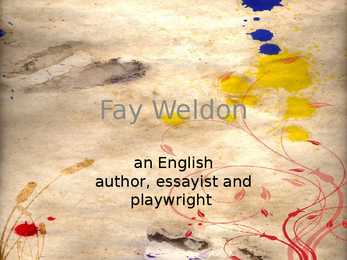
Fay Weldon an English author, essayist and playwright Early life § Fay Weldon was supposed to be born in New Zealand, but instead was born in England in 1931. At 5 weeks old she and her mother returned to New Zealand. § Her father was a doctor and her mother was a writer of commercial fiction under the pen name "Pearl Bellairs", among others. Her parents divorced when she was five. She lived with her mother, sister and grandmother until she started college and, as a result, grew up believing "the world was peopled by females". This problably influenced her works too. § She returned to England with her mother and studied economics and psychology at the University of St Andrews in Scotland. § Her actual christened name was "Franklin Birkinshaw". which she feels contributed to her being accepted at St Andrews and permitted to study economics: the school assumed she was a male student applicant.
The novel opens with a scene introducing Prince Stepan Arkadyevitch Oblonsky, "Stiva", a Moscow aristocrat and civil servant who has been unfaithful to his wife Darya Alexandrovna, nicknamed "Dolly". Dolly has discovered his affair - with the family's governess - and the house and family are in turmoil. Stiva's affair and his reaction to his wife's distress shows an amorous personality that he cannot seem to suppress. In the midst of the turmoil, Stiva reminds the household that his married sister, Anna Arkadyevna Karenina is coming to visit from Saint Petersburg. Meanwhile, Stiva's childhood friend Konstantin Dmitrievich Levin ("Kostya") arrives in Moscow with the aim of proposing to Dolly's youngest sister Princess Ekaterina Alexandrovna Shcherbatskaya, "Kitty". Levin is a passionate, restless but shy aristocratic landowner who, unlike his Moscow friends, chooses to live in the country on his large estate
when they have to deal with racism. Plot summary (NB! Use the present tenses) Anita and Me by Meera Syal is the story of a young Punjabi girl growing up in the fictional English village of Tollington in the Midlands in the 1960s. The book follows Meena during her pre-teen years as she is desperate to fit in with the other children in her neighbourhood while forever feeling like an outsider because she is "different". She and her family are the only immigrants in the village. They are trying to work out how to fit into British society while attempting to maintain their own culture. Meena's house is always full of a constant stream of ethnic visitors and her parents seem to see no need to integrate futher. Namely, her parents considered every Indian immigrant in England as a friend or even as a part of the family. Meena's family are keen to see her keeping up the family's cultural tradition. Meena on the other hand, is caught between two cultures. She is having a difficult time
The Queen Silvia Queen Silvia is the Queen of Sweden. She was born in Heidelberg, Germany, on December 23 in 1943. Her parents were the late Walther Sommerlath and his Brazilian wife Alice, née de Toledo, but unfortunately they are deceased. Silvia Sommerlath and King Carl XVI Gustaf met at the 1972 Olympic Games in Munich, where Silvia was serving at the games as a hostess. The Queen has two older brothers: Ralf and Walther Sommerlaht. Her third brother, Jörg Sommerlath , passed away in 2006. The Sommerlath family lived in Sao Paulo, Brazil. The family returned to West Germany in 1957. Queen Silvia can speak six different languages, besides Swedish she can speak German, English, French, Spanish and Portuguese. She frequently takes part in anniversaries, congresses and symposium openings and other official events. Hobbies: The Queen likes to go hiking with The King. She enjoys skiing in the environs of the
· Naturalism appealed American authors because they found it very right to describe what was going on in the turn of century in America · They wanted something fresh, new · They were disgusted by romantics · Showed the harsh tone in moral life · Refleced the development of science · Period of intense urbanisation, the city is in the center of the novel, often · New characters were businessmen, salesman, immigants, poor farmers · These characters were in new settings, skyscrapers, departments store, apartment building, ghetto, stockyard (cattle, cows were slaughtered), commercial trust · Their world is not one of culture or high moral standards · For these new writers controlling new american social experience · Naturalists offered a view that questioned the belief that now was a conscious and national being and happiness could in moral behaviour
QUEEN VICTORIA & HER TIME Project Mari Murakas Class 11A 2011 Early life of Queen Victoria Victoria was born in London on 24 May 1819, the only child of Edward, Duke of Kent, and Victoria Maria Louisa of Saxe-Coburg. [1] The Duke of Kent was the fourth son of George III and Victoria Maria Louisa was the sister of King Leopold of Belgium. The Duke and Duchess of Kent selected the name Victoria but her uncle, George IV, insisted that she be named Alexandrina after her godfather, Tsar Alexander II of Russia. [2] Victoria's father died when she was eight months old. The Duchess of Kent developed a close relationship with Sir John Conroy, an ambitious Irish officer. Conroy acted as if Victoria
Author Stieg Larsson was a Swedish journalist and writer. He was born in 1954. He is best known for writing the "Millennium series". He died suddenly and unexpectedly in November 2004, soon after delivering the manuscripts for "the Millennium trilogy". Since his death, Stieg Larsson has been haunting the bestseller list and popular media worldwide. There are many millions of copies of the millennium tilogy that has been sold worldwide. Unfortunately Larsson did not live to see the phenomenon his work has become. Sweden has already produced a trilogy of films based on the novels, and now Hollywood is doing the same. Characters *Lisbeth Salander the headcharacter in the book. She is outsider and apparently enemy of society. The state has ruled that she is mentally unstable and has a trustee to help her manage her duties. Salander doesn't really care what others think of her. In fact, she values the most her privacy and anonymity
she was likely to become queen in the future: I will be good.) VICTORIA (r. 1837-1901) Victoria was born at Kensington Palace, London, on 24 May 1819. She was the only daughter of Edward, Duke of Kent. The Duke and Duchess of Kent selected the name Victoria but her uncle, George IV, insisted that she be named Alexandrina after her godfather, Tsar Alexander II of Russia. Edward died when Victoria was eight months old, upon which her mother enacted a strict regimen that shunned the courts of Victoria's uncles, George IV and William IV. Father Mother Edward, the Duke of Kent Princess Victoria of Saxe-Coburg. Warmhearted and lively, Victoria had a gift for drawing and painting; educated by a governess, Louise Lehzen, and the Reverend George Davys at home. She was certainly busy.( Queen Victoria published two books during her lifetime, 'Leaves from the Journal
Character Sketch – Julie The Cement Garden by Ian McEvan Julie is the eldest child in her family. She also has a younger sister Sue and two younger brothers-little Tom and the narrator, Jack. Readers get to know Julie’s world through Jack’s eyes only. We get to know Jack’s thoughts of Julie. Jack can be described as an emotionally closed or distant person. As their parents passed away, Julie became the head of the family, which means that she had to take care of her younger siblings to keep the family together. They live in isolation and only have each other. The children were discouraged to bring over friends.
Describe the Sacred Heart Convent. Explain the sentence: `Where the Dark One had put in thick bush, liquor, wild dogs, and Indians' (45). It is on top of the highest hill, the windbreak is planted before the bar ,,for the purposes of tornado insurance". Buildings of painted brick, gleaming white. The cracked whitewash and swallows nesting in the busted ends of eaves. Boards sawed the size of broken windowpanes and the fruit trees, stripped. Goldenrob rubbed up the walls. It was a poor convent. Humble, ragtag, out in the middle of no place. End of the world to some. Where the maps stopped. - Satan took over with certain things, including alcohol and "Indians." 7. Sum up the influence of Catholicism on the Chippewas (based on what you have read so far). Catholicism hasn't replaced Native American customs and religion so much as claimed its own jurisdiction within those customs, perhaps the Catholic God isn't entirely responsible for
In 1958 one team buried the ball. The other team didn't know and ran after them. Later first team took the ball and won. 3) JAMES WATT He was born in the small port of Greenock on the river Clyde in Scotland in 1736. His father was a mathematical-instrument maker and also kept a shop to supply ships with goods for their voyages. James was a delicate boy and often suffered from headaches. That is why he could not go to school at the age when other children did. His mother taught him to read and his father taught him writing and arithmetic. He had very good memory and a natural love of work. He liked mathematics and was also fond of designing and making things. James was an observant and thoughtful boy. When James was able to go to school, he was sent to a private school. He learnt many subjects there. In his spare time James began to make experiments. He built a small electrical apparatus with which he gave his friends shocks that made them jump
Early Interest in Politics Although Margaret studied chemistry, politics interested her more. Following graduation, Margaret Roberts moved to Colchester and worked as a chemist. She became a member of the Association of Scientific Workers. During this period she joined the local Conservative Association when a friend of hers apprised that they were looking for candidates to strong Labour seats of Dartford. To support herself during the period of elections, she went to work for J. Lyons and Co., where she helped to develop methods for preserving ice cream and was paid 10 000 Krones per year. Margaret won national publicity as the youngest woman candidate in the country. Unlike many Conservatives at that time, she had no difficulties in presenting her speeches as she talked with force and confidence on issues that mattered to the voters. Starting a Family and Career In Dartford Margaret met her future husband Denis Thatcher who was a local businessman. The
English literature is one of the oldest literatures in Europe; dates back to the 6th century AD. Oral literature, i.e. not written down, spread from person to person. In 449 AD Anglo-‐Saxon tribes invaded England – beginning of the Anglo-‐Saxon period in English literature. The first form of literature was folklore, carried by scops and gleemen, who sang in alliterative verse (a kind of simple poetry). Prose developed much later. The first form of recorded English literature was the epic Beowulf, which was produced sometime near the end of the 7th and beginning �
Out walking one day, Jane encounters and helps a horseman who has sprained his ankle. On her return to Thornfield, she discovers that the horseman is Edward Rochester, Master of Thornfield Manor. Rochester is a moody, self-willed man nearly twenty years older than Jane. Adèle is his ward, belonging to a French "opera dancer" whom he had a romantic relationship with, in the past. Adèle however is not his daughter, but is brought up by him, after her mother abandons her. Miss Blanche Ingram Mr. Rochester disguised looking in a book. as a Gypsy woman. Jane saves Mr. Bertha Mason rips Rochester from a fire. Jane's wedding veil. Mr. Rochester seems quite taken with Jane, and she enjoys his company. However, odd things
House of Winsdor. Their influence on modern society, key personalities. People all over the world are obsessed with the British royal family. Most fans know all the royal names and faces, the line of succession to the throne, and even the family's rarely- used last name. But let's start from the beginning. The House of Windsor is the reigning royal house of the United Kingdom and the other Commonwealth realms. The dynasty is of German paternal descent and was originally a branch of the House of Saxe-Coburg and Gotha, itself derived from the House of Wettin, which succeeded the House of Hanover to the British monarchy following the death of Queen Victoria, wife of Albert, Prince Consort. The name was changed from Saxe-Coburg and Gotha to the English Windsor (from "Windsor Castle"[1]) in 1917 because of anti-German sentiment in the British Empire during World War I.[2] There have been four British monarchs of the house of Windsor
P is for Pamela who likes camera. Puritans The Puritans were a group of people who grew discontent in the Church of England and worked towards religious, moral and societal reforms. The writings and ideas of John Calvin, a leader in the Reformation, gave rise to Protestantism and were pivotal to the Christian revolt. They contended that The Church of England had become a product of political struggles and man-made doctrines. The Puritans were one branch of dissenters who decided that the Church of England was beyond reform. Escaping persecution from church leadership and the King, they came to America. Of Plymouth Plantation Of Plymouth Plantation is the single most complete authority for the story of the Pilgrims and the early years of the Colony they founded. Written between 1620 and 1647, the journal describes the story of the Pilgrims from 1608, when they settled in the Netherlands, through
Later in the morning, Mr. Bumble comes with news of a woman who has died and needs a coffin. Mr. Sowerberry takes Oliver to the home of the dead woman, and Oliver sees what the profession that Mr. Sowerberry and the state chose for him was. He attends his first funeral and burial and decides that he does not like it, but Mr. Sowerberry tells him that he will get used to it in time. Chapter 6: Noah took a joy in making Oliver cry, and one day in attempt to do so, asked Oliver about his mother. Since his mother was a very sensitive subject to him, Oliver became upset. Noah continued to taunt him and insult his mother until Oliver snapped and attacked Noah. Noah surprised screamed and called out to Charlotte and Mrs. Sowerberry. They pulled Oliver off Noah, and sent Noah to find Mr. Bumble at the workhouse because Mr. Sowerberry was not around. Chapter 7: Noah found Mr. Bumble and told him that Oliver had tried to murder him, Charlotte, and Mrs. Sowerberry. Mr
especially by Thomas Paine in "The Age of Reason" and by Thomas Jefferson in his short Jefferson Bible from which all supernatural aspects were removed. Benjamin Franklin was influential in America, England, Scotland, and France, for his political activism and for his advances in physics. The American Dream is a national ethos of the United States, a set of ideals in which freedom includes the opportunity for prosperity and success, and an upward social mobility achieved through hard work. In the definition of the American Dream by James Truslow Adams in 1931, "life should be better and richer and fuller for everyone, with opportunity for each according to ability or achievement" regardless of social class or circumstances of birth. The idea of the American Dream is rooted in the United States Declaration of Independence which proclaims that "all men are created equal"
 annaabi.ee