Leidsid 33 sarnast õppematerjali, mis on seotud failiga "Mid-term 1 in English Phonetics and Phonology". Need materjalid aitavad sul teemat sügavamalt mõista.
vowel, sound, vowels, consonant, phonetic, alveolar, closeanguage, other, differ, phonetics, nasal, tongue, plosive, speech, vocal, phoneme, occur, part, phonology, velar, these, different, tract, mouth, stream, english, syllable, studyanguages, meaning, unit, there, another, phones, open, diphthongs, closed, words, following, complete, term, dentalDefinitions: Phonology is the study that describes the systems and patterns of speech sounds in a language. Phonetics is the general study of the charecteristics of speech sounds – studies how different speech sounds are produced. Phoneme is a meaning-distinguishing sound in a language. E.g. artistic-al-ly To know if a sound is a phoneme use the minimal contrasting pair method where the difference is only one sound: pin vs pen. Allophones are different variations of how a phoneme is pronounced according to the context. E.g. dark and clear l – clear and dull. Segmentation is the act of dividing speech sounds into units. E.g. segment- ation Larnyx (kõri) is the voice box. Glottis is the opening between the vocal cords. Manner of articulation is the way the airstream is blocked when producing a sound – blocked vs partially blocked; vibrating vs no vibration. Different sound types:
In English it usually is the full infinitive (to go) although alphabetized without 'to' (go); the present tense is used for some defective verbs (shall, can, and must have only the one form). In Latin, Ancient Greek, and Modern Greek (which has no infinitive), however, the first person singular present tense is normally used, though occasionally the infinitive may also be seen. The pronunciation form in a dictionary will usually relate to the citation form of the word in question. This may differ in various respects from the forms to be expected in connected speech, sometimes referred to as phonotypical forms. Wells, J.C. 1999. Phonetic transcription and analysis. Available at https://www.phon.ucl.ac.uk/home/wells/transcription-ELL.pdf, accessed January 19, 2016. Lyons, John. 1981. Language and Linguistics. Available at https://books.google.ee/books/about/Language_and_Linguistics.html?id=8Wg57a3DdYYC,
Phonology. Mid-term 2. Syllable - is a phonological unit consisting of one or more phonemes. In phonetics a syllable is a unit which consists of a centre, that has little or no obstruction to airflow; it is comparatively louder than other sounds. In phonology syllables are the possible combinations of phonemes. The syllable consists of - onset, nucleus, coda. (every syllable has a nucleus: vowel, syllabic l, or m, n). Rhyme/rime nucleus + coda; the nucleus and the coda constitute a sub-syllabic unit rhyme. Words rhyme, when their nucleus and coda are identical. (E.g 'cr-o-wn', 'd-o-wn'). The hierarchical structure of the syllable: Onset the beginning of the syllable Nucleus/peak the open part of a syllable, generally a vowel. Coda a consonant sound which ends the syllable. Open syllable - has no coda Closed syllable - has a coda!
Loan words (Old Norse, Old French). Dual pronouns. Determiners - no separate definite article. Strong and weak verbs. Word order relatively free with tendencies towards SVO. SVO, SOV, VSO most common. Adposition and podposition were both possible (eesliide ja tagaliide). About syntax: clauses were joined much simpler than nowadays, using and, then etc. Because of case syncretion the word order in a sentence became much more important to be able to tell the difference between words. FIRST CONSONANT SHIFT (GRIMM'S LAW) Grimm's Law (also known as the First Germanic Sound Shift or Rask's rule) is a set of statements named after Jakob Grimm describing the inherited Proto-Indo-European (PIE) stop consonants as they developed in Proto-Germanic (the common ancestor of the Germanic branch of the Indo- European family) in the 1st millennium BC. It establishes a set of regular correspondences between early Germanic stops and fricatives and the stop consonants of certain other centum Indo-European
byt' est' hodit' idti shol, shla. horoshij luchij Essentially the same words suppletive in various languages, including non-related ones. The most common words (`good', `to be', `to go', `much', "people", etc). General principle: the more frequently used a word, the more one can "afford" it to be irregular/non-iconic. Suppletion perhaps the most drastic form of irregularity/iconicity), covers mainly the most frequent words Metathesis-Two sounds, at least one of which is a consonant, change places inside a word. When one of the sounds is a vowel,the other is usually /r/. Fyrst/first/frist a typical case of metathesis.Another case in the passage: beorht/briht.Metathesis present in many languages, a universal phenomenon. For Instance, Proto-Indo-European had tworoots *spek- and the metathetical *skep-, both with the basic meaning of "look, observe, examine". The first is behind Latin words that produced such English loans as spectacle, spectator, expect,
Can you tell by a single sound I make, whether I am straight, bi or gay? As ridiculous as it might sound and casting aside all stereotypes, it actually seems possible. Unbelievable? Well, sociolinguistics, sociopathology, sociophonetics are all very fascinating subjects. Never thought a single word or a sound you make could tell random strangers who you are? Well, prepare to be convinced otherwise. (Well, not solely by these two articles or my short conclusions, of course, it is a very wide field and there is yet much research to be done.) Anyhow, here I have found two research articles, both dealing with whether it is possible to distinguish someone's sexual identity solely based upon a few words, or much less, a single phone. As it turns out, it is
e.g the study of cases of disputed authorship (I may claim I have written Othello) which may study the influence of one author to another. Although still somewhat chaotic stylistic is a vigorous, young science with vast prospects. Stylistician- a scholar who studies style. Stylist- a writer or speaker skilled in a literary style. Linguistic style Linguistic style is a variety of language with its peculiar vocabulary, phraseology, grammatical, phonetic features that are used selectively and purposefully to express ideas in a given situation. Linguostylistics or linguistic stylistics Studies linguistic facts from the point of view of the ability to convey additional shades of meaning. Any act of speech that is both oral and written is meant to pass on information. There are 2 types: 1. the content as such 2. additional information The second one is expressed by emotional, emphatic shades of meaning that are attached to
MALTESE Author: Christo Leppik FAMILY TREE · Belongs to the Semitic languages · Other Semitic languages are Arabic, hebrew etc. · Only Semitic language written in the latin script · Descended from the Siculo-Arabic STATUS OF THE LANGUAGE · One of the official languages in the European Union · <400000 native speakers · Is the national language in Malta · Co-official language in Malta DOMINANCE · Has fairly little importance. · English and Italian more popular · 12 of 13 websites in English only · Only dominant on radio INFLUENCES
It includes formal and informal styles. British Standard English grammar and vocabulary, together with the RP accent should be called English English. RP (Received Pronounciation) is an accent that originates from South-East of England. A social accent, associated only with England. 12-15% of native speakers in England use Standard English (BrEng). 3-5% of them use RP (EngEng). Non-standard varieties of English are often called dialects. They are any other dialect of English other than Standard English. They are stigmatized as shameful and inferior, socially lower. Judging people by their accent might, however, be offensive. These varieties are connected to race in US and class in UK. Grammatical and lexical differences throughout the world in the English language are rather insignificant . Most oftenly pronounciation is the most significant/different. Deviations from the standards: 1. Multiple negations ,,I didn't do nothing." 2
moment. Continuous tenses may express surprise, disbelief, indignation. Sometimes continuous tenses are more polite and mild. In the dialogue we may come across ungrammatical instances: I says; we says; times has changed. These cases reflect ungrammatical, uneducated, original, or excited state of mind. Archaic verbal forms may be used to create the historical background or make the narrative more elevated. On the other hand they may suggest the colloquial speech, because these forms are preserved in dialects (e.g. ending st (you live you livest (second person Singular). ADVERBS: are expressive when used as intensifiers (e.g. terribly smart, horribly polite, awfully pleased, etc.). Such adverbs give a colloquial touch and their expressiveness depends on 2 incompatible clashing notions put together (oxymoron case). Also degrees of comparison may be involved (e.g. better weller).
1. Style, stylistics, a survey of stylistic studies 2. Inherent connotations. Phonesthemes Use lecture notes 3. Adherent connotations 4. Stylistic morphology: articles, nouns, pronouns, adjectives, verbs, adverbs, number * 5. Expressiveness on the level of word-building 6. Phonetic expressive means Study independen tly 7. Phonetic SD ("Rhythm And Style") 8. Lexical SD* 9. Syntactic SD* Use lecture notes 10. Graphical means and devices 11. Common literary and common colloquial vocabulary 12. Special literary vocabulary 13
thoughts and emotions. It studies: · Different functional styles, styles of genres, individual styles · Expressive, emotional features of different language units Stylist--a writer or a speaker skilled in a literary style Stylistition--a scholar who studies stylistics The word "style" is applied to many things. A linguistic style is a variety of subsystem of lg with its peculiar vocabulary, phraseology, grammatical and phonetic features that are used selectively and purposefully to express ideas in a given situation. The stylistics of language studies different styles, including registers, stylistic devices and shades of meaning. The stylistics of speech studies individual text, viewing the way the author's message is expressed. Literary stylistics--analyzes means of artistic expressiveness, characteristics of a literary work, a writer, a literary trend or a whole epoch. It is part of literary criticism and poetics.
word.periphery – vague. Formal usage (often polysyllabic words) from Norman French (rank, courtliness,refinement). Learning, science, abstraction: Latin, and Greek. The core vocabulary is predominantly Germanic (the, I, you, etc.) Only 4 of the topranked one hundred words in the Brown Corpus are of foreign origin. 93 of the first one hundred words in the Brown Corpus are monosyllabic, and the remaining have two syllables (only, about, other, also, many even people) Origin of the ten 10000 most frequent words: Example of stratification • Old English 31.8 % heart • French 45 % core ME [origin unknown] (!) • Latin 16.7 % cardiac LME [Fr. cardiaque or L cardiacus adjs., f. • Other Germanic languages 4
gives a complete picture of voc. Practical value lies in using and appretiating the lg more conciously. There is diachronic (historical) L that studies origin and development; syncronic studies voc at a given historical period. There are general L (studies words disregarding particular features of any particular lg); special L (studies specific features of a separate lg, there is Engl that bases on general L); contrastive (compares vocabularys in different languages). 2. Connection of L with other linguistic disciplines a) the word performes a certain grammatical function (nt, he always misses the class, how many misses are there; the girl powders her nose, soliders face powder)In speech words are combined according to grammatical rules. The plural of nouns may carry a new meaning (nt, arms-weapons, looks-appearance, works-plant) b)connected with phonetics. The meaning of a word is expressed by sounds and it depends on the order of sounds(spoonerism)
7 o The British Council site The BBC site · They can also publish in blogs, in newspapers, and on posters. Publish a class magazine of previous writing work. · Encourage learners to write with a clear purpose and for a clear audience, for example in letters to newspapers, pen friends, to teachers and other students. · Findchallenging and rewarding tasks such as summarising, project work, translation, writing up notes from interviews, and preparing a briefing or talk. · Use relevant and realistic tasks such as writing notes, recipes, e-mails, filling in forms and preparing signs for the class. · Respond to the content of the work that your learners give you as well as
o Continuing Latin influence Early Modern English. 200 000 – 250 000 words o English becomes a pluricentric language. o Polyglot. Cosmopolitan language Modern English. 500 000 words o At present at least 1 billion lexical units 2. Core and periphery. Origin of the 10,000 most frequent words: o Old English 31.8 % o French 45 % o Latin 16.7 % o Other Germanic languages 4.2 % o Other languages 2.3 % The core vocabulary is predominantly Germanic (the, I, you, etc.) Only 4 of the top-ranked one hundred words in the Brown Corpus are of foreign origin. o 64 state o 81 use v (Old French) o 93 people (Anglo-Norman, > Old French) o 100 just (> Old French) Core vocabulary and syllable structure:
language use. For example: Never use ain’t Don’t split an infinitive (To quickly run) Descriptive grammar → Underlies the actual usage of speakers of the language. Grammar also has many components: Phonetics → The study of the acoustic detail of speech sounds and how they are articulated. Phone is a smallest unit of sound in human speech. Phones can be represented with IPA symbols (International Phonectic Alphabeth).
1. Be ready to explain the terms (lecture 1): language, linguistics, synchronic approach to language, diachronic approach to language, linguistic competence, linguistic performance, what is grammar?, prescriptive grammar vs. descriptive grammar; phonology, phonetics, phone, allophone, phoneme; morphology, morphemes (types of morphemes), morphs, allomorphs, types of affixes, derivational affixes, inflectional affixes; open vs closed class words; syntax. Language: a systematic, conventional use of sounds, signs or written symbols in a human society for communication and self-expression. - human language at all levels is rule- or principle-governed. Linguistics: the scientific study of human natural language Synchronic approach to language:
understanding of the importance of learning languages, English in particular. 3 The theoretical part of the study relies upon the works of such scholars as David Cristal, Luke Mastin, David Graddol, etc. For the practical part, a survey has been conducted among the students of the 10th, 11th, 12th forms of Tallinn Mustamäe Gymnasium of the Humanities and other schools . The answers of 105 students to 23 questions of the survey have been analyzed, Analytical, statistical and descriptive methods of the study have been used. The paper is divided into an introduction, two chapters, followed by a conclusion, which summarizes the most important findings and observations that have been brought out during the analysis. 4 CHAPTER I 1.1
The variety first came to public prominence in an article by DavidRosewarne in the Times Educational Supplement in October 1984. [2] Rosewarne argued that it may eventually replace RP (Received Pronunciation) in the south-east. Studies have indicated that Estuary English is not a single coherent form of English; rather, the reality behind the construct consists of some (but not all) phonetic features of working-class London speech spreading at various rates socially into middle-class speech and geographically into other accents of south-eastern England.[3][4] Rosewarne (1984) states that "the heartland of this variety lies by the banks of the Thames and its estuary". However, in the name itself the Thames is not mentioned. This seems to have irritated some of the academics, who willingly displayed their reluctance to the term
Prof. A. V. Isacenko was replaced first by Assoc. Prof. . urovic (1955-1959) and then by Assoc. Prof. J. Kopanicák (1959-1970). The political turnaround in 1989, of course, also had impact on the evolution of Russian studies as an academic discipline. The department found itself in a peculiar situation. On the one hand, it represented one of the most developed philological disciplines with a large personnel and material base; on the other hand, the factors that had made Russian studies one of the favoured philological disciplines in the past ceased to be significant. What followed was a perceptible drop in the number of applicants for the Russian teaching programme as Russian gradually lost its dominant position at primary and secondary schools. In terms of research, literary studies, which had appeared to be less productive for decades, prevailed over Russian linguistics. Part 1. Linguistics
Congratulations! Good luck! Te toca a ti. ¡Callate! Te amo. teh toh-kah ah tee kah-yah-teh tay ah-moh It's your turn. (informal) Shut up! I love you. (informal and singular) Notice that Spanish has informal and formal ways of speaking. This is because there is more than one meaning to "you" in Spanish (as well as in many other languages.) The informal you is used when talking to close friends, relatives, animals or children. The formal you is used when talking to someone you just met, do not know well, or someone for whom you would like to show respect (a professor, for example.) Encantado, cansado, enfermo, and aburrido are the masculine forms of the words. If the words refer to a woman or are spoken by a woman, then the final o changes to a: encantada, cansada, enferma, and aburrida
This can actually coerce the distracted listener to reestablish eyetoeye contact with the speaker. When presenting dry, complex facts or statistics, odds are that the eyes and heads will stray. But, if you raise your voice, pound the lectern, or tell a story about real people and real events, the odds are that you'll turn heads back in your direction again. A good speaker communicates with the audience with his or her eyes. The first person to discover he didn't like the sound of his own voice was probably Thomas Edison. When he invented the first phonograph, he heard his own historic words, "Mary had a little lamb." Like most of us, Edison was probably disappointed because our voices sound different on a recording and we usually don't like the result. The reason is that our voices sound better inside our heads than they do when played back on recording machines. The two important lessons here are (1) Your voice probably doesn't sound as bad as
a boy a photograph a bus a refrigerator a flower a comb a slide a girl a swing a key a van 21 m ar H am Gr elp 4 Use a or an before singular nouns. Use an before words beginning with vowels (a, e, i, o, u). For example, say: an axe an igloo an egg an orange an envelope an umbrella an ice cream an uncle 4 But some words don't follow this rule. For example, use a (not an) before these words that begin with u: a uniform a university 4 Use a before words beginning with the other
• Martin Luther – his role in the history of translation studies. Lived during the 15th century. He was a priest, theologian & translator. During that time, the Bible’s were only available in either Latin or Hebrew, which made it very difficult for common people to understand. He came out with a radical plan to translate the Bible into local languages (the first language was German – translated by Martin Luther). This inspired many other translators during that period. • What happened in the 19th and 20th century in translation studies? When and who created the term ‘translation studies’? Translation Studies – James S. Holmes - 1972 Ferdinand de Saussure – Lived during the 19th and 20th century. He was a Swiss linguist and a semiotician. He is widely considered one of the fathers of 20th-century linguistics and one of two major fathers (together with Charles Sanders Peirce) of semiotics/semiology
pronoomen which lexical noun phrases indicate. The main sub- Your boxes of photos have been classification include personal (he, you), possessive delivered. Mine will arrive (his, yours), reflexive (himself, yourselves), reciprocal tomorrow. (each other, one another), relative (who, which, that), interrogative (who, what, which), demonstrative (this, that, those), and indefinite (some, none). preposition eessõna, Class of word used to express relationships between at 2 o'clock, to the school prepositsioon two events, things or people in terms of time, space, on, at, under, before, during
histories give it but passing mention. Churchill's great history of World War II has been cleaned of every single reference to Allied communications intelligence except one (and that based on the American Pearl Harbor investigation), although Britain thought it vital enough to assign 30,000 people to the work. The intelligence history of World War II has never been written. All this gives a distorted view of why things happened. Furthermore, cryptology itself can benefit, like other spheres of human endeavor, from knowing its major trends, its great men, its errors made and lessons learned. I have tried in this book to write a serious history of cryptology. It is primarily a report to the public on the important role that cryptology has played, but it may also orient cryptology with regard to its past and alert historians to the sub rosa influence of cryptanalysis. The book seeks to cover the entire history of cryptology
Review questions English lexicology Size of English vocabulary. Average speaker 45,000-60,000 words, a total of about 200,000. Core and periphery. English has been heavily influenced by other languages. 31.8 % comes from Old English, 45% comes from French, 16,7% comes from Latin, 4,2% other germanic languages and 2,3 other languages. The very core is mono-syllabic (93 of the first 100 words and the other seven are two-syllabic). The core vocabulary is predominantly germanic. Native and foreign element. Native words belong to very important semantic group (modal verbs-shall, will, can, may; pronouns- I, you, he, my, his; preps- in, out, under; numerals and conjunctions::but, till, as. Native words are head, arms, back; mother, brother, son, wife; snow, rain, wind, sun; cat, sheep, cow; old, young, cold, hot, dark; do, make, go, come, see
variables and optimize the weights). The validation sample (e.g., 200 cases) is used to evaluate the results from the first set of estimates. Most AES developers use multiple regression to create their models, but one developer uses multiple statistical techniques, and then selects the one that explains the most variance. In the second approach, the evaluation of content may be accomplished through the specification of vocabulary (i.e., the evaluation of the other aspects of writing is performed as described above). Latent Semantic Analysis and its variants are employed by some developers to provide estimates as to how close the vocabulary in the candidate answer is to a targeted vocabularly set. The third approach is to develop models that are based on a "gold standard" formulated by experts. To date this mechanism for developing models is more theoretical than applied. If normative models can be created for the relevant dimensions of writing (i.e
................................................. 5 Names that take the Definite Article...................................... 6 No article.............................................................................. 7 Countable and uncountable nouns ....................................... 9 General Rules There are two articles in the English language – the Indefinite Article and the Definite Article. The Indefinite Article has two forms – a and an (a precedes words beginning with a consonant sound and an precedes words beginning with a vowel sound). It comes from the Old English word ãn, which meant one. The Definite Article is the. It comes from the Old English word ţis, which meant this. Thus, in most general terms, a and an cannot be used with countable nouns in the plural and with uncountable nouns. Countable nouns are names of the things you can count (one elephant, two elephants, three elephants, etc). Uncountable nouns are names of the things you cannot normally count
A man climbing nearby saw the accident. We use the general determiner any with a singular noun or an uncount noun when we are talking about all of those people or things: It’s very easy. Any child can do it. (= All children can do it) With a full licence you are allowed to drive any car. I like beef, lamb, pork - any meat. We use the general determiner another to talk about an additional person or thing: Would you like another glass of wine? The plural form of another is other: I spoke to John, Helen and a few other friends. distributive Distributives: each, every, either, neither, another, other. We use a distributive determiner to refer to each element or individual of a group or class, and not to a group or class collectively. Each and every These two words have about the same meaning. We use each when we think of people or things seen as separate individuals, and every when we mean every one that together make up the group.
of scale or pace or pattern that it introduces into human affairs. The railway did not introduce movement or transportation or wheel or road into human society, but it accelerated and enlarged the scale of previous human functions, creating totally new kinds of cities and new kinds of work and leisure. This happened whether the railway functioned in a tropical or a northern environment, and is quite independent of the freight or content of the railway medium. The airplane, on the other hand, by accelerating the rate of transportation, tends to dissolve the railway form of city, politics, and association, quite independently of what the airplane is used for. Let us return to the electric light. Whether the light is being used for brain surgery or night baseball is a matter of indifference. It could be argued that these activities are in some way the "content" of the electric light, since they could not exist without the electric light. This fact
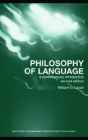
This edition published in the Taylor & Francis e-Library, 2008. "To purchase your own copy of this or any of Taylor & Francis or Routledge's collection of thousands of eBooks please go to www.eBookstore.tandf.co.uk." First edition © 2000 Taylor & Francis Group Second edition © 2008 Taylor & Francis Group All rights reserved. No part of this book may be reprinted or repro- duced or utilised in any form or by any electronic, mechanical, or other means, now known or hereafter invented, including photocopying and recording, or in any information storage or retrieval system, without permission in writing from the publishers. Trademark Notice: Product or corporate names may be trade- marks or registered trademarks, and are used only for identification and explanation without intent to infringe. Library of Congress Cataloging in Publication Data Lycan, William G. Philosophy of language: a contemporary introduction/William G. Lycan.
 annaabi.ee