Leidsid 33 sarnast õppematerjali, mis on seotud failiga "Mary Tudor". Need materjalid aitavad sul teemat sügavamalt mõista.
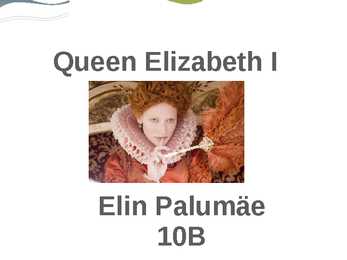
mary, philip, child, became, stake, tudor, known, henry, good, mother, elizabeth, pleased, marry, pregnant, return, later, first, languages, scienceivorce, catherine, kept, apart, lady, waiting, queen, spain, roseawn, worked, until, husband, meal, times, flute, wrong, fact, happened, thought, wantedoctors, cancer, swell, left, fight, france, ruleQueen Elizabeth I Elin Palumäe 10B Elizabeth I Reign - 17 Nov. 1558 24 March 1603 (44 years) Coronation - 15 January 1559(25 years) Predecessor - Mary I Successor - James I House - House of Tudor Father - Henry VIII Mother - Anne Boleyn Born - 7 September 1533 Greenwich, England Died - 24 March 1603 (aged 69) Burial - Westminster Abbey Anne Boleyn Queen consort of England Mother of Elizabeth I Tenure - 28 May 1533 17 May 1536 Coronation 1 June 1533 Anne Boleyn was Queen of England from 1533 to 1536 as the second wife of Henry VIII of England and the 1st Marquess of Pembroke in her own right for herself and her descendants. House - House of Tudor Father - Thomas Boleyn, 1st Earl of Wiltshire
1.SLAID Queen Mary I of England was born February 18, 1516. She was the daughter of King Henry VIII and his first of six wives, Catherine of Aragon. Mary was the only child from that union to survive infancy. She ruled as Queen of England from July 19, 1553 until her death on November 17, 1558. This era was known as the Marian Exile 2.SLAID Queen Mary I was rejected by her father during his divorce from her mother. Her parents' marriage was thought meaningless so for a while she was stripped of her statud as and heir to the throne. She was angry at her father's break from the Roman Catholic Church because it had told him that he couldn't divorce from her mother.
Mary I Mary I, called Mary Tudor (1516-1558), Queen of England (1553-1558). Mary was born in London on February 18, 1516, the daughter of Henry VIII by his first wife, Catherine of Aragón. Because Henry divorced Catherine, Mary was declared illegitimate. Nonetheless, Henry included her in his will, and on the death of her half-brother, Edward VI, on July 6, 1553, she became the legal heir to the throne. Although Lord High Chamberlain John Dudley, Duke of Northumberland, favoured the succession of his daughter-in-law, Lady Jane Grey, and proclaimed her queen on July 10, the country supported Mary. As a Roman Catholic, Mary began her reign by sweeping away the religious innovations of
This is the period when monarchies based on nationality were estabilished. The Renaessance started in Italy In the 14th century. Then it spread all over Europe, reached England in 16th century. The struggle for power culminated in a war called The War of Roses. It was a civil war between two dynasties, families. They had different emblems on one side the Yorks (white rose) other Lancasters (red). They couldn't decide who gets the throne. War ended 1485. A new dynasty came to throne, Tudor, the first king in this dynasty was Henry Vll. When he came to throne a period of stability followed because he built a nation based state. He was good at diplomacy.He could avoid quarrels and wars with neigbouring countries. France, Spain - greatest enemies.So he could save much money and thus laid a good economic basis for his state. Besides that he built a merchant fleet (kaubalaevastik) England begun to dominate in international trade. Unfortunately the king got old and died.
Megalith monument, built by western mediterraneans during 3000-1600 BC Circular structure, large standing stones, aligned with rising sun at teh solstice Attlers and bones were sued to dig pits that hold the stones The Celts in Britain and their legacy 700-200 BC celts invade Britain Gaels or Goehls(Ireland and Scotland),Cymri(Wales) and Brythons(gave name to Brittany) Fierce fighters,superb horsemen.Most of them farmers, lived in thatched houses Good at art, craftmanship, used iron Divided into tribes, ruled by kings, only in face of danger would they choose a single leader Legacy- hill-forts, farms, churches, field system, woodland, pasture, weapons, iron objects, langugae, culture Caesar in Britain The great Roman Emperor Firts came 55 BC to gather information, celts were doing agriculturally well,so romans wanted to get some food too In 54BC Caesar defeated Cassivelaunus
Queen Elizabeth I (1533-1603) Janeli Õim 11A Brief biography Elizabeth Tudor Click to edit Master text styles 7 September 1533 Second level 24 March 1603 Third level Fourth level Queen of England Fifth level Queen of Ireland - 17 November 1558 until her death (aged 69) Protestant Never married
An important legacy of the Romans was its roads, agriculture and cities. In the Roman times the land was dominated by rules and reguations. *Christianity in Roman Britain The Roman authorities were suspicious of Christianity because followers of Jesus Christ refused to take an oath of loyalty to the Roman emperor. For this reason the early Christians were regarded as dangerous enemies of the Empire. That ceased when the emperor Constantine converted to Christianity. Christianity became the official state religion of the Roman Empire in the early fourth century A.D. As the century progressed Christianity spread very quickly. Despite official recognition there was no mass conversion to Christianity; worship of the pagan gods and goddesses was not even formally banned until late in the fourth century. *Boadicea/Boudica At his death bed, Boudica's husband left half his possession to the emperor, expecting that this would protect his family
British kings and queens Kings King Henry VIII King Henry VIII is arguably the most well-known king of England. Famous for beheading his wives, of which he had six, King Henry VIII also had several children. King James I King James I was already King of Scotland when he got the English crown. King James I was the first ruler to call himself King of Great Britain, as he ruled England, Scotland and Wales. King James was the first King of Great Britain. King William I, the Conqueror King William I, otherwise known as William the Conqueror was born in France on 1028. He became friendly with the current English King, Edward the Confessor. He invaded and
and she was a part of the family, too. She is dead and if somebody reads it, he or she can learn about her and will know what she was like. The purpose of the work is to introduce Diana and get to know her better. Diana Facts about Diana Main Facts Her full name is Diana Frances Spencer and she was the Princess of Wales. Diana was called people's Princess. She was born on 1. July 1961 in Park house, Sandringham, Norfolk. She was born at the same place as her mother. She was married to Charles, Prince of Wales in 1981 and divorced in 1996. She died in car a accident on 31. August 1997 when she was only 36 years old. She is buried at Althorp, Northamptonshire. Family Her mother's full name is Frances Ruth Shand Kydd (1936 - 2004) and father's full name is Edward John Spencer (1924 1992). She has two sons with Prince Charles: Prince William, aged 27 and Prince Harry, aged 25. She gave birth to both sons in St Mary's Hospital, London. She has
Witchcraft is the alleged use of supernatural or magical powers. A witch (from Old English wicca m. / wicce f.) is a practitioner of witchcraft. Historically, it was widely believed that witchcraft involved the use of these powers to inflict harm upon members of a community or their property, and that all witches were in league with the devil. Since the mid 20th century, the term witchcraft has sometimes been used to distinguish between bad witchcraft and good witchcraft, with the latter often involving healing. Human misfortune was often blamed on a supernatural entity or a known person in the community. Reasons for accusations of witchcraft fall into four general categories: · A person was caught in the act of positive or negative sorcery · A well-meaning sorcerer or healer lost their clients' or the authorities' trust · A person did nothing more than gain the enmity of their neighbours
Chapter 17 Chapter 38 Chapter 58 Chapter 18 Chapter 39 Chapter 59 Chapter 19 Chapter 40 Chapter 60 Chapter 20 Chapter 41 Chapter 61 Chapter 21 Chapter 42 Chapter 1 It is a truth universally acknowledged, that a single man in possession of a good fortune, must be in want of a wife. However little known the feelings or views of such a man may be on his first entering a neighbourhood, this truth is so well fixed in the minds of the surrounding families, that he is considered the rightful property of some one or other of their daughters. "My dear Mr. Bennet," said his lady to him one day, "have you heard that Netherfield Park is let at last?" Mr. Bennet replied that he had not. "But it is," returned she; "for Mrs
the 29th of July in 1981. The wedding, which was held at St. Paul's Cathedral, was televised and watched by a global audience of over 750 million people. Diana and Charles had two sons, Princes William and Harry. EARLY LIFE She was born at Park House, Sandringham in Norfolk, England. Her parents were John Spencer and Frances Burke Roche. She had two older sisters Sarah and Jane and a younger brother Charles. When Diana's parents divorced in 1969, her mother took her and her younger brother live in an apartment in London's Knightsbridge, where Diana attended a local day school. Every Christmas, the children returned to Norfolk with their mother to visit their father, but he subsequently refused to allow them to return to London. Diana's mother sued for custody but she didn't get it and the custody went to the father. After that her father married to Raine Spencer. Diana and her siblings didn't get along with her. DESCENDANCE
1. What were the two institutions that Henry VII establised? Explain. Henry VII established the Court of Star Chamber to make the barons give up their private armies and overall restored finances by collecting taxes. Also Henry VII extended royal control over local government through the local magistrates called justice of peace. 2. What was the idea of the Act of supremacy? With passing the Act of Supremacy, Henry VIII was made the head of the Church of England and he was now free to divorce Catherine and marry Anne Boleyn. 3. Why did Henry VIII get the title Fidei Defensor? The title was given to him by the pope because Henry VIII was against Protestantism and other religious reforms by J. Calvin and M. Luther. For that, the pope named Henry VIII the Fidei Defensor, meaning Defender of the Faith 4. Why did Mary I get the nickname Bloody Mary?
attention to Vronsky in public, which is becoming a subject of society gossip. He is concerned about his and his wife's public image, although he believes that Anna is above suspicion. Vronsky, a keen horseman, takes part in a steeplechase event, during which he rides his mare Frou-Frou too hard and she falls and breaks her back. Vronsky escapes with minimal injuries but is devastated that his mare must be shot. Anna tells him that she is pregnant with his child, and is unable to hide her distress when Vronsky falls from the racehorse. Karenin is also present at the races and remarks to her that her behaviour is improper. Anna, in a state of extreme distress and emotion, confesses her affair to her husband. Karenin asks her to break off the affair to avoid society gossip and believes that their relationship can then continue as previously. Kitty goes with her mother to a resort at a German spa to recover from her ill health
Fresh ice cubes in the Thermos bucket. Mary Maloney was waiting for her husband to come him (correction: home) from work. Now and again she would glance up at the clock, but without anxiety, merely to please herself with the thought that each minute gone by made it nearer the time when he would come. There was a slow smiling air about her, and about everything she did. The drop of a head as she bent over her sewing was curiously tranquil. Her skin - for this was her sixth month with child - had acquired a wonderful translucent quality, the mouth was soft, and the eyes, with their new placid look, seemed larger darker than before. When the clock said ten minutes to five, she began to listen, and a few moments later, punctually as always, she heard the tires on the gravel outside, and the car door slamming, the footsteps passing the window, the key turning in the lock. She laid aside her sewing, stood up, and went forward to kiss him as he came in. "Hullo darling," she said.
He speaks Russian. 4 What nationality are you? I´m Estonian. 5 The descendants of the Africans brought to America are called settlers. 6 Uwe´s grandparents live in Germany. They speak German. 7 Michael comes from Australia. He speaks Australian English. 8 Eve lives in Ireland. She speaks English and Irish. 3 Write the sentences in reported speech. 1 Martin said, "We´re going on a class trip tomorrow." Martin said they were going on a class trip the next day. 2 Mary said to us, "I bought a book on big cats yesterday." Mary told us she had bought a book on big cats the day before. 3 Ben said to Brian, "You can wait for me here." Ben told Brian he could wait for him there. 4 Dad said, "I´ll finish work early today." Dad said he would finish work early that day. 5 My sister said to me, "This dress looks good on you." My sister told me that dress looked good on me. 6 Simon said, "I was in Springfield last week."
16th century (Tudors) 1. Henry VII - avoided wars, careful with money, didnt have expensive parties, was a rather shadowy figure 2. Henry VIII- brilliant scholar, excellent knight, good-looking, ambitious, self- centered, loved expensive clothes and parties. Wasted his fathers money very quickly and had 6 wives. His first wife couldnt give birth to a baby boy and they only had a daughter. His next wife only gave birth to a girl too. His next wife gave birth to a boy but died after the labor. He didnt like his 4th wife so he sent her back. His fifth
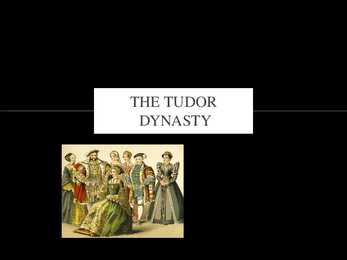
THE TUDOR DYNASTY THE TUDOR DYNASTY The Tudor dynasty or House of Tudor was a European royal house of Welsh origin that ruled the Kingdom of England and its realms, including the Lordship of Ireland, later the Kingdom of Ireland. Its first monarch was Henry VII. Henry VII THE TUDOR DYNASTY The Tudors extended their power beyond modern England, achieving the full union of England and the Principality of Wales in 1542 and successfully asserting English authority over the Kingdom of Ireland. They also maintained the traditional claims to the Kingdom of France, but none of them tried to make substance of it, though Henry VIII fought wars with France to try to reclaim that title. After him, his daughter Mary I lost the claim
QUEEN VICTORIA & HER TIME Project Mari Murakas Class 11A 2011 Early life of Queen Victoria Victoria was born in London on 24 May 1819, the only child of Edward, Duke of Kent, and Victoria Maria Louisa of Saxe-Coburg. [1] The Duke of Kent was the fourth son of George III and Victoria Maria Louisa was the sister of King Leopold of Belgium. The Duke and Duchess of Kent selected the name Victoria but her uncle, George IV, insisted that she be named Alexandrina after her
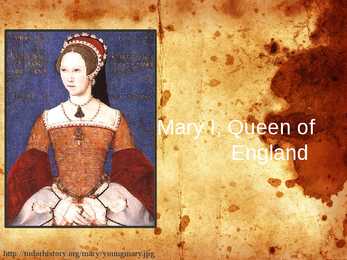
Mary I, Queen of England http://tudorhistory.org/mary/youngmary.jpg Queen Mary I of England Born: 18 February 1516 Proclaimed Queen: 19 July 1553 at St. Paul's Cathedral Coronation: 1 October 1553 Died: 17 November 1558 Buried: 14 Decenber 1558 http://tudorhistory.org/mary/marywhitehall.jpg Mary Tudor The Tudor Britain (1485-1603) Daughter of Henry VIII and Catherine of Aragon Henry divorced Catherine and married Anne Boleyn From "princess" to "The Lady Mary" http://tudorhistory.org/mary/marytudorsig.gif http://tudorhistory.org/elizabeth/signature.gif Catherine of Aragon 16 Dec 1485- 7 Jan 1536 Born in Toledo's Palace, Spain Youngest child Ferdinand and Isabella Married to Prince Arthur: 14 Nov 1501
The Mysterious Affair at Styles was adapted as a 103-minute drama and transmitted on ITV in the UK on Sunday September 16, 1990 as a special episode in their series AgathaChristie'sPoirotto celebrate the centenary of the author's birth. AGATHA CHRISTIE Agatha Christie was born Agatha May Clarissa Miller in Devon, in England in 1890, the youngest of three children. Her father died, when she was a child. At sixteen she was sent to school in Paris where she studied singing and piano. Christie was an accomplished pianist but her stage fright and shyness prevented her from pursuing a career in music. She never attended school. Dame Agatha Christie was an English crime writer of novels, short stories and plays. She also wrote romances under the name Mary Westmacott, but is best remembered for her 80 detective novels and her successful West End theatre plays.
There may be specials sections also for children. Almost every library has a special reading room with comfortable furniture for the readers and the students can work on independent study projects. School libraries. School libraries are part of the education system. It supports the curriculum as it helps the teachers and pupils to prepare for the lesson. Pupils can read extra materials there about the subjects they like. Everyone doesn't have a computer neither good encyclopedias at home so they can get the required information needed for their homework from the books or from the Internet. It is needed because it teaches how to find your books on your own from other libraries too because usually the same system is used for the book location. School libraries are definitely very good places to study for a test before the lesson because it is quiet there and one can use books as a helping hand. Our school library is very nice in my opinion
Henry VIII { Born on 28 June 1491 Second son of Henry VII He became the king after his father's death on 21 April 1509, he was 17 years old 3 children and 6 marriages Henry was spoilt, handsome, athletic, musical, interested in religion and fluent in 4 languages Early life Catherine of Aragon A Spanish princess and Henry's brother's widow Married 15091533 Loved eachother 4 sons who all died Their only daughter Mary became the queen later
increasing interest in the manuscripts that had survived from ancient Greece and Rome. Italy fell under the spell of the intellectual movement we've come to call the Renaissance the rebirth of scholarship based on classical learning and philosophy. 3. Why did the Renaissance focus on the human spirit? Stimulated by the discovery that the men and women of ancient Greece and Rome were intelligent, cultured, and creative, the Renaissance gradually became also the rebirth of the human spirit, a realization of the human potential for development. 4. What kind of ideas and beliefs did the Renaissance develop? Stimulated by the discovery that the men and women of ancient Greece and Rome were intelligent, cultured, and creative, the Renaissance gradually became also the rebirth of the human spirit, a realization of the human potential for development. This realization
Kordamine inglise keele eksamiks A 1.1 Read the text and answer the questions below. Dear Mary-Alice, It's been ages since I last wrote to you, isn't it weird? Yes, so it is, but, I do have a certain reason. Do you remember Sir Thom of the Minquettes'? That fine young man with fascinating blue eyes... Oh, my sweet Mary, you will never guess what happened yesterday! It was about seven o'clock in the evening when Lillian called me out for a walk you know I can't say `no' to my little sis. Anyway we went to the forest near the Swan Lake and, believe it or not, got lost! Awful! I was so scared... We walked and walked, not even knowing the direction we were heading to, until we reached a huge mansion. And the garden around it was so extraordinary... That is something you just must see
He/she/it has been going He/she/it has not been going Has he/she/it been going? We/you/they have been making We/you/they have not been making Have we/you/they been making? Kestev täisminevik väljendab: · Tegevust, mis on hiljuti või alles lõppenud, kuid mille algust ega lõppu pole teada. You are wet. Have you been running in the rain? They have been talking to Mary and they have decided... · Tegevust, mis algas enne kõnemomenti, kestab selleni või peale seda. Sel juhul rõhutakse tegevuse kestvusele (how long, for, since etc). How long have you been learning Italian? I have been drawing for almost two hours now. Past Continuous Kestva mineviku moodustamine Jaatav vorm Eitav vorm Küsiv vorm
period Full of great works British works in Latin Venerable Bede He lived between 673 and 735 AD The greatest of all the AngloSaxon scholars He's the earliest English historian, whose work has shed light on a period of English history that would have otherwise been unknown ,,The Father of English History" Wrote / translated about 40 books on almost every area of knowledge, i.e. nature, astronomy, and poetry His best known work is "The Ecclesiastical History of the English People" Starting with the Roman invasion in the 5th century, he recorded the history of the English up to his own day Old English Cædmon ,,The Father of English Hymn" Cædmon's Hymn is the oldest recorded Old English poem, and also one of the oldest surviving samples of Germanic alliterative verse The Hymn itself was composed between 658 and 680, recorded in the earlier part of the 8th century Middle English Geoffrey Chaucer 13431400
Marilyn Monroe Marilyn Monroe (born Norma Jeane Mortenson;[1] June 1, 1926 August 5, 1962), was a Golden Globe award winning[2] American actress, singer, model, Hollywood icon,[3] cultural icon, fashion icon,[4] pop icon and sex symbol. She is known for her comedic acting roles and screen presence. Monroe became one of the most popular movie stars of the 1950s and early 1960s. During the later stages of her career, she worked towards serious roles and her fame surpassed that of many entertainers of her time.[5] Her death at thirty six was classified as "probable suicide."[6] Many individuals including Jack Clemmons, the first LAPD Police officer to arrive at the death scene[7] believed that she was murdered.[8] She is the only female on the Forbes top earning dead celebrities list.[9] Contents
Princess Alexandra of Denmark on 10 March 1863, and they travelled to Norfolk 18 days later. The young couple made many extensions and improvements to the house and estate, including the construction of new roads, the rebuilding of cottages and landscaping. A new garden wall was built to accommodate the magnificent gift of the famous Norwich Gates - spectacular ironwork gates designed by Thomas Jekyll and presented as a wedding gift by the people of Norwich and Norfolk. It became obvious that the existing house was not suitable for large social gatherings and a growing family, so the Prince of Wales rebuilt it completely. As home to the heir to the throne and his wife, Sandringham was venue to many glittering occasions. Social life ranged from visits by Heads of State (1881, 1899 and 1902 by Kaiser Wilhelm) to informal retreats by the Royal Family. Three times a year there was a ball - for the gentry, for the farmer and for the servants
during World War I.[2] There have been four British monarchs of the house of Windsor to date: three kings and the present queen, Elizabeth II. During the reign of the Windsors, major changes took place in British society. The British Empire participated in the First and Second World Wars, ending up on the winning side both times, but subsequently lost its status as a superpower during decolonisation. Much of Ireland broke with the United Kingdom and the remnants of the Empire became the Commonwealth of Nations. King George V (1865-1936), Reigned 1910-36 As the second son of King Edward VII and Queen Alexandra, George V had not expected to ascend to the throne. He enjoyed a long and successful career in the Navy before his accession in 1910. His conscientious and unpretentious approach to his duties provided stability during an unsettled period, which included the First World War and the Great Depression. In 1932, he became the first monarch to use the medium of
......in his late twenties. He........married and........two sons. I........short, but my sister........tall. We........a dog and a cat. Our uncle........two dogs. They........brown. 2. Choose the correct item. ( 5 points ) e.g. The residents were made...D....their homes by the authorities. A leave B leaving C left D to leave 1) Ann is my best friend! We........each other for years A know B knew C knows D have known 2) Nicky........to San Francisco when the accident happened. A flies B has flown C was flying D has been flying 3) Why don`t you let her........her story? A finish B to finish C finishing D have finished 4) Tim........in a cafe at present, but he has already applied for a new job A work B have worked C is working D worked 5) My father........already worked for two years before he went to University
powerful. He pulled down some of their castles. He tried to restore law & order. He wanted the same kind of justice to be used everywhere. He appointed his own judges to travel around the country. They dealt with crimes & disagreements over poverty. Serious offences were tried in the king's court. At first they had no special knowledge or training. They were trusted to use common sense. By the end of the 12th cent. They had real knowledge & experience of the law which became known as ,,common law", based on custom, comparison, previous cases & decisions. It was unlike in the rest of Europe. In England trial by ,,ordeal" was replaced with trial by jury. The work of juries gradually changed from giving evidence to judging evidence of others. Now the king's laws were in force everywhere. In 1157 he forced Malcolm IV of Scotland to give up border regions to England. In 1171 he went to Ireland, took it under his rule & made his son John, Lord of Ireland. When he got the
Romans brought a lot with them. Their brought paved roads, the sites of important cities, the seeds of Christianity, the Roman law, Roman baths, language and advanced civilization. They also built Hadrian's Wall in 122 A.D. Romans occupied Britain for four centuries. The Roman way of life all vanished after the invasions from Northern Europe by the Angles, Saxons and Jutes from the 5th century onwards. They ruined Londinium, but they were easily turned into Christianity and religion became more and more important. The Vikings, who came in the 9th century, first raided England to plunder it, but then they decided to stay. In the 10th century England fell under Danish Rule, with King Canute finally managing to unite the Anglo-Saxons and Danes at the beginning of 11th century. Medieval England After defeating the Anglo-Saxon King Harold at the Battle of Hastings in 1066, William of Normandy (who became William I, also called William the Conqueror) introduced
 annaabi.ee