 50 punkti
Autor soovib selle materjali allalaadimise eest saada 50 punkti.
50 punkti
Autor soovib selle materjali allalaadimise eest saada 50 punkti.
 ~ 1 leht
Lehekülgede arv dokumendis
~ 1 leht
Lehekülgede arv dokumendis
 2013-10-11
Kuupäev, millal dokument üles laeti
2013-10-11
Kuupäev, millal dokument üles laeti
 6 laadimist
Kokku alla laetud
6 laadimist
Kokku alla laetud
 0 arvamust
Teiste kasutajate poolt lisatud kommentaarid
0 arvamust
Teiste kasutajate poolt lisatud kommentaarid
 napakas123
Õppematerjali autor
napakas123
Õppematerjali autor
Architecture Early Anglo-Saxon buildings in Britain were generally simple, constructed mainly using timber with thatch for roofing. The Anglo-Saxons built small towns near their centres of agriculture. In each town, a main hall was in the centre. The architectural character of Anglo- Saxon ecclesiastical buildings range from Coptic influenced architecture in the early period; basilica influenced Romanesque architecture; and in the later Anglo-Saxon period, an architecture characterised by pilaster-strips, blank arcading, baluster shafts and triangular headed openings. There are few remains of Anglo-Saxon architecture, with no secular work remaining above ground. All surviving churches, except one timber church, are built of stone or brick and in some cases show evidence of re-used Roman work. Art Anglo-Saxon art is mainly known today through illuminated manuscripts. Although they are the most well known to have survived. Perhaps the best known piece of Anglo-Saxon art is the Bayeux Tap
Scotland ! Scotland (Gaelic: Alba) is a country in northwest Europe that occupies the northern third of the island of Great Britain. It is part of the United Kingdom, and shares a land border to the south with England. It is bounded by the North Sea to the east, the Atlantic Ocean to the north and west, and the North Channel and Irish Sea to the southwest. In addition to the mainland, Scotland consists of over 790 islands including the Northern Isles and the Hebrides. Edinburgh, the country's capital and second largest city, is one of Europe's largest financial centres. It was the hub of the Scottish Enlightenment of the 18th century, which saw Scotland become one of the commercial, intellectual and industrial powerhouses of Europe. Scotland's largest city is Glasgow, which was once one of the world's leading industrial metropolises, and now lies at the centre of the Greater Glasgow conurbation which dominates the Scottish Lowlands. Scottish waters consist of a large sector o
o –by – Derby, Whitby. –beck – Troutbeck (trout brook). –thorp(e), Icelandic: o auk, eider, geyser, saga. Norse: o anger, balderdash, bing, bleak, blether, blink, bloom, blunder, blur, call, clamber, creek, crook, die, dirt, dowdy, doze, dregs, egg, fellow, flat, flaunt, flaw, fleck, flimsy, gasp, gaunt, gaze, girth, glint, glitter, gloat, happen, harsh, inkling, kick, kilt, law, leg, loan, meek, midden, muck, muggy, nasty, nudge, oaf, odd, raise, root, scalp, scant, scowl, seat, skerry, skewer, skid, skill, skin, skull, sky, sniff, snub, squall, squeal, take, they, thrall, thrift, thrust, ugly, vole, want, weak, window. Norwegian: o fjord/fiord, floe, kraken, krill, lemming, ski, slalom. Swedish: o glogg, ombudsman, smorgasbord, tungsten. 8
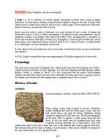
BOOKS (From Wikipedia, the free encyclopedia) A book is a set or collection of written, printed, illustrated, or blank sheets, made of paper, parchment, or other various material, usually fastened together to hinge at one side. A single sheet within a book is called a leaf, and each side of a leaf is called a page. A book produced in electronic format is known as an electronic book (e-book). Books may also refer to works of literature, or a main division of such a work. In library and information science, a book is called a monograph, to distinguish it from serial periodicals such as magazines, journals or newspaper. The body of all written works including books is literature. In novels and sometimes other types of books (e.g. biographies), a book may be divided into several large sections, also called books (Book 1, Book 2, Book 3, etc.). A lover of books is usually referred to as a bibliophile, or, more informally, a bookworm. A store where books are bought and sold is a bookstore
1. Ancient Britain: the Celtic tribes. 2000 years ago there was an Iron Age Celtic culture throughout the Br Isles. It seems that the Celts, who had been arriving from Europe from the 8th cent BC onward, intermingled with the peoples who were already there. The Celts were extremely talented people, creative and artistic. More than 1 Celtic tribe invaded Br. The descendants of ancient Celts live in Wales, Scotland, Cornwall and Ireland. They lived in primitive society. Druids priests, more powerful than chiefs. Acted like prophets. 2. Stonehenge From prehistoric period. Was built on Salisbury plain between 2500 and 1500 bc. One of the most famous and mysterious archaeological sites in the world. One of the mysteries is how it was built at all with the technology of the time. Another is its purpose. It appears to function as a kind on astronomical clock and we know it was used by the Druids for ceremonies marking the passing of the seasons. It appears in number of novels. T
BRITISH NATIONAL SYMBOLS Research work CONTENTS CONTENTS.....................................................................................................................................2 INTRODUCTION............................................................................................................................3 1. BRITISH NATIONAL SYMBOLS..............................................................................................5 1.1 Great Britain and British story................................................................................................5 1.2 National Symbols and Nation Building..................................................................................5 1.3 The Use of Flags throughout History.....................................................................................6 1.4 The Early Modern Flags. United Kindom: Union Jack..........................................................8 1.5 National Flags as Pol
SPORT In English the word ‘sport’ describes both casual play and the highest levels of performance. Recent surveys reveal that 10% of adults play sports more than twice a week, the majority of the British population involves in sport or physical recreation at least once a month. Most people have an interest in some sports as a player, spectator or gambler, but everybody in Britain seems to be fond of outdoor exercise, be it jogging, walking, rambling or just sitting on the bench outdoors. As British homes are rather cool in winter (at least for Estonians!), the saying goes that ‘the English like fresh air outdoors and indoors’. Most people are conscious of the good influence of sport on their health. They expect a lot from it – having an attractive body shape, strengthening their hearts, lowering their blood pressure and reducing stress. To keep fit or just to relax, most people in towns involve themselves
1. STYLE The term "style" is polysemantic (has many meanings): a Latin word "stilus" originally meant a writing instrument used by ancient people. Already in classical Latin the meaning was extended to denote the manner of expressing one's ideas in written or oral form. Jonathan Swift defined style as "proper words in proper places". In present day English the word "style" is used in about a dozen of principle meanings: 1. the characteristic manner in which a writer expresses his/her ideas (e.g. style of Byron) 2. the manner of expressing ideas, characteristic of a literary movement or period 3. the use of language typical of a literary genre (e.g. the style of a comedy, drama, novel). 4. the selective use of language that depends on spheres / areas of human activity (e.g. style of fiction, scientific prose, newspapers, business correspondence, etc.). STYLISTICS Stylistics is the study of style. The very term "stylistics" came in more com
 annaabi.ee







Kõik kommentaarid