Leidsid 33 sarnast õppematerjali, mis on seotud failiga "Jacques Louis David ja Prantsuse Revolutsioon". Need materjalid aitavad sul teemat sügavamalt mõista.
paint, revolution, marat, french, there, sent, king, even, therefore, political, represent, cause, roberts, republic, other, late, jacques, idea, than, hero, century, moreover, brutus, death, abletriot, bara, eventsintings, furthermore, while, startedinted, later, same, year, them, found, important, ideas, figurestriotismris, althoughThe making of a new nation. The Enlightenment in America. The emergence of the notion of the American Dream. The great Enlighteners: Crèvecoeur, Jefferson, Paine, Franklin. The American Enlightenment is the intellectual thriving period in the United States in the midtolate 18th century (17151789), especially as it relates to American Revolution on the one hand and the European Enlightenment on the other. Influenced by the scientific revolution of the 17th century and the humanist period during the Renaissance, the Enlightenment took scientific reasoning and applied it to human nature, society, and religion. American Enlightenment a gradual but powerful awakening that established the ideals of democracy, liberty, and religious tolerance in the people of America. If there were just one development that directly caused the American Revolution and uplifted the intellectual culture of the continent while it was only
1. The Jacobean masque Elizabethan one nation culture, now cultural polarisation between the new courtly culture and the rest of the country. Court in cultural isolation. Ben Jonson. King and courtiers were close to universally recognised ideal types (conflict with the reality). Mysticism. Emergence of perspective view, stage machinery, artificial light, revolution. The stage cast the monarch in the focal point (the lines of perspective of the stage met there. Inigo Jones. Masque an educative vehicle, towards classical antiquity and architecture. Tide towards absolute monarchy. Masque – linked poetry and moral philosophy into art. Music, dance, poetry, lavish illusionistic scenic display to express the doctrines of divine kingship. Great impact. Like gods come down to earth. 2. The Caroline masque Charles decided on subject matter, and acted and danced in masques. Now the regal divinity even more obvious. Ben Jonson
telegraph, telephone, and TV, creating involvement in depth. A fairly complete handbook for studying the extensions of man could be made up from selections from Shakespeare. Some might quibble about whether or not he was referring to TV in these familiar lines from Romeo and Juliet: But soft! what light through yonder window breaks? It speaks, and yet says nothing. In Othello, which, as much as King Lear, is concerned with the torment of people transformed by illusions, there are these lines that bespeak Shakespeare's intuition of the transforming powers of new media: Is there not charms By which the property of youth and maidhood May be abus'd? Have you not read Roderigo, Of some such thing? In Shakespeare's Troilus and Cressida, which is almost completely devoted to both a psychic and social study of communication, Shakespeare states his awareness that true social and political navigation depend upon anticipating the consequences of innovation:
logic, mathematical theory of grammar) and linguistics (the theory of language structure, comparative linguistics, language typology, psycholinguistics, sociolinguistics; applied linguistics including speech and text processing, quantitative linguistics, modern applied linguistics). History of the Department Russian philology was not studied as an independent academic discipline until 1945, yet from the very beginning of the faculty's existence there were courses in Russian studies on offer for students of Slavic studies. In the 1922/1923 academic year, an independent Section of Russian Language and Literature was founded within the School of Slavic Studies. The section was, from its foundation until 1945, headed by Valerij Alexandrovic Pogorielov. In 1945 another member of the post-revolutionary wave of Russian emigrants, Prof. Alexander Vasilievic Isacenko, was appointed Professor in Russian Philology. In 1946 Prof. A. V. Isacenko became
History exam *Stonehenge - is a monument located in England. It is one of the most famous prehistoric sites in the world and is composed of earthworks surrounding a circular setting of large standing stones. The surrounding circular, earth bank and ditch, have been dated to about 3100 BC. Stonehenge was produced by a culture with no written language. Many aspects of Stonehenge remain subject to debate. There is little or no direct evidence for the construction techniques used by the Stonehenge builders. *The Celts in Britain and their legacy The Cets lived in Britain in The Iron Age. They were warring tribes who were battleful amongst themselves as well as inter-tribal war. They were not centrally governed. The Celts brought iron working, iron ploughs and metal swords, horses, wheels and chariots - all these things gave them an instant superiority over the native tribes
Because of the fact that they were all students they were also very young- the oldest one, Hunt, was 21. They were soon joined by William Rossetti(critic), James Collison(painter), Frederic Stephens (critic), Thomas Woolner(sculptor). The three youthful Pre-Raphaelites deliberately challenged the established view of art, drawing up a manifesto of their intentions and publishing them in the four issues of a periodical called "The Germ". They would paint direct from nature, with objective truthfulness and genuine ideas in sympathy with what was direct and heartfelt in the art of the past. The brotherhoods techniques came from the early Flemish art- especially Van Eyck. To imitate the work of great Italian artists the PRB-s studied the colours in nature. To have the effect of glowing colours they invented a new method called "wet white". It was very difficult and wasn't used a lot (except Hunt)
Hassam painted urban scenes which were an innovation in American painting. An informal alliance, "The Ten", emerged who by way of Impressionistic paintings that refreshed the image of America (cityscapes, gardens, parades, society, landscapes). Artists: Theodore Robinson, Frederick C. Hassam. C20 till WWI General Trends. In early-C20, national consciousness started to develop. Sympathy was expressed for the oppressed workers. Before photography became preeminent, there was a brief period of newspaper illustrators and artist- reporters. By 1908, a new generation of artists had emerged who were not afraid to dabble in abstact art, Fauvism, Cubism, Futurism, Der Blaue Reiter and Orphism. The Armory Show of 1913 is the general birthdate of American modernism. "The Eight"/"The Aschan School". These artists explored the everyday life of ordinary people in large cities. They represented the transition to modernism
Hassam painted urban scenes which were an innovation in American painting. An informal alliance, "The Ten", emerged who by way of Impressionistic paintings that refreshed the image of America (cityscapes, gardens, parades, society, landscapes). Artists: Theodore Robinson, Frederick C. Hassam. C20 till WWI General Trends. In early-C20, national consciousness started to develop. Sympathy was expressed for the oppressed workers. Before photography became preeminent, there was a brief period of newspaper illustrators and artist- reporters. By 1908, a new generation of artists had emerged who were not afraid to dabble in abstact art, Fauvism, Cubism, Futurism, Der Blaue Reiter and Orphism. The Armory Show of 1913 is the general birthdate of American modernism. "The Eight"/"The Aschan School". These artists explored the everyday life of ordinary people in large cities. They represented the transition to modernism
intellectual. Jordan is against suicide, which is major theme in the novel, because Jordan's father commited suicide. Falls in love with Maria, daughter of republican mayor. Three days of love bring him back to life. Maria was raped by facists and her father was killed by facists, disturbed girl. Secondary characters are rememorable. Men and women act differently to war. Men are carried away by war propaganda, women are shown to be wised and appreciate life more than political parties. Men think on taking sides but women value life more. Jordan is an idealist. He is willing to give his life for this cause. But Maria's first loyalty is to her lover, jordan. She places love above war, politics. Pablo is another type, he is a moral coward, he is a defeatist, who wants to avoid personal danger and wants to save his life, he is mean and betrays his country men. Pilar, Pablo's woman, strong, courageous, patriot, never the less
Jacob, son of Issac, stole his brother's birthmark. Jacob was a partiarch who brought up his twelve sons to be partiarchs, but they did not take to it. One of Jacob's sons, Joseph, gave refuse to the Israelites. Pharaoh forced the Hebrew slaves to make bread without straw. Moses led them to the Red Sea, where they made unleavened bread, which is bread made without any ingredients. Afterwards, Moses went up on Mount Cyanide to get the ten commandments. David was a Hebrew king skilled at playing the liar. He fougth with the Philatelists, a race of people who lived in Biblical times. Solomon, one of David's sons, had 500 wives and 500 porcupines. Without the Greeks, we wouldn't have history. The Greeks invented three kinds of columns - Corinthian, Doric and Ironic. They also had myths. A myth is a female moth. One myth says that the mother of Achilles dipped him in the River Stynx until he became intolerable. Achilles appears in "The Illiad", by Homer. Homer also
period. Importance of religion; the stories of King Arthur (also Tristan and Isolde, based on Celtic legends). Importance of the church during the Middle Ages (5th c to 15th c). Three languages used in England: French, English and Latin. Main literary genres: (1) chivalric romance, (2) the fabliau (a comic, often anonymous tale that is characterised by an excess of sexual and other types of obscenity) and (3) literature on religious topics – either moralistic
end of the 19 century, bored. Stanfrod talks friends about horses: problem: question is, what happens with the hooves while its moving, running. Bet, with eyes, can't settle this. Cannot ever see if the hooves touch the ground. Stanford has enough money, hires most famous photographer. Eadwerd muybridge, comes to usa. Tells him to settle this with photography. That time with photography you cannot get any informatio either. Started to install boxes, in each box, there was a camera. Does the hooves touch the ground or not? Fast shutter, can freeze the moment. Makes fast shutters, to record this. Finds solution, hooves are touching. The prerequisites for cinema: camera(edison and dickson), film stock that is flexible and stable to run through camera(kodak, celluloid film), projector, can show the image on a screen(1895-max skladanowsky, lumiere brothers) The lumiere brothers and cinematographe Father was a wealthy factory owner
The Renaissance Between 14th and 16th century in Europe From French word rebirth It was an age of growth in Europe. New, powerful city states emerged. A new middle class had more and more money to spend. Great artists, writers and thinkers lived during this time. During the Middle Ages many people who lived in the countryside worked on the land that they got from the noblemen. In return, they were protected by them Between the middle and the end of the 14th century, the plague, also called "Black Death" killed almost half of Europe's population
Christopher Columbus (1451-1506) was an Italian explorer who sailed across the Atlantic Ocean in 1492, hoping to find a route to India (in order to trade for spices). He made a total of four trips to the Caribbean and South America during the years 1492-1504. He discovered America in 1492. I Indian sun, they pray for fan. J we hate Jews, they are fools. K Bush is okey, because he is not gay. L Americans are large, they eat much. M Mc`Donalds is good, there is a lot of food. N is for Nigga who pulled the trigger. O is for Osama who wears pyjamas. P is for Pamela who likes camera. Puritans The Puritans were a group of people who grew discontent in the Church of England and worked towards religious, moral and societal reforms. The writings and ideas of John Calvin, a leader in the Reformation, gave rise to Protestantism and were pivotal to the Christian revolt
Marlow later finds Jim work as a ship chandler's clerk. Jim tries to remain incognito, but whenever the opprobrium of the Patna incident catches up with him, he abandons his place and moves further east. Nostromo (1904)- Nostromo is set in the South American country of Costaguana (a fictional nation, though its geography as described in the book closely matches real-life Colombia). Costaguana has a long history of tyranny, revolution and warfare, but has recently experienced a period of stability under the dictator Ribiera. Charles Gould is a native Costaguanero of English descent who owns an important silver-mining concession near the key port of Sulaco. He is tired of the political instability in Costaguana and its concomitant corruption, and uses his wealth to support Ribiera's government, which he believes will finally bring stability to the country after years of misrule and tyranny by self-serving dictators.
I think graffiti, by the way, is also a great and invaluable work. Trends are changing. Now, young artists are moving from an endless unthinking tagging to a more conceptual and rich sense, abstract and volumetric work. Street art has become popular among the general public, because it is more accessible to him both in content and in location: for art, now you do not need to go to a museum or gallery, and the meaning of the work is often clear at a glance. In our environment there are not enough professional critics and theorists who could competently evaluate and describe the work of street artists. This is very bad, because the viewer needs a certain benchmark, according to which he could assess the quality of the works presented. 1. THEORETICAL PART Any type of history is a discourse in its own right. What is more, when talking about art history, the discourses seem to flourish immensely from one into another, and so on into many more. In
Test on Romantic Poetry and Prose 1. Approximate dates of romanticism: in the second half of the 18th century. Major events on world history at that time: · Industrial revolution · In America the Declaration of Independence, July 4, 1776 · The French Revolution, 1789 · The King of England was George III, after him George IV and then Queen Victoria Outcomes: · Revolution did not bring welfare · Lives of the lower-classes worsened · Extended the distance between the lower and upper class · The rich got richer, the poor got poorer 2. Romanticism is a reaction against classicism, science and atomic (aesthetic ideal of order and unity) worldview. Romantic ideal is the organic world. Romanticism: · Returns to nature and belief in the goodness of mankind
Teaduslik revolutsioon 15431600 I One of the most important developments in the western intellectual tradition was the Scientific Revolution. The Scientific Revolution was nothing less than a revolution in the way the individual perceives [ tajub ] the world. As such, this revolution was primarily an epistemological revolution it changed man's thought process. It was an intellectual revolution a revolution in human knowledge. Even more than Renaissance scholars who discovered man and Nature, the scientific revolutionaries attempted to understand and explain man and the natural world. Thinkers such as the Polish astronomer Nicholas Copernicus(14731543), the French philosopher René Descartes(15961650) and the British mathematician Isaac Newton(16421727)
barbarians. 406-7 barbarians begin invasion Legacy- new types of animals, plants; miles, feet, inches-roman measurements;christianity; Roman basilica in curches; reading, writing; buildings, roads Christianity in Roman Britain Until 4th C christians were persecuted 313 AD Emperor Constantine legalised christianity 380 AD Emperor Theodosius I made it the official religion of the empire Paganism had been eclipsed but continued to pose a political, religious challenge Boudicca Queen of Iceni people of Eastern England, led an uprising against Roman forces Prasutagus(ruler) was first allowed to rule when romans conquered England, after his death, romans decided to rule Iceni and flogged Boudicca and raped her daughters 60-62 AD Iceni rebelled, Boudicca´s warriors defeated Roman Ninth Legion, destroied capital-Colchester Finally Boudicca was defetated, she poisoned
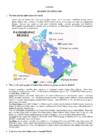
thought he had reached India. Many now prefer to call themselves First Nations, though many still call themselves Indians in everyday conversation. They are still legally categorized by the Canadian Government under the Indian Act as Status Indians. Those who have lost their legal status are called Non-Status Indians. Prime Minister Pierre Trudeau tried to get rid of the Indian Act, but First Nations political groups insisted on keeping it, because it defines their special status. The Inuit are the people who originally lived in the Arctic. Their language is Inuktitut, but it has several dialects the differ considerably from place to place. The Métis, are the group of people who resulted from the mixing of European and Native men and women. The Métis developed a unique culture that included elements of both European and Native ways and artifacts (clothes, tools, means of travel, etc.)
The Iberians brought their metal-working skills and the first real civilization to Britain in the third millennium B.C and were overrun by various Celtic invasions that began in the 8th century. The Celts introduced their tribal organization and an early form of agriculture before they were forced westward by the Roman invasion. Forms of Celtic language are still spoken in Britain. Romans (with Julius Caesar in the head of them) first tried to occupy Britain in 55 B.C., but there was a rebellion in Gaul so they had to leave to fight against it. Next time they came in 43 A.D. and their leader was Emperor Claudius. Romans brought a lot with them. Their brought paved roads, the sites of important cities, the seeds of Christianity, the Roman law, Roman baths, language and advanced civilization. They also built Hadrian's Wall in 122 A.D. Romans occupied Britain for four centuries. The Roman way of life all vanished after the invasions from Northern Europe by the
" The Wailers' first album, Catch A Fire, was released worldwide in 1973, and sold well. It was followed a year later by Burnin', which included the songs "Get Up, Stand Up" and "I Shot The Sheriff". Eric Clapton made a hit cover of "I Shot the Sheriff" in 1974, raising Marley's international profile. The Wailers broke up in 1974 with each of the three main members going on to pursue solo careers. The reason for the breakup is shrouded in conjecture; some believe that there were disagreements amongst Livingston, McIntosh, and Marley concerning performances, while others claim that Livingston and McIntosh simply preferred solo work. McIntosh began recording under the name Peter Tosh, and Livingston continued as Bunny Wailer. Bob Marley & The Wailers Despite the breakup, Marley continued recording as "Bob Marley & The Wailers". His new backing band included brothers Carlton and Aston "Family Man" Barrett on drums and bass
1. Ancient Britain: the Celtic tribes. 2000 years ago there was an Iron Age Celtic culture throughout the Br Isles. It seems that the Celts, who had been arriving from Europe from the 8th cent BC onward, intermingled with the peoples who were already there. The Celts were extremely talented people, creative and artistic. More than 1 Celtic tribe invaded Br. The descendants of ancient Celts live in Wales, Scotland, Cornwall and Ireland. They lived in primitive society. Druids priests, more powerful than chiefs. Acted like prophets. 2. Stonehenge From prehistoric period. Was built on Salisbury plain between 2500 and 1500 bc. One of the most famous and mysterious archaeological sites in the world
English Literature ,Victoria Age 1) Overview of the Victorian age · Periodization During the reign of Queen Victoria (1837-1901) · Why is the Victorian Age compared to the Elizabethan Age? Both are associated with the reign of a very popular queen; Victorian age idealised the Elizabethan Age; many changes in different fields- economy, religion etc.; focusing more on people's attitudes, political developments etc; Victorian age was inspired by Elizabethan era; Britain became an empire · What were the most important changes in politics, religion and social life that occurred during the Victorian age? Politics: 1848 Chartist movement (voting right for the working class); women's suffrage movements; feminist outburst (wanted to have business openly; own property, voting etc.); world dominion (British
Some of the things you will learn in THE CODEBREAKERS • How secret Japanese messages were decoded in Washington hours before Pearl Harbor. • How German codebreakers helped usher in the Russian Revolution. • How John F. Kennedy escaped capture in the Pacific because the Japanese failed to solve a simple cipher. • How codebreaking determined a presidential election, convicted an underworld syndicate head, won the battle of Midway, led to cruel Allied defeats in North Africa, and broke up a vast Nazi spy ring. • How one American became the world's most famous codebreaker, and another became the world's greatest. • How codes and codebreakers operate today within the secret agencies of the U
ridiculous idea. It is a comment on the pomp and circumstance of English armies. To Swift it seems that armies are often more concerned with looking impressive than with being impressive. This scene might also be an allusion to the Colossus of Rhodes, described in Julius Caesar by Shakespeare as a largerthanlife figure that men could walk through the legs of. The war between the English and the French is parodied in the conflict between the Lilliputians and the Blefuscudians. Their conflict over which end of the egg to break reflects the centuriesold conflict over how to practice religionas Protestants or Catholics. While the wars over religion certainly were very serious, Swift suggests that what was being fought over (at least on the religious rather than the political side) really was not very important. In Swift's eyes, fighting over religion is as pointless as
presents and expresses his ideas. 1.CHAPTER I 1.1. LARKIN STUDIES POINTS OF VIEW: BIOGRAPHY AND POETRY In the collection of essays edited by Stephen Regan (Philip Larkin, 1997) we can find some underlying question as: are we discussing the poem or the poet? Or, in Larkin’s terms: are we more deceived or less deceived by the metonymy of the phrase “we are reading Larkin”? The main purpose of the volume may be discussing and assessing Larkin’s poetry, but there are at least as many references to his letters (mainly published in SL) and to his life as to the poems themselves. If we think that Larkin is known as a legend we shouldn’t be surprised about the importance his life takes as a part of his work. His work, balancing on the borderline between “Life” and “Art”, will probably always is interesting not only for critics, but also for a wider reading public.
century. The author is unknown and the manuscript is kept in the British Museum (near Trafalgar Square). The story is very important as it allows us to lear about the way of life in the 4th century. The characters can be divided into two groups fictitious and historical. The epic deploys many metaphors - e.g. the sea = the swan's road, body = a house for bones and alliteration. It is structured as two parts. In the first part King Hroghtgar, king of Danes built a palace Hereot near a lake. He disturbed the lake monsters sleep with his racuous parties. Grendel then goes to the castle every night and kidnaps a man. This went on for 12 years. Beowulf, a young viking, decides to put an end to it. He chooses 14 men to join him and sails across the strait with no weapns, mind you, because Grendel fought unarmed and Beowulf was an idiot however according to the rules of fiction he defeats Grendel
Their writings were matter-of-fact accounts of life in America, which explained colonisation to Englishmen back in the homeland. An example of this form of writing is John Smith's A True Relation of Virginia, which is widely recognized to be the first example of Am lit. The early years of colonisation produced a mass of utilitarian writings including biographies, accounts of voyages, diaries, sermons, pamphlets. Much of the material addressed the problems of Church and State. There were few examples of fiction, poetry or drama. Anne Bradstreet of Massachusetts published some lyrical poems of high literary quality (1650) and Edward Taylor, who was born in England but lived in Boston, wrote some poetry in the style of John Donne and the metaphysical poets. All 17 th cent Am writings were, both in content and form, similar to English lit of the same period. The great literary figures of the 18th cent were Benjamin Franklin (1706-1790),
and Lake Peipsi. The country is populated by Estonians who belong to the Western Finnish group of nations, a branch of the Finno-Ugric stem, and speak the Estonian language. Estonia is the northernmost of the Baltic States. From west to east the length of the country is 360 kilometres and the width, from north to south, is 255 kilometres. The area is 45,227 square kilometres of which more than 4,000 square kilometres are made up by islands and islets (over 1,000); there are more than 1,400 lakes that form nearly 5% of the total area. More than 40% of the entire area is woodland. The country is flat; the average elevation is 50 metres above sea level. The highest peak, Suur Munamägi rises to only 317 metres. High limestone features characterise the north of the country, while the south has a drumlin terrain. The maritime climate is temperate, summers are warm and winters mildly cold, the average
surrounding islands which comprise the territory of England, Scotland and Wales. All of the island is territory of the sovereign state of the United Kingdom of Great Britain and Northern Ireland, and most of the United Kingdom's territory is in Great Britain. Most of England, Scotland, and Wales are on the island of Great Britain, as are their respective capital cities: London, Edinburgh, and Cardiff. The Kingdom of Great Britain resulted from the political union of the kingdoms of England and Scotland with the Acts of Union 1707 on 1 May 1707 under Queen Anne. In 1801, under a new Act of Union, this kingdom merged with the Kingdom of Ireland to create the United Kingdom of Great Britain and Ireland. After the Irish War of Independence most of Ireland seceded from the Union, which then became the United Kingdom of Great Britain and Northern Ireland.
Most of the knowledge of the period stems from archaeological investigations and especially epigraphic evidence. The invasion force in AD 43 was led by Aulus Plautius.It is not known how many Roman legions were sent; only one legion, the II Augusta, commanded by the future emperor Vespasian, is directly attested to have taken part. The IX Hispana,the XIV Gemina (later styled Martia Victrix) and the XX are attested in 60/61 during the Boudican Revolt, and are likely to have been there since the initial invasion. However, the Roman army was flexible, with units being used and moved whenever necessary, so this is not certain. Only the Legio IX Hispana is likely to have stayed there, as it is attested to being in residence at Eburacum (York) in AD 71 and on a building inscription there dated AD 108, before its eventual destruction fighting in the East, likely during the Bar Kochba Revolt. The invasion was delayed by a mutiny of the troops, who were eventually persuaded by an
Georges Braque kasvas üles Pariisi lähedal Le Harves. Mõnda aega töötas maalrina, õhtuti õppis École des Beaux-Arts kunstikoolis (18971899). Aastatel 19021904 õppis Pariisis Academie Humbert'is. Georges Braque teenis Esimese maailmasõjas Prantsuse sõjaväes ja sai raskelt haavata. Ta kasutas maalis esimesena kirjatähti, imiteeris puu ja marmori faktuuri ning leiutas kollaazitehnika Robert Delaunay Robert Delaunay (12 April 1885, Paris 25 October 1941) was a French artist who used Orphism, which is similar to abstract art, abstraction and cubism in his work. Delaunay concentrated on Orphism, while his later works were more abstract, reminiscent of Paul Klee. His key influence related to bold use of colour, and a clear love of experimentation of both depth and tone. While he was a child, Delaunay's parents divorced, and he was raised by his uncle, in La Ronchère (near Bourges). He took up painting at an early age and, by 1903, he
 annaabi.ee