Leidsid 33 sarnast õppematerjali, mis on seotud failiga "Ireland - powerpoint presentation". Need materjalid aitavad sul teemat sügavamalt mõista.
ireland, fourth, seed, irish, dance, dram, emerald, island, aints, years, gaelic, britain, republic, once, humans, arrived, literature, tradition, famous, oldest, writers, poets, europe, greek, latin, science, south, effect, blue, kelvin, electron, french, brandy, musk, fennel, skey, drink, legends, leprechaun, kings, fairy, doctor, banshee, thanks1. Ancient Britain: the Celtic tribes. 2000 years ago there was an Iron Age Celtic culture throughout the Br Isles. It seems that the Celts, who had been arriving from Europe from the 8th cent BC onward, intermingled with the peoples who were already there. The Celts were extremely talented people, creative and artistic. More than 1 Celtic tribe invaded Br. The descendants of ancient Celts live in Wales, Scotland, Cornwall and Ireland. They lived in primitive society. Druids priests, more powerful than chiefs. Acted like prophets. 2. Stonehenge From prehistoric period. Was built on Salisbury plain between 2500 and 1500 bc. One of the most famous and mysterious archaeological sites in the world. One of the mysteries is how it was built at all with the technology of the time. Another is its purpose. It appears to function as a kind on
wanted to defeat it. He could clearly see that Britain was a threat to his latest and greatest conquest - France. He invaded Britain twice, in 55 and 54 BC. The first invasion was unsuccessful - it gained a beachhead on the coast of Kent but achieved little else. The second was more successful, the Celts asked for truce. However it wasn't a victory he had imagined and Julius Caesar never returned to Britain after that. The island was left undisturbed for nearly a century. *The Roman occupation of Britain 43-410 and its legacy Britain was conquered by Emperor Claudius, the Roman rule in England lasted up to 410. The Romans left behind a huge legacy: many types of animals and plants were brought to Britain in Roman times. Roman introduced theire measurements, Christianity, reading and writing. Also, many words in English and Welsh have been borrowed from the Latin language. An important legacy of
Costaguana has a long history of tyranny, revolution and warfare, but has recently experienced a period of stability under the dictator Ribiera. Charles Gould is a native Costaguanero of English descent who owns an important silver-mining concession near the key port of Sulaco. He is tired of the political instability in Costaguana and its concomitant corruption, and uses his wealth to support Ribiera's government, which he believes will finally bring stability to the country after years of misrule and tyranny by self-serving dictators. Instead, Gould's refurbished silver mine and the wealth it has generated inspires a new round of revolutions and self-proclaimed warlords, plunging Costaguana into chaos. Among others, the revolutionary Montero invades Sulaco; Gould, adamant that his silver should not become spoil for his enemies, orders Nostromo, the trusted "capataz de los cargadores" (head longshoreman) of Sulaco, to hide it on an offshore island. ,,Heart of darkness"-1902
1. The Queen’s official title. Elizabeth the Second, by the Grace of God, of the United Kingdom of Great Britain and Northern Ireland and of Her other Realms and Territories Queen, Head of the Commonwealth, Defender of the Faith. 2. The Queen’s working day. Starts after breakfast. Reads the newspapers which are prepared by the Press Secretary, and a report on the previous day’s proceedings in the Parliament and the letters she receives. Also phone calls. Once a month she attends the Privy Council in order to give Royal Assent to various items of government legislation.
ATTENTION TO HISTORY AND FOLKLORE: JUHAN AAVIK, EDUARD TUBIN, EUGEN KAPP. VII. FURTHER MATURING OF SYMPHONIC MUSIC: HEINO ELLER, EVALD AAV, EDUARD TUBIN. THE FIRST ESTONIAN BALLET. SUMMARY OF THE REPUBLICAN PERIOD. HALF A CENTURY UNDER SOVIET OCCUPATION. IDEOLOGY OVER MUSIC. EXTENSIVE INFLUX OF CONTEMPORARY TRENDS. VIII. THE FORTIES. TRANSFORMATION OF ESTONIAN LIFE. THE WAR-TIME SYMPHONIC OUTPUT. IX. THE PLANTING OF NEW CREATIVE PRINCIPLES DURING THE POST-WAR YEARS. X. THE SECOND HALF OF THE FIFTIES. TOWARDS A MODERN IDIOM: EINO TAMBERG AND VELJO TORMIS. XI. THE NEOCLASSICISM AND CONSTRUCTIVE THINKING OF JAAN RÄÄTS. XII. THE FIRST HALF OF THE SIXTIES. DODECAPHONY OF ARVO PÄRT. XIII. THE DRAMATIC PHILOSOPHICAL OUTPUT OF HELMUT ROSENVALD. XIV. THE ELEMENTS OF JAZZ, FOLK MUSIC AND DODECAPHONY IN THE SYMPHONISM OF ANTI MARGUSTE. XV. HEIMAR ILVES AND HIS MUSIC – DEEP IN THOUGHT AND FEELING. XVI. THE POST-WAR SYMPHONIES OF EDUARD TUBIN
COFF Common Object File Format [Unix] COGO Coordinate Geometry (Programming Language) COL Collision + Computer Oriented Language COLD Computer Output to Laser Disk COLL Collision COM Component Object Model [Microsoft] + Computer Output Microfilm .COM Command (file name extension) + Commercial Business (Domain Name) [Internet] COM1 First serial Port (asynchronous port) COM2 Second serial Port COM3 Third serial Port COM4 Fourth serial Port COMDEX Computer Dealers Exposition COMET Cornell Macintosh Terminal Emulator COMM Communications COMMAT In Morse Code (.--.-.)(dot dash dash dot dash dot), name of the sign to denote the Commercial At symbol "@". (Adopted by the ITU in December 2003) COMP Compare COMP. Computers [USENET Newsgroup Category] COMSAT Communications Satellite Corporation CON Console (includes Keyboard and Screen) COND Condition CONFIG Configuration
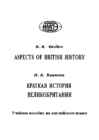
пособия. Пособие предназначено для студентов гуманитарных специальностей. Подготовлено на факультете лингвистики. The book contains an overview of the most important events in British history – from the first documented invasions of the island to the formation and fall of the British colonial empire. A series of exercises will help to remember the subject matter, practise the vocabulary and contribute to skills work. The book is intended for the Humanities students. Вавилов Н.А., 2008 3 4 Contents 5 ПРЕДИСЛОВИЕ
English literature is one of the oldest literatures in Europe; dates back to the 6th century AD. Oral literature, i.e. not written down, spread from person to person. In 449 AD Anglo-‐Saxon tribes invaded England – beginning of the Anglo-‐Saxon period in English literature. The first form of literature was folklore, carried by scops and gleemen, who sang in alliterative verse (a kind of simple poetry). Prose developed much later. The first form of recorded English literature was the epic Beowulf, which was produced sometime near the end of the 7th and beginning �
popularity with short stories and novels, novelist and playwright Vladimir Sorokin, and the poet Dmitri Prigov. In the 21st century, a new generation of Russian authors appeared, differing greatly from the postmodernist Russian prose of the late 20th century, which lead critics to speak about "new realism". Russian authors have significantly contributed to numerous literary genres. Russia has five Nobel Prize in literature laureates. As of 2011, Russia was the fourth largest book producer in the world in terms of published titles. A popular folk saying claims Russians are "the world's most reading nation". Old Russian literature Old Russian literature consists of several masterpieces written in the Old Russian language (i.e. the language of Rus', not to be confused with the contemporaneous Church Slavonic nor with modern Russian). The main type of Old Russian historical literature were chronicles, most of them anonymous
Style bears the stamp of indivual usage, that is every writer has a unique pattern/habit and abilities that form his style. This approach is best illustrated in the well-known victum of the french poet Georges-Louis de Buffon ,,Style is the man himself." Stylistics English stylistics or the study of style has not been discussed on the same scale as french stylistics, german or russian. The very term stylistics came into more common use in english only some 30-40 years ago. It was however recorded much earlier that is in 1882 for the first time, meaning ,,The Study of literary style, the study of stylistic features." A short history of the development of stylistics Stylistics is regarded a relatively new branch of philology, yet its roots go back as far as ancient Greece and Rome, where the rhetoricians (retoorikud) cultivated the art of clear and elegant use of language by developing and polishing stylistic devices.
" --Phil Town, New York Times bestselling author of Rule #1 "The 4-Hour Workweek is a new way of solving a very old problem: just how can we work to live and prevent our lives from being all about work? A world of in nite options awaits those who would read this book and be inspired by it!" --Michael E. Gerber, founder and chairman of E-Myth Worldwide and the world's #1 small business guru "Timothy has packed more lives into his 29 years than Steve Jobs has in his 51." --Tom Foremski, journalist and publisher of SiliconValleyWatcher.com "If you want to live life on your own terms, this is your blueprint." --Mike Maples, cofounder of Motive Communications (IPO to $260M market cap) and founding executive of Tivoli (sold to IBM for $750M) "Thanks to Tim Ferriss, I have more time in my life to travel, spend time with family, and write book blurbs. This is a dazzling and highly useful work." --A. J
· Their world is not one of culture or high moral standards · For these new writers controlling new american social experience · Naturalists offered a view that questioned the belief that now was a conscious and national being and happiness could in moral behaviour · Naturalists show man as a small figure in deterministic system which ignores him · Man is a huge machine · Lot of these novels end in tragedy · For 20 years naturalism remained dominant method. The beginning of the 1910 (modernism starts ) · American naturalists: frank Norris ,,The Octopus", Stephan Crane ,,Red badge of courage" · Jack London (1876-1916) · Grew up in extreme poverty. From early age had to support himself with dangerous manual jobs. Experienced the trouble of survival. Outlooks were eclectic (combination of various philosophies)
battery of challenges in the real world that I hope have made them stronger. T h e new chapters of this book will, I hope, reflect some of the ideas that have continued to evolve around the Hero's Journey concept. T h e r e are new chapters on the life force operating in stories, on the mechanism o f polarity that rules in storytelling, on the wisdom of the body, catharsis, and other concepts that I have developed in recent years in my lectures and in practical work in H o l l y w o o d and in Europe. I have gathered together this new material near the end of the book, in an appendix following "Looking Back on the Journey." In the nine years since the last edition, I have traveled widely, applied my ideas to writing, publishing, and producing projects of my own, and done a few more "tours of duty" as it were for major H o l l y w o o d studios. T h e first of these
g. style of fiction, scientific prose, newspapers, business correspondence, etc.). These are called functional styles or registers. Stylistics is the study of style. In spite of the variety of styles English Stylistics has not been discussed on the same scale as French or German stylistics; it has not been discussed thoroughly. The very term "stylistics" came in more common use in English only some 45 years ago. However, it was recorded for the first time much earlier in 1882, meaning "the study of literary style, the study of stylistic features" (Oxford Dictionary). Stylist is a writer / speaker skilled in a literary style (e.g. Hemingway is considered a peculiar stylist used a lot of repetitions). Stylistician is a scholar (a student). Style is applied to many things: clothing, architecture, hairstyles, etc. A linguistic style
Age 15 is legally a "young person" not a "child". Age 16 is a school leaving age. They can leave home, drive a moped, marry with "parents' consent" buy beer. Age 17 can drive a car. Age 18 can vote, get married, drink in pubs. Education is a very important part in the life of British youth. One can't become an independent person without it. When time comes to enter a college a young Englishman chooses one far away from home. It is a necessary part of becoming adult. During the last 30 years there were a lot of different trends in youth movements. All of them were characterized by their own philosophy, way of life, style of dressing. Each tendency was born by the influence of economic and political changes in the society. Those trends are known as the "hippies" the "punks" the "rockers". But certainly there are different traditional youth organizations in Great Britain. Among them -- the Scout Association, the Girl Guides Association, the National Union of
the manner of expressing ideas, characteristic of a literary movement or period 3. the use of language typical of a literary genre (e.g. the style of a comedy, drama, novel). 4. the selective use of language that depends on spheres / areas of human activity (e.g. style of fiction, scientific prose, newspapers, business correspondence, etc.). STYLISTICS Stylistics is the study of style. The very term "stylistics" came in more common use in English only some 45 years ago. Stylistics is a part of style; it studies principles of selecting and using different linguistic means (grammatical and phonetic) that serve to render shades of meaning. The Stylistics of language studies stylistic devices and expressive shades of linguistic units (words, construction of phrases). The Stylistics of speech studies individual texts viewing the way the message or content is expressed.
Celtic before Gaelic, Welsh, Breton, and Cornish, and through Latin, French, and Old English: ambassador/embassy, bannock, bard, bracket, breeches, car/carry/ career/carriage/cargo/carpenter/charge, crag, druid, minion, peat, piece, vassal/valet/varlet. Cornish: porbeagle, wrasse. Gaelic, general: bog, cairn, clarsach, ceilidh, coronach, crag, crannog, gab/gob, galore, skene, usquebaugh/whisk(e)y; Irish: banshee, blarney, brogue, colleen, hooligan, leprechaun, lough, macushla, mavourneen, poteen, shamrock, shebeen, shillelagh, smithereens, spalpeen, Tory; Scottish: caber, cailleach, cairngorm, clachan, clan, claymore, corrie, glen, loch, lochan, pibroch, plaid, ptarmigan, slogan, sporran, strath, trews, trousers. Welsh: bug, coracle, corgi, cromlech, cwm, eisteddfod, flannel, flummery 7. Scandinavian borrowings 1000 (2000) borrowings.
To find Dalla s follow th ese steps . at. The ligh t blue ta bs tell you the subjects of the CUlCO, Peru 78 13'3 2'5 71'S6'W 1. Look up Dallas in th e index a t th e sur ro un ding m ap spreads. If, for example, you Cyclades,Islands 85 37'OO'N 2S'OO'E Cyprus,country, 96 3S'OO'N 33' OO'E en d of thi s book. are loo king at the World Clim ate map and would Cyprus, Island 97 3S'OO'N 33'OO'E Cyrenaica,region 91 2S'OO'N 24'OO'E 2. T he index tells you th at D alla s is a lik e to co mpare it to th e World Vegeta tio n m ap, Czech Reo.. country 84 49'OO'N lS'OO'E city in Texas and that it can be you can use the tabs to find that map q uickly found on page 50
from the publisher. For information address The Macmillan Company, 866 Third Avenue, New York, New York 10022. Library of Congress Catalog Card Number: 63-16109 Crown copyright is acknowledged for the following illustrations from Great Britain's Public Record Office: S.P. 53/18, no. 55, the Phelippes forgery, and P.R.O. 31/11/11, the Bergenroth reconstruction. Published by arrangement with The Macmillan Company FIRST PRINTING SECOND PRINTING THIRD PRINTING FOURTH PRINTING FIFTH PRINTING SIXTH PRINTING SEVENTH PRINTING EIGHTH PRINTING NINTH PRINTING TENTH PRINTING SIGNET TRADEMARK: REG. TJ.S. PAT. OFF. AND FOREIGN COUNTRIES REGISTERED TRADEMARK---MARCA REGISTBADA HECHO EN CHICAGO, U.S.A. SIGNET, SIGNET CLASSICS, SIGNETTE, MENTOR AND PLUME BOOKS are published by The New American Library, Inc., 1301 Avenue of the Americas, New York, New York 10019 FIRST PRINTING, FEBRUARY, 1973 PRINTED IN THE UNITED STATES OF AMERICA
ccc_tracy_fm_i-xviii.qxd 7/7/03 3:22 PM Page x x ➤ CONTENTS Bibliography 256 Index 260 Advanced Coaching and Mentoring Program 268 About the Author 269 ccc_tracy_fm_i-xviii.qxd 7/7/03 3:23 PM Page xi Acknowledgments The writing of this book has taken many years of work, reading, teaching, and experience. Many people have contributed to my thinking and have been invisible guides as these chapters came to- gether. I would like to first thank my friend Mark Victor Hansen, who introduced me many years ago to Emmet Fox, perhaps the finest spiritual thinker of the twentieth century. Ernest Holmes, founder of Science of Mind, opened my eyes and heart to the incredible universe
........................................................183 The New Earth Is No Utopia.....................................................................184 Notes...........................................................................................................186 About the Author........................................................................................189 CHAPTER ONE THE FLOWERING OF HUMAN CONSCIOUSNESS EVOCATION Earth, 114 million years ago, one morning just after sunrise: The first flower ever to appear on the planet opens up to receive the rays of the sun. Prior to this momentous event that heralds an evolutionary transformation in the life of plants, the planet had already been covered in vegetation for millions of years. The first flower probably did not survive for long, and flowers must have remained rare and isolated phenomena, since conditions were most likely not yet favorable for a widespread flowering to occur
E.g. Panama channel, Suess channel, Bosporus and Dardanelles straits, straits between Sweden and Denmark, Danube river, river Nile Lecture 4 Antarctica Antarctica's unique regime was established by the Antarctic Treaty (Washington, 1 December 1959). Originally signed by 12 countries which were not far from Antarctica or had some explorations there (UK, Japan, South-Africa etc). Initially concluded for 30 years, then prolonged. Some scholars consider the treaty's principles as norms of customary international law. The unique feature of Antarctic is that it comprises of all territories that go under the south latitude 60 (includes all ice shelves, doesn't prohibit using rights under IL concerning high seas). So Antarctic was an international territory. So it is a common heritage of mankind.
law, culture, service, saint, miracle, clergy, sacrifice, chase, scent, falcon, quarry, forest, retrieve, colour, image, fashion, design, beauty, music, romance, costume, garment, apparel, dress, train, arch, tower, vault, religion column, transept. grades of baron, count, countess, duke, duchess, page, marquise, prinke aristocracy Normans ‘adopted’ king, queen, lord, lady leisure and cards, chess, the chase, conversation, dice, dance, leisure, recreation, tournament, sport pastimes culinary words veal, beef, mutton, venison,pork, ham, methods of roast, boil, fry preparing food Norman French (ei – veil, leisure) vs Central French (oi) 9. Spanish borrowings Armada, comrade, renegade, flotilla, cockroach, embargo, mosquito, vanilla, cargo, sombrero, siesta, tango, canyon, cigar, tabacco, cafeteria, cocoa, chocolate, chilli, tomato, potato, avocado, tortilla, anchovy, canoe, maze, gringo,
Nute Lincolnshire, DN37 9TZ UK. University of Bristol, School of Clinical E-mail: [email protected] Veterinary Science, Division of Farm Animal Science, Bristol BS40 5DU, Avon, England. Joseph P. Kerry E-mail: [email protected] Department of Food and Nutritional Sciences, University College Cork, Ireland. George-John E. Nychas E-mail: [email protected] Laboratory of Food Microbiology & Biotechnology, Department of Food Edward Kołakowski Science & Technology, Agricultural Department of Food Science and University of Athens, Iera Odos 75, Athens Technology, Agricultural University of 11855, Greece. Szczecin, Papie a Pawła VI St. 3, 71-459 E-mail: [email protected] Szczecin, Poland
More praise for Influence: Science and Practice! "We've known for years that people buy based on emotions and justify their buying decision based on logic. Dr. Cialdini was able, in a lucid and cogent manner, to tell us why this happens." --MARK BLACKBURN, Sr. Vice President, Director of Insurance Operations, State Auto Insurance Companies "Dr. Cialdini's ability to relate his material directly to the specifics of what we do with our customers and how we do it, enabled us to make significant changes. His work has enabled us to gain significant competitive
Unlike Prinz's program, the Turochamp could play a complete game and operated not by exhaustive search but under the guidance of rule-of-thumb principles devised by Turing. Early AI programs: checkers (in USA) The first AI program to run in the U.S. was also a checkers program, written in 1952 by Arthur Samuel of IBM for the IBM 701. Samuel took over the essentials of Strachey's program (which Strachey had publicised at a computing conference in Canada in 1952) and over a period of years considerably extended it. In 1955 he added features that enabled the program to learn from experience, and therefore improve its play. Samuel included mechanisms for both rote learning and generalisation. The program soon learned enough to outplay its creator. Successive enhancements that Samuel made to the learning apparatus eventually led to the program winning a game against a former Connecticut checkers champion in 1962 (who immediately turned the tables and beat the program
CHAPTER 1 GETTING TO KNOW THE TOEFL WHAT IS THE TOEFL? The TOEFL is a comprehensive English language examination required by more than 3,000 colleges and universities in the United States, Canada, and other parts of the world. In addition, foreign born professionals frequently need a TOEFL score for certification to practice their profession in the United States or Canada. The TOEFL is a timed test that consists of the three sections listed here. THE TOEFL Section 1 Listening Comprehension 50 questions 35 minutes Part A Statements 20 questions Part B Short Dialogs 15 questions Part C Minitalks and Extended Conversation
Bibliography 205 Index 217 Preface As its title slyly suggests, this book is an introduction to the main issues in contemporary philosophy of language. Philosophy of language has been much in vogue since early in the twentieth century, but only since the 1960s have the issues begun to appear in high resolution. One crucial development in the past forty years is the attention of philoso- phers of language to formal grammar or syntax as articulated by theoretical linguists. I personally believe that such attention is vital to success in phi- losophizing about language, and in my own work I pay as much of it as I am able. With regret, however, I have not made that a theme of this book. Under severe space limitations, I could not expend as many pages as would be needed to explain the basics of formal syntax, without having to omit
Where are you from? (formal) I'm from... (informal) ¿Cuántos años tiene usted? ¿Cuántos años tienes? Yo tengo _____ años. quahn-tohs ahn-yohs tee-ay-nay quahn-tohs ahn-yohs tee-ayn- yoh tayn-goh _____ ahn-yohs 1 oo-sted ays I am _____ years old. How old are you? (formal) How old are you? (informal) ¿Hablas inglés? ¿Habla usted español? (No) Hablo... ah-blahs een-glehs ah-blah oo-sted eh-spahn-yol noh ah-bloh Do you speak English? Do you speak Spanish? (formal) I (don't) speak...
The creation of the American national epic in Henry Wadsworth Longfellow's Song of Hiawatha. James Fenimore Cooper was a prolific and popular American writer of the early 19th century. His historical romances of frontier and Indian life in the early American days created a unique form of American literature. He lived most of his life in Cooperstown, New York, established by his father William. Cooper was a lifelong member of the Episcopal Church and in his later years contributed generously to it. He attended Yale University for three years but was expelled for misbehavior. Before embarking on his career as a writer he served in the U.S. Navy as a Midshipman which greatly influenced many of his novels and other writings. He is best remembered as a novelist who wrote numerous seastories and the historical novels known as the Leatherstocking Tales. Among naval historians his works on early U.S. naval history have been widely received but were sometimes
PLATINUM The platinum effect is found in some lines of Silver Persian/Chinchilla Longhair. In 1986/7, Cheryl Bennett reported in The Silver and Golden Persian Newsletter (ACFA) that one of her shaded silver females (Kelley Lane Contessa of WeANDE) had changed from pure silver to pale golden. Contessa’s parents were a shaded golden and a shaded silver; these were full siblings. At 10 – 12 months of age, Contessa began to “tarnish” i.e. show cream/reddish patches and by 3 years of age she was entirely pale golden. She produced a number of Silver Persians without tarnish, but she failed to produce any offspring when mated to a golden sire. One of Contessa’s male offspring turned from silver to golden as an adult. An adult Silver Persian from England (Lynchard Silver Shadow) was exported to Australia and also turned golden. Shadow had a few golden hairs on his paw, but did not turn golden until he was a year old when his coat turned to pale beige
she treated it that way. Thank you, Martha! To Victoria Colotta, for all her hard work on the interior design and typesetting. She took my plain text and made it gorgeous. Thank you, Victoria! To Tera Kleinfelter, who read the first half of Bared to You and told me she loved it. Thank you, Tera! To all girls who were at Cross Creek at some point in your adolescence: May all your dreams come true. You deserve it. And to Alistair and Jessica, from Seven Years to Sin , who inspired me to write Gideon and Eva's story. I'm so glad the inspiration struck twice! 1 "We should head to a bar and celebrate." I wasn't surprised by my roommate's emphatic pronouncement. Cary Taylor found excuses to celebrate, no matter how small and inconsequential. I'd always considered it part of his charm. "I'm sure drinking the night before starting a new job is a bad idea." "Come on, Eva
That would explain why I didn't remember him. I do a good job of blocking painful, unnecessary things from my memory. "He's in a wheelchair now," Charlie continued when I didn't respond, "so he can't drive anymore, and he offered to sell me his truck cheap." "What year is it?" I could see from his change of expression that this was the question he was hoping I wouldn't ask. "Well, Billy's done a lot of work on the engine -- it's only a few years old, really." I hoped he didn't think so little of me as to believe I would give up that easily. "When did he buy it?" "He bought it in 1984, I think." "Did he buy it new?" "Well, no. I think it was new in the early sixties -- or late fifties at the earliest," he admitted sheepishly. "Ch -- Dad, I don't really know anything about cars. I wouldn't be able to fix it if anything went wrong, and I couldn't afford a mechanic..." "Really, Bella, the thing runs great
 annaabi.ee