Leidsid 33 sarnast õppematerjali, mis on seotud failiga "INDIA". Need materjalid aitavad sul teemat sügavamalt mõista.
indian, know, often, person, considered, religion, marriage, hand, polite, answer, language, between, friends, relationship, religious, dress, live, hands, doctor, hindi, english, official, languages, communication, indirect, words, convey, rude, thus, real, rest, message, delivered, tone, body, essential, proper, respect, social, class, hinduism, soulTallinna Pedagoogiline Seminar Noorsootöö osakond Intercultural communication: Customs and behaviour patterns in Finland Andra Pant, NT 12 Tallinn 2011 Punctuality is very important to the Finns. Never be late for meetings, as this is considered very impolite in Finland. Be on time! Do not raise your voice when you talk to Finns, especially not in public! Speaking in a loud voice is considered rude, as Finns themselves are quiet. Remember to look Finns in the eye. Looking down or to the side is a sign of dishonesty in Finland.
Then practice Capitalist Niggerism because then you will not blame the teachers for failing your children or blame the nationwide testing services for using non-black questions in their testing. You will be in control because you will totally understand that everything that happens to your child at school is a result of the learning environment you have provided him or her at home. You want to succeed in creating wealth, join Wall Street. Don’t make excuses that Blacks don’t know how to invest their money. Go after the Caucasians. Use their guilt to your advantage. Another important point which I raised in this book concern the long study I have conducted regarding the economic behaviour of East Indians and Pakistanis. It is an economic doctrine I have christened the “Spider Web Doctrine,” because I believe we all understand how spiders behave. They build a web, and if an ant or fly dares enter the web, they are not allowed to come out. The spider closes its web
..............................................................................................................................................................8 SPANISH-SPEAKING COUNTRIES..................................................................................................................................8 CARIBBEAN...............................................................................................................................................................10 INDIAN OCEAN..........................................................................................................................................................10 LANGUAGES.............................................................................................................................................................10 THE FLAG.................................................................................................................................................................
Copyright ©2007 by Saddleback Educational Publishing. All rights reserved. No part of this book may be reproduced in any form or by any means, electronic or mechanical, including photocopying, recording, or by any information storage and retrieval system, without the written permission of the publisher. ISBN 1-59905-201-6 Printed in the United States of America 13 12 11 10 09 08 07 9 8 7 6 5 4 3 2 1 Introduction Grammar is a very old field of study. Did you know that the sentence was first divided into subject and verb by Plato, the famed philosopher from ancient Greece? That was about 2,400 years ago! Ever since then, students all over the world have found it worthwhile to study the structure of words and sentences. Why? Because skill in speaking and writing is the hallmark of all educated people. Lesson by lesson, this book provides basic instruction in the eight parts of speech--nouns, pronouns, verbs,
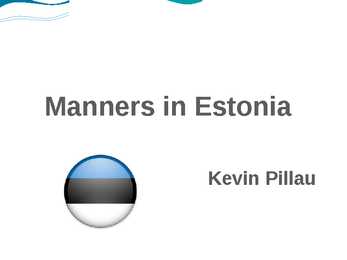
Manners Estonians on the whole are quiet and reserved. They tend to speak softly and do not like to draw attention to themselves. Being rational, calm and not going to emotional extremes are all qualities that respected. At first Estonians can come across as aloof. Once a relationship warms up this becomes less so. Meeting and Greeting Greetings can come across as rather formal and rather reserved. Men should initiate greetings with women and the younger person always greets the older person. When meeting someone make sure you are stood up, offer direct eye contact and give a nice firm handshake. The most common greeting is "tere" ("hello"). Titles are very important. "Härra" is for Mr, "Prova" is Mrs and "Preili" is Miss. All should be followed with the surname. Only use first names once you have been invited to do so. Gift Giving Etiquette Gifts are usually exchanged for birthdays and at Christmas. Gifts need not be expensive as it is more about the thought than monetary worth.
Region. Divisions are based on each area's relatively similar physical geography and landforms. Physiographic regionalization is defined here as the process by which regions with relatively homogeneous physical geography are determined 2. Who are the native people of Canada? Into which three groups can they be divided? Canada's constitution specifies three categories of aboriginal peoples: Indian (First Nations), Métis, Inuit. According to Canadian census 2011, 1.4 mln people of Aboriginal origin (4.3%): 852,000 First Nations persons, 452,000 Métis, 59,000 Inuit. Indian (First Nations) - No written history before the contact with Europeans. Chief historical sources European priests, travellers and traders not interested in the preservation of "pagan"myths. Different estimates about their number in Canada when Europeans reached North America from 300,000 to 1 mln
1. TELEPHONE ETIQUETTE · When answering the phone at your desk say..."Hello, this is Mr. or Ms. Smith". Do not say phrases such as... "Smith here!" or simply "Hello". · Many people think it is rude when you use call waiting to talk to someone else in the middle of the conversation you are having with them. · When using a cell phone, try to find a quiet spot to answer a call. It is considered particularly rude to leave a cell phone turned on in public places like: classrooms, libraries, movie theaters, churches, etc. 2. CLOTHES AND DRESS · Also, pay attention to how much of your body you are exposing (have uncovered) and whether it is appropriate for the situation. (Ex. shorts, sandals, a very short or very tight skirt, or low cut or too tight shirt, are really not appropriate for meetings, interviews, etc.) Wearing this type of clothing can
SOCIETY AND CULTURE OF ENGLISH-SPEAKING COUNTRIES Introduction 1. Nowadays, English is so widely spoken that it can hardly be considered "a one nation's" language. The main countries where English is spoken are: the U.K, the U.S, Canada, Australia, the Republic of Ireland, New Zealand, West Indies 2. There are approx. 300-400 million speakers of English in the world. English occupies the 3rd place by its number of speakers; it is right behind Mandarin and Spanish. 3. ESL (English as a Second Language) used in your own country (e.g. India)
The making of a new nation. The Enlightenment in America. The emergence of the notion of the American Dream. The great Enlighteners: Crèvecoeur, Jefferson, Paine, Franklin. The American Enlightenment is the intellectual thriving period in the United States in the midtolate 18th century (17151789), especially as it relates to American Revolution on the one hand and the European Enlightenment on the other. Influenced by the scientific revolution of the 17th century and the humanist period during the Renaissance, the Enlightenment took scientific reasoning and applied it to human nature, society, and religion. American Enlightenment a gradual but powerful awakening that established the ideals of democracy, liberty, and religious tolerance in the people of America.
as she is desperate to fit in with the other children in her neighbourhood while forever feeling like an outsider because she is "different". She and her family are the only immigrants in the village. They are trying to work out how to fit into British society while attempting to maintain their own culture. Meena's house is always full of a constant stream of ethnic visitors and her parents seem to see no need to integrate futher. Namely, her parents considered every Indian immigrant in England as a friend or even as a part of the family. Meena's family are keen to see her keeping up the family's cultural tradition. Meena on the other hand, is caught between two cultures. She is having a difficult time adjusting to her surroundings, wishing she were blonde and carefree like her 14-year-old neighbor, Anita (Brewster). Meena idolizes Anita for her looks and free spirit, and in many ways wants to be
Cuisine of South Africa has had a variety of sources and stages: · Cookery practised by indigenous people of South Africa such as the Khoisan and Xhosa- and Sotho-speaking people · Settler cookery introduced during the colonial period by people of Indian and Afrikaner and British descent and their slaves and servants - this includes the cuisine of the Cape Malay people, which has many characteristics of Malaysia and Java, and recipes from neighbouring colonial cultures such as Portuguese Mozambique. Indigenous cookery traditional South African cuisine In the precolonial period, indigenous cuisine was characterized by the use of a very
The Flowering of Human Consciousness – 6 Evocation..................................................................................................6 The Purpose of This Book........................................................................8 Our Inherited Dysfunction........................................................................10 The Arising New consciousness..............................................................12 Spirituality and Religion..........................................................................14 The Urgency of Transformation...............................................................16 A New Heaven and a new Earth...............................................................18 Chapter Two Ego: The Current State of Humanity – 19 The Illusory Self......................................................................................20
Education Education is so multifaceted that it is difficult for me to know where to begin discussing it, or how to prioritize the many factors. Relaying my own experience is easy: I had a standard classroom approach, supplemented by inordinate reading. In only the briefest and least memorable instances did I receive any individual tutoring. Education is commonly thought of as the job of schools. Adults cry "educate our children!" Everyone has opinions about the best way to do the job. It is of urgent importance, and all the
criminals. But surely, you can see what you're getting in the holiday brochure. But surely, if you raise benefits too high, people wouldn't bother to work. But surely, the canal system is much too slow for industry today 7.2 Countering politely (through agreement followed by antithesis) Well yes, but if you visit it in June, it's extremely beautiful. Yes, but a serious astrologer would want to know a person's exact date of birth, not just their star sign. Yes, but remember that prisons are often schools for criminals. Yes, but we measure our superiority in different ways. Ours is cultural and historical. We believe we're more civilized. Yes, but it isn't that women don't want to work. For a start, they suffer more discrimination in the work-place. Yes, but other things happen in the world which aren't violent. 7
· For business meetings, men should wear dark suits and ties. Women should wear suits, dresses or skirts and blouses. · Do not wear a blazer to work. A blazer is country or weekend wear. *gifts · Gifts are normally not exchanged in business settings. · When invited to someone's home, always bring a small gift for the hostess. Give flowers, chocolates, wine, champagne or books. · Gifts are opened upon receiving. · It is polite to send flowers in advance of a dinner party. Do not send white lilies, which denote death. *helpful hints for a foreigner · Men should open doors for women and stand when a woman enters a room. · Always hold the door for a person following behind you. · Respect the British desire for privacy. Don't ask personal questions, such as where a person lives or what a person does for a profession or job. Don't talk about money. · Do not violate a queue
GETTING PHYSICAL Tallinn 2012 "Delivery is more important than content." Arch Lustberg, speech trainer According to wellknown social anthropologist Edward T. Hall, 60% of our communication is nonverbal. That means whenever we stand before an audience, our stance, our posture, our facial expressions, our hand gestures, our whole body dynamic communicate more than our actual spoken words. A stiff, immobile speaker is often a boring and usually ineffective speaker as. It is therefore essential to know how to be physically relaxed, which will allow your actions to complement your words. Before we start, two important definitions: A podium is the raised platform at the
We should eat a balanced diet that includes the right kinds of food and drink plenty of clean, fresh water. We should exercise regularly, strengthening our muscles and keeping us in shape. Exercise helps the blood circulate around our bodies, cleaning out waste and supplying plenty of oxygen. It is also important what we get enough sleep. The number of hours we sleep we need depend on our age. Young babies sleep for 20-22 hours each day, whereas older people often need only 6-7 hours. 2.1 Early hospitals The earliest known institutions aiming to provide cure were Egyptian temples. In ancient times temples dedicated to the gods of healing used to have a hospital area. Sick people came there to pray and be treated. Later in the Middle Ages hospitals attached to monasteries were run by monks and nuns. The oldest hospital still in existence is in Paris. It was founded in 800's A.D. In the 1700's European cities began to build hospitals
conquests in C17. Denmark only acquired a few islands. 5. Which languages are spoken in the West Indies? What is the origin of the people who live there? Pidgin is a simplified language that is born out of contact (e.g. trade) between speakers who do not speak the same language. The elements of two or more languages coalesce. Creole is a pidgin language that has become the native language of a community. Usually it was a mix of a European and another language. 6. When did most West Indian countries gain independence? In 1804, Haiti became the first Carribean nation to gain independence. In 1844, the Dominician Republic declared its independence from Haiti. Cuba became independent in 1902. Subsequently, the British West Indies became independent, starting with Jamaica, as well as Trinidad and Tobago. 7. What are the main branches of economy in the West Indies? Sugar industry 8. Which styles of music and dance originate in the West Indies?
stem- meanings, beliefs, attitudes, values; the branches and leaves- food, clothing, behaviour Communication: is the intentional transmission of ideas from one individual to one or more others. C= the exchange of meaning, involves the sending and receiving of info between a sender and a receiver. C happens through the use of words+ non-verbal factors (eg facial expressions and gestures). Stereotype is a fixed idea or image that many people have of a prticular type of person or thing, but which is not true in reality. The word comes from printing (describes the printing plate used to produce the same image over and over again). Culture shock: is precipitated (caused) by the anxiety that results from losing all our familiar signs and symbols of our social intercourse. Symptoms: Excessive washing of the hands. Excessive concern over drinking water, food, dishes and bedding. Fear of physical contact with attendants and servants
1) Standard and non-standard varieties of English Standard varieties of English are the varieties of the English language that are considered to be a norm and are spoken and written by the minority (educated people). This is the optimum for educational purposes. The standard varieties of English are: BrEng (British), EngEng (English), NAmEng (North-America), USEng (United States), CanEng (Canada), AusEng (Australia), NZEng (New Zealand). Standard English (British English) is the most widely accepted and understood among native speakers, learned by foreigners. It is used in broadcasting, TV, news etc. It doesn't
Tolerance and diversity Tolerance is a very important issue for the people all over the world. Sadly the lack of it has influenced us more than the existence. On the other hand people have always liked the diversity of this world. For example, we can't imagine life without our Chinese food, Italian pasta and especially McDonalds , can we? We have to admit that it would be very unpleasant without simple things like these so is it so hard for us to cope with different types of people? We live our lives differently and see the world in different ways, everyone use words that they feel like using , but in the end we are all trying to answer the same question. There is no
"Outsourcing is no longer just for Fortune 500 companies. Small and mid-sized rms, as well as busy professionals, can outsource their work to increase their productivity and free time for more important commitments. It's time for the world to take advantage of this revolution." -- Vivek Kulkarni, CEO of Brickwork India and former IT secretary of Bangalore; credited as the "techno-bureaucrat" who helped make Bangalore an IT destination in India "Tim is the master! I should know. I followed his rags to riches path and watched him transform himself from competitive ghter to entrepreneur. He tears apart conventional assumptions until he nds a better way." --Dan Partland, Emmy Awardwinning producer of American High and Welcome to the Dollhouse "The 4-Hour Workweek is an absolute necessity for those adventurous souls who want to live life to its fullest. Buy it and read it before you sacri ce any more!" --John Lusk, group product manager at Microsoft World Headquarters
identical and fraternal twins (Minnesota twin study by Tellegen, Buchard). 3) Experiment: Split-brain experiments by Gazzaniga & Sperry, brain plasticity experiments by Rosenzweig and Bennett. Neurotransmission experiment by Martinez and Kesner. 4) Case studies: Phineas Gage studied by Dr John Harlow and Oliver Sack's study on Dr P. Discuss how and why particular research methods are used at the biological level of analysis. Biological researchers often adopt a reductionist approach to the study of human behavior. They work on a micro-level of research, breaking down complex behavior into its smallest parts (e.g. genes, neurotransmitters or proteins). This approach is sometimes criticized for being overly simplistic, but it is important to have detailed information of the components of human behavior in order to understand the interaction of several factors. Kasamatsu and Hirai studied a group of Buddhist monks who went on a 72-hour
but represents work that is scientifically grounded. The subsequent versions also provide new and updated material, chapter summaries, and study questions to en- hance its utility. A potentially attractive feature of the present version of Influence lies in its abil- ity to serve as an enjoyable, practical, yet scientifically documented offering. In a re- lated vein, the book might be seen as a way to demonstrate that, properly presented, what often seems like dry science can actually prove to be lively, useful, and relevant to all readers' personal lives. Comment on the Fifth Edition of Influence: Science and Practice It has been some time since Influence was last published. In the interim, some things have happened that deserve a place in this new edition. First, we now know more about the influence process than before. The study of persuasion, compli- ance, and change has advanced, and the pages that follow have been adapted to re-
present? The Russian colonization of the Americas covers the period, from 1732 to 1867, when the Tsarist Imperial Russian Empire laid claim to northern Pacific Coast territories in the Americas. The Russians were primarily interested in the abundance of fur-bearing mammals on Alaska's coast, as stocks had been depleted by overhunting in Siberia. By the middle of the 19th century, profits from Russia's American colonies were in steep decline. Faced with the reality of periodic Indian revolts, the political ramifications of the Crimean War, and unable to fully colonize the Americas to their satisfaction, the Russians concluded that their American colonies were too expensive to retain. after less than a month of negotiations, the United States accepted Emperor Alexander II's offer to sell Alaska. The purchase of Alaska for $7.2 million ended Imperial Russia's colonial presence in the Americas. The Russian's legacy in Alaska (1784) can be seen in various forms
6 drop me off A. So there you are ... problem solved! 7 to lay off Rosie Yeah, these are good 8 turned up intentions, but not if we end up poisoning people in the long run. I 1F Discussion page 9 don't know, I just find the whole thing unnatural. I don't think we have a right 1 1 laboratory 5 crops to `play God' in this way. 2 controversy 6 harmful Leo I see what you mean. But to be 3 discredited 7 term honest with you, people have been 4 campaign 8 crisis crossing breeds for hundreds of years.
your own words) the situations in which they appear in the book: the marrow of something (44) - The soft stuff inside of a bone is called marrow. ... From this biological kind of marrow comes a figurative meaning of marrow -- the essence of something. S The convent is on top of the high hill and from its window the Sisters can see the marrow of the town. to be privy to something (46) - If you're privy to something, you've been let in on a secret or know about something that most people don't. ... The adjective privy comes from the Latin privatus, meaning "private," and describes someone who has knowledge of secret or confidential information. S- Marie is privy to both worlds of Evil knowledge. a habit (49) - a long, loose garment worn by a member of a religious order. S Marie asks if she gets a habit when Leopolda tells her that Marie will be sleeping behind the stove.
1) INDIAN ROCK ART: A NATIONAL TREASURE IN DANGER Unrecognized, unprotected, this priceless legacy of primitive art has endured the ravages of nature only to fall victim to wanton destruction by ,,civilized" man. Like the huge stone statues of Easter Island and prehistoric cave paintings of Altamira and Lascaux, North American Indian rock art is surrounded by an atmosphere of mystery. Although examples of rock art exist at some 15000 sites in canyons, deserts, caves and river gorges. Nowadays, however, primitive rock art in the United States has become a new field of scientific study. Klaus F Wellmann wrote two books about rock art. He is a professor of medicine. Rock art represents the history of aboriginal Americans. In the most cases the art is an expression of ideas and way of life, ritual ceremonies, hunting, fighting
herbs it is absolutely delicious? If you ask foreigners to name some typically English dishes, they will probably say "Fish and chips" then stop. It is disappointing, but true that, there is no tradition in England of eating in restaurants, because the food doesn't lend itself to such preparation. English cooking is found at home. So it is difficult to a good English restaurant with a reasonable prices. In most cities in Britain you'll find Indian, Chinese, French and Italian restaurants. In London you'll also find Indonesian, Mexican, Greek... Cynics will say that this is because English have no "cuisine" themselves, but this is not quite the true. Vocabulary: to criticize - tasteless overcooked - ingredient - to invent - sauces - to disguise - spice herb - delicious - disappointing - to lend cuisine British Youth (2) Most 18 and 19 year-olds in Britain are quite independent people. English people say
closely connected with the United Kingdom, the Channel Islands and the Isle of Man – British Overseas Territories citizens = until 2002 (The British Overseas Territories Act) British Dependent Territories citizens – British Overseas citizens = persons connected with former British colonies (Malaysia and Kenya) – British Nationals (Overseas) = status created by the Hong Kong Act 1985 – British Protected Person (BPP). 15. Right of abode- an individual's freedom from immigration control in a particular country. A person who has the right of abode in a country does not need permission from the government to enter the country and can live and work there without restriction. Generally, in order to have the right of abode in a certain country, a person must be a citizen of that country. Those with permanent residency of the country generally have a de facto right of residence but it can be
Hello. I want you to meet John Smith. I'm so pleased to meet you. This is Jane Smith. I'm Jane Smith. My name's John Smith. Informal introduction Hi. John. Jane. Hello. Titles: Mr Mrs Miss Ms Ms is a modern form of address for women. It replaces the traditional forms of Mrs and Miss. Greetings Good morning/afternoon/evening! 'How are you?' Very often people expect you to say something positive. Here's a breakdown of how you can express how you really are without complaining too much. · Fine, thanks. / On top of the world, thanks. · OK, thanks · Not so bad, thanks. / Can't complain, thanks. · So so, thanks. / So and so, thanks. · Not so good, actually 1 The English alphabet
Drugs are chemicals that change the way a person's body works. You've probably heard that drugs are bad for you, but what does that mean and why are they bad? Medicines Are Legal Drugs If you've ever been sick and had to take medicine, you already know about one kind of drugs. Medicines are legal drugs, meaning doctors are allowed to prescribe them for patients, stores can sell them, and people are allowed to buy them. But it's not legal, or safe, for people to use these medicines any way they want. Cigarettes and Alcohol Cigarettes and alcohol are two other kinds of legal drugs. (In Estonia, adults 18 can buy cigarettes and alcohol.) But smoking and excessive drinking are not healthy for adults and off limits for kids.
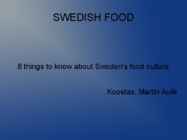
SWEDISH FOOD 8 things to know about Sweden's food culture Koostas: Martin Aulik introduction It’s safe to say Sweden’s food culture is much more than iconic meatballs and chewy fish- shaped candy. Here are eight things you should know about food traditions essential to Sweden everyday dining. Lingonberry — Sweden’s favorite sauce Just like ketchup and mustard, lingonberry sauce is widely used to accompany a variety of dishes, from meatballs and pancakes to porridge and blood pudding. But despite its sweetness, it is rarely used on bread. Thanks to the Right of Public Access (Allemansrätten), which gives
 annaabi.ee