Leidsid 33 sarnast õppematerjali, mis on seotud failiga "How to produce bioenergy from agricultural resources without harming the environment". Need materjalid aitavad sul teemat sügavamalt mõista.
biogas, biomass, production, wood, heat, alder, nature, cost, local, year, grey, farm, bioenergy, land, protection, plant, mean, sustainable, electricity, without, current, total, stands, birch, friendly, agriculture, region, part, forestry, forests, silver, value, environmental, meadow, material, economic, case, selection, farms, 3500, tons, incomeTartu Miina Härma gymnasium Biogas The source of future energy Report Tartu 2010 Table of Contents Introduction......................................................................................................... What is biogas?................................................................................................... Producing process............................................................................................... Nowadays............................................................................................................ Areas where biogas is used in............................................................................. Biogas as replacement of fuel.......
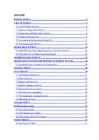
.......................... 2 1.2. Potential future utilization..............................................................................4 1.3. Why Don't We Use More Renewable Energy? ...........................................5 2. Energy Types 2.1. Wind Energy.......................................................................................................6 2.1.1. Annual Generation........................................................................................7 2.1.2. Growth and cost trends................................................................................8 2.1.3. Theoretical potential.....................................................................................9 2.1.4. Benefits of wind energy................................................................................10 2.2. Solar Energy........................................................................................................11 2.2.1 Development, deployment and economics.................
.........................................................................27 7.8 Measuring electricity..................................................................................................27 SOLAR ENERGY..............................................................................................................27 8.1 Photovoltaic energy...................................................................................................... 28 8.2 Solar thermal heat.......................................................................................................29 8.3 Solar thermal power plants......................................................................................... 30 8.4 Solar energy and the environment..............................................................................30 WIND ENERGY.................................................................................................................31 9
Margit Tepner k0848752 Sustainability aspects of biofuels 1. Introduction The literature review will discuss the sustainability aspects of biofuels. Food production will be the main concern as it is the most debated issue, but other aspects, such as land use change and water consumption will be also considered as they are essential aspects in the biofuels sustainability criteria. The review will discuss the viability of biofuels based on the current technologies. Second-generation biofuels are not yet commercially viable and therefore will not be discussed; although they could significantly improve the sustainability of biofuels
electricity and gas. No strong actor provides unbiased DH support. In the Czech Republic, gas offers DH severe competition. Much DH is produced at the expense of electricity that is considered more valuable, and waste incineration is not popular. In Romania, DH consumption was reduced by one-half. Distribution losses are enormous. New less polluting plants are needed. Consortia from established DH countries could offer DH systems from fuel to customer if local policies facilitate DH development. Introduction This paper describes barriers to district heating (DH) in various parts of Europe and to Swedish involvement in district-heating business abroad. The paper is based on a report called "District Heating in Europe: Barriers to overcome for Swedish export" , which was prepared for The Swedish District Heating Association. The losses by energy conversion in Europe are of the same magnitude as the European heat
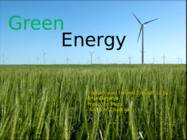
German Green Energy Cost and Efficiency Recycling What is Green Energy? -It is energy resources that are renewable -Can be naturally replenished -Clean, Safe and not harmful to the environment (aka mother earth) Types of Green Energy Green Energy going cute Solar Power · Is produced by using photovoltaic cells, which capture sunlight and turns that into energy. Problems ? -The sun has got to shine -The cost of solar panels and the systems range between $20k-40k -The light from the sun produces a very small amount of energy Wind Power -These giant pinwheels spin from strong winds which spins a turbine of a generator to produce energy. Giant Pin Wheels? Any Studies done? · It is said that wind · Bentek Energy did the energy is suppose to Study and used about bring down costs and 1/3 of the US population reduce the in the air. for 2 years.
Renewable energy Meriliin Lend Estonian University of Life Sciences Tartu 2013 Topics Renewable energy Solar energy Wind energy Hydroelectric power Geothermal energy Biomass energy Renewable energy Renewable energy comes from sources that naturally renew, or will not run out in our lifetimes. Includes sunlight, wind, water, geothermal heat and various forms of biomass. Renewable energy cannot be exhausted and is constantly renewed. Does not harm the environment. Saves money. Solar energy Solar energy is the technology used to harness the sun's energy and make it useable. Every hour the sun beams onto Earth more than enough energy to satisfy global energy needs for an entire year. Solar energy use has surged at about 20 percent a year over the past 15 years, thanks to rapidly falling prices and gains in efficiency. Solar energy is inexhaustible.
various molecular weights and other liquid organic compounds, that are found in geologic formations beneath the Earth's surface. The name Petroleum covers both naturally occurring unprocessed crude oils and petroleum products that are made up of refined crude oil. A fossil fuel, it is formed when large quantities of dead organisms, usually zooplankton and algae, are buried underneath sedimentary rock and undergo intense heat and pressure. Petroleum is recovered mostly through oil drilling. This comes after the studies of structural geology (at the reservoir scale), sedimentary basin analysis, reservoir characterization (mainly in terms of porosity and permeable structures). It is refined and separated, most easily by boiling point, into a large number of consumer products, from petrol (or gasoline) and kerosene to asphalt and chemical reagents used to make plastics and pharmaceuticals
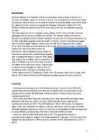
and of NATO since 29 March 2004 Estonia has also signed the Kyoto protocol. Economy Estonian economy was one of the fastest growing in the world until 2006 with growth rates even exceeding 10% annually. Despite some concerns both in and outside of the country, the Estonian economy and its currency remained highly resilient and solvent. Until recent years the Estonian economy continued to grow with admirable rates. Estonian GDP grew by 6.4% in the year 2000 and with double speeds after accession to the EU in 2004. The GDP grew by 7.9% in 2007 alone. Increases in labor costs, rise of taxation on tobacco, alcohol, electricity, fuel, and gas, and also external pressures (growing prices of oil and food on the global market) are expected to raise inflation just above the 10% mark in the first months of 2009. In the first quarter 2008 GDP grew only 0,1%. The government made a supplementary negative budget, which was passed by Riigikogu
· Don't change or harm the forests 2. EarlyAgrarian m.m. · Slash and burn -> woods replaced by brush (võsa) · Typical to Mediterranean region and East-Asia 4. Late Agrarian m.m · Very bad situation primeval fields · Population growing necessity much bigger · Forests preserved on slopes of mountains and where infertile soils were. · West Europe, North America 4. Early Industrial m.m · Development of forestry -> timber industry · Wood from boarderlands and colonies · Subequatorial and equatorial regions valuable woods · Temperate zone coniferous woods soft timber · Transport floating of logs, road transport 5. Late Industrial m.m · Ruinous economy Forestry in different regions of the world: 1. Europe 1) West Europe · A lot of forests were destructed during Late Agrarian times. · During the industrialisation only timber industry
institutional development and policy. Economically, Ukraine has grown along with the region. As such, growth rates have not been low, but they come after the economically devastating 1990s and are not built on a 6 sustainable foundation. For years Russia provided Ukraine with underpriced gas while Ukraine's export prices increased rapidly. Over the decades Ukraine, however, grew dependent on oil and gas coming from Russia, at almost no cost. Today, 70 percent of gas consumed in the country is imported. In 1991 Ukraine was one of the poorest Soviet republics. Statistics for the time are notoriously uncertain, but the best ones available show Ukraine's GDP at just $1,307 per capita. Only Azerbaijan, Georgia, Kyrgyzstan, Tajikistan, and Uzbekistan lagged behind Ukraine; even Moldova and Turkmenistan, generally regarded as very poor Soviet republics, were ahead of Ukraine. Ukraine's economy contracted annually between 9.7 and 22
the summer and descend to a chilly -25 degrees Celsius during winter. Canada's climate and environment are one of the main reasons that Canada is such a succesful country. The blend of natural resources and climate sustains us. The seasons dictate the look of the land: according to whether the natural environment is in a state of dormancy or growth. Canada's climate is characterized by its diversity, as temperature and precipitation differ depending on where you are and what time of year it is. Other than the North where it's above freezing for only a few months a year, most Canadian cities are within 300 km of the southern border, where mild springs, hot summers and pleasantly crisp autumns are common during the majority of the year. Climate sculpts the landscape through heat, cold, humidity, light and wind. In Canada, the variety of landscapes shows the diversity of our climate. In the north, low precipitation and cold
income. In general, these forests are not very large: the average forest area per establishment was 3.7 ha in 1990. Groups operating forests of less than 100 ha control 67% of the total area. Hence forests are not necessarily owned by a few large concerns. Private ownership of forestland was officially permitted after the Meiji restoration of 1868, which marked the end of feudalism. Previously, forestland was legally owned collectively for the use of local communities. After the Meiji restoration, most of these ,,commons" became privately owned land, although some still exist and are operated by permanent joint holdings. In many cases, common forests were divided equally among members of the community, and individual parcels of forestland were small. ----------------------- According to the 1995 assessment by the Forestry Agency, the private forest area was 14.6 million ha, constituting 57.9% of the total forest area
............................12 References..........................................................................................................................................13 Introduction What is nuclear power? Nuclear power is any nuclear technology designed to extract usable energy from atomic nuclei via controlled nuclear reactions. The most common method today is through nuclear fission, though other methods include nuclear fusion and radioactive decay. All utility-scale reactors heat water to produce steam, which is then converted into mechanical work for the purpose of generating electricity or propulsion. In 2007, 14% of the world's electricity came from nuclear power. More than 150 nuclear-powered naval vessels have been built, and a few radioisotope rockets have been produced. Nuclear life cycle The Nuclear Fuel Cycle begins when uranium is mined, enriched, and manufactured into nuclear fuel, which is delivered to a nuclear power plant.
3. 1 ref to operon; 2 normally repressor substance bound to operator; 3 prevents RNA polymerase binding (at promoter) / prevents transcription; 4 lactose binds to repressor; 5 changes shape of protein molecule; 6 unable to bind (to operator); 7 RNA polymerase binds (at promoter) / transcription occurs / genes switched on; 8 AVP; e.g. production of lactose permease / production of beta- galactosidase; max 5 [5] 4. a change in the genetic material; unpredictable / AW; extra detail; e.g. addition / substitution / deletion / frame shift / small part of chromosome / may code for different protein / may code for no protein
moisture. (Metsa kasvutingimused sõltuvad suuresti peene struktuuriga mullakihi tüsedusest ja liigse niiskusperioodi kestusest.)(Seda tüüpi metsade kooslus sõltub mullakihi tüseduasest ja peene tekstuuriga mullakihist, liigniiske perioodi kestvusest. The stands are mostly sparse pine forests belonging to the quality class IV ...V. Puistud on enamasti hõredad männimetsad, kuuludes boniteediklassi IV..V. The undergrowth consists of juniper, mountain currant, guelder rose, alder buckthorn, sporadically also shrubby cinquefoil. Alusmets koosneb kadakast, magesõstrast, harilikust lodjapuust, harilikust paakspuust, kohati ka maranapuhmastest. The ground vegetation is very varied, the most frequent species being: blue moor grass, glaucous sledge, tufted hair grass, tormentil.the mosses can be found mainly on microelevations. Alustaimestik on väga mitmekesine, kõige levinumad liigid on lubikas, kollane tarn, pööristarn, luht-kastevars, tedremaran. Samblaid võib leida
can be very cold. The cold winter does not necessarily mean constant snow; in fact snowfalls are few and far between. When it falls it stays though, and there tends to be a layer of snow on the ground constantly. The deepest snow cover is usually in the south-eastern part of Estonia. Temperatures range from a summer average of 30°C to an average in winter of -8°C.The coldest month is considered to be February and the hottest July. There are about 160 to 181 rainy days a year. Rainfall is distributed throughout the year with the heaviest rainfall in August. Nature Waterbodies Estonia is a country of thousands of lakes. There are about 1450 natural and man-made lakes in Estonia. The two largest of them are Lake Peipsi (the fifth largest in Europe; 3 555 sq km, shared with Russia) and Võrtsjärv (270 sq. km). Of all the other lakes, only 45 have an area of more than 100 ha. Lake Peipsi and Lake Võrtsjärv are rich in fish. In Lake Peipsi you can find
different branches of services are all equally important. Due to the available natural resources Estonian economy largely relies on the branches related to the forest; Estonian energy sector is based on oil shale, a resource quite rare elsewhere in the world. Finland and Sweden are the most important trade partners. The Estonian economy profits significantly from the business generated by more than 2 million tourists a year, most of whom come from Finland. More than 67% of the Estonian GDP is derived from the service sectors, industrial sectors yield over 28% and primary branches (including agriculture) approximately 5.5% of the overall output. The important sectors of the Estonian economy are the processing industry (approximately 18% of the overall production), transport, warehousing and communications (15%), commerce (over 14%) and estate, rental and letting, as well as business services (about 16.5%)
The Estonian economy is diverse industry and transport, as well as commerce and different branches of services are all equally important. Due to the available natural resources Estonian economy largely relies on the branches related to the forest; Estonian energy sector is based on oil shale. Finland and Sweden are the most important trade partners. The Estonian economy profits significantly from the business generated by more than 2 million tourists a year. The important sectors of the Estonian economy are the processing, transport, warehousing and communications, commerce and estate, rental and letting, as well as business services, agriculture, construction and government, education and health care. In order to be able to import all the products and services, something must be exported, that's why export holds such a prominent position for the Estonian economy and its growth.
The main aim of the reforms was to boost foreign investments, cre- ate new jobs, stimulate entrepreneurial activities in a variety of fields and increase the welfare of citizens. As a result of economic deregulation policy which was focused on liberalization of the Economy, a number of state regulated spheres were sharply decreased and regulation procedures were sim- plified. Consequently, our achievements have been recognized by a number of international in- stitutions. This year the World Bank and the International Finance Corporation published a joint research Doing Business 2011, under which Georgia ranks 12th among 183 countries in terms of Ease of Doing Business. Moreover, Georgia surpasses 174 counties in terms of reformation of business regulations since 2005. Last but not least, Georgia ranks first in the Post-soviet space, excluding the Baltic countries, in terms of counter-corruption policy. It is worth noting that de-
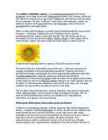
The flower is nearly flower formation 2. The flower is still covered, completely exposed but faces the sun Introduction Taste is tops, but health and nutrition rank high for consumers who want foods that are as good for them as they are good to eat. Sunflower oil and kernels meet that challenge with their combination of health benefits and flavor. From phytochemicals and important vitamins and minerals to convenience of size and cost effectiveness, the amazing sunflower kernel is a powerhouse compared to no other! And one need look no further than NuSun oil for a healthy, trans-free alternative to hydrogenated oils and shortenings. While the vibrant, strong sunflower is a recognized worldwide for its beauty, it is also an important source of food. Sunflower oil is a valued and healthy vegetable oil and sunflower seeds are enjoyed as a healthy, tasty snack and nutritious ingredient to many foods.
Parliament is consists of The House Of Representatives and The Senat. The House of Representatives consists of 150 members. The party with the majority provides the Prime Minister, who also forms the Government. Today the power is divided by three parties: The Australian Labour Party, the Liberal Party and National Party. The Senat's membership is wider, it comprises 12 senators from each state and 2 from each territory. Senators are elected for six year terms. The Executive power in Australia is in the hands of the Commonwealth Government lead by the Prime Minister. Today the Prime Minister is John Howard, the leader of the Liberal Party. History Australia was once a part of the giant continent Gondwana. It included Africa, South America and Antarctica. First Australia and Antarctica split from Gondwana, then Australia broke away from Antarctica and began to move north. Aborigines arrived there about 50 000 years ago
the little government intervention and the determination of prices of goods and services in a free price system. Therefore, economic decisions are guided solely by the aggregate interactions of a country's citizens and businesses. In addition to mentioned afore, Estonia tends to perform favourably in measurements of civil liberties, education, and press freedom. Living in Estonia has many of its good sides, for instance it is a secure place from nature disasters and it has a beautiful nature. Although, when not to look only through rose-tinted glasses, there are still some minuses in country’s organization. So, what are the beneficial and negative sides of living in Estonia? To start with, a big advantage is a great location between Scandinavia and prosperous Russia which ensures the connections, networks and possible trading options. Close connections and pendulum migration have tightened the cooperation between the countries. For instance,
nitrosomonas, nitrobacter, sulphur oxidizers, etc; 2. Fungus; 3. Viruses 4. Actinomycetes and stretomyces; 5. Algae eg. BGA, yellow gree algae, golden brown algae. The soil microflora largely depends on the type of soil, temperature, moisture, plant growth, nutrients, pH, and many other factors which may vary between locations but also within a single plot and over very small distances (OECD, 2007). Nevertheless of the quantity of microflora, biomass of all microorganisms living in soil play an important role in the functioning of entire soil ecosystems because their enormous biochemical activity (Barabasz et al. 2002). Soil microflora cycles carbon, nitrogen, phosphorus, and sulfur, plays a role in soil structure formation, decomposition of organic matter, toxin removal, promoting plant growth, and in changes in vegetation (Canbolat at al. 2005 and Martin et al. 2012). Therefore, soil microflora
chapters distributed in three parts. The first guished international experts from fifteen part deals with the description of meat chem- countries. The editor wishes to thank all the istry, its quality for further processing, contributors for their hard work and for and the main technologies used in meat sharing their valuable experience, as well as processing, such as decontamination, aging, to thank the production team at Wiley- freezing, curing, emulsification, thermal pro- Blackwell. I also want to express my appre- cessing, fermentation, starter cultures, drying, ciation to Ms. Susan Engelken for her kind smoking, packaging, novel technologies, support and coordination of this book. and cleaning. The second part describes the manufacture and main characteristics of Fidel Toldrá
02 years (2012 est.) Health expenditures: 11.7% of GDP (2009) Education expenditures: 5.9% of GDP (2007) (Central Intelligence Agency, 2012, ISSN 15538133). 2.1.4 Economic Overview Finland has a highly industrialized; largely freemarket economy with per capita output roughly that of Austria, Belgium, the Netherlands, and Sweden. Trade is important with exports accounting for over one third of GDP in recent years. Finland is strongly competitive in manufacturing principally the wood, metals, engineering, telecommunications, and electronics industries. Finland excels in hightech exports such as mobile phones. Except for timber and several minerals, Finland depends on imports of raw materials, energy, and some components for manufactured goods. Because of the climate, agricultural development is limited to maintaining selfsufficiency in basic products. Forestry, an important export earner, provides a secondary occupation for the rural population
Saskatchewan, while on the west its boundary with British Columbia follows the 120th meridian west south from the Northwest Territories at 60°N until it reaches the Continental Divide at the Rocky Mountains. The province extends 1,223 kilometres north to south and 660 kilometres east to west at its maximum width. Its highest point is 3,747 metres at the summit of Mount Columbia in the Rocky Mountains along the southwest border, while its lowest point is 152 metres on the Slave River in Wood Buffalo National Park in the northeast. Alberta contains numerous rivers and lakes used for swimming, water skiing, fishing and a full range of other water sports. There are three large lakes and a multitude of smaller lakes less than 260 square kilometres each. Lesser Slave Lake (1,168 square kilometres) is northwest of Edmonton. The longest river in Alberta is the Athabasca River which travels 1,538 kilometres from the Columbia Icefield in the Rocky Mountains to Lake Athabasca.
The government is appointed by the president after approval by the parliament. The legislative power lies with the unicameral parliament, the Riigikogu or State Assembly, which consists of 101 seats. Members are elected by popular vote to serve four-year terms. The supreme judiciary court is the National Court or Riigikohus, with 19 justices whose chairman is appointed by the parliament for life on nomination by the president. Internet voting has been used in local elections in Estonia. The lawmakers in Estonia have authorized internet voting for parliamentary elections as well. The current president is Toomas-Hendrik Ilves. Before him there have been three presidents in Estonia Arnold Rüütel, Lennart Meri and Konstantin Päts. Currency and taxes. In June 1992, Estonia replaced the ruble with its own freely convertible currency, the Kroon (EEK). A currency board was created and the
The Foundation's focus is to assist those working to achieve progress in the areas of human and civil rights, environmental and animal protection. We are part of the L'Oréal family. CLICK HERE to find out more about our parent company. History The very first The Body Shop® store opened on 26th March 1976 in Brighton, on the south coast of England. By 1978 the first overseas franchise is a kiosk in Brussels and by 1982 new shops open at a rate of two per month. In 1985, in its first year as a public company, The Body Shop sponsored posters for Greenpeace. A year later, it created an Environmental Projects Department of its own, while the first major campaign for The Body Shop is "Save the Whales" with Greenpeace, in 1986. The first Community Trade product for The Body Shop was a footsie roller, produced in 1986 by a supplier in southern India. This trade in footsie rollers has evolved into the current trade with Teddy Exports in India, one of our key Community Trade suppliers.
INVESTBULGARIA AGENCY WHO ARE WE InvestBulgaria Agency (IBA) is a Government institution providing information, contacts and project management support to potential investors. IBA services: Macroeconomic data on Bulgaria Data on operational costs Regional information Personalized administrative servicing Legal advice Liaison with central and local governments Liaison with branch chambers and NGOs www.investbg.government.bg GENERAL INFORMATION Official name: Republic of Bulgaria Area: 110 994 sq.m. Population: 7.4 million Capital: Sofia Time zone: EET (UTC+2) Official language: Bulgarian Currency: Lev (BGN) Fixed exchange rate: 1 = BGN 1.95583
A railgun is an electrically powered electromagnetic projectile launcher and a large electric circuit, made up of three parts: a power source, a pair of parallel rails and a moving armature. Along the pair of parallel conducting rails a sliding armature is accelerated by the electromagnetic effects of a current that flows down one rail, into the armature and then back along the other rail. Railguns have long existed as experimental technology but the mass, size and cost of the required power supplies have prevented railguns from becoming practical military weapons. However, in recent years, significant efforts have been made towards their development as feasible military technology. For example, in the late 2000s, the U.S. Navy tested a railgun that accelerates a 3.2 kg projectile to hypersonic velocities of approximately 2.4 kilometres per second, which is about Mach 7.
Johan Mähar Tartu 2008 Contents p. 1. Introduction....................................................................................................1 2. Nature and geography.....................................................................................2 3. Position and size.............................................................................................2 4. Climate............................................................................................................3 5. Flora and fauna...............................................................................................4 6. Main fields of economy and industry............
The mean annual precipitation ranges from 15-26 cm. Vegetation Canopy in most deserts is very rare. Plants are mainly ground-hugging shrubs and short woody trees. Leaves are "replete" (fully supported with nutrients) with water- conserving characteristics. They tend to be small, thick and covered with a thick cuticle (outer layer). These plants include: yuccas, ocotillo, turpentine bush, prickly pears, false mesquite, sotol, ephedras, agaves and brittlebush. The spiny nature of many plants in semiarid deserts provides protection in a hazardous environment. Many plants have silvery or glossy leaves, allowing them to reflect more radiant energy. These plants often have an unfavourable odor or taste. Semiarid plants include: Creosote bush, bur sage, white thorn, cat claw, mesquite, brittle bushes, lyciums, and jujube. Animals In hot and dry deserts the animals include small nocturnal (active at night) carnivores
 annaabi.ee