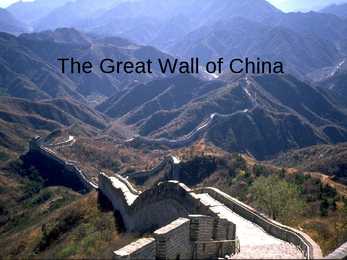
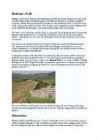
The Great Wall of China Main Facts · approximately 6700 km long · over 2000 years old · up to 16m high, 9.1m wide at base and 3.7m wide at top · average height 10m, witdh 5m History of the Wall · 1st wall in 218-208 BC (3000 miles long) · 4th wall in 1368-1620 · Ming dynasty ruled China · They built thousands of towers and forts · Over 1 million people died Construction of the Wall · made of quarried limestone or granite · in some areas made of fired brick · again over 1 million men died · that's over 300 men per mile · Qin made 70% of population build the wall Importance of the Wall · at first it was ment to keep enemies away, later to keep away semi- nomadic thiefs · nowadays a very popular tourist attraction · Simatai - wall in original state · Beijing reconstructed part · Thousands of tourists every day Parts of the Wall · from Gulf of Bohai...
Arhitektuur Suur Hiina müür Aasia, Hiina Suur Hiina müür on rida kivi fortifications ehitatud Hiinas 5. sajandil eKr kuni 16. sajandini. Müür oli ehitatud kogu mitme dünastiate kaitsta impeerium alates Xiongnu rünnakuid. Suur Hiina müür ulatub üle umbes 6700 kilomeetrit, mis kulgeb läbi Gansu provintsist Ninxia Hui autonoomse piirkonna, Shaanxi provintsis, Shanxi Province, Sise-Mongoolia, Hebei Province ja Liaoning Province. See oli kunagi väitis, müür on näha inimeste silmis alates moon. Aga see on osutunud lihtsalt müüt, sest ükski astronaut on kunagi väitnud nad olid näinud Hiina müür alates moon. Kolm peamist läbimisel Suur Hiina müür on Juyongguan, Jiayuguan ja Shanhaiguan. Juyongguan asub põhja lõpuks müür, mis on sees Changping maakond Peking City. Jiayuguan on lääne lõppu müür asub Gansu provintsis, samas Shanhaiguan on ida lõpuks müür asub linna Qinhuangdao, Hebei provintsi. Nüüd on osad Suur Hiina müür on hävinud tänu liivato...
The Great Wall UNESCO World Heritage Sites The Statue of Liberty Names: Kaspar- Eerik Maarand Ingmar Tamsalu Origin and history of The Great Wall Several walls were being built as early as the 7th century bc, the most famous wall was built during 220-206 bc King Zheng conquered the last of his opponents and unified China as the First Emperor of the Qin dynasty. He ordered the building of new walls to connect the remaining fortifications along the empire's northern frontier. ● The great wall was built when seven powerful states appeared at the same time, to defend themselves. At that time the wall was 3107 miles and each part of wall belonged to different part of the states. In 221B.C the Emperor Qin Shi Huangdi ordered to connect the walls (built by all the states) also he added a part of his section because he was afra...
Images of China China is a country full of variety. Most typical images of China are traditional, although more and more modern images start to play an important role representing China. When we first think of China we may call to mind images such The Great Wall of China, tiny people, communism, business centre Hong-Kong and the ancient emperor and dynasties. Including these images China is well known by its diverse landscapes and strong ancient traditions. The Great Wall of China is the typical and the most common symbol of China. The Great Wall of China was built from 5th century BC to 16th century to protect Chinese Empire from Mongol invaders. The Great Wall of China boasts with its lenght of 6400km and it is even recognisable for the outer space. It was really hard to build a massive wall on landscape so diverse. The northern part of China is quite mountainous and covered by huge deserts...
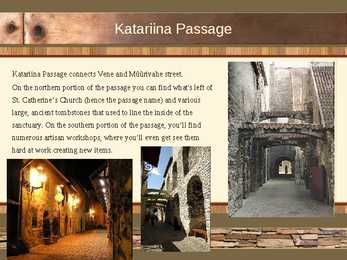
Katariina Passage Katariina Passage connects Vene and Müürivahe street. On the northern portion of the passage you can find what's left of St. Catherine's Church (hence the passage name) and various large, ancient tombstones that used to line the inside of the sanctuary. On the southern portion of the passage, you'll find numerous artisan workshops, where you'll even get see them hard at work creating new items. City wall Tallinn's medieval city wall is a sub-facility that was built to protect the lower Tallinn and upper Tallinn (Toompea). The building of the city wall began in 1310th years, and by improving over time it formed the city wall with defensive buildings (towers). It was finished by the end of the 1561. Then it was 2.35-kilometer-long circular wall, which had 27 wall gate, 8 tower gate and 21 other stone fortifications. Many parts of the to...
Study questions on chapter 1 Stonehenge - is pre-historical moument located in the English county of Wiltshire. 2400 BC 22 000 BC. It is composed of a circular setting of large standing stones. The site and its surroundings were added to the UNESCO's list of World Heritage Sites in 1986 Celtic Invasion It begun about 500 years BC. Celts brought iron with them to Britain (and pagan traditions). But it is belived that there was never an organized Celtic invasion.(Celts were too fragmented to make it happen) Iron Celts brought iron with them into Great Britain which made some big changes. Iron is stronger then bronze and iron ore is more common(it made tools and weapons better). One of the interesting innovations that they brough to Britain was the iron plough which changed a lot about the farming(made it easier). Iron changed trade and fostered local independence. Hadrian's wall was a defensive forti...
Filmimuusika TOP 4 1. Suur Gatsby (ingl.k The Great Gatsby) Režissöör: Baz Luhrmann Stsenaristid: Baz Luhrmann, Craig Pearce, F. Scott Fitzgerald Filmimuusika: https://www.youtube.com/watch?v=5snA5TEse9w Filmimuusika autor: Craig Armstrong Craig Armstrong on sündinud 29. aprillil 1959. aastal. Ta on šoti helilooja kaasaegse orkestrimuusika, elektroonika ja filmimuusika alal. Peale akadeemia lõpetamist aastal 1981, on ta sellest ajast kirjutanud muusikat Royal Shakespeare Company’le, Royal Scottish National Orchestra’le ja London Sinfonietta’le. Ta on võitnud hulgaliselt auhindu ja teda hinnatakse kõrgelt ning kiidetakse hästi. Craig Armstron’i tuntumate filmimuusikate juurde kuuluvad ka: Moulin Rouge! (2001) Love Actually (Armastus on see...) (2003) World Trade Center (Maailma Kaubanduskeskus) (2006) Elizabeth: The Golden Age (Elizabeth: Kuld...
Roman Britain 1.Ülesanne 1.Roman empire exited,more then 400 years ago. 2.Colchester was the capital of Britannia for some time,soon London or Londinium became the capital 3. Romans speaked Latin. 4. Roman rules Britannia. 5. Julius Ceasar ,Hadrian 6. Romans rules Britain before the Vikings. 2.Ülesanne a–2 b–5 c- 1 d-3 e–4 3.Ülesanne 1–d 2–g 3- i 4–h 5–j 6–a 7–b 8–f 4.Ülesanne 55- Julius Ceasar first came to Britain in the year 55 BC (before Christ ). 400- Britannia became a part of the Roman Empire for more than 400 years. 20- About 20 large towns grew araund the camps of the Roman army. 2,000,000 – The whole population of Roman Britain was about 2 million. 2000 – There were abaut 2000 villas on the south of Britannia . 12 000 – Romans built abaut 12000 kilometers of road which were wide and straight . 410 – ...
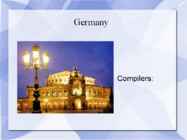
Germany Compilers: Frankfurter Engel ● The Frankfurter Engel is a memorial in the city of Frankfurt ● it is dedicated to homosexual people who were persecuted under Nazi rule ● The memorial is a statue of an angel and is the first of its kind in Germany. Freedom Memorial ● The Freedom Memorial was a memorial to the victims of the Berlin Wall in the vicinity of the Checkpoint Charlie Museum in Berlin. ● It opened on October 31, 2004, and was praised by both victims of the GDR communist regime and human rights advocates alike. The Tomb of Frederick the Great ● The Tomb of Frederick the Great was a subject to which Old Fritz, as he was popularly known, gave a great deal of thought. Frederick the Great died on August 17, 1786 in the armchair of his study in Sanssouci. ● He ...
What is London? London is one of the largest cities in the world, with an area of 1706,8 km2. It is the capital of England and The United Kingdom. It is in Central Europe. The city lies on the river Thames. London has 7,556,900 inhabitants, which is more than a quarter of the countries in Europe! For one city, London is very special. The beginning of London Before the founding of London, there had already been smaller groups of people in the area. There aren't any records on who they were. The first mayor settlement of London was in 43 AD. Romans came to the banks of the river Thames. They built houses, a port and a bridge over the river (later known as London Bridge). They named the place Londinium. In the year 200 they built a wall around their city. The wall doesn't exist today, but a part of it can be seen near the Museum of London. In the year 61 Londinium was burned down. The houses were made out of wood back then, so this was ...
Christ The Redeemer Or the Statue of Christ Redeemer (Portuguese: Cristo Redentor) is a statue of Jesus Christ with the largest Art Deco architectural style and located in Rio de Janeiro, Brazil. The statue has a height 38 meters and is located at the top of Corcovado Mountain is 710 m high in the Tijuca Forest National Park, overlooking the city. Chichen Itza It is a Mayan archaeological heritage in Mexico is the most complete and still well maintained. According to the Mayan culture of Chilam Balam, the temple complex was built between the years 502-522 AD. Mayans occupy just over 200 years, then they migrate to coastal areas in Campeche. Itza is the central point of the complex and other buildings such as the Pyramids of Kukulcan, Temple of Chac Mool, and building the Thousand Pillars. Colosseum Is a large theater / Amphitheater, located at the State Capital of Italy, Rome, called the original "Flavian Amphitheatre", founded by...
Great Coastal Gate & Fat Margaret's Tower Good morning ladies and gentlemens, and welcome to Great Coastal Gate and Fat Margaret's Tower. Before we begin the tour, I`d like to tell you a little about their history. The Great Coastal Gate (Suur Rannavärav) was the most important gate in Tallinn. It was built as a defence on the seaward side of Tallinn, but also to impress visitors coming in from the sea. In the Middle Ages the Great Coastal Gate was about 300 footsteps from the harbour. Legends say, that during storms, the waves reached the gate. . In the 16th century, a powerful cannon tower was built next to the Great Coastal Gate. It had 155 loopholes, diameter of 25 meters, and a height of about 20 meters. The tower was named Roosikrantsi, but as it was the stoutest tower in the Wall, people started to call it "Fat Margaret". Through history, the cannon tower has also served as a storehouse for gunpowder ...
Edinburgh Castle is an ancient stronghold which dominates the sky-line of the city of Edinburgh from its position atop Castle Rock. It is Scotland's second most visited tourist attraction. Human habitation of the site is dated back as far as the 9th century BC. As it stands today though, few of the castle's structures pre-date the Lang Siege of the 16th century, with the notable exception of St Margaret's Chapel, the oldest surviving building in Edinburgh, which dates from the early 12th century.As with all castles, Edinburgh's fortress has been a centre of military activity. As an ancient fortress Edinburgh Castle is one of the few that still has a military garrison, albeit for largely ceremonial and administrative purposes. The New Barrack Block is now home to the official headquarters of the Royal Regiment of Scotland and 52 Infantry Brigade, as well as home to the regimental museum of the Royal Scots and Royal Scots Dragoon Guards. ...
Introduction Tallinn, the capital city of the Republic of Estonia and of the Harju county, is a town in North Estonia on the coast of the Gulf of Finland. It has nearly half a million inhabitants and covers an area of almost 160 sqkm. It is also an important economic and cultural centre and one of the main ports in the Baltic States. Tallinn is one of the oldest cities on the Baltic Sea. It is unique for its well-preserved architecture from the 13-15 centuries. In contrast to the ancient town-walls and towers, Tallinn of today offers modern hotels, restaurants, sport and cultural centres. Every five years national song and folk dance festivals take place in Tallinn. The yachting regatta of the 1980 Moscow Olympic Games was held at Pirita. History Tallinn means in English "Danish town". The place is believed to have been settled by Finno-Ugric people about 2500 BC. It was first marked on a map of the world by the Arab geographer al-I...
TOOMPEA Toompea (from German Domberg – Cathedral Hill ) is a limestone hill with an area of about 7 hectares in the central part of Tallinn. It towers about 30-40 m above the surrounding areas. According to the legend it´s the tumulus mound over the grave of the national hero Kalev, erected stone by stone in his memory by his grieving wife Linda. It is the birthplace of Tallinn - a place where in 1229 the Knights of the Sword built a fortress instead of the wooden Estonian stronghold. Toompea Castle is also one of the most potent symbols of the reigning power. Today Toompea is the seat of the Government of Estonia as well as the Riigikogu, both of which are often simply colloquially referred to as Toompea. For centuries there was only one access to Toompea - Pikk Jalg - but there is also another way leading up to Toompea - Lühike Jalg, which was made in the 14th century. At present Pikk Jalg and Lühike Jalg are used only by pedestri...
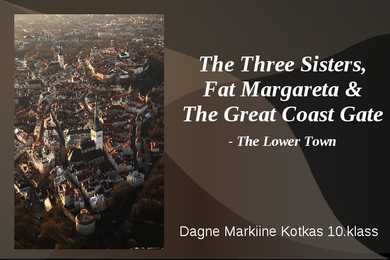
The Three Sisters, Fat Margareta & The Great Coast Gate - The Lower Town Dagne Markiine Kotkas 10.klass The Three Sisters Three Sisters is a group of 15th century houses at 71 Pikk Street with many decorative elements. The first record of The Three Sisters merchant houses comes from the year 1362. This is a typical of the Tallinn school of Gothic architecture. Recently a hotel was opened in this medieval complex. The Three Sister's Hotel Big sister's suite Middle sister's suite Junior suite The hotel has 5 stars and is very expensive. The Fat Margaret The Fat Margaret was built on the site of the eastern tower in the outer gate of the Great Coast Gate at the beginning of the 16th century to protect entrance to the town. Its walls are over 4 meters thick at the base and its flat roof is ...
Hadrian's Wall Hadrian's Wall was a stone and turf fortification built by the Roman Empire across the width of Great Britain to prevent military raids by the tribes of Scotland to the north, to improve economic stability and provide peaceful conditions in the Roman province of Britannia to the south, to physically mark the frontier of the Empire, and to separate the unruly Selgovae tribe in the north from the Brigantes in the south and discourage them from uniting. The name is also sometimes used jocularly as a synonym for the border between Scotland and England, although for most of its length the wall follows a line well south of the modern border -- and neither the Scoti tribe nor the English lived in Britain at the time of the wall's construction. The wall was the northern border of the Empire in Britain for much of the Roman Empire's rule, and also the most heavily fortified border in the Empire. In addition to its use as a milit...
The Haapsalu Bishop's Castle The Haapsalu Bishop's Castle and Cathedral, which was established in the 13th century as the centre of the SaareLääne Diocese, is one of the best preserved castles in Estonia. It is located on the western coast of Estonia in Haapsalu. The Haapsalu Castle is one of the most remarkable examples of Estonian MiddleAge fortress architecture. The stronghold construction, widening and reconstruction went on throughout several centuries, with architecture changing according to the development of weapons. The fortress achieved its final dimensions area of more than 3 hectares, thickness of the wall between 1.2 and 1.8 meters, and maximum height over 10 metres under the reign of Bishop Johannes IV(fourth). In the 17th century, the castle was no longer used as a defensive building by the Swedes who now ruled the Swedish Estonian Province. In the course of the Grea...
My Ideal Home My ideal house would be a small detached villa on a quiet tropical island, preferably with an outdoor pool. The house is made of bricks. In my case I would have as many windows as possible. Light colour in the hall, it's the first thing you see when you walk into the house. There's not much space, therefore, this is fulfilled only essential things. On the right hand, there is a low cupboard, which is next to the vase of globeflowers. On the opposite wall, there is rocking chair and a peg. The ceiling is painted white and cream colored carpet covers the parquet. The next room consists of dining and livingroom. This is the biggest and the brightest room in this house. A rich mintcream walls and hardwood floors these two are well contrasted with furniture. One wall is all glass with a nice view of the ocean, so it's left almost uncovered. Only dining table and four cha...
BABA IS YOU Game REVIEW Baba is You, developed by Hempuli Oy, is a sokoban-pushing puzzle game with a twist of rules manipulation. In this 2D game, the internal rules are presented as pushable blocks and you main goal is to push these blocks around and then combine these words to form new rules to solve puzzles. Unlike other puzzle games that require you to follow rules to complete levels, Baba is You encourages you to break rules and also gives you enough freedom to create new rules to level up. I know, the idea sounds really interesting and smart! The game doesn’t have too many instructions and it only has characters and corresponding objects on each stage. Players may be confused about how to play the game at first, but once you get deeper into the game and learn the game in practice, you will find the game has a lot of charm. We can see the little bunny Baba, three rocks, a yellow flag and four rules i...
Minu plaanid tulevikuks Nüüdseks olen juba kaheksa aastat käinud Maidla põhikoolis, üheksas aasta on hetkel käsil. Nende kaheksa aastaga on palju juhtunud, palju asju on selgemaks saanud. Viieteistkümne aastapärast on mul kolm imearmsat last. Selleks ajaks olen ma omandanud põhi-, kesk- ja kõrghariduse. Kui mu lapsed on väiksed, olen ma lastega kodus ning hoolitsen nende eest. Kuid kui nad juba koolis käima hakkavad, siis ma lähen tööle. Ma hakkan tööle ühes maailma suurimas ajalehes ajakirjanikuna. Põhitööna kirjutan ma "USA Today"-le, "The Wall Street Journal" ja "The New York Times"-ile. Kuid mõnikord rikastan ma ka Eesti ajakirjandust oma loometööga. Ma hakkan elama väga suures majas, koos oma mehe ja lastega. Meil on kaks nunnut Chihuahua ja palju kalakesi hiiglaslikus akvaariumis, mis asub elutoas. Meil on suur aed, kus on suur bassein ja laste mänguväljak. Meil on ka väike aiamajake, kus me saame suviti pere ja sõpradega grillid...
Test 13 1 Translate. 1 Minu lemmiklill on maikelluke. My favourite flower is the lily of the valley. 2 Eesti rahvuslikud sümbolid on suitsupääsuke ja rukkilill. The Estonian national symbols are the barnswallow and the cornflower. 3 See kindlus on pärit 15. sajandist. This fortress dates from the 15th century. 4 Saaremaal on palju tuuleveskeid. There are lots of windmills on Saaremaa. 5 Eesti pinnas ei ole väga rammus. Estonian soil is not very rich. 6 Kas sa oled käinud paekivi muuseumis Porkunis? Have you been to the limestone museum in Porkuni? 7 Raekoja plats The Town Hall Square 8 millegagi võrdlema compare sth with sth 2 Write the questions. 1 in / longest / What / Estonia / is / the / river What is the longest river in Estonia? 2 ever / smoke / Have / a / had / sauna / you Have you ever had a smoke sauna? 3 language / of / is / official / What / the / Estonia What is the offici...
My name is Humpty Dumpty a perfect name for me as it means the good and handsome shape I am. I hate to be called and egg. I think it is very provoking. I look rather like any human being I have two eyes, a nose and a mouth. Maybe my head is a bit bigger than usual but it is very beautiful. Actually I am glad to be a bit different from humans as I don't really see the different in their faces. I mean they all look alike. It would be way easier if some had, let's say, both eyes on one side of their nose. I love my life. I sit here, with my legs crossed, on this high and narrow wall and I am not afraid to fall. Well and even if I did fall, which will never happen, then the king promised me to send all his horses and his men and put me in my place again. But there is no need for it since this wall is my home and I am very sure in my capability of staying here. My most valuable asset is my cravat. It sometimes upsets me when others can...
The City of London History The City of London occupies one square mile in the middle of the capital. It once made up the entire town of London, surrounded by the wall first built by the Romans. The Roman Londinium grew up on the northern side of the "London Bridge" in the past. Products such as olive oil, wines and fruit were brought by ships from different parts of the Roman Empire and unloaded onto wooden quays along the river. In AD 61 the native Celtic Iceni tribe, led by Queen Boudicca, rose up against The Romans. They burnt Londinium to the ground but Roman armies eventually defeated Boudicca. The city was rebuilt and was gradually surrounded with a wall of stone and brick which lasted for many centuries. During the archeological excavations in 1954 the Roman Temple of Mithras was revealed. It was a pagan temple dedicated to the Persian Sun-god. The Temple was later reconstructed only a short way...
HISTORY TEST 5 invasions to Britain until 1066 1) The Celts o Gaels in 600BC; Cymry(Britons) in 300BC o From present-day Austria, Switzerland o The Celtic language survives in the names of many places in England- Dover, Kent, Thames o The Celts are best known for their art- many bronze objects with elaborate designs; brooches; pins; mirrors; Celtic stone crosses o The Celts had 3 social orders: warriors, druids(priests) ordinary people 2) The Romans o (55 BC-Caesar) 43 AD- 410 AD- Claudius o From present-day Italy o Southern Britain became Britannia and was ruled by a roman governor o The Romans built over 20 towns: Colchester, Londinium, Winchester etc. They were good engineers and built roads and villas that had central heating, glass windows and mosaic floors ...
Great Pyramid of Giza The Great Pyramid of Giza (also called the Pyramid of Khufu and the Pyramid of Cheops) is the oldest and largest of the three pyramids in the Giza Necropolis and is the only one of the Seven Wonders of the Ancient World that survives mostly intact. Originally the Great Pyramid was covered by casing stones that formed a smooth outer surface, and what is seen today is the underlying core structure. Some of the casing stones that once covered the structure can still be seen around the base. There have been different scientific and alternative theories regarding the Great Pyramid's construction techniques. Most accepted construction theories are based on the idea that it was built by moving huge stones from a quarry and dragging and lifting them into place. There are three known chambers inside the Great Pyramid. The lowest chamber is cut into the bedrock upon which the pyramid was built and was unfinished. The so-call...
Home I live in a village called Kapu. This is a small and beautiful place where each house seems to stand on it's own little hill like royalty. Our home is family house with a large enclosed garden which is constrained with spruce hedge. My house was built in 1992 but it has been extensively modernised and extended since then. Our house consists a lot of different elements and components what I try to describe in my essay. The most important part of construction is foundation because it keeps buildings in one piece. My house has a strip foundation which is taken 1,5m below the ground to protect the structure against ground movement and damages. Due to the fact that foundation transfer the dead and imposed loads of the structure onto the ground it must be very solid and strong. Our foundation is made of pre cast concrete blocks which has a damp-proof course made of mastics on external side. ...
London London is one of the world's great cities. Located in the southeast of England, on the River Thames, it is the capital of the United Kingdom and has been the heart of its political, cultural and business life for centuries. London has always been the centre of the world. The origin of the city may be dated around the beginning of the 1st century when a Celtic tribe settled near the Thames. The Romans founded London about 50 AD. Its name is derived from the Celtic word Londinios, which means `the place of the bold one'. The Romans brought with them forts, roads and the rule of law. Then in 61 AD Queen Boudicca led a rebellion against the Romans. Her army marched on London. No attempt was made to defend London. Boudicca burned London but after her rebellion was crushed it was rebuilt. By the end of the 2nd century, a 6metre stone wall was ...
Tallinn English College English Sergo Vainumäe 9A TALLINN Report Supervisor: Inge Välja Tallinn 2006 Order of contents: 1.Introduction 2.Toompea 3.Lower Town 4.Kadriorg and Pirita 5.Museums 1. Introduction Tallinn, the capital of Estonia, lies on the Baltic Sea. It is on almost the same latitude east St. Petersburg in Russia, Stockholm in Sweden and Stavanger in Norway, and covers 158 sq km. Tallinn was first marked on a map of the world by the Arab geographer al-Idrisi in 1154, its name then being Kolyvan (probably derived from the name Kalev). In the 13th-century Chronicle of Henricus de Lettis the town was called Lyndanise. Later came Reval (presumably after the old county of Rävala), the name used by the Germans who ruled the country for seven centuries. Russians then modified Reval...
Kunda Gymnasium Rait Türkel Old Tallinn Report Instructor:Teacher Kristi Aron Kunda 2012 Introduction Like most cities with an eight-hundred-year-old past, Tallinn is a patchwork of historic areas. The city's pride and joy is without a doubt its Medieval Old Town, but equally enchanting is the Kadriorg district, a throwback to the time when Estonia was ruled by the Russian Tsars. Tallinn is the capital and largest city of Estonia. It occupies an area of 159.2 km2 with a population of 416,470. It is situated on the northern coast of the country, on the shore of the Gulf of Finland, 80 km south of Helsinki, east of Stockholm and west of Saint Petersburg. Tallinn's Old Town is in the list of UNESCO World Heritage Sites. It is ranked as a global city and has been listed among the top 10 digital cities in the world.The city was a European Capital of Culture for 2011, along with urku, Finland.T...
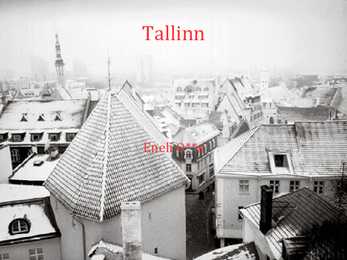
Tallinn Eneli O**a History City rights were given to Tallinn on May 15, 1248 Independent since 1991 Covers the area of 159.2 km2 Old Town of Tallinn Tallinn's Old Town is one of the most well- preserved old towns in northern Europe The golden era in lies in the period between the early 15th and mid 16th centuries It has three parts: Lower Town, Upper Town + Town Wall, Towers and the Gates Lower Town/Upper Town Town Hall Square Toompea Castle & Tall Tallinn Town Hall Hermann's Tower Town Hall Pharmacy Cathedral of Saint Mary the Virgin Great Guild Hall Danish King's Garden House of the Brotherhood of Black Heads Other Attractions Ka...
Charles Church By Annabel Peterson Charles Chruch is a Lutheran church in the centre of Tallinn, on Tõnismägi hill. It is architecturally the most magnificent out of all Estonian sacred buildings in the 19th century, also Charles congregation is currently the largest in Estonia by the number of members. It was originally built in the 17th century, during the time of Swedish rule, when king Charles XI commissioned the construction of a church for the Estonian and Finnish population in 1670. At first it was wooden and not very large, built in a Greek cross style. Traditionally, the church was named after the king that built it. In 1710, right before the invasion of the Russian troops and during the Great Northern War, the church was burnt down along with many buildings surrounding the city fortification wall. The destruction led to decreasing of th...
Underwater hockey Tartu KHK Aleksander Andrejev AT112 Content To introduce Some History Rules Equipment Positive aspects Negative aspects Conclusion Video To introduce Underwater hockey is a global non-contact sport in which two teams play the game what is very similar to good known to us hockey in the ice , but here game is held underwater , what makes this sport very intresting and unusual. Some History Was started in the United Kingdom by Alan Blake in 1954 Octopush Blake formed Southsea Sub-Aqua Club who first played in Eastney Swimming Pool, Portsmouth, England first octopush competition between teams from Southsea, Bournemouth and Brighton in early 1955. Southsea won then, and they are still highly ranked at national level today. great popularity in the United Kingdom, Australia, Canada, New Zealand...
Old Tallinn Old Town, a medieval walled city filled with old buildings and fortifications. The sheltered bay and the easily defended Toompea Hill made it a natural place to settle. Sometime about 1050 A.D. a fortress was built atop the hill, the first of many. In 1219 the Danes showed up as part of the Northern Crusade to subjugate the Baltics and convert the local pagans to Christianity whether they wanted to or not. The Danes improved the fortifications and expanded the town, which became part of the Hanseatic League, a trading organization of a hundred northern cities. The Danes sold Tallinn to the Livonan Order, a branch of the Teutonic Knights, in 1346. The Swedes came next in 1561. Tallinn weathered plague and the Great Northern War and became part of Russia in 1710. In 1918, Estonia declared independence from Russia and fought a bitter war against Bolshevik Russia. Independence didn’t last long, ...
Main Sights England is known for its many world-famous sightseeings and people all around the world come to see them. Some of them are even like symbols of England. The most famous ones are: Stonehenge is one of the greatest national icons of Britain. That prehistoric monument is located in the plain of Salisbury, in the county of Wiltshire in the south-west of England. It is built of 150 enormous stones which are set in a purposive circular pattern. Stonehenge was probably built to mark the longest and shortest day of the year because it lies on the line of the midsummer sunrise and the midsummer sunset. That would have enabled people to keep a record of changing of seasons. Although it is still unclear who built it. Hadrian’s Wall is an ancient wall which was built in 2nd century by Hadrian, the emperor of Rome from AD 117 to 138, and it marked the northern border of the Roman Empire in Britain. The wall was 80 Roman miles (117 kilom...
Kunda Ühisgümnaasium Tallin Old Town Report Student: Kristin Karu Teacher: Kristi Aron Kunda 2012 The Alexander Nevsky Cathedral The Alexander Nevsky Cathedral is an orthodox cathedral in the Tallinn Old Town,Estonia. It was built to a design by Mikhail Preobrazhensky in a typical Russian Revivalstyle between 1894 and 1900, during the period when the country was part of theRussian Empire. The Alexander Nevsky Cathedral is Tallinn's largest and grandest orthodox cupola cathedral. It is dedicated to Saint Alexander Nevsky who in 1242 won the Battle of the Ice on Lake Peipus, in the territorial waters of present-day Estonia. The late Russian patriarch, Alexis II, started his priestly ministry in the church. Interior of the Cathedral. The Alexander Nevsky Cathedral crowns the hill of Toompea where the Estonian folk hero Kalevipoeg...
William the Conqueror (~1028-1087) · Was born in Falaise , Normandy. It's not exactly known when William born but it is is believed to have been born in either 1027 or 1028.He was son of Robert I , the Duke of Normandy. He was known as "William the Bastard" because of the illegitimacy of his birth. · Duke of Normandy from 1035. By his father's will, William succeeded him as Duke of Normandy at age seven. He was knighted by Henry at age 15. By the time William turned 19 he was successfully dealing with threats of rebellion and invasion. · King of England from 1066 to his death. Upon the death of the childless Edward the Confessor, the English throne was fiercely disputed by three claimants--William, Harold Godwinson, the powerful Earl of Wessex, and the Viking King Harald III of Norway, known as Harald Hardraada. Ba...
HENRY MOORE Henry Moore was born on the 30th of July in 1898. He was an English sculptor and artist. He was best known for his abstract bronze sculptures which are located around the world. He was also the most celebrated sculptor of his time, and the second part of his career, in particular, demonstrated that Modernist sculpture was surprisingly adaptable to official needs. In this sense, Moore was the contemporary equivalent of the great Neo Classical sculptors such as Canova and Thorwaldsen. Moore was born in Castleford as the son of a mining engineer. He became well-known through his large-scale abstract cast bronze and carved marble sculptures, and was instrumental in introducing a particular form of modernism to the United Kingdom. His ability in later life to fulfill large-scale commissions made him exceptionally wealthy. Yet he lived frugally and most of the money he earned went towards s...
London There were some people living on the banks of the Thames when the Romans came to England in 43 AD. But we don't know much about them. London first called Londinium . In 200 they built a wall around their city, a part of which can still be seen near the Museum of London . London Bridge was built in stone in 1176. It was London's only bridge until 1729. Now there are about twenty bridges . London soon became the largest city in England and by the time of the Norman Conquest in 1066 it had become the most important city in Britain. It grew in are and population until September 1666, when the Great Fire destroyed four fifths of the wooden buildings in the City including St Paul's Cathedral. The fire began in the kitchen of King's baker in Pudding Lane and lasted for five days. London is an exciting city which attracts people from all over the world. It is popular place to live because there is something new to see and do every day. M...
Names with and without the. A/ We do not use 'the' with names of most streets/roads/squares/parks etc.: Union Street (not 'the...') / Fifth Avenue/ Piccadilly Circus/ Hyde Park Blackrock Road/ Broadway/ Times Square/ Waterloo Bridge Many names (especially names of important buildings and institutions) are two words: Kennedy Airport/ Cambridge University The first word is usually the name of a person ('Kennedy') or a place ('Cambridge'). We do not usually use 'the' with names like these. Some more examples: Victoria Station (not 'the...') / Edinburgh Castle/ London Zoo/ Westminster Abbey/ Buckingham Palace/ Canterbury Cathedral But we say 'the White House', 'the Royal Palace', because 'white' and 'royal' are not names like 'Kennedy' and 'Cambridge'. This is only a general rule and there are exceptions. B/ Most other names (of places, buildings etc.) have names with the: These places usually have names w...
Contents Introduction...................................................3 London's early history.....................................45 The people of London......................................6 Buildings and bridges......................................7 Intruduction London is the capital of the united kingdom (UK), which is made up of Great Britain(England, Scotland, Wales) and Northern Ireland. The city lies in the southeast of England and covers an area of about 1,578 square kilometres on either side of the River Thames. With population of seven million, London is by far the largest city in the UK. Birmingham, the second largest, has just over one million inhabitants. Cultural life London is the worldclass centre. It has more than40 theatres, where audiences enjoy everything from musicals to William Shakespeare's plays. The city also ...
London History The Romans AD 43- AD 410 The Romans finally invaded Britain in AD 43 from Kent. The Romans lead by Julius Caesar attempted to invade Britain twice before that in 55 and 54 BC but the invasions were unsuccessful. They made their way to the river Thames and sailed up it. The Romans knew it was important to control a crossing point at the river Thames, so they decided to build a settlement on the north bank. Although small settlements had been built on the banks of the Thames, the Romans were the ones who built the first city. They called their city Londinium. The Roman engineers noticed that the point where the swampy river narrowed would make an ideal crossing point, they built London Bridge. Less than 20 years later the native Iceni tribe, led by Queen Boudicca, rose up against the Romans in revenge for mistreatment and burnt Londinium to the ground. The well disciplined Roman army defeated her forces and Londinium was r...
1. Fat Margareta - 16. Cent. Tallinn's most impressive defensive structures, the Great Coastal Gate (Suur Rannavärav) and Fat Margaret's Tower. They were built not only to defend the city from the seaward side of town, but also to impress any visitors arriving via the harbour. Fat Margareta used to be a prison. It is a town wall's building. Now it's home to the Estonian Maritime Museum, which provides a detailed look at the nation's seafaring past. 2. The Great Coastal Gate - with the Viru Gates, are the last of six gates that controlled access to the town in Medieval times. 3. Kolm Õde - a hotel. In 2003, three of Tallinn's splendid merchant houses, built in 1362, were renovated and united to create The Three Sisters, which now offers modern amenities with great design and a backdrop of medieval history. 4. Oleviste church baptism. Believed to have been built in the 12th century a...
Country Study Mari-Liis Luukas 11c The British Isles Administrative / d'mnstrtv / haldus- Self-governing / self'gvn / isemajandav, iseseisev Legislative assembly/ 'ledsltv 'sembl/ seadusandlik kogu The British Isles is the name of a group of islands washed by the North Sea in the east and the ...
2 Towns (Upper & Lower Town) Tallinn used to be divided into 2 parts - Upper Town where lived the aristocracy, gentry and the clergy; and Lower Town with traders, craftsmen and merchants. Legend says the Toompea Hill is actually the tumulus mound of the great Kalev. Linda carried rocks to his grave. It is a naturally- formed limestone hill. Lower Town was a merchantile centre, Tallinn also belonged to the Hansaetic League (1285). It is often referred to as the town of citizens. Any grown-up, married and economically independent person, born in a legal marriage between two free people and having lived in the town for at least 3 months, could apply to the Magistracy for citizenship. Serfs could escape from serdom after having successfully hidden in town for a year and a day. Two parts remained separated until the end of the 19th century. Four Names Lyndanise - mentioned by Henricus de Lettis in his Chronicle; derives from the name Lind...
PÄRNU SÜTEVAKA HUMANITAARGÜMNAASIUM Oliver Stimmer SUUR DEPRESSIOON Aastatöö Tertia aste Juhendaja Peep Eenraid Pärnu 2009 2 SISUKORD Sissejuhatus.....................................................................................................................................4 1. Majandusolud enne Suurt Depressiooni...................................................................................... 5 1.1 Globaalne kapitalism............................................................................................................. 5 1.2 Majanduslik olukord, mis oli tekkinud I maailmasõjas.........................................................6 1.3 Maailmamajandus peale esi...
Tallinn English College English Anita Kuprijanovits Form 8b THE UNITED STATES OF AMERICA Report Supervisor: Mare Kallas Tallinn 2009 Introduction Name: The United States of America Area: ~10 mln km2 Population: ~300 mln people Symbols: The American Flag- consists of 13 equal horizontal stripes of red alternating with white and represent the Thirteen Colonies. The 50 small, white stars represent the 50 U.S. states. The U.S. flag is commonly called ,,the Stars and Stripes". The Statue of Liberty, that is locatd in New York,is a gift from the France. The Libety Bell, that is a bronze bell that symbolizes freedom in the United States of America. It is located in Pennsylvania,U.S. Capital: Washington D.C Biggest city: New York National language: English Location U.S is locat...
Topic London Tallinn English College Tallinn 2007 1. Introduction London is the capital city of the United Kingdom and the largest urban area in England. The ancient City of London, to which the name originally belonged, still maintains its medieval boundaries, but the name "London" has long applied more to the whole metropolis that has grown up around it. London has been an important settlement for over two millenniums. It is also one of the world's leading business, financial and cultural centres and its influence in politics, education, entertainment and even fashion contribute to its status as a major global city. London is a major tourist attraction with four world heritage sites, several royal parks and numerous iconic landmarks such as the Houses of Parliament, Towe Bridge, the Tower of London, Westminster Abbey and the London Eye. 2. History Although there is some evidence of a permanent settle...
History of Great Britain Prehistory (55BC) no written records 6th 3rd c. BC the Celts came to British isles hill figures, hill forts, stone circles ( Stonehenge ) RomanBritain (55BC 400AD) Julius Caesar, named the country Albion Hadrian's Wall, villas, roads, the town of Bath The AngloSaxon, Danish and Norman invasions Germanic tribes settled and stayed Anglia Christianity was brought, religion became important, churches were built 8th century = raids by the Vikings and the Danes 1016 1042 : Under Danish rule ( York was the capital ) 1042 : local AngloSaxons regain their rule 1066 : Normans arrive ( the Norman conquest ) Medieval Britain (106615th c.) the Battle of Hastings William the Conqueror a new AngloNorman state the feudal system introduced the rule of the king and church strengthened centralised country, military rule Scotland, Wales and Ire...
Egypt (Geography)Egypt officially the Arab Republic of Egypt, is a country mainly in North Africa. Egypt is a transcontinental country. Covering an area of about 1,010,000 square kilometers, Egypt is bordered by the Mediterranean Sea to the north, the Gaza Strip and Israel to the northeast, the Red Sea to the east, Sudan to the south and Libya to the west.Apart from the Nile Valley, the majority of Egypt's landscape is a desert. The winds blowing can create sand dunes more than 100 feet (30 m) high. Egypt includes parts of the Sahara Desert and of the Libyan Desert. Egypt does not receive much rainfall except in the winter months. Temperatures average between 80 °F (27 °C) and 90 °F (32 °C) in summer, and up to 109 °F (43 °C) on the Red Sea coast. Temperatures average between 55 °F (13 °C) and 70 °F (21 °C) in winter. (Population)Egypt is one of the most populous coun...
 annaabi.ee