Leidsid 33 sarnast õppematerjali, mis on seotud failiga "Golden Grammar rules". Need materjalid aitavad sul teemat sügavamalt mõista.
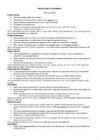
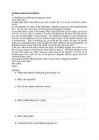
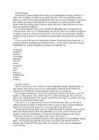
here, sent, look, noun, thing, talk, present, before, work, phone, since, late, than, years, english, there, wait, everybody, doctor, clock, verb, good, told, sister, stay, tomorrow, things, days, speak, adjective, enough, interest, mean, whole, pass, tennis, went, plural, come, today, going, live, something, study, arrive, weekend, rains, lookingHere's a breakdown of how you can express how you really are without complaining too much. · Fine, thanks. / On top of the world, thanks. · OK, thanks · Not so bad, thanks. / Can't complain, thanks. · So so, thanks. / So and so, thanks. · Not so good, actually 1 The English alphabet Spelling Work with your partner and spell out first your name and then some names of places. Write down each letter as you hear it, and then say the word. The English alphabet on the phone: You might find the following alphabet (used by international airlines) useful when trying to spell a word on the telephone. A Alpha O Oscar Ä Alpha-Echo Ö Oscar-Echo B Bravo P Papa
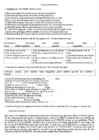
Tests Superstar 1 Luke Prodromou Test 1 Name____________________ Class_______ Use your English 1 Complete these sentences using the correct form (present simple or present continuous) of the verb in brackets. _ 1 She is in a band and she _________________________________ (record) a CD at the moment. _ 2 She is an actress and often _________________________________ (appear) on television. _ 3 At the moment she _________________________________ (have) a rest because she is tired. _ 4 Mike is a doctor and he _________________________________ (live) in Manchester. _ 5 I _________________________________ (start) work at 8.30 every morning.
The Imperative 141 The Articles 71 The Subject and the Object 143 Demonstrative Determiners 73 Direct and Indirect Objects 144 Interrogative Determiners 74 Positive and Negative Sentences146 Possessive Determiners 75 Questions 147 7 Verbs and Tenses 79 14 Punctuation 150 The Simple Present Tense 80 Period 150 Am, Is and Are 83 Comma 151 The Present Progressive Tense 89 Exclamation Point 152 Have and Has 93 Question Mark 152 The Present Perfect Tense 96 Apostrophe 153 1 What is Grammar? Here's an old children's rhyme about the eight parts of speech of English grammar
Windows are not made of wood. Simple Present · · New York is a small city. It is not important that this fact is untrue. [VERB] + s/es in third person USE 3 Scheduled Events in the Near Examples: Future · You speak English. · Do you speak English?
http://www.english-4u.de/a_an_some_ex1.htm ◦ *some bananas *some cats *some monkeys *some 2. http://www.english-4u.de/a_an_some_ex3.htm balls ◦ *some eggs*some oranges *some umbrellas *some 3. http://www.english-4u.de/a_an_some_ex6.htm eagles We us the • when we talk about a specific thing. • when it is clear which thing or person we mean. A – AN - THE • when there is only one of something. Examples:
Too full of gab, and too impertinent And free with your advice on all occasions. DAMIS But . . . MADAME PERNELLE You're a fool, my boy--f, o, o, l Just spells your name. Let grandma tell you that I've said a hundred times to my poor son, Your father, that you'd never come to good Or give him anything but plague and torment. MARIANE I think . . . MADAME PERNELLE O dearie me, his little sister! You're all demureness, butter wouldn't melt In your mouth, one would think to look at you. Still waters, though, they say . . . you know the proverb; And I don't like your doings on the sly. ELMIRE But, mother . . . MADAME PERNELLE Daughter, by your leave, your conduct In everything is altogether wrong; You ought to set a good example for 'em; Their dear departed mother did much better. You are extravagant; and it offends me, To see you always decked out like a princess. A woman who would please her husband's eyes Alone, wants no such wealth of fineries. CLEANTE
3 have/'ve caught 7 As she got older, her health and judging by the students' 4 lived deteriorated. expressions, I'd say that they are 5 haven't finished enjoying their lesson. They look 3 She was unlucky because she was 6 have/'ve known interested and it looks as though shipwrecked three times. 7 walked they are working hard. Most of She was lucky because she survived
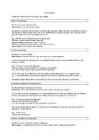
H-Helen, J - Julia 1.Receiving a money order H: - Hello, I would like to cash a money order. J: - Hello! You should present your identity card. H: - But, you know, I'd like to receive money order for my sister. How do I go about it? J: - Your identity card and letter of attorney, please. H: - Here you are. J: - Well...Unfortunately, I can't cash your money order your signature is not witnessed. H: - Ok. Than, please, I'd like to cash my money order. J: - Take this form and fill it in. May I see your passport? H: - Yes. Please. So...Should I write my full name, my passport number and the sum of money that has been sent to me, right? J: - Certainly. How would you like the money? H: - I prefer one hundred rouble notes, if you don't mind. J: - Here is your money. H: - Thank you
again to keep the noise down. between Paul and Joe. 1D Sporting origins page 67 2 She recognised him at once. 2 Phobias can be genetically 3 He's working at his father's shop inherited. 1 1 staunchly / resolutely for the time being. 3 When it comes to politics, 2 By and large 4 They'll be here any moment now. Edward and his dad have a lot in 3 swiftly 5 Everybody makes mistakes once common. 4 loosely in a while. 4 Luke is the spitting image of Matt 5 categorically 6 My brother was still a baby at the Damon. 6 widely time
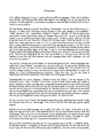
Color-- -1- -2- -3- -4- -5- -6- -7- -8- -9- Text Size-- 10-- 11-- 12-- 13-- 14-- 15-- 16-- 17-- 18-- 19-- 20-- 21-- 22-- 23-- 24 TWILIGHT By Stephenie Meyer Contents PREFACE 1. FIRST SIGHT 2. OPEN BOOK 3. PHENOMENON 4. INVITATIONS 5. BLOOD TYPE 6. SCARY STORIES 7. NIGHTMARE 8. PORT ANGELES 9. THEORY 10. INTERROGATIONS 11. COMPLICATIONS 12. BALANCING 13. CONFESSIONS 14. MIND OVER MATTER 15. THE CULLENS 16. CARLISLE 17. THE GAME 18. THE HUNT 19. GOODBYES 20. IMPATIENCE 21. PHONE CALL 22. HIDE-AND-SEEK 23. THE ANGEL 24. AN IMPASSE EPILOGUE: AN OCCASION twilight STEPHENIE MEYER LITTLE, BROWN AND COMPANY New York Boston Text copyright © 2005 by Stephenie Meyer All rights reserved. Little, Brown and Company Time Warner Book Group 1271 Avenue of the Americas, New York, NY 10020 Visit our Web site at www.lb-teens.com First Edition: September 2005 The characters and events portrayed in this book are fictitious.
.. 3. Dear Sirs, I am writing to complain about the poor quality of the items which I received from your company. I have no other alternative but to cancel the order which 1 placed earlier this week ... 4. ... thus, I recommend that you accept this advice on the matter. I am pure that the suggestion offered is the best solution. Please let me know if this was helpful. Yours sincerely, Lee Jones 5. ... I would appreciate a reply at your earliest convenience. I look forward to meeting you to discuss employment opportunities. Yours faithfully, Nicole Porter Paragraph Plan for Letters · salutation · Paragraph 1 reasons for writing · Paragraphs 2, 3 development · Final paragraph closing remarks · Name · Letters are divided into two categories, formal and informal. There are various types of formal and informal letters .
Performing the presentation Introducing yourself and your talk Greeting, name, position, opening formalities Good morning, ladies and gentlemen. Good afternoon, everyone. Good morning. My name's (...). I'm the new Finance Manager. Good morning. Let me start by saying just a few words about my own background. I started out in... Welcome to Standard Electronics. I know I've met some of you, but just for the benefit of those I haven't, my name's (...). It's very nice to see you all here today. I'm very pleased to be here. I'm glad you could all make it.
· Wishes are for lazy people who can't get up and make their dreams come true on their own. Make it happen! · It's easy to say something, but it's harder to mean it. · Distance isn't a big factor in a relationship. Communication is. But most of all, commitment is the biggest. · A broken heart can hurt but it's the memories that kill you. · Every girl deserves to be treated with respect and not to be lied to or cheated on. · Remember, you need to open your eyes before opening your mouth! · When people start telling you you've changed, it's actually because you've just stopped living life THEIR way. · In life, shit happens, so forget about the past, and make the best of the future! · If you don't understand my silence, how do you understand my words? · Karma exists, good or bad. Karma comes in any ways. It may not come today but it WILL someday. · A man falls in love through his eyes, a woman through her ears. · All men are idiots..
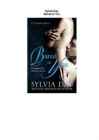
This one is for Dr. David Allen Goodwin. My love and gratitude are boundless. Thank you, Dave. You saved my life. Acknowledgments My deepest gratitude to my editor, Hilary Sares, who really dug into this story and made me work for it. Basically, she kicked my ass. By not pulling her punches or letting me shortchange the details, she made me work harder and because of that, this story is a much, much better book. BARED TO YOU wouldn't be what it is without you, Hilary. Thank you so much! To Martha Trachtenberg, copy editor extraordinaire. This book is an important one for me and she treated it that way. Thank you, Martha! To Victoria Colotta, for all her hard work on the interior design and typesetting. She took my plain text and made it gorgeous. Thank you, Victoria!
TIME CLAUSES Present Simple · Permanent states, facts (Tom works..) · Repeated and habitual actions, routines (She usually goes..) · Laws of nature and general truths (The sun sets in the west) · Timetables and programmes · Sporting commentaries, rewiews (Beckham wins the ball, crosses and Owen scores) · Feelings and emotions (I love Tallinn..) TIME EXPRESSIONS USED WITH PRESENT SIMPLE: usually, often, always, every day/week etc, in the morning/evening etc, at night/the weekend, on Fridays etc. Present Continuous · Actions taking place at or arount the moment of speaking (The kids are watching TV..) · Fixed arrangements in the near future (I'm going to the dentist tomorrow) · Currently changing ang developing situations (The number of burgularies is increasing)
Kõik õigused on kaitstud. Ilma autoriõiguse omaniku eelneva kirjaliku loata pole lubatud ühtki selle töövihiku osa paljundada ei elektroonilisel, mehaanilisel ega muul viisil. Töövihik on kooskõlas 2009. a uuendatud õppekomplektiga I Love English 6. Tartu, 2014 ISBN 978-9949-436-59-0 Kirjastus Studium Riia 15b, Tartu 51010 www.studium.ee Trükitud OÜ Greif trükikojas Lohkva, Luunja vald Tartumaa 62207 --- 3 xxx 1. The Big Apple 1. Write the verbs in the present continuous or the past continuous tense. Do you remember? am is are was were verb -ing 1 Sorry. I ... (write) a report at the moment. I can't come with you. 2 When Peter arrived, his friends ... (play) football. 3 I ... (sleep) when the alarm went off in my sister's room. 4 Dad's mobile phone is switched off because he ... (fly) to Paris. He's on the plane at the moment. 5 I ... (read) an interesting book. It's a collection of memories. 6 Leo was late again. He ..
People and Behaviour 1. Underline the most suitable word or phrase. a) Please don't push. It's very bad-tempered/rude/unsympathetic. b) Jack hates spending money. He's rather frank/greedy/mean. c) Our teacher is very proud/strict/tolerant and won't let us talk in class. d) Helen never does her homework. She is rather gentle/lazy'/reliable. e) I didn't talk to anyone at the party because I felt ambitious/lonely/shy. f) When Harry saw his girlfriend dancing with Paul he felt jealous/selfish/sentimental. g) I don't like people who are noisy and aggressive/courageous/sociable. h) Thanks for bringing us a present. It was very adorable/grateful/thoughtful of you. i) Teresa never gets angry with the children. She is very brave/patient/pleasant. j) Tom always pays for everyone when we go out. He's so cheerful/generous/honest. 2
Reported speech is often also called indirect speech. When we use reported speech, we are usually talking about the past (because obviously the person who spoke originally spoke in the past). The verbs therefore usually have to be in the past too. For example: "I'm going to the cinema". He said he was going to the cinema. Basic tense chart The tenses generally move backwards in this way (the tense on the left changes to the tense on the right): present simple past simple I'm a teacher. He said he was a teacher past continuous. present continuous He said he was having lunch with his I'm having lunch with my parents. parents. past perfect simple
Highly recommended." --Dr. Stewart D. Friedman, adviser to Jack Welch and former director of the Work/Life Integration Program at the Wharton School, University of Pennsylvania "It's about time this book was written. It is a long-overdue manifesto for the mobile lifestyle, and Tim Ferriss is the ideal ambassador. This will be huge." --Jack Can eld, cocreator of Chicken Soup for the Soul®, 100+ million copies sold "Stunning and amazing. From mini-retirements to outsourcing your life, it's all here. Whether you're a wage slave or a Fortune 500 CEO, this book will change your life!" --Phil Town, New York Times bestselling author of Rule #1 "The 4-Hour Workweek is a new way of solving a very old problem: just how can we work to live and prevent our lives from being all about work? A world of in nite options awaits those who would read this book and be inspired by it!" --Michael E. Gerber, founder and chairman of E-Myth Worldwide and the world's #1 small business guru
•He took his boots off. •They called the doctor in. apposition a grammatical construction in which two usually adjacent nouns having the same referent stand in the same syntactical relation to the rest of a sentence (as the poet and Burns in “a biography of the poet Burns”) back-reference In grammatical analysis, the term reference is often used to state a relationship of identity which exists between grammatical units, e.g. a pronoun 'refers' to a noun or noun phrase. When the reference is to an earlier part of the discourse, it may be called a 'back-reference' (or anaphora); collective noun Collective noun is the name we give to a group of nouns to refer to them as one entity. A crew of sailors. A flock of birds. A range of mountains. conjunction any member of a small class of words distinguished in manylanguages by their function as connecto rs between words, phrases,clauses, or sentences, as and, because, but, however. content words
What would you like to me tell Did you have a party in your yester flat day? When were you here? Articles Rules: 1. Rule: When you have a single, countable English noun, you must always have an article before it. We cannot say "please pass me pen", we must say "please pass me the pen" or "please pass me a pen" or "please pass me your pen". Nouns in English can also be uncountable. Uncountable nouns can be concepts, such as 'life', 'happiness' and so on, or
a) When Dick saw his neighbour kick his dog he became angry/nervous. b) Sue wasn't really interested/interesting in the film. c) We were both afraid/anxious that we would miss the plane. d) I wish you wouldn't snap your fingers. It's very annoying/worrying. e) You're not scared/thrilled of spiders, are you? f) If we forget to do our homework, our teacher gets cross/terrifying. g) Tim completely lost his temper! He was absolutely furious/upset. h) Your written work is full of careless/naughty mistakes. 2. Replace the word(s) in italics with a suitable word from the box. Use each word once. confused fascinating scared depressed dull glad naughty upset a) I'm afraid the children have been very badly-behaved today. b) I felt a bit frightened when I went into the dark room. c) Jean was very unhappy when her kitten was run over. d) This film we saw last night was rather boring. e) This is a really interesting book
4) Are you going ..... the ball? 5) ..... piano sounds great, don't you agree? 6) Hey, Keith, bring me some of ..... ice cream, too! 7) Linda sat ..... the rock and sang ..... song. 8) ..... school is something you never forget, yet while studying many things just are forgotten. 9) He jumped off ..... cliff and fell ..... the ice-cold ocean. 10) It was ..... noisiest concert ever! 11) What are you doing? Don't you know that ..... fishing isn't allowed here? 12) Neither ...... them moved, they were just staring ..... each other. 13) You must go, Susan, or else I won't go ..... there as well. 14) He laughed ..... her, not feeling any pity at all. 15) Mother listened ..... the radio while Jim was catching ..... butterflies. 16) She was soon bored, so he decided ..... finish his speech earlier. 17) Marta was hungry; she went ..... the kitchen .... order to grab ..... sandwich and ..... bottle ..... milk. 1
Well, there's that. And I also learned a lot of Russian from my mother's lover who was a Russian military officer and pretty much my father figure at the time. I tried to teach him Estonian and learned some Russian instead. My Russian studies in school have always been very hectic and making very little sense. Teachers kept changing all the time, teaching methods kept changing as well and learning Pushkin by heart does not work wonders with one's speaking skills, really. (Although I still can recite one of his poems...) The point is, I actually really like Russian. I've never been good at it, but I like the language and I really wish I knew it better. I can speak some, but not read much. As soon as the characters stop talking to each other, I'm stuck and can barely understand anything. Most of my Russian skills my ten years younger mates envy come from my year of living in Narva (literally starve or learn!) and
FUTURE SIMPLE BE GOING TO Will + infinitive (will go) Am/is/are going to + infinitive (is going to rain) 1.A decision at the moment of 1.Future plans made before the speaking: moment of speaking: A: 'I'm cold'. A: 'We've run out of milk.' B: 'I'll close the window'. B: 'I know, I'm going to buy some.' 2.Prediction based on opinion: 2.Prediction based on present I think the Conservatives will win the evidence: next election. Look at those boys playing football! 3
must be in want of a wife. However little known the feelings or views of such a man may be on his first entering a neighbourhood, this truth is so well fixed in the minds of the surrounding families, that he is considered the rightful property of some one or other of their daughters. "My dear Mr. Bennet," said his lady to him one day, "have you heard that Netherfield Park is let at last?" Mr. Bennet replied that he had not. "But it is," returned she; "for Mrs. Long has just been here, and she told me all about it." Mr. Bennet made no answer. "Do you not want to know who has taken it?" cried his wife impatiently. "You want to tell me, and I have no objection to hearing it." This was invitation enough. "Why, my dear, you must know, Mrs. Long says that Netherfield is taken by a young man of large fortune from the north of England; that he came down on Monday in a chaise and four to see the place, and was so much delighted with it, that he agreed with Mr. Morris
Conditionals Sentences with if are used to express possibilities. 0 Zero conditional If-clause present (past) simple Main clause present (past) simple Sometimes sentences with if express certainty rather than possibility. The zero conditional is used to talk about sth. that is always true (such as a scientific fact), or that was always true in the past. In this type of conditional we can use when instead of if. E.g., If/When you mix blue and red, you get purple. If/When you don't water flowers, they die. (present simple in both parts of the sentence) If/When I asked her to come with us, she always said no.
five, for example, it is more convenient and less expensive to sit comfortably at home than to go out to find entertainment in other places. They don't have to pay for expensive seats at the theatre or cinema. They turn on the TV-set and can watch interesting films, concerts, football matches. But some people think that it's bad to watch TV. Those who watch TV need do nothing. We are passive when we watch TV. Television shows us many interesting programmes. But again there is a disadvantage here: we watch TV every evening, and it begins to dominate our lives. My friend told me that when his TV-set broke down, he and his family found that they had more time to do things and to talk to each other. There are other arguments for and against television. Very often the programmes are bad. Sometimes they show too much violence in films and news programmes. There is also too much pop music and ads. Ads on the whole are convenient for grown-ups
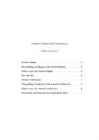
Present Simple and Continuous Table of Contents Present Simple ..................................................................... 2 The spelling of endings in the Present Simple ....................... 2 When to use the Present Simple ........................................... 3 The verb 'be' ......................................................................... 4 Present Continuous.............................................................. 5 The spelling of endings in the Present Continuous................ 5 When to use the Present Continuous.................................... 6 State verbs and event (action or dynamic) verbs ................... 7 Present Simple
Lamb to the Slaughter by Roald Dahl (1916-1990) The room was warm and clean, the curtains drawn, the two table lamps alight - hers and the one by the empty chair opposite. On the sideboard behind her, two tall glasses, soda water, whiskey. Fresh ice cubes in the Thermos bucket. Mary Maloney was waiting for her husband to come him (correction: home) from work. Now and again she would glance up at the clock, but without anxiety, merely to please herself with the thought that each minute gone by made it nearer the time when he would come. There was a slow smiling air about her, and about everything she did. The drop of a head as she bent over her sewing was curiously tranquil. Her skin - for this was her sixth month with child - had acquired a wonderful translucent quality, the mouth was soft, and the eyes, with their new placid look, seemed
Libraries. We know a lot of things thanks to books, but we do not know exactly when and where they originated, and what should be considered the first book in the world. Ancient document, written on parchment, papyri and vellum can hardly be qualified as books the way we understand the word today. Centuries went before paper replaced parchment and papyri. In the 15 th century Johann Gutenberg invented a mechanical process of duplicating texts, which we today call book printing. The first book was printed between 1444 and 1446, so these years can be considered as the beginning years of book printing. His most important preserved printings are the 40 copies of the Bible. By the end of the 15 th century there were about 1000 print-shops in Europe already. The oldest Estonian book dates back to 1535.
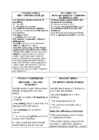
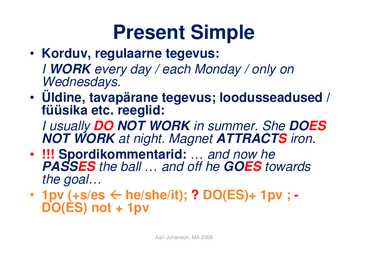
Present Simple · Korduv, regulaarne tegevus: I WORK every day / each Monday / only on Wednesdays. · Üldine, tavapärane tegevus; loodusseadused / füüsika etc. reeglid: I usually DO NOT WORK in summer. She DOES NOT WORK at night. Magnet ATTRACTS iron. · !!! Spordikommentarid: ... and now he PASSES the ball ... and off he GOES towards the goal... · 1pv (+s/es Å he/she/it); ? DO(ES)+ 1pv ; - DO(ES) not + 1pv Aari Juhanson, MA 2008 Present Progressive · Hetkel toimuv, pooleliolev tegevus: S/he IS TALKing on the phone now. I AM READing an interesting book. · Ajutine, regulaarsele ja tavapärasele vastanduv tegevus (tulevikku viitav): This summer they ARE not GROWing cucumbers as usual. They'RE GROWing tomatoes instead. · !!! Halvakspanu väljendus harjumuspärase tegevuse kohta: He IS always COMPLAINing! · BE (am/is/are) + 1pv-ing Aari Juhanson, MA 2008 Present Perfect ON -NUD
......................................117 Chaos and Higher Order.............................................................................118 Good and Bad.............................................................................................119 Not Minding What Happens.......................................................................120 Is That So?..................................................................................................121 The Ego and the Present Moment .............................................................122 The Paradox of Time...................................................................................124 Eliminating Time.........................................................................................125 The Dreamer and the Dream.......................................................................127 Going Beyond Limitation...........................................................................128
 annaabi.ee