 50 punkti
Autor soovib selle materjali allalaadimise eest saada 50 punkti.
50 punkti
Autor soovib selle materjali allalaadimise eest saada 50 punkti.
 ~ 2 lehte
Lehekülgede arv dokumendis
~ 2 lehte
Lehekülgede arv dokumendis
 2013-04-19
Kuupäev, millal dokument üles laeti
2013-04-19
Kuupäev, millal dokument üles laeti
 4 laadimist
Kokku alla laetud
4 laadimist
Kokku alla laetud
 0 arvamust
Teiste kasutajate poolt lisatud kommentaarid
0 arvamust
Teiste kasutajate poolt lisatud kommentaarid
 194934
Õppematerjali autor
194934
Õppematerjali autor
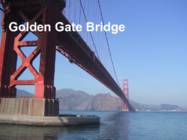
Golden Gate Bridge • General facts • History • Construction Golden Gate Bridge connects the city of San Francisco on the northern tip of the San Francisco Peninsula to Marin County as part of US Highway 101 and California State Highway 1 Measures • Total length of Bridge (including approaches): 1.7 miles = 8,981 ft = 2,737 m • Width of Bridge: 90 ft = 27 m • Clearance above water: 220 ft = 67 m • Height of tower above water: 746 ft = 227 m • Height of tower above roadway: 500 ft = 152 m Main reasons of building this bridge • Population centers were growing • Traffic congestion at the ferry docks was becoming intolerable Beginning • The main idea of bridge construction was proposed by Charles Crocker in 1872. • August 27, 1930 Strauss submitted his final plans.
The Golden Gate Bridge The Golden Gate Bridge in San Francisco, California is one of the most beautiful, and most photographed, bridges in the world. The Golden Gate Bridge is a 1.7 mile(2,74 km)long bridge that can be crossed by car, on bicycles or on foot. It is the second longest bridge in the United States. The Golden Gate Bridge, completed after more than four years of construction at a cost of $35 million, opened to traffic on May 28, 1937 at twelve o'clock noon. One of the most interesting Golden Gate Bridge fact is that only eleven workers died during construction, a new safety record for the time. One of the bridge's safety innovations was a net suspended under the floor. This net saved the lives of 19 men during construction . There are also 128 lights installed on the bridge roadway
Foreword Bridging rivers, gorges, narrows, straits, and valleys always has played an important role in the history of human settlement. Since ancient times, bridges have been the most visible testimony of the noble craft of engineers. A bridge can be defined in many ways, but Andrea Palladio, the great 16th century Italian architect and engineer, hit on the essence of bridge building when he said "...bridges should befit the spirit of the community by exhibiting commodiousness, firmness, and delight." In more practical terms, he went on to explain that the way to avoid having the bridge carried away by the violence of water was to make the bridge without fixing any posts in the water. Since the beginning of time, the goal of bridge builders has been to create as wide a span as possible which is commodious, firm, and occasionally delightful
THE CITY OF LONDON History The City of London occupies one square mile in the middle of the capital. It once made up entire town of London, surrounded by the wall first built by Romans. The Romans also built a bridge over the Thames and there has been one in the same area ever since. The Roman Londinium grew up on the northern side of the bridge. In AD 61 the native Celtic tribe, led by Queen Boudicca, rose up against the Romans. They burnt down Londinium to the ground and killed most of its inhabitants. Roman armies eventually defeated Boudicca and Londinium was rebuilt. At the end of the fourth century AD the Roman Empire began to crumble and the Roman armies were recalled from Britain to defend Rome itself. Once they had left, tribes such as Angles, Saxons and Jutes invaded and settled in from Holland, Germany and Denmark
The White Tower, called so on account of the white Caen stone Brought from Normandy, is the original Norman stronghold. It is the central building of the Tower of London. The white tower has three small square towers and one round one. Later other buildings were added. It has served as a palace as well as a fortress, but it is as a prison that it is known best. Many people have been locked in the Tower, for religious beliefs or suspected treason. Traitors' Gate, set in the southern wall of the Tower, has steps leading down to the river Thames. Countless prisoners, including the future Queen Elisabeth I, were brought to the Tower by barge and went up the steps before being imprisoned for many it was their last moment of freedom before their death. Fortunately, Elisabeth was released from the Tower and later became Queen. Elisabeth's father, Henry VII, made the Tower the feared destination of his enemies
unsuccessful. They made their way to the river Thames and sailed up it. The Romans knew it was important to control a crossing point at the river Thames, so they decided to build a settlement on the north bank. Although small settlements had been built on the banks of the Thames, the Romans were the ones who built the first city. They called their city Londinium. The Roman engineers noticed that the point where the swampy river narrowed would make an ideal crossing point, they built London Bridge. Less than 20 years later the native Iceni tribe, led by Queen Boudicca, rose up against the Romans in revenge for mistreatment and burnt Londinium to the ground. The well disciplined Roman army defeated her forces and Londinium was rebuilt. By AD 100 it had also become the capital of the Roman province. A massive wall was built to protect the city from further attacks. The Roman Empire came under increasing attack across Europe and in AD 410 they retreated.
..........................................................68 5.2.5 Discussion ...............................................................................................................................69 5.3 EMPIRICAL EVIDENCE FOR LC AND BIM SYNERGY.........................................................................69 5 5.3.1 Crusell Bridge case study........................................................................................................69 5.3.2 Discussion ...............................................................................................................................71 5.4 CONCLUSION ..................................................................................................................................73 CHAPTER 6- CONCLUSION ..........................................................
true to form. It contains one of the world's most pristine and varied collections of architecture, from Art Nouveau to Baroque, Renaissance, Cubist, Gothic, Neo-Classical and ultra-modern. Some popular sights include: · Old Town (Staré Msto) with its Old Town Square. 10 · The Astronomical Clock (Orloj) on Old Town Square. · The picturesque Charles Bridge (Karlv Most). · The vaulted Gothic Old New Synagogue (Staronová Synagoga) of 1270. · New Town (Nové msto) with its busy and historic Wenceslas Square. · Malá Strana (Lesser Quarter) with its Infant Jesus of Prague. · Prague Castle (Prazsk hrad - the largest castle in the world) with its St. Vitus Cathedral. · Josefov (the old Jewish quarter) with Old Jewish Cemetery and Old New Synagogue.
 annaabi.ee








Kõik kommentaarid