• Human population has been rising continuously since the end of the Black Death, around the year 1350 • The most significant increase has been since the 1950s, mainly due to medical advancements and increases in agricultural productivity • The recent rapid increase in human population over the past three centuries has raised concerns that the planet may not be able to sustain present or future numbers of inhabitants. Loss of Fresh Water • Most of the freshwater resources are either unreachable or too polluted, leaving less than 1% of the world's freshwater, or about 0.003% of all water on Earth, readily accessible for direct human use. • According to the Global Outlook for Water Resources to the Year 2025, it is estimated that by 2025, more than half of the world population will be facing water-based vulnerability and human demand for water will account for 70% of all available freshwater.
2 MINUTIT. I'm going to talk about water consumption and about the importance of the water. I've chosen this topic because water is our most important resource and I'm also very worried about how little there is left of it. At the moment a bottle of water costs less than an euro, but within the next 10 years the very same bottle may cost 5 to 10 euros, if we don't conserve and protect our fresh water supply. The thing is, we have enough sea water, but it's the freshwater we lack of. Water covers over 70% of the Earth, but just 3% of it is fresh and less than 1% is the water that is available and we can drink. The amount of freshwater is rapidly decreasing. The water we have now is all we will ever have, we cannot produce anymore. Moving on to the importance of water. There wouldn't be any life on Earth without water. Water cools the Earth and all plants, animals and humans need clean water to survive.
Most of Estonia's many islands belong to the West Estonian archipelago. The largest islands are Saaremaa with 2671 sq km, Hiiumaa with 989 sq km and Muhu with 200 sq km. The sea between these islands and the Mainland Väinameri is very shallow (less than five metres deep on average) and rich in shoals. The water of the Baltic Sea is brackish. Its average saltinity is only one fourth of that of the sea in general. Thus, most Estonian freshwater fish (about 30 species) also inhabit the sea. There are some 1450 lakes in Estonia (6.1% of its territory). The two largest of them are Lake Peipsi (the fifth largest in Europe) at 3555 sq km and Võrtsjärv with its 270 sq km area. About 1440 vascular plant species grow in Estonia, while ¾ of the total number of species are found in the coastal lowlands and islands. There are 82 species of fish living in Estonia, which are hard to divide into freshwater and sea species.
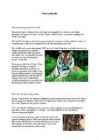
Hawksbill Turtle 3. Tiger 8. Big Leaf Mahogany 4. Beluga Sturgeon 9. Green-Cheeked Parrot 5. Goldenseal 10. Mako Shark Black rhino The Black Rhinoceros or Hooklipped Rhinoceros. An adult Black Rhinoceros stands 140170 cm high at the shoulder and is 3.33.6 m in length. An adult weighs from 800 to 1,400 kg . The females are smaller than the males. Black rhino Alligator Snapping Turtle largest freshwater turtles in the world about 12 years of age. Female clutch of 1050 eggs hunted for their carapaces Alligator Snapping Turtle Thank you!!!
Loch Ness Mariann Kolk 9d Geographical particulars · large, deep freshwater · 37 km long · southwest from Inverness · surface area 56.4 km² · deepest point 230 m · about 10,000 years old Urquhart Castle · beside Loch Ness · the largest strongholds · majority of Loch Ness Monster sightings Cherry Island · only island on Loch Ness · artificial island · from the Iron Age The Loch Ness Marathon · an annual marathon race · along Loch Ness to Inverness · $2,500 · supports several charities · over 1,500 participants
Only found in Queensland Stay on trees the majority of their life Can leap up to 15 m Feed on leaves, fruits Cushioned feet Sugar Glider Native to Australia Found along eastern and northen Australia 40 cm long from nose to tail, weigh 150 grams Feed at night Glide up to 100 m through the air Nest in a hollow tree Platypus Found in western Australia Live in freshwater rivers or lakes Swim 2 minutes before returning to the surface Can consume their own body weight in 24 h Male platypus has venom strong enough to kill a dog Thank you!
.., 2010). Veekasutuse indeks näitab riigis või piirkonnas olemasolevaid veeressursside ja veekasutuse suhet. Indeks üle 20% viitab tavaliselt veenappusele, 40% viitab kriitilisele piirile. Üheksas riigis on täheldatud veenappust - Belgias, Bulgaarias, Küprosel, Saksamaal, Itaalias, endine Jugoslaavia Makedoonia Vabariigis, Maltal, Hispaania ja Ühendkuningriigis (Inglismaal ja Walesis), mis moodustab 46% Euroopa elanikkonnast (Use of freshwater resources..., 2010). Sellele teabele toetudes saab luua tõhusad kohalikke strateegiaid, et kohaneda kliimamuutustega. Enamikes Euroopa riikides on veevõtt võrreldes 1990-ndate algusega vähenenud. See on seotud majanduslike muutuste ja ümberkorraldustega vee säästva kasutamise suunas, eriti uutes EL-i riikides. Veevõtu kasvu on täheldatud Hollandis, Suurbritannias, Kreekas, Soomes, Sloveenias, Hispaanias ja Türgis, seda seostatakse kliimamuutuse ja turismi hoogustumisega. Veekasutuse
2.2.1 Leia Jim Browni artikkel Tools of jobs a) Jim Brown juhatab Tech-Clarity Inc. In Media, Pa. b) Kasutasin Basic Search otsingut, kuhu sisestasin artikli nime. Leidsin ühe artikli, kus avades oli Abstract (referaat) ja Full text (täistekst). Täisteksti alt leidsin infot autori kohta. 2.2.2 Ava andmebaasi ProQuest tesaurus: Advanced Search/Thesaurus a) Laiemad märksõnad: aquatic ecosystems (vee ökosüsteemid), ecosystems (ökosüsteemid), freshwater ecosystems (magevee ökosüsteemid), terrestrial ecosystems (maapealsed ökosüsteemid) b) Märksõnaga rainforests leidsin 6222 kirjet, millest vanima autor on Daniel Janzen. 2.3 Otsing andmebaasist EBSCOhostWeb a) Parima tulemuse andis Advanced Search, kus otsiprofiiliks panin biocatalytic or stereochemical and synthesis. Lisaks täpsustasin keeleks inglise keele ja otsisin täistekste Scholarly Journal`ist. Leidsin 367 teemakohast tulemust. b) Parthiban, P
⦿ Underground storage ⦿ Global warming WHY IS IT A PROBLEM? ⦿ It causes worldwide disasters and deaths. ⦿ It may not damage our health immediately but can be harmful after long time. ⦿ Industrial waste often contains many toxic compounds that damage the health of animals who live in a water and those who eat them. ⦿ Microbial water pollution is a major problem in the developing world, it causes a number of different diseases. ⦿ Suspended particles in freshwater reduces the quality of drinking water for humans and the aquatic environment for marine life. ⦿ Suspended particles can often distrub the growth of plants and micro-organisms. HOW DO BREVENT WATER POLLUTION? ⦿ Recycle. ⦿ Use water wisely. ⦿ Take Responsibility. ⦿ Set up a composter. ⦿ Swim responsibly. ⦿ Help cleaning up your nearest beach, lake or river. ⦿ Dispose of household wastes, oils, and other litter properly.
vulkaanilisi gaase, et sel on Maa kliimale väga suur ja pikaaegne mõju. 6.This detailed astronaut photograph depicts the summit caldera of the volcano. The huge caldera is 6 kilometers (3.7 miles) in diameter and 1,100 meters (3,609 feet) deep. It formed when Tambora's estimated 4,000-meter- (13,123-foot) high peak was removed, and the magma chamber below emptied during the April 10 eruption. Today the crater floor is occupied by an ephemeral freshwater lake, recent sedimentary deposits, and minor lava flows and domes from the nineteenth and twentieth centuries. Layered tephra deposits are visible along the northwestern crater rim. Active fumaroles, or steam vents, still exist in the caldera. Archaeology: Pompeii of the East 7.In 2004, scientists discovered the remains of a village, and two adults buried under approximately 3 meters
It all depends on the environmental consciousness of farm owners. Many tend to discharge wastewater directly into rivers, wastewater treatment is expensive.” Kathryn Arnold, at the University of York, who has been researching reasons of wildlife decline said: “With thousands of antibiotics in use globally, they have the potential to have potent effects on wildlife and ecosystems.” Research published in 2014 revealed that in the last 40 years, in freshwater habitats, where drug residues are most commonly found, the research found 75% of fish and amphibians had been lost. That shows clearly the harmful effect of the antibiotics to aquatic animals. In my opinion, the authors have succeeded with their articles. Firstly, I really liked that all of the articles had specific statistics and I appreciate it. Secondly, all the examples were apposite and points were clear. I personally find the topic very actual and the problems need even more attention.
com/images/user/Small-patagonia-1.jpg 9e2a24ba44807f8f9b96aad7c4082bf6ded075dc Tulemaa veestik • Mäeorgude põhjas on palju ilusaid järvi või turbarabasid. • Saarel on arvukalt jõgesid. • Enamik jõgesid suubub Rio Grande jõkke. http://www.hellomagazine.com/imagenes/travel/20120 http://images.nationalgeographic.com/wpf/media- 3027339/patagonia-chile-photo-gallery/0-34-110/a- live/photos/000/451/cache/freshwater-rivers-rio-grande- parque-nacional-torres-del-pain-a.jpg 1_45146_600x450.jpg Tulemaa saare majandus • Peamised majandusharud on nafta- ja gaasitootmine. • Tegeletakse veisekasvatuse, kalapüügi ja metsamajandusega. • Kaevandatakse kulda ning vase- ja tsingimaaki, ka kivisütt. • Üks peamisi sissetulekuallikaid on turism. http://patbrit.org/img/rr/postal-armando-draga- tdf_magallanes.png Reisimine Tulemaale
Intragenomic Profiling Using Multicopy Genes: The rDNA Internal Transcribed Spacer Sequences of the Freshwater Sponge Ephydatia fluviatilis Liisi Karlep, To~nu Reintamm, Merike Kelve* Department of Gene Technology, Tallinn University of Technology, Tallinn, Estonia Abstract Multicopy genes, like ribosomal RNA genes (rDNA), are widely used to describe and distinguish individuals. Despite concerted evolution that homogenizes a large number of rDNA gene copies, the presence of different gene variants within a genome has been reported
grey-silver coat. They are around 40 cm's long from nose to tail, and weigh just 150 grams. They feed at night. Sugar Gliders can glide through the air for up to 100 metres. When they glide, they spread their arms and legs out and float down to their landing. They use their long tail to help steer when gliding through the air.Sugar Glider's nest in a hollow of a tree, or in a nest made of twigs and leaves. VII slaid The platypus is found in eastern Australia. They live aside freshwater rivers or lakes, and create burrows for shelter and protection. When swimming the platypus has its eyes shut. They swim underwater for 2 minutes, before returning to the surface for oxygen. Platypuses can consume their own body weight in food in a 24 hour period! The male platypus has venom strong enough to can kill a small dog, or cause excruciating pain among humans. VIII slaid Thank you for listening!
kooslus V Kõrgelt eutroofne, orgaaniliselt Navicula atomus Piiratud ränivetikate kooslus reostunud vesi, väga halb Nitzschia palea Ränivetikate kooslus on ülimalt veekvaliteet Väikeserakulised ränivetikad piiratud orgaanilise saasteaine sissevoolu tõttu Kasutatud kirjandus 1. Sigee, C. David, 2006. Freshwater Microbiology. Biodiversity and Dynamic of Microorganisms in the Aquatic Environment. John Wiley & Sons, LTD.
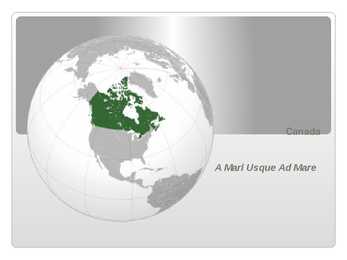
Fifth level Ottawa Capital 45°24N 75°40W / 45.4°N 75.667°W / 45 Largest city Toronto Capital, Largest City Since the end of the last glacial period, Canada has consisted of eight distinct forest regions, including extensive boreal forest on the Canadian Shield Canada has more lakes than any other country, containing much of the world's fresh water Geography There are also freshwater glaciers in the Canadian Rockies and the Coast Mountains Canada is geologically active, having many earthquakes and potentially active volcanoes, notably Mount Meager, Mount Garibaldi, Mount Cayley, and the Mount Edziza volcanic complex The volcanic eruption of the Tseax Cone in 1775 was among Canada's worst natural disasters, killing 2,000 Nisga'a people and destroying their village in the Nass River valley of northern British Columbia
It borders in the south with The United States and it's surrounded in the west by the Pacific Ocean, in the east by the Atlantic Ocean and above by many smaller bays, but is also borderedd with Alaska in the north-west. To the north of Canada is the broad Canadian Shield, an area of rock scoured clean by the last ice age, thinly soiled, rich in minerals, and dotted with lakes and rivers. Canada by far has more lakes than any other country and has a large amount of the world's freshwater. You can see more lakes in the south eastern part, on the U.S.A's border, including the famous waterfall Niagara Falls. The eastern areas of Canada are occupied by the Saint Lowrence Lowlands. The Saint Lawrence River widens into the world's largest estuary before flowing into the Gulf of Saint Lawrence. In northwestern Canada, the Mackenzie River flows from the Great Slave Lake to the Arctic Ocean. Northern Canadian vegetation tapers from coniferous forests to tundra and
During the war Estonia was occupied b yNazi Germany in 1941, then reoccupied by the Soviet Union in 1944. Estonia regained independence in 1991 after the collapse of the USSR and joined the European Union in 2004. Rivers, Lakes, Waterfalls Estonia is a country of thousand of lakes. In the Estonian territory there are about 1200 natural lakes whose water area exceeds 1 ha. The largest of these is Lake Peipsi, which is the fourth largest freshwater lake in Europe. Most of Estonia's lakes are small and are found in the south of the country. Larger lakes such as Lake Peipsi and Lake Võrtsjärv are rich in fish. One can find rare species of fish such as the lake whitefish and the Peipsi smelt in Lake Peipsi. Võrtsjärv is famous for its catches of pike-perch and eel, which are regarded as a delicacy. There are also many rivers in Estonia, but only ten of them are longer than 100 kilometres
you can come across types of primeval forest cover, which have long ago disappeared from other parts of Europe. Examples of such primeval forests are the Järvselja forest in Tartumaa County and Poruni in Ida- Virumaa County. Meadows in Estonia are rich in different species much more so than in Western Europe. Estonia is a country of thousand of lakes. In the Estonian territory there are about 1200 natural lakes. The largest of these is Lake Peipsi, which is the fourth largest freshwater lake in Europe. Most of Estonia's lakes are small and are found in the south of the country. Larger lakes such as Lake Peipsi and Lake Võrtsjärv are rich in fish. One can find rare species of fish such as the lake whitefish and the Peipsi smelt in Lake Peipsi. Võrtsjärv is famous for its catches of pike-perch and eel, which are regarded as a delicacy. There are also many rivers in Estonia, but only ten of them are longer than 100 kilometres.
river spanning 7 countries provides an estimate of the abundance of the two species, and essential information on the most serious threats they face, the current state of their habitats and potential conservation strategies. Communications director for WWF Colombia Julio Mario Fernández said one early conclusion scientists could draw was that river dolphins in the Amazon were doing better than those in the Orinoco. "This is the first phase of a wider programme to preserve freshwater cetaceans in these areas," he added. Fresh water dolphins are among the most threatened aquatic mammals in the world. The situation is most dire in Asia, where the Yangtze river dolphin is probably extinct and the Indus river dolphin faces a high risk of becoming extinct. Fernández said it was essential to act now before South America's dolphins go the same way. The pink river dolphin, or boto, is already classified as vulnerable by the IUCN's Red List of Threatened Species
osades. Valgusmikroskoop Mikroskoop on suurendusvahend, millega saab uurida väga õhukesi objekte, mis lasevad valgust läbi. Mikroskoobi kõige tähtsamad osad on objektiiv ja okulaar, milles asuvad suurendavad läätsed. Kujutise teravustamiseks tuleb kasutada makromeetrilist ja mikromeetrilist kruvi. Valgust eseme vaatlemiseks juhitakse peegli abil. 6 Name: Robert Hooke Born: 18-Jul-1635 Birthplace: Freshwater, Isle of Wight, England Died: 3-Mar-1703 Location of death: London, England Cause of death: unspecified Gender: Male Race or Ethnicity: White Sexual orientation: Straight Occupation: Scientist Nationality: England Executive summary: Law of Elasticity, microscopist 7 Kokkuvõte Robert Hooke ehitas mikroskoobi, et uurida mitmesuguste füüsikaliste kehade ehitust, mida pold silmaga näha. Kõige huvitavam oli korgitamme koor
Fishery resources Capture fisheries resources are highly diverse. FAO landing statistics refer to about 2 500 species or group of species most of which are finfish. By far the most numerous fish species, and those most important to aquaculture and fisheries, are teleosts, or bony fish, which in the sea extend from small "grazing" species such as anchovy to large active predatory fish such as tuna. A similarly wide range is also found in freshwater, with the most important species from a production point of view belonging to the carp family. These account for over half the total of inland waters fisheries production. Marine capture fisheries resources are usually considered close to full exploitation worldwide with about half of them fully exploited, one quarter over exploited, depleted or recovering from depletion and one quarter only with some capacity to produce more than they presently do
10 Kasutatud kirjandus 1. Paaver, T., Kasesula J., Gross, R., Puhk, M., Tohvert, T., Liiv, A., Aid, M. Kalakasvatus ja kalade tervishoid, 2006, Tartu, lk 77-80 2. Pihu, E. & Turovski, A. Eesti mageveekalad: Tallinn: Kalastaja raamat. 2001, lk 91-93 3. Spanovskaja, V. Kalad. Loomade elu, 4. kd. Tallinn: Valgus. 1979, lk 148-151 4. Kottelat, M. & Freyhof, J. Handbook of European Freshwater Fishes.Kottelat, Cornol, Switzerland and Freyhof, 2007, lk 342 Interneti aadressid: 1. http://et.wikipedia.org/wiki/Haug 2. http://bio.edu.ee/loomad/Kalad/ESOLUC2.htm 11
18. What was Shakespeare famous for? Plays, poems. Shakespeare influenced the English language greatly, he introduced more than 2000 new words ,making it more colourful and expressive. He helped develop the style and structure of the language. 19. What is the official name of Britain? The United Kingdom of Great Britain and Northern Ireland. Largest lake- lough Neagh- Also the largest freshwater lake in the British Isles 20. How did the Normans influence Britain? Added vocabulary from French . Impressive castles, introduced the bow into the English army, 21. Name some countries where English is used as the second language.- India, Nigeria, Philippines 22. What language was used by Romans and Normans? Romans- latin; Normans- French 23. Describe Scotland.- Scotland is a mountainous country in the north of the island of Great Britain, Scotland is Famous
of Great Britain and Norther Ireland. The UK is situated north-west of the European continent between the Atlantic Ocean and the North Sea. The UK consists of England, Wales, Scotland and Northern Ireland. Its highest point is Ben Nevis in Scotland followed by Snowdon in Wales. The Severn is the longest river in the United Kingdom. Other important rivers are the Trent, the Mersey, the Tyne, etc. Lough Neagh which lies in the centre of Northern Ireland is thr UK's largest freshwater lake. The climate in the UK is variable. The weather changes so frequently that it is difficult to forecast. It is not unusual for people to complain that the weathermen were wrong. Fortunately there is no extreme weather conditions, it is never very cold or very hot. The first inhabitants were Iberians and Celts who settled on the land and were often at war with each other. In AD 43 the Roman Emperor Claudius invaded, and made Britain a Roman province
/1/ Birds of paradise continue to be smuggled out of Papua Province, Indonesia. The trade in the birds adds to the pressure they already get from continued hunting and the destruction of their habitat by logging, road construction and conversion for human use. Although banned by the Indonesian government since 1990, trading in the feathers of the birds of paradise is still ongoing./5/ Vital waterways for people and wildlife Home to crocodiles, freshwater sharks, barramundi and hundreds of other fish species, the rivers of New Guinea rival terrestrial ecosystems in terms of complexity and diversity. They are also integral parts of forest ecology. River systems form extensive floodplains at lower altitudes, arising from networks of progressively smaller rivers and streams originating in the highlands. /2/ 10 References 1. http://www.iexplore.com/dmap/Papua+New+Guinea/Overview 2
8. Hydrofore (BESI Armaturen 300l) 9. Standby lub. Oil pump ME (Behrens Pumpen Type: ZB IV/b) 9 10. Hydrofor pump x 2pc. (Behrens Pumpen Type: VKO 112 WW) 11. Preheater ME (V16-2P-L; 27 kW) 12. Solenoid valve unit (BESI Armaturen) 13. LT circulation pump (Behrens Pumpen Type: VNF 2/325) 14. Standby FW pump HT (Behrens Pumpen Type: VNF 2/325) 15. Preheating circulation pump (CR-4-20F) 16. Sewage treatment plant (DVZ- M50-20) 17. Freshwater generator (Alfa Laval Type: JWP-16-C40) 18. Sewage pimp- Freshwater generator (CNL 40-40/200) 19. MDO Separator (FOPX 605 TFD- 24/50) 20. GO Separator (FOPX 605 TFD- 24/50) 21. Lub.Oil Separator (LOPX 705 SFD-34/50) 22. Feed pump for MDO purifier (ACP-025L) 23. Feed pump for GO purifier (ACP-025L) 24. Spindle pump for L.O separator (ACP-025L) 25. Heater MDO Separator (HEATPAC EHS 62) 26. Heater GO Separator (HEATPAC EHS 62) 27. Heater L.O separator (HEATPAC EHS 62) 28
In the north The Gulf of Finland separates Estonia from Finland. The Gulf of Riga is situated to the south-west. Estonia has more than 1500 islands. The biggest ones are located to the west. The four biggest islands are Saaremaa, Hiiumaa, Vormsi and Muhu. The highest point in Estonia and also in the Baltic region is Suur Munamägi. It is 318. above sea level. Estonia is a country of a thousand lakes. The Largest one is Lake Peipsi which is also the fourth biggest freshwater lake in Europe. Lake Peipsi and Lake Võrtsjärv are rich in fish. Estonia has many rivers but only nine of them are longer than 100km. The most important ones are Pärnu River and Emajõgi River Climate Estonia lies in the northern part of the temperate climate zone and in the transition zone between maritime and continental climate. Because Estonia is continuously warmed by the Gulf Stream it has a milder climate despite its northern latitude. Northern latitude means long
At the heart of the continent is Uluru (named Ayers Rock by the colonial settlers), a monolith of great spiritual significance. This great rock reaches 348 metres tall and measures nine kilometres at its base. Take a guided walk around Uluru or visit the Aboriginal Cultural Centre to find out more about the history of the area. Sydney Sydney is well known for its seafood including Balmain Bugs (a small local freshwater lobster creature), Crayfish from Tasmania, Barramundi (large white meaty fish) and John Dory (smaller white fish). There are also specialties from other areas such as Queensland Mud Crab, and Coral Trout from the Great Barrier Reef, and Ocean Salmon and Trout. Known for its famed opera house and harbor, Sydney also boasts an incredible bridge, great parks, delicious food, lots of free stuff to do, and amazing surfing. Whether you go to Manly Beach or hang out with
About half of Australia's 230 mammal species are marsupials. As well as meateating Tasmanian devils, possums, bandicoots and ofcourse kangaroos, wombats and koalas. The largest meateating marsupial Tasmanian Tiger is probably extinct. Most of Australian native animals move around at night. But the birds which are very colourful are easy to see. There are about 750 species ofbirds in Australia. Two types of crocodiles, the saltwater crocodile and the freshwater crocodile can be found in the north. The dingo or the native dog is not really an Australian native. It has brought from Asia around 3500 years ago. The dingo is an efficient sheep hunter. To protect sheep the dog fence was built in 1964. Climate Australia is the driest continent in the world except Antarctica. It has very low average rainfalls. About 70 per cent of the country is arid or semiarid and cannot support agriculture. The north part of the countrygets about 300
(the national animal), Gray Wolf, elk and reindeer. Other common mammals include the Red Fox, Red Squirrel, and Mountain Hare. Some rare and exotic species include the flying squirrel, Saimaa Ringed Seal and the Arctic fox, which is considered the most endangered. The Whooper Swan, the national bird of Finland, is a large Northern Hemisphere swan. The most common breeding birds are the Willow Warbler, Chaffinch and Redwing. Of some seventy species of freshwater fish, the northern pike, perch and others are plentiful. Salmon remains the favorite of fly rod enthusiasts. The endangered Saimaa Ringed Seal, one of only three lake seal species in the world, exists only in the Saimaa lake system of southeastern Finland, down to only 300 seals today. It has become the emblem of the Finnish Association for Nature Conservation. Due to hunting and persecution in history, many animals such as the Golden Eagle, Brown
The Scottish flag has a white cross on a blue background. It is also on the Union Jack. Northern Ireland is the smallest part of the UK as it only covers about 5500 square kilometres. About half of the 1.7 million inhabitants live in or around Belfast, the capital, in the eastern coastal region. The centrepiece of Northern Ireland's geography is Lough Neagh, at 151 square miles (392 km²) the largest freshwater lake both on the island of Ireland and in the British Isles, and the third largest lake in Western Europe. A second extensive lake system is centred on Lower and Upper Lough Erne in Fermanagh. Northern Ireland don't have an official flag any more nor a coat of arms. Due to the division of the population along ethnic, religious and political lines, a wide variety of flags can be seen flying from lampposts and private houses across Northern Ireland. Government
mountain massifs such as the Cairngorms and Skye Cuillins. A significant exception to the above are the fossil-bearing beds of Old Red Sandstones found principally along the Moray Firth coast. The Highlands are generally mountainous and the highest elevations in the British Isles are found here. Scotland has over 790 islands, divided into four main groups: Shetland, Orkney, and the Inner Hebrides and Outer Hebrides. There are numerous bodies of freshwater including Loch Lomond and Loch Ness. Some parts of the coastline consist of machair, a low lying dune pasture land. Highlands and Islands lie to the north and west of the Highland Boundary Fault, which runs from Arran to Stonehaven. This part of Scotland largely Scotland within the UK A policy of devolution had been advocated by the three main UK parties with varying enthusiasm during recent history
The largest of them are Saaremaa, Hiiumaa, Muhu and Vormsi. There are over 1,400 lakes in Estonia, biggest being Lake Peipsi and Lake Võrtsjärv, while the deepest is Rõuge Suurjärv. The two longest rivers are the Võhandu and the Pärnu and the widest is Emajõgi. About 50% of the country is covered by forests while wetlands cover 30%. The landscape of Estonia, through covering a small area, is varied and unique. Lake Peipsi is Estonia's largest lake and Europe's fourth largest freshwater lake. 5. Symbols The flag The Estonian blue-black and white national flag was originally the flag of the Estonian Students' Society and was consecrated in Otepää Church in 1884. Today there is a memorial plaque on the church wall commemorating the event. The Flag Museum, opened in an annex in 1996, attracts tourists who take an interest in the history of the flag. After about half a century, during which it was
, Yuan, Q., & Yang, Q.-E. (2016). Karyology of Aconitum subgenus Lycoctonum (Ranunculaceae) from China, with a report of the new base chromosome number x = 6 in the genus Aconitum. Nordic Journal of Botany, 34(4), 441454. http://doi.org/10.1111/njb.00957 Kapusci Nski, K. L., Farrell, J. M., Stehman, S. V, Boyer, G. L., Nilo, D., Fernand O, D., ... Kapuscinski, K. L. (2014). Selective herbivory by an invasive cyprinid, the rudd Scardinius erythrophthalmus. Freshwater Biology, 59, 23152327. http://doi.org/10.1111/fwb.12433 12 Kellmann-Sopyla, W., & Gielwanowska, I. (2015). Germination capacity of five polar Caryophyllaceae and Poaceae species under different temperature conditions. Polar Biology, 38(10), 17531765. http://doi.org/10.1007/s00300-015-1740-x Kim, C., Na, H. R., Shin, H., & Choi, H.-K. (2009). Systematic Evaluation of Isoëtes
Today Australian marsupials are dying out. Dogs, cats, and rabbits brought to Australia by men are rapidly destroying the gentler marsupials. Some day there may be nothing left of the ancient animals. Australia has around 800 species of birds, 400 of which are unique to this country. There are 55 species of parrots in Australia, and the birds are as numerous as they are colourful. Two types of crocodile, the saltwater and the freshwater crocodile are found in the north. The dingo, or native dog is not really an Australian native. It was bought from Asia around 4000 years ago. The dingo is an effective hunter. To save their sheep from dingo attacks, farmers built many fences to keep the dingo out. These fences didn't work so in 1946 the government built a single fence which stretched 5400 km from Great Australian Bight in South Australia to near the Queensland coast. The single fence worked better.
About half of Australia’s 230 mammal species are marsupials. As well as the meat-eating Tasmanian devil, possums, bandicoots and of course kangaroos, wombats and koalas. The large meat eating marsupial, the Tasmanian tiger is probably extinct. Most of Australian native animals move around at night. But the birds which are very colourful are easy to see. There are about 750 species of birds in Australia. Two types of crocodiles, the saltwater and the freshwater crocodile can be found in the north. The dingo or the native dog is not really an Australian native. It was brought from Asia around 3500 years ago. The dingo is an efficient sheep hunter. To protect sheep The Dog fence was built in 1946. Population About 20, 2 million people live in Australia. Mainly they live on in the eastern and southeastern part of the country, because the middle part of the country is mainly plains and deserts
8. Mille alusel eristatakse bioome? Bioom ehk makroökosüsteem on geograafiliselt piiritletav ala mingi taimkatte- ja ühtlasi ka kliimavööndi piires. Biomes are climatically and geographically defined as similar climatic conditions on the Earth, such as communities of plants, animals, and soil organisms,[1] and are often referred to as ecosystems. A fundamental classification of biomes is: 1. Terrestrial (land) biomes 2. Aquatic biomes (including Freshwater biomes and Marine biomes) Biomes are often known in English by local names. For example, a temperate grassland or shrubland biome is known commonly as steppe in central Asia, prairie inNorth America, and pampas in South America. Tropical grasslands are known assavanna in Australia, whereas in Southern Africa it is known as veldt (fromAfrikaans). 9. Mis on ökotüüp? Ökotüüp e ökoloogiline rass sarnaselt kohastunud organismid ühe liigi piires (nt lillakas turbasammal)
preservation, and in photographic film production. Formaldehyde is combined with methanol and buffers to make embalming fluid. Formaldehyde is also used in many hospitals and laboratories to preserve tissue specimens. Physical-chemical date: CAS number: 50-00-0 IUPAC name: Methanal Structure formula: HCHO Physical characteristics: Colorless gas (normal.), Odor: Pungent, suffocating odor; highly irritating , Density: 0.815 g/mL (8153 g/cm³ (20°C) ) Molar mass 30.03 g mol-1 s, Solubility: Freshwater at 20°C Very soluble; up to 55% Partition coefficients: Log Pow=0.35 (25°C), Log Koc= 1.567 Melting and boiling point: Tm=-92°C,Tb=-19°C Autoignition temperature: 300 °C Henry's law constant at 25°C H: 0,034 Pa*m3/mol TOXICOKINETICS The toxicokinetics of formaldehyde after inhalation, oral, or dermal exposure has been reported in several species by many investigators. The toxicokinetics in all of the animals studied is similar across species lines
congregate along the Iberian Peninsula since it is the closest stopover between northern Europe and Africa. Six hundred bird species occur in Portugal (either for nesting or during the course of migration), and annually there are new registries of nesting species. The archipelagos of the Azores and Madeira are transient stopover for American, European, and African birds, while continental Portugal mostly encounters European and African bird species. There are over 100 varieties of freshwater fish species, varying from the giant European catfish (in the Tagus International Natural Park) to some small and endemic species that live only in small lakes (along the western lakes for example). Some of these rare and specific species are highly endangered because of habitat loss, pollution and drought. Upwelling along the west coast of Portugal makes the sea extremely rich in nutrients and diverse species of marine fish; the Portuguese marine waters are one of the richest in the world
, Ronald, K. 1974. In Vitro Development of the Nematode Contracaecum osculatum Rudolphi 1802 (Nematoda: Anisakinae) Can. J. Zool. 52 (7), 847-855 Mikelsaar, N. 1950. Lest Balti Mere Kirde Osas. Vsesojuznõi nauchno issledovatelskii institut morskovo rõbnovo hozjaistva i okeanografii. Mikelsaar, N. 1957. Lesta Sigimisbioloogiast Läänemere Idaosas. ENSV TA Toimetised. 3, 255-265 Mikelsaar, N. 1984. Eesti NSV Kalad. Valgus, Tallinn. Moravec, F. 1994. Parasitic Nematodes of Freshwater Fishes of Europe. Kluwer Acad. Publishers, Doldrecht. Möller, H. 1974. Untersuchungen über die Parasiten der Flunder (Platichthys flesus L.) in der Kieler Förde. Ber. dt. wiss. Kommn Meeresforsch. 23: 136-149 Nicholas, W.L. 1973. The biology of the Acanthocephala. Adv. Parasitol. II, 671- 710 Nikol, B.B. 1985. Epizootiology. In Biology of the Acanthocephala. (toim. Crompton, D.W.T & Nickol, B.B.). Cambridge University Press, Cambridge, 307- 346 Noga, E.J. 2000
People with liver damage and hemolyze human blood. Environmental with immunocompromised conditions should strains are negative for this test. The organ- definitely avoid eating raw seafood. There ism is distributed in fish and shellfish from was one outbreak with two cases and one seawater as well as from freshwater. Most of death reported in the United States in 1990. the outbreaks are recorded in the summer There was no report of an outbreak of this months when the water is warm in the organism in 2002. Northern Hemisphere. Symptoms of the disease occur about 12 hours after ingestion Bacillus cereus
 annaabi.ee