Leidsid 33 sarnast õppematerjali, mis on seotud failiga "Filosoofid, kes räägivad teadusest". Need materjalid aitavad sul teemat sügavamalt mõista.
cause, thing, nature, there, move, other, effect, things, even, science, know, experience, between, once, observation, another, connection, power, first, final, false, hume, follow, able, causes, ways, change, method, same, object, never, before, sent, rule, perception, philosophy, aristotle, movement, terms, happen, something, argues, deductionWhat is the real meaning of life? Why prefer one thing to another? Can we trust observation? It’s raining outside - how do you know it is? I can see it’s raining. How to convince yourself its raining? A good reason to doubt - 49 other peaople have the same opinion. Falsifiable → possible; not falsified World disappeared in 2012 and got recreated 3 secs later → unfalsifiable - cannot prove it’s true/wrong, cannot provide any tests to prove it. Or - one or another but not both → exclusive - one or another (both) → inclusive (Invited those who are managers or specialists - both) Arguments valid or not - logic is a science where to decide it
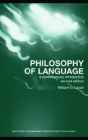
philosophy rather than to convince students of a single position. Classical Philosophy Philosophy of Mind Christopher Shields Second Edition John Heil Epistemology Second Edition Philosophy of Religion Robert Audi Keith E. Yandell Ethics Philosophy of Science Harry Gensler Alex Rosenberg Metaphysics Social and Political Second Edition Philosophy Michael J. Loux John Christman Philosophy of Art Philosophy of Psychology Noël Carroll José Bermudez Philosophy of Language Classical Modern Second Edition Philosophy William G
1 The Medium Is the Message In a culture like ours, long accustomed to splitting and dividing all things as a means of control, it is sometimes a bit of a shock to be reminded that, in operational and practical fact,, the medium is the message. This is merely to say that the personal and social consequences of any medium-that is, of any extension of ourselves-result from the new scale that is introduced into our affairs by each extension of ourselves, or by any new technology. Thus, with automation, for example, the new patterns of human association tend to eliminate jobs, it is true
Innate idea. If God is God, he should be perfect. 9. How does Descartes prove the existence of God? The fact that I have an idea of God implies its existence. Also unicorns 10. Why God's truthfulness is important for Descartes? If God is the truth, and he created our minds, we can trust that our minds are good means to reach the truth. 11. According to Descartes, by what elements is man constituted and how are they connected? Human beings are formed by the union of a res cogitans (thinking thing - mind/soul) and a res extensa (an extended thing - material substance), that are united in the pineal gland. 12. What is the main problem of Descartes philosophy? Dualism. Idea- Things; soul-body c. Hume 13. What is the problem that Hume is trying to solve? What answer he gives to this problem? Can we be certain about anything? He wants to show that this pretension is absolutely false. 14. What is Empiricism? 15. What is Skepticism? Skepticism is generally any questioning attitude
PSYCHOLOGY PART 1: CORE Biological level of analysis Outline principles that define the biological level of analysis. 1) Behavior can be innate, because it is genetically based. Evolution may play a key role in behavior. 2) Animals may be studied as a means of understanding human behavior. 3) There are biological correlates of behavior. Cognitions, emotions and behaviors are products of the anatomy and physiology of our nervous and endocrine system. Explain how principles of the biological level of analysis may be demonstrated in research. 1) Correlational studies: Study by Buss, who hypothesized that across cultures, men will prefer to marry younger women because of greater reproductive capacity and women will place greater value on a potential mate's earning
..............................................................18 Chapter Two Ego: The Current State of Humanity – 19 The Illusory Self......................................................................................20 The Voice in the Head.............................................................................22 Content and Structure of the Ego.............................................................24 Identification with Things........................................................................25 The Lost Ring...........................................................................................26 The Illusion of Ownership........................................................................29 Wanting: The Need for More....................................................................31 Identification with the Body.....................................................................33 Feeling the Inner Body
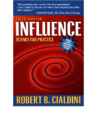
do it, enabled us to make significant changes. His work has enabled us to gain significant competitive differentiation and advantage" -LAURENCE HOF, Vice President, Relationship Consulting, Advanta Corporation "This will help executives make better decisions and use their influence wisely ... Robert Cialdini has had a greater impact on my thinking on this topic than any other scientist." -CHARLES T. MUNGER, Vice Chairman, Berkshire Hathaway, Inc. If you're wondering why of Latin America, the Far East, and Central Europe. you should buy this new edition of Influence: o More neuroscience evidence of how the influence process works is inte-
another way, such as in hearing. It is also possible to be so ultra-sensitive that the result is disadvantageous. I expect no argument in asserting that a normal sensitivity is a healthy, indispensable ingredient for optimal education. Sensitivity can be heightened or blunted by education. It is intertwined with curiosity. An ideal education affords numerous and varied opportunities for students to touch, see, smell, listen, hear; to spark their curiosity. When I was a child the things that pleased me were largely other than the plants which have earned me a living as an adult. For example, I collected postage stamps, played basketball, was fond of listening to music, played all manner of games, but dealt only in a neutral, uninspired fashion with plants. The one thing that was constant and of supreme importance was my love of reading. I don't recall why, but by an early age, say age 9, I was a phenomenal reader of books, a habit that persisted all the way until college.
The making of a new nation. The Enlightenment in America. The emergence of the notion of the American Dream. The great Enlighteners: Crèvecoeur, Jefferson, Paine, Franklin. The American Enlightenment is the intellectual thriving period in the United States in the midtolate 18th century (17151789), especially as it relates to American Revolution on the one hand and the European Enlightenment on the other. Influenced by the scientific revolution of the 17th century and the humanist period during the Renaissance, the Enlightenment took scientific reasoning and applied it to human nature, society, and religion. American Enlightenment a gradual but powerful awakening that established the ideals of democracy, liberty, and religious tolerance in the people of America.
3. All stereotypes are true; the fact that you recognize a slur proves that it isn't. 4. Anything you're afraid is true is true. 5. Before most people get to the point of being able to tell their ass from a hole in the ground they're already assholes and it's too late. 6. Concentrating on something important can make you lose track of your soap opera. 7. Debunking the bunk is everyone's responsibility. 8. Don't ask me to pay for anyone else's mistakes. I make enough of my own. 9. Even those who possess real magic must beware of being misled by "magical thinking." 10. Everyone knows what shit tastes like. 11. Exclusive occupancy of a private room is a basic human right. 12. Fair compensation for genius is wealth. 13. God's not perfect, so it's a pretty good bet that you're not, either. 14. Good institutions help to overcome human moral inertia. 15. I am not one of your little friends. 16. If a dimension is anywhere it's everywhere. 17. If God's not crazy, why are you? 18
Ameerika Kirjandus 30.01.13 Naturalism · France, Emile Zola · Put down his theory in 1879: Le Roman Experimental, attempt to explain the development of human society throuch biological laws · Outlook is deterministic, pessimistic, fatalistic (fate or biology) · Man as an animal-clever than other beasts, still explainable within the framework · Man is not a free agent, is govern by something · Unable to determine his own faith · Hereditary · Naturalists tried to apply in fiction the processes of natural sciences · Writers task is to record facts, systems of behaviour, living conditions, never revealing any natural unbiased (completely natural) · Point of view: amoral-outside the category of morality, neither good or bad
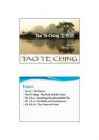
Tim Chiu April 4th , 2009 Topics y Lao Zi The Person y Tao Te Ching The Book and the Name y Ch. 1 & 14 Describing the indescribable Tao y Ch. 2 & 11 On duality and Formlessness y Ch. 8 & 78 The Virtues of Water Lao Zi The Person y Real name was Lee Er, who was a highly regarded philosopher of his time y Keen observer of the virtues of Nature and the relationship between man and his environment y Realized the existence of a formless and indescribable origin: Tao y Can not thoroughly analyzed by our thoughts and logic y Its existence gave rise to everything and pervades all that we know y The manifestation of Tao in humans is called our True Nature y Purity and innocence of a child y Spring and Autumn, Warring States Era of the Chou dynasty (~500BC), during a time of turmoil and spiritual disintegration
- Greeks are pirates, they steal- high technology - Bad tempered people Men's progress towards freedom. (Hegel) Persia is under emperor Xerxes- slaves, fighting for Xerxes and their country, but it does not mean anything to them Greece cities- Patriotism, they are fighting for their freedom and for their country, you can quit, because you volunteered, individuality. o Zeus (son of Chronos Time and Gaia Earth) · Moira- Fate, An underlying order which not even the Gods can alter · Transmigration of Souls- souls leave the bodies · Psyche- the mind · Morality and psychology might be important Miletus Underlying principle of the universe- H20 Milesian or Ionian School · Thales circa 624-546 BC - "All things come from water into water all things are resolved" - Nietzsche claimed that he deserved to be considered the first philosopher because he argued:
celebrating Africa’s coming of age, as more and more African countries received their independence either from Britain or France. It was especially a poignant time for Africa, as then British Prime Minister Harold McMillan articulated his now famous “winds of change” sweeping Africa. We had high hopes for Africa, for the Black race, that the insidious imposition of foreign rule on us, the looting of Africa’s natural resources by our colonial masters accorded us would be things of history. That is more than forty years ago. Unfortunately, the promise of independence has not been fulfilled. Today, Africa has become more desolate; there is more starvation, diseases and non-provision of essential services than when we got our independence. There are all kinds of wars in Africa than the rest of world put together. The majority of so-called Africans leaders want to stay in power until the day their bodies are put in the grave
today. He is, in addition, acid, disagreeable, unpleasant, and we can catalogue these characteristics like the most appreciated by its followers. Larkin gives us through his poetry, a vision of middle-aged conservative, that in a politically incorrect way in our days, does not stand children, detests the life in family, he does not believe in anything and he does not wait anything of the life. He scorns the “literary life” and also the things that normally soften everybody: the romantic love, the memories of the childhood, the nature, etc. Keywords: Larkin, poetry, cruelty, suffering, nature Index Introduction 4 1. Chapter I 5 1.1. Larkin Studies Points of View: Biography and Poetry 5 1.2. Larkin Stylistic Map 8 2
"I am become death, the destroyer of worlds." So said the physicist Robert Oppenheimer, who helped to invent the atomic bomb. The two bombs dropped on Hiroshima and Nagasaki in 1945 killed around 200,000 Japanese people. No other species has ever wielded such power, and no species could. The technology behind the atomic bomb only exists because of a cooperative hive mind: hundreds of scientists and engineers working together. The same unique intelligence and cooperation also underlies more positive advances, such as modern medicine. But is that all that defines us? In recent years, many traits once believed to be uniquely human, from morality to culture, have been found in the animal
I One of the most important developments in the western intellectual tradition was the Scientific Revolution. The Scientific Revolution was nothing less than a revolution in the way the individual perceives [ tajub ] the world. As such, this revolution was primarily an epistemological revolution it changed man's thought process. It was an intellectual revolution a revolution in human knowledge. Even more than Renaissance scholars who discovered man and Nature, the scientific revolutionaries attempted to understand and explain man and the natural world. Thinkers such as the Polish astronomer Nicholas Copernicus(14731543), the French philosopher René Descartes(15961650) and the British mathematician Isaac Newton(16421727) overturned the authority of the Middle Ages and the classical world. And by authority I am not referring
Silicon Valley Could you reproduce Silicon Valley elsewhere, or is there something unique about it? It wouldn't be surprising if it were hard to reproduce in other countries, because you couldn't reproduce it in most of the US either. What does it take to make a silicon valley even here? What it takes is the right people. If you could get the right ten thousand people to move from Silicon Valley to Buffalo, Buffalo would become Silicon Valley. That's a striking departure from the past. Up till a couple decades ago, geography was destiny for cities. All great cities were located on waterways, because cities made money by trade, and water was the only economical way to ship. Now you could make a great city anywhere, if you could get the right people to move there
1707 formation of the British Parliament Social Contract philosophy: The reasons for entering a social contract and the responsibilities of the goverment *Hobbes: To preserve one's safety *Locke: To preserve one's safety and property *Rosseau: To preserve one's safety, property and freedom, but to guarantee the latter, the goverment also has the responsoility of improving/educating the citizens. Laws are historical conventions, people can be forsed to be free. State of nature Hobes: state of nature is a state of conflict, a state of war. Locke: state of nature is peaceful, all men are equal. They treat others as themselves. Rousseau - people in the state of nature were neither good or bad. Man was like an animal not posessing any needs besides the primary ones. The bad habits of men are byproducts of ingaging in a civil society. All men are equal Sovereign Hobbes: can not be overthrown and can do whatever the fuck it wants. The best one is monarch.
1. What does the word “philosophy” mean? The study of proper behaviour and the search for wisdom, in greek means love for wisdom 2. Is philosophy a science? Why? What kind of science it is? Yes it is. It tries to understand the meaning of reality. It’s the science of truth. Science, as it exists today, happens within the framework of philosophy. Philosophy, however, is bigger than science. It is also a form of art and discipline…... 3. Name three characteristics of Classical philosophy? deeply rooted in religious traditions ; believes that inferior was created by superior ; more positive ; seeks the real truth ; about intelligence ; reaalsuse üle mõtisklus ; believes that god is truth 4. Name three characteristics of Modern philosophy. believes that superior was created by inferior (!) ; more negative ; about will ; power ; domain of reality ; believes that
Ishavasya Mantra 1 How living in harmony with it benefits. principle Mantra 3 How living in disharmony with it harms Scriptures don't say that we have to give up all happiness. We can enjoy even on material level, but how? We can enjoy our quota. OVERVIEW OF ISO MANTRA 1 PURPORT (P 1-2) Glory of Vedic knowledge (p 3-4) How the Lord is the proprietor of everything. (p 5) Eg of one's quota in nature. (p 6-8) Eg of one's quota in human possession if the earth. (p 9-10) Eg of quota in human diet. (p 11) Live according to Ishavasya. We focus primarily on Srila Prabhupada's purports, because we want to understand Srila Prabhupada's mood. GLORY OF VEDIC KNOWLEDGE (P 1-2)
combating terrorism and will present the reasons for why this controversial behaviour that democratic governments have been proven to conduct and still are being accused of until the current day is irrational and dangerous. Theoretical justification of torture The utilitarian view that a political leader should allow torture to rescue civilians’ lives is justified by that this would result in maximum happiness for the greatest number of people. It is said that in case of a moral dilemma there is never the possibility of 2 complete justification. Torture is illegal but if human lives can be saved, it is worth it. This disregards the act itself and only looks at the result (Driver, 2014). Hedonism supposes that a decision is ethically correct if the consequence brings maximal satisfaction to the individual. Eudemonism replaces the word satisfaction by happiness
A woman who would please her husband's eyes Alone, wants no such wealth of fineries. CLEANTE But, madam, after all . . . MADAME PERNELLE Sir, as for you, The lady's brother, I esteem you highly, Love and respect you. But, sir, all the same, If I were in my son's, her husband's, place, I'd urgently entreat you not to come Within our doors. You preach a way of living That decent people cannot tolerate. I'm rather frank with you; but that's my way-- I don't mince matters, when I mean a thing. DAMIS Mr. Tartuffe, your friend, is mighty lucky . . . MADAME PERNELLE He is a holy man, and must be heeded; I can't endure, with any show of patience, To hear a scatterbrains like you attack him. DAMIS What! Shall I let a bigot criticaster Come and usurp a tyrant's power here? And shall we never dare amuse ourselves Till this fine gentleman deigns to consent? DORINE If we must hark to him, and heed his maxims, There's not a thing we do but what's a crime;
An analysis of the problem of Political Power Written by: Katre Kikkas Introduction It is said that in the political philosophy there are only two questions: ,,Who can have what?" and ,,Who will decide over it?". It is not exactly like that but it is quite close to the trough, to begin with. The first question includes material amenity's, and dividing rights and liberties.(Wolff, 1996) What is power? It is ability to influence others to do something they otherwise would not. Also, others can be affected with threats and force. (Kilp, 2010) Political power includes also right to force the others and to punish them if
for a particular purpose. No warranty may be created or extended by sales representatives or written sales materials. The advice and strategies contained herein may not be suitable for your situation. The publisher is not engaged in rendering professional sevices, and you should consult with a professional where appropriate. Neither the publisher nor author shall be liable for any loss of profit or any other commercial damages, including but not limited to special, incidental, consequential, or other damages. For general information on our other products and services, please contact our Customer Care Department within the United States at (800) 762-2974, outside the United States at (317) 572-3993 or fax (317) 572-4002. Wiley also publishes its books in a variety of electronic formats. Some content that
5 (possible answers) she was my age and apart from the 1 1 go ahead 5 come to eighties hairstyle we're the spitting 1 Well, you will go to bed late every night. 2 fall through 6 bring about image of each other! Some people 2 Well, you will refuse to wear a 3 tip off 7 go down with say that they can see a strong family coat. 4 mistake for 8 come up with resemblance between my dad and me.
Chapter 21 Chapter 42 Chapter 1 It is a truth universally acknowledged, that a single man in possession of a good fortune, must be in want of a wife. However little known the feelings or views of such a man may be on his first entering a neighbourhood, this truth is so well fixed in the minds of the surrounding families, that he is considered the rightful property of some one or other of their daughters. "My dear Mr. Bennet," said his lady to him one day, "have you heard that Netherfield Park is let at last?" Mr. Bennet replied that he had not. "But it is," returned she; "for Mrs. Long has just been here, and she told me all about it." Mr. Bennet made no answer. "Do you not want to know who has taken it?" cried his wife impatiently. "You want to tell me, and I have no objection to hearing it." This was invitation enough. "Why, my dear, you must know, Mrs
PIL regulates relations between states. Thats why PIL is important for international relation students. PIL influences the life of everybody, it doesn't regulate people directly but indirectly (through the decisions of the states), because it's everywhere. It's like air. E.g. when you want to send a letter to Brazil, you put a stamp from your own country and send it from your post office and the letter gets delivered. Why is this so easy, because there are certain international conventions that regulate postal services. E.g. traffic signs are almost the same everywhere, why? Because of certain int conventions that require the states to have more or less unified traffic signs. States apply international regulations to national regulations and they have to be in accordance with each other, the states can always specify these regulations. Therefore, PIL regulates people indirectly.
Sõprus 1. Aristoteles sõpruse olemusest ning tüüpidest Sõprus ja armastus pole selgelt eristatud philia. Sõprus iseloomustab vabal kiindumusel põhinevaid inimsuhteid perekondlikud, võimulolijate suhted kodanikesse, kodanike omavahelised suhted. Sõprus hoiab riike koos. Eeldab vastastikku heasoovlikkust ja ühistegevust. Sõprus jaguneb 2 viisil 3-ks: Vastavalt põhjusele, miks head soovitakse: Kasu äri Nauding sõbrad Täiuslik sõprus loomutäiuselt sarnaste inimeste vahel Vastavalt osapoolte seisundile: Ülimuslikkus vanemad laste suhtes Paremus mehed naiste suhtes Võrdsus vennad Täielikku sõprust naudivad üksikud, sest nad suudavad arendada omavahel loomutäiust täiuslikkuseni. Linnriik põhineb sõprusel, kiindumusel põhinevatel inimestevahelistel suhetel. Timokraatia (varanduslikel klassidel rajanev poliitiline süsteem) põhineb võrdsusel vennalikel suhetel. 2. Cicero isiklikust ja po
g. law of gravity Prescriptive law – prescribe how people ought to behave e.g. speed limits In all societies relations between people are regulated by prescriptive law; customs (informal rules of social and moral behaviour); rules we accept if we belong to a particular institution (religion, organization); laws imposed on people by a government Penalties for breaking the rules are different. For not following the customs there may not be a punishment, or a person may be criticized by the society; rules of a social institution tend to carry precise penalties but they are not enforceable by any political authority; however governments use a system of courts backed by the power of the police to enforce the laws they have made. The relations between people are regulated by a combination of all these rules. One of the ways to classify laws is to separate them into prescriprive and descriptive law.
Source: Feedbooks 1 About Shakespeare: William Shakespeare (baptised 26 April 1564 – died 23 April 1616) was an English poet and playwright, widely regarded as the greatest writer in the English language and the world's pre-eminent dramatist. He is often called England's national poet and the "Bard of Avon" (or simply "The Bard"). His surviv- ing works consist of 38 plays, 154 sonnets, two long narrative poems, and several other poems. His plays have been trans- lated into every major living language, and are performed more often than those of any other playwright. Shakespeare was born and raised in Stratford-upon-Avon. At the age of 18 he married Anne Hathaway, who bore him three children: Susanna, and twins Hamnet and Judith. Between 1585 and 1592 he began a successful career in London as an actor, writer, and part owner of the playing company the Lord Chamberlain's Men, later known as the King's Men. He ap-
However, it was recorded for the first time much earlier in 1882, meaning "the study of literary style, the study of stylistic features" (Oxford Dictionary). Stylist is a writer / speaker skilled in a literary style (e.g. Hemingway is considered a peculiar stylist used a lot of repetitions). Stylistician is a scholar (a student). Style is applied to many things: clothing, architecture, hairstyles, etc. A linguistic style (style in language) is a variety of subsystems of language with its peculiar vocabulary, phraseology, grammatical and phonetic features that are used selectively to express ideas in a given situation. Stylistics is a part of style; it studies principles of selecting and using different linguistic means (grammatical and phonetic) that serve to render shades of meaning. Stylistics studies
Why do we need morality? As an English philosopher Thomas Hobbes (1588-1679) said, all humans are made equal in mental and physical abilities. This does not mean that all of us are equally strong, smart or beautiful, but that everyone has the ability to damage or kill the other. The main goals, we all want to achieve, are having a shelter, security, power, wealth and enough food. This means that people are constantly competing with each other and that makes all of us (who desire the same things) enemies. Hobbes names the insecurity and fear people feel towards each other a "state of nature". In this state there are no moral rules or enforced laws, also no justice or injustice. People, being violent and arbitrary, will only follow their own interest. So without laws and boundaries, people would be in constant war - every man for himself. In this kind of society there is no time for cultural or industrial development.
 annaabi.ee