Leidsid 33 sarnast õppematerjali, mis on seotud failiga "Contitional sentences". Need materjalid aitavad sul teemat sügavamalt mõista.
rather, wish, present, conditional, clause, simple, bare, perfect, express, infinitive, conditionals, talk, tense, possible, real, verb, night, refer, fact, unreal, subject, acts, essay, tonight, could, situations, contrary, happen, suppose, though, following, sentences, than, come, action, afternoon, might, continuous, consequence, other, zero, such............................................................ 2 B. Unreal Conditionals ......................................................... 3 Linking words used in Conditionals ...................................... 4 Conditionals Conditions deal with imagined situations: some are possible, some are unlikely, some are impossible. A. Real Conditionals Real Conditionals refer to situations that are true, have happened, generally happen or are likely to happen. The First Conditional expresses a possible condition and a probable result: If I have time, I will help you. In the if-clause we use the Present Simple, in the main clause will + the verb. We can also use the Present Continuous or Perfect in the if-clause and a Modal Verb in the main clause. If we are having a party tomorrow, we shouldn’t go out tonight. If you have finished with the computer, you should turn it off. It can also be used in offers and suggestions, or warnings and threats.
INGLISE KEELE KORDAMINE TIME CLAUSES Present Simple · Permanent states, facts (Tom works..) · Repeated and habitual actions, routines (She usually goes..) · Laws of nature and general truths (The sun sets in the west) · Timetables and programmes · Sporting commentaries, rewiews (Beckham wins the ball, crosses and Owen scores) · Feelings and emotions (I love Tallinn..) TIME EXPRESSIONS USED WITH PRESENT SIMPLE: usually, often, always, every day/week etc, in the morning/evening
7. Verb: The principal forms of the verbs: Verbil on 4 põhivormi: Regular verb Irregular verb 1. the base form Talk Speak üldoleviku tüvivorm 2. the past form/ -ed form Talked Spoke üldmineviku vorm 3. the past participle (-ed Talked Spoken participle) mineviku kesksõna 4. the present participle (- Talking Speaking ing participle) oleviku kesksõna The tenses: Expressing the future: Simple Perfect Continuous Perfect Continuous Present Base Have / has + to be + base+ ing has/ have been +s + pariticiple base+ -ing
Future Forms Future Forms · 1) Future Simple will work · 2) Be going to am/is/are going to work · 3) Present Continuous am/is/are working · 4) Present Simple start(s) Future Forms · 5) Future Continuous will be working · 6) Future Perfect will have worked · 7) Future Perfect Continuous will have been working Future Simple · We do our morning exercises and think, "I think we will have a nice day " · Prediction (ennustused kõhutunde põhjal) · verbs think, believe, guess, expect, hope etc · expressions be sure, be afraid etc · adverbs probably, perhaps, certainly Future Simple · You see your little brother carrying a very heavy suitcase and you think, "I will help him carry the suitcase." · on-the-spot decision (hetkeotsused)
b) Gender: Gender is a grammatical classification of nouns, pronouns, or other words in the NP, according to certain meaning-related distinctions, especially a distinction related to the sex of the referent. Grammatical gender or overt gender of nouns: German: der Mann `the man' die Frau `the woman' das Kind `the child' der Tisch `the table' die Feder `the pen' das Buch `the book' English has no inflectionally-marked gender distinctions. Some 3 rd person pronouns and wh- pronouns express natural gender distinctions: it, which, etc. [NONPERSONAL] contrasts with the following: who, whom, [PERSONAL] he, himself [MASCULINE, chiefly PERSONAL] she, herself, etc. [FEMININE, chiefly PERSONAL] Gender in English nouns is `notional' or `covert' (cf. French, German, Russian). There is no grammatical gender in English. Male entities are referred to masculine pronouns - he; female - she; sexless - it. Some other remarks:
First Conditional: A real possibility in the future A First Conditional sentence is for future actions dependent on the result of another future action or event, where there is a reasonable possibility of the conditions for the action being satisfied. Formation: if + present simple, + will For example: If she gets good grades, she will go to university. We are talking about the future, but we use a present tense for the condition and will for the result. In this case, the person is sure about going to university. We can use other modal verbs in the result part of the sentence. For example: I Condition Result Possibility F she gets good she will go to If the condition is met, then she definitely If grades, university. will go he gets good he may go to
This is Jane Smith. I'm Jane Smith. My name's John Smith. Informal introduction Hi. John. Jane. Hello. Titles: Mr Mrs Miss Ms Ms is a modern form of address for women. It replaces the traditional forms of Mrs and Miss. Greetings Good morning/afternoon/evening! 'How are you?' Very often people expect you to say something positive. Here's a breakdown of how you can express how you really are without complaining too much. · Fine, thanks. / On top of the world, thanks. · OK, thanks · Not so bad, thanks. / Can't complain, thanks. · So so, thanks. / So and so, thanks. · Not so good, actually 1 The English alphabet Spelling Work with your partner and spell out first your name and then some
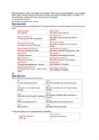
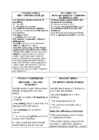
CONDITIONALS ZERO CONDITIONAL If you don't water flowers, they die. If you have a headache, stop watching TV. If clause: Main clause: PRESENT SIMPLE PRESENT SIMPLE or IMPERATIVE With zero conditional we express a general truth or we give advice. FIRST CONDITIONAL If the weather is nice, we will go for a walk. If you don't apologize, she will never trust you again. If clause: Main clause: PRESENT SIMPLE FUTURE SIMPLE The first conditional refers to the present and future. It expresses a possible condition and its probable result in the future. SECOND CONDITIONAL Jack wants to buy a house but he can't do this because he doesn't have any money. If I had a lo t o f m o ne y, I would buy a b ig h o us e . SECOND CONDITIONAL Susan wants to phone Paul but she can't do this
Golden Grammar rules 1. Don't use an with own. Sue needs her own room. (NOT Sue needs an own room.) I'd like a phone line of my own. (NOT ... an own phone line.) 2. Use or rather to correct yourself. She's German or rather, Austrian. (NOT She's German or better, Austrian.) I'll see you on Friday or rather, Saturday. 3. Use the simple present play(s), rain(s) etc to talk about habits and repeated actions. I play tennis every Saturday. (NOT I am playing tennis every Saturday.) It usually rains a lot in November. 4. Use will ..., not the present, for offers and promises. I'll cook you supper this evening. (NOT I cook you supper this evening.) I promise I'll phone you tomorrow. (NOT I promise I phone you tomorrow.) 5. Don't drop prepositions with passive verbs. I don't like to be shouted at. (NOT I don't like to be shouted
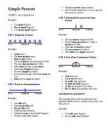
every day something happens repeatedly sometimes how often something happens always I work. I don't work. Do I work? one action follows another often Infinitive He works. He doesn't work. Does he work? Simple Present things in general usually he/she/it + -s I go. I don't go. Do I go? after the following verbs (to love, seldom to hate, to think, etc.) He goes. He doesn't go. Does he go?
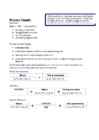
Cali 2005 Was Born Traveled to Europe Husband 1978 School graduates @ Oxford 1999 Started Got married School 1983 2008 2 The Six English Verb Tenses Three Simple Tenses Simple continuous Present You walk. You are walking I run. I am running. Past You Walked You were walking. I ran. I was running. Future You will walk. You will be walking. I will run. I will be running. Three Perfect Tenses Perfect continuous Present perfect you have walked
I had to work hard at school. The prisoner was able to/managed to escape by climbing onto the roof of the prison. (NOT *could escape) (=ability / performance on one occasion) In some cases could can be used with a past meaning: I could swim when I was six. (=general ability) • They have no infinitives and no –ing forms. Other expressions are used instead. I’d love to be able to ski. I hate having to get up early. • They are followed by an infinitive without -to. The exception is ought to. You must go. I’ll help you. You ought to see a doctor. • They can be used with perfect infinitives to talk about the past. You should have told me that you can’t swim. You might have drowned. 2 When to use the Modal Verbs • Each Modal Verb has at least two meanings: I must post this letter! (= obligation) You must be tired! (= deduction, probability)
Grammar point Made by Nikolai Hodosevich Conditional mood The conditional mood is the form of the verb used in conditional sentences to refer to a hypothetical state of affairs. Conditional verb forms can also have temporal uses, often for expressing "future in the past" tense. Condition sentences are often entered with conjunction IF Real events Structure: Additional clause Present Indefinite Main clause Future Indefinite If I have a lot of money, I will buy a car , Almost unreal events *In additional and main clauses usually use Subjunctive I and II *When you translate into Russian these sentences, you should use conjunction * This type of unreal conditional sentence use, when speaker wants to underline small probability of condition realization Almost unreal events Structure: Additional clause Past Simple
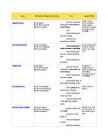
tense Affirmative/Negative/Question Use Signal Words always, every ..., action in the present Simple Present A: He speaks. never, normally, N: He does not speak. taking place once, never or often, seldom, Q: Does he speak? several times sometimes, usually if sentences type I
Reported speech is often also called indirect speech. When we use reported speech, we are usually talking about the past (because obviously the person who spoke originally spoke in the past). The verbs therefore usually have to be in the past too. For example: "I'm going to the cinema". He said he was going to the cinema. Basic tense chart The tenses generally move backwards in this way (the tense on the left changes to the tense on the right): present simple past simple I'm a teacher. He said he was a teacher past continuous. present continuous He said he was having lunch with his I'm having lunch with my parents. parents. past perfect simple
Active Present Past Future Simple I work II (-ed) Will + I usually Don’t work Didn’t work Will not work
PAST TENSES Past Simple Used to talk about a completed past action which happened at a completed time in the past. We went to Tallinn yesterday. I saw him a long time ago. We met last week. Used to talk about a series of events that happened one after another. He walked to school, took off his coat, went to class and fell asleep. Used to report what people said. He said that he was tired. He asked to go home.
Windows are not made of wood. Simple Present · · New York is a small city. It is not important that this fact is untrue. [VERB] + s/es in third person USE 3 Scheduled Events in the Near Examples: Future · You speak English. · Do you speak English?
The Present Simple is the most basic tense in the English language. It is an interesting tense because it can be used Present Simple to express the future. Generally, though, we use it to Basic form describe the present activities or to talk about routines or Subject + Verb + -s (present form) John lives in New York. We play football every day. You are really kind. The meeting starts at 3 PM. Use the Present Simple: with state verbs. to talk about situations in life that last a relatively long time. when an event is certain to happen in the future.
on Christmas Day (but at Christmas) We use at in these expressions: at night - at Christmas - at the moment / at present - at the same time - at weekends - at the age of... IN DURING
· only facts, infrequent use of descriptive Best wishes / Love / Yours / Regards. adjectives · no use of short forms Name: Steve Name: Yours faithfully/Yours sincerely, Steven Hill TASK 2 Put an - for formal and an I for informal language. Give reasons . 1 In reply to your query about ... 2 I trust that this is the information you require .... 3 Hope this information helps you ... 4 I would like to express my dissatisfaction with the item I purchased ... 5 I'm afraid I won't be able to make it on Friday ... 6 Why don't you come and visit us ... 7 I'm looking forward to hearing from you ... 8 I look forward to meeting you. 9 I am writing with regard to the advertisement ... 10 How about getting together next Friday instead? 11 Pop in for a chat some time soon ... 12 You've been very helpful ... 13 Well, I must leave now ... 14 By the way, I've got to tell you ...
Tests Superstar 1 Luke Prodromou Test 1 Name____________________ Class_______ Use your English 1 Complete these sentences using the correct form (present simple or present continuous) of the verb in brackets. _ 1 She is in a band and she _________________________________ (record) a CD at the moment. _ 2 She is an actress and often _________________________________ (appear) on television. _ 3 At the moment she _________________________________ (have) a rest because she is tired. _ 4 Mike is a doctor and he _________________________________ (live) in Manchester. _ 5 I _________________________________ (start) work at 8.30 every morning.
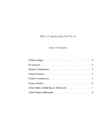
Ways of expressing the Future Table of Contents Future Simple ...................................................................... 2 Be going to ........................................................................... 3 Present Continuous .............................................................. 3 Present Simple ..................................................................... 4 Future Continuous ............................................................... 4 Future Perfect....................................................................... 6 Other ways of referring to the future ..................................... 7 Other future references......................................................... 8 Future Simple In Future Simple we use the modal verb will + the verb
adjectives, adverbs, prepositions, conjunctions, and interjections--as well as the standard patterns of English sentences. All students of English, be they native speakers or those who are studying English as a second language, will profit from the fundamental introduction and review of grammar provided by SADDLEBACK'S BASIC ENGLISH GRAMMAR 1 and 2. Helpful marginal notes throughout the books have been provided to reinforce existing skills and call attention to common problem areas. We wish you every success in your pursuit of English proficiency. 1 What is Grammar? 5 The Simple Past Tense 98 Regular and Irregular Verbs 99 Was and Were 104 2 The Capital Letter 6 The Past Progressive Tense 106 The Future Tense 108
(They have already decided to do it.) BUT: They're getting married next month. (They have decided and arranged to do it.) c) in predictions when there is evidence that something will happen in the near future. Look at the clouds! It's going to rain. Note: 1) We normally use be going to to talk about something we intend to do and will to give details or make comments. e.g. A: I'm going to have a party next week. I'll invite all my friends. B: That'll be great. 2) We normally use the present continuous rather than be going to with verbs which express movement, especially the verbs go and come. e.g. Sam is going to the market in a few minutes. Sheila is coming to my house for tea this afternoon NB! The future simple and be going to are used with the following time expressions: tomorrow, the day after tomorrow, tonight, soon, next week/month/year, in a week/month/year, in two/three days/weeks, etc. Future Continuous (will be +ing)
Vosotros is used only in Spain when speaking to more than one person with whom you know well. Nosotras and vosotras refer to a group of all females, as well as ellas. Ustedes is almost always used for saying "you all" in all Spanish speaking countries. Usted can be abbreviated to Ud. Ustedes can also be abbreviated to Uds. Please note that the subject pronouns are rarely used before verbs. 6. To Be & to Have ser - to be present past future soy I am fuí I was seré I will be eres you are fuiste you were serás you will be es he/she/it is fué he/she/it was será he/she/it will be somos we are fuimos we were seremos we will be
FUTURE SIMPLE BE GOING TO Will + infinitive (will go) Am/is/are going to + infinitive (is going to rain) 1.A decision at the moment of 1.Future plans made before the speaking: moment of speaking: A: 'I'm cold'. A: 'We've run out of milk.' B: 'I'll close the window'. B: 'I know, I'm going to buy some.' 2.Prediction based on opinion: 2.Prediction based on present I think the Conservatives will win the evidence: next election
Conditional sentences tingiv kõneviis Type 0 (the zero conditional, the present condition) Kasutatakse selleks, et väljendada üldist tõde või teaduslikku fakti. Nende lausete puhul on võimalik kasutada sõna 'if' asemel sõna 'when.' If-clause main clause If /When + present simple, present simple If/ When you drop an egg, it breaks. Kui sa pillad muna maha, läheb see katki. If my sister eats too much, she gets fat. (See juhtub alati.) Kui mu õde sööb liiga palju, läheb ta paksuks. Type 1 (the first conditional, the will-condition) Kasutatakse selleks, et rääkida tõelisest või väga tõenäolisest olukorrast olevikus või tulevikus. If-cl main cl If + present simple, future simple, imperative, can/must/may etc + bare infinitive (verb)
1 blooded 6 action 2 hearted 10 undermining Challenge! Students' own answers 11 sympathies 2 1 time-consuming 12 verdict 2E Narrative tenses page 16 2 long-lasting 3 light-hearted 2 That he was responsible not only for 1 1 past perfect continuous 4 absent-minded his family but also to wider society. 2 past simple 5 wide-eyed 3 1 set 7 on 3 past continuous 6 fair-skinned 2 tells 8 on 4 future in the past 3 made 9 for 5 past perfect
.............................................................................................................................................. 13 Ajavormid Present simple (The earth goes round the sun) Reeglid, absoluutsed tõed Rutiin ja harjumused Püsivad situatsioonid või olukorrad Tabelid, ajagraafikud Present continuous (She is driving to work) Käsil olev tegevus Ajutine tegevus; pooleli olev Ettekorraldatud tegevus tulevikus Ärritus Present perfect (He has lost his key) Sündmus minevikus, tagajärg olevikus Üksik või korduv tegevus, mille aeg ei ole oluline (I have been in the USA)
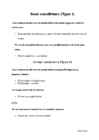
Real conditions (Type I) These sentences describe what the speaker thinks will possibly happen as a result of a real situation. If you train hard, you will succeed in sport. If you don’t train hard, you won’t succeed in sport. We can also use modal verbs (can, may, must, should) instead of verbs in the main clause. If i have enough time, i can visit you. Unreal conditions (Type II) These sentences describe what the speaker thinks would possibly happen in an imaginary situation. If I saw a ghost, I would be scared. If I had wings, I could fly. We can give advice with If I were you. If I were you wouldn’t do that NOTE We normally use were instead of was in conditional sentences.
3 The wooden floor had rotted. Challenge! 4 The little boy was sobbing and Transcript Students' own answers pointing to his sister's ice cream. 5 The thief grabbed my bag and ran The photos are connected with the 1B Past and perfect tenses off. topic of school. Both photos show page 4 6 He dropped a leaf into the water students in class. In the first photo I imagine that 1 1 ate and watched it drift under the
speaker the way the language should be written or spoken in order for the speaker to appear correct or educated. It could be said that this is an academic and strictly correct language use. For example: Never use ain’t Don’t split an infinitive (To quickly run) Descriptive grammar → Underlies the actual usage of speakers of the language. Grammar also has many components: Phonetics → The study of the acoustic detail of speech sounds and how they are articulated. Phone is a smallest unit of sound in human
 annaabi.ee