Leidsid 33 sarnast õppematerjali, mis on seotud failiga "Blue Whale". Need materjalid aitavad sul teemat sügavamalt mõista.
whale, blue, male, years, meters, female, important, mammal, weight, tons, span, 3540, little, warm, waters, drink, milk, skin, sports, than, dive, below, hours, today, there, still, whales, growingWhale There are 13 species of great whale and several species of smaller whales. Whales are large, intelligent, aquatic mammals. Whales have many features that we- other mammals have. Such as four-chambered heart,hair, they are warm- blooded. They are the only mammals, other than seacows , that live their entire life in the water, and the only mammals that have adapted to life in the open oceans. Whales are not fish, because they have lungs and they breath air with them.What is special about the whales is their size. They are enormous.
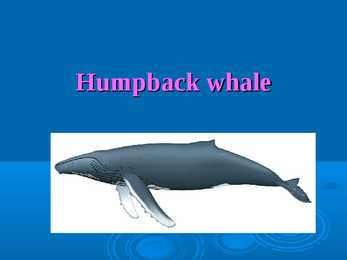
least one stiff hair. The body is black on the dorsal side, and mottled black and white on the ventral side. About 2/3 of the way back on the body is an irregularly shaped dorsal fin. Its flippers are very long, between 1/4 and 1/3 the length of its body, and have large knobs on the leading edge. The flukes, which can be 5.5 m wide, is serrated and pointed at the tips. Adult males measure 12.2-14.6 m, adult females measure 13.7-15.2 m. They weigh 25 to 40 tons. Feeding Feed on krill, small shrimp-like crustaceans, and various kinds of small fish. Each whale eats up to 1 and 1/2 tons of food a day. Mating and breeding Humpback whales reach sexual maturity at 6- 10 years of age or when males reach the length of 11.6 m and females reach 12 m. Each female typically bears a calf every 2-3 years and the gestation period is 12 months. The calf is between 3-4.5 m long at birth, and weighs up to 907 kg.
Gröönimaa vetes ujub umbes 225 kalaliiki, osa järvedes ja jõgedes, osa meres. Piisavalt on ka erinevaid putukaliike. Kuna meie ekspeditsioon kulgeb valdavalt mööda mandrijääd, ei kohta me loodetavasti rannikuil toitu jahtivat jääkaru. Samas loodame ekspeditsiooni lõpuosas saada osa Gröönimaa elusloodusest ja ehk õnnestub kohata mõnda põtra või muud looma. http://www.greenland-guide.gl/animal_life.htm ehk siis loomade pildid ja txt In Greenland whale watching can be enjoyed from the streets or even from your hotel room. During the late summer and early autumn whales swim close to the coast and are sometimes seen in the harbours. But of course the best way to spot these huge mammals is at sea. Whale-watching tours are offered in several towns in Greenland. When you sail along the coast on a passenger ship, the captain will often notify you when whales are close. There are many different species of whales in Greenlandic waters including the
situated directly beneath the islands and also It is the point where major ocean currents meet. These circumstances combine to make an area that truly is like no other place on earth. Galapagos is comprised of 13 major islands, more than 120 smaller islets and rocks, and the surrounding ocean. The total land mass is almost 8,000 sq. km. Highest peak is Wolf Volcano reaching 1707m. The present islands are all younger than 4 million years and were formed separately from other land masses as a result of volcanic eruptions. The Galapagos were discovered in 1535 by Fray Toms de Berlanga, the Bishop of Panama. He was sailing from Panama to Peru when he accidentally discovered the islands. Islands became a favorite hideout for Pirates and the favorite location for whale hunters. After whales were locally cleared the whalers went there for tortoises, an estimated 200 000 or more adults had been removed. The island of Floreana was
loss. Alpine animals also have larger lungs, more blood cells and hemoglobin because of the increase of pressure and lack of oxygen at higher altitudes. This is also true for people who have lived on mountains for a long time, like the Indians of the Andes Mountains in South America and the Sherpas of the Himalayas in Asia. 6. What animals live in Arctic and Antarctica. Arctic-reindeer, polar bear, Arctic fox, narwhal, walrus, seal, ox, moose, orca, and snowy owl Antarctica- blue whale, emperor penguin, weddell seal, octopus, sea star 7. Why is tundra so wet? The warmer weather in summers causes a layer of permafrost, ice that never goes away in the ground, to melt, creating bogs and shallow lakes that don't drain. 8. What is snowline? A snow line is the point above which snow and ice cover the ground throughout the year. The actual snow line may seasonally be significantly lower. 9. What is treeline (timberline)
The · Is used when both the person speaking and listener know the specific object they are talking about. Example: I remembered the fun I had with them. · Is used when you have mentioned something/somebody before. Example: I live in a house. The house is quite old and has four bedrooms. · Is used with nouns when talking about something specific. Example: Bob has got a car and a bike. The car is green and the bike is blue. · Is used with nouns that are unique. Example: The sky was a brilliant blue. They all sat in the sun. · Is used with superlative adjectives. Example: He was the cleverest man I ever knew. · Is used with the names of families. Example: the Browns · Is used with the names of newspapers, organisations, buildings, titles and art works. Examples: the United Nations, the Taj Mahal, the Queen of England, the Times, the Mona Lisa
Tundra animals Reindeer Reindeer were first domesticated in Norway and northern Asia. When it was seen how valuable they were, they were brought to Alaska in 1887 and later to parts of Canada. These North American reindeer became known as caribou. Although they are called by different names, they are both considered to be a single species. Unlike deer, both the male and female have antlers. The antlers of the male are long, branched and massive, and they are a little flattened at the ends. The antlers of the female are much shorter, simpler and more slender and irregular. Their large, spreading hooves support the animal in snow in the winter and marshy tundra in the summer. Reindeer are also great swimmers and use their feet as paddles. They can also lower their metabolic rate and go into a semi-hibernation when conditions get very harsh.
Australia, the Coral Sea in the north-east of Australia and the Tasman Sea, near the island of Tasmania, in the south-east of Australia. Government The full name of the county is the Commonwealth of Australia. Its territory is 7.7 million square kilometres and population is about 19.7 million. The state symbols are the coat of arms, flag anthem and aboriginal symbols. Australia's flag has a British Union flag. . It is blue with the flag of the UK in the upper left corner. Five stars represent the Constallation Southern Cross and a large star is for the country's states and territories. The coat of arms features a kangaroo and an emu. The kangaroo and emu are chosen for the coat of arms of Australia because they can only move forward just like Australia. The national anthem of Australia is "Advance Australia Fair". This replaced the "God Save
staples of their diet. Clothing for Staying Warm Traditional Inuit clothing was made from animal skins and fur. Boots were also made from animal skins. Large, thick coats with big hoods called "parkas" were worn as an outer layer. Today the parka style of coat is worn in other places in the world and it is made of many other materials. Traditions Although Inuit life has changed significantly over the past century, many traditions continue. Traditional storytelling, mythology, and dancing remain important parts of the culture. Family and community are very important. The Inuktitut language is still spoken in many areas of the Arctic and is common on radio and in television programming. Changes to Inuit Life during the 20th Century Inuit a century ago lived very differently than Inuit today. Before the 1940s, Inuit had minimal contact with Europeans. Europeans passed through on their way to hunt whales or trade furs but
the Senate (77 members) and the House of Representatives(148 members). Australia's Flag and Coat of Arms. Australia's flag has a Brittish flag, five stars that represent the constellation Southern Cross and a large star for the country's states and territories. The coat of arms features a kangaroo and an emu, golden whattle blossoms, a shield with the coats of arms of the six states of Australia and a star for the states and territories. Landforms Only 5% of the land is above 600 meters. Most of the land is empty. Most of the people live in the south and in east. 2/3 of Australia is a desert with hills and big saltlakes. The biggest deserts are the Great Sandy Desert, the Gibson Desert, the Simpson Desert, The Great Victoria Desert. The biggest mountain ranges are the Great Divining Range, the Australian Alps, the Blue Mountains and the New England Range. The outback is flat and hot centre of Australia. The nearest neighbor may be a hundred kilometers away
What emerged was Deism, which was more or less a new religion that considered reason its foundation. In Deism, there is no interference by a deity, and man controls his own destiny. These ideas stirred the masses into action, as the people dreamed of carving their own futures. Adopted by the Founding Fathers, Enlightenment ideals became the vision for modernday America, where these ideologies are deeply rooted in the nation. The Enlightenment was important America because it provided the philosophical basis of the American Revolution. The Revolution was more than just a protest against English authority; as it turned out, the American Revolution provided a blueprint for the organization of a democratic society. And while imperfectly done, for it did not address the terrible problem of slavery, the American Revolution was an enlightened concept of government whose most profound
The dominant version of the gene produces normal black pigment in the coat while the recessive version produces red pigment. The name comes from the effect of black or brown pigment not being extended throughout the whole coat, but being restricted to the skin of the extremities and to the eyes (for example in bay horses). This Norwegian Forest Cat was bred by Yve Hamilton Bruce from a silver mackerel tabby female (imported from Denmark) and a classic red tabby and white male. The result was 1 silver tabbies and 2 silver tabbies with white. At just over 3 months old, this silver and white tabby male developed a large patch of bright red hair on his back which continued to spread. Eventually the whole fur will become amber. The effect of amber during the colour-change stage depends on the original colour - solid black or blue, bicolour or tabby. The cat pictured is not a typical amber as it has the silver gene so the amber effect is overlaid on silver.
the world. Its area is about 7,6 million sq kilometers. Its population is about 20,0 million and most of the people live in bigger cities: Sydney (4.2 million), Melbourne (3.7 million), Brisbane (2 million) and in Canberra, Which is also the capital of Australia. National language in Australia is english and the monetary unit is Australian dollar. Australia is divided into 6 states and 2 territories. Symbols Australia has a British Union flag. It is red, white and blue. Five small stars represent the constellation Southern cross. The big star represents country's states and territories. In 1901 the flag was chosen from about 30000 entries in a public contest. It was officially adopted as Australian flag in 1953. The coat of arms features a kangaroo and an emu (the national animals of Australia), golden wattle (the national floral emblem), a shield with the coats of arms of the six states of Australia and a star for all states and territories.
people) and the yellow in the middle (representing the sun) is a source of pride for Indigenous Australians. The present coat of arms was granted by King George V in 1912. It consists of a shield containing the badges of six Australian states, enclosed by an ermine border. The shield is a symbol for the federation of the states, which took place in 1901. The crest, which is above the shield, is a seven-pointed gold star on a blue and gold wreath. The seven points of the star represent exactly the same thing that they do on the flag. The supporters of the shield are native Australian animals: the red kangaroo and the emu. Usually the coat of arms is depicted on the background of sprays of golden wattle with a scroll beneath it containing the word `Australia'. Australia's national anthem is `Advance Australia Fair', which replaced `God Save the Queen' in 1984
Elias and the Pelly Mountains in the northern regions. Canada has about two million lakes and they cover about 7.6% of Canada's land. The biggest lakes in order by their surface are Lake Huron, Lake Great Bear, Lake Superior, Lake Great Slave (which is also the deepest), Lake Winnipeg, Lake Erie and Lake Ontario. There are also a lot of rivers in Canada. The longest river is the Mackenzie River which is 4241 kilometers long. It runs through the Northwest Territories. Other large and important rivers are the St. Lawrence River, the Yukon River, the Columbia River, the Nelson River, the Churchill River and the Fraser River. 4. Land regions Mountains Parts of Canada are very mountainous and the tallest mountain in Canada is the Yukon's Mount Logan, which is 6050 meters tall. Canada has many mountain ranges. In the east there are the Appalachians, Torngats and Laurentias. In the western region
If you prefer a quieter beach, this is the one for you. The water can be extremely rough and swimming only "between the flags" is advised. Karekare is popular for its annual beach race day, in which local ponies and horses race to raise money for local causes. Beach race day is usually held in early April. 4. Kaiteriteri Beach, Nelson-Golden sand and the highest rate of sunshine hours in New Zealand mean Kaiteriteri Beach has all the prerequisites for an idyllic seaside experience. 5. Whale Bay, Raglan-The hills are covered with native trees, while the beach itself is world-renowned for its surf. The left-hand point break is a favorite of surfers. This is a great place to learn how to ride the waves, and there are plenty of surf schools in the area. Without guidance and tutelage, however, this isn't a place for "grommets" or beginner surfers. 6. Mission Bay, Auckland-With its bustling feel, vibrant restaurants, ice cream parlors, cafés and pubs,
they use like wings for gliding from one tree to another. The Tasmanian devil is the only native carnivore that lives on the Australian island of Tasmania. The Tasmanian devil is about one metre long and it is usually black. It eats small mammals and lizards and even dead animals. As it is a marsupial, its babies grow up in its pouch. The Tasmanian tiger (often also known as the Tasmanian wolf) also lived on Tasmania a hundred years ago. It had stripes on its back like a tiger. It was more than 1.5 metres long. Scientists believe that hunters killed all of them at the beginning of the 20th century. The egg-laying mammals are the strangest of all the Australian animals.They lay eggs like birds and feed their young with milk as mammals do.They form a link between birds and mammals. The platypus or the duck-bill is one of them.The female lays two eggs in a nest of leaves and grass at the end of a burrow in a river bank
Inland areas are warmer in summer, and colder in winter there are usually around 40 days of below freezing temperatures (0 °C) at inland weather stations, but only 10 days at coastal stations. Ireland is sometimes affected by heat waves, most recently 1995, 2003, 2006. Nature Ireland has fewer animal and plant species than either Britain or mainland Europe because it became an island shortly after the end of the last Ice Age, about 8,000 years ago. Many different habitat types are found in Ireland, including farmland, open woodland, temperate broadleaf and mixed forests, conifer plantations, peat bogs, and various coastal habitats. Forest covers about 10% of the country. Only 26 land mammal species are native to Ireland, because it was isolated from Europe by rising sea levels after the Ice Age. Some species, such as the red fox, hedgehog, and badger are very common,
with an average elevation of about 50 metres above sea level. South-eastern and eastern parts of Estonia are higher than the western parts. The relief of the present-day landscape was shaped during the Ice Age. Ice sheet has carried large boulders and limestone blocks here, not to mention that the hilly terrain in Estonia was also shaped by the continental ice and the melting water. The land is rising 25 cm every one hundred years. In folklore, many features of the relief are explained by the activities of giants such as the legendary national hero Kalevipoeg. The Haanja and Otepää Uplands are particularly rich in Hills. It is here that You find Big Egg Hill, the highest point in the Baltic states with 318 metres above sea level. 4. Land regions The northern coast features a steep limestone bank, the Baltic glint, which is one of the world's most important denudations of Ordovician sedimentary rocks. The
New South Wales is the most populated state and Victoria is the most densely populated state. The national language is English. It is English because British settlers came to live in Australia in the past and they brought convicts with them who were also British. Symbols. The Australian Flag came into being after the federation of the Australian States into the Commonwealth of Australian on the first January, 1901. The Commonwealth Blue Ensign was selected as a result of a public competition (over 30 000 designs were submitted). In the upper left corner there is the Union Jack that is the national flag of England. It denotes Australia's historical links with Great Britain. Under the flag there is the Commonwealth star which has seven tips. Six of them represent the states and the last one is for the Commonwealth of Australia. The Southern Cross is in the right. It consists of five stars. The group of stars on the flag
hydrocarbons such as pentane, hexane, and heptane in the gaseous state. At surface conditions these will condense out of the gas to form natural gas condensate, often shortened to condensate. Condensate resembles petrol in appearance and is similar in composition to some volatile light crude oils. The proportion of light hydrocarbons in the petroleum mixture varies greatly among different oil fields, ranging from as much as 97 percent by weight in the lighter oils to as little as 50 percent in the heavier oils and bitumens. The hydrocarbons in crude oil are mostly alkanes, cycloalkanes and various aromatic hydrocarbons while the other organic compounds contain nitrogen, oxygen and sulfur, and trace amounts of metals such as iron, nickel, copper and vanadium. The exact molecular composition varies widely from formation to formation but the proportion of chemical elements vary over fairly narrow limits as follows:
surface area of the country is growing by about 7 square kilometres (2.7 square miles) a year. The distance from the most Southern point Hanko to the most northern point of Finland Nuorgam is 1,445 kilometres (898 miles) (driving distance), which would take approximately 18.5 hours to drive. This is very similar to Great Britain (Land's End to John o' Groats 1,404 kilometres (872 miles) and 16.5 h) Finland is a land of all seasons. Its blue and white flag is said to represent the white snow of winter and the blue lakes of summer. In between the two is the dramatic spring when everything turns green in a week, and autumn, full of reds and browns as the leaves swirl over the city squares.Finland is certainly Scandinavia`s least understood and most culturally remote country. Finland is covered by a mixture of forest and marshland. It seems , for every Finnish
In the southern two thirds of the country the climate is temperate to cool. Winter temperatures can be low but not freezing. There are four seasons. The seasons are the opposite of our seasons. When we have summer then in Australia is winter. In Australia droughts and floods are pretty usual. The draught is caused by El Nino, a weather pattern which happens when the Southern Pacific Ocean heats up. This causes the wind direction to reverse. An El Nino occurs every four or five years, causing drought and bushfires. Droughts are followed by floods. Australia has three time zones. In Western Australia is equal to Greenwich Mean Time plus 8 hours. In New South Wales, Victoria, Queensland, and Tasmania and in Australian Capital Territory time is equal to Greenwich Mean Time plus 10 hours. In South Australia, Northern Territory, Broken Hill, NSW time is equal to Greenwich Mean Time plus 9 ½ hours. Plants A rich variety of plants can be found in the natural
station .Small aero planes are used to take people ,food ,post and machines. Radio is used to talk with doctor Alice Spring is the largest Outback town with population of 25,000.That was just a small group of houses and shops, but recently the population has grown. Animals Australian animals are very beautiful animals. The kangaroo is a symbol of Australia. There are more than 50 kind of red kangaroos. Adults are often 2.0 meters long. Kangaroos eat grass and leaves. Kangaroos live in group of ,twelve. But there are more interesting animals .Koalas are sleepy and their colour is grey .Koalas' babies ride on mothers back till six months .They live on eucalyptus trees and sleep 18 hours! Koalas eat eucalyptus trees leaves, they don't drink. The word koala means "No water " .In the sea you can find crocodiles that are 5 or 6 metre long. They eat fish, animals and sometimes people.You must be careful
During (around) full moon, when corn was ready. Holy Man- light+tend sacred fire Eating corn-bread, soup,roasted corn, etc. Lacrosse. Music. 1) Water drum-clay pot with skin stretched on top. 2-3cm of water. 2) River cane flute-30 cm long, 6 holes 3) Trumpet-buffalo horn or long necked gourd. 4) Turtle-shell rattle Unusual music, instrumental+lyrical music. Lyrics:family+tribe: sometimes meaningless, syllables. Men were usually composers. Great emotional depth. RELIGION. Certain numbers were important. 4: a) elements: earth, air, fire, water b) directions (north etc.) 7: a) directions: north etc. + up, down, centre 7- purity, sacredness-it was occosiated with owl+cougar (wild cat), days of creation, state of perfetion: pine, spruce, hollybush, * udor Circle: important symbol, Ceremonial dances moved in circular directions Rivers. ,,Long Man" ,,going to water" spirtual cleansing. Good is rewarded and evil punished. Witchcraft-regular and killer witches :Raven,Mockers.
" --Phil Town, New York Times bestselling author of Rule #1 "The 4-Hour Workweek is a new way of solving a very old problem: just how can we work to live and prevent our lives from being all about work? A world of in nite options awaits those who would read this book and be inspired by it!" --Michael E. Gerber, founder and chairman of E-Myth Worldwide and the world's #1 small business guru "Timothy has packed more lives into his 29 years than Steve Jobs has in his 51." --Tom Foremski, journalist and publisher of SiliconValleyWatcher.com "If you want to live life on your own terms, this is your blueprint." --Mike Maples, cofounder of Motive Communications (IPO to $260M market cap) and founding executive of Tivoli (sold to IBM for $750M) "Thanks to Tim Ferriss, I have more time in my life to travel, spend time with family, and write book blurbs. This is a dazzling and highly useful work." --A. J
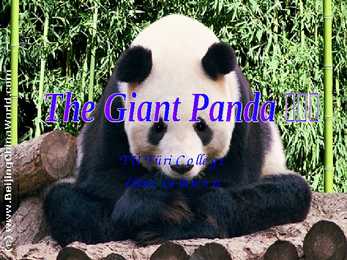
T Ü T üri C o lle g e Liina Le inm e ts Introduction · Panda (Ailuropoda melanoleuca) is a mammal classified in the bear family, native to centralwestern and southwestern China. It is easily recognized by its large, distinctive black patches around the eyes, over the ears, and across its round body. · The Giant Panda lives in a few mountain ranges in central China. · It once lived in lowland areas, but farming, forest clearing, and other development now restrict the Giant Panda to the mountains. In the wild
Ayers Rock was created a national park in 1950. Uluru is also famous for its rock paintings. Reef One of the natural wonders of the modern world is the Great Barrier Reef. The reef is located in the Coral Sea, off the coast of Queensland in northeast Australia It is the largest coral reef on earth, extending for 2000 km along the eastern coast. Some scientists estimate that the reef is 30 million years old. The corals consist of tiny animals known as polyps that protect themselves by forming and external skeleton of lime and when the polyp dies its shell hardens. When the number of these little creatures increases, fantastically beautiful shapes that we know as corals are form. The Great Barrier Reef can be seen from outer space and is sometimes referred to as the single largest organism in the world. More than 300
BUOYANCY STABILIZED Technology and advantages Access to previously inaccessible waters. Commissioned and assembled at the quayside. Foundations not necessary 1. Sea life disturbance minimized 2. Reduced geotechnical requirements Also 3. Considerably less noise and visual pollution 4. Greater energy/cost value Initiatives - Hywind Developed by Norwegian energy company Statoil ASA World's first full-scale floating wind turbine 10 km off the soutwest coast of Norway 100 meters beneath the sea's surface Can be employed at ocean depths of 120 to 700 meters Main objective is to test the impact of wind and waves on the structure over a two-year period Initiatives Blue H Dutch company Blue H Technologies has devised a `Submerged Deepwater Platform' (SDP) In 2008, the company installed a 75% scale prototype SDP with a small wind turbine in 113-metre deep water 20 km off the coast of Southern Italy After 6 monts at sea, the unit was decommisioned early on 2009
Norway in the east and France in the south. Britain also has many dependant territories which are scattered throughout the world and are the remains of the huge former British Empire. Today Britain assists them, but they may become independent whenever they wish. There have been some difficulties with some of the territories. Argentina has made claims to the Falkland Islands and Spain to Gibraltar. History When the glaciers retreated from Britain about 10,000 years ago, Stone-Age men started to inhabit the isles. The early Britons came across the land bridge which joined Britain to the continent. They were cave-dwellers at first. This way of life was replaced by the invaders from the Mediterranean lands. These men were the first farmers. In about 500 BC came the people whose homeland was near the Rhine River. These were the Celts. The Roman invasion began in 43AD. The Romans were highly organized conquerors. They built good roads, baths and bridges
Kordamine inglise keele eksamiks A 1.1 Read the text and answer the questions below. Dear Mary-Alice, It's been ages since I last wrote to you, isn't it weird? Yes, so it is, but, I do have a certain reason. Do you remember Sir Thom of the Minquettes'? That fine young man with fascinating blue eyes... Oh, my sweet Mary, you will never guess what happened yesterday! It was about seven o'clock in the evening when Lillian called me out for a walk you know I can't say `no' to my little sis. Anyway we went to the forest near the Swan Lake and, believe it or not, got lost! Awful! I was so scared... We walked and walked, not even knowing the direction we were heading to, until we reached a huge mansion. And the garden around it was so extraordinary..
These reactions, among other changes, cause the clay to be converted into a ceramic material. Because of these properties, clay is used for making pottery items, both practical and decorative, and construction products such as bricks, wall and floor tiles. Depending on the content of the soil, clay can appear in various colors, from a dull gray to a deep orange-red. Clay in Estonia (slide 6) There are 3 basic types of clay in Estonia. Firstly from Cambrian era the blue clay, which has blue-greenish color and deposit fields round 100m thick found in North-Estonia. Secondly from Devon era the Red-Brown colored clay mostly find in South-Estonia and finally the layered clay found on islands mainly. The quality of the layerd clay is poor beacause it is limestone-rich. There are aroud 30 filed mineral deposits in Estonia. What is a brick? (slide 7) A brick is a block or a single unit of a ceramic material used in masonry construction.
The capital was moved to Spanish Town, now located in the parish of St. Catherine, as early as 1534. It was then called ,,Villa de la Vega". Spanish Town has the oldest Cathedral in the British colonies. The English Admiral William Penn and General Robert Venables seized the island in 1655. In 1660 the population of Jamaica was about 4 500 whites and some 1 500 blacks. As early as the 1670s, blacks formed a majority of the population. During its first 200 years of British rule, Jamaica became one of the world's leading sugar- exporting, slave-dependent nations, producing more than 77 000 tons of sugar annually between 1820 and 1824. The population in 1834 was 371 070 of whom 15 000 were white, 5 000 free black, 40 000 coloured or mixed race, and 311 070 slaves. Strong economic growth, averaging approximately 6% per annum, marked the first ten years of independence under conservative goverments which were led
 annaabi.ee