Leidsid 33 sarnast õppematerjali, mis on seotud failiga "Arthur Conan Doyle ". Need materjalid aitavad sul teemat sügavamalt mõista.
doyle, conan, arthur, holmes, other, case, first, spirit, sherlock, wrote, south, became, novel, death, edinburgh, stories, practice, year, work, wife, during, land, mother, while, ship, though, later, father, mary, married, although, left, university, appeared, following, former, success, friend, even, character, kingsley, novels, deaths, since, boerThe Adventures of Sherlock Holmes By Arthur Conan Doyle Sveta Kostina Arthur Conan Doyle was born in Edinburgh on 22nd May 1859. he studied medicine at the University of Edinburgh medical practice at Bush Villas in Elm Grove, Southsea good at sport two wives: Louisa (or Louise) Hawkins and Jean Elizabeth Leckie five childrens: two with his first wife and three with his second wife studied the eye in Vienna; practice as an ophthalmologist died of his heart attack, aged 71, on 7th July 1930 Arthur Conan Doyle Bibliography A Study in Scarlet (1887) The Sign of Four (1890) The Adventures of Sherlock Holmes (1892) The Memoirs of Sherlock Holmes (1894) The Hound of the Baskervilles (1902) The Return of Sherlock Holmes (1904) The Valley of Fear (1915) His Last Bow (1917)
The Hound of the Baskervilles Sir Arthur Conan Doyle Unknown words p4 hound - jahikoer p4 mire mülgas,mädasoo p 31 tor - kaljune künkatipp a) The titel of the book is ,,The Hound of the Baskervilles" and the author is Sir Arthur Conan Doyle. b) I choose this book because it seemed interesting. c) This is a mystery. d) The action takes place in the southwest of England on Dartmoor in 1889. e) The main characters are Sherlock Holmes (detective), Dr. Watson (the friend of the Sherlock Holmes), Dr. Mortimer, Sir Hugo Baserville, Sir Charles Baskerville, Sir Henry Baskerville, Mr and Mrs Barrymore, Mr Jack Stapleton, Miss Stapleton, Mr Frankland, Selden (escaped prisoner) and the dog. f) Summary Dr. Mortimer comes to the Sherlock Holmes for consulting about the death of Sir Charles Baskerville, who died of a heart attack and tells Holmes and dr.Watson the legend from huge dog which has killed some centuries ago Hugo Baskerville. Near Sir Charles body were the footprints of
Scotland The creator of the modern historical novel A prominent figure in Edinburgh society, entertained famous people like Washington Irving and William Wordsworth First Englishlanguage author to have a truly international career in his lifetime Influenced writer such as J. F. Cooper, A. Dumas, A. Pushkin Famous titles include Ivanhoe, Rob Roy, The Lady of the Lake, Waverley, The Heart of Midlothian and The Bride of Lammermoor. "A sound head, an honest heart, and an humble spirit are the three best guides through time and to eternity" Robert Burns 17591796 National poet of Scotland He is the best known of the poets who have written in Scottish Grew up in poverty and hardship Made compositions and collected folk songs from across Scotland His song Auld Lang Syne is often sung at Hogmanay (the last day of the year), and Scots Wha Hae served for a long time as an unofficial national anthem of the country.
The British Who are they? The British are world famous on almost all walks of life. Their culture is rich and varied. Theatre The British have a tradition of theatre. Long, long time ago the culture of theatre was introduced from Europe to the British by the Romans. Many auditoriums were constructed across the country. The most famous British playwright is obviously William Shakespeare. He lived from 1564 to 1616. During that time he wrote about 40 plays, which are still played and used in today's theatre. His plays are performed more often than those of any other playwright. The first professional woman playwright was Aphra Behn. Nowadays there are not so many world famous dramatists in England but the memory of William Shakespeare and many others has preserved until today. Important modern playwrights include Alan Ayckbourn, John Osborne, Harold Pinter, Tom Stoppard, and Arnold Wesker. Music
vivacious woman about whom a future Viceroy of India would say, "Dullness and Mrs. Kipling cannot exist in the same room."[3] Father - John Lockwood Kipling. Lockwood Kipling, a sculptor, an illustrator, museum curator and pottery designer, was the principal and professor of architectural sculpture at the newly- founded Sir Jamsetjee Jeejeebhoy School of Art and Industry in Bombay. Later in life Kipling illustrated many of Rudyard Kipling's books, and other works. Kipling also remained editor of the Journal of Indian Art and Industry, which carried drawing works from the students of the Mayo School. COUPLE named their son after the place they had first met Rudyard Lake. Alice Kipling Fleming - Sister of British author Rudyard Kipling who became a well-known psychic, producing automatic writing under the name "Mrs. Holland." Born June 11, 1868, Alice Kipling was privately educated
80,000 people had been made homeless. To prevent such a disaster happening again the king commanded that all new houses in London should be of stone and brick not wood. In 1834 Parliament was destroyed by fire. The new parliament included a great clock, which is now known as Big Ben. In the 19th century new museums were created in London such as the Victoria & Albert, the Science Museum and the Natural History Museum. The first doubledecker bus appeared in the streets of London as early as in 1904. After the two world wars, London went through a massive rebuilding. Several structures were built in London to mark the year 2000: the Millenium Dome, Millenium bridge, London Eye etc. London's vast urban area is often described using a set of district names. Since 1965 Greater London has been divided into 32 London boroughs. However, it is a city that is surprisingly easy to get
massive worldwide popularity in his lifetime. Charles Dickens was born in Landport, Portsmouth in Hampshire, the second of eight children to John Dickens n 7 February 1812. The 12-year-old Dickens began working ten hour days in a Warren's boot-blacking factory. In May 1827, Dickens began work in the office of Ellis and Blackmore as a law clerk. At the age of seventeen, he became a court stenographer and, in 1830, met his first love, Maria Beadnell. Maria's parents disapproved of the courtship and effectively ended the relationship when they sent her to school in Paris. In 1834, Dickens became a political journalist, reporting on parliamentary debate and traveling across Britain by stagecoach to cover election campaigns for the Morning Chronice. His journalism, in the form of sketches which appeared in periodicals from 1833, formed his
............ 8 7. SETTING................................................................ 9 8. LANGUAGE AND STYLE................................... 9 9. WHOM DO I RECCOMEND THIS NOVEL........ 9 10. SUMMARY........................................................... 10 11. SOURCES.............................................................. 11 INTRODUCTION The Mysterious Affair at Styles is a detective novel by Agatha Christie. It was written in 1916 and was first published by John Lane in the USA in October 1920 and in the UK by The Bodley Head (John Lane's UK company) on January 21 1921. In her first novel, The Mysterious Affair at Styles(1920), she created the now-famous Belgian detective Hercule Poirot, the most popular sleuth in fiction since Sherlock Holmes. Poirot and Marple have also been portrayed in the many films, radio programmes and stage plays based on her books
say about anything; not part of the politics, usually from arts department...); cast nature as a reflection of divine truth; instead classicism, looking for sth essentially British; believed in artistic socialism art and morality closely linked; against mass production , emphasis on quality; preferred Gothic, medieval revival in architecture; he taught people to appreciate art and he said that things that are important to British should be from Britain (not from other countries around the world) · The more prominent artistic and cultural movements of Victoria Britain: The Arts and Crafts Movements, Anglican Oxford Movement, Public Health Act; (founding of the National Trust and National Arts Collections Fund and Society for the Protection of Ancient Buildings); conservation movement · What were their aims/concerns? Main aims were to restore old things; make new things more like Gothic (old); displaying old things etc.
REVISION QUESTIONS 1. What do you know about Margaret Thatcher? Winston Churchill? Margaret Thatcher was the first female Prime Minister in Europe. She was a member of the conservative party. She died recently. Winston Churchill was the Prime Minister during WW II. He was excellent in making speeches, but he was a heavy drinker and also smoker. 2. What are the main countries of the UK and their capitals? There are 4: England with London as the capital; Wales with Cardiff as the capital; Scotland with Edinburgh as the capital; and Northern Ireland with Belfast as the capital. 3
The making of a new nation. The Enlightenment in America. The emergence of the notion of the American Dream. The great Enlighteners: Crèvecoeur, Jefferson, Paine, Franklin. The American Enlightenment is the intellectual thriving period in the United States in the midtolate 18th century (17151789), especially as it relates to American Revolution on the one hand and the European Enlightenment on the other. Influenced by the scientific revolution of the 17th century and the humanist period during the Renaissance, the Enlightenment took scientific reasoning and applied it to human nature, society, and religion. American Enlightenment a gradual but powerful awakening that established the ideals of democracy, liberty, and religious tolerance in the people of America.
Ameerika Kirjandus 30.01.13 Naturalism · France, Emile Zola · Put down his theory in 1879: Le Roman Experimental, attempt to explain the development of human society throuch biological laws · Outlook is deterministic, pessimistic, fatalistic (fate or biology) · Man as an animal-clever than other beasts, still explainable within the framework · Man is not a free agent, is govern by something · Unable to determine his own faith · Hereditary · Naturalists tried to apply in fiction the processes of natural sciences · Writers task is to record facts, systems of behaviour, living conditions, never revealing any natural unbiased (completely natural) · Point of view: amoral-outside the category of morality, neither good or bad
American literature The literary history of this nation when the first humanbeing living in what has since become the U.S used language creatively. · Mid to late 18 century put down · Words are powerful, magical · Words must be remembered · Native Americans stories creation of the world · Attidude thought their land/language · Similar stories Dates and names · America was discovered in 1492 by Columbus · 1497 John Cabot went to Canada · 1579 San Fransisco/St
Department of Russian Literature and Modern Language Studies in 1948. Prof. Isacenko was still holding the leading post in 1950 when the Department of Russian Language and Literature came into being. In 1955, when Prof. A. V. Isacenko left Bratislava for Olomouc, the department already had ten full-time teachers. Russian studies continued developing in the second half of the 1950s and in the 1960s when Prof. A. V. Isacenko was replaced first by Assoc. Prof. . urovic (1955-1959) and then by Assoc. Prof. J. Kopanicák (1959-1970). The political turnaround in 1989, of course, also had impact on the evolution of Russian studies as an academic discipline. The department found itself in a peculiar situation. On the one hand, it represented one of the most developed philological disciplines with a large personnel and material base; on the other hand, the factors that had made Russian studies one
Topic Libraries Tallinn English College 8b form 2007 1. Introduction A library is a collection of books. Libraries are maintained by a public body such as an institution or an individual. These collections are used by people who choose not to (or cannot afford) purchase an extensive collection themselves or who need professional assistance with their research. However, with the collection of media other than books, many libraries are now also access points for maps, prints or other documents and artworks such as microfilm, audio tapes, CDs, cassettes and DVDs. So, modern libraries are being redifined as places to get access to information in many formats and from many sources. In addition to providing materials, they also provide the services of specialists who are experts in matters related to finding and organizing information, called librarians. 2. History
tribes. The Celts built a number of hill forts throughout the region. The society was divided into warrior aristocracy, agricultural commons and the priests, the druids. *Caesar in Britain - Britain was very rich in minerals but that wasn't the main reason Caesar wanted to defeat it. He could clearly see that Britain was a threat to his latest and greatest conquest - France. He invaded Britain twice, in 55 and 54 BC. The first invasion was unsuccessful - it gained a beachhead on the coast of Kent but achieved little else. The second was more successful, the Celts asked for truce. However it wasn't a victory he had imagined and Julius Caesar never returned to Britain after that. The island was left undisturbed for nearly a century. *The Roman occupation of Britain 43-410 and its legacy Britain was conquered by Emperor Claudius, the Roman rule in England lasted up to 410. The Romans left behind a
............................................................................................ Orson Scott Card He was born on the 24th of August, 1951 in Richland, Washington. Card's writing career began primarily as a poet, studying at Brigham Young University. During his studies as a theatre major, he began "doctoring" scripts, adapting fiction for theatre production, and finally writing his own one-act and full-length plays. Later he has worked both as a freelancer and a contracted writer. He first wrote the short story "Ender's Game" while working at the BYU press. Ender's Game and its sequel Speaker for the Dead were both awarded the Hugo Award and the Nebula Award, making Card the only author (as of 2008) to win both of science fiction's top prizes in consecutive years. Card continued the series with seven books, which divide into "Shadow" and "Speaker" series. He has also announced his plan to write two more novels: Shadows in
I was spread orally until it was written down in the 10th century. The author is unknown and the manuscript is kept in the British Museum (near Trafalgar Square). The story is very important as it allows us to lear about the way of life in the 4th century. The characters can be divided into two groups fictitious and historical. The epic deploys many metaphors - e.g. the sea = the swan's road, body = a house for bones and alliteration. It is structured as two parts. In the first part King Hroghtgar, king of Danes built a palace Hereot near a lake. He disturbed the lake monsters sleep with his racuous parties. Grendel then goes to the castle every night and kidnaps a man. This went on for 12 years. Beowulf, a young viking, decides to put an end to it. He chooses 14 men to join him and sails across the strait with no weapns, mind you, because Grendel fought unarmed and Beowulf was an idiot however according to the rules of fiction he defeats Grendel
HECHO EN CHICAGO, U.S.A. SIGNET, SIGNET CLASSICS, SIGNETTE, MENTOR AND PLUME BOOKS are published by The New American Library, Inc., 1301 Avenue of the Americas, New York, New York 10019 FIRST PRINTING, FEBRUARY, 1973 PRINTED IN THE UNITED STATES OF AMERICA To my Parents and my Grandmother Contents A Note on the Abridged Version Preface A Few Words 1. One Day of Magic: I 2. One Day of Magic: II 3. The First 3,000 Years 4. The Rise of the West 5. On the Origin of a Species 6. The Era of the Black Chambers 7. The Contribution of the Dilettantes 8. Room 40 9. A War of Intercepts 10. Two Americans 11. Secrecy for Sale 12. Duel in the Ether: I 13. Duel in the Ether: II 14. Censors, Scramblers, and Spies 15. The Scrutable Orientals 16. PYCCKAJI Kranrojioras 17. N.S.A. 18. Heterogeneous Impulses 19. Ciphers in the Past Tense 20. The Anatomy of Cryptology Suggestions for Further Reading Index
ravages of nature only to fall victim to wanton destruction by ,,civilized" man. Like the huge stone statues of Easter Island and prehistoric cave paintings of Altamira and Lascaux, North American Indian rock art is surrounded by an atmosphere of mystery. Although examples of rock art exist at some 15000 sites in canyons, deserts, caves and river gorges. Nowadays, however, primitive rock art in the United States has become a new field of scientific study. Klaus F Wellmann wrote two books about rock art. He is a professor of medicine. Rock art represents the history of aboriginal Americans. In the most cases the art is an expression of ideas and way of life, ritual ceremonies, hunting, fighting. The pictures of people and animals are often strikingly lifelike and artistic. Many of these ancient relics have been destroyed by the ravages of nature and of man. Wind and water have worn away and continue to wear away, unprotected sites.
Read carefully, and you will learn a lot. The inhabitants of Egypt were called mummies. They lived in the Sarah Dessert and traveled by Camelot. The climate of the Sarah is such that the inhabitants have to live elsewhere, so certain areas of the dessert are cul- tivated by irritation. The Egyptians built the Pyramids in the shape of a huge triangular cube. The Pramids are a range of mountains between France and Spain. The Bible is full of interesting caricatures. In the first book of the Bible, Guinesses, Adam and Eve were created from an apple tree. One of their children, Cain, asked "Am I my brother's son?" God asked Abraham to sacrifice Issac on Mount Montezuma. Jacob, son of Issac, stole his brother's birthmark. Jacob was a partiarch who brought up his twelve sons to be partiarchs, but they did not take to it. One of Jacob's sons, Joseph, gave refuse to the Israelites. Pharaoh forced the Hebrew slaves to make bread without straw
The origins of American literature The first Americans were explorers and settlers, adventurers and idealists who crossed the ocean in search of new opportunities or to escape the poverty and intolerance. Their writings were matter-of-fact accounts of life in America, which explained colonisation to Englishmen back in the homeland. An example of this form of writing is John Smith's A True Relation of Virginia, which is widely recognized to be the first example of Am lit. The early years of colonisation produced a mass of utilitarian writings including biographies, accounts of voyages, diaries, sermons, pamphlets. Much of the material addressed the problems of Church and State. There were few examples of fiction, poetry or drama. Anne Bradstreet of Massachusetts published some lyrical poems of high literary quality (1650) and Edward Taylor, who was born in England but lived in Boston,
icon,[4] pop icon and sex symbol. She is known for her comedic acting roles and screen presence. Monroe became one of the most popular movie stars of the 1950s and early 1960s. During the later stages of her career, she worked towards serious roles and her fame surpassed that of many entertainers of her time.[5] Her death at thirty six was classified as "probable suicide."[6] Many individuals including Jack Clemmons, the first LAPD Police officer to arrive at the death scene[7] believed that she was murdered.[8] She is the only female on the Forbes top earning dead celebrities list.[9] Contents 1 Childhood 1.1 Family and early life 1.2 Foster homes 2 Career 2.1 Early years 2.2 Stardom 2.2.1 Playboy playmate 2.2.2 A-list actress 2.2.3 Marilyn Monroe Productions 2.3 Later years 3 Marriages and relationships 3.1 James Dougherty 3.2 Joe DiMaggio 3.3 Arthur Miller 4 The Kennedys 5 Death and aftermath 5
language- Gaelic · Most people speak the Scottish dialect becoming endangered language · Weather unpredictable · Breathtaking scenery Scottish Industries · Traditional -coal mining, steel production, shipbuilding · Today offshore oli and gas, finacial services, high technology, fishing, forestry, whisky, tourism, computer production, HISTORY · Completely different from other countries · Resistance to foreign domination · The Celtic influence began in the 6th c., - Gaelic language · In 1296 William Wallace, started a war of independence · Sacred Scottish Stone of Destiny was taken from Scone · In 1314 Robert the Bruce defeated the English at Bannockburn · In 1503 James IV of Scotland hoped to gain independence for Scotland but wasn't successful · Mary Queen of Scots claimed the English throne of Elizabeth I
Roald Dahl Roald Dahl was born on September 13, 1916 in Llandaff, South Wales. In 1953, he published the best-selling story collection ''Someone Like You'' and married actress Patricia Neal. He published the popular book ''James and the Giant Peach'' in 1961. In 1964, he released another highly successful work, ''Charlie and the Chocolate Factory'', which was later adapted for two films. Over his long writing career, Dahl wrote 19 children's books. He died on November 23, 1990 in Oxford, England. He also wrote several television and movie scripts. Early Life Dahl's parents were Norwegian. As a child, he spent his summer vacations visiting with his grandparents in Oslo. When Dahl was 4 years old, his father died. The young Dahl received his earliest education at Llandaff Cathedral School. When the principal gave him a harsh beating for playing a practical joke, Dahl's mother decided to move her child at St
He borned in Cambridge. When he was five years old, his parents got divorced and he moved to Bretnwood with his mother and sister. From 1959 until 1970 he studied at Brentwood School in Essex. In 1974 he decided to become a writer. But nothing didn't bring him success. He worked with Graham Chapman, John Lloyd, but mos of his projects fell flat. In 1977 he met Simon Brett from Radio 4 and they produced a radio show there. It was the birth of "The Hitchhiker's Guide to the Galaxy". He even wrote "The Hitchhiker's Guide to the Galaxy" into the novel in 1979. Adams wrote 4 books as a sequel and "Life, The Universe and Everything" is the 3rd book of the series. Books have been adapted into television series, stage plays, comic books. Over 15 miullions copies of books have been sold during his lifetime. In 2005, Garth Jennings even made a film "The Hitchhiker's Guide to the Galaxy". Adams has also written "Dirk Gently's Holistic Detective Agency" (1987), "The Long Dark
1. Beowulf. The dating of Beowulf is still controversial. The poem is one of the earliest and greatest monuments of the Germanic literatures. The main stories of the poem (the fights of B.) are versions of common folk-tales, but the poet also introduces many incidental stories, some of which belong to the world of ancient Germanic legend. He writes his folk-tales and legends in a web of other events, mainly set in the Baltic Kingdoms. He shows a very rich and leisurely portrayal of this Baltic world, providing many customs like the close relationship between lord and man in the war-band and others. All this encouraged the supposition that the unknown author of the poem was himself a bard of the ancient type portrayed within the poem (a lord's scoop). However, many people propose that the author could be
During this period a new class called bourgeoeisie came into being. This is the period when monarchies based on nationality were estabilished. The Renaessance started in Italy In the 14th century. Then it spread all over Europe, reached England in 16th century. The struggle for power culminated in a war called The War of Roses. It was a civil war between two dynasties, families. They had different emblems on one side the Yorks (white rose) other Lancasters (red). They couldn't decide who gets the throne. War ended 1485. A new dynasty came to throne, Tudor, the first king in this dynasty was Henry Vll. When he came to throne a period of stability followed because he built a nation based state. He was good at diplomacy.He could avoid quarrels and wars with neigbouring countries. France, Spain - greatest enemies.So he could save much money and thus laid a good economic basis for his state. Besides that he built a
Britain History Pre-Norman Britain The Iberians brought their metal-working skills and the first real civilization to Britain in the third millennium B.C and were overrun by various Celtic invasions that began in the 8th century. The Celts introduced their tribal organization and an early form of agriculture before they were forced westward by the Roman invasion. Forms of Celtic language are still spoken in Britain. Romans (with Julius Caesar in the head of them) first tried to occupy Britain in 55 B.C., but there was a rebellion in Gaul so they had to leave to fight against it
buildings, roads Christianity in Roman Britain Until 4th C christians were persecuted 313 AD Emperor Constantine legalised christianity 380 AD Emperor Theodosius I made it the official religion of the empire Paganism had been eclipsed but continued to pose a political, religious challenge Boudicca Queen of Iceni people of Eastern England, led an uprising against Roman forces Prasutagus(ruler) was first allowed to rule when romans conquered England, after his death, romans decided to rule Iceni and flogged Boudicca and raped her daughters 60-62 AD Iceni rebelled, Boudicca´s warriors defeated Roman Ninth Legion, destroied capital-Colchester Finally Boudicca was defetated, she poisoned herself to avoid capture Hadrian´s wall A defensive barrier builtin 122 AD by Roman emperor Hadrian to guard the northern part of
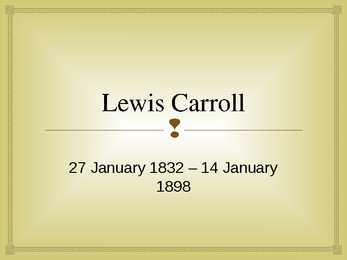
officers or Church of England clergymen. His greatgrandfather, also Charles Dodgson, had risen through the ranks of the church to become a bishop. His grandfather, another Charles, had been an army captain, killed in action in Ireland in 1803, when his two sons were hardly more than babies. His mother's name was Frances Jane Lutwidge. The elder of these sons yet another Charles was Carroll's father. He reverted to the other family business and took holy orders. He went to Rugby School, and thence to Christ Church, Oxford. He was mathematically gifted and won a double first degree, which could have been the prelude to a brilliant academic career. Instead he married his first cousin in 1827 and became a country parson. Young Charles' father was an active and highly conservative clergyman of the
One of the mysteries is how it was built at all with the technology of the time. Another is its purpose. It appears to function as a kind on astronomical clock and we know it was used by the Druids for ceremonies marking the passing of the seasons. It appears in number of novels. These days it is not only the interest of tourists but is also a gathering point of certain minority groups. It is now fenced off to protect it from damage. 3. The Roman conquest Julius Caesar's first raid was in 55 BC but the romans left. Ad 43- the Romans came to stay. The army established Roman rule in the south and SW of the country. The Romans started to introduce their laws to a new province of the Roman Empire and started to build good roads. Officials were appointed (governors, procurators to collect taxes, look after the estates and mines and se that the gold, silver, iron and lead were exported back to Rome). Introduced schools,a new language Latin, large farms (villas), baths.
His modest background and upbringing are crucial to his development as a writer. Chekhov always felt that he missed out on childhood. It was a very hard lifeand it may have contributed to his poor health: he succumbed later on to the"family disease", tuberculosis, which led to his early death at the age of 44.His mother was a quiet, gentle soul who was full of stories of her early life. In later years, Chekhov would say that "we inherited our talent from our father,but mother gave us soul". The other great passion of his formative years was nature, the Russiancountryside. As a port, Taganrog was surrounded on all sides by the landscapes of the Steppe and Chekhov's earliest stories reveal how intensely aware he was of his bond with the Don Steppe. Chekhov had always claimed that medicine was his wife and literature his mistress. Chekhov had lived for much of his career as a writer under the shadow of the great literary colossus of the age, Lev Tolstoy.
 annaabi.ee