Leidsid 33 sarnast õppematerjali, mis on seotud failiga "Ajad, reeglid". Need materjalid aitavad sul teemat sügavamalt mõista.
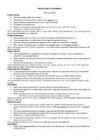
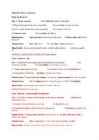
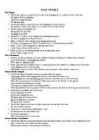
minevik, before, since, names, perfect, momenti, yesterday, going, nouns, while, rang, present, täisminevik, already, years, gone, austrias, enneminevik, come, waiting, hours, night, verbs, could, nationalities, plural, titles, adjectives, cinema, theatre, simple, lihtminevik, tennis, ajutised, reading, having, shower, phone, kellaaeg, watching, never· Timetables and programmes · Sporting commentaries, rewiews (Beckham wins the ball, crosses and Owen scores) · Feelings and emotions (I love Tallinn..) TIME EXPRESSIONS USED WITH PRESENT SIMPLE: usually, often, always, every day/week etc, in the morning/evening etc, at night/the weekend, on Fridays etc. Present Continuous · Actions taking place at or arount the moment of speaking (The kids are watching TV..) · Fixed arrangements in the near future (I'm going to the dentist tomorrow) · Currently changing ang developing situations (The number of burgularies is increasing) · With ,,Always" to express anger or irritation at a repeated action (You're always forgetting..) TIME EXPRESSIONS USED WITH PRESENT CONTINUOUS: now, at the moment, at present, these days, nowadays, still, today, tonight etc. Present Perfect · Action happened at an unstated time in the past. Emphasis on the action, time is unimportant or unknown
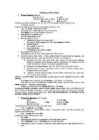
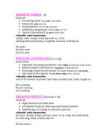
I´m looking for a new job these days. 2. Adverbidega always, constantly, continually sageli korduv tegevus, mida kõneleja heaks ei kiida. Mary is always laughing. 3. Lähimas tulevikus toimuv tegevus, mis on ette kavatsetud, kokku lepitud. I´m meeting Jim tonight. 4. Muutuv, arenev tegevus. The weather is getting worse. Ajamäärused now, at the moment, at present, these days, nowadays, today, tonight, always, still etc. 3. Present Perfect (täisminevik) he has worked have (I, you, we, they) III (-ed) he has not worked has (he, she, it) has he worked? Verbidel, mille lõpus on üksik rõhuline vokaal 2 konsonandi vahel, -ed lõpu lisamisel tüve lõppkonsonant kahekordistub stop-stopped Kui tüvi lõpeb konsonant + y, muutub y i-ks cry cried Vrdl: play played 1
He plays the piano well. The rose is my favourite flower. We us a or an The dollar is a strong currency. only with singular nouns. The tiger lives in Asia. when we are talking about a thing in general. • when we refer to a system or service. Examples: When does the train arrive? We should call the ambulance.
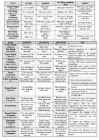
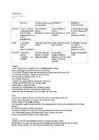
Present Simple Am/is/are + Every day, year, often, I pv + do/does Have/ get + sth+ III pv Lihtolevik III pv usually, always Past Simple Yesterday, last year, II pv(-ed)+ did Was/ were + III pv Had/got + sth + III pv Lihtminevik last week Present Am/is/are + Am/ is/ are + being + Am/ is/are + have/get At the moment, this Continuous
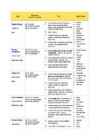
· at present plaanitud tegevus tulevikuks. · at the present moment Simple Past A: He spoke. · yesterday N: He did not speak. · action in the past taking place once, never or several times - tegevus, · 2 minutes ago Lihtminevik Q: Did he speak? mis toimub ühe korra, mitte kunagi · in 1990 või mitu korda · the other day
They are building a new bridge in our town. 2. Changes happening around now. The population of the world is increasing fast. 3. Arrangements for the future. I am flying to Toronto next Friday. Negative form: We aren't (are not) working at the moment. I am not enjoying this show very much. Question form: Are they playing football in the park right now?Why is she laughing? Signal words: at the moment, now, right now, Listen!, Look! etc. PRESENT PERFECT (täisminevik) Form: have/has + past participle (3. põhivorm) Use: 1. An action in the past, where the fact, not the time, is important. I have been to England four times. 2. An action in the past that has a result now. She has lost her keys. 3. Something that began in the past and still continues now. He has been in hospital since Monday. Negative form: We haven't (have not) done our homework yet. He hasn't (has not) visited his granny since August.
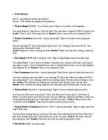
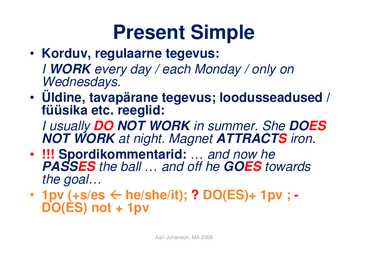
The sun sets in the west. · ajatabelid ja programmid. The buss leaves at 7 am. · (spordi) kommentaarid. Ben passes ball to Tom. väljendid, mida kasutatakse: usually, often, always, every day/week etc, in the morning/afternoon/evening, at night/the weekend, on Friday etc. He works He don't work Does he work PRESENT CONTINUOUS [ is + ing] kestev olevik · tegevused, mis praegu leiavad aset. Karl is doing his homework at the moment. · plaanitud tegevus lähitulevikus. I am going to school tomorrow. · kui midagi toimub/muutub praegu. The number of burglaries is increasing. · alati sama korduv tegevus. You are always eating, when i wake up. väljendid, mida kasutatakse: now, at the moment, at present, these days, nowdays, still, today, tonight etc. He is working He isn't working Is he working PRESENT PERFECT [have/has + ed] täisolevik · algab minevikus ja kestab siiani · just lõpetatud tegevus, mille tegevused ilmuvad olevikus
· Tegevust mingil ajal. I go to school at 8 o´clock. You have to pay taxes once a month. · Kõigile tuntud fakte. Life passes by quickly. Present Continuous Kestva oleviku moodustamine Jaatav vorm Eitav vorm Küsiv vorm I am speaking I am not speaking Am I speaking? He/she/it is going He/she/it is not going Is he/she/it going? We/you/they are making We/you/they are not making Are we/you/they making? NB! ERANDID! · Verbidel, mis lõppevad ega kaob, ing lisamisel e ära. take taking make making · Lühikeste silpidega verbidel kahekordistub kaashäälik. get getting swim swimming · Yga lõppevatel verbidel, y ei kao ära.
3. Present Continuous [am/is/are + present participle]. Tegevus toimub/ei toimu praegusel hetkel. You are watching TV. You are learning English now. I am studying to become a doctor. I am meeting some friends after work. Active= Right now, Tom is writing the letter. Passive= Right now, the letter is being written by Tom. 4. Past Simple [VERB+ed] or irregular verbs. Tegevus algas/lõppes minevikus täpsel ajal. . You called Debbie. I saw a movie yesterday. I finished work, walked to the beach, and found a nice place to swim. I lived in Brazil for two years. I studied French when I was a child. Active = Tom repaired the car. Passive= The car was repaired by Tom. 5. Past Continuous [was/were + present participle]. Pikalt kestev tegevus katkestati minevikus. You were studying when she called. I was watching TV when she called. Last night at 6 PM, I was eating dinner. I was studying while he was making dinner. She was always coming to class late
(NOT The books are expensive.) I love music. (NOT I love the music.) 10. Use had better, not have better. I think you'd better see the doctor. (NOT I think you have better see the doctor.) We'd better ask John to help us. 11. Use the present progressive am playing, is raining etc to talk about things that are continuing at the time of speaking. I'm playing very badly today. (NOT I play very badly today.) Look! It's raining! (NOT Look! It rains!) 12. Use for with a period of time. Use since with the beginning of the period. for the last two hours = since 9 o'clock for three days = since Monday for five years = since I left school I've been learning English for five years. (NOT I've been learning English since three years.) We've been waiting for ages, since eight o'clock. 13. Don't separate the verb from the object. VERB OBJECT She speaks English very well . (NOT She speaks very well English.) Andy likes skiing very much. (NOT Andy likes very much skiing.) 14
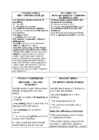
They went camping by the last kestev tegevus: month. At six o'clock they were having Minevikus üksteise järel toimunud dinner. tegevused: Kaks või enam pikka samaaegset First she paid the driver, then she tegevust minevikus: got out the taxi. She was talking on her mobile Praeguseks lõppenud mineviku phone while she was driving to harjumused ja olukorrad: work. Kitchens were very different a Kestev tegevus minevikus, kui hundred years ago. teine tegevus tuli sisse: Laused, milles on järgmisi sõnu: He was walking down the street yesterday, then, when, How long when he ran into an old friend. ago ...?, last night/week/month/ /year, Tuesday, three days/years P.S. ago, in 1999.
They went camping by the last kestev tegevus: month. At six o'clock they were having Minevikus üksteise järel toimunud dinner. tegevused: Kaks või enam pikka samaaegset First she paid the driver, then she tegevust minevikus: got out the taxi. She was talking on her mobile Praeguseks lõppenud mineviku phone while she was driving to harjumused ja olukorrad: work. Kitchens were very different a Kestev tegevus minevikus, kui hundred years ago. teine tegevus tuli sisse: Laused, milles on järgmisi sõnu: He was walking down the street yesterday, then, when, How long when he ran into an old friend. ago ...?, last night/week/month/ /year, Tuesday, three days/years P.S. ago, in 1999.
They went camping by the last kestev tegevus: month. At six o'clock they were having Minevikus üksteise järel toimunud dinner. tegevused: Kaks või enam pikka samaaegset First she paid the driver, then she tegevust minevikus: got out the taxi. She was talking on her mobile Praeguseks lõppenud mineviku phone while she was driving to harjumused ja olukorrad: work. Kitchens were very different a Kestev tegevus minevikus, kui hundred years ago. teine tegevus tuli sisse: Laused, milles on järgmisi sõnu: He was walking down the street yesterday, then, when, How long when he ran into an old friend. ago ...?, last night/week/month/ /year, Tuesday, three days/years P.S. ago, in 1999.
.................................................................................... 3 Lihtminevik The past simple....................................................................................... 3 Lihttulevik The future simple...................................................................................... 3 Kestev olevik The present continuous......................................................................... 3 Kestev minevik The past continuous........................................................................... 4 Kestev tulevik The future conrinuous..........................................................................4 Täisminevik The present perfect..................................................................................4 Enneminevik The past perfect..................................................................................... 4
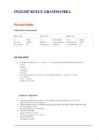
INGLISE KEEL Sisukord Sisukord 2 Ajavormid Tense vorms 3 Lihtolevik The present simple 3 Lihtminevik The past simple 3 Lihttulevik The future simple 3 Kestev olevik The present continuous 3 Kestev minevik The past continuous 4 Kestev tulevik The future conrinuous 4 Täisminevik The present perfect 4 Enneminevik The past perfect 4 Ennetulevik Future perfect 5 Üldminevik Past tense 5 Üldtulevik Future indefinite 5 Artiklid ja eessõnad 7 Eessõnad 7
Present Progressive · Hetkel toimuv, pooleliolev tegevus: S/he IS TALKing on the phone now. I AM READing an interesting book. · Ajutine, regulaarsele ja tavapärasele vastanduv tegevus (tulevikku viitav): This summer they ARE not GROWing cucumbers as usual. They'RE GROWing tomatoes instead. · !!! Halvakspanu väljendus harjumuspärase tegevuse kohta: He IS always COMPLAINing! · BE (am/is/are) + 1pv-ing Aari Juhanson, MA 2008 Present Perfect ON -NUD · Toimunud tegevus, seos olevikuga: I have WORKed here for 3 years. · Toimunud olevikuga seotud/lõpetamata tegevus (saab muuta): S/he has CALLed them twice already. · !!! Kordne tegevus: It's the umpteenth time you've TOLD me this! Have I ever FORGOTTEN anything? · !!! Tutvuse pikkuse väljendus: I don't know how long I have KNOWN her. · have/has (s/he, it) + -ed/3 pv Aari Juhanson, MA 2008 Present Perfect Progressive
Examples: USE 3 Near Future · You are watching TV. · Are you watching TV? · You are not watching TV. USE 1 Now Examples: · I am meeting some friends after work. · I am not going to the party tonight. · Is he visiting his parents next weekend? · Isn't he coming with us tonight? Examples: USE 4 Repetition and Irritation with · You are learning English now. "Always" · You are not swimming now. · Are you sleeping? · I am sitting. · I am not standing.
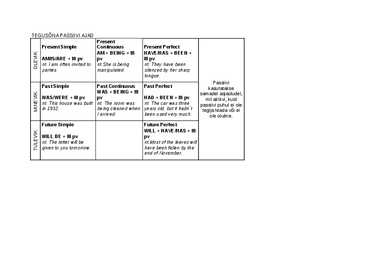
TEGUSÕNA PASSIIVI AJAD Present Present Simple Continuous Present Perfect AM + BEING + III HAVE/HAS + BEEN + OLEVIK AM/IS/ARE + III pv pv III pv nt. I am often invited to nt.She is being nt. They have been parties. manipulated. silenced by her sharp tongue. Passiivi
· Fine, thanks. / On top of the world, thanks. · OK, thanks · Not so bad, thanks. / Can't complain, thanks. · So so, thanks. / So and so, thanks. · Not so good, actually 1 The English alphabet Spelling Work with your partner and spell out first your name and then some names of places. Write down each letter as you hear it, and then say the word. The English alphabet on the phone: You might find the following alphabet (used by international airlines) useful when trying to spell a word on the telephone. A Alpha O Oscar Ä Alpha-Echo Ö Oscar-Echo B Bravo P Papa C Charlie Q Quebec
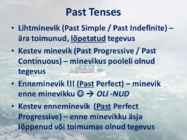
Past Tenses • Lihtminevik (Past Simple / Past Indefinite) – ära toimunud, lõpetatud tegevus • Kestev minevik (Past Progressive / Past Continuous) – minevikus pooleli olnud tegevus • Enneminevik !!! (Past Perfect) – minevik enne minevikku OLI -NUD • Kestev enneminevik (Past Perfect Progressive) – enne minevikku äsja lõppenud või toimumas olnud tegevus Created by Aari Juhanson, MA 2009 Past Simple • Ära toimunud (regulaarne) tegevus: I WORKED yesterday. S/he didn’t WORK last Monday. • Lõpetatud tegevus: I already CALLED them today. (I’m not going to call again!) Which countries did you VISIT? (You’re back …) BUT: Which countries have you VISITED so far? (You’re not back yet
recording, or by any information storage and retrieval system, without the written permission of the publisher. ISBN 1-59905-201-6 Printed in the United States of America 13 12 11 10 09 08 07 9 8 7 6 5 4 3 2 1 Introduction Grammar is a very old field of study. Did you know that the sentence was first divided into subject and verb by Plato, the famed philosopher from ancient Greece? That was about 2,400 years ago! Ever since then, students all over the world have found it worthwhile to study the structure of words and sentences. Why? Because skill in speaking and writing is the hallmark of all educated people. Lesson by lesson, this book provides basic instruction in the eight parts of speech--nouns, pronouns, verbs, adjectives, adverbs, prepositions, conjunctions, and interjections--as well as the standard patterns of English sentences. All students of English, be they native speakers or those
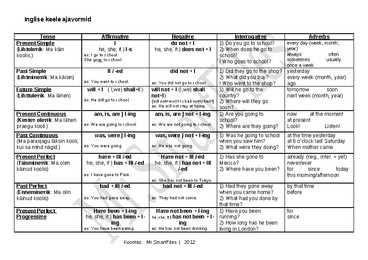
Present Simple I Make Do not make Do I make? (lihtolevik) He/she/it Speaks Does not speak Does they go? We/you/they Do not go Do not go Present Continuous I am speaking Am not speaking Am I speaking? (kestev olevik) He/she/it is going Is not going Is he going? We/you/they are making Are not making Are you making? Present Perfect I Have asked Have not asked Have I asked? (täisminevik) He/she/it Has gone Has not gone Has she gone? We/you/they Have made Have not made Have they made? Present Perfect I have been asking Have not been asking Have I been asking?
always often She goes to school. ! Who goes to school? sometimes usually once a week Past Simple II / -ed did not + I 1) Did they go to the shop? yesterday (Lihtminevik: Ma käisin) 2) What did you buy? every week (month, year) ex: You went to school. ex: You did not go to school. ! Who went to the shop? ago Future Simple will + I ( I,we} shall+I ) will not + I (I,we} shall 1) Will he go to the tomorrow soon
The Six English Verb Tenses Three Simple Tenses Simple continuous Present You walk. You are walking I run. I am running. Past You Walked You were walking. I ran. I was running. Future You will walk. You will be walking. I will run. I will be running. Three Perfect Tenses Perfect continuous Present perfect you have walked. You have been walking. I have run. I have been running. Past Perfect You had walked. You had been walking. I had run. I had been running. Future Perfect You will have walked You will have been walking. I will have run. I will have been running. The Simple Present Tense Expresses a habit or often repeated action. Adverbs of
action taking place now only for a limited period of time action arranged for the future Simple Past A: He spoke. yesterday, 2 action in the past N: He did not speak. minutes ago, in Q: Did he speak? taking place once, never or 1990, the other day, several times last Friday
2.Past (minevik) 3.Future (tulevik) 4.Future in the past (kaudne tulevik) Iga aeg võib esineda neljas eri rühmas 1.IndefiniteTenses (üldajad) 2.Continious Tenses (kestvad ajad) 3.Perfect Tenses (perfekti ajad) 4.Perfect Continious Tenses (perfekti kestvad ajad) Indefinite Tenses (üldajad) used to describe actions but do not state whether the action is completed or on- going märgivad tegevuse sooritamise fakti Peter visits us every day. Peter visited us yesterday. Peter will visit us tomorrow. Continuous Tenses (kestvad ajad) are used when talking about a particular point in time · We were sleeping when the storm began. What were you doing at five o'clock? When I came, the children were sleeping. Perfect Tenses are used when an action or situation in the present is linked to a moment in the past often used to show things that have happened up to now but aren't finished yet
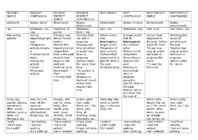
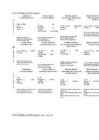
PRESENT PRESENT PRESENT PRESENT PAST SIMPLE PAST PAST PERFECT PAST PERFECT SIMPLE CONTINIOUS PERFECT PERFECT CONTINUOUS SIMPLE CONTINUOUS SIMPLE CONTINUOUS Lihtolevik Kestev olevik Täisminevik Kestev Lihtminevik Kestev minevik Enneminevik Kestev täisminevik enneminevik I pv Am/is/are, I pv, Has/have, III Has/have, II pv, -ed Was/were, -ing Had, III pv Had, been, -ing -ing pv/-ed been, -ing
FUTURE SIMPLE BE GOING TO Will + infinitive (will go) Am/is/are going to + infinitive (is going to rain) 1.A decision at the moment of 1.Future plans made before the speaking: moment of speaking: A: 'I'm cold'. A: 'We've run out of milk.' B: 'I'll close the window'. B: 'I know, I'm going to buy some.' 2.Prediction based on opinion: 2.Prediction based on present I think the Conservatives will win the evidence: next election. Look at those boys playing football! 3.A future fact: They're going to break the window. He will be ten next year. 4.Promises / requests / refusal / willingness: I'll help you with your homework. Will you give me a hand? 5.In the same way as the future
Tenses 27. jaanuar 2012. a. 9:24 SIMPLE CONTINUOUS -ing PERFEFCT PERFECT on alati sees! CONTINUOUS PRESEN I work in school. I am working in I have worked in I have been working T loodusseadused school. school. in school for/since 5 pidev korduv lähituleviku plaanid Surnute kohta EI SAA years. tegevus(hommiku ÖELDA! siiamaani kestab kohvi) aja-graafikud
PAST TENSES Past Simple Used to talk about a completed past action which happened at a completed time in the past. We went to Tallinn yesterday. I saw him a long time ago. We met last week. Used to talk about a series of events that happened one after another. He walked to school, took off his coat, went to class and fell asleep. Used to report what people said. He said that he was tired. He asked to go home. Used after "It's time" (even though we're talking about now) It's time we talked about the past (now). After "I'd rather" (even though we're talking about now)
Infixation is common in languages of Southeast Asia and the Philippines, and it is also found in some Native American languages. circumfixes morphemes that are attached to a root or stem morpheme both initially and finally. Morphs: the concrete realisation of a morpheme (`was' be, past, singular) Allomorphs: a/an Types of affixes: Derivational and infelctional Derivational affixes: Derivational affixes may change the grammatical class of the root verbs into nouns, nouns into adjectives (boy, boyish), and so on. Derivation is a lexical process which actually forms a new word out of an existing one by adding affixes to stems or roots. consideration, considerate, inconsiderate, inconsiderateness Inflectional affixes: Inflectional affixes may be described as `relational markers' that fit words for use in a sentence (express a syntactic relation). Inflections do not change the grammatical class of a given item or produce new lexemes, just different word forms.
E.g. She stood up, went up to her and grabbed her wrists. Completed actions or events, which happened at a stated past time. E.g. I went to the cinema last night. Past habits or states. E.g. my grandfather always wore a hat. Complete actions not connected to the present with a stated or implied time reference. E.g. Beethoven created wonderful classical pieces. Time expressions used with Past Simple: yesterday, last week/month etc, ago, then, just, now, when, in 1991, etc Past continuous is used for: Actions in the middle of happening at a stated past time. E.g. She was flying to Paris this time last Monday. A past action in progress interrupted by another past action. The longer action is in the Past Continuous, the shorter action is in the past Simple. E.g. I was watching television when my mother came home.
Has he been working hard? He has not been working har He has worked here since 1987. He always works hard. He is working in his room now. Has he worked here long? Did he work much yesterday? Is he working now? He has not worked here long. He does not work hard. He is not working now. Lihtminevik Kestev minevik Perfekti minevik Perfekti kestev m
 annaabi.ee